





Psychiatry is a dynamic and evolving specialty that has grown in popularity in the UK over recent years, with high fill rates for training posts in the UK (99.8 and 100% in 2023 and 2024, respectively) 1,2 and national campaigns showcasing the benefits of a career in the field, such as the Royal College of Psychiatrists ‘Choose Psychiatry’ scheme. 3
However, psychiatry has historically experienced recruitment difficulties, often attributed to stigma around mental health and attitudes of clinicians from other specialties. Reference Mukherjee, Maier and Wessely4 Recruitment into the specialty remains a challenge internationally, with just under half of the world’s population living in countries with fewer than one psychiatrist per 100 000 people. Reference Shields, Ng, Ventriglio, Castaldelli-Maia, Torales and Bhugra5 The Royal Australian and New Zealand College of Psychiatrists (RANZCP) recently predicted a 20.7% shortage of psychiatrists by 2048. 6 Likewise, UK workforce growth remains slow; England faces a shortage of 690 consultant psychiatrists, representing 15% of the consultant workforce. 7
A 2013 systematic review of 32 studies reported that although attitudes towards psychiatry as a specialty among medical students were generally positive, psychiatry as a career choice was viewed less favourably. Contributing factors included perceptions of the lack of scientific foundation and perceived low status, prestige and financial reward of psychiatry. Reference Lyons8 More recent evidence suggests that this remains the case. Reference Hollands, McCulloch, Scott, Hancock and Mattick9 It has also been suggested that psychiatry may be a ‘forgotten’ specialty, overshadowed by other specialties perceived as more attractive. Reference Brown, Barnes, Silver, Williams and Newton10
Early exposure to psychiatry during preliminary stages of medical training appears to be impactful. A cross-sectional study across 20 countries reported that 4.5% of all medical student respondents were ‘definitely’ considering psychiatry. Those who participated in optional psychiatry activities, such as a university psychiatry club, were three times more likely to choose a career in psychiatry, while those who participated in psychiatry electives were four times more likely. Reference Farooq, Lydall, Malik, Ndetei and Bhugra11 Similarly, a 2017 systematic review reported that enrichment activities, including psychiatry research experiences, university psychiatry clubs, special study modules and psychiatry electives, significantly increased interest in psychiatry. Reference Choudry and Farooq12
Students report that extracurricular activities allow them to meet positive role models, connect with like-minded peers and gain exposure to specialist areas of psychiatry rarely encountered during placements. Reference Crowley, Banerjee, Page and Daley13 This suggests that extracurricular activities during undergraduate studies play a key role in fostering early interest in psychiatry and promoting the specialty as a viable and rewarding career.
Our aim in this study was to systematically review the available published literature on extracurricular enrichment activities in psychiatry for undergraduate medical students, in order to provide an up-to-date insight into the variety of programmes available, their strengths and limitations and current evidence gaps. This will inform the design of future extracurricular programmes in psychiatry for undergraduate medical students. Our research question was: What is the nature and impact of extracurricular enrichment activities in psychiatry for undergraduate medical students, in terms of their experiences, attitudes towards psychiatry and subsequent career intentions or specialty choice?
Method
The review was conducted in accordance with the Preferred Reporting Items for Systematic Reviews and Meta-Analyses (PRISMA) guidelines. The study protocol was developed prospectively and registered with the International Prospective Register of Systematic Reviews (PROSPERO ID CRD420251025990) on 11 April 2025.
Search strategy
Literature searches were performed on 9 April 2025 using Embase, Ovid MEDLINE, APA PsycInfo and ERIC databases. The following search terms and Boolean operators were applied: Psychiatry AND (extracurricular OR mentoring OR enrichment OR summer school OR institute OR recruitment OR elective) AND (medical student OR medical school). The full search strategy is provided in Supplementary Document 1 available at https://doi.org/10.1192/bjo.2026.12089. Grey literature searches were conducted using Google Scholar and the same search terms. Duplicates were removed manually. The reference lists of included studies were searched for other studies of relevance, and forward citation searching was conducted using PubMed. Searches were updated on 17 October 2025.
Study selection
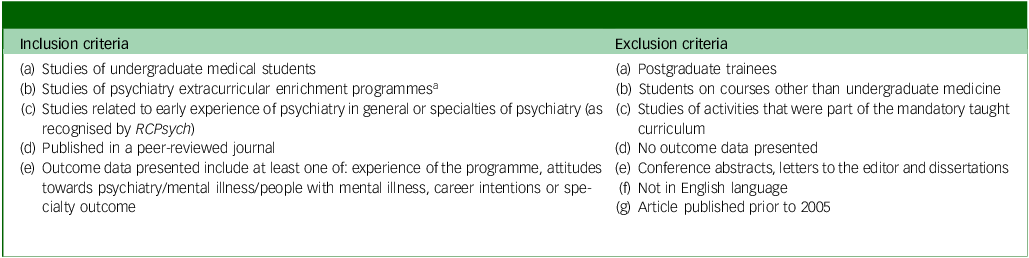
Two authors (S.B. and J.R.) independently screened all articles by title and abstract, with discrepancies resolved through discussion. Cohen’s kappa is reported in the Results section. Full texts of potentially eligible articles were reviewed against the inclusion criteria (Table 1) by two authors (S.B. and J.R.), with discrepancies again resolved through discussion. Inter-rater agreement statistics for full-text screening are not available, as independent decisions were not recorded separately prior to discussion, and this is acknowledged as a limitation. Peer-reviewed studies published in the English language from 2005 onwards were eligible for review. This start date was selected to capture approximately 20 years of literature, ensuring that studies included in the review reflect contemporary medical education and training contexts. Earlier literature was considered less generalisable to current psychiatry recruitment and training structures.
Inclusion and exclusion criteria

Table 1 Long description
A table with two columns and five rows each, detailing inclusion and exclusion criteria for studies. The inclusion criteria are: studies of undergraduate medical students, studies of psychiatry extracurricular enrichment programs, studies related to early experience of psychiatry in general or specialties of psychiatry as recognized by RCPsych, published in a peer-reviewed journal, and outcome data presented including at least one of: experience of the program, attitudes towards psychiatry/mental illness/people with mental illness, career intentions, or specialty outcome. The exclusion criteria are: postgraduate trainees, students on courses other than undergraduate medicine, studies of activities that were part of the mandatory taught curriculum, no outcome data presented, conference abstracts, letters to the editor and dissertations, not in English language, and article published prior to 2005.
a. Studies of special study modules were included where these functioned as optional or selective experiences aimed at enriching psychiatry exposure.
Data extraction
Data extraction commenced on 24 April 2025 (after protocol registration) and was completed independently by two reviewers (S.B. and T.G.-I.), with discrepancies resolved by discussion. Extracted data included study population, sample size, country, study procedure and data collection methods, psychiatric specialty, summary of the programme, objectives, length of programme and number of sessions, mode of delivery, comparators, outcomes evaluated, results, conclusions and study limitations. Given the heterogeneity of study designs, which included a mix of quantitative, qualitative and mixed-methods research, the Mixed Methods Appraisal Tool (MMAT) was used to critically appraise each study. The MMAT is a validated tool, originally developed in 2006, with several revisions, including an e-Delphi study with international experts. Reference Hong, Pluye, Fàbregues, Bartlett, Boardman and Cargo14 Quality appraisal was conducted independently by two reviewers (S.B. and T.G.-I.), with discrepancies resolved through discussion. Inter-rater reliability was assessed using the intraclass correlation coefficient (ICC).
Synthesis
A narrative synthesis approach was used to organise and integrate the findings from the included studies. Using the extracted data, the findings were first categorised according to the length and type of programme. Following this, the findings were grouped according to the outcomes outlined in the inclusion criteria: student experiences of the programme, attitudes towards psychiatry, mental illness and people with mental illness, career intentions and specialty choice.
Within each outcome category, the main findings were examined to identify similarities, differences and recurring themes. The narrative synthesis process was iterative, allowing repeated comparison and refinement of findings to ensure consistent and reliable interpretation. This process enabled the development of an integrated narrative that summarised the overall findings of the studies and generated themes while accounting for heterogeneity between studies.
Results
Search results
Literature searches identified 731 unduplicated references. Title and abstract screening excluded 666 articles, leaving 65 full-text articles for review. Inter-rater agreement for title and abstract screening was substantial (Cohen’s kappa = 0.71). Of the full-text articles, 23 were included (PRISMA diagram in Supplementary Document 2). The reasons for exclusion of full-text articles are summarised in Supplementary Table 1. Citation searching identified an additional four articles. Therefore, a total of 27 studies were included in this systematic review. Inter-rater agreement was not calculated for full-text screening, as initial independent decisions were not consistently available. However, all discrepancies were resolved through discussion between reviewers.
Study characteristics
Study characteristics are summarised in Table 2. Of the 27 included studies, 10 were from the UK, Reference Ahmed, Bennett, Halder and Byrne15–Reference Vinchenzo, Nabavi and Tracy24 7 were from the USA, Reference Himmelstein, Guth, Enenbach, Gleason, Stevens and Glowinski25–Reference Stein, Althoff, Anders, Davison, Edwards and Frosch31 2 each were from Canada, Reference Andermann, De Souza and Lofchy32,Reference Lee, Morra, Bazaid, Bezzahou, Simas and Taplin33 Finland Reference Karukivi, Saxen and Haapasalo-Pesu34,Reference Karukivi35 and Australia Reference Lyons, Power, Bilyk, Lofchy and Claassen36,Reference Lyons, Hans and Janca37 and 1 each from Taiwan, Reference Fan, Kosik, Su, Tsai, Syu and Chen38 Switzerland, Reference Gerke, Rufer and Schnyder39 Germany Reference Graf, Abler, Weydt, Kammer and Plener40 and Ireland. Reference O’Connor, Thekiso, Douglas, Barry, Flynn and McCarthy41 Participant numbers from studies in which students directly participated in an enrichment programme ranged from 8 to 241, with a median of 38.5 participants. One study looked at cohort effects of an enrichment programme across multiple schools, with a total of 39 316 medical students. Reference Himmelstein, Guth, Enenbach, Gleason, Stevens and Glowinski25 All but one study Reference Himmelstein, Guth, Enenbach, Gleason, Stevens and Glowinski25 used questionnaires to evaluate the outcomes. Other study designs included an objective knowledge test, Reference Graf, Abler, Weydt, Kammer and Plener40 a qualitative interview, Reference Rice, Arnovitz, Hubert, Weiss, Gao and Christopher28 a focus group, Reference Shapiro29 a retrospective cohort study Reference Himmelstein, Guth, Enenbach, Gleason, Stevens and Glowinski25 and a comparison of exam scores between those who completed the special study module and those who did not. Reference Fan, Kosik, Su, Tsai, Syu and Chen38
Summary of study characteristics

Table 2 Long description
The image shows a large, multi-column table compiling research studies that evaluate educational programmes related to psychiatry for medical students. Each row represents a different study, while columns describe key aspects of each study.
MMAT, Mixed-Methods Appraisal Tool; CAP, child and adolescent psychiatry; SHD, Satakunta Hospital District; OPEP, Ottawa Psychiatry Enrichment Program; ATP-30, Attitudes Toward Psychiatry-30 scale; Q&A, question and answer session.
a. Majority medical students, minority graduate students in other areas, e.g. public health.
Programme duration varied considerably from 1 day to 5 years (median 10 weeks). Two studies evaluated programmes that were 1-day events. Reference Ahmed, Bennett, Halder and Byrne15,Reference O’Connor, Thekiso, Douglas, Barry, Flynn and McCarthy41 Seven described programmes lasting between 2 days and 1 week, Reference Beattie, Lister, Khan and Cornwall17,Reference Hankir and Zaman19,Reference Vinchenzo, Nabavi and Tracy24,Reference Andermann, De Souza and Lofchy32,Reference Lee, Morra, Bazaid, Bezzahou, Simas and Taplin33,Reference Lyons, Power, Bilyk, Lofchy and Claassen36,Reference Lyons, Hans and Janca37 while eight focused on activities that lasted between 1 week and 3 months. Reference Badenhorst and Rubitel16,Reference Datta18,Reference Langley, Lomas, Schofield and Doody23,Reference Shapiro29,Reference St Victor, Ajeti, Ahmed, Jain, Sarfraz and Person30,Reference Karukivi, Saxen and Haapasalo-Pesu34,Reference Karukivi35,Reference Graf, Abler, Weydt, Kammer and Plener40 Three studies assessed longer-term programmes lasting between 3 months and 1 year, Reference Jokinen, Benachar and Rahim22,Reference Stein, Althoff, Anders, Davison, Edwards and Frosch31,Reference Fan, Kosik, Su, Tsai, Syu and Chen38 and five studies evaluated programmes spanning the majority, or all of the student’s time at medical school. Reference Hewson, Thomas, Lovett, Bruce and Tracy20,Reference Holt, Mirvis, Bao, Cross, Hussain and Hutchings21,Reference Himmelstein, Guth, Enenbach, Gleason, Stevens and Glowinski25,Reference Kwok, Moftakhor, Johnston, Evans and DelBello26,Reference Gerke, Rufer and Schnyder39 The total duration of participation was unclear in two studies. Reference Mishan and Dragatsi27,Reference Rice, Arnovitz, Hubert, Weiss, Gao and Christopher28
The most common programme type was a summer school, featured in 10 studies. Reference Beattie, Lister, Khan and Cornwall17,Reference Hankir and Zaman19,Reference Vinchenzo, Nabavi and Tracy24,Reference Shapiro29,Reference Andermann, De Souza and Lofchy32,Reference Karukivi, Saxen and Haapasalo-Pesu34,Reference Karukivi, Saxen and Haapasalo-Pesu34,Reference Lyons, Power, Bilyk, Lofchy and Claassen36,Reference Lyons, Hans and Janca37,Reference O’Connor, Thekiso, Douglas, Barry, Flynn and McCarthy41 Others included elective courses, Reference Badenhorst and Rubitel16,Reference Lee, Morra, Bazaid, Bezzahou, Simas and Taplin33,Reference Fan, Kosik, Su, Tsai, Syu and Chen38–Reference Graf, Abler, Weydt, Kammer and Plener40 mentoring programmes, Reference Hewson, Thomas, Lovett, Bruce and Tracy20,Reference Himmelstein, Guth, Enenbach, Gleason, Stevens and Glowinski25,Reference Kwok, Moftakhor, Johnston, Evans and DelBello26,Reference St Victor, Ajeti, Ahmed, Jain, Sarfraz and Person30,Reference Stein, Althoff, Anders, Davison, Edwards and Frosch31 special study modules, Reference Datta18,Reference Jokinen, Benachar and Rahim22,Reference Langley, Lomas, Schofield and Doody23 a student-run clinic Reference Mishan and Dragatsi27 a film festival, Reference Ahmed, Bennett, Halder and Byrne15 a shadowing programme Reference Holt, Mirvis, Bao, Cross, Hussain and Hutchings21 and a literacy outreach initiative, in which medical students read to in-patients on a child and adolescent psychiatry unit. Reference Rice, Arnovitz, Hubert, Weiss, Gao and Christopher28
Most of the studies included a mixture of subjects and activity types involving clinical exposure, mentoring, social experiences, lectures and seminars. Six studies were focused on film, media, literature or art, Reference Ahmed, Bennett, Halder and Byrne15,Reference Badenhorst and Rubitel16,Reference Hankir and Zaman19,Reference Jokinen, Benachar and Rahim22,Reference Fan, Kosik, Su, Tsai, Syu and Chen38,Reference Graf, Abler, Weydt, Kammer and Plener40 four specifically focused on child and adolescent psychiatry Reference Himmelstein, Guth, Enenbach, Gleason, Stevens and Glowinski25,Reference Rice, Arnovitz, Hubert, Weiss, Gao and Christopher28,Reference Stein, Althoff, Anders, Davison, Edwards and Frosch31,Reference Gerke, Rufer and Schnyder39 and two focused on psychotherapy. Reference Badenhorst and Rubitel16,Reference Gerke, Rufer and Schnyder39
In terms of study outcomes, 21 studies reported on student experiences of the programme, Reference Ahmed, Bennett, Halder and Byrne15,Reference Badenhorst and Rubitel16,Reference Datta18–Reference Jokinen, Benachar and Rahim22,Reference Vinchenzo, Nabavi and Tracy24,Reference Kwok, Moftakhor, Johnston, Evans and DelBello26–Reference Lyons, Hans and Janca37,Reference Gerke, Rufer and Schnyder39 19 reported on career intentions, Reference Ahmed, Bennett, Halder and Byrne15–Reference Hewson, Thomas, Lovett, Bruce and Tracy20,Reference Jokinen, Benachar and Rahim22–Reference Vinchenzo, Nabavi and Tracy24,Reference Kwok, Moftakhor, Johnston, Evans and DelBello26–Reference Andermann, De Souza and Lofchy32,Reference Lyons, Power, Bilyk, Lofchy and Claassen36,Reference Lyons, Hans and Janca37,Reference O’Connor, Thekiso, Douglas, Barry, Flynn and McCarthy41 13 reported on attitudes towards psychiatry, Reference Ahmed, Bennett, Halder and Byrne15,Reference Beattie, Lister, Khan and Cornwall17,Reference Hankir and Zaman19,Reference Holt, Mirvis, Bao, Cross, Hussain and Hutchings21,Reference Langley, Lomas, Schofield and Doody23,Reference Mishan and Dragatsi27,Reference Rice, Arnovitz, Hubert, Weiss, Gao and Christopher28,Reference Lee, Morra, Bazaid, Bezzahou, Simas and Taplin33,Reference Lyons, Power, Bilyk, Lofchy and Claassen36–Reference Fan, Kosik, Su, Tsai, Syu and Chen38,Reference Graf, Abler, Weydt, Kammer and Plener40,Reference O’Connor, Thekiso, Douglas, Barry, Flynn and McCarthy41 12 reported on the impact on knowledge, Reference Datta18,Reference Hewson, Thomas, Lovett, Bruce and Tracy20,Reference Jokinen, Benachar and Rahim22,Reference Mishan and Dragatsi27,Reference Rice, Arnovitz, Hubert, Weiss, Gao and Christopher28,Reference St Victor, Ajeti, Ahmed, Jain, Sarfraz and Person30,Reference Karukivi, Saxen and Haapasalo-Pesu34–Reference Fan, Kosik, Su, Tsai, Syu and Chen38,Reference Graf, Abler, Weydt, Kammer and Plener40 7 reported on specialty outcome Reference Holt, Mirvis, Bao, Cross, Hussain and Hutchings21,Reference Himmelstein, Guth, Enenbach, Gleason, Stevens and Glowinski25,Reference Kwok, Moftakhor, Johnston, Evans and DelBello26,Reference Andermann, De Souza and Lofchy32,Reference Lee, Morra, Bazaid, Bezzahou, Simas and Taplin33,Reference Karukivi35,Reference Lyons, Hans and Janca37 and 5 reported on attitudes towards mental illness or people with mental illness. Reference Badenhorst and Rubitel16,Reference Langley, Lomas, Schofield and Doody23,Reference Rice, Arnovitz, Hubert, Weiss, Gao and Christopher28,Reference St Victor, Ajeti, Ahmed, Jain, Sarfraz and Person30,Reference Graf, Abler, Weydt, Kammer and Plener40
Quality appraisal
The quality of studies was appraised using the MMAT, with quality scores ranging from 0 to 100%. Inter-rater reliability for quality appraisal using the ICC was 0.571 (p = 0.0014). Although this represents moderate agreement, all discrepancies were resolved through discussion, with full agreement between reviewers. The majority of studies were of high quality (80–100%). Reference Badenhorst and Rubitel16,Reference Beattie, Lister, Khan and Cornwall17,Reference Holt, Mirvis, Bao, Cross, Hussain and Hutchings21–Reference Himmelstein, Guth, Enenbach, Gleason, Stevens and Glowinski25,Reference Mishan and Dragatsi27–Reference Shapiro29,Reference Stein, Althoff, Anders, Davison, Edwards and Frosch31,Reference Andermann, De Souza and Lofchy32,Reference Karukivi, Saxen and Haapasalo-Pesu34–Reference Lyons, Hans and Janca37,Reference O’Connor, Thekiso, Douglas, Barry, Flynn and McCarthy41 Five studies were of moderate quality (60%) Reference Datta18,Reference Hewson, Thomas, Lovett, Bruce and Tracy20,Reference Kwok, Moftakhor, Johnston, Evans and DelBello26,Reference St Victor, Ajeti, Ahmed, Jain, Sarfraz and Person30,Reference Graf, Abler, Weydt, Kammer and Plener40 and five studies were of low quality (40% or below). Reference Ahmed, Bennett, Halder and Byrne15,Reference Hankir and Zaman19,Reference Lee, Morra, Bazaid, Bezzahou, Simas and Taplin33,Reference Fan, Kosik, Su, Tsai, Syu and Chen38,Reference Gerke, Rufer and Schnyder39
Higher-quality studies displayed clearly defined study designs and methods and included a cohort study Reference Himmelstein, Guth, Enenbach, Gleason, Stevens and Glowinski25 and long-term follow-up over a 3-year period. Reference Holt, Mirvis, Bao, Cross, Hussain and Hutchings21
Lower-quality studies generally used a mixed-methods approach and often lacked detail regarding the rationale for the study design or the integration between qualitative and quantitative findings, limiting interpretability.
Students’ experiences of programmes
Across all studies reporting on student experiences, feedback was generally positive. Film was a notably popular teaching medium; Jokinen Reference Jokinen, Benachar and Rahim22 reported in a high-quality study that 100% of the 66 students who participated in a special study module in cultural psychiatry stated that they enjoyed the seminar, which focused on media, literature, film and the arts, and 84.5% would find further sessions useful. Similar feedback was also reported in moderate- and lower-quality studies. Ahmed Reference Ahmed, Bennett, Halder and Byrne15 reported that 95% of medical students across nine medical schools felt that the 1-day film festival was a success. Datta Reference Datta18 reported that all participants would recommend the special study module in films in psychiatry to other medical students, although it should be noted that there were only eight participants.
Mentoring programmes were also well received, although many relied heavily on subjective participant feedback. Gerke Reference Gerke, Rufer and Schnyder39 found that 100% of students (n = 56) taking part in a psychotherapy mentoring programme for the duration of their medical school course rated it as good or very good; 87% were satisfied or very satisfied with the accessibility and availability of mentors. Hewson Reference Hewson, Thomas, Lovett, Bruce and Tracy20 reported that over 90% of students rated their experience of an early-years career-based mentoring programme as good or excellent. Shapiro Reference Shapiro29 described a child and adolescent psychiatry-focused summer school with individual mentorship, with 100% of attendees reported to be very satisfied with the programme and finding the individual mentoring sessions to be one of the two most useful parts of the programme. Similarly, Stein Reference Stein, Althoff, Anders, Davison, Edwards and Frosch31 reported positive views of mentorship for research and career guidance in a child and adolescent psychiatry mentoring and shadowing programme for first-year medical students, but no significant change in opinion regarding mentorship to learn medicine. St Victor Reference St Victor, Ajeti, Ahmed, Jain, Sarfraz and Person30 found that weekly 1-hour individualised lectures and mentoring sessions focused on liaison psychiatry provided necessary mentoring.
Several of the enrichment programmes were described as well organised Reference Andermann, De Souza and Lofchy32,Reference Lee, Morra, Bazaid, Bezzahou, Simas and Taplin33,Reference Lyons, Power, Bilyk, Lofchy and Claassen36 and interesting, Reference Badenhorst and Rubitel16,Reference Hankir and Zaman19 and all students who participated in a Psychiatry Institute comprising teaching and shadowing Reference Lyons, Power, Bilyk, Lofchy and Claassen36,Reference Lyons, Hans and Janca37 would recommend it to other students. Teaching sessions and seminars were felt to be useful and enjoyable. Reference Datta18,Reference Karukivi35 In a study involving 215 medical students, Vinchenzo Reference Vinchenzo, Nabavi and Tracy24 reported that over 98% of attendees either agreed that a 2-day online summer school was successful or that the speakers were enthusiastic about psychiatry.
Qualitative feedback highlighted the value of positive mentoring relationships, Reference Hewson, Thomas, Lovett, Bruce and Tracy20,Reference Kwok, Moftakhor, Johnston, Evans and DelBello26 while suggested improvements included increased patient contact Reference Badenhorst and Rubitel16,Reference Kwok, Moftakhor, Johnston, Evans and DelBello26 and greater mentor engagement. Reference Hewson, Thomas, Lovett, Bruce and Tracy20,Reference Holt, Mirvis, Bao, Cross, Hussain and Hutchings21 Mishan, Reference Mishan and Dragatsi27 however, reported that students participating in a student-run clinic requested more teaching sessions.
Impact on attitudes towards psychiatry
All but one of the studies presenting relevant data reported an improvement in attitudes towards psychiatry. This was a special study module combining lectures with clinical observations. Reference Langley, Lomas, Schofield and Doody23 Several studies used validated tools such as the Attitudes Toward Psychiatry-30 scale (ATP-30), the Attitudes Toward Psychiatry-35 scale (ATP-35) and the modified Nielson questionnaire. Reference Beattie, Lister, Khan and Cornwall17,Reference Holt, Mirvis, Bao, Cross, Hussain and Hutchings21,Reference Lee, Morra, Bazaid, Bezzahou, Simas and Taplin33,Reference Graf, Abler, Weydt, Kammer and Plener40,Reference O’Connor, Thekiso, Douglas, Barry, Flynn and McCarthy41 The ATP-30 was most commonly used. It is a validated tool comprising thirty questions on a Likert-type scale to assess attitudes towards psychiatry. Reference Burra, Kalin, Leichner, Waldron, Handforth and Jarrett42 Findings were similar across both high- and low-quality studies. Holt Reference Holt, Mirvis, Bao, Cross, Hussain and Hutchings21 found long-term improvements in mean ATP-30 score following participation in a shadowing programme throughout medical school, with sustained improvement over 3 years. This mixed-methods study met all of the quality criteria on the MMAT. Lee Reference Lee, Morra, Bazaid, Bezzahou, Simas and Taplin33 found a slight decline in ATP scores 2–3 years following participation in a 1-week elective course, although interpretation of this is limited by the short programme duration and limited integration of qualitative and quantitative data.
Interest in psychiatry as a specialty also increased. Lyons Reference Lyons, Power, Bilyk, Lofchy and Claassen36 found that mean interest scores from baseline to follow-up increased from 7.8 to 8.9 out of 10 after participating in a week-long course with interactive seminars and clinical experiences, and the follow-up study found a statistically significant improvement in all interest domains. Reference Lyons, Hans and Janca37 Mishan Reference Mishan and Dragatsi27 reported that 87% of students held psychiatry in higher regard as a result of their experiences in the student-led clinic, while Ahmed Reference Ahmed, Bennett, Halder and Byrne15 reported that 95% of students’ views changed for the better towards psychiatry following the film festival.
Qualitative findings supported this, with several students describing enrichment activities as helpful and psychiatry as highly relevant. Reference Hankir and Zaman19,Reference Holt, Mirvis, Bao, Cross, Hussain and Hutchings21,Reference Rice, Arnovitz, Hubert, Weiss, Gao and Christopher28 A student who participated in Fan’s Reference Fan, Kosik, Su, Tsai, Syu and Chen38 psychiatry and literature course for first-year medical students reported that the course materials changed their feelings towards psychiatry, although it should be noted that this was the opinion of a single student.
Impact on attitudes towards mental illness/people with mental illness
Several moderate- to high-quality studies found improvements in empathy and reduced stigma, with 100% of students taking part in a 6–12-week mentorship programme described by St Victor Reference St Victor, Ajeti, Ahmed, Jain, Sarfraz and Person30 reporting that their experience enhanced empathy and reduced stigma towards psychiatric patients. Badenhorst Reference Badenhorst and Rubitel16 reported improvement in empathy scores following an elective course for 12 medical students in psychodynamic psychotherapy.
Medical students also reported increased understanding of mental illness, with Graf Reference Graf, Abler, Weydt, Kammer and Plener40 reporting improvements in responses to statements about psychiatric patients and treatment after participation in 10 weeks of film-based seminars. In a study by Langley, Reference Langley, Lomas, Schofield and Doody23 after participating in a special study module, one student said ‘Mental illness is just as real as physical illness and deserves the same amount of respect’. In a literacy outreach programme based on a child and adolescent psychiatry in-patient unit, Reference Rice, Arnovitz, Hubert, Weiss, Gao and Christopher28 87% of students reported increased understanding of mental illness.
Impact on career intentions
Eighteen studies assessed career intentions, Reference Ahmed, Bennett, Halder and Byrne15–Reference Hewson, Thomas, Lovett, Bruce and Tracy20,Reference Jokinen, Benachar and Rahim22–Reference Vinchenzo, Nabavi and Tracy24,Reference Mishan and Dragatsi27–Reference Andermann, De Souza and Lofchy32,Reference Lyons, Power, Bilyk, Lofchy and Claassen36,Reference Lyons, Hans and Janca37,Reference O’Connor, Thekiso, Douglas, Barry, Flynn and McCarthy41 and most reported that participation in enrichment programmes led to increased interest in a career in psychiatry. Reference Ahmed, Bennett, Halder and Byrne15–Reference Beattie, Lister, Khan and Cornwall17,Reference Hankir and Zaman19,Reference Hewson, Thomas, Lovett, Bruce and Tracy20,Reference Jokinen, Benachar and Rahim22–Reference Vinchenzo, Nabavi and Tracy24,Reference Kwok, Moftakhor, Johnston, Evans and DelBello26–Reference St Victor, Ajeti, Ahmed, Jain, Sarfraz and Person30,Reference Andermann, De Souza and Lofchy32,Reference Lyons, Power, Bilyk, Lofchy and Claassen36,Reference Lyons, Hans and Janca37
Jokinen Reference Jokinen, Benachar and Rahim22 reported that 84.5% of students participating in the cultural psychiatry module were more likely to consider pursuing psychiatry, while Ahmed Reference Ahmed, Bennett, Halder and Byrne15 reported that 46% of film festival attendees were more likely to consider a career in psychiatry. Langley Reference Langley, Lomas, Schofield and Doody23 noted that none of the 12 medical students were considering a career in psychiatry at the beginning of the special study module, but afterwards 25% reported intending to become psychiatrists, with a further 17% considering the specialty.
Many students attended the programmes with a pre-existing interest in psychiatry. Nonetheless, the programmes helped to either maintain or increase interest. In Hewson’s PsychStart scheme, Reference Hewson, Thomas, Lovett, Bruce and Tracy20 66.2% maintained their interest, while 32.3% reported increased interest. Beattie Reference Beattie, Lister, Khan and Cornwall17 found an increase in students who ‘definitely’ or ‘probably’ wanted to pursue psychiatry from 47 to 68% after participation in a summer school.
A minority of studies showed no change, and one study found the programme solidified the decision not to choose psychiatry. Stein found no change from baseline to follow-up in the level of interest in becoming a child and adolescent psychiatrist or general psychiatrist after participation in a long-term shadowing and mentoring scheme. Reference Stein, Althoff, Anders, Davison, Edwards and Frosch31 Datta Reference Datta18 found that the film module did not appear to have a significant effect on career intentions, while St Victor Reference St Victor, Ajeti, Ahmed, Jain, Sarfraz and Person30 noted that although the mentorship programme helped 46.2% of mentees to choose a career in psychiatry, the remaining 53.8% decided against it.
The most consistent evidence arose from higher-quality studies, such as those by Beattie Reference Beattie, Lister, Khan and Cornwall17 and Langley Reference Langley, Lomas, Schofield and Doody23 , which included both pre- and post-programme questionnaires. Moderate- and lower-quality studies, such as those by Datta Reference Datta18 and Ahmed, Reference Ahmed, Bennett, Halder and Byrne15 showed more variation in findings related to career intentions.
Impact on specialty outcome
Seven studies assessed longer-term outcomes, such as entry into psychiatry training. Kwok Reference Kwok, Moftakhor, Johnston, Evans and DelBello26 found that 47% of students (n = 31) selected a career in psychiatry after participating in a 4-year research and mentoring programme. Andermann and Lee Reference Andermann, De Souza and Lofchy32,Reference Lee, Morra, Bazaid, Bezzahou, Simas and Taplin33 each reported that 43% of participants matched to psychiatry residency programmes after participating in an elective course and a mentoring and shadowing programme, respectively.
A number of high-quality studies reported on the potential impact of extracurricular programmes on specialty outcomes. Karukivi Reference Karukivi, Saxen and Haapasalo-Pesu34 reported that 25.5% of the 22 participants were in psychiatry residency at follow-up after participating in a 2-month summer school, and Lyons Reference Lyons, Hans and Janca37 reported that 21% of Institute alumni were currently training in psychiatry. Himmelstein Reference Himmelstein, Guth, Enenbach, Gleason, Stevens and Glowinski25 found that schools offering long-term mentoring schemes had significantly higher psychiatry match rates than those that did not. This study met 100% of the MMAT quality criteria.
Discussion
This systematic review identified 27 studies from 10 countries exploring the impact of psychiatry extracurricular enrichment activities for medical students, including summer schools, elective courses, mentoring schemes and arts-based programmes delivered across a range of durations and international settings. Participant numbers varied, with a median of 38.5 students per study. The most frequently described activity type was a summer school (n = 10). Despite the heterogeneity of programme designs, enrichment activities were consistently well received, with high levels of student satisfaction reported across studies. Participation was associated with positive experiences, improved attitudes towards psychiatry, enhanced empathy and understanding of people with mental illness and increased interest in pursuing psychiatry as a career. However, it is important to recognise that study samples were generally small, with voluntary participation, short-term follow-up and reliance on self-reported outcomes.
Overall, most studies in this systematic review reported statistically significant improvements in attitudes and interest, with several reporting higher subsequent entry into psychiatry training among participants. This is consistent with the findings from a 2017 review of 11 enrichment programmes, which concluded that participation increased students’ interest, both in psychiatry as a discipline and as a career. Reference Lyons43 These patterns were observed across the evidence base but most consistently in higher-quality studies, particularly those incorporating longitudinal follow-up and validated outcome measures. Reference Holt, Mirvis, Bao, Cross, Hussain and Hutchings21,Reference Himmelstein, Guth, Enenbach, Gleason, Stevens and Glowinski25
Student experiences of programmes
Programmes incorporating film, media and cultural psychiatry were particularly popular, likely because they offered a creative and engaging alternative to traditional didactic teaching. Two of the three special study modules were film-based Reference Datta18,Reference Jokinen, Benachar and Rahim22 and were reported to be enjoyable, particularly with the use of film as a teaching medium. However, it should be noted that Datta’s film special study module included only eight participants, which limits generalisability. Positive findings regarding the use of film are in keeping with a randomised controlled trial reporting that exploration of psychotic symptoms through movie characters was associated with greater reported interest in the topic, as well as understanding of psychotic symptoms. Reference Song, Ma, Huang, Wang, Xu and Huang44
The positive experiences of mentoring schemes are supported by a systematic review of mentoring programmes for medical students across a range of specialties, which reported that students valued career mentoring and advice, ongoing contact and available research opportunities. Reference Frei, Stamm and Buddeberg-Fischer45 It is also important to acknowledge that mentoring programmes for medical students are associated with significant challenges, as evidenced by student feedback in the included studies regarding engagement and expectations. Reference Hewson, Thomas, Lovett, Bruce and Tracy20,Reference Kwok, Moftakhor, Johnston, Evans and DelBello26 Nimmons articulates many of these challenges in a 2019 review, including limited mentor training, unclear role expectations, time constraints among clinician–educators and variable student engagement. These challenges can potentially be mitigated by providing structured mentor training, allocating protected time and administrative support, clarifying roles and goals, ensuring institutional recognition and regularly evaluating programme impact to sustain engagement and quality. Reference Nimmons, Giny and Rosenthal46
Summer schools, Reference Hankir and Zaman19,Reference Shapiro29,Reference Andermann, De Souza and Lofchy32,Reference Karukivi, Saxen and Haapasalo-Pesu34,Reference Karukivi35 achieved high levels of satisfaction, with the programmes reported as being relevant, interesting and well organised. There is a risk in all enrichment programmes, and perhaps most pronounced for summer schools, of ‘selective enrichment’ – i.e. benefiting already engaged or advantaged students. Those without mentors, who need to work over the holidays and/or who cannot afford travel and accommodation, could be excluded. These risks could be at least partially mitigated through inclusive design strategies, such as offering hybrid or weekend formats, providing attendance bursaries and ensuring transparent and equitable selection processes.
Attitudes towards psychiatry
Across almost all included studies, participation in enrichment activities was associated with improved attitudes towards psychiatry, consistent with other reports that structured exposure is associated with more positive perceptions of the specialty. Reference Hollands, McCulloch, Scott, Hancock and Mattick9,Reference Engel, McNicholas, O’Flaherty and Barrett47 Improvements were observed across diverse formats, including summer schools, electives and special study modules, with the ATP-30 most commonly used to measure change.
The strongest evidence for change in attitudes was seen in higher-quality, longitudinal studies using validated measures such as the ATP-30. Holt Reference Holt, Mirvis, Bao, Cross, Hussain and Hutchings21 reported sustained attitudinal improvements over a 3-year period, suggesting that repeated exposure may have enduring effects beyond immediate post-programme enthusiasm. By contrast, several lower-quality studies measured outcomes only immediately after programme completion, making it difficult to determine whether improvements reflected long-term change or short-term positive reactions to the experience itself. Furthermore, many studies lacked comparator groups, limiting the ability to distinguish programme effects from pre-existing student interest or the influence of the programme. Although some decline in attitudes over time was noted, scores remained above baseline. These findings should be interpreted cautiously given potential self-selection bias, but there is consistency across studies, suggesting that enrichment activities are associated with improving medical students’ understanding and appreciation of psychiatry, with possible implications for recruitment into the specialty.
Attitudes towards mental illness
Improvements were observed in attitudes towards mental illness, with participants demonstrating greater empathy and understanding, although many outcomes were measured using questionnaires immediately after the programme, with no longer-term data available upon which to base conclusions about any sustained effects. Reference Badenhorst and Rubitel16,Reference Langley, Lomas, Schofield and Doody23,Reference Rice, Arnovitz, Hubert, Weiss, Gao and Christopher28,Reference St Victor, Ajeti, Ahmed, Jain, Sarfraz and Person30 Three of the included studies incorporated direct patient contact within the programmes. Programmes incorporating direct patient contact may be particularly effective in fostering a more humanistic and meaningful perspective, which can in turn enhance empathy and reduce stigmatising beliefs around mental illness, an idea supported by a systematic review that found education combined with social contact to be the most effective anti-stigma intervention. Reference Lien, Lin, Lien, Tsai, Wu and Li48 This is further supported by findings from a study of psychiatry clerkships, which found that stigmatised attitudes towards mental illness decreased and empathy increased with direct patient contact, although it was based on a small sample of only 14 students. Reference Manley, Biddle, Savović and Moran49
Career intentions
Several studies explored whether positive changes in attitudes towards psychiatry translated into intentions to pursue a career in psychiatry. It should be noted that students who voluntarily participate in extracurricular psychiatry programmes are likely to have a pre-existing interest in the field. Several studies showed that, even in these individuals, their interest in pursuing a career in psychiatry was maintained or enhanced, suggesting that these programmes support or maintain interest in psychiatry and do not only appeal to already-interested students. These findings echo wider literature, although not specific to psychiatry, reporting that participation in extracurricular activities such as study groups, social clubs and career development activities were positively associated with career intentions. Reference You50
Mentoring in particular appeared to support students in making career choices. Reference Kwok, Moftakhor, Johnston, Evans and DelBello26,Reference St Victor, Ajeti, Ahmed, Jain, Sarfraz and Person30 This was also found in a study of psychiatric trainees, who reported that positive role models and mentors in psychiatry during medical school influenced their career choices. Reference Appleton, Singh, Eady and Buszewicz51 It remains unclear whether these programmes are effective for students without prior interest in psychiatry.
Specialty outcome
Several studies explored longer-term specialty outcomes, with match rates into psychiatry ranging from 21 to 47% across programmes. This variation may partly reflect differences in programme intensity, design, duration and the baseline level of interest among participants. The strongest evidence comes from Himmelstein’s multisite, controlled analysis, Reference Himmelstein, Guth, Enenbach, Gleason, Stevens and Glowinski25 which found significantly higher psychiatry match rates at schools with an established mentorship programme than at matched control schools. This was the only study in this review that attempted to control for institutional differences, but it has its own limitations, including that student-level participation data were unavailable. In addition, the programme was specifically designed to increase recruitment into child and adolescent rather than general psychiatry, limiting generalisability. Although the findings from this and other included studies align with other reviews Reference Engel, McNicholas, O’Flaherty and Barrett47,Reference Farkas, Allenbaugh, Bonifacino, Turner and Corbelli52 reporting an association between longitudinal exposure and mentorship and career interest in psychiatry, a causal relationship cannot be established from the available evidence.
Strengths and limitations
This review is the first, to our knowledge, to focus exclusively on extracurricular psychiatry enrichment activities, providing a comprehensive synthesis of a previously underexplored area. It was prospectively registered with PROSPERO, conducted in line with PRISMA guidelines, and used a rigorous, systematic search strategy. Despite this, it is possible that some studies were missed. It is also likely that information about some extracurricular psychiatry initiatives will have been shared in publication formats not included in this review. Independent screening, data extraction and critical appraisal by two reviewers strengthened the methodological robustness and minimised bias. The use of the MMAT enabled consistent evaluation across heterogeneous study designs.
Limitations of the literature base include the heterogeneity of study design, programme type, outcome measures, cohort size, content and duration, which limited direct comparison between studies. Although 17 studies were rated as high quality on the MMAT, most studies were small, single-institution quantitative descriptive studies, lacking control groups or standardised outcomes measures. As all programmes were voluntary, the risk of self-selection bias is high. Furthermore, as outcomes were predominantly self-reported, findings are susceptible to social desirability bias. Most studies reported short-term outcomes, making it difficult to determine whether benefits were sustained; the few longer-term studies available suggested potential positive impacts, but could not definitively attribute these to programme participation. The predominance of UK and US studies further limits generalisability across different medical training contexts. These limitations mean that the findings could overestimate the true impact of enrichment programmes.
Nonetheless, this review provides a timely overview of existing evidence, highlighting the positive role of psychiatry enrichment programmes in shaping student attitudes and career interest.
Future directions
The available literature on voluntary extracurricular enrichment programmes in psychiatry for medical students suggests that they are associated with positive student experiences and improvements in attitudes towards psychiatry and mental illness. However, the evidence base is limited by small, self-selected cohorts with short-term follow-up and largely self-reported, heterogeneous outcomes. Therefore, the effect on subsequent entry into psychiatry cannot be inferred with confidence. Feedback was consistently positive despite considerable variation in programme type, structure and duration.
Future research can address some of the limitations of the current evidence base by including larger, multi-site cohorts, comparator groups and longitudinal follow-up that captures both career intentions and choices. Additional areas for exploration include the impact of programmes on students without a prior interest in psychiatry, as well as demographic factors and the optimal timing of programme delivery.
Overall, extracurricular enrichment programmes appear to provide meaningful, novel learning experiences, improve attitudes towards psychiatry and support the recruitment of future psychiatrists. Investment in providing these early and positive experiences may support both recruitment into and esteem for the specialty in the future.
Supplementary material
The supplementary material is available online at https://doi.org/10.1192/bjo.2026.12089
Data availability
Data availability is not applicable to this article as no new data were created or analysed in this review.
Author contributions
S.B. and J.R. developed the study concept and design. S.B. and J.R. conducted the initial screening. S.B. and T.G.-I. performed the data extraction and critical appraisal. S.B. carried out the narrative synthesis and drafted the manuscript, with input and guidance from J.R.. All authors reviewed and approved the final manuscript.
Funding
This research received no specific grant from any funding agency in the public, commercial or not-for-profit sectors.
Declaration of interest
None.


 Open access


eLetters
No eLetters have been published for this article.