Paediatric cardiomyopathy has an incidence of 1.1–1.5:100,000. Reference Choudhry, Puri and Denfield1 Although rare, paediatric cardiomyopathy carries a major risk of morbidity and mortality. Reference Lipshultz, Law and Asante-Korang2 Data from international paediatric dilated cardiomyopathy registries indicate that the rates of heart transplantation or death over 1- and 5-year periods are 31 and 46%, respectively. Reference Merlo, Pivetta and Pinamonti3 Elmasry et al reported the annual incidence of paediatric cardiomyopathy to be 1.24 per 100,000 Egyptian children <10 years. Reference Elmasry, Kamel and El-Feki4 In Egyptian hospital-based paediatric studies, dilated cardiomyopathy was the most common phenotype of cardiomyopathy, representing 76 Reference Bakeet, Montaser, Allam and Gamal5 to 88.7% Reference Elmasry, Kamel and El-Feki4 of patients.
Dilated cardiomyopathy (OMIM 115200) is classified as idiopathic when all detectable causes had been excluded, it accounts approximately for 50% of cases. Reference Adadi, Radi and Lahrouchi6 Pathogenic variants in many genes involved in cardiac functions accounted for a significant proportion of idiopathic dilated cardiomyopathy. Reference Yotti, Seidman and Seidman7 It is estimated that approximately 30–50% of dilated cardiomyopathy patients have a known genetic cause. Reference Hänselmann, Veltmann, Bauersachs and Berliner8 Dilated cardiomyopathy is heterogeneous, and mutations have been reported in >50 genes. Reference Hershberger, Hedges and Morales9 However, most genetic studies have been focused on dilated cardiomyopathy in adult. Reference Quiat, Witkowski, Zouk, Daly and Roberts10
Left ventricular noncompaction cardiomyopathy (OMIM 604169) is the third most common cardiomyopathy phenotype. Reference Dong, Fan and Tian11 The prevalence of left ventricular noncompaction in the paediatric age group is around 0.14%. Reference Pignatelli, McMahon and Dreyer12 Studies of adult and paediatric left ventricular noncompaction cohorts reported that 18–44% of cases Reference Oechslin, Attenhofer Jost, Rojas, Kaufmann and Jenni13 have a disease-causing variant; however, the underlying cellular and molecular mechanisms are not fully understood.
Genetic disorders are a great public health problem in Egypt. The consanguinity is prevalent in Egypt, up to 86% among first cousins. Reference Shawky, Elsayed, Ibrahim and Seifeldin14 In an Egyptian study of 50 children with paediatric cardiomyopathy, 64% of patients were consanguineous, and a history of similar disease in the family was present in 22% of patients. Reference Bakeet, Montaser, Allam and Gamal5
There is no report about the genetic basis of dilated cardiomyopathy and left ventricular noncompaction in Egyptian children. Dilated cardiomyopathy was the most common cardiomyopathy phenotype (72%) at the Pediatric Cardiomyopathy Clinic of Cairo University Children’s Hospital, whereas left ventricular noncompaction accounted for 2.7% of patients. Reference Sobeih, El-Saiedi, Abdel Khalek, Attia and Hanna15 Due to limited genetic testing at Cairo University Children’s Hospital, the patients were not genetically tested.
Next-generation sequencing has become an important part of the clinical workup of cardiomyopathies and is now included in clinical guidelines. Reference Sabater-Molina, Pérez-Sánchez, Hernández del Rincón and Gimeno16 By establishing next-generation sequencing technology in Cairo University Children’s Hospital, the current study aimed at elucidating the genetics of dilated cardiomyopathy and left ventricular noncompaction in a cohort of Egyptian children.
Materials and methods
The current pilot study included 68 unrelated patients aged <16 years who presented to the Cairo University Children’s Hospital with primary idiopathic dilated cardiomyopathy (58 patients) or left ventricular noncompaction (10 patients). Patients with two subtypes of left ventricular noncompaction were included: (a) isolated left ventricular noncompaction and (b) co-occurring with dilated cardiomyopathy or hypertrophic cardiomyopathy. Patients older than 16 years and those with myocarditis, severe concomitant disease, hypertension, ischaemia, primary valvular heart disease, or a history of cardiotoxic drug exposure were excluded from the study. Patients with underlying cardiac hypertrophy or with extracardiac manifestations were also excluded. Methods for clinical genetic workup and bioinformatic data analysis have been described previously. Reference Darwish, Haghighi and Seliem17
Clinical workup included (a) documenting the family history and pedigree. If two or more closely related family members were affected, they were classified as familial Reference Miller, Hinton and Czosek18 ; (b) documenting the medical history with the assessment of heart failure symptoms using ROSS/NYHA classification Reference Yancy, Jessup and Bozkurt19 ; (c) full physical and cardiac examination; and (d) radiological investigations including chest X-ray and two-dimensional echocardiography. Patients were diagnosed as idiopathic dilated cardiomyopathy according to the definition by World Health Organization/International Society and Federation of Cardiology, Reference Richardson, McKenna and Bristow20 and the diagnosis of left ventricular noncompaction was made using previously described criteria Reference Jenni, Oechslin, Schneider, Attenhofer Jost and Kaufmann21 ; (e) 12-lead electrocardiogram to rule out arrhythmias; and (f) other tests such as metabolic screen and enzymatic assays for the exclusion of inborn errors of metabolism.
Next-generation sequencing and bioinformatic analysis
The Illumina MiSeq system and the TruSight Cardio panel (Illumina, San Diego, CA, United States of America) were used for targeted next-generation sequencing. Following data demultiplexing and generating FASTQ files by the MiSeq Reporter software, the Burrows-Wheeler Aligner was used to align the reads against the hg19 human reference genome. The Genome Analysis Toolkit Reference Poplin, Ruano-Rubio and DePristo22 was used for variant calling. The variant call files were annotated using ANNOVAR, Reference Wang, Li and Hakonarson23 Human Gene Mutation Database (HGMD Professional 2019.4), Online Mendelian Inheritance in Man (OMIM), and ClinVar. The variants were annotated with in silico predictions including SIFT, PolyPhen-2, and Combined Annotation Dependent Depletion (CADD). The variants were filtered for minor allele frequency in general population using 1000 genome database, dbSNP (V138), the Genome Aggregation Database (gnomAD v2.1), and the Middle Eastern databases. Reference Aguib, Allouba and Afify24,Reference Scott, Halees and Itan25 Variants with minor allele frequencies >0.05% were excluded. Variants were considered very rare and rare if they have minor allele frequencies <0.01 and <0.05%, respectively. The pathogenicity of variants was assessed according to the guidelines of the American College of Medical Genetics and Genomics. Reference Richards, Aziz and Bale26 Sanger sequencing was used to confirm the identified variants.
Results
In total, 58 dilated cardiomyopathy patients (32 females and 26 males) and 10 left ventricular noncompaction patients (8 males and 2 females) were investigated. Six patients had isolated left ventricular noncompaction, two had left ventricular noncompaction and dilated cardiomyopathy, and two had left ventricular noncompaction and hypertrophic cardiomyopathy. The median (range) age of the dilated cardiomyopathy and left ventricular noncompaction patients was 3.5 years (2.4 months – 16 years) and 5.25 years (6 months – 14 years), respectively. The age of initial presentation was <2 years in 51% of dilated cardiomyopathy and 80% of left ventricular noncompaction patients. Consanguinity was present in 53% of dilated cardiomyopathy and 70% of left ventricular noncompaction patients. Totally, 28% of dilated cardiomyopathy patients had a positive family history of cardiomyopathy, compared to 10% of the left ventricular noncompaction patients. The most common clinical presentation was heart failure. Dyspnea was the most common symptom followed by recurrent respiratory infections. The demographic, clinical, and cardiac evaluation data of the dilated cardiomyopathy and left ventricular noncompaction patients are summarised in Supplementary Table S1.
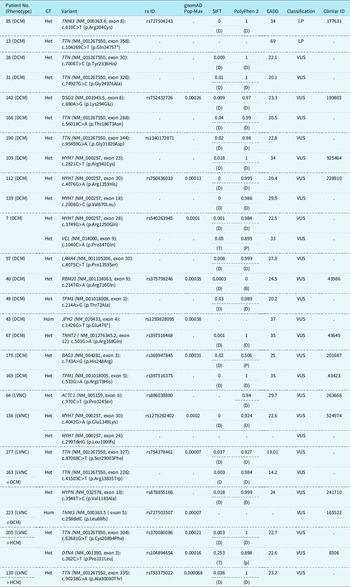
Nineteen variants were identified in 18 dilated cardiomyopathy patients. Nine novel variants were not previously reported in the literature, ClinVar, or gnomAD (Table 1). Two likely pathogenic variants were detected in dilated cardiomyopathy patients, TNNI3:c.610C>T (p.Arg204Cys) and TTN:c.104269C>T (p.Gln34757*). The other 17 variants were classified as variants of uncertain significance per the American College of Medical Genetics guidelines. Reference Richards, Aziz and Bale26 Those variants of uncertain significance were rare and found to be deleterious by in silico prediction algorithms. One patient (#43) had a homozygous variant, JPH2:c.1426G>T (p.Glu476*), and one patient (#7) had compound heterozygous variants in MYH7 and VCL. Table 1 includes all the rare (minor allele frequency < 0.05%) variants. Here, we describe the very rare (minor allele frequency <0.01%) variants that we identified.
List of identified variants in DCM and LVNC patients

GT: Genotype, Het: heterozygous, Hom: homozygous, LP: Likely pathogenic, VUS: variant of uncertain significance, HCM: hypertrophic cardiomyopathy, DCM: dilated cardiomyopathy, LVNC: left ventricular noncompaction.
A likely pathogenic variant in TNNI3, c.610C>T (p.Arg204Cys) (ClinVar ID: 177631), was identified in a male dilated cardiomyopathy patient (#85) presented at the age of 2 years with dyspnea and heart failure. The patient was born to consanguineous parents with normal parental echocardiography. His brother and sister had dilated cardiomyopathy and restrictive cardiomyopathy, respectively. Therefore, the condition was classified as familial dilated cardiomyopathy. This variant was reported previously in hypertrophic cardiomyopathy patients Reference Doolan, Tebo and Ingles27–Reference Walsh, Thomson and Ware29 but was absent from gnomAD. This variant affects a highly conserved amino acid. Functional studies confirmed its deleterious effect on the interactions of cardiac troponin. Reference Nguyen, Siu, Dewey, Cui and Gomes30 Another missense variant in the same codon TNNI3:Arg204His has been reported in association with hypertrophic cardiomyopathy Reference Doolan, Tebo and Ingles27 and restrictive cardiomyopathy Reference Gambarin, Tagliani and Arbustini31 and was classified as pathogenic suggesting the critical importance of Arg204 for the function of TNNI3. Therefore, the other missense variants at this position are more likely to be pathogenic.
A stop variant was identified in TTN, c.104269C>T (p.Gln34757*), in a female dilated cardiomyopathy patient (#13) who presented at birth with recurrent attacks of chest infection and dyspnea. The patient eventually developed heart failure. She was born to consanguineous parents with a normal cardiac examination. This loss of function variant is absent from general population databases and has not been previously reported in the literature. Truncating variants in TTN are only known to cause dilated cardiomyopathy when found in exons constitutively expressed in the heart (proportion spliced in>0.9). This variant is located in exon 358 (A band with PSI = 1) of the gene and is predicted to introduce a premature stop codon at position 34,757 of the titin protein. Therefore, we classified this variant as likely pathogenic.
We identified two variants of uncertain significance in MYH7 (patients #109 and #7). c.2821C>T (p.Arg941Cys) was identified in a male patient (#109) who presented with a recurrent chest infection at the age of 6 months. He was born to non-consanguineous parents with a normal cardiac examination. This variant was previously reported in one Chinese left ventricular noncompaction patient with heart failure Reference Lu, Wu and Liu32 and in a Japanese paediatric left ventricular noncompaction patient with heart failure whose father had dilated cardiomyopathy. Reference Wang, Hata and Hirono33 p.Arg941Cys has been reported in ClinVar as a variant of uncertain significance (ID 925464). Also, it was reported in a compound heterozygote state in a 66-year-old female with hypertrophic cardiomyopathy and end-stage progression to dilated phenotype. Another variant of uncertain significance in the same codon (p.Arg941Ser) was reported in a hypertrophic cardiomyopathy patient (ClinVar ID: 407201). It has a very low minor allele frequency in population databases.
In a male dilated cardiomyopathy patient (#7), we identified two variants of uncertain significance: MYH7 c.3749G>A (p.Arg1250Gln) in MYH7 and c.1040C>A (p.Pro347Gln) in VCL. This patient presented with a recurrent chest infection, dyspnea, and heart failure and was diagnosed with dilated cardiomyopathy at the age of 3 years. His father had dilated cardiomyopathy and left ventricular noncompaction. c.3749G>A occurs at a conserved nucleotide (p.Arg1250Gln), and in silico algorithms predicted that it is deleterious. A different missense variant (p.Arg1250Trp) in the same residue was reported in an African American patient with left ventricular noncompaction and dilated cardiomyopathy and two family members with dilated cardiomyopathy. Reference Dellefave, Pytel and Mewborn34 c.1040C>A (p.Pro347Gln) in VCL was not previously reported in the literature; however, another rare variant in the same codon (p.Pro347Leu) was reported as variant of uncertain significance by clinical testing laboratories in dilated cardiomyopathy and familial hypertrophic cardiomyopathy patients (ClinVar ID: 300786).
The variant TNNT2:c.503G>A (p.Arg168Gln) was reported in a female dilated cardiomyopathy patient (#67) who presented since birth with dyspnea and heart failure. She was born to non-consanguineous parents with a normal echocardiogram. This variant was reported by a clinical laboratory and classified as variant of uncertain significance (Clinvar ID: 43645).
A TPM1 variant, c.533G>A (p.Arg178His), was identified in a 4-year-old male patient (#169), who had presented at the age of 1 year with dyspnea and heart failure and was diagnosed with dilated cardiomyopathy. The patient was born to healthy consanguineous parents. This variant was reported in an infant with heart failure and left ventricular noncompaction Reference Farnaes, Hildreth and Sweeney35 and was classified as variant of uncertain significance (ClinVar ID: 43423).
Ten rare variants of uncertain significance were identified in seven left ventricular noncompaction patients (Table 1). They were predicted to be deleterious by in silico algorithms. Two variants were novel: MYH7:c.2997delG (p.Leu1000fs) and TTN:c.41503C>T (p.Arg13835Trp). Compound heterozygous variants were detected in MYH (patient #136), TTN, MYPN (patient#163), TTN, and DTNA (patient#205) (Table 1).
One homozygous variant in TNNI3, c.258del (p.Leu88fs), was reported in a 7-year-old male (patient #223) who presented with dyspnea and heart failure and was diagnosed at the age of 6 months with left ventricular noncompaction and dilated cardiomyopathy. He was born to healthy consanguineous parents. This variant was previously reported in an adult hypertrophic cardiomyopathy patient. Reference Coppini, Ho and Ashley36 It remains unclear if this variant would impact protein function, and therefore it was classified as variant of uncertain significance (ClinVar ID:165522).
ACTC1:c.970C>T (p.Pro324Ser) was identified in a 2.5-year-old male patient (#64) with left ventricular noncompaction who presented at the age of 6 months with dyspnea and heart failure. The patient was born to non-consanguineous healthy parents. p.Pro324Ser was reported by a clinical laboratory in association with a cardiovascular phenotype and classified as variant of uncertain significance (ClinVar ID: 263668).
We identified MYPN:c.3548T>C (p.Val1183Ala) in a 14-year-old male patient (#163) who was diagnosed with left ventricular noncompaction and dilated cardiomyopathy at the age of 1 year. The patient was born to healthy consanguineous parents. This variant is absent in gnomAD and has not been reported in the literature. However, it was reported in ClinVar in association with dilated cardiomyopathy (ClinVar ID: 241710). The same patient harboured a TTN variant of uncertain significance, c.41503C>T (p.Arg13835Trp) that was not previously reported.
Discussion
In the current study, we analysed cardiomyopathy-associated genes in 68 unrelated paediatric dilated cardiomyopathy and left ventricular noncompaction patients using next-generation sequencing. Among these 68 patients, 29 rare variants were detected in 25 patients. Two variants in TNNI3 and TTN that were likely pathogenic could explain only 2/68 (2.9%) of patients. Twenty-seven variants were of uncertain significance. This detection rate is much lower than 25–50% that was previously reported in other paediatric cohorts from other parts of the world. Reference Quiat, Witkowski, Zouk, Daly and Roberts10,Reference Burstein, Gaynor and Griffis37 The differences in the detection rates among different studies could be attributed to the different genetic causes, the phenotypic composition of the cohorts, the inclusion of secondary cardiomyopathy, different next-generation sequencing strategies used, and different degrees of stringency for the variant classification criteria. In the majority of children, the genetic role remains unclear. Reference Yotti, Seidman and Seidman7 A lower detection rate in the Egyptian patients might be due to different genetic aetiology in this population and possibly the higher rates of consanguinity.
In this study, most of the variants were in TTN followed by MYH7 and MYPBC3. TTN variants have been implicated in diverse types of cardiomyopathies. Reference Gigli, Begay and Morea38 Studying TTN gene variants was not previously straight-forward due to the size and complexity of the gene; however, the introduction of next-generation sequencing has made it feasible. Reference Merlo, Sinagra and Carniel39 Truncating variants in the TTN gene are estimated to account for ˜25 and 15% of familial and sporadic dilated cardiomyopathy, respectively, Reference Roberts, Ware and Herman40 whereas the significance of non-truncating variants in TTN is not clear. Reference Herman, Lam and Taylor41
We identified many rare damaging variants in sarcomere and non-sarcomere genes in the left ventricular noncompaction patients. However, all these variants were classified as variant of uncertain significance. Although genetic analysis has not been a first-line clinical diagnostic method for left ventricular noncompaction, sequencing patients will help us to better understand the disease process and to identify at-risk family members. Reference Dong, Fan and Tian11
Variants of uncertain significance represent a major clinical challenge, as proper genetic diagnosis and genetic counseling may not be provided. Reference Towbin42 In this study, nine dilated cardiomyopathy and two left ventricular noncompaction patients harboured 11 novel variants that were not previously reported. We classified these as variants of uncertain significance according to the American College of Medical Genetics guidelines. Seven out of the 11 patients (63.6%) were born to consanguineous parents. Three of these variants of uncertain significance (27.2%) were reported in patients with positive family history. In addition, 11/37 (29.7%) cases who did not have any variant in the cardiomyopathy gene had a family history of a similar cardiac condition. Besides, the echocardiographic examination resulted in the diagnosis of dilated cardiomyopathy in 17/58 (29.3%) parents, who were not previously aware of such diagnosis. These findings suggest that there is an underestimation of the population frequency of dilated cardiomyopathy/left ventricular noncompaction, as well as the familial pattern among the Egyptian paediatric cardiomyopathy patients. It is important to note that some variants of uncertain significance might be pathogenic; however, we may not have enough evidence (such as segregation analysis and functional studies) to establish such effect. Reference Burstein, Gaynor and Griffis37 Therefore, the clinicians should consider the variants of uncertain significance in risk stratification. Reference Burstein, Gaynor and Griffis37
To the best of our knowledge, the current study is the first national and regional report analysing cardiomyopathy-associated genes in paediatric idiopathic primary dilated cardiomyopathy and left ventricular noncompaction patients using next-generation sequencing. Genetics underlying cardiomyopathy might be different in Egyptian patients. Genome-wide tests (i.e., exome/genome sequencing) might be more suitable than a targeted testing approach, to improve our understanding of the genetics and management of paediatric cardiomyopathy among Egyptian patients. Molecular characterisation of cardiomyopathies in different ethnic populations will allow global comparative studies that could result in understanding the pathophysiology and heterogeneity of cardiomyopathies.
Supplementary material
To view supplementary material for this article, please visit https://doi.org/10.1017/S1047951121002055
Acknowledgements
We thank the patients and their families for participating in this study. The authors would like to thank Seidman Lab team at Harvard Medical School (Professors Christine Seidman, MD, and Jonathan Seidman, Barbara McDonough, and Steven DePalma, PhD) for their help in conducting this study. A.H. was supported by The National Heart, Lung, and Blood Institute (NHLBI K8HL150284), American Heart Association, and the Saving Tiny Hearts Society.
Financial support
This work was supported by the Science and Technology Development Fund (Centers of Excellence grants, grant number 5288), Cairo, Egypt. The sponsor did not have any role in study design, data collection, analysis, or preparation of the manuscript.
Conflict of interest
None.
Ethical standards
The study was approved by the ethical committee of the Faculty of Medicine, Cairo University. The procedures used in this study adhere to the tenets of the Declaration of Helsinki. An informed consent was obtained from the parents.