After milking of cows, the teat canal remains open for approximately 30 min to 2 h. As a result, bacteria from the open teat might ascend into the mammary gland and cause mastitis. Many methods, such as post-milking feeding, have been used to prevent the animals from lying on the ground after milking to reduce the risk of bacteria entering the udder. Conventional teat dipping has found widespread application for the same reason. The working principle of this method is to immerse the teat in an antiseptic solution to reduce the entry of bacteria from the teat canal. However, despite all the precautions taken, the entry of bacteria cannot be totally prevented. For this reason, new prevention control programs are needed (Borucki et al., Reference Borucki, Berthiaume, Robichaud and Lacasse2012).
Dipping or spraying of teats with an antiseptic solution is the most widely used method of controlling mastitis in dairy cow farming. With the right antiseptic selection and proper application, new infections that will form in the udder are reduced by 50–90%. The antiseptics used include 0.1–1.0% iodine solutions, chlorhexidine, ammonium querternal compounds, sodium hypochlorite, and hydrogen peroxide. For effective prevention, teats should be immersed in the teat dipping solution within 1–2 s after the milking clusters are removed, and the teats should be in contact with the solution for 30 s. Teat dipping solutions are also recommended to contain 10–14% of substances with skin protective and softening properties such as lanolin and glycerol. However, the incidence of mastitis in cows does not decrease despite teat dipping and other prevention methods (Boddie et al., Reference Boddie, Nickerson and Adkinson2000; Borucki et al., Reference Borucki, Berthiaume, Robichaud and Lacasse2012).
Many studies are used in vivo, in situ, and in vitro to reveal the effects of different chemicals on smooth muscles. Techniques such as manual palpation, strain measurement recording, intra-organ pressure recording (intraluminal tomography), and ultrasonography are used to determine tissue activity in vivo. The use of in situ techniques is not very common. In this technique, changes in the contraction and relaxation of organs and tissues are observed in anesthetized animals with surgical intervention (Bajcsy, Reference Bajcsy2005). In the in vitro technique, using an isolated organ/tissue bath system, muscle activity can be monitored using isotonic or isometric techniques in strips prepared from tissue samples (Ocal et al., Reference Ocal, Yuksel and Ayar2004). Electrical field stimulation is one technique used in organ bath experiments. For electrical stimulation, various stimulators and stimulus isolation units are used to create contractions by giving pulses of 120–150 V amplitude and 1 ms duration to smooth muscles. Again, by evaluating the contraction and relaxation times of the muscles, applications of 500 ms duration consisting of 1, 10, 20, 40, 60, 80, 100, and 150 Hz square waves are applied at 5 min intervals, and the contraction activities of the muscles are recorded. There are also applications related to electrical field stimulation on living animals. For example, it has been reported that norepinephrine is secreted due to electrical stimulation of the adrenergic nerves of the urinary bladder (Aksoz et al., Reference Aksoz, Bilge, İlkaya, Baş, Kesim and Çelik2009). In cows, the teat canal (Ductus papillaris) consists of longitudinal and circular smooth muscles, approximately 8–12 mm long and 2–3 mm wide. Therefore, it is expected that the teat canal would be affected by electrical field stimulation applications.
In this study, we describe a new approach to controlling mastitis in cows by determining the effects of the device called ‘Electrical Teat Dipping’, which was developed by combining teat dipping and electrical field stimulation technique.
Material and methods
Approval for the study was obtained from the Firat University Animal Experiments Local Ethics Committee (2019/101).
Ultrasonographic examination of the diameter of the teat canal
In total, 100 clinically healthy Holstein cows were used and two teats were studied in each cow. These animals were non-pregnant, aged 3–5 years and within the first 2–3 months of the postpartum period, weighing 450–500 kg, producing 15–20 liters of milk daily, having medium-sized udders, with lactation numbers of 2–3 and being milked twice daily on a farm in Elazig (Turkey) in December 2020. The animals used in the study were selected from among the 500 animals on the farm. The electronic herd management system was used on the farm (DeLaval, Turkey). Cows were housed in semi-open and free-roaming barns throughout the year. The cows on the farm were milked twice a day in the milking parlor with 12 automatic milking machines (DeLaval, Turkey). Conventional teat dipping was applied within the farm's milking hygiene scope.
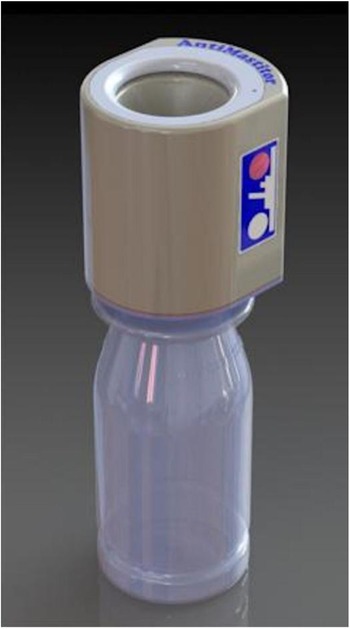
The front quarters of the cows included in the study were evaluated in two groups; Group 1: Electrical teat dipping (Turkish Patent No: 2021 001883B, PCT-TR2021-36) applied to the left front teat (n = 100) (Fig. 1). Group 2: Conventional teat dipping applied to the right front teat (n = 100). This application has only been done in a single milking.
Electrical teat dipping.

The diameters of the teat canal examined in two groups were measured firstly before milking and secondly after milking by ultrasonography. Ultrasonographic examination of the diameter of the teat canals was performed with an 8 MHz linear probe (IBEX, USA) after teat dipping by immersing the teats in a container filled with warm water using the water bath technique (Seker et al., Reference Seker, Risvanli, Yuksel, Saat and Ozmen2009). In measurements related to the teat, the probe was applied vertically parallel to the teat canal. The width of the teat canal was measured from the midpoint of the teat canal.
Statistical analysis
The conformity of the data of the parameters examined during the ultrasonographic tests to the normal distribution was evaluated using the Kolmogorov–Smirnov test. As a result of the evaluation, it was determined that they did not meet the parametric test assumptions and did not show a normal distribution. The Mann–Whitney-U test was used to compare the pre-milking and post-milking aspects of ETD and CTD practices. SPSS 22.0 program was used for these analyses.
Results
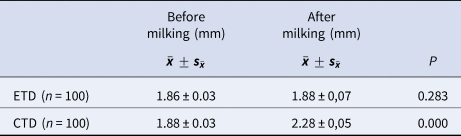
After milking, it was determined that the width of the teat canal (1.88 ± 0.07 mm) in which ETD was applied narrowed more than the width of the teat canal (2.28 ± 0.05 mm) in which CTD was applied (P = 0.000) (Table 1).
The diameters of the teat canal

ETD, Electrical teat dipping; CTD, Conventional teat dipping.
Discussion
Different methods are used to prevent cows from mastitis in dairy cattle farms. Among these, the teat dipping practice has an important place. Different views should be considered in the selection of the teat dipping solution, and the technique should be examined in more depth because teat dipping solutions may cause irritation, cracks, and lesions on the teat skin after dipping. There is also a need to better understand the antiseptic sensitivities of more than 140 mastitis-causing agents. Too low or too high pH value, improper storage of solutions, exposure to extreme temperatures and improper dilution, or routine disinfection of teat dipping cups are factors that reduce the effectiveness of this practice (Yanuartono et al., Reference Yanuartono, Nururrozi, Indarjulianto, Purnamaningsih and Ramandani2020). In addition to these, residue problems in milk are one of the handicaps of teat dipping. In a study conducted in Turkey in 2014 (Sentürk et al., Reference Sentürk, Teke, Uğurlu and Akdağ2014), the teat dipping usage rate was 11.50% in farms with 7–20 head, 13.60% in farms with 21–30 head and 31–94% in larger herds. In the study by Risvanli et al. (Reference Risvanli, Saat, Safak, Yiılmaz, Yuksel, Kilinc, Dogan, Yuksel, Kul and Seker2021), teat dipping application rates were found to be higher in large-scale farms (70.4%) than in family-type farms (19.2%).
The electrical field stimulation technique has been used for many years to stimulate the contraction of smooth muscles, especially in organ bath experiments, where an electrical field stimulation is applied to smooth muscles at different voltages (10–50 V), in a short time such as 5 ms and at varying frequencies (5, 10, 20, 40, 60, 80 Hz) (Aksoz et al., Reference Aksoz, Bilge, İlkaya, Baş, Kesim and Çelik2009). The ETD device used here was developed and patented by the team of the presented study. It was developed by combining the CTD application with the electrical field stimulation technique. The developed ETD device operates with a voltage between 1.8 and 3 V and a current between 5.5 and 7.2 A. This applied electricity is not felt by the animal since the applied current is a linear current. For this reason, it does not pose a problem in terms of animal welfare and ethics. Reinemann (Reference Reinemann2012) reported that exposure to stray voltage at levels of 2 to 4 V may be a mild stressor to some dairy cows, but it will not contribute to increased SCC or incidence of mastitis, or reduced milk yield. In addition, stray voltage is alternating current, but the one applied in ETD is linear current. As a result of the presented study, ultrasonographic examinations revealed that the teats with ETD were closed more quickly after the device application than those with CTD. In addition, the teats of the animals included in the study were followed during and after the study, and no adverse effects were found in any of them. The results could not be compared due to the lack of a similar ETD device. However, it produces much better results than CTD applications.
We concluded that the effects of ETD on the udder are very positive and can potentially be used as a new approach in the prevention and control of mastitis in cows.
Acknowledgments
This study was supported by the Scientific and Technological Research Council of Turkey (TUBITAK-TEYDEB No: 3191749).