The current expansion of the shari‘a legal system to include criminal aspects in 12 out of 19 states in northern Nigeria is greatly influencing the dynamics of gender relations in the region. This is because since the expansion the question of the rights of women under shari‘a is increasingly raised as one of the many issues now entering public discourse and debate. As implemented, the expanded shari‘a law contains a bias when it comes to gender issues and women's concerns. This is demonstrated by some of the laws promulgated and the subsequent structures established to enforce these laws. One of the shari‘a structures is the hisba organization, which has the duty of monitoring and enforcing the implementation of the new legal regime and ensuring compliance by Muslims. A central role of hisba – enforcing public morality through policing people's behaviour – is mainly associated with the curtailment of women's activities, mobility and visibility. The existence of hisba as a monitor and enforcer of morality beyond the family level has re-landscaped the public space within which women operate. Morality has become less of a private and personal matter and more of a public issue. This will no doubt impact on women who are generally viewed as custodians and symbols of morality in so many societies.
This article concerns the experiences of women under this new moral regime and its effects on gender relations in northern Nigeria. The article is analytical, focusing on the evolving reconstruction of what is viewed as appropriate behaviour for women in the current expanded shari‘a legal system. Of particular interest is the role of hisba as an institution in such a redefinition. How are hisba activities contributing to changes in the definition of morality? How is the redefinition of morality affecting women? We intend to answer these questions by situating our analysis within the issue of transportation and the more specific context of the current crisis involving hisba, commercial motorcycle riders, and their female customers.
Information used in this article is drawn from two studies conducted in 2003 and 2006 on ‘Strategic Conflict Assessment in Nigeria’ by the Institute for Peace and Conflict Resolution, Abuja. In-depth interviews were conducted with various stakeholders such as the state security agencies and the Hisba Commission. The author is the zonal coordinator of two research projects in the north-western states of Zamfara and Kano. The second source of information is the author's observations and analysis of gender issues in Hausa society and her involvement in the ‘Promotion of Women's Rights through Shari`a in Northern Nigeria’ programme.
GENDER AND SHARI‘A IMPLEMENTATION
The relationship between religious institutions and women's struggle against gender inequality has been described as ambiguous (Walker Reference Walker1999). On the one hand, religion and religious institutions are described as major vehicles for the reproduction of gender ideologies that oppress women and assert the superiority of men as a result of their appropriation of religious texts (Mama Reference Mama1996). Sweetman (1999: 2) notes that ‘Custom and tradition, often justified on religious grounds, ensure women's conformity to conventional gender roles, which can be the source of powerlessness and pain … at the same time [as] constraining people from seeking change.’ On the other hand, Sweetman points out, ‘oppressive interpretations of religious texts promoted by male-dominated religious institutions can be challenged by alternative interpretations of religious writings’ (1999: 4). According to this perspective, religion is a resource and vehicle for women's struggle against gender inequality in many societies of the Third World. With reference to Islam, Hashim (1999), Adamu (2005) and Mir-Hosseini (2001) have argued that women can fight for the attainment of political, social and economic rights from within the framework of Islam.
It is within the frame of this ambiguity that this article is situated. It contends that the expansion of the shari‘a legal system in northern Nigeria may have provided Muslim women with opportunities to demand the rights of women in Islam that are being denied – such as the right to education – by using the shari‘a legal system as an instrument.Footnote 1 For instance, under the Hisba Commission, there is a programme called zauren sulhu (community dialogue). The programme created women's spaces to give them the opportunity to meet, discuss and take decisions on community issues. This structure is called zauren inna in Hausa or inna wuro in Fulfulde: it means ‘a mother's hut’. It was the first opportunity of its kind in recent times to actively involve and engage women in community decision making.
Less positively, however, the implementation of shari‘a law in northern Nigeria has revealed a negative bias in relation to gender issues and women's concerns – on which this article will focus. Of particular interest currently is the implementation of shari‘a on questions of public morality – most frequently identified with the curtailment of women's activities, mobility and visibility. Other gender concerns in the implementation of shari‘a include the adoption of pregnancy as evidence of fornication. When pregnancy becomes the evidential focus in adultery cases, only women can be convicted.Footnote 2 Other gender biases are the exclusion of women from leadership positions or their segregation in roles restricted to women's issues only. In addition, pressure on women, not on men, to marry has intensified since the reintroduction of shari‘a. At the beginning of the shari‘a, it was reported that the Zamfara State government, for instance, had asked unmarried women to marry or quit government employment.
Perhaps the most enduring gender discrimination in the implementation of shari‘a, publicly justified in the name of protecting public morality, is the restriction of women's mobility. As noted above, saddling women with the burden of upholding public morality is not confined to Muslim communities and societies. It is a general feature of patriarchal societies and of all religious communities – particularly communities and societies experiencing religious revivalism, as is the case in Nigeria. Women's central role as wives, mothers and transmitters of cultural and religious beliefs is seen as a justification for regulating women's behaviour. Moghissi, for example, contends that [the] ‘Muslim woman, her sexuality and her moral conduct, has remained a central preoccupation of Muslim men over many centuries. This preoccupation has been translated into institutions, policies, legal practice and personal status codes which determine women's participation in public life’ (1999: 19). In the case of Kano and Zamfara states, this preoccupation has led to the establishment of the hisba corps, charged with the responsibility of enforcing shari‘a.
THE CONCEPT OF HISBA
It is necessary at this juncture to define hisba, to delineate its structure and to address how its activities affect gender relations and curtail women's rights. Hisba is an Arabic word meaning an act performed for the good of society. The word is derived from Qur'anic verses and the sayings of Prophet Muhammad (SAW)Footnote 3 that make enjoining what is right and forbidding what is wrong obligatory on every Muslim. In the Qur'an, Allah states: ‘Let there arise from you a group calling to all that is good, enjoining what is right and forbidding what is wrong. It is these who are successful’ (The Qur'an 3: 104). Prophet Muhammad states that: ‘Whosoever among you sees an act of wrong should change it with his hands. If he is not able to do so, then he should change it with his tongue. If he is not able to do so, then with his heart, and this is the weakest of faith.’ Islamic scholars have interpreted these injunctions as applying to individuals, society and the state. At an individual level, a Muslim is not to watch quietly as transgressions are committed or acts of righteousness are neglected. At the society or state level, hisba is meant to act as a mechanism for safeguarding the welfare and laws of the society. Thus, as a religious institution, an Islamic state or society is expected to have a hisba body responsible for enforcing the shari‘a legal system and safeguarding against its violation.
In the Islamic literature hisba performs the following functions:
1. Protecting the Islamic faith by ensuring that it is applied in the lives of the people, and safeguarding against its corruption. That is, hisba is responsible for everything to do with safeguarding, reviving and facilitating the faith.
2. Preparing a righteous society by supporting and cultivating high moral standards and by combating and eliminating immoral behaviour. The duty of a hisba official is to prevent public acts of immorality and he may be authorized to punish those who engage in them.
3. Working towards building a social conscience or social deterrent that deters people from violating the principles and general customs of the society.
4. Maintaining, fostering, and preserving upright social standards and ensuring that they are properly understood.
HISBA IN NORTHERN NIGERIA: VIGILANTE GROUP OR ORGAN OF GOVERNMENT?
While these are the stated functions of hisba in Islamic tenets one needs to consider its functions and operations in practice. Hisba becomes relevant in the vocabulary and social formation of northern Nigeria as a result of the expansion of the shari‘a legal system in some states in the region. The evolution of hisba and its operation has earned the group the label of ‘vigilante’. Like other vigilante groups in Nigeria, the hisba is dominated by youths who are locally recruited by traditional and religious leaders of the community. However, the extent to which hisba can be labelled ‘vigilante’ remains an issue of academic discourse. This is because hisba evolved from a vigilante group to become a government agency. Hisba started formally in the two states of Zamfara and Kano and in most parts of the shari‘a states at a localized level of individuals and communities. As soon as the criminal side of shari‘a law was reintroduced, people in their capacities as Muslims started to answer the Islamic call for believers to ‘enjoin good and forbid bad deeds’ by volunteering to enforce the shari‘a laws and forming hisba at community levels, independently of government.
Youths in their thousands across the shari‘a states voluntarily offered their services to make the shari‘a a success. Coordinated mostly at this grassroots level by traditional leaders, the groups helped in detecting crimes, making arrests and forwarding suspects to the police for investigation and prosecution. This relationship with the police, however, was not consistent. Hisba operated by patrolling the neighbourhood and, while apprehended suspects might sometimes be handed over to the police, they sometimes administered summary justice. Hisba members carry sticks and whips which they use to beat up suspected offenders. They are recognizable by their uniforms and their clearly labelled vehicles when on patrol. As private individuals who volunteered their services they enjoy little or no fixed salary, though occasionally receiving support from local or state governments or community authorities.
As the activities of the hisba groups expanded and complaints regarding their use of extra-judicial procedures mounted, the state governments intervened to regulate and supervise their activities. In some states like Kaduna and Katsina, a committee was set up to supervise and monitor their activities and to ensure that they operated within the boundaries of the law. Under this arrangement, the independent hisba group came to be recognized by, while not being part of government. In other states, however, the group either became integrated into government, or else the idea of hisba as an enforcement agency was formally adopted by the state. In both these cases, a structure generally referred to as a Hisba Commission or Board was created. By 2003 laws reinforcing the structure were also passed by states such as Zamfara and Kano, which meant that members of such boards or commissions were drawn from the existing government ministries and parastatals, from traditional authorities and from the pool of Islamic scholars in the states. As a result these members also enjoyed regular salaries and the benefits of civil servants.
Despite the adoption of hisba as a government institution, the relationship between the hisba and the governments of the shari‘a states has not always been smooth and sometimes has proved antagonistic. The involvement of Islamic scholars in the operation of hisba meant that hisba sometimes held different views and adopted alternative approaches to those of the government. For instance, independent hisba flourished in Kano under Governor Rabiu Kwankwaso between 2000 and 2002 because of the perception by Islamic scholars and the general public that the government's approach to the implementation of shari‘a was inadequate. However, with the election in 2003 of Governor Malam Ibrahim Shekarau, an Islamic scholar and a trusted supporter of shari‘a in the state, the official and the independent hisba merged.
The marriage between the Kano state government and the Islamic scholars was short-lived, however. Some Islamic scholars have questioned the strategies adopted by the government in the implementation of shari‘a. They accuse the government of not being sufficiently hard on social vices such as the mixing of men and women, and of tolerating such places as beer parlours and brothel houses. Consequently some members of the Hisba Commission resigned their appointments in protest and continued to attack the state government over its moderation. In its response, the government accused the disgruntled Islamic scholars of extremism and intolerance fanned by their disappointment at not receiving permanent appointments in the shari‘a bodies.
Another implication of integrating hisba into government is the utilization of state power against the so-called shari‘a violators. For instance, various Human Rights groups have expressed concern over the abuse of the human rights of citizens by the hisba force. A Human Rights Watch Report enumerated cases of abuse that took place between 2000 and 2002. The cases cited in this report included: (1) the summary and extra-judicial arrest, flogging and beating of people for a variety of offences; (2) the stopping of vehicles carrying men and women, with the women forced to disembark, in states such as Zamfara and Kano that prohibited women and men travelling together; (3) the disruption of conversations between men and women in public places on the grounds that such gatherings were immoral; (4) the seizure and destruction of alcoholic drinks and the causing of damage to the vehicles transporting them; and (5) the violation of the rights of people to privacy. Although this type of abuse of privacy has abated in recent years, it was through such abuse that the internationally reported cases of adultery against Safiya Hussaina and Amina Lawal were brought before the courts. In both cases, the hisba members acted on tip-offs and used them as a basis for questioning the women, even though they had no right to do so. Inconsistencies, however, are also exposed. In one case in Zamfara State in 2000 a hisba member who had reported the case of a woman seen with a man in a room was himself charged for spying on the woman, and was flogged (Human Rights Watch 2004).
The problems associated with hisba, outlined above, are partly linked to the characteristics of the group itself. It is dominated by young men with low levels of formal education who also lack any training in law or law enforcement procedures. Indeed, there are no training programmes for the hisba. In Kaduna, once members are recruited, they are given a handbook in Hausa on the definition and duties of the hisba, and other guidelines, such as how to approach people in the right manner (Human Rights Watch 2004).
From the foregoing, therefore, it appears that the operation of hisba in northern Nigeria is shot through with local and religious politics, and that as it evolves the future of hisba remains uncertain. How long it will remain a relevant institution within the shari‘a states remains debatable.
ORGANIZATIONAL STRUCTURE OF HISBA IN KANO STATE
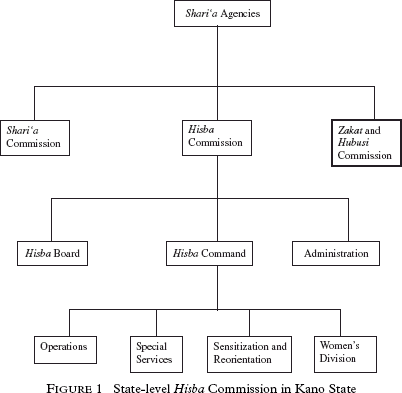
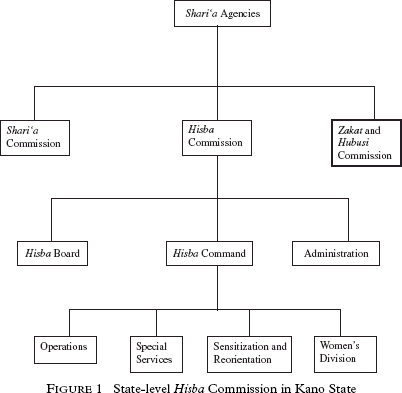
The expansion of shari‘a in northern Nigeria has resulted in the creation of three government agencies across the shari‘a states. They are the Shari`a Commission, the Zakkat and Hubusi Commission and the Hisba Board or Commission. However, in this article we are only interested in the Hisba Commission and will use Kano State as a point of reference because it has the most elaborate and comprehensive structure thus far. Most of the information given below was provided by the chairman of the Hisba Commission during interviews conducted by the author in December 2006 or gathered from documents made available to me. In Kano State, hisba is organized at five levels: state, senatorial district, local government, village and community. At the state level, the Hisba Commission has three divisions: the Hisba Board, the Administration and the Hisba Command (as presented in Figure 1). The Hisba Board is responsible for advising the government on Islamic legal matters. The Board is composed of a full-time chairman and a wide range of representatives from other bodies: the Shari‘a and Zakkah and Hubusi commissions, all the Nigerian law enforcement and security agencies (police, state security, customs, immigration, etcetera), the judiciary, the traditional authority, the Islamic authority and various NGOs. The Administration is responsible for administering and coordinating the activities of the Hisba Commission.
The last arm of the Hisba Commission – the Hisba Command, which has the responsibility for enforcing shari‘a law – has four divisions. Hisba corps fall under the Operations Division, while other services rendered by the Hisba Commission such as traffic control and humanitarian service delivery are under the Special Services Division. The Sensitization and Reorientation Division is responsible for reorientation and the settling of disputes, while the Women's Division handles issues of concern to women such as the abuse of women's rights over divorce, inheritance and domestic violence.
A similar structure and membership operates in the three senatorial districts of Kano State. The third and fourth levels of operation – the local government and village levels – have three divisions: advisory, management and hisba corps. Membership of the hisba bodies involves all relevant stakeholders, as previously spelt out at the state level. The last level of operation of hisba is the community, which is sub-divided into the zauren sulhu (meaning community dialogue) localities mentioned earlier. The zauren sulhu operate at different community levels such as streets/areas, markets, schools and transport stations. The hisba corps operates at all five levels (state, senatorial districts, LGAs, villages, communities) and each level is expected to have a Women's Division whose size should not be less than 10 per cent of the overall size of the hisba force at that level.
FUNCTIONS OF HISBA
Each state has spelt out the roles and duties of the hisba. In Zamfara State, the responsibilities of the hisba include:
1. Monitoring the implementation and application of laws relating to shari‘a.
2. Ensuring proper compliance with the teachings of shari‘a by workers in the private and public sector.
3. Monitoring the daily proceedings of shari‘a courts to ensure compliance with the shari‘a penal codes and codes of criminal procedure.
4. Reporting on all actions likely to interfere with the proper dispensation of justice.
5. Keeping a record of all people in prison with pending criminal cases.
6. Taking every measure to sanitize society against all social vices and whatever vice or crime is prohibited by shari‘a.
7. Taking every measure to ensure conformity with the teachings of shari‘a by the general public in matters of worship, dress code and social or business interactions and relationships.
8. Enlightening the general public on the shari‘a system and its application (Human Rights Watch Report 2004).
In Kano State an officially established and controlled hisba became operational with the creation of a Hisba Board in 2003 (Lawan Reference Lawan2004). The responsibilities of the hisba spelled out in Section 7 of the Hisba Board laws of 2003 include:
1. Rendering necessary assistance to the police and other security agencies, especially in the areas of prevention, detection and reporting of offences.
2. Encouraging Muslims to unite in their quest for justice and equality, enjoining one another to do good and avoid evil.
3. Advising against acquiring wealth by interest, usury, hoarding or speculation.
4. Reconciliation of civil disputes between willing parties.
5. Assisting in traffic control and emergency relief operations.
In pursuit of its function of social reorientation the hisba airs a weekly radio programme, Muryar hisba (Voice of hisba). Most of the topics covered in this programme focus on moral issues related to gender relations and marriage. The programme is meant to act as an instrument of sensitization and admonition of the public. To further strengthen and control the activities of hisba, the Kano State government inaugurated 9,000 hisba corps members, 900 of whom were women. The members are drawn from different parts of the state and from the volunteer or independent hisba groups.
Other functions of the hisba include the control of traffic during and after working hours, especially during the rush hours and in areas that traffic wardens do not cover. For instance, the hisba stay longer – from 7 a.m. to 9 p.m. – compared to the police, who patrol until 6 p.m. After seeing the impact the hisba is having on traffic and the commendation from the public, the police extended their patrols until 8 p.m. The hisba also helps in settling minor accident cases and marital disputes, thereby decongesting the courts (Lawan Reference Lawan2004). For instance, a woman from Sabuwar Gandu has tried for nearly a decade to get a divorce through the court process on the grounds of her husband's alleged impotence. At the intervention of hisba, the husband has granted the wife her wish (Lawan Reference Lawan2004).
The preference of the people for hisba justice is captured by one Kano resident in Kofar Na'isa who said: ‘I prefer to take my problems to hisba because they are more transparent than the police. No bribery, no bail money, and no hassle. In our area they have reconciled many family problems, and helped in curbing juvenile delinquency among our children’ (quoted from Weekly Trust, 18–24 February 2006). Another area of interest to hisba is providing humanitarian assistance. When the recent religious crisis in Jos threatened stability in Kano, the group was used by the government to quell tension by discouraging the spread of rumour. They also distributed relief materials to victims of the crisis using donations collected from the public.
The functions of hisba were aptly captured by two of its leaders as guidance and education. One leader in Kaduna said that their function is to ensure that Islamic law is implemented, and to enlighten people so as to prevent them from going the wrong way:
If someone commits a mistake, it is the duty of the hisba to tell him it is unlawful. If the person changes his conduct, then it's OK. If he doesn't or continues making the mistake, it is the duty of the hisba to report him. But the hisba is not the police or the army. They just have a duty to guide people the right way. If a person offends once or even twice, they don't apprehend him. (Human Rights Watch 2004)
Another leader in Kano said:
Enforcement is done by the police and the courts. The hisba is not a law enforcement agency per se. It is a supportive agency. If they apprehend someone, they preach to them. If the person refuses to change their ways, they hand them to the police. …The hisba are supposed to draw attention to transgressions. They enjoin people to do good or preach to prevent them from doing bad. In shari‘a there is room for advice before you get to the courts. (Human Right Watch 2004)
HISBA AND THE NIGERIAN STATE
As this analysis indicates hisba is gradually being integrated into government. This raises the question, therefore, of the implications of this alternative security force in relation to the Nigerian state. The existence of hisba to enforce shari‘a and to maintain law and public order despite the existence of the Nigeria Police Force in such states has earned the group the label of ‘vigilante’, though the extent to which it can be so labelled remains unresolved. Obvious and uncontested, however, are the complications arising from the existence of such parallel institutions in the shari‘a states. The first complication is linked to the legal positioning of the two institutions within the Nigerian state. Hisba corps belong to the state government, and the police force is a federal institution answerable to the federal authority. Although the police are expected to enforce both federal and state laws, they are not trained in the field of Islamic law and, therefore, lack the capacity and the will to act where shari‘a law is being applied. This is especially so if the police officer on the ground is not a Muslim and, therefore, has no personal inclination to enforce shari‘a law. The problem is compounded if such shari‘a laws contradict the federal laws. For instance, in states where alcohol has been banned, policemen and soldiers have continued to drink openly. In addition, the police have not been active in enforcing new shari‘a codes of behaviour such as dress codes for women and segregation of sexes in public transport.
Related to the above is the nature of the relationship that exists between the police and hisba. Feelings of mutual suspicion and distrust between hisba and the police have been reported (Human Rights Watch 2004; Adamu Reference Adamu2002; Lawan Reference Lawan2004). It is a general belief among the Muslim leaders that the police will try to sabotage shari‘a implementation in line with federal government opposition to its introduction. In fact, hisba emerged because of the belief that the police cannot be trusted to enforce shari‘a. Human Rights Watch has reported that hisba members often complain of a lack of cooperation from the police, and claim that when hisba groups apprehend suspects and hand them over to the police, such cases are not followed up and sometimes suspects are released. For their part, the police have claimed that hisba often arrest people on frivolous grounds, or on suspicion of committing acts which are not criminal offences.
The existence of these parallel institutions performing similar functions has resulted in a conflict of interests between the police and the hisba, attended by violent clashes. For example, on 30 May 2003 in Hotoro, in Nasarawa LGA, Kano State, police officers clashed with members of hisba who had disrupted a wedding party on the basis that it was an ‘immoral gathering’. A group of about twenty members of the hisba group from neighbouring Tarauni LGA entered the house of the person hosting the party, beat and injured several people, and damaged property. The police responded to complaints from the organizers of the party and about thirty members of the hisba were arrested. Such incidents occurred in many shari‘a states, especially between 2000 and 2003, though since 2003 cooperation between the bodies has improved considerably across the states.
A recent development in Kano State, however, has significantly changed the relationship between hisba and the Nigeria Police Force, and by extension with the federal government. On 9 February 2006 the Inspector-General of the Nigeria Police Force accused the state of trying to turn hisba into a parallel police force. He also accused hisba leaders of soliciting foreign funding and technical assistance for training the hisba corps. As a result, the group was banned and its leadership arrested for questioning by the federal government. Soon after, it was reported that the Minister of Information, Frank Nweke, had alleged that ‘The Kano State Hisba Board has, with brazen disregard for the overriding imperatives of national security, sought the assistance of foreign governments for the training of “100 jihadists” in the areas of “intelligence” and “practice of jihad” ‘ (Daily Trust, 10 February 2006).
Responding to this allegation in a live radio broadcast, the Kano State Governor called the banning of hisba unconstitutional and stated that ‘it is a blunder for anybody to interpret hisba as an independent terrorist group.…We will pursue all constitutional means to assert our right on this issue.’ He then challenged the federal government to take the matter to court:
We have heard the Inspector-General of Police's announcement but to us, we have followed constitutional due process before hisba was established and the law that constitutionally gave us [the] right to form hisba is still in existence and therefore, hisba will continue operating in the state…. In a democratic regime, if any government or individual felt that a particular law which was constitutionally established was wrongly formulated, such government or individual has only two alternatives: that is either go to court to challenge it or through the Assembly. (Daily Trust, 10 February 2006)
To sum up, the position of hisba within the Nigerian state is controversial and the legality of the group, along with the criminal jurisdiction of shari‘a, remains unresolved. The debate has centred on three issues. The first of these is the extent to which adopting the shari‘a legal system amounts to the adoption of Islam as a state religion, and the extent to which hisba constitutes a parallel police force. The second is whether the Nigeria Police Force (or even the federal government) holds the constitutional authority to proscribe an institution established by a state law. And the third issue is whether there is any substance to the allegation of foreign support for jihadists' training (and the credibility of evidence traced to a letter written to the Libyan and Iranian embassies). Answers to these questions may have to wait until the Federal High Court and Supreme Court pass judgement on cases brought before them separately by the Kano State government.
If the legal status of hisba is clouded by controversies, perception of some aspects of its operation is also subject to ongoing public disputes, particularly concerning the manner in which women's rights are being violated. To enable us to analyse how women fared under the hisba and the impact of the organization on gender relations we turn in this final section to discuss the contested issue of women's rights to use commercial transport.
NEW REGIMES OF MORALITY AND THE RECONSTRUCTION OF GENDER RELATIONS
One of the most noticeable changes occasioned by the emergence of hisba in the shari‘a states is the assertion of a new regime of morality – one defined by the transfer of morality from the private sphere of the family and individual conscience to a public sphere of the state and religious bodies. This new regime is reflected in a series of restrictions on both men and women and over gender-related issues. For instance, all cases of zina (fornication) that have attracted the death penalty under the shari‘a criminal legal system to date have their roots in this shift of stance on morality. The Safiya and Amina cases would have been handled and settled at the level of their families and those of their alleged lovers prior to shari‘a expansion, rather than being a state or court affair. The new regime of morality has imposed restrictions in many areas of interaction between men and women, therefore, and one of these is public transportation.
Like many countries in Africa, Nigeria has no publicly managed transport system. The vacuum created by a lack of public means of transportation is filled by private individuals. Transportation within Nigerian cities is dominated by buses and small car taxis. However, as the costs of fuel and maintenance for cars and buses rose, many owners diverted cars and buses to long-distance routes, thereby creating a scarcity of buses and taxis in urban areas. Conditions were ripe, therefore, for the introduction of a new and alternative means of city transportation, such as motorcycles. The motorcycle soon became the most popular means of transport in Nigerian cities because of a number of factors.
First, small amounts of capital are needed to start the business. A new motorcycle costs between 60,000 and 120,000 Naira, compared to a second-hand car that may cost between 300,000 and 500,000 Naira. Second, the cost of maintenance is extremely low compared to cars and buses – especially in the area of fuel consumption, given the increase in the price of fuel over recent years. These two factors attracted many small-scale investors, especially women, into the business. The third factor in the popularity of the commercial motorcycle business (variously referred to as Acaba, Okada and Kabu-Kabu) is the availability of young, otherwise unemployed secondary school leavers who have entered the sector.
Despite frequent accidents the motorcycle transport service is popular among consumers because of its convenience. It is available in every corner of the Nigerian city. A person does not have to wait long for service or walk a distance to a service point, as is the case with buses and cars. Equally, because motorcycles can operate on the narrowest of the roads and footpaths, Okada can take customers closer to their destination. In addition, it is the fastest means of transport because motorcycles can avoid main roads and traffic congestion, and it is cheap (significantly less than an equivalent taxi ride).
In view of the above factors, motorcycle transportation becomes the choice of most of those who cannot afford their own motorcycles or cars, the majority of whom are women. Motorcycle transportation for women was a sensitive issue for the general public long before the expansion of shari‘a. However, the expansion of the shari‘a legal system and the establishment and operation of hisba brought more general concerns over safety and female comportment more sharply into focus. Women and men on a motorcycle sitting very close to each other began to be seen as an offence to public morality and therefore the concern of hisba. According to the Director-General of the Shari`a Commission in Kano State:
Everyone knows the type or manner in which women sit on motorcycles and it looks quite adulterous because women sit quite close to Achaba riders with their bodies touching each other. If mere looking can lead to adultery, then the manner in which women sit on motorcycles can increase the rate of adultery. (Weekly Trust, 18–24 February 2006)
Thus, the argument for gender segregation in transport emerged for the first time in the public domain, especially among shari‘a-implementing scholars. The debate over women's use of motorcycle transportation shifted its focus from women's safety to public morality.
According to the Director-General of hisba, if public morality was to be enforced and safeguarded, the practice of men and women sitting very close to each other on a motorcycle had to be stopped. The options adopted were first to declare such an act as anti-shari‘a, and therefore to prohibit the practice; second, to provide women with an alternative means of transportation; and third, to encourage female motorcyclists. This third option was rejected because it was deemed further to offend public morality. Consequently, the first and second options were adopted by the two states of Zamfara and Kano. The rest of the shari‘a states seem to lack the political and religious will to act on the matter.
Thus in May 2004 the Kano State House of Assembly passed its Traffic Amendment Law 2004 banning women from riding on commercial motorcycles. The law punishes a defaulter with a six months' imprisonment and a fine of 5,000 Naira (US$37). The defaulter may also lose his permit for six months. Months after the passage of the law, the hisba corps of 9,000 members were inaugurated by the government to enforce shari‘a, including the new traffic law. During the inauguration period about 500 three-wheeled motorcycle taxis and 100 buses for women only were made available in the city. But months after the ban, women have continued to travel on commercial motorcycles, claiming that the buses and tricycles provided for them are inadequate.
The ban was enforced by hisba members who stopped and warned commercial motorcyclists and their female passengers to desist from disobeying the law. Over 2,000 motorcycles were seized by the hisba group. However, on 14 December 2004 the hisba members changed their tactics by ordering women off the bikes. This action angered the commercial motorcyclists who responded by attacking the hisba members and burning the tricycle bikes provided for women by the government. It was reported in the Nigerian media that at least 11 people were injured and dozens of government vehicles belonging to the hisba were destroyed in this violence. The ensuing confrontation between the Kano State government and the federal government over the banning of hisba just a few days later (discussed above) took the heat out of the issue, and hisba members became less visible in enforcing the ban.
It is evident that the outcry and condemnation of the ban on women riding commercial vehicles is economically motivated and is championed by the youth who stand to lose if such a ban is enforced. In fact there was little condemnation or lobbying to lift the ban from any women's or human rights groups. The central reason for this silence is the manner in which the whole shari‘a issue has been politicized since its inception. The issue has been debated in the language of ‘us’ versus ‘them’, and consequently, the question of gender and shari‘a has polarized women in Nigeria on religious and sectional lines.
CONCLUSIONS: IMPLICATIONS FOR GENDER RELATIONS
The redefinition of the role of women in relation to public morality, and the recent campaign against women riding on commercial motorcycles in particular, will impact on gender relations more generally. There is increasing concern that the emphasis given to public morality may in the immediate future feed into re-evaluation of private morality. As a result, private and family morality may become linked to the behaviour of women in public, and brothers or other male family members may be further emboldened to monitor, ‘protect’ and curtail the behaviour of younger women.
If public morality is interpreted in terms of women riding or not riding on commercial motorcycles, for example, then the majority of women will suffer as a result. There is no doubt that it will affect women's access to education, particularly in the areas of enrolment and school attendance. The majority of schools in Kano city are not boarding schools, and consequently female students have to compete with workers during the morning rush hours to use the available public buses and tricycles provided by the government. Female students and their parents may become discouraged and, even where they continue to attend, lateness is inevitable. A similar situation is possible with regard to women's access to health services. Because of the inconvenience and risks involved in road transport, women are likely to store up their health problems and those of their children before seeking medical assistance.
One of the main criticisms levelled against shari‘a implementation is its insensitivity to the condition of the poor. The law forbidding women to ride on commercial motorcycles is no doubt disadvantageous to the poor. Women whose husbands cannot afford private cars and generally rely on motorcyclists to pursue their lives and livelihoods rely on inadequate government bus services. This will no doubt restrict their movements. Equally important is the effect the ban would have on the earnings of the commercial motorcyclists, who are also mostly poor. Responding to the ban, a motorcyclist stated that ‘the government intends to put us out of business by this new law because we can’t feed our family by relying on male customers who do not pay as much as women' (AFP news agency).
Perhaps one of the most prominent casualties of this change is women's involvement in politics and governance. Already, across the north of the country the record of women's participation in politics and governance is a poor one. The prospect that the state apparatus may be used to deny women's participation in politics and governance on the grounds that it involves the mixing of women and men in such activities is very real. The ban on riding commercial motorcycles could be a step towards imposing further restrictions on women's involvement in activities within the public space.
State-level Hisba Commission in Kano State