Introduction
Many Helicoperva spp., including H. armigera (Hübner), H. punctigera (Wallengren), and H. zea (Boddie), are important worldwide polyphagous pests. In the USA, H. zea is a damaging pest of many crops including soybean, Glycine max (Merr.), especially in the southern United States (Musser et al., Reference Musser, Catchot, Davis, Lorenz, Reed, Reisig, Stewart and Taylor2016). Chloridea virescens (Fab.) is also a pest of soybean in this region with similar behavior (Kogan et al., Reference Kogan, Sell, Stinner, Bradley and Kogan1978) and is difficult to morphologically distinguish from H. zea as a larva. Helicoverpa zea prefers to oviposit in soybean during the R2 (full flowering) stage, usually on the abaxial side of open leaves (Hillhouse and Pitre, Reference Hillhouse and Pitre1976). Upon eclosion, larvae move within the plant, preferring different tissue types as larvae age in synchrony with plant development. Small larvae occur most often on rolled (expanding) leaves and blooms, with feeding evident in the blooms; in contrast, medium larvae are distributed throughout the plant, while large larvae are often found on flowers and pods (Eckel et al., Reference Eckel, Terry, Bradley and Van Duyn1992).
There is evidence for several non-mutually exclusive potential drivers to influence oviposition and larval preferences among tissue types including nutrition (Suits et al., Reference Suits, Reisig and Burrack2017) (Eckel et al., Reference Eckel, Terry, Bradley and Van Duyn1992), avoidance of predation, parasitism and cannibalism (Eckel et al., Reference Eckel, Terry, Bradley and Van Duyn1992), and the ability to penetrate soybean pod walls (McWilliams, Reference McWilliams1983). More support is available for the nutrition and penetration hypotheses, perhaps because they are easier to test experimentally. For example, H. zea larvae have been experimentally shown to prefer a laboratory-based diet that optimizes development (Waldbauer et al., Reference Waldbauer, Cohen and Friedman1984). During the reproductive stages of soybean, neonate H. zea establishment decreases with plant maturity and mortality is lower on expanding leaves compared to mature leaves (Terry et al., Reference Terry, Bradley and Duyn1989). Furthermore, larval survival is greater on soybean plants during the early reproductive stages, compared to later stages (Terry et al., Reference Terry, Bradley and Van Duyn1987a). Soybean tissue type that H. zea larvae feed on is important for development. For example, second instar H. zea larvae fed specific soybean tissue types in no-choice assays only reached pupation when fed trifoliate leaves (ca. 30–50%) or blooms (>10%), but not when fed petioles, R4 developing pods, R5 seed-filling pods, and stems. In a similar no-choice assay, fourth-instar larvae could reach pupation when fed trifoliate leaves, R5 seed-filling pods, and R6 fully developed pods with seeds, but not blooms or R4 developing pods. Furthermore, H. zea growth characteristics were influenced by soybean tissue in both no-choice and choice assays (Suits et al., Reference Suits, Reisig and Burrack2017). These studies lend support to the optimal foraging hypothesis (MacArthur and Pianka, Reference MacArthur and Pianka1966); Helicoverpa zea larvae choose among available soybean tissues to optimize their development and not all tissue types will support development for all larval stadia.
It is also possible that H. zea have ovipositional and larval preferences among tissue types to avoid predation, parasitism and cannibalism, but the data are more indirect. Both predation and parasitism of eggs and larvae can be significant. For example, one study found that 3–28% H. zea eggs were parasitized and that most mortality occurred between the egg and third instar, with only 6–18% surviving past this stage (Terry et al., Reference Terry, Bradley and Van Duyn1987b). Quantifying predation of larvae is more problematic than eggs because larvae are mobile, but some studies have found that predation of eggs can be significant and varies temporally (Anderson and Yeargan, Reference Anderson and Yeargan1998; Pfannenstiel and Yeargan, Reference Pfannenstiel and Yeargan2002). Therefore, since H. zea larval location varies across time and space, it is conceivable that factors such as predation, parasitism, and cannibalism could influence their location.
There are several gaps in knowledge concerning H. zea larval temporal and spatial heterogeneity. First, not much is known about the variability in time in the position of specific larval instars, especially first instars. While Terry et al. (Reference Terry, Bradley and Duyn1989) studied first instar establishment on soybean, this was done using artificial infestation of first instars directly on the plant. Because most first instar lepidopteran larvae succumb to mortality through unknown factors (Zalucki et al., Reference Zalucki, Clarke and Malcolm2002), manipulating and placing larvae directly on plants may influence movement and mortality. Furthermore, past studies have not compared differences in larval position among determinate and indeterminate soybean varieties. Because H. zea larvae likely choose among available soybean tissues to optimize their development, the spatial position of various instars could differ among determinate and indeterminate varieties. While indeterminate varieties have various stages of reproductive growth occurring simultaneously, all reproductive structures develop in concert in determinate varieties. For example, during R4, there may be large pods with developing seed, large pods without seed, small pods, and flowers available for consumption in an indeterminate variety, but only large pods without seed will be available in a determinate variety. The purpose of the studies presented here was not to disentangle these potential drivers of ovipositional and larval temporal and spatial heterogeneity. In contrast, our objectives were to (1) characterize the distribution of different H. zea larval instars on various soybean tissue types over time and to (2) see if the distribution of larvae were different between a determinate and indeterminate variety.
Methods
Natural infestation study
Two soybean varieties were planted in 12.2 m × 3.7 m plots (four rows wide) during 2015 at Plymouth, NC, in a completely randomized block design with four replications. The first variety, which was determinate (AG5533; Bayer Crop Science, St. Louis, MO), was planted on 27 May. The second variety, which was indeterminate (AG4533, Bayer Crop Science), was planted on 17 June. These planting dates were chosen to synchronize the timing of reproductive stages between the varieties, including the R2 stage – an attractive period for H. zea oviposition – with an expected large H. zea moth flight. Plots were monitored twice weekly using 1 m long beat sheets from only rows one and four. Neonate H. zea were first noticed in the plots on 30 July using this sampling method which triggered a more intensive sampling effort.
Intensive sampling events occurred on 3, 10 and 17 August, after which point most H. zea larvae had completed their development. During each sampling event, the growth stage of the plants was recorded. Twenty-five total plants were randomly selected from rows two and three of each plot. These plants were clipped carefully at the base and gently moved to tables outside the experiment. Tissues were clipped from each plant into four different types: (1) blooms, (2) small pods (>4.8 mm), (3) large pods (≤4.8 mm), and (4) leaves. Blooms and pods were placed into jars of 70% ethanol by plot and leaves were swirled into jars of 70% ethanol to dislodge larvae. Leaves were briefly checked to ensure that larvae were dislodged. Larvae were then quantified in the lab and head capsule widths were measured to determine instar (Hardwick, Reference Hardwick1965). Blooms were dissected to ensure that larvae harboring within the bloom were quantified. At each sampling event, mandibles were dissected from 20 fourth- or fifth-instar larvae to quantify the ratio of H. zea to C. virescens present in the experiment.
Results from field studies using natural infestations should be the closest reflection of reality. However, such studies are difficult to do since larval recovery rates are low. Therefore, cage studies are often used to confine a known number of insects on plants and to increase recovery rate.
Cage study experiment 1
Two soybean varieties were planted in 12.2 m × 4.1 m plots (four rows wide) at Stoneville, MS, in a completely randomized block design, with four replications, on 11 May 2017. One variety was indeterminate (AG46X6; Bayer Crop Science) while the other was determinate (AG5533; Bayer Crop Science). Helicoverpa zea larvae were collected from non-Bt corn and reared under standard laboratory conditions. Upon pupal eclosion, 12 to 15 pairs of moths (1:1 M:F ratio) were released into 1.8 m3 cages covered with Amber Lumite® screen (BioQuip Products, Inc., Rancho Dominguez, CA), with one cage per plot during the R2 growth stage. Intensive sampling, as described previously, was performed on 17, 20, 25, and 27 July for the indeterminate variety and 20, 25, and 28 July for the determinate variety, except that ten plants were sampled per cage (plot) on each sampling date. Head capsules were not measured, as in the field experiment, but larval instars were quantified based on visual estimation of head capsule size. This study design was similar to the field study, but results should be interpreted with care given the limitations of cage studies (discussed further in the discussion section).
Cage study experiment 2
An indeterminate (AG46X6; Bayer Crop Science) soybean variety was planted in 12.2 m × 4.1 m plots (four rows wide) at Stoneville, MS, in four replications, on 1 May 2018. Unlike cage study experiment 1, a determinate variety was not planted due to time constraints. Infestation of H. zea followed that described in cage study experiment 1. Intensive sampling, as described previously, was performed on 16, 19, and 24 July. Five plants per cage (plot) were sampled on 16 July, while ten plants were sampled on 19 and 24 July. Head capsules were not measured, as in the field experiment, but larval instars were quantified based on visual estimation of head capsule size. This study design was similar to cage study experiment 1 and was used as a comparison to see if the study design (field vs. cage) influenced the results. While we acknowledge that this cannot be shown statistically, a rigorous comparison of study design was outside the scope of our objectives.
Statistical analysis
Natural infestation study
Individual repeated measures analysis of variance models (PROC GLIMMIX, (SAS Institute, 2011)) were constructed for larval number, mean larval instar, number of each individual instar. Fixed factors in the analyses were tissue type, variety (representing a determinate and indeterminate soybean variety), date, and their interactions. Random factors included replication, replication × variety, replication × variety nested within date, and the repeated subject. The covariance was specified as compound symmetry and the residuals were used as an overdispersion parameter. Distributions of the covariance were selected by using various fit statistics and Pearson panel graphs (Littell et al., Reference Littell, Milliken, Stroup, Wolfinger and Schabenberger2006). Data were transformed before analysis taking the square root of the value, in the case where fit statistics indicated that a log-normal covariance distribution was more appropriate.
Cage studies
Individual repeated-measures generalized linear mixed models analysis of variance models (PROC GLIMMIX) were constructed for larval number, mean larval instar, number of first, second, third, fourth, and fifth/sixth instars (fifth and sixth instar numbers were combined). Analyses for these variables were performed for each variety (the indeterminate and determinate variety in 2017 and the indeterminate variety in 2018) to simplify analysis. Fixed factors were tissue type, date, and interaction. Random factors included replication, replication × tissue type, replication × date, and the repeated subject. Transformations and selection of the covariance distribution were as described previously, except that the square root transformation was used without adding one to the value.
For all analyses, including the natural infestation and cage studies, mean separations were analyzed for statistical significance using Tukey's honest significant differences test. Values were considered significantly different for all analyses when α < 0.05. The SLICE function was used to isolate simple effects. Denominator degrees of freedom were calculated following the methods of (Kenward and Roger, Reference Kenward and Roger1997). Data are depicted as number per 100 plants, when applicable, even though a range of plants from 5 to 25 per plot were sampled on an individual sampling date. Not all tissue types were present on all sampling dates; therefore, degrees of freedom varied.
Results
Natural infestation study
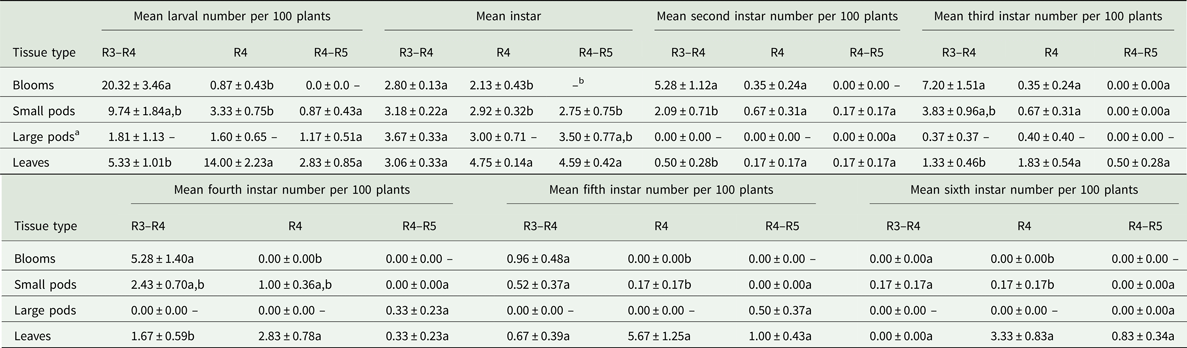
All larvae dissected for species identification in the study were H. zea. Number of larvae per plant varied for the interaction of tissue type and sampling date (F = 15.79, d.f. = 6, 15.79, P < 0.0001; table 1) and variety and sampling date (F = 4.04, d.f. = 2, 12, P = 0.0455). Mean separations were not significant for the interaction of variety and date (data not shown). Larvae were concentrated on blooms during the first sampling period and were primarily on foliage during the second sampling date. Larval instar varied for the interaction of tissue type and sampling date (F = 4.21, d.f. = 5, 85, P = 0.0018; table 1). During the R4 and R4-5 sampling dates, later instars were found on foliage compared to other structures. First instar number varied for the interaction of variety and sampling date (F = 3.90, d.f. = 12, 3.90, P = 0.0496), but mean separations were not significant. In contrast, the interaction of variety and sampling date was not significant for second through sixth instar number (P values ranged from 0.08 to 0.87). However, second instar number varied for the interaction of tissue type and sampling date (F = 6.13, d.f. = 6, 205, P < 0.0001; table 1), as did third instar number (F = 6.22, d.f. = 6, 15.79, P < 0.0001; table 1), fourth instar number (F = 5.20, d.f. = 6, 205, P < 0.0001; table 1), fifth instar number (F = 8.35, d.f. = 6, 205, P < 0.0001; table 1), and sixth instar number (F = 8.46, d.f. = 6, 205, P < 0.0001; table 1).
Natural infestation study in Plymouth, NC. Mean H. zea larvae ± standard error (SE) across three sampling dates from GS R3 to R5.

a Large pods were only present on the determinate variety during R4–R5 and blooms were not present on the indeterminate variety during R4–R5. Therefore, these numbers only represent mean larval number for the sampling date when these tissues were present.
b – Denotes when a tissue type was not present across enough sampling dates or replication to provide enough degrees of freedom for mean separation.
Cage study experiment 1 with an indeterminate variety
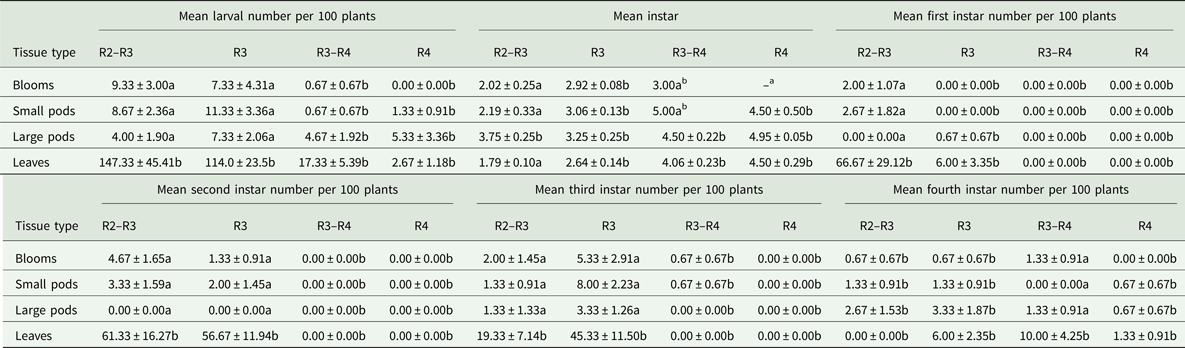
Number of larvae per plant varied for the interaction of tissue type and sampling date (F = 13.59, d.f. = 9, 196, P < 0.0001; table 2), as did larval instar (F = 2.54, d.f. = 8, 52, P = 0.0203; table 2). First instar number varied for the interaction of tissue type and sampling date (F = 19.56, d.f. = 9, 196, P < 0.0001; table 2), as did second instar number (F = 30.23, d.f. = 9, 196, P < 0.0001; table 2), third instar number (F = 17.33, d.f. = 9, 196, P < 0.0001; table 2), and fourth instar number (F = 2.56, d.f. = 9, 196, P = 0.0085; table 2). Finally, fifth/sixth instar number varied for the interaction of sampling date (F = 4.81, d.f. = 3, 12, P = 0.0201), but mean separations were not significant.
Cage study 1 with indeterminate variety AG46X6 at Stoneville, MS. Mean H. zea larvae ± standard error (SE) across three sampling dates from growth stage R2 to R4.

a No larvae were found on this tissue type for this sampling date.
b Not enough larvae were found on this particular tissue type to generate a standard error.
Cage study experiment 1 with a determinate variety
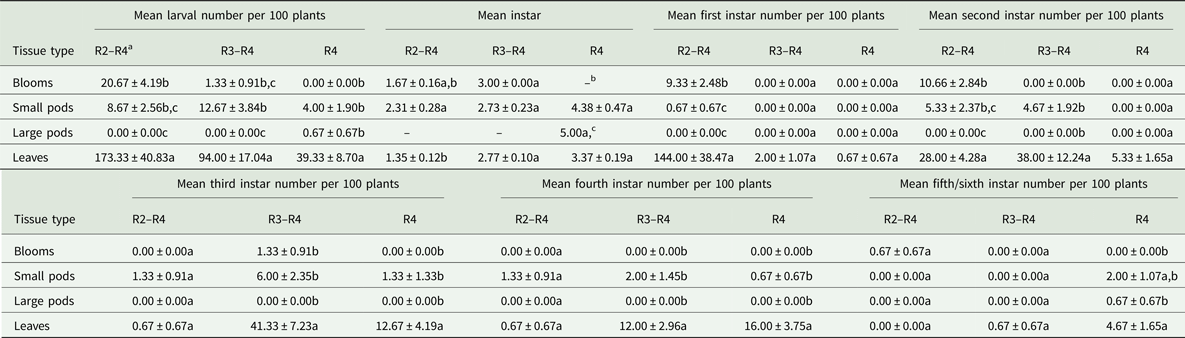
Number of larvae per plant varied for the interaction of tissue type and sampling date (F = 8.29, d.f. = 6, 144, P < 0.0001; table 3), as did larval instar (F = 4.08, d.f. = 3, 49, P = 0.0116; table 3), first instar number (F = 47.24, d.f. = 6, 144, P < 0.0001; table 3), second instar number (F = 7.54, d.f. = 6, 144, P < 0.0001; table 3), third instar number (F = 17.84, d.f. = 6, 144, P < 0.0001; table 3), fourth instar number (F = 9.77, d.f. = 6, 144, P < 0.0001; table 3), and fifth/sixth instar number (F = 3.49, d.f. = 6, 144, P = 0.0030; table 3).
Cage study 1 with determinate variety AG5533, Stoneville, MS. Mean H. zea larvae ± standard error (SE) across three sampling dates from GS R2 to R4.

a Most cages contained plants that were GS R2–R4 on the first sampling date; however, one of the cages contained plants that were R3–R4, which is why large pods were available for quantification. No larvae were found on these pods during the first sampling date.
b No larvae were found on this tissue type for this sampling date.
c Not enough larvae were found on this particular tissue type to generate a standard error.
Cage study experiment 2 with an indeterminate variety
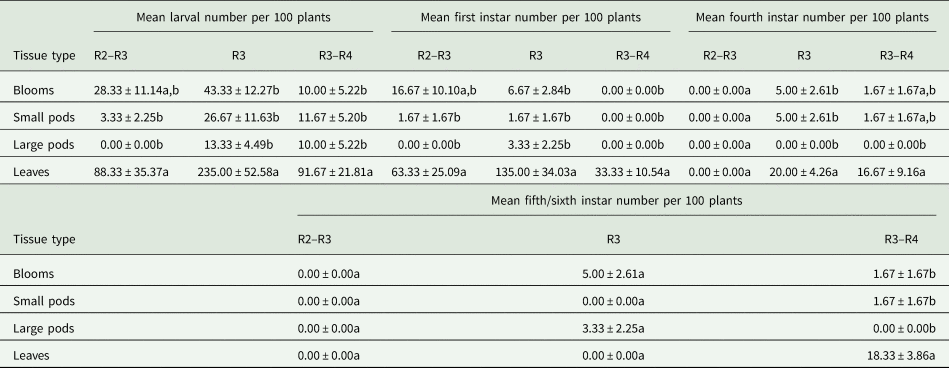
Number of larvae per plant varied for the interaction of tissue type and sampling date (F = 2.28, d.f. = 6, 114, P < 0.0001; table 4). However, this interaction was not significant for larval instar; larval instar was only significant across sampling date (F = 15.06, d.f. = 2, 6, P = 0.0046), with smaller instar larvae on the first sampling date (mean of 1.52 ± 0.11 SEM stage larvae) compared to the second (2.65 ± 0.17) and third sampling date (2.99 ± 0.19). First instar number varied for the interaction of tissue type and sampling date (F = 3.10, d.f. = 6, 144, P = 0.0076; table 4), while this interaction was not significant for second instar number; second instar number varied for the across tissue type (F = 4.07, d.f. = 3, 9, P = 0.0441), with more second instars on leaves (27.78 ± 7.86) compared to large pods (2.22 ± 1.33). The second instar number on leaves was similar to that on blooms (9.44 ± 2.45) and small pods (3.89 ± 1.92) and the number on blooms and small pods was similar to that on large pods. Third instar number varied for the interaction of tissue type (F = 4.86, d.f. = 3, 9, P = 0.0282) and sampling date (F = 8.81, d.f. = 2, 6, P = 0.0164). Similar to second instars, more third instars were on leaves (15.00 ± 3.60) compared to large pods (3.33 ± 1.87). The third instar number on leaves was similar to that on blooms (5.56 ± 1.71) and small pods (6.11 ± 2.37) and the number on blooms and small pods was similar to that on large pods. More third instars were found on the second sampling date (14.17 ± 3.09) than the first (2.08 ± 0.89). Third instar number was similar on the second (14.17 ± 3.09) and third (6.25 ± 1.80) sampling date and on the third and first sampling date. Finally, fourth instar number varied for the interaction of tissue type and sampling date (F = 3.51, d.f. = 6, 114, P = 0.002; table 4), as did fifth/sixth instar number (F = 14.29, d.f. = 6, 114, P < 0.0001; table 4).
Cage study 1 with indeterminate variety AG46X6 at Stoneville, MS. Mean H. zea larvae ± standard error (SE) across three sampling dates from GS R2 to R4.

Discussion
We found that H. zea larval number and distribution varied over time and space in concordance with previous studies (e.g., (Terry et al., Reference Terry, Bradley and Van Duyn1987a; Terry et al., Reference Terry, Bradley and Duyn1989; Eckel et al., Reference Eckel, Terry, Bradley and Van Duyn1992)); however, we found a distinct preference of larvae for leaves not documented in these studies. Furthermore, because results were different between the natural infestation and cage study experiments, our findings may have potential implications on the past interpretation of experiments and future experimental design that will be discussed later. Two other important findings were the lack of differences in H. zea larval number and spatial distribution between a determinate and indeterminate variety, when compared directly in the natural infestation experiment, and observations of early instar preference for blooms during R2 and R3 relative to later larval instars, which will be discussed later.
When an indeterminate and determinate variety were compared directly in the natural infestation experiment, number of larvae per plant and first instar numbers were significantly different across variety and sampling date, but the mean separations were not significant (note that we chose to use a mean separation procedure that was conservative and prone to Type II errors). None of the other measurements tested had any differences associated with the variety. While only one variety each was selected as a proxy for determinate and indeterminate growth types, the lack of difference between these varieties suggests that, if larvae are influenced by growth type, differences are not large. Moreover, while determinate and indeterminate varieties were not directly compared in the cage studies, the pattern of relative abundances of larvae on different tissue types was not noticeably different among experiments. Therefore, H. zea larval preference for different soybean tissue types is likely not influenced by determinate and indeterminate growth types.
Our results differ from those of Eckel et al. (Reference Eckel, Terry, Bradley and Van Duyn1992), who found small larvae on expanding leaves and blooms, medium larvae distributed throughout the plant, and large larvae on flowers and pods. In our study, leaves were, by far, a preferred tissue type in the cage experiments, and for larger instars in the natural infestation experiment, especially during later growth stages. Moreover, we found that blooms are a preferred tissue type for larvae during R2 and R3, but not during later stages. Furthermore, smaller-sized larvae preferred blooms in the natural infestation experiment, but not the cage experiment. Finally, pods were never a preferred tissue type, although pod feeding was observed at levels that would have exceeded the economic threshold in all experiments.
Nutrition may play an important role in preference. For example, although H. zea larvae can survive from second instar to pupation on soybean leaf tissue alone, when given a choice they feed on various types of tissue (Suits et al., Reference Suits, Reisig and Burrack2017). Although we found most larvae on leaves, they were in various other tissue types as well. Because we found evidence that smaller larvae (sometimes) preferred blooms during R2 and R3, this lends support to the hypothesis that nutrition plays a role in tissue preference. Previous studies that have shown that blooms serve as a food source (Reisig et al., Reference Reisig, Suits, Burrack, Bacheler and Dunphy2017; Suits et al., Reference Suits, Reisig and Burrack2017) and smaller instar larvae found during these growth stages cannot penetrate soybean pod walls (McWilliams, Reference McWilliams1983). Not only do blooms provide unique nutritional resources, but smaller larvae can shelter in them to provide potential protection from contact insecticides, parasites, predators, and unique microclimates that could potentially influence disease susceptibility. Therefore, our findings may lend support to the hypothesis that the avoidance of predation, parasitism, and cannibalism is responsible, at least in part, for influencing spatial location on different tissue types. Although cages were free of intra-specific predation and parasites, the overall larval number was much higher than the natural infestation experiment. Therefore, potentially density-dependent factors such as inter-specific predation (cannibalism) and disease could also be influential.
There are alternative explanations, as well. For example, leaves compose the most surface area of any tissue types tested on a soybean plant. Therefore, assuming that larvae are dispersed randomly in space independent of tissue type, we would expect to encounter more larvae on leaves. Furthermore, our study did not document the larval movement. Larvae must balance nutritional needs with other environmental factors, such as avoiding predation, optimizing temperature for growth, etc. Therefore, it is possible that a tissue type that is nutritionally superior may be inferior for some other reason. Because of this, it is possible that larvae are constantly moving between sites that are optimal for feeding, and sites that are optimal for survival due to factors not related to nutrition. Future studies should be designed to test the influence of these factors on the preference of larvae for tissues over time. If these factors are important drivers in tissue preference, then experimental design is important for interpretation.
We employed two different experimental designs, using natural infestations and cage studies; between the two different experimental designs, some findings were similar and others were different. One major difference in the cage studies was the extreme preference of larvae for leaves compared to the natural infestation study. For example, in the natural infestation study, there were nearly 4 times as many larvae on average on blooms than leaves during R3-R4. In contrast, during these stages in the cage studies, there were nearly 3 times as many larvae on leaves than all other tissue types combined in the indeterminate studies and nearly 7 times as many larvae on leaves than all other tissue types combined in the determinate study. Results were more similar during the later growth stages in both experimental designs since larvae were larger and showed a clear preference for leaves over other tissues. The type of material used, Amber Lumite®, has been shown to influence microclimate by reducing air penetration, reducing solar radiation, and increasing moisture (Fritz et al., Reference Fritz, Hoffmann, Farooq, Walker and Bonds2010; Perillo et al., Reference Perillo, Kucharik, Meehan, Serbin, Singh, Townsend, Whitney and Gratton2015). Therefore, some have cautioned that, while cage studies are important and often useful, experimenters should be cautious in their interpretation of results (Perillo et al., Reference Perillo, Kucharik, Meehan, Serbin, Singh, Townsend, Whitney and Gratton2015). Hence, it is feasible that cages influenced larval behavior in our study.
The apparent preference of small larvae for blooms has other important implications. While first instar larval position is likely highly influenced by ovipositional location, by the second and third instar, larvae have fed and had the ability to choose among tissues on which to feed. In transgenic corn and cotton expressing insecticidal proteins from Bacillus thuringiensis (Bt), toxin expression varies across tissue types (e.g., (Greenplate, Reference Greenplate1999; Siebert et al., Reference Siebert, Patterson, Gilles, Nolting, Braxton, Leonard, Van Duyn and Lassiter2009; Bilbo et al., Reference Bilbo, Reay-Jones, Reisig and Greene2019)). Therefore, it is likely that Bt toxin expression varies across tissue types in soybean, though no data are yet available to support this. Because Helicoverpa spp. are important pests in Brazil, where Bt soybean is planted (de Freitas Bueno and Sosa-Gómez, Reference de Freitas Bueno and Sosa-Gómez2017), knowledge of tissue feeding preference of early larval instars and potential exposure to different doses of Bt is important to resistance management (Showalter et al., Reference Showalter, Heuberger, Tabashnik and Carrière2009; Brevault et al., Reference Brevault, Heuberger, Zhang, Ellers-Kirk, Ni, Masson, Li, Tabashnik and Carriere2013).
In conclusion, our study confirms some previous findings on H. zea larval preference for specific tissue types, but our finding that larvae prefer leaves is different. We also provide evidence that experimental design can influence the results. In the natural infestation experiment, most larvae were found on blooms during R3 and they were early to middle instars; by R4, most larvae were found on leaves and they were middle to late instars. In contrast, in the cage studies, most larvae were found on leaves regardless of soybean growth stage or larval stage. Finally, we did not find determinate and indeterminate growth to be important for the larval preference of different soybean tissue types.
Acknowledgements
Portions of this work were funded by the USDA/NIFA Biotechnology Risk Assessment (BRAG) program grant #2014-33522-2226 and by USDA/NIFA Multistate Hatch Project NC01080 accession #1017866.