Introduction
Aedes aegypti (L.) (Diptera: Culicidae) acts as a vector for the transmission of the arboviruses responsible for yellow fever and dengue fever (de Omena et al., Reference de Omena, Navarro, de Paula, Luna, Ferreira de Lima and Sant'Ana2007). The mosquitoes are active throughout the year in all warm and humid tropical regions. In contrast to Aedes albopictus (Skuse), A. aegypti do not hibernate in temperate climatic zones (Hawley et al., Reference Hawley, Pumpuni, Brady and Craig1989; Hanson and Craig, Reference Hanson and Craig1995). Most of the synthetic insecticides used in the control of mosquito larvae are not only non-biodegradable but also lead to the development of resistance in the mosquitoes, thus rendering them ineffective (Garcez et al., Reference Garcez, Garcez, da Silva and Hamerski2009). Plants are rich in bioactive compounds that can be used as a target-specific insecticide and have the added advantage of being biodegradable (Jeyabalan et al., Reference Jeyabalan, Arul and Thangamathi2003). The phytochemicals can act as larvicides, insect growth regulators, repellents and ovipositional attractants (Murugan et al., Reference Murugan, Murugan and Noortheen2007).
Macrotyloma uniflorum (Lam.) Verdc. (Leguminosae), commonly known as horse gram, is largely cultivated in dry areas of Australia, Burma, India and Sri Lanka (Siddhuraju and Manian, Reference Siddhuraju and Manian2007). Horse gram possesses certain phytochemicals such as phytic acid, α-amylase inhibitor and trypsin inhibitor, which have antinutrient effects associated with the digestion of lipids, starch and protein (Sreerama et al., Reference Sreerama, Neelam, Sashikala and Vishwas2010).
Mosquito salivary glands are located in the thorax. Ultrastructural studies of the morphology of the salivary glands demonstrated that the proximal parts of the lateral lobes contain various enzymes such as α-glucosidase, α-amylase and maltase, which are involved in the metabolism of carbohydrate-rich meals (Barreau et al., Reference Barreau, Conrad, Fischer, Lujan and Vernic1999). The sugar meal is utilized as an energy source for flight, survival and fertility of females (Marinotti and James, Reference Marinotti and James1990). The present investigation was undertaken to establish the target-specific bioinsecticidal potential of M. uniflorum α-amylase inhibitor (MUAI) against A. aegypti larvae and adults.
Materials and methods
Preparation of seed extract and isolation of the α-amylase inhibitor
Macrotyloma uniflorum seeds were purchased from the local market in Pune. Macrotyloma uniflorum seed meal (100 g) was extracted with 500 ml physiological saline (0.145 m NaCl) for 4 h at 4°C. The extract was centrifuged at 12,080 g and the supernatant thus obtained was subjected to fractional precipitation with ammonium sulphate. The protein fraction precipitating between 30 and 80% saturation of ammonium sulphate was collected by centrifugation, dissolved in a minimum amount of distilled water, and extensively dialysed against distilled water and finally against acetate buffer (pH 5.4, 10 mm). The dialysed protein solution, clarified by centrifugation, was used to isolate the α-amylase inhibitor by ion exchange chromatography on carboxymethyl cellulose column using acetate buffer (pH 5.4, 10 mm).
The adsorbed proteins were eluted with a discontinuous gradient of sodium chloride (0.05, 0.2, 0.5 and 1.0 m). Fractions of 5 ml each were collected and monitored for protein content by monitoring the absorbance at 280 nm on a spectrophotometer (Jasco V-630 spectrophotometer, Japan), and the α-amylase inhibitory activity was determined according to Bernfeld (Reference Bernfeld1955). α-Amylase inhibitor-rich fractions were pooled, lyophilized and used for further studies.
Mosquito culture
In the present study, laboratory-reared A. aegypti was used. The culture was maintained at 28 ± 2°C and 60–70% relative humidity under a 14 h light–10 h dark photoperiod cycle. The larvae were fed on a diet of rat feed. Pupae were separated from the larvae and placed in a cup containing only water. The adults were maintained in a screened cage and reared on a cotton wick soaked in 10% sucrose solution.
Larvicidal and pupicidal assay
First to fourth instar larvae were used in these studies. Each experiment was performed in five replicates. The larvicidal studies were conducted using ten larvae per replicate taken in a cup containing 50 ml water and rat feed. Next, defined concentrations (20, 60, 100 and 200 ppm) of MUAI were added to the respective cups. A negative control having only water along with rat feed and without the MUAI was also maintained. The results were subjected to Probit analysis (Finney, Reference Finney1971) to evaluate the LC50 and LC90 values. Similar experiments were conducted using pupae.
Adulticidal assay
Four- to six-day-old A. aegypti adults (ten each) were placed in glass jars covered with muslin cloth. Each jar contained a cotton wick soaked in 10% sucrose solution. In all the jars except the negative control, MUAI was added to final concentrations of 20, 60, 100 and 200 ppm, respectively. Mortality count was measured after 24 h and up to 10 days after treatment. The experiment was conducted in five replicates.
Oviposition deterrence assay
A double-choice experiment was conducted. Ten gravid females were given a choice between the cotton wick treated with 20, 60, 100 and 200 ppm of MUAI and the cotton wick treated with 10% sucrose, respectively. The number of eggs deposited on each cotton wick was counted after 3 days and the oviposition deterrence index (ODI) (Hwang et al., Reference Hwang, Schultz, Axelord, Kramer and Mulla1982) was calculated using the following formula:
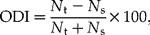
where N t is the total number of eggs deposited in test and N s is the total number of eggs deposited in control.
Ovicidal assay
Six glass jars containing 50 ml water along with 20, 60, 100 and 200 ppm of MUAI were used. A control with only water was also maintained. Aedes aegypti eggs were released in each jar and egg hatching was observed for 1 week. The percentage hatching in the test groups was compared with that of the control.
α-Amylase assay
α-Amylase was isolated from A. aegypti fourth instar larvae (MUAI treated and untreated) according to Jbilou et al. (Reference Jbilou, Amri, Bouayad, Ghailani, Ennabili and Sayah2008) with slight modifications. Twenty larvae were homogenized in 2 ml acetate buffer (pH 5.4, 10 mm) containing 10 mm sodium chloride and 10 mm calcium chloride, followed by centrifugation at 10,000 g for 15 min at 4°C. The supernatant obtained was subjected to gel filtration on a Sephadex G-50 column. Fractions (0.5 ml) were collected. Each fraction was monitored for its protein content by monitoring the absorbance at 280 nm on a spectrophotometer (Jasco V-630 spectrophotometer, Japan), and the α-amylase activity was determined according to the dinitrosalicylic acid method (Sadasivam and Manickam, Reference Sadasivam and Manickam2005). The fraction showing the highest activity was used for the kinetic studies. One unit of α-amylase activity was defined as the amount of α-amylase that liberates 1 μmol of maltose equivalent under assay conditions.
Enzyme kinetic studies
α-Amylase (0.06 units) was incubated with MUAI (0.1 ml, 100 μg) in acetate buffer (pH 5.4, 10 mm) at 37°C for 1 h in a total reaction volume of 0.25 ml, before initiating the reaction with different concentrations of the substrate (0.5–2.5% starch solution). The inhibitory activity of MUAI on the α-amylase activity was studied according to Bernfeld (Reference Bernfeld1955) with slight modification. Lineweaver–Burk plots were drawn for the uninhibited and the partially inhibited α-amylase and the values of K i were obtained from the plots.
Statistical analysis
Data are expressed as means ± SEM. Raw percentage data were transformed to arcsine square root values and then analysed by repeated measures analysis of variance followed by post hoc Tukey's test to determine the difference in the larval and adult percentage mortality and α-amylase activity of the MUAI-treated and the control groups (GraphPad InStat version 3.00 for Windows Vista™ BASIC). P < 0.05 was considered statistically significant. The lethal concentration (LC50 and LC90) values were calculated by means of Probit analysis (Finney, Reference Finney1971).
Results
Effect on larval, pupal and adult mortality
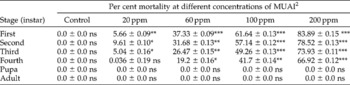
There was no mortality observed in the negative control group, whereas an increased mortality was observed in the MUAI treatments from first to fourth instar larvae in a dose-dependent manner. At 200 ppm concentration, 83.9% mortality was observed in the first instar larvae, whereas 66.9% mortality was observed in the fourth instar larvae after 24 h of treatment (Table 1). The results observed were well in agreement with the LC50 and LC90 values obtained (Table 2).
Per cent mortality observed in the larval, pupal and adult stages of Aedes aegypti after 24 h of Macrotyloma uniflorum α-amylase inhibitor (MUAI) treatment1

1 Values are means ± SEM, n = 10.
2 The percentage of mortality was determined and transformed to arcsine square root values for analysis of variance followed by post hoc Tukey's test; ns, not significant; *** P < 0.001; ** P < 0.01; * P < 0.05 compared with the negative control (blank without MUAI).
LC50 and LC90 values of Macrotyloma uniflorum α-amylase inhibitor at different larval instar stages of Aedes aegypti +

+ Lethal concentration values are means from five replicates and determined by Probit analysis.
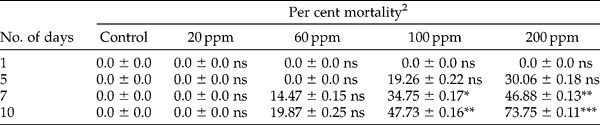
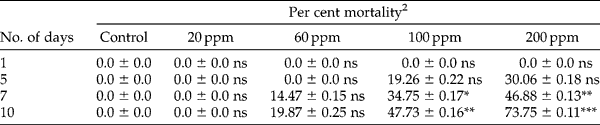
MUAI did not show any pupicidal effect but pupal stage duration was increased at 200 ppm but not at the lower concentrations. In adults, a delayed response was observed; at 200 ppm, about 73.7% mortality was observed in adults after 10 days of treatment with MUAI (Table 3).
Per cent mortality in Aedes aegypti adults at different Macrotyloma uniflorum α-amylase inhibitor (MUAI) concentrations1
1 Values are means ± SD; n = 10.
2 The percentage of mortality was determined and transformed to arcsine square root values for analysis of variance followed by post hoc Tukey's test; ns, not significant; *** P < 0.001; ** P < 0.01; * P < 0.05 compared with the negative control (blank without MUAI).
Effect on oviposition deterrence and egg hatching
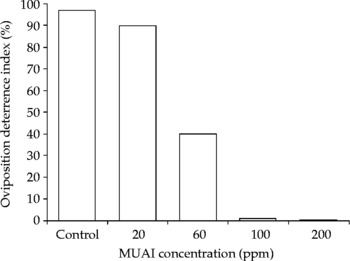
MUAI caused high oviposition deterrence at high concentrations (Fig. 1). Egg laying was seen only in the untreated cotton wick. MUAI did not result in ovicidal effects and did not affect egg hatching.
Effect of MUAI on the oviposition deterrence index

Effect on α-amylase activity
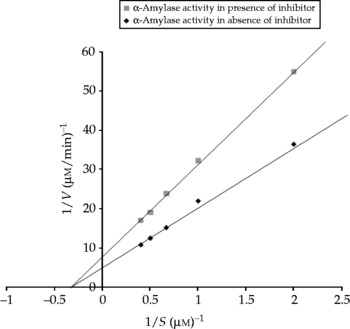
MUAI inhibited the α-amylase in a non-competitive manner (Fig. 2). A significant (P < 0.001) decrease in the α-amylase activity of MUAI-treated fourth instar larvae in comparison with the untreated control was observed (Table 4). A K i value of 6.2 μm was obtained from the Lineweaver–Burk plot.
Lineweaver–Burk plot for the Aedes aegypti fourth instar larvae α-amylase in the presence and absence of MUAI

α-Amylase activity (μmol/min/ml) in the fourth instar larvae of Aedes aegypti at different Macrotyloma uniflorum α-amylase inhibitor (MUAI) concentrations1

1 Values are means ± SD; n = 10.
2 Statistical analysis by analysis of variance followed by post hoc Tukey's test; ns, not significant; *** P < 0.001; ** P < 0.01, compared with the negative control (blank without MUAI).
Discussion
Certain synthetic pesticides such as lindane and endosulfans are relatively biodegradable (Brooks, Reference Brooks2001). However, all chemical or metabolic changes that occur with a synthetic pesticide do not necessarily lead to a complete degradation or mineralization of the pesticide molecule. In some instances, a parent pesticide molecule may be converted to a more toxic substance (Kaufman, Reference Kaufman1976). Also, insecticide resistance develops as a consequence of repeated and intensive use of an insecticide. However, if insecticides that target different pest life stages (e.g. larvicides versus adulticides) are alternately used, then this will delay the development of resistance (Wirth, Reference Wirth2010).
Biopesticides have a relatively short life in heavily polluted water as they can get easily biodegraded (Wirth, Reference Wirth2010), but most defence-related plant proteins such as amylase and protease inhibitors and lectins are able to withstand heat and are resistant to animal and insect proteases (Peumans and Van Damme, Reference Peumans and Van Damme1995). Also, plant-derived pesticides are less known to promote resistance in pests (Ramya et al., Reference Ramya, Rajasekaran, Kalaivani, Sundararajan and Jayakumararaj2008).
The α-amylase activity was found to be very high in the A. aegypti larvae, which dropped markedly in the pupal stage and remained very low throughout the adult life (McGeachin et al., Reference McGeachin, Willis, Roulston and Lang1972). The antinutritional factors present in the seeds of M. uniflorum are responsible for inhibition of digestive enzymes such as α-amylase by non-competitive inhibition mechanism (Sreerama et al., Reference Sreerama, Neelam, Sashikala and Vishwas2010). In view of these findings, the bioefficacy of MUAI was tested against the A. aegypti α-amylase.
The MUAI-treated fourth instar larvae showed a significant decrease in the α-amylase activity at 200 ppm. This inhibition is due to the binding of the MUAI to the α-amylase in a non-competitive manner, and it may also be attributed to the cytotoxic effect on the cells synthesizing α-amylase, thereby causing mortality of larvae (Jbilou et al., Reference Jbilou, Amri, Bouayad, Ghailani, Ennabili and Sayah2008).
The first instar larvae are more susceptible compared with fourth instar larvae (Murugan et al., Reference Murugan, Murugan and Noortheen2007). The LC50 and LC90 values obtained were well in agreement with this observation.
Because of its antinutritional effects, MUAI needs to be ingested to be effective. Because the pupal stage is non-feeding (Lucas and Romoser, Reference Lucas and Romoser2001), MUAI did not exhibit any pupicidal effect, thus confirming that it is not a contact insecticide. Similarly, MUAI did not exhibit any ovicidal effect. However, a marked oviposition deterrence effect was observed at high concentrations, suggesting its repellent action.
In A. aegypti adults, MUAI showed a delayed response. About 73.7% mortality was observed at 200 ppm 10 days post-treatment. This may be attributed to the relatively low levels of α-amylase in adults (McGeachin et al., Reference McGeachin, Willis, Roulston and Lang1972).
Conclusion
Our results show that MUAI is an effective larvicide and possesses oviposition deterrence in A. aegypti. Being a plant-derived product, it is eco-friendly and may improve mosquito control.
Acknowledgements
The authors wish to thank the University Grants Commission, New Delhi, India, for funding the project. The authors also wish to thank Dr S.N. Mukherjee for giving us permission to carry out the bioassay at the Entomology Section, National Chemical Laboratory, Pune, India. The authors are also thankful to Mrs G.D. Mebbalkar, National Chemical Laboratory, Pune, India, for helping us in carrying out the bioassay.