Organic sheep and goat milk production has increased during the last decade, possibly due to consumer belief that organic is more hygienic than conventional production (Sahota, Reference Sahota, Willer and Klicher2009; Liu et al. Reference Liu, Kanter, Messer and Kaiser2013). Greece has a significant organic sheep and goat population in comparison with other European countries and, consequently, produces and exports a considerable amount of products (Anonymous, 2010). Organic milk production in Europe must comply with EU Commission Regulations 889/2008 and 834/2007, which relate to several farming practices, such as health management and welfare issues. With reference to antibiotics for example, only three courses of treatment per year are allowed in organically reared animals. These regulatory livestock management practices could be expected to have impact on milk quality characteristics, such as the microbiological profile and the antibiotic resistance of certain microorganisms, mostly related to intramammary infection.
Comparison of the milk microbiological profile from organic and conventional goat milk production is contradictory (Coorevits et al. Reference Coorevits, De Jonghe, Vandroemme, Reekmans, Heyrman, Messens, De Vos and Heyndrickx2008; Haskell et al. Reference Haskell, Langford, Jack, Sherwood, Lawrence and Rutherford2009; Cicconi-Hogan et al. Reference Cicconi-Hogan, Gamroth, Richert, Ruegg, Stiglbauer and Schukken2013). Total Viable Count (TVC), Total Coliform Count (TCC) and Somatic Cell Count (SCC) have been used as the main indicators for such comparisons. High TVC may be a result of poor hygiene and health management in the farm (Jayarao et al. Reference Jayarao, Pillai, Sawant, Wolfgang and Hegde2004); TCC are most frequently related to soiled udders or coliform mastitis (Hogan & Larry Smith, Reference Hogan and Larry Smith2003); and SCC is a value related to mastitis that indicates possible infection with Staphylococcus sp., Streptococcus sp., Pasteurella sp., Escherichia coli (Keefe, Reference Keefe2012). All microbiological parameters in milk are closely related to the hygienic practices on farm, animal health, season and feeding regime (Coorevits et al. Reference Coorevits, De Jonghe, Vandroemme, Reekmans, Heyrman, Messens, De Vos and Heyndrickx2008), practices possibly influenced by the different livestock management requirements of organic standards.
Organic standards also restrict use of antibiotics. Thus intramammary pathogens on organic farms could present lower antibiotic resistance in comparison with conventional farms. Staphylococcus aureus and Escherichia coli are the major clinical and subclinical mastitis-causing pathogens on dairy farms (Fthenakis, Reference Fthenakis1994) and have been found more frequently on organic dairy farms than conventional farms, while there are different views on their antimicrobial susceptibility (Mørk et al. Reference Mørk, Tollersrud, Kvitle, Jørgensen and Waage2005; Sato et al. Reference Sato, Bartlett and Saeed2005; Gündoğan et al. Reference Gündoğan, Citak and Turan2006; Concepción Porrero et al. Reference Concepción Porrero, Hasman, Vela, Fernández-Garayzábal, Domínguez and Aarestrup2012). Currently, research on organic and conventional milk is mainly focused on bovine milk; therefore a study addressing issues related to sheep and goat industry would be valuable.
This study tested the hypothesis that the microbiological load of milk produced on organic goats and sheep farms was better that on conventional farms, with fewer pathogens and lower levels of antimicrobial resistance.
Methods
Study population – sample collection
Twenty-five organic farms, confirmed by inspection of appropriate certification, were randomly selected to participate in this study. An equal number of conventional farms was selected for comparison. A total of 50 raw milk samples (one per farm) were collected in sterile glass bottles and were transported under refrigeration to the lab for analysis. A standardised, detailed questionnaire was completed for each participating farm (Malissiova et al. Reference Malissiova, Tzora, Katsioulis, Hatzinikou, Tsakalof, Arvanitoyannis, Govaris and Hadjichristodoulou2015), to collect data concerning the farming system (e.g. farm hygiene profile, herd health management etc.), to be considered as potential factors affecting milk's microbiological profile and antimicrobial susceptibility.
Sample analysis
Microbiological analysis
Fifty samples were analysed for TVC, TCC and SCC using standard methods (ISO 4833-1:2013, ISO 4832:2006 and ISO 13366-1:2008 respectively). S. aureus was isolated on Baird Parker agar supplemented with egg yolk tellurite (LabM, UK). E. coli was isolated on Mac Conkey Lactose Agar (Oxoid, UK). A representative colony was selected from each sample, and both bacteria were identified by conventional phenotypic methods including Gram staining, cell morphology tests, and the API Rapid ID 32A (BioMerieux, Lyon, France) system, according to the manufacturer's instructions. For comparisons, S. aureus and E. coli isolates were also identified at species level by Matrix-Assisted Laser Desorption/Ionisation-Time of Flight Mass Spectrometry (MALDI-TOF MS), using a Microflex LT (Bruker Daltonik GmbH, Germany) mass spectrometer. For E. coli identification a single colony from freshly grown isolates was picked and directly applied to a steel MALDI target plate. This was then overlaid with 1 µl of a saturated solution of a-cyano-4-hydroxycinnamic acid (HCCA) (Bruker Daltonics, Bremen, Germany) and allowed to co-crystalise at room temperature. For S. aureus identification with MALDI-TOF MS, an ethanol/formic acid protein extraction method was used according to the manufacturer's standardised protocols provided by Bruker Daltonics to increase spectrum quality. Spectra were automatically acquired in a linear positive mode, at a laser frequency of 20 Hz, within a mass range from 2000 to 20 000 Da, with AutoXecute acquisition software (Flex control 3.4, Bruker Daltonics, Bremen, Germany). The spectra were externally calibrated using Escherichia coli DH5alpha. Raw spectra were processed using MALDI BioTyper v.3.1 software (Bruker Daltonik GmbH, Germany). Results were classified using modified score values proposed by the manufacturer.
Antimicrobial susceptibility
Susceptibility to a panel of 20 antimicrobials for E. coli and 16 for S. aureus was determined by agar dilution method in Mueler–Hinton agar (Merck, Darmstadt, Germany) as previously described (Clinical and Laboratory Standards Institute, 2009). For E. coli strains the final plate concentrations (μg/ml) used were: ampicillin (A) 8 and 128; chloramphenicol (C) 8; colimycin (Co) 8; gentamicin (G) 4; kanamycin (K) 16; neomycin (Ne) 8; streptomycin (S) 16 and 128; spectinomycin (Sp) 64; sulphonamide (Su) 64; tetracycline (T) 8 and 128; trimethoprim (Tm) 2; ciprofloxacin (Cp) 0·125 and 1; nalidixic acid (Nx) 16; furazolidone (Fu) 8; amikacin (Ak) 4; cephalexin (Cx) 16; cephradine (Cr) 16; cefuroxime (Cf) 16; ceftriaxone (Cn) 1; cefotaxime (Ct) 1. For S. aureus strains the final plate concentrations (μg/ml) used were: penicillin (P) 0·25 and 0·12; sulphonamide (S) 300; tetracycline (T) 8; erythromycin (E) 8; vancomycin (V) 4; oxacillin (Ox) 0·25 and 2; chloramphenicol (C) 32; cephalothin (Kt) 32; ciprofloxacin (Cp) 2; trimethoprim/sulfamethoxazole (Sxt) 4–76; gentamycin (G) 4; trimethoprim (Tm) 2; amoxicillin/clavulanic acid (AMX); cefotaxime(Ct) 64; clindamycin (Cl) 4; rifampicin (R) 4.
Genotyping
Pulse Field Gel Electrophoresis (PFGE) was performed for S. aureus strains using SmaI (Takara, Tokyo, Japan) as restriction endonuclease as described previously (Sergelidis et al. Reference Sergelidis, Papadopoulos, Komodromos, Sergelidou, Lazou, Papagianni, Zdragas and Papa2015) and for E. coli strains according to Pulsenet protocol (Ribot et al. Reference Ribot, Fair, Gautom, Cameron, Hunter, Swaminathan and Barrett2006) with slight modifications. Briefly, S. aureus strains were grown overnight in 5 ml Brain Heart Infusion broth at 37 °C, while 200 µl harvested by centrifugation, washed with TE buffer (10 mM Tris:1 mM EDTA, pH 8·0) and finally suspended to 300 µl TE buffer. 100 µl of cell suspension in TE -containing 1 µg of lysostaphin (Sigma Aldrich, Poole, UK) and 5 µl proteinase K (Sigma Aldrich, Poole, UK) 20 mg/ml were mixed with an equal volume of 2% Seakem Gold agarose (FMC BioProducts, Rockland, MD, USA) in TEadded into a block molds and allowed to solidify at 4 °C for 15 min. E. coli strains were staked to TSA agar plates (Merck, Darmstadt, Germany) and incubated overnight at 37 °C. 4–5 colonies were suspendedin 3 ml Cell Suspension buffer (100 mM Tris:100 mM EDTA, pH 8·0). 100 µl of cell suspension in CSB -containing 5 µl proteinase K (Sigma Aldrich, Poole, UK) 20 mg/ml were mixed with an equal volume of 2% Seakem Gold agarose (FMC BioProducts, Rockland, MD, USA) in TEadded into a block moulds and allowed to solidify at 4 °C for 15 min. S. aureus agarose plugs were placed in 3 ml EC-buffer [6 mM Tris–HCl, pH 8; 1 M NaCl; 100 mM EDTA, pH 8; 0·5% Brij 58 (Sigma Aldrich, Poole, UK); 0·2% sodium desoxycolate (Difco Laboratories, Detroit, USA); 0·5% sodium N-lauroylsarkosine] and lysed overnight at 37 °C. E coli agarose plugs were placed in 5 ml Lysis-buffer [(50 mM Tris; 50 mM EDTA, pH 8·0 + 1% Sarcosyl (Sigma Aldrich, Poole, UK)] containing 25 µl proteinase K (Sigma Aldrich, Poole, UK) and lysed overnight at 54 °C. Subsequently, the plugs were washed four times in TE-buffer (10 mM Tris–HCl, 1 mM EDTA, pH 8) each one for 15 min with gentle agitation at 54 °C and finally stored in fresh TE-buffer at 4 °C until further analysis. For S. aureus strains digestion of DNA was performed with 40 U of the restriction enzyme SmaI (TaKaRa, Kyoto, Japan) for 4 h at 25 °C and E. coli with 40 U of the restriction enzyme XbaI (TaKaRa, Kyoto, Japan) for 2 h at 37 °C. Restriction fragments of DNA were separated by PFGE using 1% Seakem Gold agarose gels (FMC BioProducts, Rockland, MD, USA) in 0·5× Tris–borate–EDTA buffer with CHEF-DR III (Bio-Rad, Hercules, CA, USA). Salmonella serotype Branderup strain H9812 digested with 40 units XbaI (TaKaRa, Kyoto, Japan) was used as size standard. For S. aureus electrophoresis conditions were 14 °C for 21 h, with pulsetime ranging from 5 to 40 s at an angle of 120° and for E. coli 14 °C for 19 h, with pulsetime ranging from 2·2 to 54·2 s at an angle of 120°. Gels were stained with a solution of ethidium bromide and photographed. For each microorganism a database containing all the PFGE patterns was created by using Bionumerics software (version 6.6 Applied Maths, Sint-Martens-Latem, Belgium), where band patterns over the multiple gels were normalised and compared. Clustering was performed by using the Dice similarity coefficient and the unweighted pair group method with arithmetic means (UPGMA), with 1·5 and 1·8% of tolerance and optimisation for S. aureus and E. coli respectively. The cut-off value for cluster differentiation was set as 80%.
Statistical analysis
A database for the information collected from the questionnaires was created in EpiInfo (v.3.4.3). Data were analysed using the statistical package SPSS v.21. Qualitative data are presented as frequencies with percentages and quantitative data are presented as median with interquartile range (25°–75° percentile), minimum and maximum value. Chi-square test or Fisher's exact test was used to explore any associations between qualitative variables and the Mann-Whitney test was used to explore any associations between binary variables with quantitative variables. Results were considered statistically significant when the P-value was less than 0·05. The diversity of PFGE type distribution was calculated using the Simpson's diversity index (D), which ranges from 0 (no diversity) to 1 (extreme diversity) (Hunter & Gaston, Reference Hunter and Gaston1988).
Results
Microbiological profile
Lower counts of TVC, TCC and SCC were identified in organic milk, but the differences were not statistically significant (Table 1). Certain parameters of the microbiological profile significantlyly affected the results. TVC and TCC were increased in farms with poor hygiene profile of the milk room, the milk containers and the milk tank, parameters that statistically significantly differ among organic and conventional farms (P = 0·011, 0·015, 0·005 respectively), with organic farms presenting better results. In 11 out of 25 conventional and 19/25 organic milk samples S. aureus was isolated, while in 10 out of 25 conventional and 12/25 organic samples E. coli was isolated without statistically significant difference.
Comparison of the microbiological profile of organic and conventional milk samples

† Mann–Whitney.
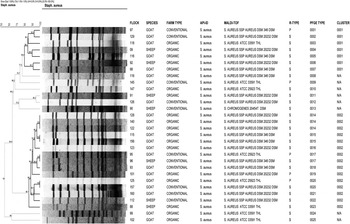
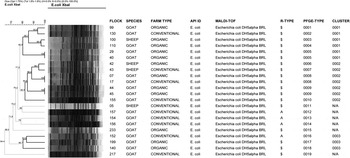
The 30 S. aureus and 22 E. coli isolates identified with API test were further confirmed with MALDI-TOF MS with 100% level of agreement (Figs 1 and 2).
SmaI-PFGE dendrogram based on the Dice coefficient indicating the genetic relatedness and the antimicrobial resistance patterns of the 30 S. aureus isolates from conventional and organic farms. The scales at the top indicate the similarity indices (in percentages).

XbaI-PFGE dendrogram based on the Dice coefficient indicating the genetic relatedness and the antimicrobial resistance patterns of the 22 E. coli isolates from conventional and organic farms. The scales at the top indicate the similarity indices (in percentages).

Antimicrobial susceptibility
Overall, antimicrobial resistance rates were low, but statistically higher among strains originating from conventional in comparison to organic. For S. aureus, based on the antimicrobials tested, 25 out of 30 isolates (83%) were pan susceptible and five of them showed resistance only to penicillin (17%: Fig. 1). For S. aureus three out of 11 (27%) were resistant strains isolated from conventional farms and two out of 19 (11%) from organic farms showing statistically significant difference (P = 0·036). For E. coli 18 out of 22 isolates (82%) were pansusceptible and only 4 of them showed resistance to ampicillin (18%: Fig. 2); all were isolated from conventional farms (4 out of 10, 40%) showing statistically significant difference (P = 0·028).
Genotyping
Twenty-five pulsotypes were revealed among the 30 S. aureus isolates designated 0001–0025 with an overall similarity of 55%. Each pulsotype differed by at least one band from the others. Two main clusters were constructed using an 80% cut off value clusters 0001 and 0002. These two main clusters consisted of 22 of 30 isolates (73%) with cluster 0001 formed from 7 isolates and 0002 from 15 isolates (Fig. 1). In these clusters isolates with or without resistance to penicillin were simultaneously present. The Simpson index of diversity for S. aureus was calculated as D = 0·986. As resistance to penicillin was found in only five of the 30 S. aureus strains investigated all five represented different single pulsotypes and four belonged to the main clusters (Fig. 1).
Nineteen single pulsotypes were revealed among the 22 E. coli isolates, differing by at least one band and designated 0001–0019. The three main clusters created (80% cut off value) 0001, 0002 and 0003 consisted of 6, 7 and 3 strains, respectively (Fig. 2). In these clusters isolates with or without resistance to ampicillin were simultaneously present, while the Simpson index of diversity was D = 0·987. As resistance to ampicillin was found in only four of the 22 E. coli strains investigated all represented different single pulsotypes (Fig. 2).
Discussion
This study revealed a better microbiological profile in milk from sheep and goats farmed organically as compared with conventionally although there was no statistically significant difference. Our results are similar to others (Coorevits et al. Reference Coorevits, De Jonghe, Vandroemme, Reekmans, Heyrman, Messens, De Vos and Heyndrickx2008; Haskell et al. Reference Haskell, Langford, Jack, Sherwood, Lawrence and Rutherford2009; Cicconi-Hogan et al. Reference Cicconi-Hogan, Gamroth, Richert, Ruegg, Stiglbauer and Schukken2013), while there are contradictory reports for a higher prevalence of subclinical mastitis in organic herds (Busato et al. Reference Busato, Trachsel, Schällibaum and Blum2000), or lower levels of somatic cells in organic farms (Olivo et al. Reference Olivo, Beck, Gabbi, Santini Charão, Sobczak, Gomes Uberty, Dürr and Araújo Filho2005). Our findings may correlate with differences in several risk factors affecting the microbiological profile of milk, such as milk room hygiene, milk container hygiene, milk tank hygiene, as reported earlier (Jayarao et al. Reference Jayarao, Pillai, Sawant, Wolfgang and Hegde2004). These risk factors were significantly different between the organic and conventional farms, something that may be related to the regulations for organic production being implemented and additionally to the positive attitude that organic farmers generally show, such as being more aware of the hazards occurring, being more proactive and willing to make an effort and produce products of high quality (Padel, Reference Padel2008).
Both identification tests used (API and MALDI-TOF MS) for S. aureus and E. coli isolates revealed the same results. The level of agreement was 100% at both species and genus level, while no isolates were misidentified. Others have reported lower comparability among API and Maldi-Tof MS (Risch et al. Reference Risch, Radjenovic, Han, Wydler, Nydegger and Risch2010; El-Bouri et al. Reference El-Bouri, Johnston, Rees, Thomas, Bome-Mannathoko, Jones, Reid, Ben-Ismaeil, Davies, Harris and Mack2012) possibly due to differences in the sample size and the microorganisms checked. Nevertheless, based on our results it is likely would be that MALDI-TOF MS can be used as a first step for identification of isolates faster and more cheaply (Benagli et al. Reference Benagli, Rossi, Dolina, Tonolla and Petrini2011; El-Bouri et al. Reference El-Bouri, Johnston, Rees, Thomas, Bome-Mannathoko, Jones, Reid, Ben-Ismaeil, Davies, Harris and Mack2012; Jamal et al. Reference Jamal, Shahin and Rotimi2013).
Antimicrobial resistance was found to be relatively low for both S. aureus and E. coli isolates originating from organic milk. Resistance to penicillin in S. aureus was around 27% (n = 3) in strains coming from conventional farms and around 11% (n = 2) from organic farms, a statistically significant difference. For E. coli, all four resistant strains were isolated from conventional farms and only in one antimicrobial (ampicillin) showed a statistically significant difference. Similarly, isolates from organic cow milk were found to be more susceptible (Tikofsky et al. Reference Tikofsky, Barlow, Santisteban and Schukken2003; Sato et al. Reference Sato, Bennedsgaard, Bartlett, Erskine and Kaneene2004), although no significant differences have been reported by others (Bennedsgaard et al. Reference Bennedsgaard, Thamsborg, Aarestrup, Enevoldsen, Vaarst and Christoffersen2006). These findings support our hypothesis for lower antibiotic resistance rates in isolates from organic milk, as a result of the more limited use of antimicrobials required by organic regulations. To the best of our knowledge this is the first report on evaluating antimicrobial susceptibility of isolates from sheep and goat organic and conventional milk.
It is interesting that 83% of S. aureus isolates were susceptible to all the antimicrobials tested. The penicillin resistance level of 17% is similar to some other reports (Mørk et al. Reference Mørk, Tollersrud, Kvitle, Jørgensen and Waage2005; Zdragas et al. Reference Zdragas, Papadopoulos, Mitsopoulos, Samouris, Vafeas, Boukouvala, Ekateriniadou, Mazaraki, Alexopoulos and Lagka2015) but low compared with the 96·3% elsewhere (Gündoğan et al. Reference Gündoğan, Citak and Turan2006). This is a strong evidence of the low pressure of antibiotics in sheep and goat industry in Greece. In contrast, resistance to penicillin and also to oxacillin is common in bovine milk (Juhász-Kaszanyitzky et al. Reference Juhász-Kaszanyitzky, Jánosi, Somogyi, Dán, Van Der Graaf-van Bloois, Van Duijkeren and Wagenaar2007; Türkyilmaz et al. Reference Türkyilmaz, Tekbiyik, Oryasin and Bozdogan2010; Vanderhaeghen et al. Reference Vanderhaeghen, Hermans, Haesebrouck and Butaye2010; Spohr et al. Reference Spohr, Rau, Friedrich, Klittich, Fetsch, Guerra, Hammerl and Tenhagen2011). In our study 82% of the E. coli strains were pan susceptible and only 18% showed resistance to ampicillin. E. coli strains isolated from raw milk (mostly bovine) have been examined several times for antimicrobial susceptibility, 66% of cow milk strains were pan susceptible (Berge et al. Reference Berge, Champagne, Finger and Sischo2007) and 7–10% resistant for ampicillin (Lehtolainen et al. Reference Lehtolainen, Shwimmer, Shpigel, Honkanen-Buzalski and Pyörälä2003). In contrast high rates of resistance, around 75%, for ampicillin have been reported by others (Adesiyun et al. Reference Adesiyun, Webb and Rahaman1995; Erskine et al. Reference Erskine, Walker, Bolin, Bartlett and White2001; Solomakos et al. Reference Solomakos, Govaris, Angelidis, Pournaras, Burriel, Kritas and Papageorgiou2009).
PFGE revealed diversity in S. aureus and E. coli from both organic and conventional milk samples, while no statistical significant difference was found It has been stated that PFGE of S. aureus is the most discriminant genotyping tool and a good method to resolve clonal relationships (Hennekinne et al. Reference Hennekinne, Kerouanton, Brisabois and De Buyser2003; He et al. Reference He, Xie, Reed and Ji2014). Although a wide diversity of isolates was observed (D = 0·986), two main clusters represented the majority of the isolates suggesting that at least two clones were distributed throughout the farms with slight changes through their evolution with strong genetic relationship among them. However, closely related or identical isolates were detected in different farms and probably this is evidence that certain genotypes dominate. Same results had been published from France (Vautor et al. Reference Vautor, Abadie, Guibert, Huard and Pépin2003), from Spain and Italy (Goñi et al. Reference Goñi, Vergara, Ruiz, Albizu, Vila and Gómez-Lus2004; Spanu et al. Reference Spanu, Scarano, Virdis, Melito, Spanu and De Santis2013) and recently from Greece (Zdragas et al. Reference Zdragas, Papadopoulos, Mitsopoulos, Samouris, Vafeas, Boukouvala, Ekateriniadou, Mazaraki, Alexopoulos and Lagka2015). Diversity in epidemiologically unrelated strains has been observed several times (Campos et al. Reference Campos, André, Borges, Kipnis, Pimenta and Serafini2009; Otero et al. Reference Otero, Rodríguez-Calleja, Otero, García-López and Santos2013; Zdragas et al. Reference Zdragas, Papadopoulos, Mitsopoulos, Samouris, Vafeas, Boukouvala, Ekateriniadou, Mazaraki, Alexopoulos and Lagka2015) and the same was observed in this study. However, even if some clusters are dominant, it seems that the pressure from using antimicrobials is not the reason for these clusters predominating.
For E. coli genotyping was performed to detect clones that dominate in sheep and goat milk, however such clones have not been revealed as diversity was found among strains from conventional and organic farms. The presence of diverse strains of E. coli in milk indicates possible contamination by manure, soil and contaminated water, supported by the low rates of antimicrobial resistance among these strains. E. coli is often used as indicator microorganisms, and the presence of E. coli implies a risk that other enteric pathogens may be present in the samples.
Even though, the farming systems in sheep and goat production in Greece may eliminate the differences among organic and conventional (Malissiova et al. Reference Malissiova, Tzora, Katsioulis, Hatzinikou, Tsakalof, Arvanitoyannis, Govaris and Hadjichristodoulou2015), in this study there was strong evidence for lower antibiotic resistance and an indication for better microbiological profile in organic milk. The fact that the present study was conducted in Greece, a country with high rates of antimicrobial resistance where several dairy products from sheep and goat milk are produced and exported, adds an extra value to our results that are of special interest globally and could also possibly resemble other Mediterranean countries. In any case, further studies are required, possibly with longer monitoring and larger number of samples, to assess resemblance or difference among organic and conventional sheep and goat farms in relation to milk microbiological profile and antimicrobial resistance patterns.
According to our results, it can be concluded that organic milk presents a better microbiological profile in comparison with conventional production, possibly due to the farming system differences recorded. Diversity was noticed among E. coli and S. aureus populations, with the overall low antimicrobial resistance rates and lower among strains originating from organic farms, possibly due to the restriction of antibiotic use in organic farming. There were no predominant clones found when comparing organic with conventional.