So go ahead, invest and gain from these excellent times. Be part of the growing enthusiasm, and make India stronger and shine even brighter.
— India Shining Campaign, 2003In the digital universe, the remains of the once iconic India Shining campaign are hard to find. Of the approximately 4.5 million images tagged with the search term “India Shining,” barely a handful lead to the original images released in 2003–4 to mark the success of India's economic reforms. Most of these images accompany news reports that had documented, depending on one's vantage point, one of India's most successful or unsuccessful advertising campaigns of all time. Most of the search results contain an assortment of images ranging from artistic subversion of the original theme to plain factual news reportage of India's economic growth and stories of success in various fields. The digital shards—broken links to erased websites—reveal that any presence of the original images has been carefully removed. Neither the website of the advertising agency that created it nor that of the political party popularly associated with the campaign has retained any links with the images. The official portal of India Shining (www.indiashining.com) that once proudly displayed images of the newfound prosperity and well-being of Indians does not exist any longer. It is telling that the vacant domain name itself has been available for sale for some years now without being able to attract a buyer.
This deliberate erasure of one of the most publicized, and probably the most acrimonious, mega-publicity spectacles by the very forces that created it remains yet mired in controversy. In this article, I unpack the work of the spectacle in shaping new forms of national belonging and surfacing the underlying tensions in the newly reformed free markets in the South. Taking India Shining as an example, I locate the mega-publicity campaigns as the spectacular embodiment of the postcolony's transition to capitalism in the twenty-first century that potentially not only enhance the national reputation but also lay bare the conflicts and anxieties under the full global gaze.
In the past decade, the nations in the South have strategically deployed publicity campaigns featuring global sporting events, nation-branding campaigns, and cultural extravaganzas to enhance tourism and draw foreign investments in order to raise their global stature. The well-known examples of “big-ticket spectacles” (Aiyar Reference Aiyar2010) include China's spectacular debut in the 2008 Beijing Olympics—which scholars have variously interpreted as a “diagnostic event” (Hubbert Reference Hubbert2013) or a global “coming out party” (Leibold Reference Leibold2010)—or the less examined though highly visible Malaysian global tourism campaign “Malaysia, Truly Asia,” and “Brand South Africa,” which seek to position these places as tourist and investment hubs.
In post-reform India, the mega-publicity campaigns—Incredible India, India Shining, Brand India, Lead India—have been a particular feature of its dramatic makeover from an aid-dependent developing nation to a lucrative emerging market in the global economy.Footnote 1 Of these campaigns, India Shining gained a distinct singularity for being disowned and even actively wiped out by its makers. In short, it is most remembered for being a spectacular failure. The specific question I address here concerns the disintegration of the spectacle (Debord Reference Debord and Knabb2005), or what the effacement of the publicity campaign might mean. Put differently, what did the popular notion of the failure of India Shining actually signify, and what did it not?
When the Bharatiya Janata Party (BJP) abandoned the India Shining campaign, few were surprised given the public discourse that firmly connected India Shining to its stunning defeat in the 2004 general elections. In fact, the BJP leadership itself cited the campaign as the prime reason for its electoral defeat (Economic Times 2004; Indiresan Reference Indiresan2004). The campaign had seemingly failed to connect to the true aspirations of the people and realities on the ground. Its critics labeled it as a “feel-good factory” (Sainath Reference Sainath2004) that made “fool good” (Dasgupta Reference Dasgupta2004) false claims about the state of the nation to the public (Deshpande and Iyer Reference Deshpande and Iyer2004). The images were likened to the fallen icons, the ones that concealed reality and turned out to be hollow when hammered and scrutinized by the desiring publics (Chandrasekhar Reference Chandrasekhar2004).
Yet if India Shining stands out in the history of publicity campaigns for this ultimate betrayal and abandonment, it also stands out for precisely not fading out of collective vision despite all attempts to erase it. Not only is India Shining now deeply etched in public memory as an old promise as well as its subversion, it is also a popular catchphrase that is invoked in all shades of irony and desire to describe the state of the nation. Thus, for Rama Bijapurkar (Reference Bijapurkar2007, 149), India Shining is a popular symbol of the good life that the aspirational middle class remains forever in search of. Similarly Christiane Brosius (Reference Brosius2010, 2) takes it as a marker of new sites, spaces, and events where the Indian Dream becomes fully visible. Whereas for the economist Jayati Ghosh (Reference Ghosh2004), India Shining was a gloss over ground realities that were “at the best a mixed economic picture, and at worst, a story of stagnation, decline, neglect, and even deterioration for a substantial part of India's population.” This dichotomy between representation and reality constitutive of India Shining visuals is what Shaila Bhatti and Christopher Pinney (Reference Bhatti, Pinney and Clark-Decès2011) call a struggle between the shiny surface and the dark interiority of the Indian nation. While the various themes of clash and contrast have framed the India Shining debate thus far, the nature of disenchantment itself that growing inequality and deprivation has produced in the post-reform years has been less explored.
In this article, I make two interlinked and somewhat against-the-grain claims. First, the visible disenchantment with the India Shining campaign in the popular domain was never with the neoliberal project of economic reforms as such. The discontent accrued from the failure of individuals to fully profit from the good times seemingly ushered in by the reforms. Second, the India Shining images helped popularize the reforms at an unprecedented mass scale that until then had largely been limited to elite policy debates and governmental reform packages. Even as the India Shining controversy brought out the tensions at the heart of the economic reforms, it helped firmly establish the reforms as the prime strategy of social mobility and prosperity in India. It is in this controversy too that we witness the lack of alternatives to the capitalist visions of prosperity. The stubborn, acrimonious absence/presence of the India Shining images, and their very indelibility in the popular domain, indicates the upheavals and rearrangements beneath the surface that have taken place in the reformed nation.
In order to bring these ongoing reconfigurations to the surface, I depart from the popular perception of India Shining images as desecrated signs of failure and instead approach them as the icons of good times or the hyper-icons (Mitchell Reference Mitchell1986) of neoliberal reforms that successfully conjured a desirable, yet unattainable vision of the long promised good times.Footnote 2 The discontent accumulated not because the vision was found to be wanting or even flawed, but because it turned out to be far beyond the reach of all those who desired it. In the theater of reforms, India Shining images appeared as characters in their own right on the historical stage, and were endowed with magical, almost mythical status by both their supporters and their critics. In contrast to other state-sponsored publicity campaigns—for instance, the 2002 Incredible India campaign—that are routinely dismissed as propaganda, the India Shining images were taken too seriously, almost as idols that had lied and offended and thereby failed their worshippers. Yet, even the most ardent iconoclasts and the harshest critics did not smash and eliminate the hyper-icon of neoliberal prosperity; all they did was to show how distant and unattainable it was for its ordinary followers.
In what follows, I retrace the history of the India Shining campaign to locate it as the first major publicity effort that effectively publicized the promise of economic reforms even in its spectacular failure. In this trajectory of the reforms process, we also witness how new forms of being and belonging in the upwardly mobile new India arose. Central to this shift is the emergence of the autonomous figure of the “investor-citizen” whose belonging to the nation is authenticated primarily through a capacity to invest and grow with the nation. The language of political demand making itself undergoes a change from demanding rights and public goods from the state to calculating and speaking of one's profits and losses as a result of being part of the nation. Even the opposition's campaign, “aam aadmi ko kya mila” or “what did the common man gain,” spoke and authenticated this new language of investment and returns. In short, what we witness is the beginning of a large-scale internal rearrangement—of discourse as well as practice—within the nation that sharply aligned the public opinion with the reforms agenda.
Trickle-Down Euphoria
The 2003–4 financial year was unprecedented in India's economic history in many ways. It was the first time ever, since the reforms initiated in 1991, that India had achieved an average growth rate of 8.2 percent, which the policymakers could only dream of before. Hidden within this average were figures that created a full sense of euphoria—the last quarter of 2003 had even shown the fabled double-digit growth of 10.4 percent, which was way more than double the depressing 4 percent of the previous 2002–3 financial year (Business Standard 2004). The macroeconomic indicators from manufacturing, industry, agriculture, and services all showed a rise beyond expectations (Mohan Reference Mohan2008). Soon this good news would be followed by the ultimate sign of India's growing economic strength—the unprecedented leap in foreign exchange reserves that had taken it to the magical threshold of $100 billion (Reserve Bank of India 2003). The old, oft-repeated rhetoric of “unleashing the India opportunity” appeared to be close to realization (Indian Express 2004).
If there was a dark edge to this upswing in India's fortunes, it was the fact that Indians appeared to be out of step with the changing state of India. The sense of euphoria experienced in the policy circles and government offices had not trickled down to the Indian public. The people still consumed and expended their income in pretty much the same way as they had done a decade earlier. Though India's economy, after initial hiccups, was finally on its way toward the much-longed-for growth acceleration, or as C. K. Prahalad put it, the “train had left the station,” these were yet early days in the formation of consumer culture (cited in Waldman Reference Waldman2003). According to the 2001 Indian census, the use of amenities and ownership of assets was as follows: 31.6 percent of households possessed a television, 17.5 percent used cooking gas, 9.1 percent had a telephone connection, and only 2.5 percent owned a car or jeep or van (Government of India 2001). Even more telling was the fact that 34.5 percent of the population did not possess any assets, such as a television, radio, scooter, bicycle, or car, and 35.5 percent did not have access to banking services. The first mall in India had opened in 1999 and had yet to become a ubiquitous feature of the urban landscape a decade later (Gooptu Reference Gooptu2009). The consumption of luxury items and branded retail goods was still in its infancy. And Indians still put their money in forms of fixed-term bank deposits and gold rather than circulating those in risk-prone markets. The challenge, it seemed, was how to encourage individual consumption and investment in order to stimulate the domestic market.
In early 2003, the Ministry of Finance, led by Yashwant Sinha, handed over the task of framing a strategy to move the domestic market to Financial Dynamics, a London-based British financial consultancy firm.Footnote 3 The firm conducted a market survey and returned to the ministry with the finding that “your country men and women don't believe, or don't know that the country is doing well, and that it (the state of economy) is conducive to more financial growth and will actually help you multiply your wealth.”Footnote 4 The report recommended that the government launch a mass communication campaign with a simple and coherent message that the country is doing well, and “this is the right time for you to take advantage of that” and do well yourself too.Footnote 5 The first campaign that sought to fulfill this objective was called “India's time has come” and appeared in several print publications in mid-2003. However, the image of a happy farmer with a mobile phone in his hand accompanied by photos of the prime minister and the finance minister—the usual government propaganda in an unappealing style, as it was described to me—was unsuccessful in generating public attention. The campaign was short lived and quickly abandoned. It had failed to grab attention and move the markets.
The project was revived shortly after a cabinet reshuffle when Jaswant Singh took over as the finance minister. This time the contract was awarded to a Delhi-based ad agency that approached the project with an altogether different logic. Prathap Suthan, the new campaign creative director, believed the failure of the previous campaign lay in its inability to appeal to the target group, who, according to the official brief, consisted of successful urban Indians, often English-speaking, who had a high disposable income and spare money but remained tightfisted in spending, preferring instead to put their savings in nonfinancial assets (Kant Reference Kant2014; Shetty Reference Shetty1990). The challenge, as Prathap saw it, lay in convincing this group to shift their idle money to the markets. The campaign that emerged from these deliberations was called “India Shining,” said to be a metaphor for the country doing well, which was immediately approved by the government officials. The other suggestions, like “India Rising” and “India Alive,” were discarded, as Prathap found those “too soft” and argued moreover that “India had already risen.”Footnote 6 India in this discourse was no longer a work in progress, and this fact was in need of communication to fellow citizens. The strategy was to embark upon a two-phase campaign that would be unveiled in the domestic markets, followed by an international campaign. At this early stage, the makers of India Shining had little inkling of the kind of response the campaign would generate. It would not only become the biggest and the most iconic mass publicity campaign ever undertaken by the Indian state inside the nation, but also the most divisive and acrimonious the nation had ever seen.
The campaign was inaugurated in early October, but in less than a fortnight it was suspended until December 1, 2003, as India had just gone into election mode with the Legislative Assembly elections scheduled in seven states.Footnote 7 Even in this short period, the campaign had managed to touch a popular nerve. Prathap Suthan recalled the moment when he knew the campaign had entered the popular lexicon for good. On October 16, during the India–New Zealand cricket test match in Ahmedabad, Virendra Sehwag hit a boundary in a tough match. The cheerful moment was captured by television cameras telecasting the event live as they zoomed in on an “India Shining” placard that a spectator was holding up. This visual was accompanied by an Australian commentator's impromptu remark, “indeed India is shining,” as the crowd cheered India's stride to victory. It seemed India Shining had touched a popular chord or “connected with the people,” as its makers had hoped. And if any other proof was required, the Sensex touched the 5,000 mark for the first time in the days that followed. The markets were responding jubilantly to the message, Prathap felt, for “India Shining at that time was just the medicine, just the feeling the country wanted to have, that made Indians proud that the country has actually woken up, is doing well. It gave you an umbrella feeling for successful India. So, the moment the ad hit the country, it went like wildfire. It was instant. It was a true feeling, you see. It was hyperbole in its own way, but it was a feeling that encapsulated the pent-up pride of India.” It seemed that the mood of optimism had found a new name—India Shining—that would be used from then on to signify any achievement of India.
Prathap recounted this narrative of India Shining's initial success when we finally met following several phone and e-mail conversations in a South Delhi café in late 2013. This was more than a decade after the India Shining campaign had first made its appearance and then been categorized as a failure of historical proportions in the public discourse. To hear the campaign being talked about in terms of success almost seemed a bit misplaced. But for Prathap this part of the story appeared to be of particular importance. He narrated this in as much detail as he could recall in order to “put it on record,” as he put it. In a way, this was not surprising given that he had to bear the burden of India Shining's political failure all alone—shunned and distanced by the political party that had appropriated it and then disowned it. In the world of advertising professionals, he had become a story himself, with his name firmly attached to a publicity campaign that no one wanted to be associated with after the electoral debacle. I had expected him to distance himself from the images, but to my surprise he spoke about them passionately. Clearly he believed in the images he had created just as he believed in the promise of the economic reforms they had come to embody in the public discourse. To recall the initial celebratory acclaim that had accompanied the images was for him to activate a double act of recovery—of the promise of India Shining images from the waste bin of history as well as his professional name that he felt had been unfairly dragged into this controversy. In 2003, he pointed out, India Shining was seen as a lucky totem, especially for the political party that had sanctioned its creation, as the BJP scored an unexpected victory in the three states of Madhya Pradesh, Rajasthan, and Chhattisgarh (Tribune 2003). Its critique and subversion remained almost unanticipated at that stage.
The relaunch of India Shining in December took place in this optimistic mode, and by early January the campaign was ranked among the top four brands on the national scale. A survey of the first fortnight of January alone showed that India Shining was the second most recognizable national brand, ranked just after the Ministry of Health's Pulse Polio campaign that was launched to advocate immunization among children. The campaign was described as “blazing across the print media” rather than merely shining, with 392 insertions in more than 450 newspapers. Of these, about 40 percent were back-page ads, 20 percent full page, and almost 90 percent of the volume was color prints (AdEx India 2004).
The actual impact of the campaign went far beyond the advertising, because India Shining had by then become a popular theme of national discussion. The thin trickle of skepticism that had begun surfacing in December was gaining traction. India Shining had already spawned a series of contrasting themes that rhymed with the original—India Whining, India Stinking, India Burning, and India Declining—that sought to draw attention to an alternative reality. The optimistic tone of the campaign, termed as “feel good” in ad-speak, was translated into “fool-good” in the popular domain. The underlying message was obvious—the publicity campaign was an act of concealment that sought to divert attention from the poverty and deprivation visible to all but the state. Yet it was precisely within this contentious and acerbic setting that more fundamental changes had been set in motion. The very language and politics of citizenship were undergoing a massive shift, a shift that barely made its presence felt at the moment of its appearance.
The Investor-Citizen in the New Times
I begin with the launch advertisement of India Shining issued in early October, which occupied prominent, full-page space in several national newspapers. Devoid of any photo-images, and under the official seal and sign of the Government of India, it was a lyrically composed poetic account of changing times in India. It was both a bearer of good news and an open invitation to join the enterprise that India now was. The opening lines thus began:
Our country is prospering.
Our lives are changing.
Our tomorrow is promising.
You've never had
a better time to shine together.
Embedded in this grammatical structure is an uplifting portrait of the arrival of neuzeit, the new time (Koselleck Reference Koselleck2004; Rosa Reference Rosa2013) that Indians had long dreamed of but never truly expected to be realized. The ad was telling the readers that we had not just reached the epochal threshold, but had already crossed it effortlessly. So effortlessly that the shift had not even been noticed. The tense used was the present and present continuous, to invoke the sense of being in the middle of events yet unfolding, of belonging to history rather than being out of it. The other notable feature is the use of “our,” the first-person plural pronoun, also called the possessive pronoun, that is invoked to indicate ownership of a given object. In this case, it is the ownership of the country, of one's life as well as the collective future. The first three adverbs—prospering, changing, promising—lay out the thus uncharted map of the new times, ultimately revealing the “shining” present. The reader is drawn into the project at this point not just as a mere reader, but as a co-author too in this rhetoric, as a participant in the project of transformation. Yet there remains a rhetorical conflict in the text—the “our” in the beginning is interchanged with “you” as the narrative progresses. The function of this shift is not completely clear, but in these blurred reader/author lines, it is almost as if one has taken to talking to oneself.
Across India, you can feel a new radiance.
The economy is looking up. Industry is upbeat.
We are on the threshold of further progress.
Prices are stable. Home loans are plentiful.
Interest rates are low.
Roads are being added. Highways are being modernized.
Markets are busy. Telecom is expanding.
Job opportunities are improving.
Rains are good, and the harvest richer.
The bouncing macroeconomic indicators that sprang into the policy documents and spreadsheets just a few months before had now found a poetic narrative and a place in the popular domain. Here we get a glimpse of the journey across the epochal threshold that the readers/authors found had taken place while the public gaze was still distracted. The cold statistics—ranging from industrial manufacturing, agricultural production, financial capital, and infrastructure expansion, including highways and telecom, to keeping inflation in control and adding more jobs—had now found a collective essence and purpose. The story of an economic upswing was no longer a collection of mere numbers; it had been manufactured as a fable-in-progress. All the text meant to do was to capture the attention and redirect the public gaze toward the erstwhile hidden economic miracle:
In fact, all the factors for greater growth have come together.
Ready to encourage individual enterprise.
Ready to support corporate initiative.
The environment is fertile for you to invest, build and create.
The epoch-changing transformation of India into a corporatized nation set in motion more than a decade before had gained ground. The blueprint of India laid out here revealed the new logic at the heart of the liberalized nation—the magic formula of economic growth that was now invoked as a mantra more than ever before. The success of the neoliberal state was primarily measured by its ability to facilitate capital flows smoothly without obstructions, or the proverbial red tape, in order to aid growth (Harvey Reference Harvey2007). Growth itself was taken as a sign of prosperity and the well-being of the nation (Bhagwati and Panagariya Reference Bhagwati and Panagariya2013). Thus, the natural inhabitants of this nation by extension were those who demonstrated and lived the entrepreneurial spirit. The state identified its role in this new time quite clearly: it was no longer just the owner of capital, but an efficient facilitator of capital committed to removing barriers in the path. The making of the corporatized state, its capacity to become an able manager of capital (Comaroff and Comaroff Reference Comaroff and Comaroff2009) is what began unfolding here:
So go ahead, make use of this opportunity, and gain from these excellent times.
Spread this proud enthusiasm, and make India stronger and shine even brighter.
The poem ends in the form of an invitation, or more a proposal to collaborate. India itself is pitched first and foremost as a profitable investment proposition for its citizens. While reminding the readers/authors of their journey into the new epoch they are now gently nudged to take advantage of the opportunities, to gain from the excellent times. The bargain is twofold. The citizen is asked to “invest, build, create” in order to profit from the new possibilities opening up, and the state expects that the entrepreneurial acts of the citizens will amplify “proud enthusiasm” and make India “stronger and shine even brighter.” Clearly, the state-citizen relationship undergoes a transformation here too. The earlier compact between the state and citizen was broadly based upon rights and responsibilities, of citizens receiving security, rights, and public goods in exchange for accepting the sovereignty of the state. The compact we witness here is different—it is based upon the logic of economic growth, where citizens help grow the nation by diverting their individual capital to the domestic markets. As a consequence, individuals profit from the growing economy and multiply their personal capital. What becomes apparent at this juncture is the figure of the investor-citizen, the ideal-type neoliberal subject who not only fits in the new economy, but is a product of the decade-old societal transformations.
The figure of the investor-citizen sets itself apart from the citizens of a previous era involved in similar projects of nation building. The spirit of nation building in the post-independence era called for selfless service, and at times even sacrifice, for the greater common good (see Khilnani Reference Khilnani1997; Singh Reference Singh, Brar and Mukherjee2012). One might say that even the parameters of development were different given the focus on large-scale infrastructure—big dams, public sector industries, and building projects—and on acquiring self-reliance, especially in food production.
The India Shining campaign unveils a different kind of nation building altogether. For one, it does not call for sacrifice or self-less service, but frames service itself in terms of individual profits and gains from the national economic growth. Citizens are enticed to invest in the nation based on the possibility of gaining what is called in financial circles return on investment. Unlike the marginalized people in the “political society” (Chatterjee Reference Chatterjee2004) who actively contest and negotiate with the government for public goods, the largely middle-class investor-citizens lay claim to their citizenship rights and entitlements through investment and consumption. To invest or expend capital is now to serve the nation itself. The very notion of self-sacrifice here is replaced by its opposite: consumption and self-interest.
Another notable aspect of investor-citizenship is the implicit requirement that one possesses something in order to expend and enter the new compact. This was emphasized to me again and again in my conversations: the India Shining campaign was never meant for “the have-nots” who did not have anything to invest or spend to begin with. This categorization—without explicitly setting out to do so—had by default created an opposing category of surplus citizens who did not fit the needs of the corporate nation. How could they contribute to or invest in the nation, given they could not even look after themselves? And how could they ever be part of the new compact between the state and the investor-citizen in such case? These questions, it seems, were never part of the considerations and discourse from which India Shining emerged., but became the source of frictions and chinks.
In the meantime, eight follow-up portraits of “India Shining” in everyday life followed the inaugural advertisement. Each of these portraits featured a face of the new India that became the human expression of economic policies pursued by the Indian state over the previous decade. New India, here, appeared as a catalogue of images that visually aligned with the spirit of mass optimism—cheerful, smiling faces, often with arms stretched upwards to gesture enthusiasm, happiness, and enterprise—that India Shining sought to convey. The telling feature of this catalogue is the new classification of the ideal-type citizen in new India. The portraits are no longer representative of different regions, cultural diversity, or civilizational richness, as previous forms of representation in postcolonial India usually were, but that of enterprising, skillful people who are defined by their value in the new economy.
The point here is not about mere representation, for that it is too, but that the images signal how India and its ideal citizens should appear to be in the post-reform era. Each of the eight portraits addressed a target group that policymakers wished to reach—young mothers, students, prosperous villagers, techno-friendly small-town dwellers, big-city corporate executives, single career women, retired grandparents, and tourism entrepreneurs. The categorization, in some ways, recalls the microtrends approach in political advertising popularized by Mark Penn, the well-known American pollster, in the mid-1990s. The idea behind micro-targeting consumers or voters was to categorize groups around a combination of demographic, psychographic, and attitudinal traits that helped ascertain consumption or polling preferences (Penn Reference Penn2007). In the world of advertising, micro-targeting is considered to be the most productive option that helps create “customized winning messages, proof points and offers accurately predicating their impact, and delivering them directly to individuals” (Agan, Reference Agann.d.). One micro-group that entered America's political advertising lexicon in an almost mythical way was the “soccer moms”—the suburban mothers who placed their kids' interests before their own—that were said to have altered the 1996 elections in favor of Bill Clinton. Regardless of doubts expressed about the myth of the soccer mom in American media (MacFarquhar Reference MacFarquhar1996; Miller and Buchanan Reference Miller and Buchanan2010), its strong shades could be seen in the first India Shining follow-up ad.
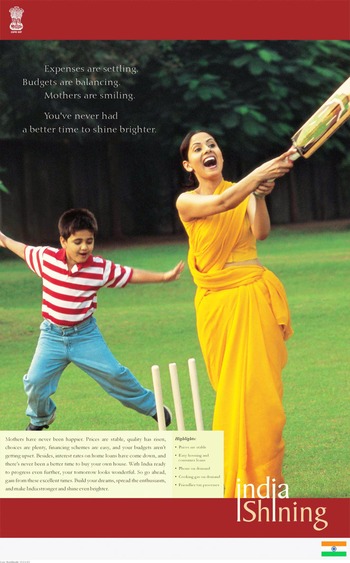
The first follow-up image was of an attractive mother clad in bright yellow sari, probably in her early thirties, playing the game of cricket with her young son (see figure 1). If soccer is the quintessential participatory sport for youth in America, then cricket is its all-consuming counterpart in India.The mother-son duo is seen cheerfully engaged in a celebratory posture. The “cricket mom” is seen holding the cricket bat in an upward swing, and she appears be happy even though she has been stumped (struck out). The boy is joyous, with his arms stretched outwards and one knee slightly bent. The image is accompanied by the following text:
Expenses are settling.
Budgets are balancing.
Mothers are smiling.
You've never had a better time to shine brighter.
The “Cricket Mom” featured in the first advertisement series of the India Shining campaign. Image courtesy of Prathap Suthan.

The small print at the bottom offered a longer explanation:
Mothers have never been happier. Prices are stable, quality has risen, choices are plenty, financing schemes are easy, and your budgets aren't getting upset. Besides interest rates on home loans have come down, and there's never been a better time to buy your own house. With India ready to progress even further, your tomorrow looks wonderful.
Unlike the American soccer mom, whose commitment to her children is what supposedly defines her, the Indian cricket mom featured in India Shining is burdened with more weighty issues. Here the figure of the mother is imagined as a key decision maker in the household who is concerned with not only the choice, quality, and price of daily goods but also interest rates on loans to secure home ownership for the family.
This direct form of address to mothers recalls the growing realization among marketing experts that women are often the key decision makers when it comes to household purchases. A global survey conducted by the American consultancy firm Nielsen showed that “when it came to spending decisions, women were in control,” and even more so in emerging markets like Nigeria and India (Nielsen 2011). Another influential study claims that “women now drive the world economy” and that globally “they control about $20 trillion in annual consumer sending” (Silverstein and Sayre Reference Silverstein and Sayre2009, 46). Their influence not only extends to purchasing groceries for everyday consumption, but also 91 percent of homes, 92 percent of vacations, 60 percent of automobiles, and 51 percent of consumer electronics (50). In the world of advertising, the ability of women to invest and consume not only as individuals but also as members of family units has clearly gained them particular visibility and prominence.
India Shining, in many ways, was a forerunner to the global trends in advertising, as it set out to target women investors and consumers. Here the scope of the maternal nurturing role was expanded and the domestic sphere recrafted in ways that Hannah Arendt ([Reference Arendt1958] 1998) may not have completely anticipated in making the public/private distinctions—the well-being of the family here also meant taking responsibility for the family's financial well-being and ensuring a roof over the family's head.Footnote 8 And this also meant opening up the narrowly defined domestic sphere to include full participation in the economy. Thus, the advertisement highlighted the key features of the government's economic policy aimed at the cricket mom group. These incentives—or “sops,” as the critics would call them later—included stable prices, easy housing and consumer loans, phone on demand, cooking gas on demand, and friendlier tax processes.
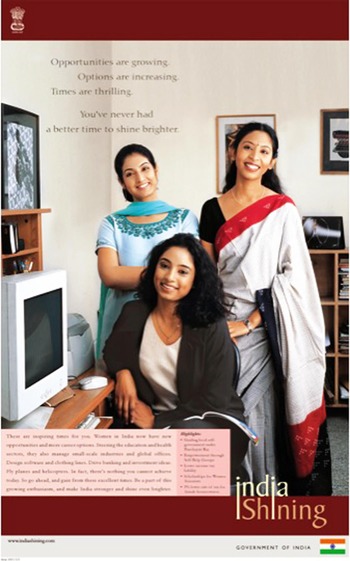
This imagination of women as asset-bearing individuals at the center of the neoliberal economy, rather than the margins, was evident in a second ad that focused on single career women (see figure 2). Here three smiling young women dressed up in professional attire of formal sari, salwar kameez, and Western-style pantsuit pose for the camera. The presence of a desktop computer and shelves in the background suggest an office-like setting. The accompanying text reads:
Opportunities are growing.
Options are increasing.
Times are thrilling.
You've never had a better time to shine together.
The techno-friendly, highly skilled, professional woman as the new face of Indian womanhood. Image courtesy of Prathap Suthan.

The text below explains, “Women in India have new opportunities and more career options. Steering the education and health sectors, they also manage small-scale industries and global offices. Design software and clothing lines. Drive banking and investment ideas. Fly planes and helicopters. In fact, there's nothing they cannot achieve today.” The women in this image are not identified in terms of the usual familial web of relations—beti, bahu, maa (daughter, daughter-in-law, mother), but rather as women framed within a different web of keywords—opportunity, career, education, industries, software, investment, and achievements. The absence of any obvious symbols of matrimony—sindoor, ritual pieces of jewelry—is probably meant to portray single women oriented toward their careers.
The policy measures aimed at this group are also telling about the ways in which this micro-group is positioned. These include “guiding local self-government under Panchayati Raj, empowerment through self-help groups, lower income tax liability, scholarships for women scientists and 3% lower rate of tax for female houseowners.” The last bit is significant, as the policy incentivizes female home ownership by lowering taxes slightly, just as it seeks to promote women scientists with financial support. This kind of government support stands in contrast to the usual women-centric schemes like Mukhyamantri Kanyadaan Yojana (the Chief Minister's Financial Aid Scheme for Girl Marriage), where the state intervenes to organize mass wedding ceremonies for girls from poor families and offer financial aid to that end (see, e.g., Chouhan Reference Chouhan2013). The women in India Shining visuals are pitched quite differently—they are middle-class, professional, empowered women who pay their taxes and are probably already on the property ladder even without being in matrimony. In these visuals, what we witness is the incorporation of the female investor-citizens into the new economy.
The collective euphoria generated by the India Shining ads was largely intact at this stage. A big boost to the government's claims about the state of the economy came in the form of the Reserve Bank of India's 2003 year-end statement of foreign exchange reserves. India had for the first time in its history reached the long-desired US$100 billion mark (Reserve Bank of India 2003). The significance of this sum and the attendant celebrations can only be understood in the context of the economic crisis India faced in 1990–91 and its fallout. The cash-strapped Indian government at this point was left with a mere US$5.8 billion in foreign exchange, which further shrunk to US$1.1 billion or a mere two weeks' worth of imports by summer (Reddy Reference Reddy2002; Reserve Bank of India 2005; Weinraub Reference Weinraub1991). India was said to be in the midst of its “most serious crisis” (T. N. Ninnan quoted in Weinraub Reference Weinraub1991). The crisis also became postcolonial India's moment of humiliation, as it had to pledge its gold reserves as collateral to gain international loans from its former colonizer. In the summer of 1991, about 47 tons of gold was airlifted to the Bank of England and 20 tons to the Union Bank of Switzerland to raise US$600 million. This crisis also became a turning point in India's economic history, as it agreed to “open up” its economy and undertake structural adjustment programs as part of a further IMF-led bailout. That the 1991 crisis is deeply etched in the national psyche was evident in 2009 when India made it a point to purchase 200 tons of gold reserves put on sale by the IMF (Bandyopadhyay and Roy Reference Bandyopadhyay and Roy2009). Almost every news report recounted the shame of 1991 and noted the reversal of India's fortunes. And in 2003–4, India Shining set out to capture precisely that collective need to erase national shame and replace it with the “feeling of pride that the country is doing well.”Footnote 9
On January 1, 2004, the India Shining campaign issued the following message to fellow Indians:
Happy New Year.
You are now stronger and prouder with $100 billion shining.
Our foreign exchange reserves have raced past the $100 billion mark.
We have never been more robust, healthier and radiant.
It's a moment that makes every Indian stand proud and tall.
From the days of dreaming self-reliance, we have traveled a long way.
It's a figure that inspires the world to applaud our resolve.
The New Year's greeting touched a raw nerve, a theme that had long simmered below the surface but had never been fully addressed in the open. In popular discourse, the economic reforms were presented as a matter of choice, a carefully considered policy decision, while glossing over the actual events that had forced India to open up its markets. The India Shining message directly invoked the memory of that hidden national shame to put the new optimism in context. The publicity campaign was as much a celebration of the glorious present as an attempt to exorcise this humiliating past.
Aesthetics of the Extraordinary
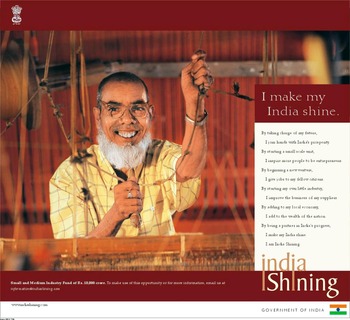
Once the first phase of the India Shining campaign had successfully established the miraculous rise of “the macros” (economic indicators) in the public mind, the challenge was “how to transfer the spirit of euphoria on to the individual” at a micro level.Footnote 10 The answer to this challenge was the next phase of the campaign, called “I Am India Shining,” that, I was told, sought to move the “wonders of India” on to the individuals. The idea was to pitch the individual as “the personal embodiment, the reflection of India Shining” in the meta-narrative of new India.Footnote 11 A noteworthy aspect of this series was that each advertisement was released in conjunction with policy announcements by the government that offered concessions and incentives to select groups. A prominent ad in the new series featured the success story of a weaver-turned-entrepreneur seen operating a weaving mill (see figure 3):
By taking charge of my future,
I join hands with India's prosperity.
By starting a small scale unit,
I inspire more people to be entrepreneurs.
By beginning a new venture,
I give jobs to my fellow citizens.
By starting my own little industry,
I improve the business of my suppliers.
By adding to my local economy,
I add to the wealth of the nation.
By being a partner in India's progress,
I make my India shine.
I am India Shining.
The small-scale entrepreneur embodies the spirit of India Shining. Image courtesy of Prathap Suthan.

This “ode to entrepreneurship” follows the typical neoliberal narrative of an autonomous, enterprising citizen who proves his worth “by taking charge of [his] own future.” The recipe of liberation lies in transforming oneself into an entrepreneur, the celebrated job-giver who provides employment to fellow citizens, and in doing so adds to the local economy and the wealth of the nation. In many ways, the narrative of taking charge is an old one that has defined citizenship in postcolonial India for a long time. In fact, this celebration of entrepreneurial citizens as opposed to loathing for those forced to depend on the state has always been deeply ingrained in the official procedures and policies of the Indian state. The hierarchical distinction between self-reliant and state-dependent citizens was already evident in the very formative moment of the Indian nation-state when the partition refugees had to be resettled in the late 1940s (Kaur Reference Kaur2009). Thus, the neoliberal script of entrepreneurship and wealth generation has never been an imposition from the outside alone. It is tied together with previous discourses of self-reliance that have always characterized the most valuable form of citizenship. The figure of the investor-citizen is merely the latest form in this lineage of belonging to the nation.
What is noteworthy in this India Shining image is the appearance of the entrepreneur himself. The visual and the text suggest that the central figure is a Muslim weaver who has probably scaled up his traditional vocation into a small industry. His entrepreneurial skill evidently opened up a fresh space from where new relationship to the nation could be claimed. Given that Muslim groups often tend to be on the economic margins in India, this representation of an entrepreneur is significant (Sachar 2006). In this instance, the claim to belonging is predicated upon one's ability to enter the neoliberal economy as a job-giver, a wealth-generator who enriches both oneself and the nation. The ability to generate wealth for oneself here almost becomes a form of national service, a coveted form of investment in the nation-building project that any enterprising individual can undertake.Footnote 12
This advertisement appeared in conjunction with policy announcements aimed at medium-sized enterprises. The government had set up a Small and Medium Industry Fund of Rs. 10,000 crores that offered easy loans and concessions to develop businesses. The policy was part of a larger package of economic measures aimed at the middle class or those who aspired to join the middle class. On January 8, 2004, the finance minister announced the package that commentators saw as the BJP's early foray into the forthcoming general elections. A noteworthy feature of these measures was that unlike the usual pre-poll benefits offered by governments—for example, concessions on items of mass consumption such as kerosene oil, sugar, food grains, or train tickets—this time an entirely new category of goods and services was being offered. These included reductions in customs and excise duties on consumer items like mobile phones; computers; DVDs; automobiles, especially the sports utility vehicles; and air tickets (Sridhar Reference Sridhar2004). These items clearly did not belong to the category of basic necessities but instead to a luxury lifestyle segment that signaled the prosperity the reforms had brought in.
The images helped conjure the ideal life of affluence and plenty lived by all those who had taken the opportunities the reforms presented. The visuals were also an invitation to all those deemed to be left behind to make use of the fresh possibilities to invest, consume, and help grow one's personal wealth and the national economy. And in keeping with this idea, a variety of loans, Dada-Dadi retirement bonds aimed at elderly citizens, and several tax/excise concessions on consumer items were introduced.Footnote 13 A particular gesture aimed at the corporate sector was the reduction of restrictions on capital convertibility and mobility that allowed Indian citizens to transfer up to US$25,000 out of the country annually. The peak rate of customs duties was lowered from 25 percent to 20 percent, and some duties amounting to 4 percent were abolished altogether. These concessions were estimated to cause a revenue loss of about Rs. 10,000 crores to the government, though in the hope of aiding economic growth (Sridhar Reference Sridhar2004).
The BJP government's policy announcements were met with severe critiques on two counts. First, the government had introduced significant changes in the structures of taxes, duties, and capital mobility without presenting them for parliamentary debates and procedures. Second, the concessions and benefits were solely targeted at the nation's elite, the upwardly mobile, affluent middle classes. The economic package had conspicuously left out poor citizens who were in need of public support. But what made this presence of the affluent and the absence of the poor in the images noteworthy was the insistence that the images represented ordinary life in India. And the proof of this claim, I was told, lay in the assemblage of the photographs itself where real people were featured:
No, these were not models, these were real people. The teacher in the ad is a teacher, the farmer is a farmer, and the schoolchildren are real schoolchildren. The ads were shot in and around Delhi. The second campaign, “I Am India Shining,” was shot all around the country. We went to the streets to take these images. We saw a bunch of schoolgirls, and asked them if we could take their pictures, real life pictures.Footnote 14
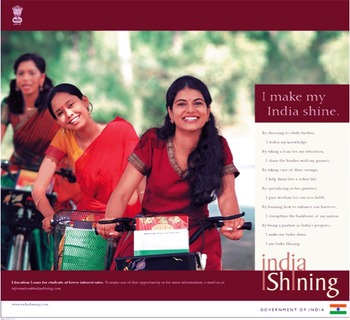
The girls mentioned here were featured in an ad focused on education and student loans (see figure 4). The image shows three young women on bicycles, probably on their way to college. The titles of their notebooks in the cycle baskets allow us a glimpse into the education they are receiving—“Technology Today and Tomorrow” and “Digital Logic and Computer Design.” The accompanying text reads:
By choosing to study further,
I widen my knowledge.
By taking a loan for my education,
I share the burden with my parents.
By taking care of their savings,
I help them live a richer life.
By specializing in bio-genetics,
I gain wisdom for our rice fields.
By learning how to enhance our harvests,
I strengthen the backbone of my nation.
By being a partner in nation's progress,
I make my India shine.
I am India Shining.
Young college students of bio-genetics representing ordinary Indians. Image courtesy of Prathap Suthan.

The authenticity of the subjects in this photo assemblage as real people as opposed to professional models is irrelevant. What is important is their position as models in the sense of being representative, as the ideal-types who are able to convey the desired impression. At the heart of this image is the claim of being ordinary, of bringing to surface unexceptional scenes from the everyday into the frame of national publicity. The photographer had seemingly captured a commonplace scene on the street that could plausibly be witnessed by anyone. Yet the image is far from the ordinary it seeks to represent. In fact, it breaks far too many barriers to be categorized as a routine, unexceptional feature of Indian life. For one, the young women represent a face of modern Indian womanhood as innovators and entrepreneurs in the fields of science and technology. In a nation where a lopsided male-to-female sex ratio, a marked preference for sons, gender-based violence, and low human development indicators define the lives of its female citizens, this frame of representation is noteworthy.
In sheer numbers, India actually ranks high among BRIC nations with a 65 percent female representation in science and engineering higher-education enrollments, buoyed by high numbers in the more traditionally female caregiver roles of nursing and other medical fields. Yet, in contrast, the female presence in the science and engineering workforce is merely 12.7 percent, which places India at the bottom (Women in Global Science and Technology 2013, 7). The disparity in these figures is not clearly explained but suggests that women do fall off the professional ladder or perhaps switch to the more conventional female occupations such as teaching rather than research innovation, as gender stereotypes in science and technology continue to prevail.Footnote 15
While in some ways the image of young women engaged in science and technology education represents these statistics in their capacity as students, it also exceeds the figures by positioning them as future professionals. The students here are expected to contribute to the economy not only by “specializing in bio-genetics” and “gaining wisdom for our rice fields” but by “enhanc(ing) our harvests” and thereby “strengthen(ing) the backbone of [the] nation.” The young women also appear to be challenging norms by taking loans and “shar(ing) the burden with [their] parents” instead of being the financial and social burden that a daughter presents in the patriarchal context.
A part of the architecture of this extraordinary masked as ordinary was its temporal performance as the present. In the eyes of its makers, India Shining was not a vision of the future. It was, as Prathap put it, “a vision of the present, of currently where you are—a very prosperous environment. It was a mirror where you could see yourself. You are right here. Why are you not taking advantage of the growing prosperity around you?”Footnote 16 This conception of the ordinary presented an in-built antagonism. To be ordinary is to be unexceptional, mundane, a routine that is shared by large numbers. The claim to represent the ordinary, then, was an attempt to speak for everyone even when the speech itself was addressed to a particular class of people: the highly educated, prosperous, professional, upwardly mobile elite. So the euphoric invitation to the haves, a category that Prathap invoked frequently, was also revealed to the have-nots who did not possess the surplus necessary to invest and grow with the nation.
During my conversations with Prathap, there was only one moment when he did not have an immediate, thoughtful, witty response to my queries. The question I had asked him was about his much-favored analogy: India Shining as the mirror to the present. What if you were not able to see yourself in the mirror the state had set up, I asked. And was not the desire to see only yourself, apart from others, in the frame of prosperity indicative of a kind of selfishness? After a long pause, he replied: “Listen, in India I am not bothered about you because my survival comes first.… We come from a land of famine, a lot of hardship, huge population, fewer resources and all that. So India Shining in a way was pandering to that spirit in you, your survival instinct.” In other words, the focus here was not on the collective, but on individual interest. Or as Prathap reiterated, “if you do well, your nation will benefit too, so look after your own interest first.”Footnote 17
The spirit of India Shining, then, embodied a new subjectivity constitutive of self-centered individuals who had seceded from the collective. This possibility both appealed to the newly prosperous middle class and legitimized the same in the public discourse (Kaur Reference Kaur2012, Reference Kaur and Jodhka2014). But this spirit of self-first that India Shining successfully invoked is precisely what created acrimony, given the widespread feeling of exclusion from the celebration that India Shining represented. It is within these factions and antagonisms that we need to rethink the notion of failure with which India Shining is popularly associated. What appeared to be failure in the aftermath of the 2004 electoral defeat, in fact, was a decisive turn towards a broad consensus in favor of economic reforms. The icons of good times never really disappeared; they returned in full force in a new form of acche din or good times in the 2014 general elections.
The Indelible Icon
I will begin unpacking the controversial moment of failure here by addressing the counter-campaign launched by the Congress Party in 2004 to oppose India Shining. Provocatively called “aam aadmi ko kya mila,” or “what did the common man gain,” the campaign emotively channeled the feeling of being left behind, of being excluded from the forward march of a nation on the move. As would be clear from the slogan itself, the campaign set out to voice the discontent brewing over increasing wealth disparity, socioeconomic gaps, and the triumph of the privileged.
The campaign was noteworthy on several counts. First, in contrast to the India Shining visuals assembled in vivid, striking colors, the aam aadmi visuals were shades of black and white that created a stark, austere appearance. If the colorful India Shining ads sought to depict modernity via an accelerated present firmly tied to the future (Rosa Reference Rosa2013), aam aadmi ads stirred the uncomfortable past from which the present had been unable to disconnect itself. Absent in these visuals were objects like computers, industrial machinery, mobile phones, and other devices, which India Shining deployed as a means to convey progress and techno-futures. Second, the hope, happiness, and satisfaction visible in India Shining is replaced in aam aadmi by a sense of dejection and hopelessness. The subjects in these photographs rarely look into the camera, their eyes remain downcast, and expressions of angst and uncertainty are conspicuous. Third, the catchy slogan itself was posed in the interrogative form that questioned the promises and claims of prosperity made by the ruling government. If one of the advertisements reminded the public about the failure of the government to provide the promised five crores jobs, another raised the issue of higher education and the diminishing possibilities for the young generation. The interrogative form unsettled the poetic narrative of economic reforms that India Shining had publicized. It successfully questioned what the common man had gained, or rather failed to gain, from the growing prosperity that the rising macro-indicators signaled.
The last feature of the aam aadmi campaign is probably the most telling, however, and the one that has mostly been overlooked—the ways in which the campaign reproduced the language and logic of the India Shining campaign even while seeming to oppose it. Consider the language of loss and gain to the individual, a hallmark of India Shining, which was internalized in the aam aadmi campaign. The discourse of public good and welfare for all was replaced by that of profit for one's self. And related to this, it never questioned the logic of the economic reforms themselves that privileged economic growth over equitable distribution within the population. To be sure, the Congress Party, the chief architect of the 1991 economic reforms that paved the way for the emergence of the kind of prosperity and consumption featured in the India Shining campaign, could hardly be expected to do that. The only battle it could engage in with the BJP was about bringing more reforms and managing capital more efficiently. In a surprise electoral upset, the Congress Party was able to successfully turn the rhetoric of India Shining to make it seem like a political liability. When the Congress-led United Progressive Alliance (UPA) formed a government in 2004, the blame for the BJP's electoral loss was attributed to India Shining images that were said to have presented a false impression of prosperity and well-being to the people.
We might ask if the electoral defeat of the BJP signaled the demise of the iconic India Shining. At first this would appear to be the case, as the BJP distanced itself from the images that had been popularly identified as the cause of its defeat. Not only was the website erased without leaving any trace, any leftover digital links that might connect the political party to India Shining had been carefully removed too. The act of erasure indeed could be read as symbolic death, or more the consignment of India Shining into the waste bin of history. Yet upon closer examination it becomes obvious that the notion of the failure of India Shining is a conflation: it misreads electoral failure as the failure of the idea of capitalist growth itself. To pick the two apart, one needs to trace the decade between the closure of the India Shining campaign in 2004 and the beginning of Narendra Modi's “acche din,” or “good times” campaign in the 2014 general elections. What becomes palpable is the way in which the idea of capitalist growth presented as the “India growth story” took firm root in the Indian sociopolitical landscape.
That the logic of growth was now the inner logic of political mobilization was revealed in the very opposition to the India Shining campaign. The Congress Party's aam aadmi ko kya mila campaign, as I have shown, mirrored the language of profit and self-interest over that of the collective, which had become the hallmark of India Shining images. The political claim of the Congress Party was based on its credentials as the original party of reforms and its experience as the successful manager of capital in the first decade of reforms. What the Congress now promised was more reforms and consequently greater growth that the NDA government had been unable to deliver. During the two terms of the Congress-led UPA government during 2004–14, this promise to bring more growth—albeit people-friendly, or “reforms with a human face”—became the prime policy prescription. The difference was that the old question of growth in this period was now conjoined with the question of distribution of growth. In short, the Congress Party offered the same model that it had originally introduced in the 1990s, albeit with a difference—it articulated the need for greater distribution of the gains of reforms to the common man.
To be sure, the political consensus around the question of economic growth in various gradations went beyond the Congress-BJP contestations. The political parties across the spectrum, including regional parties, have been keen on establishing their pro-business and pro-growth credentials following the example of Modi's Vibrant Gujarat initiative and Chandrababu Naidu's transformation of Hyderabad into the hub of cyber-technology. Even the state of West Bengal, ruled by the Communist Party of India (Marxist), sought to rebrand itself as the hub of special economic zones, though that ultimately led to the downfall of the state government following conflict with farmers over land acquisition. In short, the spirit of prosperity embodied in the India Shining images not only remained intact but became more influential in the intervening decade.
The most forceful manifestation of the indelibility of the India Shining images is the success of Modi's 2014 electoral campaign. The campaign built upon, and eventually usurped, the public anger and frustration mobilized in the form of the India Against Corruption movement that ultimately led to the formation of the Aam Aadmi Party. The public disenchantment over unfulfilled promises and wasted opportunities was articulated around the agenda of anti-corruption; corruption had been identified as the prime cause of India's failure to grow. In this politically volatile mood, the uplifting promise of acche din, or good times, was offered by the Modi campaign. The notion of good times was both vague and exhilarating; it was deliberately kept undefined to allow its consumers to create their personalized dream worlds of good times. The one thing concrete and uncontested in the idea of good times was its expected mode of arrival: successful economic reforms would ensure and even hasten its arrival.
During the campaign, Modi had successfully positioned himself as the agent via whom the good times would be brought in (Kaur Reference Kaur2015). It is noteworthy that in the initial years of reforms, the BJP—pushed by the Swadeshi Jagran Manch (Forum for the Awakening of Swadeshi) to promote self-reliance rather than opening up of markets to foreign investors—was ambivalent about the neoliberal economic project. That the BJP under Modi transformed itself into a more dependable facilitator of capital, thereby wresting the reforms agenda from the Congress Party, is a significant development in the history of India's economic reforms.
The day Modi won the electoral battle, he sent out a single tweet—“acche din aa gaye,” or “the good times have arrived”—which became the most retweeted tweet in India's social media history. Clearly, the message that good times are intertwined with capitalist growth had been etched powerfully in the public consciousness to an extent that it became a matter of common sense even if the BJP had carefully erased any association with the India Shining images. Though less spectacular than the original India Shining icons, the idea of good times had even more effectively repackaged the tantalizing prospects of the future that capitalist growth held. In short, the icons of good times had found a new enduring life-form harnessed firmly to the ever-enchanting dream worlds of capitalism.
Conclusions
The overarching question I have pursued in this article is what the controversial failure of the spectacular India Shining publicity campaign constitutes in the longue durée of India's post-reform history. If the productive value of the spectacle is in capturing attention and creating enchanting dream worlds (Buck-Morss Reference Buck-Morss1992; Crary Reference Crary2001), where the idea of good times to which human beings forever aspire is firmly harnessed to the magic of capitalist growth, what does the deliberate erasure of the entire website, as well as campaign images from the Internet, and the complete disassociation of the political party that commissioned the campaign asks us to reconsider what the effacement of spectacular, iconic images might mean?
Debord's conception of spectacle offers an opening for discussion.. For Debord (Reference Debord and Knabb2005, 9), spectacle signifies the transformation of all “that was once directly lived” into representation, and life under capitalism itself “an immense accumulation of spectacles” where appearances mask reality even while projecting a unified worldview of the dominant powers. The making of the spectacle presupposes a split, an alienation of humanity from its very essence, as Feurbach pointed out, that leaves behind an empty shell, an incomplete version of itself (Debray Reference Debray1995).
If the spectacle veils reality, then what does its obliteration or disintegration signify—the disclosure of a more organic, enchanting social world unmediated by images and commodities? Or put differently, what was revealed once the publicity machinery that provided life and sustenance to the India Shining campaign severed its ties, and allowed it to disintegrate? If the hope was that the spectacle in disintegration would reveal the organic reality that had been masked by mere appearances seeking to mimic reality, then that hope remained unrealized. Instead of recovering a lived reality unmediated by appearances, we find ourselves questioning Debord's idea that such an organic, unmediated social world exists to begin with. What we do find instead is the productive value of the spectacle in capturing attention and creating enchanting dream worlds (Buck-Morss Reference Buck-Morss1992; Crary Reference Crary2001) where the idea of good times to which human beings forever aspire is firmly harnessed to the magic of capitalist growth.
To be sure, the campaign was deemed to be a success for several months, following which it was incorporated into the BJP's electoral campaign, and even translated into L. K. Advani's Bharat Uday Yatra (literally, India Rising/Shining Journey) across the nation. The failure was more a retrospective commentary, an afterthought that came to define India Shining after the BJP's stunning electoral defeat. The beautiful dream world of India Shining was blamed not only for the BJP's electoral failure, but for being a failed project per se, and for circulating “false images” of prosperity. The publicity itself was an act of concealment in that it masked the state of deprivation in the nation, as its critics argued.
The perception of failure evolved within the double work of the spectacle—its productive value in bringing to the fore the potential of a good life and simultaneously revealing to people their distance from that life and the difficulty they face in realizing that dream. Here, we witness how—unlike Debord's spectators, who presumably can be duped into taking the spectacle at face value—the spectator-consumers of India Shining demonstrated more awareness of the vast gap that separated them from the good times depicted in the images. Despite this recognition, the dream and prospects of a good life remained vibrant. What emerged unscathed from the ashes of India Shining is the notion of good times, most recently in the form of acche din, which swept the BJP to a landslide victory a decade later in the 2014 general elections.
Even during the height of the India Shining controversy, the critics (e.g., Desai Reference Desai2004; Ghosh Reference Ghosh2004; Vanaik Reference Vanaik2004) never offered an alternative dream world where the masses could imagine a different path to a good life. The simmering resentment at being excluded was instead redirected by the pro-reform challenger Congress Party toward paving the way for a further “opening up” of the Indian economy.
Thus, the investor-citizen, the extraordinary aam aadmi, who privileges personal gain as a form of nation building, has become a lasting legacy of India Shining. This figure has defined the kind of self-centered, middle-class politics that has gained strength in the Indian polity. It is not a coincidence that the 2011 anti-corruption movement was mobilized upon a shared mistrust of the political class that had allowed crony-capitalism, bled the nation's wealth through corruption, scared away foreign investors, and thus slowed down the pace of economic reforms.
It is telling that the exclusion depicted in the aam aadmi campaign never transformed into resentment and anger that challenged the structures of inequality. It was more like a knock on the door of prosperous India to be let in than a call for radical political change. In this edifice of opposition the gradual shift to a dream world facilitated by capitalism became apparent. It is in the very spectacle of disintegration (Wark Reference Wark2013) of India Shining, its memorable failure, that we witness the withering away of the old order, even as its logic steadily takes root in the Indian social landscape.
Acknowledgments
I want to thank John Comaroff, Thomas Blom Hansen, Keith Hart, and Nandini Sundar for their helpful comments. The initial drafts of this paper have benefited from discussions at the “New India's Worlds” (2015) and “Southern Futures: Thinking through Emerging Markets” (2014) workshops at the University of Copenhagen and the “Social Mobility in Post-reform India” (2013) workshop held at the University of Delhi.