Chickpea is a cool-season pulse crop commonly grown in rotation with small grains in the Pacific Northwest. Chickpeas compete poorly with weeds because of their slow growth and limited canopy development, resulting in yield losses of 48% to 97% when weeds are not controlled (Al-Thahabi et al. Reference Al-Thahabi, Yasin, Abu-Irmaileh, Haddad and Saxena1994; Mohammadi et al. Reference Mohammadi, Javanshir, Khooie and Mohammadi2005; Paolini et al. Reference Paolini, Faustini, Saccardo and Crino2006; Plew et al. Reference Plew, Hill and Dastgheib1994). Chickpeas are typically drilled in rows spaced 15 to 30 cm apart, so cultivation is not practiced for weed control. Grass weeds are managed well in chickpeas with PRE- and POST-applied herbicides. Broadleaf weeds such as common lambsquarters (Chenopodium album L.), Russian-thistle (Salsola tragus L.), mayweed chamomile (Anthemis cotula L.), prickly lettuce (Lactuca serriola L.), and kochia [Kochia scoparia (L.) Schrad.] are common problems in many chickpea production areas of Washington and Idaho. Several PRE herbicides are registered for use in chickpeas that control many broadleaf weeds. However, timely rainfall is necessary to move the herbicide into the soil and make it available for uptake by weeds. When rainfall isn’t adequate or timely, herbicides perform poorly and broadleaf weeds can become problematic. Even in situations where PRE herbicides control early-season broadleaf weeds, herbicide persistence may not always control broadleaf weeds season-long, and broadleaf weeds emerging later can greatly impede harvest operations.
No POST broadleaf herbicides are labeled for use in chickpeas grown in the United States. Control of broadleaf weeds and registering a POST-applied broadleaf herbicide in chickpeas were listed as critical priorities in a recent Pest Management Strategic Plan for the pulse crops (O’Neal Reference O’Neal2017). Flumetsulam is labeled for POST use in Australia on chickpeas, but there is no interest from manufacturers to label it in the United States (Dorigo Reference Dorigo1999). Imazamox applied POST to chickpea from 0.02 to 0.04 kg ai ha−1 caused unacceptable injury and reduced chickpea yield (Vasilakoglou et al. Reference Vasilakoglou, Vlachostergios, Dhima and Lithourgidis2013). POST imazamox and imazethapyr at three growth stages of chickpea resulted in visual injury and yield reductions on two imidazolinone-susceptible cultivars (Jefferies et al. Reference Jefferies, Willenborg and Bunyamin2016). POST-applied imazethapyr, imazamox, and metribuzin delayed flowering and maturity of chickpeas and reduced yield (Taran et al. Reference Taran, Holm and Banniza2013).
Acifluorfen and fomesafen are diphenylether herbicides that inhibit protoporphyrinogen oxidase. One or both herbicides are labeled in several annual legume crops including soybeans, peanuts, snap beans, and dry beans. Fomesafen and acifluorfen applied POST to chickpeas at 0.42 kg ai ha−1 in Arizona injured chickpeas only 5% (Umeda and MacNeil Reference Umeda and MacNeil1999). In contrast, acifluorfen at 0.45 kg ai ha−1 applied POST to chickpeas in Australia caused unacceptable injury (Kay and McMillan Reference Kay and McMillan1990). Fomesafen applied at 0.28 kg ai ha−1 injured chickpeas and reduced the ability of the crop to suppress late-emerging weeds in Washington State (Yenish and Schneider Reference Yenish and Schneider2000). Chickpea tolerance to the POST photosynthetic inhibitor herbicide pyridate has been previously demonstrated at rates up to 3.6 kg ai ha−1, which is over three times the rate needed for control of most annual broadleaf weeds (Giménez-Espinosa et al. Reference Giménez-Espinosa, Jiménez-Díaz and De Prado1995; Kay and McMillan Reference Kay and McMillan1990; Seidel and Russell 1990). Pyridate controls many annual broadleaf weeds including kochia, Russian-thistle, pigweed (Amaranth species), and common lambsquarters when applied POST to small seedlings in the three- to four-leaf stage (Anonymous 2003). Pyridate was previously registered for POST broadleaf weed control in chickpeas in the United States, but all U.S. registrations for the herbicide were voluntarily canceled in 2007. Tank-mixing metribuzin at 17 g ai ha−1 with pyridate at 0.9 kg ai ha−1 improved control of lanceleaf sage (Salvia reflexa L. Hornem.) from 59% to 91% and turnipweed (Rapistrum rugosum L. All) from 78% to 97% compared to pyridate alone (Seidel and Russell 1990).
These studies were conducted to determine the tolerance of chickpeas to POST-applied acifluorfen and fomesafen alone and in combination with pyridate in the Washington production region.
Materials and Methods
‘Sierra’ chickpeas were planted near Prosser, WA, and near Wilbur, WA, in 2015 and 2016, and also near Paterson, WA, in 2016. Inoculant was added to the seed at planting at the rate recommended by the manufacturer. Chickpea were seeded at 207 to 215 kg ha−1 with a drill with 18-cm row spacing at Prosser and 30-cm row spacing at Wilbur. Planting dates were April 15, 2015 (Wilbur), April 27, 2015 (Prosser), April 11, 2016 (Wilbur), April 20, 2016 (Paterson), and April 21, 2016 (Prosser). POST herbicides were applied on June 5 (Wilbur) and May 18 (Prosser) in 2015, and on May 18 (Wilbur) and May 17 (Paterson and Prosser) in 2016.
Herbicides were applied with a compressed CO2 sprayer equipped with four (Prosser) or six (Paterson) 8002XR flat fan nozzles operated at 179 kPa and calibrated to deliver 190 L ha−1. At Wilbur sites, herbicides were applied with a CO2 sprayer equipped with four 11003XR flat-fan nozzles operated at 207 kPa and calibrated to deliver 140 L ha−1. Chickpeas averaged 20 cm tall at the Wilbur locations and 15 to 20 cm tall at Prosser and Paterson locations when POST herbicides were applied. Broadleaf weeds were 5 to 10 cm tall at Wilbur, 3 to 4 cm tall at Prosser, and 3 to 6 cm tall at Paterson. Plots were kept free of grass weeds season-long in all trials by hand-removal or an application of clethodim at 0.14 kg ai ha−1.
Acifluorfen was tested at 0.42 kg ai ha−1 and fomesafen at 0.28 kg ai ha−1, commonly labeled rates in other legume crops such as peanuts (Arachis hypogaea L.), soybeans [Glycine max (L.) Merr.], and dry beans (Phaseolus species). Untreated control plots were included for comparison. In 2015, acifluorfen treatments included nonionic surfactant (NIS) at 0.25% (v/v) spray solution at Prosser and ammonium sulfate at 2% (v/v) spray volume at Wilbur. Fomesafen treatments included crop oil concentrate at 1% (v/v) spray solution at Prosser and NIS at 0.25% (v/v) spray solution at Wilbur. In 2016, treatments of pyridate applied POST at 1 kg ai ha−1 with and without NIS at 0.25% (v/v) spray solution were included. In addition, tank-mixes of pyridate at 1 kg ai ha−1 with acifluorfen at 0.28 kg ai ha−1, fomesafen at 0.21 kg ai ha−1, and metribuzin at 60 g ai ha−1 were also included in 2016. At the Wilbur site in 2016, fomesafen was tested at a slightly higher rate (0.28 kg ai ha−1) in the tank-mix with pyridate. All treatments containing fomesafen or acifluorfen included NIS at 0.25% (v/v) spray solution in 2016. Treatments were arranged in a randomized complete block design replicated four times, and plots were 2.3 by 7.6 m at Prosser, 3 by 9.1 m at Paterson, and 2.3 by 9.1 m at Wilbur.
Chickpea injury was visually estimated at approximately 1 and 4 weeks after application on a scale of 0 to 100, where 0 indicates no injury and 100 indicates death. Control of Russian-thistle, the most prevalent weed at both sites in 2015, was visually rated on a scale of 0, indicating no control, to 100, indicating complete control, on July 20 at Prosser and June 30 at Wilbur. In 2016, broadleaf weed density was determined by counting all broadleaf weed species from each plot at approximately 4 WAT at Prosser and Paterson or 3 WAT at Wilbur. Because plot size at each site was different, all data was adjusted to a 25 m2 area.
Chickpeas were harvested with a Wintersteiger small plot combine from the center 1.5 m by 7.6 m or 8.8 m area of each plot. Seed weight was determined from the Prosser and Paterson sites by subsampling 100 seeds from each plot and weighing them. Data were subjected to ANOVA using the PROC GLIMMIX procedure in SAS (Statistical Analysis Systems®, version 9.4, SAS Institute Inc., Cary, NC). Trials in 2015 were analyzed separately from trials in 2016 because of differences in treatments each year. Years were analyzed and presented separately, with sites and blocks considered random factors. Mean separation was conducted using Tukey-Kramer for the calculated LSMEANS (P=0.05).
Results and Discussion
Fomesafen and acifluorfen applied POST injured chickpeas at 8 days after treatment (DAT) at both the Prosser and Wilbur sites in 2015 (Table 1). There were significant herbicide, site, and site by herbicide interactions on crop injury, so the data are presented separately for each site. At Prosser, fomesafen at 0.28 kg ai ha−1 injured chickpeas 25% at 8 DAT and injury reduced to16% by 14 DAT and 8% by 28 DAT. Fomesafen injured chickpeas only 11% and 8% at Wilbur at 8 and 28 DAT, respectively. Acifluorfen at 0.42 kg ai ha−1 injured chickpeas only 10% at Prosser and 8% at Wilbur at 8 DAT, and injury decreased to 7% and 3%, respectively, at 28 DAT (Table 1). These results are similar to those of Umeda and MacNeil (1998), who reported only 5% injury on chickpeas at 6 weeks after treatment (WAT) with 0.42 kg ai ha−1 acifluorfen and fomesafen.
Chickpea injury 8, 14, and 28 days following postemergence herbicide applications in 2015 at two sites in Washington State.

a Chickpea injury recorded at 25 DAT at Wilbur site.
b Means within a column followed by the same letter do not differ significantly at P=0.05 according to Tukey-Kramer means test.
c Crop oil concentrate added at 1% (v/v) spray solution at Prosser, and nonionic surfactant added at 0.25% (v/v) spray solution at Wilbur.
d Nonionic surfactant added at 0.25% (v/v) spray solution at Prosser and ammonium sulfate added at 2% (v/v) spray solution at Wilbur.
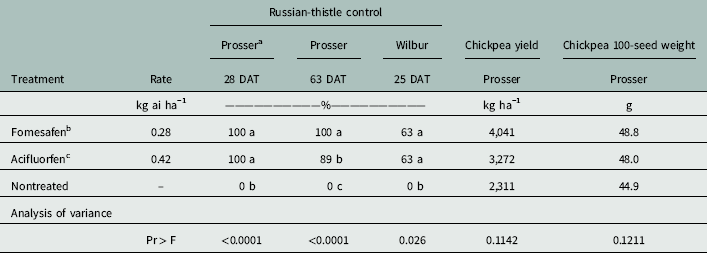
Russian-thistle was the primary broadleaf weed at both sites in 2015 and averaged 0.8 plants m−2 in nontreated controls at Prosser 0.2 plants m−2 at Wilbur in late June. At Prosser, Russian-thistle was completely controlled by fomesafen and acifluorfen 28 DAT, but by 63 DAT, control with acifluorfen dropped to 89% due to additional emergence of seedlings (Table 2). Both herbicides only marginally (63%) controlled Russian-thistle at Wilbur 25 DAT. Poor control at Wilbur was attributed to warm and dry conditions following the herbicide application, which may have stressed the weeds. No precipitation was received during the month following herbicide application at Wilbur, and average minimum, average, average maximum, and peak air temperatures were 15, 23, 30, and 39 C, respectively, for the period.
Russian-thistle control and chickpea yield and 100-seed weight following postemergence herbicide applications in chickpeas in 2015 at two sites in Washington State.

a Means within a column followed by the same letter do not differ significantly at P=0.05 according to Tukey-Kramer means test. Means not followed by a letter indicate no significant treatment effect.
b Crop oil concentrate added at 1% (v/v) spray solution at Prosser, and nonionic surfactant added at 0.25% (v/v) spray solution at Wilbur.
c Nonionic surfactant added at 0.25% (v/v) spray solution at Prosser and ammonium sulfate added at 2% (v/v) spray solution at Wilbur.
Chickpea yield at Prosser in 2015 was quite variable because of unevenness in crop stand resulting from early-season ground squirrel (Urocitellus washingtoni A.H. Howell) damage and was not impacted by herbicides or weed control ranging from 2,311 kg ha−1 in nontreated control plots to 4,041 kg ha−1 in fomesafen-treated plots (Table 2). Chickpea 100-seed weight ranged from 44.9 to 48.8 g and was not affected by herbicide treatment. No yield data was collected at the Wilbur site in 2015 due to late-season grasshopper damage to the plots.
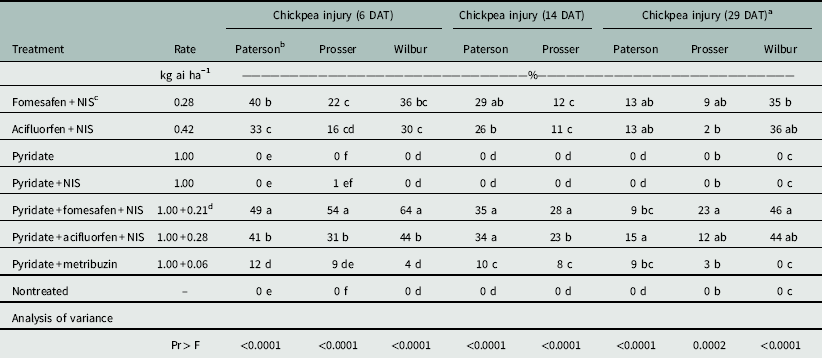
In 2016, fomesafen and acifluorfen applied alone to chickpeas injured chickpeas at 6 DAT at all three sites, with injury ranging from 22% to 40% and from 16% to 33%, respectively (Table 3). Injury symptoms consisted of necrotic lesions and spotting on leaves and stems. There were significant site, herbicide treatment, and site by herbicide treatment effects on chickpea injury, so each site is presented separately. Chickpea injury reduced with time, and new growth appeared normal. Injury at the Paterson and Prosser sites ranged from 11% to 29% at 14 DAT and from 2% to 13% at 29 DAT. At Wilbur, chickpea injury persisted longer, ranging from 35% to 36% for both herbicides applied alone at 29 DAT (Table 3). In 2016, the Wilbur site received 0.6 cm rainfall the day following the herbicide application, and maximum and minimum average air temperatures were relatively cool (18 and 7 C, respectively) the week following the herbicide application, which may have influenced chickpea response. Kay and McMillan reported unacceptable crop injury from acifluorfen applied POST to chickpeas at 0.45 kg ai ha−1, but only tested in one site-year and did not include details on chickpea stage of growth when treated. Yenish reported 63% injury following fomesafen applied POST to chickpeas, but no details were given on stage of growth when applied or the interval between application and injury ratings. The moderate level of chickpea injury observed in 2016 with these two herbicides warrants further research to determine factors influencing chickpea tolerance.
Chickpea injury 6, 14, and 29 days following postemergence herbicide applications in 2016 at three Washington sites.

a Chickpea injury at Wilbur recorded June 10, 2016, at 23 DAT.
b Means within a column followed by the same letter do not differ significantly at P=0.05 according to Tukey-Kramer means test.
c Abbreviation: NIS, nonionic surfactant included at 0.25% (v/v) spray solution.
d Fomesafen was tested at 0.28 kg ai ha−1 in the tank-mix with pyridate at the Wilbur site.
Pyridate at 1 kg ai ha−1 applied POST to chickpeas was safe at all three sites in 2016 and no significant injury was observed both with and without nonionic surfactant added. When fomesafen at 0.21 (Paterson and Prosser) to 0.28 (Wilbur) kg ai ha−1 or acifluorfen at 0.28 kg ai ha−1 were tank mixed with pyridate, chickpea injury ranged from 31% to 64% at 6 DAT at all sites (Table 3). However, the injury was relatively short-lived at the Paterson and Prosser sites, ranging from 9% to 23% for pyridate plus fomesafen and from 12% to 15% for pyridate plus acifluorfen at 29 DAT. Injury from the tank-mixes of fomesafen or acifluorfen with pyridate persisted longer at Wilbur and ranged from 44% to 46% at 23 DAT (Table 3). As mentioned previously, cool and moist conditions followed the herbicide applications at the Wilbur site in 2016, which may have contributed to the greater injury and slower growth and recovery of the chickpeas. Chickpea injury was minor following pyridate plus a low rate of 0.06 kg ha−1 metribuzin at all sites.
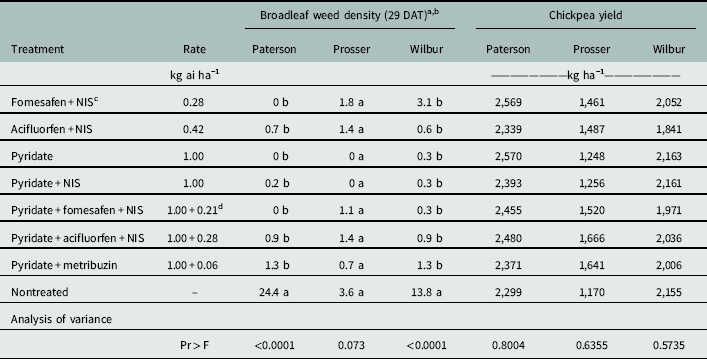
In 2016, broadleaf weeds at the Paterson site consisted of Russian-thistle, hairy nightshade (Solanum physalifolium Rusby), and puncturevine (Tribulus terrestris L.). At the Prosser site, broadleaf weeds were composed mainly of common lambsquarters and Russian-thistle with lesser amounts of kochia, and at the Wilbur site the primary broadleaf weed was Russian-thistle with lesser amounts of tumble mustard (Sisymbrium altissimum L.), cutleaf nightshade (Solanum triflorum Nutt.), and common lambsquarters. Total broadleaf weed density at 29 DAT was reduced equally by all herbicide treatments compared to the nontreated checks at the Paterson and Wilbur sites (Table 4). Total weed density was lower at the Prosser site, and although all herbicide treatments averaged lower broadleaf weed density than nontreated checks, differences were not statistically significant (Table 4). Tank-mixing a low rate of metribuzin with pyridate did not improve broadleaf weed control at any of the sites, which is to be expected given that pyridate alone performed well.
Broadleaf weed density in chickpea at 29 DAT and chickpea yield following POST herbicide applications in 2016 at three Washington sites.

a Means within a column followed by the same letter do not differ significantly at P=0.05 according to Tukey-Kramer means test. Means not followed by a letter indicate no significant treatment effect.
b Weed density units are number of plants per 25 m2. Weed density at Wilbur recorded June 10, 2016, at 23 DAT.
c Abbreviation: NIS, nonionic surfactant included at 0.25% (v/v) spray solution.
d Fomesafen was tested at 0.28 kg ai ha−1 in the tank-mix with pyridate at the Wilbur site.
Chickpea yield was not affected by herbicide treatment at any site in 2016 (Table 4). At the Paterson and Prosser sites, chickpea yield average was lowest in the nontreated controls, but was not statistically different among treatments. Broadleaf weed density was relatively low (<1 plant m−2) at all sites, so the impact of uncontrolled weeds on chickpea yield was likely minor. In Pakistan, a dragon spurge (Euphorbia dracunculoides Lam.) density of 5 plants m−2 reduced chickpea yield only 1%, and 25 plants m−2 were required to reduce yields 50% (Tanveer et al. Reference Tanveer, Javaid, Irfan, Khaliq and Yaseen2015). Chickpea yield loss ranged from 76% to 97% in Italy when weed density averaged 120 plants m−2 or more and were not controlled (Paolini et al. Reference Paolini, Faustini, Saccardo and Crino2006). Full-season weed competition led to 48% to 66% yield loss in chickpea in Iran when weed densities ranged from 69 to 98 plants m−2 (Mohammadi et al. Reference Mohammadi, Javanshir, Khooie and Mohammadi2005). Chickpea tolerance to pyridate was excellent in previous research and yield following pyridate applied POST was equal to or greater than that of weed-free controls (Giménez-Espinosa et al. Reference Giménez-Espinosa, Jiménez-Díaz and De Prado1995; Kay and McMillan Reference Kay and McMillan1990; Seidel and Russel Reference Seidel and Russel1990; Yenish and Schneider Reference Yenish and Schneider2000). Despite significant chickpea injury following acifluorfen and fomesafen treatments early in the growing season, chickpea yields were not significantly reduced compared to pyridate treated plots. Moderate levels of herbicide injury in chickpea did not always result in chickpea yield loss in Canadian studies (Taran et al. Reference Taran, Holm and Banniza2013). Chickpea 100-seed weight at the Prosser and Paterson sites averaged 49.9 and 43.5 g, respectively and was not significantly affected by herbicide treatment (data not shown).
Research Implications
Chickpea tolerance to pyridate was excellent, and registration of pyridate in chickpea would allow for improved POST control of some broadleaf weed species. Forty susceptible broadleaf weed species were listed on the pyridate label (Anonymous 2003). Our results support previous studies demonstrating excellent chickpea tolerance to pyridate (Giménez-Espinosa et al. Reference Giménez-Espinosa, Jiménez-Díaz and De Prado1995; Kay and McMillan Reference Kay and McMillan1990; Seidel and Russell 1990; Yenish 2000; Yousefi et al. Reference Yousefi, Alizadeh and Rahimian2007). Acifluorfen and fomesafen applied POST injured chickpeas until the final evaluation, but chickpeas eventually recovered and had yields similar to those of nontreated controls and pyridate-treated plots. Weed-free controls were not included in our research, but weed densities were low and not likely to have reduced yields appreciably in nontreated controls (Tanveer et al. Reference Tanveer, Javaid, Irfan, Khaliq and Yaseen2015). There are few reports of chickpea response to POST applications of acifluorfen and fomesafen, and given the potential for crop injury, more research is warranted to gain a better understanding of factors that influence the crop response. Growers may be willing to tolerate moderate herbicide injury to chickpeas if broadleaf weed control is improved, given that there are currently no POST broadleaf herbicides registered in the crop in the United States. Greater broadleaf weed densities than those encountered in this study could substantially reduce chickpea yield and result in crop failures in some instances if left uncontrolled (Al-Thahabi et al. Reference Al-Thahabi, Yasin, Abu-Irmaileh, Haddad and Saxena1994; Mohammadi et al. Reference Mohammadi, Javanshir, Khooie and Mohammadi2005; Paolini et al. Reference Paolini, Faustini, Saccardo and Crino2006; Plew et al. Reference Plew, Hill and Dastgheib1994). Although not measured in the current study, harvest losses from uncontrolled broadleaf weeds can also occur. Ideally, broadleaf weed management in chickpeas would include PRE herbicides followed by POST herbicides if needed to control weeds that escape PRE herbicide treatments. The herbicides tested in these studies have potential to be useful for POST control of broadleaf weeds in the crop.
Acknowledgments
The authors are grateful to Encarnacion Rivera, Marc Seymour, Tyler McClure, and Nick Loebsack for their technical assistance. The authors thank AgriNorthwest for supplying irrigation water, power, and land for studies conducted at Paterson, WA.