Parliaments are emblematic democratic institutions. Indeed, in parliamentary systems, legislators are usually the only national-level policy makers directly elected by citizens. Ironically, until quite recently, conventional wisdom among scholars held that parliaments play a negligible role in policy making. While legislatures in parliamentary systems are obviously critical to government formation and termination, they were perceived as having only a marginal influence on day-to-day policy decisions. Over the past several years, numerous studies have begun to challenge this understanding.Footnote
1
A central conclusion that emerges from this literature is that, in parliaments endowed with strong legislative committees, legislators can exercise considerable influence on policy, particularly with respect to their scrutiny of government policy proposals. Effective scrutiny is necessary for the development of feasible alternatives to government initiatives and for holding government members to account for their actions. Standing committees that correspond to ministerial jurisdictions, that have extensive investigative powers and that possess the ability to force changes to government bills enable legislators to shape the policy initiatives of cabinet ministers in significant ways.Footnote
2
Although the general importance of strong legislative committees in parliamentary systems is now well understood, we know little about the extent to which the impact of committees depends on committee leadership – that is, on the chairs who head these committees. This contrasts sharply with the literature on the US Congress, which has examined the impact of chairs extensively and has shown that they are able to use their control of the agenda to secure policy concessions and distributive benefits, as well as increase their legislative productivity and success.Footnote
3
As in the American context, chairs in parliamentary settings typically possess significant formal and informal powers that may allow them to enhance or limit the effectiveness of the committees over which they preside. Therefore it is not surprising that scholars have recently taken an interest in understanding which parties are able to secure which committee chairs – in particular, whether parties in coalition governments systematically appoint committee chairs to ‘shadow’ ministries held by their partners.Footnote
4
However, while these studies have increased our knowledge about who is likely to chair legislative committees, they have not explored whether these committee chairs have a meaningful impact on policy making: Does the ability of legislators to take advantage of strong legislative committees to scrutinize policy proposals depend on who serves at the head of these committees? Answering this question is of obvious importance in understanding the nature of representation in parliamentary systems. If committee chairs are significant in shaping the impact of committees, then the effectiveness of political parties in the legislative process depends, in part, on securing leadership positions on relevant committees.
Our purpose in the current article is to begin answering that question. First, we develop a theoretical argument that suggests that control of committee chairs enhances parties’ ability to scrutinize government policy proposals, and that this effect will be particularly pronounced for parties in the opposition. We then examine the legislative treatment of 1,100 government bills in three parliamentary democracies – Denmark, Germany and the Netherlands – to test this argument. Consistent with our expectations, we find that when an opposition party controls the chair of the committee responsible for reviewing a government bill, the bill is changed more extensively in the legislative process. We find no evidence of a similar ‘boost’ for cabinet parties.
Beyond their immediate implications for the impact of committee chairs, these findings are also significant for our understanding of the role and significance of opposition parties in parliamentary systems. Seminal work on parliamentary institutions and democratic representation has argued that strong committee systems enhance the impact of opposition parties on policy making. Most notably, both Strøm and Powell argue that strong committee systems provide opposition parties with significant opportunities to shape legislation.Footnote
5
In contrast to these theoretical expectations, Martin and Vanberg, studying the legislative scrutiny of government bills in parliamentary democracies, find little evidence of policy influence by opposition parties.Footnote
6
Instead, their analysis suggests that strong committee systems enable government parties to affect legislation introduced by ministries controlled by their coalition partners. Importantly, however, Martin and Vanberg do not investigate whether the partisan identity of committee chairs matters. Our results suggest that failing to account for party control of committee chairs masks opposition influence that becomes apparent when this factor is taken into account.
COMMITTEE CHAIRS AND LEGISLATIVE REVIEW
The internal organization of most modern legislatures features the extensive use of committee systems. The precise nature of committees, including their powers, varies considerably across national legislatures. Broadly speaking, scholars distinguish between strong committee systems that generate the potential for meaningful legislative scrutiny and weak systems that lack sufficient institutional resources for such scrutiny.Footnote
7
Strong committee systems are characterized by several features:
∙ Standing committees of limited size that correspond to the jurisdictional boundaries of cabinet ministries;
∙ Committees with extensive investigative rights, such as the right to compel testimony by ministers and civil servants, subpoena documents and commission expert reports;
∙ Committees that can offer amendments to, or even rewrite, government bills; and
∙ Rules that prevent ministers from curtailing legislative debate or vetoing proposed amendments.
Committee systems with these features are ‘strong’ in the sense that they enhance legislators’ ability to develop policy expertise, to secure relevant information and to force consideration of alternative legislative proposals they develop. Weak committee systems, conversely, lack these features, and therefore limit the capacity of legislators to offer effective input into the policy process.
Scholars have argued that strong legislative committees play a potentially significant role in parliamentary systems for at least two separate reasons. One line of argument, most prominently developed by StrømFootnote
8
and Powell,Footnote
9
is that strong committees enhance the ability of opposition parties to exercise policy influence. Thus, Powell presents evidence that expert evaluations of opposition influence are explained almost perfectly by the formal powers of legislative committees and the majority status of the cabinet.Footnote
10
For Powell, these ‘power-sharing’ effects of committees are important because they affect the overall quality of representation, or how well voter preferences (including the preferences of those who voted for opposition parties) are represented in the policy process. Strøm argues that the fact that strong committees enhance opposition influence is critical to explaining minority governments. The ability to affect policy from the opposition benches decreases the incentive for parties to enter cabinet or dismiss a cabinet with dissimilar preferences, and thus makes the formation of a minority government more likely.
A second strand of literature argues that strong committee systems play a central role in managing the tensions of multiparty governance. Given the scope and complexity of policy making in modern democracies, cabinets typically do not develop policy proposals collectively. Rather, the task of drafting initiatives is delegated to individual cabinet ministers, who have at their disposal the expertise of civil servants working beneath them.Footnote
11
While such delegation to ministers is unavoidable, it poses a challenge for coalition governments: given the need to maintain and expand their party’s electoral support, ministers have strong incentives to use their privileged position to engage in ‘position taking’ by drafting legislation designed to please core supporters, even if doing so is inconsistent with the coalition agreement or at odds with the preferences of their coalition partners.Footnote
12
Importantly, these position-taking incentives imply that ministers are motivated to introduce draft bills that reflect positions favored by their core constituents even if they expect these bills to be amended and changed in the legislative process. That is, even if the ultimate policy is a compromise that includes concessions to coalition partners, the introduction of the original bill signals that the party and minister are working on their constituents’ behalf. Because ministers can be expected to introduce bills that pull policy in the direction of their preferred policy, ‘policing’ the activities of coalition partners becomes a central and necessary task of multiparty government.Footnote
13
Scholars have shown that parties employ a variety of policing mechanisms, including the appointment of junior ministers,Footnote
14
cabinet committeesFootnote
15
and – most importantly for the present purposes – the process of legislative review. Thus, Martin and Vanberg demonstrate that in parliamentary systems with strong committee systems, the degree to which ministerial draft bills are scrutinized and amended during the legislative process can be strongly predicted by ideological divisions within the cabinet on the issues under consideration.Footnote
16
While these studies have greatly advanced our understanding of the importance of the legislative process in parliamentary systems, they abstract away from a feature that has the potential to shape how legislators can use strong committee systems – namely, partisan control of committee chairs. In most strong committee systems, chairs have formal and informal powers that may allow them to enhance or limit the legislative influence of the committees over which they preside. Consider the three legislative chambers that are the focus of our empirical analysis below: the Danish Folketing, the Dutch Tweede Kamer and the German Bundestag. All of them feature strong committee systems, and their standing orders specify similar roles for committee chairs to ‘prepare, call, and preside over committee meetings, and to implement committee decisions’.Footnote
17
In practice, these vaguely defined roles often endow chairs with considerable influence. For example, in the Bundestag, committee chairs serve as the point of contact between the committee and ministries, as well as between the committee and interest groups.Footnote
18
This central ‘position of committee chair provides privileged access to information’.Footnote
19
Chairs also appoint the rapporteurs who are responsible for preparing committee deliberations and draft committee reports.Footnote
20
Further, chairs have formal control over committee hearings, and ‘are entitled – in contrast to the presiding officers of the plenary sessions – to speak on any point at any time’.Footnote
21
Taken together, these powers can place a committee chair in a powerful position. As Dach concludes, ‘the influence of a committee chair, regardless of party, in guiding and changing policy should not be underestimated. Over time, the influence of a chair on a bill, and even on an entire policy area, can be more significant than that of a minister, depending on the chair’s power, interests, and personal engagement’.Footnote
22
A number of commentators have observed that this influence is especially important for opposition parties. For example, Ismayr writes that ‘especially those committee chairs belonging to opposition parties can be of service to their parties by introducing compromise positions, allocating sufficient time for committee deliberations, or supporting requests for information or technical reports from the bureaucracy’.Footnote
23
The fact that committee chairs are in a position to shape the work of their committee suggests that the extent to which strong committees enable opposition and government parties to scrutinize legislative initiatives may depend on who occupies the chairs of relevant committees. (Indeed, this expectation is implicit in the works by Strøm and Powell, who include the proportional distribution of committee chairs to opposition parties as one component of their indices of opposition influence.) In particular, committee chairs may: (1) attempt to steer committee deliberations in ways that strengthen their own party and (2) attempt to limit the ability of parties with opposing interests to scrutinize and affect legislation within the jurisdiction of their committee.
Thus a committee chair who shares a minister’s party affiliation may be tempted to use her discretion to limit the ability of other parties to scrutinize and amend the minister’s bill. In contrast, if a minister’s coalition partner controls the chair of the relevant committee, the partner is in a stronger position to use committee deliberations to ‘police’ the minister. Naturally, these incentives increase with the level of policy disagreement between the chair and the minister. Similarly, when an opposition party chairs the committee reviewing a minister’s proposal, the chair has good reason to promote effective committee review, and this places opposition parties in a stronger position. Put differently, relative to a baseline situation in which the relevant legislative committee is controlled by the party of the minister introducing a bill, ministerial proposals are more likely to be subject to effective parliamentary scrutiny when the legislative committee reviewing a bill is chaired by the minister’s coalition partners or the opposition. This argument implies the following two hypotheses.
Hypothesis 1 (Coalition policing): Ceteris paribus, ministerial draft bills that are reviewed by a committee chaired by a coalition partner will be subjected to greater scrutiny during the legislative review process than bills reviewed by a committee chaired by the party of the proposing minister. This effect will be greater for bills dealing with issues on which the minister and the coalition partner committee chair are highly divided.
Hypothesis 2 (Opposition impact): Ceteris paribus, ministerial draft bills that are reviewed by a committee chaired by an opposition party will be subjected to greater scrutiny during the legislative review process than bills reviewed by a committee chaired by the party of the proposing minister. This effect will be greater for bills dealing with issues on which the minister and the opposition party committee chair are highly divided.
The central logic behind these expectations is that chairs can use their powers to steer committee deliberations in ways that enhance the legislative effectiveness of their own party and limit the effectiveness of parties with opposing interests. This latter (negative) power of chairs introduces an additional consideration: using the chair’s powers to limit other parties is potentially costly. Parties that feel that their opportunities to scrutinize policy are being abrogated by the manner in which the chair is conducting the committee’s business may object and, if necessary, attempt to punish chairs and the parties to which they belong. The opportunities to retaliate against chairs who engage in this behavior are significantly higher within a coalition. To govern effectively, coalitions must maintain sufficiently co-operative relations among their member parties. Attempts by the party of the proposing minister to deny a coalition partner the opportunity to scrutinize a draft bill during the committee stage may jeopardize the internal harmony of the government, and induce the coalition partner to engage in various forms of ‘punishment’ (such as obstructing the policy actions of the minister’s party at the cabinet level or, in the extreme, withdrawing from the government). These concerns are (largely) absent from the relations between the minister’s party and the opposition. Put differently, all else being equal, a committee chair associated with the party of the proposing minister should feel less constrained in using her prerogatives in her interactions with opposition parties than in her dealings with her coalition partners. One implication of this is that the ‘boost’ in effective committee scrutiny that derives from control of a committee chair is more pronounced for opposition parties than for coalition partners: coalition partners are in a good position to scrutinize a minister’s bill even when the minister’s party chairs the committee, because it is costly for the chair to exercise her discretion in a way that limits the influence of coalition partners. In contrast, chairs affiliated with government parties feel less constrained in limiting opposition influence, and therefore, the ability of opposition parties to exercise meaningful influence may be significantly enhanced by control of committee chairs. This leads to our final hypothesis.
Hypothesis 3 (Attenuation): The impact of committee chair control on legislative scrutiny is more pronounced for opposition parties than for coalition partners.
DATA AND ANALYSIS
Because our hypotheses concern the impact of legislative committee chairs on the extent of legislative scrutiny, we focus our empirical analysis on legislatures with institutional structures and procedures that provide parties with meaningful opportunities to scrutinize legislation. As we discussed earlier, such parliaments generally have numerous standing committees of moderate size, with jurisdictions corresponding to those of government ministries, and the means to effectively gather information relevant to the policy issues under consideration. Such parliaments also typically have procedures in place that allow parties to make changes to government bills even if the minister opposes them. In recent work, Martin and Vanberg construct an original dataset that tracks the legislative histories of over 1,000 government bills from three parliamentary democracies with legislative chambers meeting these institutional criteria: Denmark (1984–2001), Germany (1983–2002) and the Netherlands (1982–2002).Footnote
24
We draw on these data for the current study and add new information pertaining to the committees reviewing these bills, the partisan affiliation of their chairs, and the policy divisions between the chairs and the proposing minister. Our final sample consists of 1,100 government bills.
Our dependent variable must measure the extent to which these government bills are scrutinized by legislators during the period of parliamentary review. Although one could imagine several reasonable measures of legislative scrutiny (for example, the number of committee hearings scheduled for a bill, the number of expert witnesses invited to testify in those hearings, and the amount of time that passes between bill introduction and passage), we focus on one measure in particular, collected by Martin and Vanberg,Footnote
25
which serves as a good proxy for the amount of effort legislators put into the review process: the number of articles and sub-articles in a bill that have been altered, added or deleted between the bill’s introduction and its conclusion in the lower legislative chamber.Footnote
26
As outlined above, the position-taking incentives of ministers imply that the draft bills introduced by them are likely to reflect positions favored by the core constituencies of the minister’s party, and to deviate from the coalition compromise. As a result, in cases where legislators have devoted significant attention to gathering information about the consequences of a bill and investigating possible alternatives, we should see more extensive alterations (as legislators not affiliated with the minister’s party attempt to ensure that the final policy reflects their party’s preferences) than for cases in which legislators have engaged in minimal levels of scrutiny.
Our central task is to investigate whether the number of changes made to a government bill in the legislative process is greater when the parliamentary committee reviewing the bill is chaired by a coalition partner of the proposing minister (as suggested by the coalition policing hypothesis) or when it is chaired by a party from the opposition (as suggested by the opposition influence hypothesis), and whether the bills are changed more extensively as the level of policy disagreement between these committee chairs and the minister increases. We must also investigate whether the impact of holding a committee chair is greater for opposition parties than for coalition partners (as suggested by the attenuation hypothesis). For each bill in the sample, we have recorded whether the committee chair reviewing the bill belongs to the party of the proposing minister, to one of the minister’s coalition partners or to a party in the opposition. Of the 1,100 bills in our sample, 270 (25 per cent) were reviewed by committees chaired by a legislator from the same party as the minister, 244 (22 per cent) were reviewed by committees chaired by a legislator from one of the minister’s coalition partners and 586 (53 per cent) were reviewed by committees chaired by a member of the opposition. Based on this information, we construct two dichotomous indicators, Coalition Partner Committee Chair and Opposition Party Committee Chair. When both indicators are zero, the bill was reviewed by a committee chair from the same party as the minister.
To measure policy divisions between the proposing minister and relevant committee chair, it is first necessary to identify the policy issues dealt with in each bill, since party positions on these issues, and the importance parties place on them, vary significantly.Footnote
27
Martin and Vanberg have classified each bill in their dataset into one of five conceptually distinct policy areas: tax and welfare policy, industry and markets policy, social (morality) policy, regional policy and environmental policy.Footnote
28
These areas correspond to the five policy areas that are common to the expert surveys of party policy preferences conducted by Laver and Hunt and Benoit and Laver.Footnote
29
In each of these surveys, country specialists placed the leadership of political parties on positional scales in the five policy areas, and indicated the saliency of each policy area for the parties. Our measures of the policy divisions between the proposing minister and the committee chair reviewing a bill – Distance between the Minister and Coalition Partner Committee Chair and Distance between the Minister and Opposition Party Committee Chair – are simply the (absolute) policy distance between the chair’s party and the minister’s party on the issue dimension associated with the bill, weighted by both the saliency of the issue dimension to the committee chair’s party and the proportion of committee seats this party controls (which, for the three legislatures in this study, is roughly proportional to the party’s overall proportion of legislative seats). Note that each of these variables is implicitly interacted with the corresponding dichotomous variables discussed above (that is, they can only take positive values when the chair is from a coalition partner party or an opposition party, respectively).
There are, of course, a number of additional factors that are likely to impact the extent to which a bill is altered in the legislative process that we wish to control for in the empirical analysis. First, using the recent study of Martin and Vanberg, we include their central theoretical variable of interest, Distance between the Minister and the Coalition Compromise.Footnote
30
As Martin and Vanberg argue, if coalition partners use the legislative review process to contain ministerial policy drift (that is, to ‘police the coalition bargain’), then ministerial proposals should be changed more extensively when they deal with issues on which the proposing minister and the partners highly disagree. Martin and Vanberg measure the coalition compromise position in a given policy area as the seat-weighted, saliency-weighted average position of the government parties. Then, for each bill, they calculate the absolute distance between the position of the coalition compromise in the associated policy area and the party position of the proposing minister.Footnote
31
We also account for the level of preference divergence between the minister and the opposition. As Martin and Vanberg point out, if opposition parties are generally able to effectively use strong committee systems to scrutinize and amend government bills, their influence should be most apparent on bills dealing with issues on which they and the proposing minister most fervently disagree.Footnote
32
As noted earlier, their findings – which do not account for whether an opposition party chairs the reviewing committee – suggest that opposition parties enjoy no such influence in the legislative process. In our analysis, we re-examine this result by including the variable Distance between the Minister and Opposition Parties, which is simply the absolute distance between the party position of the proposing minister and the seat-weighted, saliency-weighted average position of the parties in the opposition on the issues associated with the bill.Footnote
33
In addition to these policy divergence control variables, we also take into account the number of committees to which a bill is referred (Number of Committee Referrals), which we expect should increase the number of changes made to a bill, as well as an indicator of the numerical status of the government (Minority Government) to account for the possibility that minority governments may have to allow for more policy changes than majority governments in order to garner opposition support for legislation. We also control for the Number of Articles/Subarticles in the Draft Bill, since large bills are naturally more likely to have more articles changed than small bills. Moreover, we account for the Length of Legislative Review (in days) that a bill has undergone, and we include an indicator variable, Expiration of Bill before Plenary Vote, to take into account the possibility that bills are less likely to be changed extensively if they receive a short period of review in the legislative process or do not receive a full period of review. Finally, we include the ‘fixed-effects’ indicators from Martin and Vanberg’s study, denoting the country and the issue dimensions associated with a bill.Footnote
34
Because the dependent variable is a count of the number of articles changed in a government bill, we employ an event count model in the analysis. More specifically, we use a multilevel negative binomial model in which we allow the intercept to vary randomly across the fifty-five legislative committees that reviewed the government bills in our sample.Footnote
35
We use the negative binomial to allow for overdispersion in the dependent variable, which can occur if amendments made to a bill early in the period of legislative deliberation lead to more amendments later in the process (since various sections of the bill may be related). We allow for random intercepts because we believe there is a possibility of committee-level heterogeneity in the number of changes made to government bills. Committees differ in terms of several (unmeasured) factors that might affect the degree to which they can effectively scrutinize and amend bills, such as their size, internal decision-making procedures, the expertise of their legislators and staff, and the degree of their jurisdictional overlap with ministries. These differences imply that the changes made to bills may not be independently and identically distributed. Our multilevel approach allows us to take into account the dependencies between bills that are due to committee-level differences.
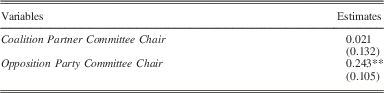
In the online appendix, we provide the full results from our analysis. For simplicity, because there are interactions in the model (as noted earlier) between each committee chair indicator and the chair’s policy distance from the proposing minister, in Table 1 we present the committee chair effects when the bill under consideration is set at its median sample value in terms of the distance between the chair and the minister.Footnote
36
First, we see that, counter to the coalition policing hypothesis, it does not appear to be the case that control of a committee chair by a coalition partner (rather than the minister’s party, the baseline category) results in more extensive changes to a draft bill. That is, holding a committee chair does not appear to ‘boost’ the ability of coalition partners to police hostile ministers. At the same time, of course, this does not imply that committee scrutiny is not central to intra-coalition policing. As the results in the online appendix show, the positive effect of Distance between the Minister and the Coalition Compromise indicates that increasing policy disagreement between a minister and his coalition partners makes it more likely that the minister’s bill will be altered extensively in the legislative review process. This is consistent with the prevailing view that parliaments with strong committee systems are an important arena for parties in multiparty governments to manage their internal policy tensions.Footnote
37
However, the results here suggest that the ability to do so is not notably strengthened by control of the committee chair.
Table 1Effects of Committee Chairs on the Extent of Changes to Government Bills
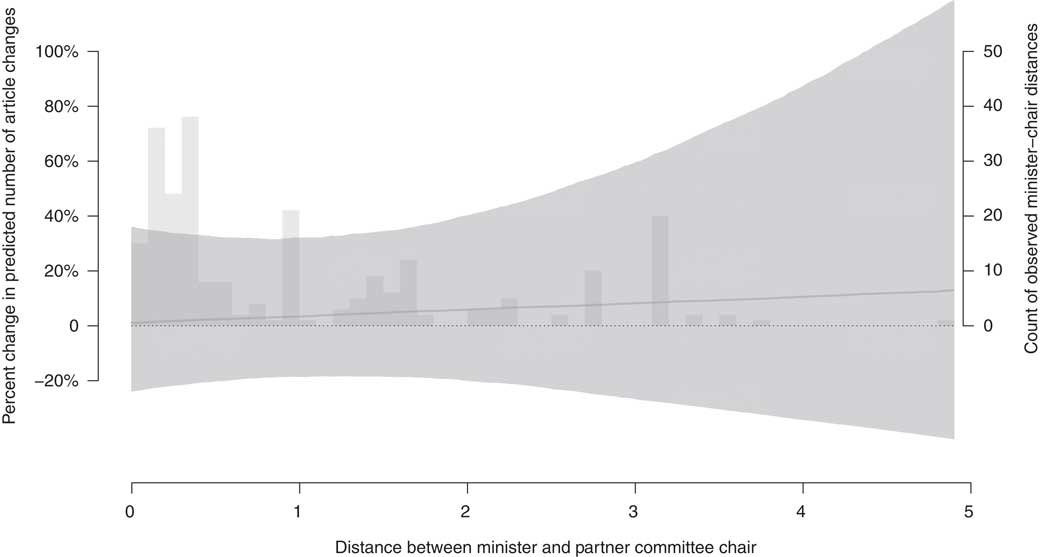
We illustrate this finding in more detail in Figure 1, which shows the substantive impact of a coalition partner holding a committee chair (along with 95 per cent confidence bounds) on the extent of changes made to a bill. We display this effect across the full sample range of policy divisions between a partner chair and the proposing minister. The left vertical axis represents the percentage increase/decrease in the predicted number of article changes when a coalition partner (rather than the minister’s party) chairs the committee. The histogram shows the distribution of bills across distance values.Footnote
38
Fig. 1Effect of coalition partner committee chairs on expected changes to government bills
As the figure makes clear, a bill is predicted to experience essentially the same amount of change regardless of whether the party of the proposing minister or the minister’s coalition ally chairs the committee reviewing it. This lack of difference between the chairs has two possible explanations. Either we are incorrect in our claim that committee chairs have significant prerogatives that can allow them to enhance the influence of their own party and limit the ability of parties with opposing interests to affect policy, or committee chairs do have these prerogatives, but government parties are constrained from being able to use them within the coalition – that is, the party associated with the proposing minister, if it also controls the relevant committee, does not use the power of the chair to prevent its coalition partners from scrutinizing and amending the minister’s bill.
Our second key finding from Table 1 strongly favors the latter explanation, suggesting that the party that chairs the committee can (and does) use its procedural influence to scrutinize government policy. Specifically, we see that legislative review by a committee chaired by an opposition party (when dealing with a bill at the median level of policy divisions between the chair and minister) results in more extensive changes to a draft bill than review by a committee chaired by the minister’s party. This finding is clearly consistent with the argument that opposition parties can use the agenda-setting powers of the committee chair to push for greater scrutiny of government bills, while the minister’s party can use those powers to suppress scrutiny.
Thus we see a difference between how government parties and opposition parties use the chair position. Consistent with the attenuation hypothesis, the impact of having a coalition partner chair the committee is smaller than the impact of having an opposition party as chair (the conditional coefficients in Table 1 are statistically distinguishable at p<0.10). As we have argued, this should be the case because there are substantial costs that can accrue to the minister’s party for openly denying coalition partners the opportunity to effectively scrutinize her policy proposal. The costs to the minister’s party are much lower (if not altogether absent) for impeding parties in the opposition in a similar manner.
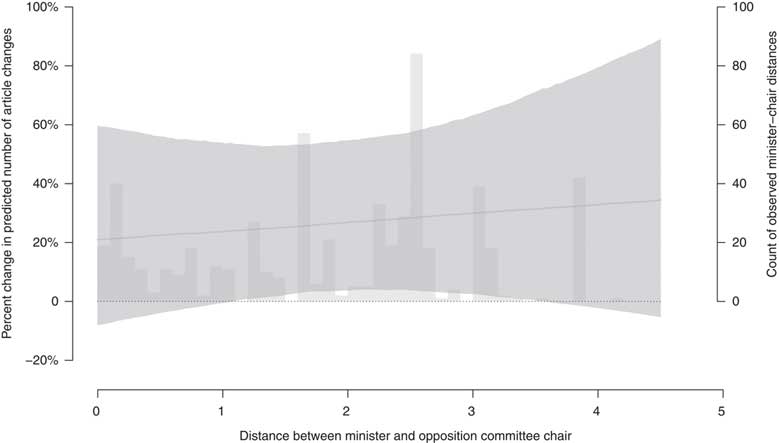
To explore the opposition party findings in more detail, Figure 2 displays the substantive impact of an opposition party committee chair on the extent of bill change across the full sample range of distances between the chair and the minister.Footnote
39
This figure reveals two interesting nuances about the effect of an opposition party chair. First, the effect is more or less constant (a 20–35 per cent increase in the number of articles changed) regardless of how divided the chair is from the proposing minister. Secondly, the impact is statistically discernible for approximately two-thirds of the bills reviewed by an opposition party committee chair (in the range of divisiveness between approximately 1.1 and 3.6), but not for bills in which policy distance from the minister is either very low or very high. This is not particularly surprising: opposition party chairs have little motivation to scrutinize bills dealing with non-contentious issues, and while they do have reason to scrutinize highly contentious bills, there are very few bills in the sample (less than 10 per cent of all legislation) that are reviewed by opposition party chairs who are ideologically distant from the proposing minister.
Fig. 2Effect of opposition party committee chairs on expected changes to government bills
CONCLUSION
Scholars of the US Congress have long known that chairs of powerful legislative committees are prizes that provide those who secure them with significant influence.Footnote
40
In this study, we extend the analysis of committee chairs to legislatures in parliamentary democracies. The literature on parliamentary systems has emphasized the role of powerful legislative committees in providing opposition parties with policy influence, and in allowing parties that participate in coalitions to use the legislative process to ‘keep tabs’ on ministers associated with their partners.Footnote
41
However, little is known about the extent to which both of these functions depend on who chairs the relevant committees. Of course, it is intuitive that it matters which party chairs a committee. It is precisely for this reason that scholars have used the proportional distribution of chairs to opposition parties as a sign of opposition influence,Footnote
42
and have investigated whether coalition parties systematically secure committee chairs that ‘shadow’ their partners.Footnote
43
However, to the best of our knowledge, this study is the first to trace the impact of partisan control of committee chairs on legislative scrutiny.
Analysis of the legislative treatment of more than 1,000 government bills across three legislatures provides evidence that control of legislative committee chairs significantly enhances the ability of opposition parties to have an impact in the legislative process. Controlling for a wide array of factors known to affect the degree to which ministerial draft bills are changed in the legislative process, opposition control of relevant committees significantly increases the extent to which draft bills are scrutinized as they undergo legislative review. Moreover, while our results affirm that strong committees appear to serve an important intra-coalition policing function – as evidenced by the fact that the degree of policy division between ministers and their coalition partners is a strong predictor of bill change – we do not find that control of committee chairs further enhances the ability of partners to scrutinize bills effectively. Our interpretation of this finding is that, within a coalition, the need to maintain co-operative relations prevents committee chairs associated with a minister’s party from using their discretion to limit the ability of their coalition partners to scrutinize draft bills. In their relations with opposition parties, chairs from the minister’s party are less constrained. As a result, the ability of opposition parties to use strong committees to their advantage depends on whether their party chairs the committee. If opposition parties are able to secure the chairs of relevant committees, they are able to have an impact in the legislative process – a finding that underscores that securing the chairs of relevant committees is not merely a symbolic victory, but one with tangible consequences for policy making.





 $0.010{\plus}0.023(0.45)\!\approx\!0.021$
. The conditional standard error for a coefficient β
x
in a model that includes an interaction between variables x and z is
 $\sqrt {\sigma _{{\beta _{x} }}^{2} {\plus}z^{2} \sigma _{{\beta _{{xz}} }}^{2} {\plus}2z\sigma _{{\beta _{x} \beta _{{xz}} }} } $
. Thus, using the standard errors from the online appendix for these two coefficients (plus their covariance, not shown, of −0.007), the conditional standard error shown in Table 1 is
 $\sqrt {0.150^{2} {\plus}(0.45^{2} )(0.081^{2} ){\plus}2(0.45)({\minus}0.007)} \!\approx\!0.132$
.


 You have
Access
Parliaments are emblematic democratic institutions. Indeed, in parliamentary systems, legislators are usually the only national-level policy makers directly elected by citizens. Ironically, until quite recently, conventional wisdom among scholars held that parliaments play a negligible role in policy making. While legislatures in parliamentary systems are obviously critical to government formation and termination, they were perceived as having only a marginal influence on day-to-day policy decisions. Over the past several years, numerous studies have begun to challenge this understanding.Footnote 1 A central conclusion that emerges from this literature is that, in parliaments endowed with strong legislative committees, legislators can exercise considerable influence on policy, particularly with respect to their scrutiny of government policy proposals. Effective scrutiny is necessary for the development of feasible alternatives to government initiatives and for holding government members to account for their actions. Standing committees that correspond to ministerial jurisdictions, that have extensive investigative powers and that possess the ability to force changes to government bills enable legislators to shape the policy initiatives of cabinet ministers in significant ways.Footnote 2
Although the general importance of strong legislative committees in parliamentary systems is now well understood, we know little about the extent to which the impact of committees depends on committee leadership – that is, on the chairs who head these committees. This contrasts sharply with the literature on the US Congress, which has examined the impact of chairs extensively and has shown that they are able to use their control of the agenda to secure policy concessions and distributive benefits, as well as increase their legislative productivity and success.Footnote 3 As in the American context, chairs in parliamentary settings typically possess significant formal and informal powers that may allow them to enhance or limit the effectiveness of the committees over which they preside. Therefore it is not surprising that scholars have recently taken an interest in understanding which parties are able to secure which committee chairs – in particular, whether parties in coalition governments systematically appoint committee chairs to ‘shadow’ ministries held by their partners.Footnote 4 However, while these studies have increased our knowledge about who is likely to chair legislative committees, they have not explored whether these committee chairs have a meaningful impact on policy making: Does the ability of legislators to take advantage of strong legislative committees to scrutinize policy proposals depend on who serves at the head of these committees? Answering this question is of obvious importance in understanding the nature of representation in parliamentary systems. If committee chairs are significant in shaping the impact of committees, then the effectiveness of political parties in the legislative process depends, in part, on securing leadership positions on relevant committees.
Our purpose in the current article is to begin answering that question. First, we develop a theoretical argument that suggests that control of committee chairs enhances parties’ ability to scrutinize government policy proposals, and that this effect will be particularly pronounced for parties in the opposition. We then examine the legislative treatment of 1,100 government bills in three parliamentary democracies – Denmark, Germany and the Netherlands – to test this argument. Consistent with our expectations, we find that when an opposition party controls the chair of the committee responsible for reviewing a government bill, the bill is changed more extensively in the legislative process. We find no evidence of a similar ‘boost’ for cabinet parties.
Beyond their immediate implications for the impact of committee chairs, these findings are also significant for our understanding of the role and significance of opposition parties in parliamentary systems. Seminal work on parliamentary institutions and democratic representation has argued that strong committee systems enhance the impact of opposition parties on policy making. Most notably, both Strøm and Powell argue that strong committee systems provide opposition parties with significant opportunities to shape legislation.Footnote 5 In contrast to these theoretical expectations, Martin and Vanberg, studying the legislative scrutiny of government bills in parliamentary democracies, find little evidence of policy influence by opposition parties.Footnote 6 Instead, their analysis suggests that strong committee systems enable government parties to affect legislation introduced by ministries controlled by their coalition partners. Importantly, however, Martin and Vanberg do not investigate whether the partisan identity of committee chairs matters. Our results suggest that failing to account for party control of committee chairs masks opposition influence that becomes apparent when this factor is taken into account.
COMMITTEE CHAIRS AND LEGISLATIVE REVIEW
The internal organization of most modern legislatures features the extensive use of committee systems. The precise nature of committees, including their powers, varies considerably across national legislatures. Broadly speaking, scholars distinguish between strong committee systems that generate the potential for meaningful legislative scrutiny and weak systems that lack sufficient institutional resources for such scrutiny.Footnote 7 Strong committee systems are characterized by several features:
∙ Standing committees of limited size that correspond to the jurisdictional boundaries of cabinet ministries;
∙ Committees with extensive investigative rights, such as the right to compel testimony by ministers and civil servants, subpoena documents and commission expert reports;
∙ Committees that can offer amendments to, or even rewrite, government bills; and
∙ Rules that prevent ministers from curtailing legislative debate or vetoing proposed amendments.
Committee systems with these features are ‘strong’ in the sense that they enhance legislators’ ability to develop policy expertise, to secure relevant information and to force consideration of alternative legislative proposals they develop. Weak committee systems, conversely, lack these features, and therefore limit the capacity of legislators to offer effective input into the policy process.
Scholars have argued that strong legislative committees play a potentially significant role in parliamentary systems for at least two separate reasons. One line of argument, most prominently developed by StrømFootnote 8 and Powell,Footnote 9 is that strong committees enhance the ability of opposition parties to exercise policy influence. Thus, Powell presents evidence that expert evaluations of opposition influence are explained almost perfectly by the formal powers of legislative committees and the majority status of the cabinet.Footnote 10 For Powell, these ‘power-sharing’ effects of committees are important because they affect the overall quality of representation, or how well voter preferences (including the preferences of those who voted for opposition parties) are represented in the policy process. Strøm argues that the fact that strong committees enhance opposition influence is critical to explaining minority governments. The ability to affect policy from the opposition benches decreases the incentive for parties to enter cabinet or dismiss a cabinet with dissimilar preferences, and thus makes the formation of a minority government more likely.
A second strand of literature argues that strong committee systems play a central role in managing the tensions of multiparty governance. Given the scope and complexity of policy making in modern democracies, cabinets typically do not develop policy proposals collectively. Rather, the task of drafting initiatives is delegated to individual cabinet ministers, who have at their disposal the expertise of civil servants working beneath them.Footnote 11 While such delegation to ministers is unavoidable, it poses a challenge for coalition governments: given the need to maintain and expand their party’s electoral support, ministers have strong incentives to use their privileged position to engage in ‘position taking’ by drafting legislation designed to please core supporters, even if doing so is inconsistent with the coalition agreement or at odds with the preferences of their coalition partners.Footnote 12
Importantly, these position-taking incentives imply that ministers are motivated to introduce draft bills that reflect positions favored by their core constituents even if they expect these bills to be amended and changed in the legislative process. That is, even if the ultimate policy is a compromise that includes concessions to coalition partners, the introduction of the original bill signals that the party and minister are working on their constituents’ behalf. Because ministers can be expected to introduce bills that pull policy in the direction of their preferred policy, ‘policing’ the activities of coalition partners becomes a central and necessary task of multiparty government.Footnote 13 Scholars have shown that parties employ a variety of policing mechanisms, including the appointment of junior ministers,Footnote 14 cabinet committeesFootnote 15 and – most importantly for the present purposes – the process of legislative review. Thus, Martin and Vanberg demonstrate that in parliamentary systems with strong committee systems, the degree to which ministerial draft bills are scrutinized and amended during the legislative process can be strongly predicted by ideological divisions within the cabinet on the issues under consideration.Footnote 16
While these studies have greatly advanced our understanding of the importance of the legislative process in parliamentary systems, they abstract away from a feature that has the potential to shape how legislators can use strong committee systems – namely, partisan control of committee chairs. In most strong committee systems, chairs have formal and informal powers that may allow them to enhance or limit the legislative influence of the committees over which they preside. Consider the three legislative chambers that are the focus of our empirical analysis below: the Danish Folketing, the Dutch Tweede Kamer and the German Bundestag. All of them feature strong committee systems, and their standing orders specify similar roles for committee chairs to ‘prepare, call, and preside over committee meetings, and to implement committee decisions’.Footnote 17
In practice, these vaguely defined roles often endow chairs with considerable influence. For example, in the Bundestag, committee chairs serve as the point of contact between the committee and ministries, as well as between the committee and interest groups.Footnote 18 This central ‘position of committee chair provides privileged access to information’.Footnote 19 Chairs also appoint the rapporteurs who are responsible for preparing committee deliberations and draft committee reports.Footnote 20 Further, chairs have formal control over committee hearings, and ‘are entitled – in contrast to the presiding officers of the plenary sessions – to speak on any point at any time’.Footnote 21 Taken together, these powers can place a committee chair in a powerful position. As Dach concludes, ‘the influence of a committee chair, regardless of party, in guiding and changing policy should not be underestimated. Over time, the influence of a chair on a bill, and even on an entire policy area, can be more significant than that of a minister, depending on the chair’s power, interests, and personal engagement’.Footnote 22 A number of commentators have observed that this influence is especially important for opposition parties. For example, Ismayr writes that ‘especially those committee chairs belonging to opposition parties can be of service to their parties by introducing compromise positions, allocating sufficient time for committee deliberations, or supporting requests for information or technical reports from the bureaucracy’.Footnote 23
The fact that committee chairs are in a position to shape the work of their committee suggests that the extent to which strong committees enable opposition and government parties to scrutinize legislative initiatives may depend on who occupies the chairs of relevant committees. (Indeed, this expectation is implicit in the works by Strøm and Powell, who include the proportional distribution of committee chairs to opposition parties as one component of their indices of opposition influence.) In particular, committee chairs may: (1) attempt to steer committee deliberations in ways that strengthen their own party and (2) attempt to limit the ability of parties with opposing interests to scrutinize and affect legislation within the jurisdiction of their committee.
Thus a committee chair who shares a minister’s party affiliation may be tempted to use her discretion to limit the ability of other parties to scrutinize and amend the minister’s bill. In contrast, if a minister’s coalition partner controls the chair of the relevant committee, the partner is in a stronger position to use committee deliberations to ‘police’ the minister. Naturally, these incentives increase with the level of policy disagreement between the chair and the minister. Similarly, when an opposition party chairs the committee reviewing a minister’s proposal, the chair has good reason to promote effective committee review, and this places opposition parties in a stronger position. Put differently, relative to a baseline situation in which the relevant legislative committee is controlled by the party of the minister introducing a bill, ministerial proposals are more likely to be subject to effective parliamentary scrutiny when the legislative committee reviewing a bill is chaired by the minister’s coalition partners or the opposition. This argument implies the following two hypotheses.
Hypothesis 1 (Coalition policing): Ceteris paribus, ministerial draft bills that are reviewed by a committee chaired by a coalition partner will be subjected to greater scrutiny during the legislative review process than bills reviewed by a committee chaired by the party of the proposing minister. This effect will be greater for bills dealing with issues on which the minister and the coalition partner committee chair are highly divided.
Hypothesis 2 (Opposition impact): Ceteris paribus, ministerial draft bills that are reviewed by a committee chaired by an opposition party will be subjected to greater scrutiny during the legislative review process than bills reviewed by a committee chaired by the party of the proposing minister. This effect will be greater for bills dealing with issues on which the minister and the opposition party committee chair are highly divided.
The central logic behind these expectations is that chairs can use their powers to steer committee deliberations in ways that enhance the legislative effectiveness of their own party and limit the effectiveness of parties with opposing interests. This latter (negative) power of chairs introduces an additional consideration: using the chair’s powers to limit other parties is potentially costly. Parties that feel that their opportunities to scrutinize policy are being abrogated by the manner in which the chair is conducting the committee’s business may object and, if necessary, attempt to punish chairs and the parties to which they belong. The opportunities to retaliate against chairs who engage in this behavior are significantly higher within a coalition. To govern effectively, coalitions must maintain sufficiently co-operative relations among their member parties. Attempts by the party of the proposing minister to deny a coalition partner the opportunity to scrutinize a draft bill during the committee stage may jeopardize the internal harmony of the government, and induce the coalition partner to engage in various forms of ‘punishment’ (such as obstructing the policy actions of the minister’s party at the cabinet level or, in the extreme, withdrawing from the government). These concerns are (largely) absent from the relations between the minister’s party and the opposition. Put differently, all else being equal, a committee chair associated with the party of the proposing minister should feel less constrained in using her prerogatives in her interactions with opposition parties than in her dealings with her coalition partners. One implication of this is that the ‘boost’ in effective committee scrutiny that derives from control of a committee chair is more pronounced for opposition parties than for coalition partners: coalition partners are in a good position to scrutinize a minister’s bill even when the minister’s party chairs the committee, because it is costly for the chair to exercise her discretion in a way that limits the influence of coalition partners. In contrast, chairs affiliated with government parties feel less constrained in limiting opposition influence, and therefore, the ability of opposition parties to exercise meaningful influence may be significantly enhanced by control of committee chairs. This leads to our final hypothesis.
Hypothesis 3 (Attenuation): The impact of committee chair control on legislative scrutiny is more pronounced for opposition parties than for coalition partners.
DATA AND ANALYSIS
Because our hypotheses concern the impact of legislative committee chairs on the extent of legislative scrutiny, we focus our empirical analysis on legislatures with institutional structures and procedures that provide parties with meaningful opportunities to scrutinize legislation. As we discussed earlier, such parliaments generally have numerous standing committees of moderate size, with jurisdictions corresponding to those of government ministries, and the means to effectively gather information relevant to the policy issues under consideration. Such parliaments also typically have procedures in place that allow parties to make changes to government bills even if the minister opposes them. In recent work, Martin and Vanberg construct an original dataset that tracks the legislative histories of over 1,000 government bills from three parliamentary democracies with legislative chambers meeting these institutional criteria: Denmark (1984–2001), Germany (1983–2002) and the Netherlands (1982–2002).Footnote 24 We draw on these data for the current study and add new information pertaining to the committees reviewing these bills, the partisan affiliation of their chairs, and the policy divisions between the chairs and the proposing minister. Our final sample consists of 1,100 government bills.
Our dependent variable must measure the extent to which these government bills are scrutinized by legislators during the period of parliamentary review. Although one could imagine several reasonable measures of legislative scrutiny (for example, the number of committee hearings scheduled for a bill, the number of expert witnesses invited to testify in those hearings, and the amount of time that passes between bill introduction and passage), we focus on one measure in particular, collected by Martin and Vanberg,Footnote 25 which serves as a good proxy for the amount of effort legislators put into the review process: the number of articles and sub-articles in a bill that have been altered, added or deleted between the bill’s introduction and its conclusion in the lower legislative chamber.Footnote 26 As outlined above, the position-taking incentives of ministers imply that the draft bills introduced by them are likely to reflect positions favored by the core constituencies of the minister’s party, and to deviate from the coalition compromise. As a result, in cases where legislators have devoted significant attention to gathering information about the consequences of a bill and investigating possible alternatives, we should see more extensive alterations (as legislators not affiliated with the minister’s party attempt to ensure that the final policy reflects their party’s preferences) than for cases in which legislators have engaged in minimal levels of scrutiny.
Our central task is to investigate whether the number of changes made to a government bill in the legislative process is greater when the parliamentary committee reviewing the bill is chaired by a coalition partner of the proposing minister (as suggested by the coalition policing hypothesis) or when it is chaired by a party from the opposition (as suggested by the opposition influence hypothesis), and whether the bills are changed more extensively as the level of policy disagreement between these committee chairs and the minister increases. We must also investigate whether the impact of holding a committee chair is greater for opposition parties than for coalition partners (as suggested by the attenuation hypothesis). For each bill in the sample, we have recorded whether the committee chair reviewing the bill belongs to the party of the proposing minister, to one of the minister’s coalition partners or to a party in the opposition. Of the 1,100 bills in our sample, 270 (25 per cent) were reviewed by committees chaired by a legislator from the same party as the minister, 244 (22 per cent) were reviewed by committees chaired by a legislator from one of the minister’s coalition partners and 586 (53 per cent) were reviewed by committees chaired by a member of the opposition. Based on this information, we construct two dichotomous indicators, Coalition Partner Committee Chair and Opposition Party Committee Chair. When both indicators are zero, the bill was reviewed by a committee chair from the same party as the minister.
To measure policy divisions between the proposing minister and relevant committee chair, it is first necessary to identify the policy issues dealt with in each bill, since party positions on these issues, and the importance parties place on them, vary significantly.Footnote 27 Martin and Vanberg have classified each bill in their dataset into one of five conceptually distinct policy areas: tax and welfare policy, industry and markets policy, social (morality) policy, regional policy and environmental policy.Footnote 28 These areas correspond to the five policy areas that are common to the expert surveys of party policy preferences conducted by Laver and Hunt and Benoit and Laver.Footnote 29 In each of these surveys, country specialists placed the leadership of political parties on positional scales in the five policy areas, and indicated the saliency of each policy area for the parties. Our measures of the policy divisions between the proposing minister and the committee chair reviewing a bill – Distance between the Minister and Coalition Partner Committee Chair and Distance between the Minister and Opposition Party Committee Chair – are simply the (absolute) policy distance between the chair’s party and the minister’s party on the issue dimension associated with the bill, weighted by both the saliency of the issue dimension to the committee chair’s party and the proportion of committee seats this party controls (which, for the three legislatures in this study, is roughly proportional to the party’s overall proportion of legislative seats). Note that each of these variables is implicitly interacted with the corresponding dichotomous variables discussed above (that is, they can only take positive values when the chair is from a coalition partner party or an opposition party, respectively).
There are, of course, a number of additional factors that are likely to impact the extent to which a bill is altered in the legislative process that we wish to control for in the empirical analysis. First, using the recent study of Martin and Vanberg, we include their central theoretical variable of interest, Distance between the Minister and the Coalition Compromise.Footnote 30 As Martin and Vanberg argue, if coalition partners use the legislative review process to contain ministerial policy drift (that is, to ‘police the coalition bargain’), then ministerial proposals should be changed more extensively when they deal with issues on which the proposing minister and the partners highly disagree. Martin and Vanberg measure the coalition compromise position in a given policy area as the seat-weighted, saliency-weighted average position of the government parties. Then, for each bill, they calculate the absolute distance between the position of the coalition compromise in the associated policy area and the party position of the proposing minister.Footnote 31
We also account for the level of preference divergence between the minister and the opposition. As Martin and Vanberg point out, if opposition parties are generally able to effectively use strong committee systems to scrutinize and amend government bills, their influence should be most apparent on bills dealing with issues on which they and the proposing minister most fervently disagree.Footnote 32 As noted earlier, their findings – which do not account for whether an opposition party chairs the reviewing committee – suggest that opposition parties enjoy no such influence in the legislative process. In our analysis, we re-examine this result by including the variable Distance between the Minister and Opposition Parties, which is simply the absolute distance between the party position of the proposing minister and the seat-weighted, saliency-weighted average position of the parties in the opposition on the issues associated with the bill.Footnote 33 In addition to these policy divergence control variables, we also take into account the number of committees to which a bill is referred (Number of Committee Referrals), which we expect should increase the number of changes made to a bill, as well as an indicator of the numerical status of the government (Minority Government) to account for the possibility that minority governments may have to allow for more policy changes than majority governments in order to garner opposition support for legislation. We also control for the Number of Articles/Subarticles in the Draft Bill, since large bills are naturally more likely to have more articles changed than small bills. Moreover, we account for the Length of Legislative Review (in days) that a bill has undergone, and we include an indicator variable, Expiration of Bill before Plenary Vote, to take into account the possibility that bills are less likely to be changed extensively if they receive a short period of review in the legislative process or do not receive a full period of review. Finally, we include the ‘fixed-effects’ indicators from Martin and Vanberg’s study, denoting the country and the issue dimensions associated with a bill.Footnote 34
Because the dependent variable is a count of the number of articles changed in a government bill, we employ an event count model in the analysis. More specifically, we use a multilevel negative binomial model in which we allow the intercept to vary randomly across the fifty-five legislative committees that reviewed the government bills in our sample.Footnote 35 We use the negative binomial to allow for overdispersion in the dependent variable, which can occur if amendments made to a bill early in the period of legislative deliberation lead to more amendments later in the process (since various sections of the bill may be related). We allow for random intercepts because we believe there is a possibility of committee-level heterogeneity in the number of changes made to government bills. Committees differ in terms of several (unmeasured) factors that might affect the degree to which they can effectively scrutinize and amend bills, such as their size, internal decision-making procedures, the expertise of their legislators and staff, and the degree of their jurisdictional overlap with ministries. These differences imply that the changes made to bills may not be independently and identically distributed. Our multilevel approach allows us to take into account the dependencies between bills that are due to committee-level differences.
In the online appendix, we provide the full results from our analysis. For simplicity, because there are interactions in the model (as noted earlier) between each committee chair indicator and the chair’s policy distance from the proposing minister, in Table 1 we present the committee chair effects when the bill under consideration is set at its median sample value in terms of the distance between the chair and the minister.Footnote 36 First, we see that, counter to the coalition policing hypothesis, it does not appear to be the case that control of a committee chair by a coalition partner (rather than the minister’s party, the baseline category) results in more extensive changes to a draft bill. That is, holding a committee chair does not appear to ‘boost’ the ability of coalition partners to police hostile ministers. At the same time, of course, this does not imply that committee scrutiny is not central to intra-coalition policing. As the results in the online appendix show, the positive effect of Distance between the Minister and the Coalition Compromise indicates that increasing policy disagreement between a minister and his coalition partners makes it more likely that the minister’s bill will be altered extensively in the legislative review process. This is consistent with the prevailing view that parliaments with strong committee systems are an important arena for parties in multiparty governments to manage their internal policy tensions.Footnote 37 However, the results here suggest that the ability to do so is not notably strengthened by control of the committee chair.
Effects of Committee Chairs on the Extent of Changes to Government Bills
Note: conditional coefficient estimates (and standard errors) from a random-intercepts negative binomial model (grouped on legislative committee). See Appendix Table 1 for the full set of coefficient estimates. N=1,100. Number of committees across countries: 55. To calculate the conditional effects, the policy distance between the minister and the committee chair is set to its median sample value (0.45 for coalition partner chairs and 2.22 for opposition party chairs). Significance levels: *10%, **5%, ***1%
We illustrate this finding in more detail in Figure 1, which shows the substantive impact of a coalition partner holding a committee chair (along with 95 per cent confidence bounds) on the extent of changes made to a bill. We display this effect across the full sample range of policy divisions between a partner chair and the proposing minister. The left vertical axis represents the percentage increase/decrease in the predicted number of article changes when a coalition partner (rather than the minister’s party) chairs the committee. The histogram shows the distribution of bills across distance values.Footnote 38
Effect of coalition partner committee chairs on expected changes to government bills
As the figure makes clear, a bill is predicted to experience essentially the same amount of change regardless of whether the party of the proposing minister or the minister’s coalition ally chairs the committee reviewing it. This lack of difference between the chairs has two possible explanations. Either we are incorrect in our claim that committee chairs have significant prerogatives that can allow them to enhance the influence of their own party and limit the ability of parties with opposing interests to affect policy, or committee chairs do have these prerogatives, but government parties are constrained from being able to use them within the coalition – that is, the party associated with the proposing minister, if it also controls the relevant committee, does not use the power of the chair to prevent its coalition partners from scrutinizing and amending the minister’s bill.
Our second key finding from Table 1 strongly favors the latter explanation, suggesting that the party that chairs the committee can (and does) use its procedural influence to scrutinize government policy. Specifically, we see that legislative review by a committee chaired by an opposition party (when dealing with a bill at the median level of policy divisions between the chair and minister) results in more extensive changes to a draft bill than review by a committee chaired by the minister’s party. This finding is clearly consistent with the argument that opposition parties can use the agenda-setting powers of the committee chair to push for greater scrutiny of government bills, while the minister’s party can use those powers to suppress scrutiny.
Thus we see a difference between how government parties and opposition parties use the chair position. Consistent with the attenuation hypothesis, the impact of having a coalition partner chair the committee is smaller than the impact of having an opposition party as chair (the conditional coefficients in Table 1 are statistically distinguishable at p<0.10). As we have argued, this should be the case because there are substantial costs that can accrue to the minister’s party for openly denying coalition partners the opportunity to effectively scrutinize her policy proposal. The costs to the minister’s party are much lower (if not altogether absent) for impeding parties in the opposition in a similar manner.
To explore the opposition party findings in more detail, Figure 2 displays the substantive impact of an opposition party committee chair on the extent of bill change across the full sample range of distances between the chair and the minister.Footnote 39 This figure reveals two interesting nuances about the effect of an opposition party chair. First, the effect is more or less constant (a 20–35 per cent increase in the number of articles changed) regardless of how divided the chair is from the proposing minister. Secondly, the impact is statistically discernible for approximately two-thirds of the bills reviewed by an opposition party committee chair (in the range of divisiveness between approximately 1.1 and 3.6), but not for bills in which policy distance from the minister is either very low or very high. This is not particularly surprising: opposition party chairs have little motivation to scrutinize bills dealing with non-contentious issues, and while they do have reason to scrutinize highly contentious bills, there are very few bills in the sample (less than 10 per cent of all legislation) that are reviewed by opposition party chairs who are ideologically distant from the proposing minister.
Effect of opposition party committee chairs on expected changes to government bills
CONCLUSION
Scholars of the US Congress have long known that chairs of powerful legislative committees are prizes that provide those who secure them with significant influence.Footnote 40 In this study, we extend the analysis of committee chairs to legislatures in parliamentary democracies. The literature on parliamentary systems has emphasized the role of powerful legislative committees in providing opposition parties with policy influence, and in allowing parties that participate in coalitions to use the legislative process to ‘keep tabs’ on ministers associated with their partners.Footnote 41 However, little is known about the extent to which both of these functions depend on who chairs the relevant committees. Of course, it is intuitive that it matters which party chairs a committee. It is precisely for this reason that scholars have used the proportional distribution of chairs to opposition parties as a sign of opposition influence,Footnote 42 and have investigated whether coalition parties systematically secure committee chairs that ‘shadow’ their partners.Footnote 43 However, to the best of our knowledge, this study is the first to trace the impact of partisan control of committee chairs on legislative scrutiny.
Analysis of the legislative treatment of more than 1,000 government bills across three legislatures provides evidence that control of legislative committee chairs significantly enhances the ability of opposition parties to have an impact in the legislative process. Controlling for a wide array of factors known to affect the degree to which ministerial draft bills are changed in the legislative process, opposition control of relevant committees significantly increases the extent to which draft bills are scrutinized as they undergo legislative review. Moreover, while our results affirm that strong committees appear to serve an important intra-coalition policing function – as evidenced by the fact that the degree of policy division between ministers and their coalition partners is a strong predictor of bill change – we do not find that control of committee chairs further enhances the ability of partners to scrutinize bills effectively. Our interpretation of this finding is that, within a coalition, the need to maintain co-operative relations prevents committee chairs associated with a minister’s party from using their discretion to limit the ability of their coalition partners to scrutinize draft bills. In their relations with opposition parties, chairs from the minister’s party are less constrained. As a result, the ability of opposition parties to use strong committees to their advantage depends on whether their party chairs the committee. If opposition parties are able to secure the chairs of relevant committees, they are able to have an impact in the legislative process – a finding that underscores that securing the chairs of relevant committees is not merely a symbolic victory, but one with tangible consequences for policy making.