Introduction
The Indo-Malayan zoogeographical region contains several hotspots of biodiversity, which also concern freshwater fish and their parasites, including tapeworms (Cestoda). More than 200 species of freshwater fish tapeworms have been described from the Indo-Malayan region (Caira et al., Reference Caira, Jensen and Barbeau2022). They include, among others, 59 and 19 caryophyllideans from Clarias batrachus (Linnaeus) and Heteropneustes fossilis (Bloch), respectively (Ash et al., Reference Ash, Scholz, Oros and Kar2011a), 54 and nine species of bothriocephalidean genera Senga Dollfus, 1934 and Ptychobothrium Lönnberg, 1889 (see Kuchta & Scholz, Reference Kuchta and Scholz2007) and 48 species of the proteocephalid genera Gangesia Woodland, 1924 and Silurotaenia Nybelin, 1942 (see Ash et al., Reference Ash, Scholz, de Chambrier, Brabec, Oros, Kar, Chavan and Mariaux2012). However, most of these taxa are invalid, having been poorly characterized and not reliably differentiated from previously known species and genera (Caira et al., Reference Caira, Jensen and Barbeau2022).
The taxonomic situation is especially deplorable in caryophyllideans, a lineage of non-proglottized tapeworms that represent one of the earliest diverging groups of these helminths (Waeschenbach et al., Reference Waeschenbach, Webster and Littlewood2012). For example, Ash et al. (Reference Ash, Scholz, Oros and Kar2011a) critically reviewed caryophyllideans of C. batrachus in the Indo-Malayan region. Based on the evaluation of new and properly fixed material, the authors recognized as valid (and redescribed) only eight species of five genera of a single family, rather than as many as 59 species of 15 genera of three families described by several researchers by 2010. A single species, Lytocestus indicus (Moghe, 1925), which has a very peculiar morphology and can hardly be misidentified with any other caryophyllidean, was described under 24 different species names in seven (sic!) genera (see Ash et al., Reference Ash, Scholz, Oros and Kar2011a). A most comprehensive molecular phylogenetic study of caryophyllideans, which also included Indo-Malayan species (Scholz et al., Reference Scholz, Waeschenbach, Oros, Brabec and Littlewood2021), fully supported the taxonomic conclusions of Ash et al. (Reference Ash, Scholz, Oros and Kar2011a, Reference Ash, Scholz, Oros, Levron and Karb) and confirmed the generic placement of individual taxa from clariid and heteropneustid catfishes in the Indian subcontinent.
In contrast to extensive data on caryophyllideans from the few above-mentioned hosts, very little is known about cestode parasites of other freshwater teleosts in the Indian subcontinent. This also concerns caryophyllideans occurring in small bagrid catfishes of the genus Mystus Scopoli, 1777, which were previously placed in the genus Mystoides Mathur, Reference Mathur1992. Scholz et al. (Reference Scholz, Waeschenbach, Oros, Brabec and Littlewood2021) provided evidence that the tapeworm found in the striped dwarf catfish, Mystus vittatus (Bloch), from West Bengal, India, represents a separate lineage close to that composed of two species of Bovienia Fuhrmann, 1931 (see Scholz et al., Reference Scholz, Waeschenbach, Oros, Brabec and Littlewood2021, Fig. 1). Subsequent sampling performed by one of the present authors (A.A.) in Maharashtra made it possible to collect additional material of presumably conspecific tapeworms occurring in another host species, Mystus cavasius (Hamilton). In the present paper, these tapeworms are described as a new species and a new genus is proposed to accommodate them. In addition, the taxonomic status of caryophyllidean tapeworms placed in the genus Mystoides Mathur, Reference Mathur1992 is critically reviewed.
Material and methods
A total of 204 Mystus catfishes of three species, Gangetic mystus, M. cavasius (Hamilton), tengara catfish, Mystus tengara (Hamilton), and striped dwarf catfish, M. vittatus (Bloch), were examined from the following localities in India and Bangladesh from 2006 to 2017 (geographic coordinates are provided only for localities where tapeworms were found – see Taxonomic summary below): Dhubri (8 fish examined/0 positive), Guwahati (26/0), Jorhat (5/0) and Kaziranga (4/0) (all Assam, India); Nanded (42/4 positive) (Maharashtra, India); Baharampur (2/0), Balurghat (3/0), Farakka (6/0), Jhargram (1/0), Kolkata (1/0), Mukutmanipur (5/0), Rishra (2/0), Siliguri (85/1 positive), Sunderban (2/0) (all West Bengal, India); Durgapur (2/0), Mymensingh (10/0) (both Bangladesh).
Newly collected tapeworms were processed as described in previous accounts (e.g. Ash et al., Reference Ash, Scholz, Oros and Kar2011a). Briefly, only fresh fish hosts were examined, and tapeworms found were fixed immediately after their cleaning from the intestinal mucus by gentle flushing saline by a pipette. First, a small piece of tissue (middle portion of the body in the specimen from Siliguri, West Bengal) or complete immature specimens (tapeworms from Maharashtra) were placed in 96% molecular-grade ethanol for DNA sequencing. Thereafter, remaining parts of the body or other entire specimens were fixed in 4% hot (almost boiling) formaldehyde solution (=formalin) for morphological evaluation. Fixed specimens were stained in Mayer's carmine, cleared in eugenol (clove oil) after dehydration in an ethanol series and mounted in Canada balsam or damar gum as permanent preparations.
Four mature specimens from M. cavasius were used for scanning electron microscopical (SEM) observations. Specimens were dehydrated through a graded ethanol series, transferred to hexamethyldisilazane, dried in air, sputtered with gold (approximately 10 nm thick) (Kuchta & Caira, Reference Kuchta and Caira2010) and examined with a Zeiss Sigma-300 FE SEM (Carl Zeiss AG, Oberkochen, Germany). Eggs isolated from the distal part of the uterus of an egg-bearing specimen from M. cavasius were photographed and measured in distilled water. Drawings were made with a drawing attachment of Olympus BX-51 and BX-53F2 microscopes (Olympus Corporation, Tokyo, Japan); measurements were taken with the same microscopes using the program Quick-Photo and a stage micrometre, respectively.
Measurements are in micrometres (μm) unless otherwise stated. Scientific and common names of fish follow Froese & Pauly (Reference Froese and Pauly2021). The terminology of microtriches follows Chervy (Reference Chervy2009). Type specimens and vouchers have been deposited in the Helminthological Collection of the Institute of Parasitology, Biology Centre of the Czech Academy of Sciences, České Budějovice, Czech Republic (IPCAS) and Zoological Survey of India, Kolkata, India (ZSI).
Results
Mystocestus n. g.
Diagnosis
Caryophyllidea, Lytocestidae (sensu Scholz et al., Reference Scholz, Waeschenbach, Oros, Brabec and Littlewood2021). Small tapeworms (<10 mm), body slender, rod-like, tapering gradually towards anterior region. Scolex digitiform, without any specialized attachment structure, slightly wider than long neck, with blunt or slightly concave anterior edge. Outer and inner longitudinal musculature well-developed, formed by irregular bands of bundles of muscle fibres. Several pairs of narrow longitudinal osmoregulatory canals. Testes medullary, begin posterior to anteriormost vitelline follicles, posteriorly not reaching to cirrus sac. External seminal vesicle absent. Male and female genital pores separate, open into a shallow common genital atrium on ventral surface (corresponding to Fig. 5.23 in Mackiewicz, Reference Mackiewicz, Khalil, Jones and Bray1994). Ovary follicular, medullary, close to posterior extremity, H-shaped, with slightly pre-equatorially to equatorially situated isthmus. Seminal receptacle absent. Vitelline follicles cortical, lateral and median, variable in shape and size, with some follicles almost as large as testes, usually not reaching to ovary posteriorly (but very close in some specimens). Postovarian vitelline follicles absent. Uterus reaching anteriorly up to posterior end of cirrus sac. Uterine glands well-developed. Eggs unembryonated, operculate. Parasites of small bagrid catfishes (Mystus spp.).
Type and single species: Mystocestus anindoi n. sp.
Etymology. The new genus is named after its fish definitive host – that is, Mysto- for catfishes of the genus Mystus, and sufix -cestus, which means a tapeworm; the generic name is masculine.
Differential diagnosis
The new genus is a member of the Lytocestidae, as recently amended by Scholz et al. (Reference Scholz, Waeschenbach, Oros, Brabec and Littlewood2021), because of its simple scolex without specialized attachment organs, follicular ovary and absence of an external seminal vesicle and postovarian vitelline follicles. Molecular data also placed this new genus among lytocestids (see Fig. 1 in Scholz et al., Reference Scholz, Waeschenbach, Oros, Brabec and Littlewood2021).
Morphologically, Mystocestus is most similar to Lucknowia Gupta, Reference Gupta1961 in the shape of the body, which is elongate, slightly tapering towards the anterior end, and scolex, which is digitiform, but differs by the absence of a seminal receptacle (present in both species of the latter genus), H-shaped ovary (vs. the ovary with the posterior wings touching each other or even connected, i.e. inverted A-shaped, in Lucknowia), exclusively cortical position of vitelline follicles in the new genus (some follicles are in the medulla in Lucknowia) and by the absence of prominent osmoregulatory canals in the posterior part of the body and dense network of narrow canals in the anterior part of species of Lucknowia (main osmoregulatory canals in Mystocestus are narrow and there is no network of extensively anastomosed canals in the anterior part of the body (see Gupta, Reference Gupta1961; Ash et al., Reference Ash, Scholz, Oros, Levron and Kar2011b).
Based on molecular data of Scholz et al. (Reference Scholz, Waeschenbach, Oros, Brabec and Littlewood2021), the new genus is most closely related to Bovienia Fuhrmann, 1931, but can be easily differentiated by lateral and median vitelline follicles (exclusively lateral in species of Bovienia), the absence of a seminal receptacle (present in the latter genus) and digitiform scolex not distinctly separated by a long neck from the remaining body (vs. scolex of different shape, usually well separated by a neck; see Ash et al., Reference Ash, Scholz, Oros and Kar2011a for information on all three species of Bovienia).
Lytocestus indicus, which is one of the most common parasites of walking catfish, C. batrachus, differs by the larger size (10–29 mm), robust body, club-shaped scolex well-separated from the remaining body by a short neck, and dumb-bell-shaped ovary. Pseudocaryophyllaeus Gupta, Reference Gupta1961 can be distinguished from Mystocestus by a long and slender body with a spatulate scolex and a very long neck (see Ash et al., Reference Ash, Scholz, Oros and Kar2011a for more data).
The last Indo-Malayan lytocestid genus, Djombangia Bovien, 1926, differs from all caryophyllidean genera by a peculiar shape of the body, which is bottle-shaped, with numerous transverse grooves on lateral margins (Ash et al., Reference Ash, Scholz, Oros and Kar2011a).
Mystocestus anindoi n. g., n. sp.
Material studied
One gravid specimen (hologenophore) from the striped dwarf catfish, M. vittatus (Bloch) (IND 203/PBI-59 – sample code of a National Science Foundation-funded project of the Planetary Biodiversity Inventory programme – see Caira & Jensen, Reference Caira and Jensen2017 and Table 1 in Scholz et al., Reference Scholz, Waeschenbach, Oros, Brabec and Littlewood2021; deposited as IPCAS C-906/1), Fulbari Dam Lake, West Bengal, India, collected by T. Scholz and A. Ash on 7 March 2009; ten (two gravid and eight mature, but not egg-bearing) specimens from the Gangetic mystus, M. cavasius (Hamilton), Nerli village, Tehsil – Dharmabad, Nanded, Maharashtra, India, collected by A. Ash from 28 February to 2 March 2015.
Description
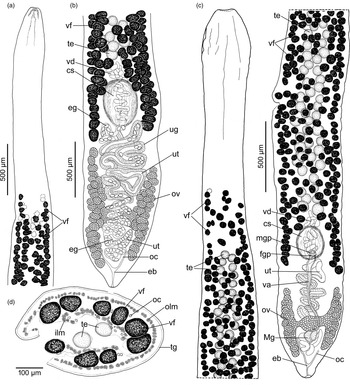
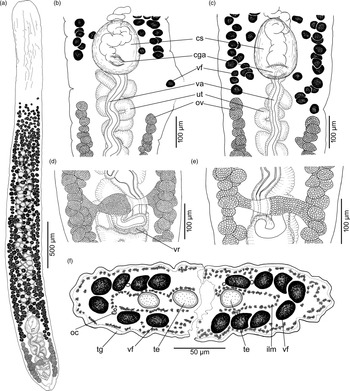
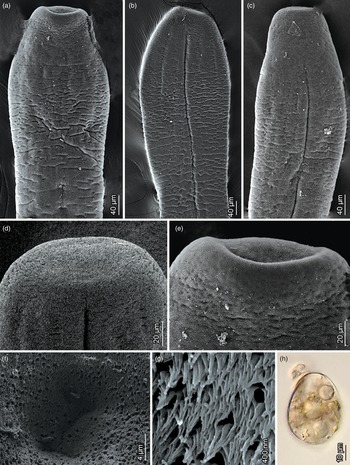
Based on whole mounts of five specimens, two slides with cross sections and four specimens used for SEM, one specimen for drawing and measuring extrauterine eggs; measurement of the holotype in parentheses; n = number of structures measured. Body long and slender, rod-like (figs 1a and 2a) 4.1–6.92 mm (>6.92 mm; n = 5) long, with maximum width 375–717 (717; n = 4) at level of anterior part of ovary (between second and last thirds of body), tapering gradually towards anterior region. Body width 275–400 (400; n = 4) at level of first vitelline follicles, 347–715 (715; n = 5) at level of cirrus sac and 259–628 (628; n = 5) at level of ovarian isthmus. Scolex digitiform (figs 1a, c, 2a and 3a–c), 300–360 (360; n = 4) wide, slightly wider than long neck 278–335 (335; n = 4) wide, with anterior edge blunt or slightly concave (figs 1a, c, 2a and 3a–e). Body surface including scolex covered with acicular filitriches (fig. 3g). Outer and inner longitudinal musculature well-developed, formed by irregular bands of bundles of muscle fibres (figs 1d and 2f). Several pairs of narrow longitudinal osmoregulatory canals present (figs 1d and 2f).
Mystocestus anindoi n. g., n. sp. from Mystus vittatus (Bloch), Siliguri, West Bengal, India – holotype and hologenophore (deposited as IPCAS C-906/1) (a, b, d), and from Mystus cavasius (Hamilton), Nanded, Maharashtra, India – paratype (deposited as IPCAS C-906/2) (c). (a) Anterior end; (b) posterior end, dorsal view; (c) total view, ventrally; (d) cross section. Abbreviations: cs, cirrus sac; eb, excretory bladder; eg, eggs; fgp, female gonopore; ilm, inner longitudinal musculature; Mg, Mehlis’ gland; mgp, male gonopore; oc, osmoregulatory canals; olm, outer longitudinal musculature; ov, ovary; te, testes; tg, tegument; ug, uterine glands; ut, uterus; va, vagina; vd, vas deferens; vf, vitelline follicles (anteriormost follicles on ventral (a), and dorsal (c), sides are illustrated by dashed line).

Mystocestus anindoi n. g., n. sp. from Mystus cavasius (Hamilton), Nanded, Maharashtra, India – paratypes. (a) Total view, ventrally (deposited as ZSI/W/10959/1/2); (b, c) male and female gonopores opening into shallow common genital atrium and region with the anterior-most ovarian follicles and posterior-most vitelline follicles; note different posterior extent of vitelline follicles in relation to the anterior extent of ovarian follicles (deposited as ZSI/W/10959/1/4 and ZSI/W/10959/1/1); (d, e) ovarian isthmus, part of ovary; note slightly swollen proximal part of the vaginal canal lacking a true seminal receptacle (deposited as ZSI/W/10959/1/2 and ZSI/W/10959/1/1); (f) cross section (deposited as ZSI/W/10959/1/5). Abbreviations: cga, common genital atrium; cs, cirrus sac; ilm, inner longitudinal musculature; oc, osmoregulatory canals; ov, ovary; te, testes; tg, tegument; ut, uterus; va, vagina; vf, vitelline follicles; vr, vitelline reservoir.

Mystocestus anindoi n. g., n. sp. from Mystus cavasius (Hamilton), Nanded, Maharashtra, India. SEM (a–g); light microscopy (h). (a, b, c) Frontal view of scoleces; note slight variations in their anterior ends; (d, e) detail of the anterior end of scoleces, with blunt and concave anterior extremity, respectively; (f) common genital atrium; (g) acicular filitriches (filiform microtriches) on the scolex; (h) egg liberated to water.

Testes medullary, 79–82 (n = 3) in number, subspherical, 39–113 long × 47–105 wide (92–113 × 84–105; n = 61). Anteriormost testes 306–1150 (>1150; n = 4) posterior to first vitelline follicles; testicular field formed by irregularly arranged longitudinal row of 1–3 testes, reaches to vas deferens close to anterior margin of cirrus sac. Cirrus sac large, widely oval, 177–447 long × 134–305 wide (447 × 305; n = 5); length:width ratio 1.11–1.47:1 (1.47:1; n = 5); width of cirrus sac represents 39–49% (43%; n = 5) of width of body. Male and female genital pores separate, open into shallow common genital atrium on ventral surface (figs 2b, c and 3f).
Ovary follicular, medullary, close to posterior extremity, H-shaped, with long and narrow lateral wings (figs 1a, c and 2a, d, e). Total width of ovary (in anterior third) 238–633 (633; n = 5), width at level of isthmus 228–553 (553; n = 5); length of ovarian wings 439–1070 (left wing, 1070; n = 5) and 405–877 (right wing, 877; n = 5); maximum width of wings 52–164 (164; n = 5); isthmus situated slightly pre-equatorially to equatorially or slightly post-equatorially, at 45–59% (45%; n = 5) of ovary length. Length of ovary representing 82–97% (85%; n = 4) of uterus area. Vagina tubular, slightly sinuous (figs 1c and 2b–e). Seminal receptacle absent (fig. 2d, e).
Vitelline follicles cortical, lateral and median, variable in shape and size, some follicles almost as large as testes, especially in posterior part of body, 17–111 long × 21–94 (51–111 × 44–94; n = 70) wide. Anteriormost vitelline follicles begin 1.00–2.19 mm (2.19; n = 4) from anterior extremity; posteriorly, follicles present alongside cirrus sac, with posteriormost follicles slightly posterior to cirrus sac, but not reaching to ovarian wings, at distance of 8–322 (54–322; n = 4; some very close to ovarian follicles, others at moderate distance) from ovary (see figs 1a, c and 2a, c for the variation). Postovarian vitelline follicles absent.
Uterus forms several loops between ovarian isthmus and posterior margin of cirrus sac (figs 1b, c and 2a–c), with well-developed uterine glands except for proximal and distal parts of uterus (fig. 1b, c). Uterus area 486–1260 (1260; n = 4) long. Eggs oval, unembryonated, operculate (fig. 3h); intrauterine eggs 46–48 long × 31–34 wide (n = 6); extrauterine eggs 47–52 long × 36–39 wide (n = 5).
Taxonomic summary
-
Type host. Mystus vittatus (Siluriformes: Bagridae), striped dwarf catfish.
-
Additional host. Mystus cavasius (Siluriformes: Bagridae), Gangetic mystus.
-
Type locality. Fulbari Dam Lake, south of Siliguri, West Bengal, India (26°38′49″N, 88°23′58″E).
-
Other locality. Nerli village, Tehsil – Dharmabad, Nanded, Maharashtra, India (18°50′41″N, 77°50′54″E).
-
Distribution. India (Maharashtra, West Bengal).
-
Site of infection. Anterior intestine.
-
Infection parameters. One gravid tapeworm found in one of 85 M. vittatus from Siliguri, West Bengal – that is, prevalence 1%, intensity of infection 1; 37 tapeworms (23 juvenile, four immature, eight mature, two gravid) found in four of 42 M. cavasius from Nanded, Maharashtra – that is, prevalence 10%; intensity of infection ranged 2 to 23 worms (mean intensity 9.3).
Type material. Holotype (hologenophore) – one mounted specimen without the middle part (used for DNA sequencing and cross section) from M. vittatus (IND 203), West Bengal, India, collected on 7 March 2009 (IPCAS C-906/1); six paratypes – four complete specimens (MS 28, 28a, 28b and 28c), one posterior part (MS 28d) and one cross section (MS 29) from M. cavasius, Maharashtra, India, collected from 28 February to 2 March 2015 (IPCAS C-906/2; ZSI/W/10959/1/1, ZSI/W/10959/1/2, ZSI/W/10959/1/3, ZSI/W/10959/1/4, ZSI/W/10959/1/ 5).
Etymology. The new species is named after Anindo Choudhury, St Norbert College, De Pere, Wisconsin, USA, for his continuous help to the present authors in studies on fish parasites.
Representative DNA sequences and phylogenetic relationships. MW027413 (ssrDNA), MW027477 (lsrDNA), MW027355 (rrnL) (Scholz et al., Reference Scholz, Waeschenbach, Oros, Brabec and Littlewood2021). Mystoides anindoi n. sp. (sample PBI-59) appears in the lineage composed of two species of species of Bovienia Fuhrmann, 1931; this clade is sister to the clade containing caryophyllideans from catfishes in the Indo-Malayan (Lucknowia spp.) and Afrotropical (Lytocestus filiformis Woodland, 1925, species of Monobothrioides Fuhrmann & Baer, 1925 and Wenyonia Woodland, 1923) realms (see Scholz et al., Reference Scholz, Waeschenbach, Oros, Brabec and Littlewood2021, Fig. 1).
Remarks
Mystocestus anindoi is the only species in Mystocestus and, therefore, different from all other known Caryophyllidea. Description of this new species is based on specimens from two host species (M. vittatus and M. cavasius) collected in two different states, at relatively distant localities in India. Conspecificity of the holotype (from M. vittatus in West Bengal), which is also a hologenophore and is thus characterized by sequences of three molecular markers (see Scholz et al., Reference Scholz, Waeschenbach, Oros, Brabec and Littlewood2021), with tapeworms from M. cavasius in Maharashtra could not be confirmed by molecular data because all attempts to obtain DNA sequences failed, most likely due to contamination of the fixative used. However, tapeworms from both hosts are considered conspecific because they share taxonomically important characteristics, which are missing in other Indo-Malayan caryophyllideans. The holotype is slightly larger than tapeworms from M. cavasius, which are, however, in earlier stages of sexual development, which explains their smaller measurements. The present authors examined more than 200 Mystus catfishes from 14 localities in three Indian states (Assam, Maharashtra and West Bengal) and two localities in Bangladesh. They found only very few caryophyllidean tapeworms, which all exhibited the same body plan and almost identical morphology, with just slight differences in scolex shape that are considered to represent intraspecific variation only.
Taxonomic history of Mystoides Mathur, Reference Mathur1992
With the aim to clarify the convoluted and still unsatisfactorily resolved taxonomy of caryophyllideans in the Indo-Malayan region, the taxonomic history of the genus Mystoides Mathur, Reference Mathur1992 is critically reviewed, with the emphasis on the validity of individual taxa placed in this genus. Type specimens of species of Mystoides were repeatedly requested by the present authors but these requests have never been answered. Therefore, data from the original descriptions were the only source of information on species of this genus.
List of genera
Mystoides Mathur, Reference Mathur1992 – unavailable genus name
The genus was proposed by Mathur (Reference Mathur1992) to accommodate Mystoides bundelkhandensis Mathur, Reference Mathur1992 from Mystus aor (Hamilton) (=syn. of Sperata aor (Hamilton)), Pahuj River in Jhansi, Uttar Pradesh, India. The genus was proposed in an unpublished PhD thesis, which does not fulfil requirements of the International Code of Zoological Nomenclature (ICZN) (1999, 2012, Articles 8, 10, 11) and, thus, the generic name becomes unavailable. In addition, the type species of the genus is indistinguishable from Lucknowia fossilisi Gupta, Reference Gupta1961, the type species of Lucknowia Gupta, Reference Gupta1961, which was redescribed by Ash et al. (Reference Ash, Scholz, Oros, Levron and Kar2011b).
Mystoides Singh, 2011 – unavailable genus name
Singh (Reference Singh2011b) proposed this genus to accommodate Mystoides nawabgangensis n. sp. from M. aor (=S. aor) from Nawabganj District, Uttar Pradesh, India in her unpublished PhD thesis. Therefore, the generic name also becomes unavailable like Mystoides Mathur, Reference Mathur1992 according to the ICZN (1999, 2012). Furthermore, its type species is conspecific with L. fossilisi from H. fossilis, type species of Lucknowia Gupta, Reference Gupta1961 (see below the list of species of Mystoides and table 1).
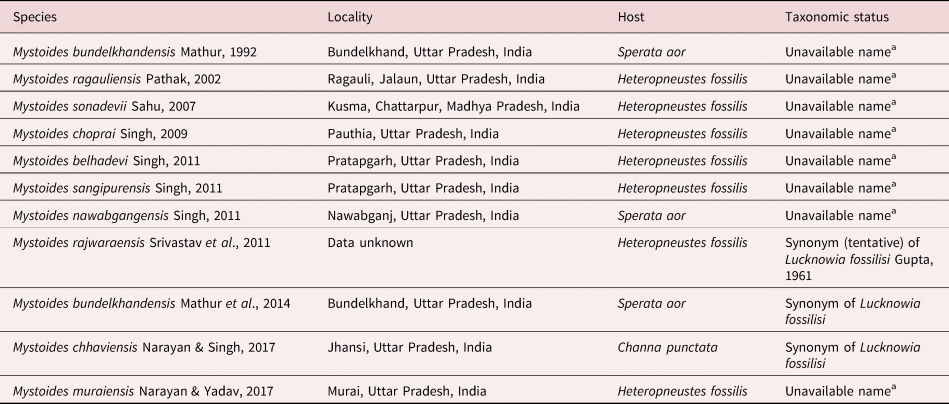
List of nominal species of cestodes (Caryophyllidea) described in the genus Mystoides.

a Morphologically indistinguishable from Lucknowia fossilisi.
List of species
Mystoides bundelkhandensis Mathur, Reference Mathur1992 – unavailable species name
Mystoides bundelkhandensis was described based on a single specimen from S. aor in an unpublished thesis of Mathur (Reference Mathur1992), which makes this specific name unavailable according to Articles 8, 10 and 11 of the ICZN (1999, 2012). This species is indistinguishable in its morphology from L. fossilisi, including shape and size of the body, digitiform scolex, distribution of vitelline follicles, reaching posteriorly alongside preovarian loops of the uterus near to the ovary, inverted A-shaped ovary (ovarian isthmus, which is present in all caryophyllidean tapeworms in the Old World, including the Indo-Malayan region, was overlooked), long uterine region, etc. Therefore, it is conspecific with L. fossilisi, a common parasite of H. fossilis.
Mystoides ragauliensis Pathak, Reference Pathak2002 – unavailable species name
This species was described from H. fossilis from Ragauli, Jalaun District, Uttar Pradesh in India in an unpublished PhD thesis by Pathak (Reference Pathak2002) and, thus, its specific name becomes unavailable according to the ICZN (1999, 2012). In addition, M. ragauliensis is indistinguishable from L. fossilisi, which occurs in the same fish host (see above and in Ash et al., Reference Ash, Scholz, Oros, Levron and Kar2011b for species-specific characteristics of the latter species).
Mystoides sonadevii Sahu, Reference Sahu2007 – unavailable species name
This species was found in H. fossilis from Chhatarpur, Madhya Pradesh, India. It was superficially described by Sahu (Reference Sahu2007) in an unpublished PhD thesis. Therefore, its specific name becomes unavailable according to Articles 8, 10 and 11 of the ICZN (1999, 2012). In addition, M. sonadevii was described based on strongly contracted and partly deformed specimens as obvious from Fig. 6a–c in the original description. Moreover, several structures were misinterpreted in morphological description: (i) damaged tissue on lateral sides of the scolex was misinterpreted as paired ‘suckers’ (sic!), even though suckers do not occur in any caryophyllidean, which are monofossate (see Olson et al., Reference Olson, Littlewood, Bray and Mariaux2001; Waeschenbach et al., Reference Waeschenbach, Webster and Littlewood2012); (ii) ovarian isthmus, which is present in all Indo-Malayan caryophyllideans, was apparently overlooked; (iii) two small swollen parts of the sperm duct (vas deferens) were misinterpreted as external and internal seminal vesicles, respectively – the former structure is never present in any Old World caryophyllidean (Scholz et al., Reference Scholz, Waeschenbach, Oros, Brabec and Littlewood2021). In fact, M. sonadevii is indistinguishable from L. fossilisi, which is a typical and common parasite of H. fossilis (see above for its characteristics).
Mystoides choprai Singh, Reference Singh2009 – unavailable species name
In his unpublished PhD thesis, Singh (Reference Singh2009) described M. choprai from H. fossilis purchased at the village of Pauthia in Hamirpur District, Uttar Pradesh, India. Therefore, this specific name is unavailable according to Articles 8, 10 and 11 of the ICZN (1999, 2012). The description is brief and illustrations are rather schematic, containing two serious errors: (i) the ovarian isthmus was overlooked and, thus, the shape of the ovary was misinterpreted (erroneously reported as U-shaped); (ii) swollen ejaculatory duct near the male gonopore was misinterpreted as an internal seminal vesicle, which could not be located in this part of the cirrus sac that contains a muscular cirrus with ejaculatory duct. However, the original description, including illustrations (Fig. 1a–d), clearly demonstrates that this species is actually indistinguishable from L. fossilisi.
Mystoides belhadevi Singh, 2011 – unavailable species name
Singh (Reference Singh2011a) described this species from H. fossilis purchased from a local fish catcher at Pratapgarh, Uttar Pradesh, India, in his unpublished thesis (Reference Singh2011a), which makes the specific name unavailable (ICZN, 1999, 2012, Articles 8, 10, 11). In addition, the specimens of M. belhadevi are indistinguishable from L. fossilisi, even though they were apparently macerated (see Singh, Reference Singh2011a, Fig. 1a, b) and original description contains obvious errors such as the alleged presence of suckers in the scolex (sic!) or absence of an ovarian isthmus (see section Mystoides sonadevii Sahu, 2007 for more details).
Mystoides sangipurensis Singh, 2011 – unavailable species name
This species was described from H. fossilis from Pratapgarh, Uttar Pradesh, India, by N.K. Singh in his unpublished thesis (Reference Singh2011a). Thus, this species name becomes unavailable based on Articles 8, 10 and 11 of the ICZN (1999, 2012). Moreover, M. sangipurensis possesses the characteristics specific of L. fossilisi (see Ash et al., Reference Ash, Scholz, Oros, Levron and Kar2011b), such as unspecialized, digitiform scolex not clearly distinguished from a long neck, inverted A-shaped ovary (Singh, Reference Singh2011a apparently overlooked the ovarian isthmus, which is always present in all Indo-Malayan caryophyllideans – Ash et al., Reference Ash, Scholz, Oros and Kar2011a, Reference Ash, Scholz, Oros, Levron and Karb; Oros et al., Reference Oros, Ash, Brabec, Kar and Scholz2012) and a long preovarian uterine area, with the cirrus sac situated at a long distance from the ovary.
Mystoides nawabgangensis Singh, 2011 – unavailable species name
In her unpublished PhD thesis, Singh (Reference Singh2011b) described M. nawabgangensis based on a single specimen from M. aor (=S. aor) from Nawabganj District, Uttar Pradesh, India. Therefore, the specific name becomes unavailable according to Articles 8, 10 and 11 of the ICZN (1999, 2012). Moreover, the description and figures of this single specimen are identical to that of M. bundelkhandensis Mathur, Reference Mathur1992 and seem to have been compiled from Mathur (Reference Mathur1992) (compare plate 3 in Singh, Reference Singh2011b with plate 4 in Mathur, Reference Mathur1992 and very similar measurements of both species). It is obvious that M. nawabgangensis is also indistinguishable from L. fossilisi.
Mystoides rajwaraensis Srivastav et al., Reference Srivastav, Singh and Narayan2011 – probable new synonym of L. fossilisi Gupta, Reference Gupta1961
Mathur et al. (Reference Mathur, Srivastav and Narayan2014) and Narayan & Singh (Reference Narayan and Singh2017) listed this species, which was described by Srivastav et al. (Reference Srivastav, Singh and Narayan2011 – the original description was not available to the present authors despite intensive literature search and requests to the taxon authors) from the stinging catfish, H. fossilis, in India, in their comparative tables with diagnostic characters of species placed in Mystoides (see the following two sections). Based on morphological characteristics of M. rajwaraensis provided in these tables, this species is most likely another synonym of L. fossilisi, a common and specific parasite of this catfish (Ash et al., Reference Ash, Scholz, Oros, Levron and Kar2011b).
Mystoides bundelkhandensis Mathur et al., Reference Mathur, Srivastav and Narayan2014 – a new synonym of L. fossilisi Gupta, Reference Gupta1961
Mathur et al. (Reference Mathur, Srivastav and Narayan2014) described for the second time the same species, M. bundelkhandensis, based on a single tapeworm found in M. aor (syn. of S. aor) from Uttar Pradesh, India, as she did 22 years ago in her unpublished PhD thesis. However, this species is indistinguishable from L. fossilisi. Both species are characterized by a long and slender body (length of 37 mm according to Mathur et al., Reference Mathur, Srivastav and Narayan2014; 15–45 mm according to Ash et al., Reference Ash, Scholz, Oros, Levron and Kar2011b), tapering gradually towards the anterior end, a digitiform, simple scolex not clearly distinguished from a long neck (constriction considered by Mathur et al., Reference Mathur, Srivastav and Narayan2014 and illustrated in their Fig. 1a is apparently artificial because a similar constriction has never been observed in any caryophyllidean – see Mackiewicz, Reference Mackiewicz1972, Reference Mackiewicz, Khalil, Jones and Bray1994), posteriormost testes do not reach to the level of the cirrus sac, the ovary is inverted A-shaped (Mathur et al., Reference Mathur, Srivastav and Narayan2014 apparently overlooked the ovarian isthmus, which is always present in all Indo-Malayan caryophyllideans – Ash et al., Reference Ash, Scholz, Oros and Kar2011a, Reference Ash, Scholz, Oros, Levron and Karb), male and female genital pores are separate, opening into a shallow genital atrium, preovarian vitelline follicles do not reach the ovary, but reach posterior to the cirrus sac, a preovarian uterine area is long and the cirrus sac is situated at a long distance from the ovary. Therefore, M. bundelkhandensis becomes a junior synonym of L. fossilisi and S. aor becomes a new host of this tapeworm, although it may be just an accidental host.
Mystoides chhaviensis Narayan & Singh, Reference Narayan and Singh2017 – a new synonym of L. fossilisi Gupta, Reference Gupta1961
Narayan & Singh (Reference Narayan and Singh2017) described M. chhaviensis from the spotted snakehead, Channa punctata (Bloch) (Anabantiformes: Channidae), from Parichha Dam, Jhansi District, Uttar Pradesh, India. Its morphological description was brief and illustrations very small, not showing necessary details. The authors misinterpreted the swollen sperm duct as an internal seminal vesicle (never present in Indo-Malayan caryophyllideans from catfishes – Ash et al., Reference Ash, Scholz, Oros and Kar2011a, Reference Ash, Scholz, Oros, Levron and Karb) and overlooked the ovarian isthmus, thus reporting erroneously the ovary as U-shaped (such an ovary has never been found in any caryophyllidean from the Old World – Mackiewicz, Reference Mackiewicz, Khalil, Jones and Bray1994). Based on the shape of the body (rod-like, slightly tapering towards the anterior ends) and its size (total length 20.1–22.5 mm), a simple, digitiform scolex, which is not clearly distinguished from a long neck, shape of the ovary with posterior wings joined (inverted A-shaped ovary) and a long uterine region lined with a few vitelline follicles, this species is indistinguishable from L. fossilisi. Therefore, M. chhaviensis becomes a new synonym of L. fossilisi, which was also reported from another snakehead, Channa striata (Linnaeus) – see Ash et al. (Reference Ash, Scholz, Oros, Levron and Kar2011b). However, snakeheads are most likely postcyclic or incidental hosts of this tapeworm due to predation.
Mystoides muraiensis Narayan & Yadav, Reference Narayan and Yadav2017 – unavailable species name
Narayan & Yadav (Reference Narayan and Yadav2017) described this species from H. fossilis from a village of Murai, Jhansi District, Uttar Pradesh, India. Since this species was described in a book of abstracts from a local seminar (State Level Seminar ‘Recent Trends in Zoology’), the specific name becomes unavailable based on Articles 8, 10 and 11 of the ICZN (1999, 2012). Despite a brief description, schematic illustrations (Fig. 1a–d) containing obvious errors (ovarian isthmus is missing), extremely poor microphotographs of strongly contracted worms (Figs 2a, b and 3c, d), it is obvious that M. muraiensis is conspecific with L. fossilisi found in the same species of catfish.
Discussion
The present study reports the first caryophyllidean cestode from small bagrid catfishes of the genus Mystus because none of the tapeworms previously placed in the genus Mystoides actually occurred in any of these bagrids. Even though the type species of this genus, M. bundelkhandensis, was described from catfish identified as Mystus aor (Hamilton), this fish was in fact the long-whiskered catfish, Sperata aor (Hamilton) (Froese & Pauly, Reference Froese and Pauly2021). All but two remaining species placed in Mystoides were found in the stinging catfish, Heteropneustes fossilis, of the family Heteropneustidae; one species was described from the spotted snakehead, Channa punctata (Anabantiformes) and another one from S. aor (see table 1). In addition, none of the species of Mystoides were conspecific with the tapeworms found in Mystus catfishes by the present authors. Therefore, it was necessary to describe them as a new species. Based on morphological and molecular evidence, this new species also had to be accommodated in a newly erected genus, because Mystoides became an unavailable genus name according to the ICZN (1999, 2012).
A critical review of the original descriptions of 11 species of Mystoides (no type specimens were available for scrutiny despite written requests to authors of original descriptions) also revealed that none of these taxa are actually valid for two reasons: (i) almost all species are indistinguishable from Lucknowia fossilisi, a common and typical parasite of H. fossilis, and the formally published ones become its junior synonyms (see table 1); (ii) most species were described in unpublished PhD theses and one in an abstract from a local conference – according to Articles 8, 10 and 11 of the ICZN (1999, 2012), these specific names became unavailable. Based on recent revisions of Indo-Malayan caryophyllideans, the following nine genera with 15 species, rather than hundreds of species in dozens of genera, are considered valid (numbers of species of individual genera are provided in parentheses): Bovienia (3), Djombangia (1), Lucknowia (2), Lytocestus (2), Mystocestus (1), Pseudocaryophyllaeus (2) (all family Lytocestidae); Adenoscolex (1), Lobulovarium (2), Paracaryophyllaeus (1) (all family Caryophyllaeidae) (Scholz & Oros, Reference Scholz, Oros, Caira and Jensen2017; Scholz et al., Reference Scholz, Waeschenbach, Oros, Brabec and Littlewood2021).
A recent molecular phylogenetic study on the order Caryophyllidea, which also included sequences of M. anindoi n. g., n. sp. (reported as ‘Mystoides’ sp. – sample PBI-58), revealed that Indo-Malayan caryophyllideans from siluriforms are closely related to caryophyllideans from African catfishes and elephantfishes (Mormyriformes), forming the newly circumscribed family Lytocestidae Hunter, 1927 (see Scholz et al., Reference Scholz, Waeschenbach, Oros, Brabec and Littlewood2021). This family now includes all but three Indo-Malayan caryophyllideans (Scholz & Oros, Reference Scholz, Oros, Caira and Jensen2017; Scholz et al., Reference Scholz, Waeschenbach, Oros, Brabec and Littlewood2021). Interestingly, molecular data did not reveal Indo-Malayan caryophyllideans from bagrid, clariid and heteropneustid fish as a monophyletic group. Whereas M. anindoi from bagriids is most closely related to species of Bovienia from clariids, the remaining tapeworms from Clarias batrachus form four separate lineages, and L. fossilisi from heteropneustids and L. microcephala (Bovien, 1926) from clariids group with African lytocestids of the genera Lytocestus Cohn, 1908, Monobothrioides and Wenyonia (see Scholz et al., Reference Scholz, Waeschenbach, Oros, Brabec and Littlewood2021).
The description of a new species of caryophyllidean from small bagrid catfishes (Mystus spp.), together with the recent discovery of the Indo-Malayan member of the family Caryophyllaeidae, L. longiovatum Oros et al., Reference Oros, Ash, Brabec, Kar and Scholz2012, in cypriniform fishes (Puntius spp.) in India and Bangladesh, demonstrates that fish hosts that were not studied previously by fish parasitologists may harbour interesting parasites. A serious obstacle in the necessary development of fish parasitology in the region is unfortunate and undesired practice to repeatedly examine easy-to-get and frequently studied fish hosts, such as walking and stinging catfishes (C. batrachus and H. fossilis), snakeheads, Channa spp., zigzag eel, Mastacembelus armatus (Lacepède), wallago, Wallago attu (Bloch & Schneider) and giant river catfish, Sperata seenghala (Sykes), with the principal aim to describe new taxa, without considering a handful of previously described species. The use of inappropriate methods, such as examination of dead hosts and use of decomposed or strongly flattened tapeworms, absence of histological and ultrastructural (SEM) studies, etc., is another reason why our understanding of the actual diversity of fish parasites in aquatic ecosystems of the Indo-Malayan region is still in its infancy (Scholz & Kuchta, Reference Scholz and Kuchta2017). Future studies should always combine morphological and molecular phylogenetic methods applied on properly processed material of tapeworms to provide robust data necessary for reliable assessment of the actual biodiversity of fish parasites in the Indo-Malayan region, their phylogenetic relationships and host associations.
Acknowledgements
Two reviewers provided valuable suggestions. Thanks are also due to Pradip Kumar Kar (sampling in West Bengal and Assam in 2009 and 2011) and Shivaji Prabhakar Chavan (Maharastra in 2015) for organizing sampling trips of two authors in India (T.S., A.A). The authors express their gratitude to Sumit Kumar Hira, Priyajit Chatterjee (both University of Burdwan, Burdwan), Martina Borovková and Blanka Škoríková (both Institute of Parasitology, České Budějovice) for technical help. Aditya Narayan kindly helped with searching for the literature.
Financial support
This study was partly based on a PhD thesis of the co-first author (R.B.), who received financial assistance from the Government of India as a CSIR-Junior Research Fellowship (award number 09/025 (0270)/2019-EMR-I). This study was also supported by the University Grant Commission (grant number F-30-383/2017(BSR)) and Department of Higher Education, Science and Technology and Biotechnology, Government of West Bengal (project number 279(Sanc.)/ST/P/S&T/2G-04/2017) (both to A.A.). It was also partially supported by the Institute of Parasitology, BC CAS (RVO: 60077344). Sampling trips of T.S. and A.A. to India were financially supported by the National Science Foundation, USA, project ‘A survey of the Tapeworms (Cestoda: Platyhelminthes) from Vertebrate Bowels of the Earth’ (PBI award numbers 0818696 and 0818823).
Conflicts of interest
None.
Ethical standards
The authors assert that all procedures contributing to this work comply with the ethical standards of the relevant national and institutional guides on the care and use of animals.