THE SIGEION STELE
Interest in the history of collecting in relation to European colonial expansion is growing. Recent researchers are Maja Jasanoff, who treated European collecting in the East relating to British imperial history, and Holger Hoock, who described the competition between France and Britain in the quest for antiquities.Footnote 1 Hoock claimed that the role of the British state was more important than is commonly suggested, while Jasanoff contrasted French and British collectors in India and Egypt. The “war of antiquities,” as the race for Greek, Egyptian, and Eastern artefacts is sometimes called, is predominately represented as an Anglo-French affair. An approach that interprets history as rivalry tends to exclude everyone that does not seem to be actively participating in the contest. By focusing on the acquiring countries, important perspectives have been disregarded.
Several successor states of the Ottoman Empire, including Greece and Egypt, have made claims for the repatriation of artefacts deemed important for their cultural heritage. What we usually hear of are exceptional objects, such as the Parthenon sculptures and great Egyptian art, or highly symbolic objects like the Rosetta stone. At the same time as major pieces such as these were being taken, an intense traffic of ships carrying lesser antiquities plied the Mediterranean. I believe that tracing that class of object, no longer well-known but with an exceptional and documented history, can offer new insights.Footnote 2
The cultural property debate is important, and the following discussion contributes to it.Footnote 3 Nevertheless, I will avoid explicitly discussing present ownership, restitution, and museum practices. I will also not provide an account of, for example, the “rescue and stewardship” narratives and “universal museum” arguments so common in today's debate. As soon as such themes are raised, peoples' standpoints tend to freeze, and questions that are difficult to frame in the current configuration of the debate disappear.
The stone central to this article is a stele contained in a basement room of the British Museum. The stele, a 2.31-meter-high marble shaft, is the bearer of the so-called Sigeion inscription. In the 1710s the British consul in Smyrna, William Sherard, noticed the stele outside a chapel in the small village Yenişehir. This is less than 15 kilometers from what we now call Troy near the Dardanelles in Aegean Turkey and close to the site of the ancient city of Sigeion. Sherard communicated the inscription to Edmund Chishull, who published it in 1721 (Figure 1).Footnote 4 The stele's exceptionality was immediately recognized. It is an example of the Greek alphabet, given that it was taking a definite shape and is written in so-called boustrophedon—as the ox plows—starting from left to right, with the next line following on from right to left. Few such inscriptions were known at the time and any specimen greatly sought after. It was even said to be the oldest Greek inscription in existence, and today is dated to around 550 bce. The text itself is written in two slightly different Greek alphabets and dialects, Ionian and Attic.Footnote 5 It is most probably a funerary monument, and—as is common in early Greek inscriptions—it is the stone itself that speaks. The lower script reads:
I am of Phanodikos, son of Hermokrates, of Prokonnesos; and I gave a mixing bowl [krater] with a support and a strainer for the prytaneum to the citizen of Sigeion as a memorial; if I should suffer in any way, care for me, citizens of Sigeion, and Aisopos and his brothers made me.Footnote 6
News of the stone's existence spread before the transcription was published and other travelers visited the site. Lady Mary Wortley Montagu wrote about it in her collection of letters from Constantinople and her Mediterranean travels. She saw it in 1718:
On the stone, on the left side [of the chapel], is a very fair inscription … I am very sorry not to have the original in my possession, which might have been purchased of the poor inhabitants for a small sum of money. But our captain assured us, that without having machines made on purpose, 'twas impossible to bear it to the sea-side; and, when it was there, his long-boat would not be large enough to hold it.Footnote 7
Lady Mary and her husband managed to buy a smaller inscription from inside the chapel. As soon as the boustrophedon was published, more travelers sought out the original. In 1764 Richard Chandler proposed the following strategy for the removal of the inscription:
It is to be wished that a premium were offered, and that the undertaking recommended to commanders of ships in the Levant trade. They have commonly interpreters to negociate for them, with men, leavers, ropes, and the other requisites … By a proper application of all-prevailing gold, it is believed they might gain the permission or connivance of the papas [priests] and the persons concerned. It should be done with secrecy.Footnote 8
Chandler recommended approaching the Greek priests while keeping Ottoman officials in the dark. However, both Montagu and Chandler had underestimated the difficulty; neither all-prevailing gold nor large enough boats were sufficient for the stele's removal. Sir Richard Worsley, who visited the area in 1786, wrote about another attempt to take both the stele and a bas-relief placed at the other side of the chapel entrance (Figure 2). He chiefly commented on the bas-relief:
It has been much injured by the inhabitants of the place to prevent its being taken away … an English Gentleman … had bid 400 Venetian sequins for this beautiful fragment. The Governor of the Castle had given his consent to the sale and had sent some Turks to assist the gentleman in getting it away, but they met with a violent opposition from the Inhabitants, who immediately began to beat off the heads of four of the figures out of the five, and defacing the inscription [the Sigeion stele] alleging that the reason why they would not be prevailed with to part with the fragment was that upon a former occasion they had sold a fragment, and soon after their village was infested with a dreadful plague.Footnote 9
The previously sold fragment mentioned here might well be the inscription acquired by Montagu in 1718; the plague of 1719 was one of the major outbreaks of the century.Footnote 10 Another traveler interested in the stones was the classical scholar Robert Wood, who first visited Sigeion in 1743. When he returned in 1750, he unsuccessfully tried to buy both the inscription and the bas-relief. From Wood's description of the bas-relief, it is clear that it was already damaged in 1750, thus rendering Worsley's story about the destruction questionable or of older provenance.Footnote 11
The Sigeion stele from Chishull's 1728 Antiquitates Asiaticae. Source: Uppsala University Library.

William Pars drew the relief in 1764: “It is placed as a Seat on one side of the Door of the Greek Church, which has the famous Sigéan Inscription placed for the same purpose, on the other.” Source: Uppsala University Library.Footnote 12

It was easy to visit Yenişehir as it lay on the thoroughfare toward Constantinople. Although Swedish visitors to the area were not numerous in the eighteenth century, we nevertheless have records of three Swedes inspecting the stones in 1784, 1796, and 1797.Footnote 13 Sweden enjoyed friendly relations with the Ottoman Empire for most of the century. Indeed, the Swedish travelers mentioned in the article were all connected to Sweden's diplomatic mission in Constantinople. Sturzenbecker and Berggren were legation chaplains, Asp was an envoy and Bergstedt and Åkerblad were both diplomats and scholars. Of these travelers, Åkerblad—introduced in the following sections—was exceptional in his knowledge of the Ottoman Empire, its history, and languages.Footnote 14
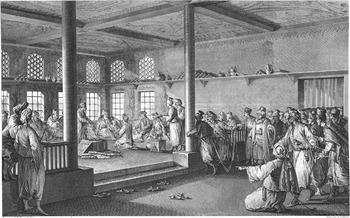
Erik Bergstedt (1760–1829) wrote on the Sigeion stele: “Count Choiseul's attempt to remove it, supported by firmans [permissions] from the Porte and with the help of [the local governor] Hassan Pasha, could not do anything against the prejudices of the village inhabitants.”Footnote 15 The French ambassador at Constantinople, Count Marie-Gabriel-Florent-Auguste Choiseul-Gouffier, tried to take the boustrophedon as well as the bas-relief of five female figures in the 1780s (Figure 3). His biographer interprets his failure as a token of his civility: “He tried to buy it but the indigenous would not part with their treasure at any price, he refused to resort to force, something that was recommended to him and that he could have done with impunity.”Footnote 16 Choiseul-Gouffier reputedly lied to the responsible Ottoman official when asking permission to remove the stones. He claimed that the inscription was connected to an ancestor of his who had participated in the crusades. When the British ambassador Robert Ainslie learned of Choiseul-Gouffier's request, he informed the official that the Sigeion inscription was much older than the era of the crusades, and that it anyhow would be very hard to find an ancestor of Choiseul-Gouffier that took part in them.Footnote 17 The rivalries in the diplomatic community in Constantinople were fierce, both for political gains in relation to the Ottoman government and in the individual quest for antiquities. Ainslie was himself a keen collector.
Choiseul-Gouffier's audience with the governor of the area where the inscription was found. The French ambassador received permission to take the stele but was thwarted by local resistance. Only when Elgin brought sufficient troops was the stele removed against the villagers' will. Source: Uppsala University Library.Footnote 18

Someone was bound to take the stele. Bergstedt again: “The English Ambassador at Constantinople Lord Elgin has been more fortunate. He … obtained … permission and assistance to remove this remarkable monument.”Footnote 19 Thomas Bruce, seventh earl of Elgin, was on his way to Constantinople in 1799 when a British military mission met him at sea in the Dardanelles. The British contingent was assisting the Ottoman forces who were fighting the French invasion of Egypt and Syria. The military surgeon William Wittman explained how the stones were taken a few days later:
On the 7th [November], at eight in the morning, I accompanied the general and officers to Koum Kali…. We there paid our respects to the Bey, Adam Oglu, governor of the four fortresses, and of the district of the Dardanelles…. The purport of our journey thither was to procure a very curious bas-relief, and the celebrated Sigæan inscription, for Lord Elgin, who had seen them, and was desirous to transmit them to England. To accomplish this, a firman was procured from the Capitan Pacha, who also furnished a chaous [courier] to be the bearer of it. We were not long in coming at these valuable antiquities, which we found at the entrance of a small Greek chapel. The Greeks, by whom the village was exclusively inhabited, were extremely averse to their being taken away.Footnote 20
Elgin thus managed to engage the Kapudan Pasha, the chief admiral of the Ottoman navy, the local governor, the commander of the British mission in Turkey, and several British officers and soldiers in his quest for the stele. According to Philip Hunt, embassy chaplain in Elgin's suit, the general was accompanied by a detachment of soldiers for protection and to transport the stones.Footnote 21 The “extremely averse” reaction of the villagers may have included physical resistance as in earlier attempts to take the stone. The Sigeion stele and the bas-relief of five female figures were the first pieces of what soon became Elgin's famous collection.Footnote 22
Some of the travelers mentioned in this article were highly accomplished scholars, and others were collectors with little interest in history or art. Their accounts and the images that accompany them are, in several cases, testimonies to now lost, or substantially changed, antiquities. Recording and collecting were often aspects of the same project, and in this context, it serves us little to try to distinguish between their different aims.Footnote 23 The goal here is not to portray them as perpetrators or saviors, but rather to understand how they reacted to, and described, local use and ideas about the antiquities they were so interested in themselves.
SUPERSTITION AND AVARICE
Contemporary literature sometimes included reports of the local inhabitants' resistance to the stones' removal. We only know how Western writers perceived this resistance. Many scholars have observed that it is not possible to represent a “pure” voice of people from other cultures, particularly those in situations of subjugation.Footnote 24 Even if we do not claim to hear the voices of the Yenişehir villagers, their attachment to the stele is obvious. Many of the descriptions contain elements which are repeated but some are probably firsthand accounts. Hunt visited the area after the stele was taken:
The sighs and tears with which the Greek priest accompanied his story did not, however, arise from any veneration he bore to the antiquity of these marbles, from any knowledge of their remote history, or any supposed relation they bore to the tale of Troy divine, but because, as he told us, his flock had thus lost an infallible remedy for many obstinate maladies … such is the state of superstition at present among the Greek Christians, that when any disease become chronic, or beyond the reach of common remedies, it is attributed to daemoniacal possession. The Papas or priest is then called in to exorcise the patient … at Yenicher, the custom was to roll the patient on the marble stone which contained the Sigean inscription, the characters of which never having been deciphered by any of their Διδασκαλοι [teachers], were supposed to contain a powerful charm. This practice had, however, nearly obliterated the inscription.Footnote 25
“Superstition” is often used to denote what the writers perceive to be foreign religious practices, and it can most easily be defined as “somebody else's religion.” James Dallaway, another British embassy priest, visited Yenişehir before the removal and described why the “Turks” were attached to the inscriptions: “The Turks assign a singular reason for the curiosity travellers discover to examine all inscribed stones, but this [the Sigeion stele] in particular, ‘that it contains an exact account of the treasures secreted under the different barrows’ [the grave mounds in the vicinity].”Footnote 26 Thus the Turkish-speaking inhabitants also invested the stele with meaning. This belief may have been strengthened by the persistent foreign interest in the inscriptions. Choiseul-Gouffier's lie—that it named an ancestor—invested the stone with a significance not wholly unlike that assigned to it by the Greek- and Turkish-speaking inhabitants.
The reuse of artefacts in new circumstances has recently been labeled “indigenous archaeology,” a term that investigates the relationship of local populations with—in a wide meaning—the archaeological record. The concept has been mostly used in the context of native peoples, but it has also been explored in the analysis of past practices.Footnote 27
The customs of local populations were sometimes noted when the object was of no interest to the collectors. John Cam Hobhouse described a ritual embraced by both the Christian and Muslim inhabitants:
Went out with B.[yr]on horseback to the Temple of Theseus and the tomb of Philoppapus. Noted, on the Right (North) of the Pnyx, a descent about a yard & a half, worn smooth & shining … This, Mr Lusieri told me, was a place where the women of Athens, Greeks & Turks, came to slide down repeatedly, in hopes that the operation would favour their production of male children.Footnote 28
Later, writing on local religious customs, Hobhouse concluded: “In fact, there is a great conformity of practice in many particulars, observable between the two nations [Greek & Turk].”Footnote 29
It was not only at Yenişehir that the local inhabitants resisted proposals for the sale or removal of artefacts against their will. The strong attachment some owners had to smaller objects was sometimes reported. The Reverend Hunt, who is best described as a touring art buyer in this context, wrote to Elgin: “At a village near Thebes, I saw an exquisite cameo of a female Centaur suckling her infant, but the peasant to whom it belongs refused 600 Piastres which I offered. Indeed I believe 2,000 would not tempt him, as he supposes the welfare of his family and flocks depends upon keeping it.”Footnote 30 At that time, 600 piastres could buy approximately 100 sheep.Footnote 31 Not even after soliciting the influence of the local bishop did he manage to purchase the cameo. However, eventually the “cameo of very exquisite beauty” was secured.Footnote 32 Hunt tried to acquire a coin in Yenişehir; “but we could not induce a peasant to sell a most beautiful little copper coin, containing on one side the full face of a female, and on the reverse two owls.”Footnote 33 Hobhouse reported from Salamis the impossibility of acquiring another cameo: “A peasant of Salamis wore on his finger a ring, mounted with a most beautiful cameo, and, though himself ready to sell it, was prevented by his wife, who regarded it as a talisman, effectual against evil spirits.”Footnote 34 Not surprisingly, women were sometimes made out to be even more superstitious than men.
Cases from Athens and especially those concerning the removal of sculpture from the Acropolis are well-known. Hobhouse recorded in his diary how local workers reacted to the removal. It was Elgin's agent Lusieri who spoke to Hobhouse:
They [the Greeks] consider that the statues antiques in Greece are men & women enchanted by some magician, & that they will at some future time recover their pristine form. Some men employ'd in loading my Lord Elgin's marbles a few days past, refused to put one of the chests on board, saying that it was an “Arabin,” or had a spirit within—and some Greeks who convey'd two busts to Captn Leake declared they heard the Arabin groan & scream most piteously within them. Some of these statues, they say, have been heard to bewail at leaving their friends & fellow marbles in the Acropolis.Footnote 35
A similar report—maybe based on the same incident—was published by Frederick S. North Douglas, whose source was “an illiterate servant of the Disdar [military governor] of Athens.”Footnote 36 Another often-cited case is the removal to Cambridge in 1801 of a female head and torso from Eleusis near Athens.Footnote 37 The local population venerated the statue as protector of their crops and regarded it a representation of Demeter (Ceres), but today it is considered a caryatid. Edward Daniel Clarke was convinced it was a Demeter when he took it; he was certainly influenced by previous authors' descriptions and the local population's beliefs.
The local priest was forced by the Turkish governor to assist Clarke. Clarke possibly also paid the priest: “the Priest of Eleusis, arrayed in his vestments as for high mass, descended into the hollow in which the Statue was partially buried, to strike the first blow with a pickaxe for the removal of rubbish, that the people might be convinced that no calamity would befal the labourers.”Footnote 38
The cultivation of local clergy was a recurrent strategy used by collectors trying to acquire antiquities that locals did not want to part with. Their cooperation was, as shown in the Sigeion case, not always guaranteed, but it can be suspected that in certain circumstances the local priesthood was not adverse to the removal of objects used in “pagan” worship. Chandler recommended dealing with the local priests, and Hunt sought the support of the local bishop in acquiring the cameo. In Eleusis the priest was instrumental to the release of the statue, and Capuchin monks in Athens received money to facilitate removals from the city.Footnote 39 The role of the clergy is a difficult issue, considering the church's ambiguous relationship to pre-Christian cults.
The Swedish Constantinople legation chaplain Jacob Berggren (1790–1868) visited the chapel in Yenişehir during his 1819–1823 posting and spoke to the old priest who still lamented the loss of the Sigeion inscription: “This marble earned pastor loci [the local priest] considerable income, in that it was believed that it could cure a variety of ailments … In this way it had been used for centuries, as a talisman of the church, and it was well that it was saved from a superstition.”Footnote 40 Berggren's account is similar to Hunt's, but he added the income earned by the priest as the main reason for his lament. It was not uncommon that travelers criticized churchmen for taking money for “magical” services.Footnote 41
The chaplains Dallaway, Hunt, and Berggren were surely aware of the rich tradition of “superstitions” in their own mainly protestant countries of origin. These did not vanish after the reformation, and a range of practices similar to those of the Greek and Turkish populations survived far into the modern age. Such practices were not restricted to popular use but were also common among the elites and often connected to objects containing texts and/or images.Footnote 42
Local inhabitants' “avarice” was sometimes associated with their superstitions. Robert Wood, who tried to acquire the Sigeion inscription and bas-relief, wrote about his 1751 visit to Palmyra, where he did his best to remove some inscribed stones: “Inscriptions we copied as they fell in our way, and carried off the marbles whenever it was possible; for the avarice or superstition of the inhabitants made that task difficult and sometimes impracticable.”Footnote 43 The locals were equally despised for either wanting to sell too expensively or for being victims of superstition and not wanting to sell at all. The collectors thus accused the inhabitants both of protecting and selling too dearly the antiquities in their areas. Superstition is often noted in collectors' and travelers' reports without giving details of what the beliefs or uses consisted of. Such accusations were part of an overall strategy to denigrate the inhabitants' resistance to removals by mixing “avarice and superstition.”Footnote 44
As a result of these foreign attempts to take the Sigeion inscription and other antiquities the local population was probably spurred into putting a higher value on them. Seeing foreign visitors covet the stones surely impacted on the locals' views of them, especially as the stones were already invested with spiritual significance. The relationship between the foreign cognoscenti's infatuation with certain artefacts and the local populations' use of and ideas about them remains elusive. A more than superficial interaction clearly emerges in, for instance, the case of the Sigeion stele and the “Demeter” statue. Nevertheless, local use, often conveniently called superstition, continues to be questioned today. A Keeper of Greek and Roman Antiquities at the British Museum recently wrote: “The reasons for this affection, [the inhabitants' reaction to the removal] as usual with antiquities, do not seem to have been engendered by any scientific sense of the sculptures' importance or even a sense of ‘national heritage’ … but rather by a mixture of superstition that their loss would bring bad luck and a belief that they were magical or contained gold.”Footnote 45
William St. Clair noted in his book on Elgin that around 1800 local resistance was not expressed as a national sentiment, and one might add that the opposite would have been surprising considering the then fledging ideas about a Greek nation.Footnote 46 But there was some “national” awareness; Hobhouse quoted the “singular speech of a learned Greek of Ioannina,” who with foresight said, “You English are carrying off the works of the Greeks, our forefathers—preserve them well—we Greeks will come and re-demand them.”Footnote 47 Greek national identity took shape throughout the nineteenth century and was partly constructed on an image of an ancient past heavily influenced by foreign philhellenism.Footnote 48
FEAR OF DESTRUCTION
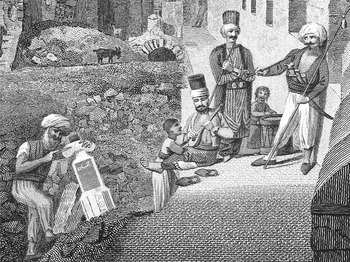
Fear of the destruction and loss of the artefacts was one of the main arguments used by collectors to justify their actions. Inscriptions and funerary monuments were subject to various dangers which were discussed by collectors. An engraving in the second volume (1787) of the influential Antiquities of Athens clearly depicted one of these fears (Figure 4).
A Turkish sculptor making a tombstone of an inscribed marble on the Acropolis. It is possible that inscribed stones were considered especially propitious for funerary monuments. Unknown writing was often invested with significance. The image on the journals' cover is William Pars' original drawing on which the print is based. Source: Uppsala University Library.Footnote 49

This scene was left without verbal description. In the next volume (1794), the situation at the island of Delos was described: “The number of curious marbles here is continually diminishing, on account of a custom, the Turks have, of placing, at the heads of the graves of their deceased friends, a marble column; and the miserable sculptors of that nation come here every year, and work up the fragments for that purpose.”Footnote 50 The custom of turning funerary monuments, like the Sigeion stele, into Turkish gravestones, “with their tops rudely carved into the shape of a turban” was well-known.Footnote 51 An Italian discovered a reverse business possibility. He identified ancient Greek fragments in Turkish graveyards and had them dug up by night and transported to Italy to remarket the stones as Greek antiquities. Turkish cemeteries have until recently been good hunting grounds for ancient marbles.Footnote 52
In 1797, the Swedish diplomat Johan David Åkerblad (1763–1819) visited the Troad for the third time. Åkerblad had been employed in the Swedish Foreign Service since 1783 and had spent most of this time in Turkey. He traveled extensively in the Eastern Mediterranean during the 1780s and spoke Arabic, Turkish, and Modern Greek well enough to be able to travel in disguise. He had an unusual understanding of Ottoman culture and politics and had observed the major powers fight for influence at the Ottoman court with skepticism. A few years later he would become one of Europe's foremost Coptic scholars, and in 1802 he gained instant fame when his dissertation on the Rosetta stele's Demotic text was published in Paris. He was an extremely gifted linguist and is today mostly known for being one of Jean-François Champollion's predecessors.Footnote 53
Åkerblad copied the Sigeion inscription and noted its bad state.Footnote 54 He was typical in assuming that it was in a much worse shape than when it had originally been published. Chishull's engraving was based on a copy made by Bernard Mould in 1722. Mould described the poor shape of the letters: “very mean & poor, a thin, shallow stroke. Especially the upper One, wch looks more like scratching than engraving.”Footnote 55 Mould's comments on the condition of the inscription already in 1722 question the commonly held belief that the locals' use of the stone had destroyed it.
There is a difference between maintaining that use had obliterated the inscription and that it had been destroyed on purpose, but the distinction is sometimes small. Robert Wood, who saw the Sigeion inscription in 1750, did not mention any damage done by the population, but claimed that another inscription he saw at Bodrum, further south, was destroyed by the “Turks” to avert it being taken: “[the inscription] now lyes in a mangl'd condition … for some Franks [Westerners] offering to purchase It the Turks defac'd & broke It on purpose to prevent its being carried away & 'tis now no longer legible.”Footnote 56 Worsley's story suggests (see n. 9) that the Yenişehir inhabitants both cut off the heads of the bas-relief and tried to obliterate the inscription to prevent its removal. As the Sigeion inscription was highly valued, it is harder to believe that the population would destroy it on purpose, but it is not impossible. Nevertheless, his and others' accounts of destruction are still often unquestioned and sometimes repeated in the debate. For instance, William St. Clair takes Worsley's account at face value as well as stating that Montagu could have bought the inscription without problems.Footnote 57 However, it should be remembered that most destruction, as well as preservation, has been done by local inhabitants or overlords. The coastal area of Sigeion was mined for centuries for building materials and marbles to adorn both local buildings and the capital.Footnote 58
Visitors from Western Europe were often equally disparaging toward the Christian and Muslim populations. Erik Bergstedt related a 1790s conversation with Louis-François-Sébastien Fauvel (1753–1838), a French consul and “art agent” in Athens. Fauvel speculated on the destruction of sculptures:
Mister Fauvel … has in Athens told me that when he copied the bas-reliefs of the friezes of the Parthenon and the Theseion temple, he appears to have found that some of the figures were mutilated by a hammer, damage that surely should be ascribed to the barbarous zeal of the Iconoclasts while the Turks certainly have not dedicated time to such a slow and difficult destruction of these monuments of Phidian art, which are located so high up that they cannot be reached and destroyed without effort.Footnote 59
Fauvel believed that the damage was the work of Christian iconoclasts, and his judgment combined ideas on Eastern Church aberrations and “oriental laziness.” Jean-Baptiste-Gaspard D'Ansse de Villoison, who traveled with Åkerblad in the Greek archipelago in 1785, put forward another religious reason for the destruction of inscriptions. They were obliterated to prevent their possible profaning of the name of the Lord, a custom “common to both Greeks and Turks.”Footnote 60 Eastern Christianity was often no more favored than Muslim customs, and believers were often collated into a single Eastern or Levantine category.
FOREIGN OBSERVERS
Before the arrival of the Parthenon marbles in Britain there had been little criticism of the removals. Interestingly, Åkerblad described the activities of Fauvel in a book published in 1800. He was scathing:
No one has destroyed more grave mounds than the French painter Fauvel. He has excavated almost all in the vicinity of Athens, Marathon and other areas…. The worst thing about it is that Fauvel has not given us the slightest notice about the remarkable items found in these venerable monuments, and that one does not even know what has become of the objectsFootnote 61
The main problem for Åkerblad was the lack of documentation during the search for objects. He recognized that the loss of context severely impaired the quest for further knowledge. The digs resembled grave robbing rather than archaeology in any modern sense. Scandinavian ideas on archaeology were influential in the seventeenth and eighteenth centuries, and the Swedish state had in 1734 instituted a law that prescribed finders of antiquities to render them to the state, which paid finders more than the metal value.Footnote 62 Åkerblad's critique may be connected to a greater sensitivity born out of a tradition where the state valued archaeological finds.
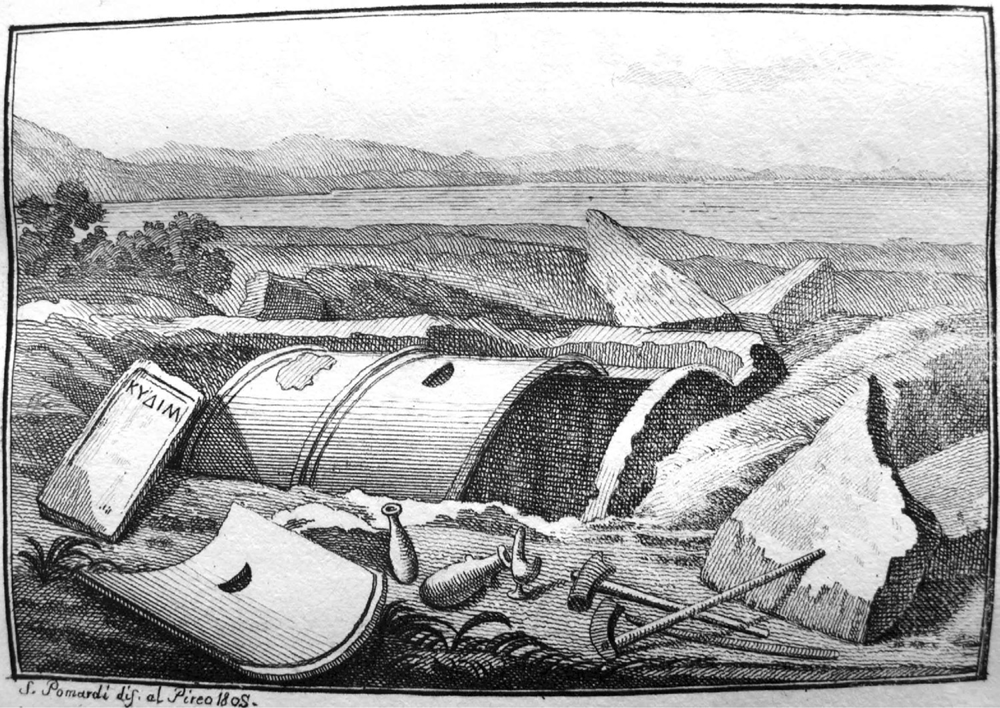
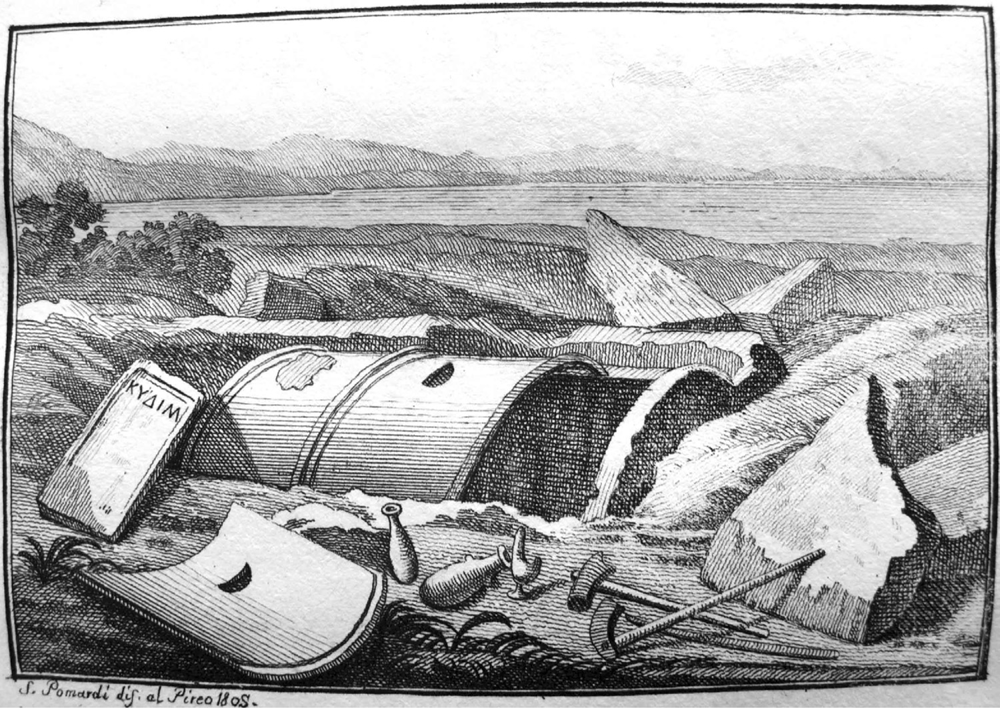
Åkerblad was critical of the practices of the great collectors just when the most famous removal of antiquities was on the verge of taking off in Greece. What makes his critique of Fauvel especially interesting is the value he puts on the artefacts as being “historical” and not only “artistic.” He regarded objects in a wider environment and stressed that removal not only affects the single monument but also implies a loss of knowledge and context. In a dissertation in 1811 Åkerblad underlined the importance of keeping finds from graves together.Footnote 63 This was especially evident in the case of inscriptions where texts give important information about the places and contexts where they are found.Footnote 64 Åkerblad was an excellent Greek epigrapher, and in 1813, he published the first ever treatment of what is now called a “curse tablet,” most often a small lead sheet, inscribed with magical invocations.Footnote 65 He was well aware of the magical powers that could be invested in inscriptions and words. The engraving Åkerblad used as frontispiece to his dissertation on Greek magical inscriptions is telling in the way it depicts archaeological tools and practices, this was one of the graves opened by Fauvel close to Athens (Figure 5). A hammer and a pickaxe rest by the broken tomb, and the objects found are exposed in front of it.Footnote 66
Frontispiece from Åkerblad's 1813 treatise illustrating the archaeological practices.
In his 1811 publication, Åkerblad commented on new finds in Athens and criticized the wrongs done there previously: “The grand staircase … was discovered some years ago by Lord Aberdeen, a small gain that can not cancel the memory of all the wrongs, that another Englishman, Lord Elgin, did to the monuments of Athens.”Footnote 67 It quickly became customary to denigrate Elgin's deeds. Åkerblad's friend Edward Dodwell had traveled in Greece in the beginning of the century but only published his travelogue 1819 when decrying Elgin was commonplace. Dodwell lambasted the “wanton destruction” by Elgin and his agents, but on the next page he proudly admitted that “The head of the male figure in the western tympanon, [of the Parthenon] … is in my possession.”Footnote 68
Åkerblad had already in 1800 commented in print on Fauvel's methods and in 1811 on Elgin's, but little critique appears in British publications before Byron attacked Elgin in 1812. Having personally seen the sites may have been an important factor. Byron had anonymously mocked Elgin in 1810, but it was only after he himself visited Greece that his critique became incisive.Footnote 69
Åkerblad lived in Rome from 1809 onwards. News was scarce as communications broke down during the final turbulent Napoleonic years. The British who arrived in Rome after the French defeat brought news on the marbles. Their pent-up lust for acquisitions was ironically described by Åkerblad: “the English milordi … all walking around with their servants carrying vases under their arms, leaving the Uggeri, Visconti, Guattani and all that bunch of antiquarians with dry mouths.”Footnote 70 He elaborated on his earlier critique in a letter written in 1816 to a Swedish friend who had seen the sculptures in London:
The marbles you have seen in London and which were barbarously taken from Greece by Lord Elgin have been bought by the English government and shall without doubt be placed somewhat more decently than how you found them. Indeed, you are perfectly right in saying that it would have been better to leave them where they were taken. The damage that the villainous Lord has done is irreparable and even his compatriots that have visited Athens after him have sworn to relegate this man to public despise and loathing. You might have seen Childe Harold by Lord Byron where he is treated as deserved.Footnote 71
SHRINES ON THE THAMES AND SEINE
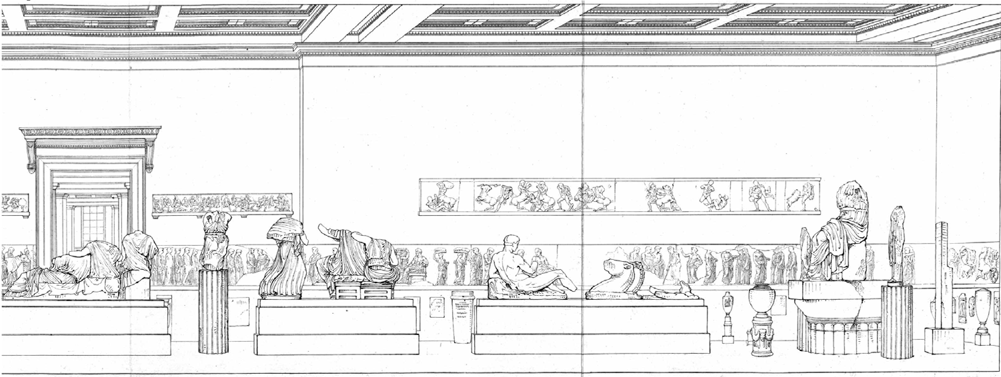
The Sigeion stele resurfaced in a temporary building in the yard of Elgin's London house. It had a prominent place in the arrangement of his collection.Footnote 72 In the complicated sale of Elgin's collection to the British government in 1816, the “artistic” artefacts were given much greater values than “historic” objects such as inscriptions.Footnote 73 Nevertheless, when the collection was exhibited in the British Museum, the stone was still given an important position (Figure 6).
Detail of a fold-out illustration of the Elgin Room. The Sigeion stele stands on a square base on the far right. Source: Uppsala University Library.Footnote 74

Soon the Parthenon sculptures became the focus of the “inner sanctum of Bloomsbury's Temple of the Muses,” and the Sigeion stele, and with it other inscriptions, were demoted to basement locations.Footnote 75 The years during which the marbles were permanently exhibited in the British Museum saw a slowing down of major removals from Greece. But removals in Ottoman territories would continue, with additional actors in the arena. Many other countries took part in the quest to fill newly founded or enlarged museums. The wholesale removal of artefacts from Egypt that started with the French invasion in 1798 escalated during the following decades. Jacob Berggren, who had been sanguine about the taking of the Sigeion inscription, was less understanding of the spoliations in Athens. But he could not help being scandalized at the extent of plunder going on when he visited Egypt in the early 1820s.Footnote 76 He questioned whether “these shrines, on the banks of the Seine and the Thames,” were better than the original locations of the monuments. Having witnessed the battles of European traders in Egypt, he conceded that it might be preferable to come from a nation that did not have any museums:
When you add to these violations against what a distant antiquity bequeathed us of greatness and beauty above earth, add the battles, between mercenary agents on the ruins of Thebes and Philes of what the tombs contain, it is better like certain countries to be without Museums, and to be content with living mummies—and antiquaries.Footnote 77
That an object's function changed when it was put into a museum was also clear to another astute observer of the movement of art and antiquities, Antoine-Chrysostome Quatremère de Quincy. He remarked in 1815, when objects that had been taken to Paris during the wars were about to return to Italy, how collecting itself took objects out of their context and altered their function: “How many works have lost their real value in losing their use! … Thus every day we see reduced to the tribute of barren admiration all the scattered mutilated fragments of antiquity—gods without altars, altars without worshippers.”Footnote 78 Could such a value also be given to an object like the Sigeion stele that had been assigned a role different from what it was made for in antiquity?
Berggren exploited the advantage of being from a poor nation such as Sweden, taking the opportunity to self-righteously criticize the greater powers for their misdeeds. Significantly, it is not the individual who is blamed, but the system, that is, collections and museums. Coming from a country lacking in great collections and virtually no museums in the 1820s, facilitated the task of criticizing others' rapaciousness. Åkerblad, who was highly critical of the large-scale removals, himself collected portable antiquities on a small scale. He never had the money, or the political backing, to acquire any major objects if he had so desired.Footnote 79 Maybe these factors—the lack of Swedish institutions and the fact that the Swedish observers could not themselves collect—were instrumental in making them see and value things differently than the great collectors? Or simply, to quote Aesop: The grapes are sour anyway, said the fox?
EXCHANGES ON VALUE AND USE
One of main themes of this article is how collectors and travelers justified their actions and how they described the local inhabitants' resistance to the removal of objects considered of religious or magical importance. The local populations repeatedly resisted removals, and the reuse of a range of objects was common. These practices existed in both the Greek- and Turkish-speaking populations. The justifications used by collectors were often based on their professed superiority; the local populations were accused of ignorance, superstition, avarice, and destruction of artefacts.
That most justifications used by the collectors were self-serving is obvious. When criticizing the local inhabitants of, for instance, superstition, they disregarded similar traditions in their countries of origin, both past and present. Many accounts are by churchmen—Dallaway, Hunt, Berggren—and many of the counterparts that facilitated the removals were local priests, both Orthodox and Catholic. There is not yet sufficient evidence to conclude to what extent such cooperation was motivated by religious concerns, but it would surely be an exaggeration to ascribe it to only money matters or pressure from the local Ottoman overlords. It was quickly understood that local churches were allies in the removal of pre-Christian artefacts that were used in religious practices.
If local populations were influenced by the collectors' interest, some of the antiquarians and collectors were probably likewise inspired by the local use of antiquities. Clarke's and previous authors' identification of the Eleusis caryatid as Demeter is an example of how there was an exchange of ideas on the identity and value of antiquities. We may also ask ourselves to what extent our own perception of objects is influenced by knowledge of their history. In the case of the Sigeion stele, does the information on the resistance to its removal compiled here change how we see it? Would this perception change again if it were to be reclaimed?
The evidence put forward here indicates that a larger element of exchange occurred between how the local population and the collectors valued and perceived the artefacts than has been commonly understood. This may be compared to how the antiquities became imbued with meaning when exhibited in Europe. Even if, for instance, Berggren's critique was laced with irony, the worship functions of European museums were noted immediately. Some observers were clear about how the removal of an object changed its context and the perception of it.
The debate today probably bears more similarity to the discussions held during the removals than what appears obvious. Though some positions have changed, the configuration of the actors as local populations, collectors, and third-party observers remains in many respects similar, even though the first two parties have changed their names to states of origin and museums and their states, and for the third party, it would be convenient—true or not—to suggest academics. We often, knowingly or unknowingly, repeat arguments that were formulated during the period of removals. In taking the accounts of the removals for granted, we might repeat early plaidoyers in the debate. It must, of course, be likewise questioned whether we can trust the evidence of local resistance. The accusation of superstition formed part of a strategy to denigrate the local inhabitants and served the collectors in their quest for antiquities. The repetition of “facts” and dubious chronologies in certain accounts render some of them questionable. However, the range of testimonies makes for convincing evidence of the local practices as well as the resistance in, for instance, the Sigeion case.
Another important theme is the role of the third-party observers, in our case the Swedish travelers. The evidence shows that it is difficult to construct a common European attitude toward the removal of antiquities. Opinions did differ in a Europe that often has been constructed as a single cultural sphere, especially in its contacts with the Orient. Both Åkerblad and Berggren had seen the sites and knew the effects of the removals. Perspectives changed, and what Berggren initially saw as the saving of the Sigeion stele could no longer be defended when he witnessed the bizarre scale of the removals from Egypt. Being observers from a country that was not involved in the “war for antiquities” gave them the possibility to see the removals from a different perspective. Could this also be true today?
The collecting of antiquities was a small but not insignificant component of European expansion in the nineteenth century. By seeing the removals largely from the perspective of the acquiring countries—and whether these countries and individuals are made out to be villains or not may not change our perceptions much—we forfeit the possibility of investigating other reactions and interactions that were prompted by the removals.