Introduction
Alloy development has traditionally been a lengthy, painstaking process, and insertion in safety-critical applications can take a decade or more from initial development to widespread adoption. This traditional path for alloy development typically involves incremental modifications to chemistry and process conditions based on a combination of expert knowledge, model-based guidance, and Edisonian experimentation. The resulting alloys are often marked improvements over previous solutions, yet they are likely not the optimal alloy design for a given application.
For insight into the possibility of improved optimization, one can turn to mechanical engineering, where increased usage of topology optimization theory is changing the design paradigm from human experts using computer-aided design (CAD) tools to, instead, the human defining the requirements and boundary conditions, and the computer algorithms automatically iterating between CAD and finite element analysis to identify optimal solutions. The results are often complex organically shaped topologies, far more efficient and intricate than traditional designs.Reference Eschenauer and Olhoff1
Translating these concepts to alloy development, one can envision a future where engineers define the requirements of the alloy (i.e., the functionality of the alloy in the operational environment), and artificial intelligence (AI) systems would identify optimal combinations of composition and processing that produce microstructures with properties far beyond conventional alloys. Ultimately, such an expert system would not just serve as the metallurgist, but also the mechanical engineer—the material, processing, and topology would be holistically optimized for both performance and cost within the limits of the manufacturing capabilities.Reference Jared, Aguilo, Beghini, Boyce, Clark, Cook, Kaehr and Robbins2 With mastery of the governing equations, all of this optimization can take place in silico without the need for experimental iteration. However, because process–structure–property relationships are so multidimensional and complex, in the foreseeable future, we must rely on iterative experimentation to inform material models on the pathway toward optimization.
Autonomy requires both the ability to act independently (automation) and the ability to react based on evolving knowledge (intelligence)—an autonomous system is an “expert” that can incorporate new information to revise a governing hypothesis and guide improvements.Reference Sparkes, Aubrey, Byrne, Clare, Khan, Liakata, Markham, Rowland, Soldatova and Whelan3 Recently, researchers from the Air Force Research Laboratory demonstrated an Autonomous Research System, which was able to optimize the growth rate of single-walled carbon nanotubes through the combination of an automated growth reactor, rapid in situ characterization, and an AI system.Reference Nikolaev, Hooper, Webber, Rao, Decker, Krein, Poleski, Barto and Maruyama4 The system utilized an AI planner to iteratively propose new experiments to optimize the process and converge on a maximum growth rate without a priori knowledge of the physical processes that control carbon nanotube growth.
As the science and engineering behind autonomy continues to mature and expand, we anticipate the translation of these capabilities into the field of metallurgy, where the aforementioned “robot metallurgists” will be employed to create and optimize alloys in less time and with better performance characteristics than previously possible. In this article, we explore emerging research toward significantly increasing the speed of alloy discovery and process optimization through the combination of automation and AI applied to the process–structure–property design paradigm. Automation is an essential component in future autonomous systems, as decreasing the human and time “cost” for iterative experimentation lowers the barrier to performing the activity, which can greatly aid in accelerating the training of AI systems that have incomplete databases in high-dimensional space. Accordingly, the US Department of Energy’s recent report on accelerated materials discovery identified “modular material robotics” as one of the five needed innovations.Reference Aspuru-Guzik and Persson5 As such, this article selectively emphasizes recent advances and gaps in processing, characterization, and testing of materials for structural applications.
Rapid synthesis and processing
Miracle and co-workersReference Miracle, Majumdar, Wertz and Gorsse6 recently discussed in detail the current state-of-the-art and upcoming challenges for high-throughput screening of structural alloys; they highlight two different stages for rapid experimental screening capabilities. The first stage considers screening, which is primarily dependent on composition and is not strongly sensitive to microstructure. For this type of screening, Zhao demonstrated the utility of diffusion multiples, where several different alloys can be combined into a single gradient test coupon, and after thermal exposure, all corresponding equilibrium intermetallic compounds and solid-solution phases can be probed.Reference Zhao7 This rich data set can be used to calibrate CALculation of PHAse Diagrams (CALPHAD) thermodynamic databases. In addition, kinetic information such as chemical diffusion coefficients can be determined, and local properties can be probed using techniques such as nanoindentation or micropillar compression. Similarly, compositional gradients can be produced via deposition techniques such as magnetron sputtering or additive processes such as laser engineered net shaping (LENS) with multiple feedstock hoppers.Reference Cooper, Zhang and McGinn8,Reference Ren, Ward, Williams, Laws, Wolverton, Hattrick-Simpers and Mehta9 Most combinatorial materials synthesis studies on metals focus on chemical variations, although there are notable exceptions that explore gradient thermomechanical processing.Reference Sinclair, Hutchinson and Brechet10
Raabe and co-workersReference Raabe, Springer, Gutiérrez-Urrutia, Roters, Bausch, Seol, Koyama, Choi and Tsuzaki11,Reference Springer and Raabe12 demonstrated rapid alloy development by casting 4-kg ingots of Fe-Mn-C-Al alloys with five distinct Al concentrations in a vacuum induction furnace for alloy screening where microstructure is controllably modified. The ingots were each subsequently subdivided into nine sections for distinct aging cycles, resulting in a total of 45 different combinations of chemistry and thermal treatment. In addition, the resurgence in additive manufacturing technologies has opened new doors for rapid, complex alloy synthesis. In addition to printing alloys with spatially varying compositionReference Hofmann, Kolodziejska, Roberts, Otis, Dillon, Suh, Liu and Borgonia13–Reference Qian, Dong, Tian, Liu and Wang15 or process conditionsReference Dehoff, Kirka, Sames, Bilheux, Tremsin, Lowe and Babu16 to achieve customizable local microstructures and properties, additive manufacturing opens the door for complex multi-material manufacturing.Reference Vaezi, Chianrabutra, Mellor and Yang17 At the University of Texas El Paso’s Keck Center for 3D Innovation, a robotic automation platform, Multi3D, integrates fused deposition molding with a computer numeric controlled routerReference Coronel18 and electronics, including sensors, wireless communication chips, and interconnects.Reference Shemelya, Banuelos-Chacon, Melendez, Kief, Espalin, Wicker, Krijnen and MacDonald19 There are several other examples of automated integration of additive and subtractive manufacturing processes.Reference Flynn, Shokrani, Newman and Dhokia20
Autonomous assessment of structure and chemistry
Characterization of the internal structure of metallic alloys is a key step in alloy development, involving observation and measurement of the obtained microstructural state after processing or throughout its intended service. The speed, fidelity, and capabilities of many types of microstructural characterization systems have significantly improved over the past half of a century via the development of new probes and sensors, and perhaps more importantly, the integration of computers with scientific instruments that enable complex automation, digital data collection, real-time post-processing, and data analysis. These changes have enabled the materials community to gradually transition from qualitative or limited quantitative analysis of data that could be performed by manual observation, to digital, data-rich methods that provide a foundation for future autonomous systems. For example, the quantitative analysis of grain microstructures has been dramatically enhanced since the mid-1990s with the development of probe-based electron diffraction-based methods such as electron backscatter diffraction,Reference Schwartz, Kumar, Adams and Field21 which are likely employed in many situations because of the high level of automation in data collection and analysis that provides statistically significant data. Concurrently, there has been development of sophisticated automated machines for single or multiple sample preparation steps by several equipment vendors. Nonetheless, the typical characterization workflow is still a highly human-guided and often labor-intensive process. In this section, we comment on selected aspects of modern characterization toolsets that should promote autonomy-based workflows for rapid, closed-loop optimization.
One of the challenges in characterization is the extreme range of structural length scales that can affect the balance of properties in alloys, ranging from features at the centimeter scale and larger in metal castings, to precipitates, dislocations, and lattice site occupancy at the nanometer-to-angstrom scales. It is beyond the scope of this article to comment on the full breadth of modern techniques that can be used to characterize key microstructural features in two-dimensional, three-dimensional (3D), and four-dimensional (three spatial dimensions plus time).Reference Liu, Furrer, Kosters and Holmes22 In short, new techniques and instruments continue to be developed to gather microscopy data efficiently and quickly address multiscale data collection needs. For example, new multibeam scanning electron microscopes (SEMs) can produce data at prodigious rates—gigapixels-per-second—thereby producing millimeter-scale fields of view with nanometer-scale resolution in a matter of minutes.Reference Michael, Nakakura, Garbowski, Eberle, Kemen and Zeidler23–Reference Malloy, Thiel, Bunday, Wurm, Mukhtar, Quoi, Kemen, Zeidler, Eberle and Garbowski25 Multi-megapixel-per-second collection rates also occur in state-of-the-art optical microscopes, and such technology addresses one aspect of “rapid” feedback for closed-loop control processes.
Another challenge in microstructure characterization is that the failure of an alloy under fatigue loading conditions is often governed by the outlier features of the microstructure, such as large pores or grains, and foreign inclusions. To find such rarely occurring features efficiently, correlated workflows are being developed to link characterization methods across length scales and sensing modalities. Recent publications have highlighted the ability to utilize correlative tomographic techniques to characterize the competition between corrosion mechanismsReference Burnett, McDonald, Gholinia, Geurts, Janus, Slater, Haigh, Ornek, Almuaili and Engelberg26 and creep cavitationReference Slater, Bradley, Bertali, Geurts, Northover, Burke, Haigh, Burnett and Withers27 in stainless-steel alloys. Note that while the data collection procedures in these studies are highly automated, the movement of samples between systems, the selection of the regions-of-interest (ROI) for correlative analysis, and aspects of data registration are still human-based or guided activities. Nevertheless, these studies are topical examples of efficient, multiscale workflows.
A notable development in materials characterization toward autonomous systems has been the integration of sample preparation tools with microscopes, thus connecting what were historically asynchronous steps in the materials characterization workflow into a single system. In the context of this article, many of these systems offer the potential for autonomous characterization protocols to prepare multiple ROIs for microstructural analysis. The most ubiquitous systems are the focused ion beam (FIB)-SEMs, which were first utilized by the materials community in the early 2000s for sample preparation of thin transmission electron microscope lamellae and micro- to nanoscale microscopy.Reference Volkert and Minor28 Other systems include the “TriBeam” femtosecond-laser/FIB-SEM platform,Reference Echlin, Straw, Randolph, Filevich and Pollock29 plasma FIB-SEM microscopes,Reference Burnett, Kelley, Winiarski, Contreras, Daly, Gholinia, Burke and Withers30 and RoboMet.3D systemsReference Spowart, Mullens and Puchala31 that collectively operate across a broad range of length scales.
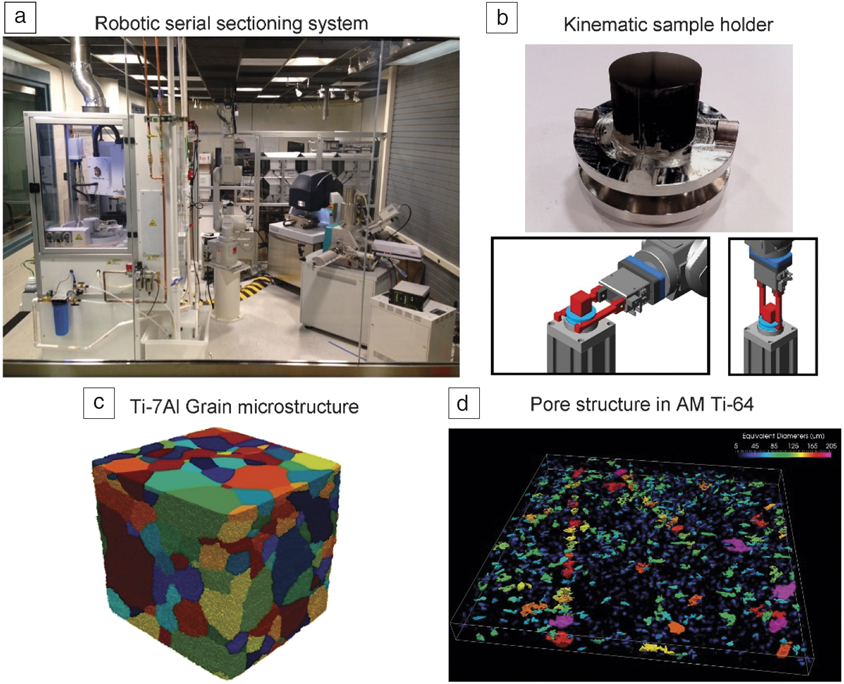
Figure 1 highlights a robotic characterization system at the Air Force Research Laboratory, which integrates a RoboMet.3D system for multistep metallographic preparation and cleaning with a fully automated SEM outfitted with electron backscatter diffraction and energy-dispersive spectroscopy detectors and two automated optical microscopes, used to characterize the 3D microstructure of aerospace alloys and composite materials in volumes larger than 1 mm3.Reference Uchic, Groeber, Shah, Callahan, Shiveley, Scott, Chapman and Spowart32 The system utilizes kinematic holders (Figure 1b) and a commercial six-axis robot to reliably transfer samples between the various stations of the robotic cell in a user-defined sequence. It is capable of long-term round-the-clock operation. The state-of-the-art capabilities for these systems are highly repeatable sample preparation, predefined microscope-based data collection activities, and real-time post-processing of dataReference Madison, Underwood, Poulter and Huffman33 to potentially pause or interrupt the experiments, which enable experimental collection campaigns (Figure 1c–d) that are prohibitively difficult if performed by humans. In the future, one can envision algorithms guiding an iterative process that combines multiple sample preparation and quantitative characterization steps within one sample, continuing the characterization process until target metrics are achieved.
(a) Example of a robotic microscopy system at the Air Force Research Laboratory that integrates a RoboMet.3D system for multistep sample preparation, cleaning, and optical microscopy, along with additional optical and scanning electron microscopes for high-throughput and multimodal automated microstructural data collection. (b) Kinematic sample holder and schematics of robot gripping modes. (c) Example serial section electron backscatter diffraction (EBSD) data set from a titanium alloy. Volume shown is approximately 0.9 × 0.9 × 0.8 mm3. (d) Example serial section optical microscopy data; volume shown is approximately 6.3 × 6.3 × 0.4 mm3.Reference Chapman, Scott, Schwalbach, Groeber, Donegan and Uchic34

In addition to these improvements in automation and workflows, there are new applications of AI to both interpretation of materials characterization data and instrument control. DeCost and Holm have shown that machine-learning algorithms can be used in classification problems for materials characterization, such as identifying classes of materials from a database of micrographs,Reference DeCost and Holm35 or identifying a specific powder feedstock for additive manufacturing from an SEM image library.Reference DeCost, Jain, Rollett and Holm36 Another example includes machine learning for more accurate algorithms for image segmentation from microstructural images of steels.Reference Azimi, Britz, Engstler, Fritz and Mücklich37
Moreover, autonomy has been realized in the use of novel sampling strategies to sparsely collect data from point-probe microscopes such as SEMs. The benefit of these strategies is decreased total acquisition times by significantly reducing the number of data points that are collected. Examples include real-time modification of the scanning strategy to perform a refined characterization (based on an initial raster scan collected on a coarse grid),Reference Nuspl, Wegscheider, Angeli, Posch and Mayr38 and dynamic sparse sampling combined with a data reconstruction process.Reference Godaliyadda, Ye, Uchic, Groeber, Buzzard and Bouman39,Reference Zhang, Godaliyadda, Ferrier, Gulsoy, Bouman and Phatak40 In the latter case, machine-learning algorithms have been trained to develop an accurate iterative data collection strategy, wherein the location of each new data point is informed by the set of previously collected data points, to maximize the information gained from each new measurement. In this way, autonomy is used to reduce the instrument time for data collection and the amount of data produced by an experiment, and minimize sample damage for beam-sensitive materials, with the drawback that reconstruction methods must be employed if the goal is to produce a complete image or map.
Finally, feedback between the AI system and experimentation has also been demonstrated for high-throughput x-ray diffraction for structureReference Hattrick-Simpers, Gregoire and Kusne41 and fluorescence for composition.Reference Gregoire, Dale, Kazimirov, DiSalvo and van Dover42 In a recent example, Xing et al.Reference Xing, Zhao, Wang, Zhang, Ren, Yan, Gao, Li, Zhang and Wang43 utilized a combination of isothermal annealing of a ternary gradient thin-film, high-throughput diffraction and an unsupervised hierarchical clustering algorithm to construct ternary temperature-composition-phase maps for Fe-Ni-Co, identifying important deviations from the existing ASM Phase Diagram Database. In another example, Ren et al. used machine learning to guide high-throughput synchrotron diffraction measurements on combinatorial ternary alloys to discover a new metallic glass system, Co-V-Zr.Reference Ren, Ward, Williams, Laws, Wolverton, Hattrick-Simpers and Mehta9 Simultaneously, the AI system can train on these expanding data sets, not just the successful discoveries offered in the literature.
Rapid assessment of material properties
The goal of alloy development is to produce material with consistent material properties that meet or exceed a minimum allowable design requirement.Reference Rice44 For structural metals, each application may require some combination of mechanical properties—elastic stiffness, yield strength, ultimate strength, toughness, high-temperature strength, creep resistance, fatigue resistance, and stress-corrosion performance. Within industry, some existing techniques such as hardness testing and ultrasonic modulus measurements are already utilized for rapid preliminary material property screening or process control.Reference Papadakis, Mason and Thurston45,Reference Baker46
Instrumented indentation has proved to be a useful technique for high-throughput property assessment. Nanoindentation, with indentation depths measured in nanometers to micrometers, can directly assess hardness and modulus and can also be used to screen other properties such as viscoelasticity in polymers or toughness in brittle materials. Nanoindentation has been particularly useful in combinatorial materials evaluation, as exemplified by the work of Zhao.Reference Zhao47 There are some important limitations: the small sampling volume typically requires smooth, undisturbed surfaces; for typical coarse-grained materials where the indent samples only one or a few grains, many indents are necessary to obtain average response. Also, the hardness value from a sharp indenter may be difficult to translate into stress–strain response for engineering design. Kalidindi and co-workersReference Weaver, Khosravani, Castillo and Kalidindi48 utilized instrumented spherical micro- or macroindentation to determine indentation stress–strain curves over larger sampling volumes that are less sensitive to microstructural variations and surface effects, and mitigated these limitations to some extent. Recently, new indentation-based capabilities have emerged to replicate application environments such as elevated temperatures up to 800°C,Reference Wheeler, Armstrong, Heinz and Schwaiger49 high-rate shock/impact loading,Reference Guillonneau, Mieszala, Wehrs, Schwiedrzik, Grop, Frey, Philippe, Breguet, Michler and Wheeler50–Reference Wang, Bringa, McNaney, Victoria, Caro, Hodge, Smith, Torralva, Remington and Schuh52 and fatigue loading.Reference Steck, Fleming, Goss and Zou53,Reference Bufford, Stauffer, Mook, Syed Asif, Boyce and Hattar54 Improvements in high-speed actuation and sensing have also permitted the first one million indent spatial map, demonstrated this year on Damascene steel.Reference Stauffer, Hintsala and Hangen55 The map, which took a total of 159 h, required only 0.6 s for each positioning and indentation step.
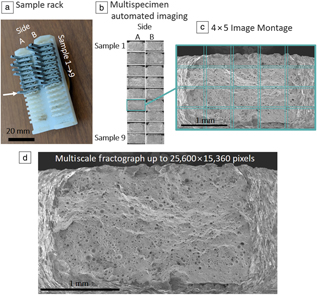
Beyond the indentation platform, there are several relevant examples of automation that are accelerating mechanical–property measurements. The simplest form is automated sample loading systems attached to an individual test system, such as a Charpy impact tester or tensile loadframe. When used alone, these techniques merely improve the time efficiency of the testing while still requiring significant time for sample preparation and data analysis/interpretation. In the case of additive manufacturing, it is possible to produce sample arrays that can be tested directly in sequence with scripted analysis algorithms to extract relevant material properties.Reference Salzbrenner, Rodelas, Madison, Jared, Swiler, Shen and Boyce56 In this way, more than 1000 independent tensile tests can be fabricated and tested in a matter of days by a single operator.Reference Boyce, Salzbrenner, Rodelas, Swiler, Madison, Jared and Shen57 After the tests, not only can the quantitative stress–strain behavior be analyzed automatically, but it is possible to automate fractographic analysis, as shown in Figure 2. Such images can be subsequently analyzed with machine-vision algorithms.Reference Konovalenko, Maruschak and Prentkovskis58,Reference Dutta, Das, Barat and Roy59 Beyond tensile behavior, other mechanical properties such as compressive behavior, fracture toughness, or fatigue testing in ambient or nonambient environments are conceptually automatable in a similar manner.
An example of automated fractography resulting in a ∼30× reduction in operator time. After ∼20 min of setup time, a total of 360 scanning electron microscope (SEM) images were collected in 2.5 h of unattended SEM operation on a JEOL IT300-HR SEM. A sample loading rack (a) enabled 18 specimens to be imaged (b). Each sample was imaged with a montage of 20 images (c) to compose (d) a multiscale fractograph. Pore size distribution was subsequently analyzed by automated image analysis software. Courtesy of Nathan Heckman and Jay Carroll, Sandia National Laboratories.

Full-field property measurement methods are also accelerating alloy discovery and model calibration. Digital image correlation (DIC) strain-field mappingReference Chu, Ranson and Sutton60 can be used to calibrate anisotropic yield behavior and nonassociative flow behavior in a single test.Reference Rossi, Broggiato and Papalini61 In conjunction with the virtual fields method,Reference Grediac, Pierron, Avril and Toussaint62 DIC can parameterize anisotropic hardening lawsReference Fu, Barlat, Kim and Pierron63 or even more complex multiparameter material models.Reference Avril, Pierron, Sutton and Yan64 Unique specimen designs can improve parameter estimation by reducing nonuniqueness (codependence) and maximizing the experimental sensitivity.Reference Jones, Carroll, Karlson, Kramer, Lehoucq, Reu and Turner65 DIC can also be used in conjunction with graded or layered combinatorial materials for concurrent property evaluation. For example, Raabe and co-workersReference Knoll, Ocylok, Weisheit, Springer, Jägle and Raabe66 utilized laser metal deposition as an additive manufacturing technique to produce a single test coupon with seven unique compositions graded between a Cr-Mo-V tool steel to a Ni-based maraging steel. Using DIC, the unique stress–strain behavior of each of the seven materials could be characterized simultaneously in a single test. Other full-field measurements such as infrared thermographyReference Wang, Wang and Huang67 or scanning infrared vibrometryReference Ehrhardt, Allen, Yang and Beberniss68 can be applied independently or in conjunction with DIC to further enhance materials property evaluation and model calibration.
In cases where material property measurements are difficult, AI and high-throughput structure/chemistry measurements can guide more efficient exploration of properties. For example, Kusne et al. utilized cluster analysis in conjunction with combinatorial synchrotron diffraction libraries and existing crystal structure data from the inorganic crystal structure database to identify candidate rare-earth-free permanent magnet alloys. This guided subsequent lower-throughput coercivity measurements with magnetometry.Reference Kusne, Gao, Mehta, Ke, Nguyen, Ho, Antropov, Wang, Kramer and Long69
There are also substantial efforts to integrate property evaluation in process. For industrial-scale production, several vendors produce automatic inline hardness testers, and inline ultrasonic measurements are used for nondestructive defect detection and modulus measurement.Reference Hauptmann, Hoppe and Püttmer70 In the case of additive manufacturing, there is a rapid evolution of in-process monitoring techniques and their integration into a feedback control loop.Reference Tapia and Elwany71,Reference Everton, Hirsch, Stravroulakis, Leach and Clare72 However, a vast majority of the in-process metrology capabilities are not focused on direct measurement of material properties, but rather detection of off-nominal process conditions, dimensional accuracy, and defects through the use of infrared thermography, high-speed imaging, ultrasonics, or spectroscopy.Reference Everton, Hirsch, Stravroulakis, Leach and Clare72
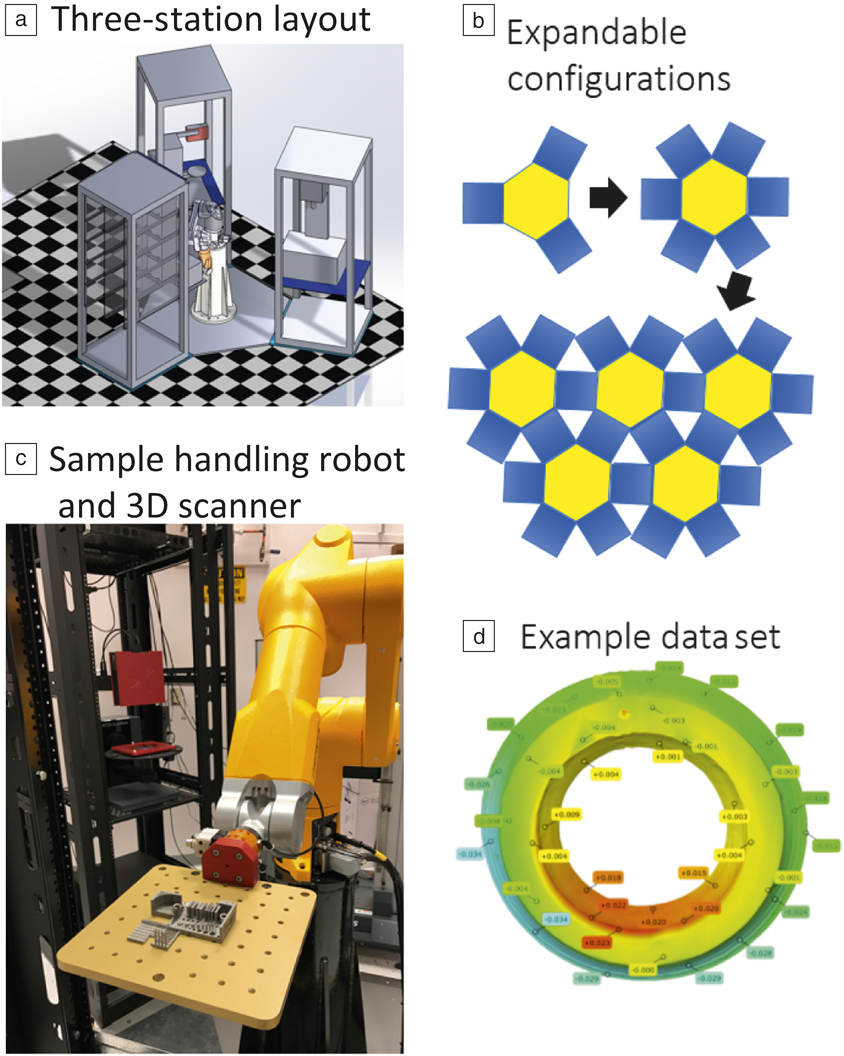
Some material properties are not readily measurable in process. In such cases, it is possible to expedite post-process evaluation with automation. Sandia National Laboratories has been developing a prototype automation platform, Alinstante, Spanish for “in an instant.” The Alinstante platform was originally developed as a robotically automated multistation inspection tool for additively manufactured materials and components, illustrated in Figure 3. However, this automation platform could also be used to inspect nonadditive materials, such as castings, forgings, or weldments. The inspection station, which is modular, expandable, and reconfigurable, currently consists of a 3D scanner to characterize geometric distortions arising from process anomalies or warpage due to residual stress, and an electromechanical loadframe capable of performing a variety of mechanical tests from hardness measurements to fracture toughness measurements.
The Alinstante system (a) is a modular multistation platform for automated materials processing and inspection that can be easily expanded or reconfigured (b). The robot (c) transfers specimens/parts to inspection and processing stations and supervisor software manages workflow on multiple stations simultaneously and collates data streams (d) for subsequent analysis.

Additional stations or modules could be developed for Alinstante, such as spectroscopic measurements of chemistry, x-ray computed tomography for pore detection, Archimedes testing for density, automated metallography for microstructure, a vibrometer for resonance testing, or a profilometer for surface roughness. It is also possible to add a 3D printer directly to Alinstante, as well as additional processing tools such as a heat-treat oven or subtractive machining tools for improved dimensional tolerances and surface remediation. An important element of Alinstante is the ability to register data from all the stations into a unified data stream, including process/inspection history and spatially varying properties.
Anticipated horizon
From the previously described examples, automated systems associated with many aspects of experimental alloy development have been instantiated in prototype form and are beginning to be utilized in research institutions. In the future, autonomous systems will be capable of self-guided exploration, especially in subdisciplines that leverage the development of AI in commercial applications (e.g., image segmentation and classification, super-resolution imaging, and complex robotic operations). For the broader challenge of realizing autonomous process–structure–property systems, there are a host of potential implementation barriers that pace research. These include rapidly evolving and expansive research in AI methods and their application in materials engineering,Reference Dimiduk, Holm and Niezgoda73 the multidisciplinary nature of engineering skillsets required to implement such systems, the expense and cost to embed automation and robotics into experimental systems, and nascent maturity for software linking multiple experimental systems to AI planners. In addition, there are nontrivial aspects of robotic implementation that require automation specialists: safety considerations, limitations in reach and payload weight, positional accuracy, and compatibility with environments (e.g., vacuum, chemical, or high temperature).
Furthermore, while not unique to autonomous system implementation, another hurdle is the integration of information management technology, including data storage, transfer, and curation.Reference Blaiszik, Chard, Pruyne, Ananthakrishnan, Tuecke and Foster74,Reference Dima, Bhaskarla, Becker, Brady, Campbell, Dessauw, Hanisch, Kattner, Kroenlein and Newrock75 As mentioned previously, new instruments can create data at previously unthinkable generation rates measured in Gb/s,Reference Michael, Nakakura, Garbowski, Eberle, Kemen and Zeidler23–Reference Malloy, Thiel, Bunday, Wurm, Mukhtar, Quoi, Kemen, Zeidler, Eberle and Garbowski25 exacerbating the difficulties in information management. Here, AI offers other potential benefits beyond traditional data-reduction strategies that minimize lost information. Genetic algorithms, for example, can reduce a complex multidimensional data set into a human-interpretable mathematical expression, and have been shown to “discover” governing equations for natural phenomena.Reference Schmidt and Lipson76 This is one example of a broad range of machine-learning solutions ranging from neural networks that can predict the hot deformation behavior of an aluminum alloyReference Haghdadi, Zarei-Hanzaki, Khalesian and Abedi77 to Bayesian learning that can discover a precipitation strengthened shape-memory alloy.Reference Solomou, Zhao, Boluki, Joy, Qian, Karaman, Arróyave and Lagoudas78 The growing field of materials informatics has been recognized as a new paradigm in the evolution of materials science,Reference Agrawal and Choudhary79 and will undoubtedly benefit from access to rapidly expanding data sets.
In closing, while the “robot metallurgist” paradigm is not yet realized, we anticipate that systems—whether semi-supervised or completely autonomous—will soon begin to make an impact on future alloy development activities.
Acknowledgments
B.L.B. was supported through a subcontract from the Stanford Linear Accelerator Center by the US Department of Energy (DOE) Advanced Manufacturing Office (FWP 100250), and M.D.U. acknowledges support from the Air Force Research Laboratory. The high-throughput fractography example was provided by the Center for Integrated Nanotechnologies. The Alinstante example was funded by Sandia’s Laboratory Directed Research and Development program. Sandia National Laboratories is a multi-mission laboratory managed and operated by National Technology and Engineering Solutions of Sandia LLC, a wholly owned subsidiary of Honeywell International Inc., for the US DOE’s National Nuclear Security Administration under Contract No. DE-NA0003525. The views expressed in the article do not necessarily represent the views of the US DOE, US Department of Defense, or the United States Government.

Brad L. Boyce is a distinguished member of the Technical Staff at Sandia National Laboratories. He received his BS degree in metallurgical engineering from Michigan Technological University in 1996, and his MS and PhD degrees in materials science and engineering in 1998 and 2001 from the University of California, Berkeley. He has published more than 100 peer-reviewed articles on topics such as additive manufacturing, microsystems reliability, nanoindentation, fracture in structural alloys, weld metallurgy, ocular tissue viscoelasticity, and fatigue mechanisms. Boyce can be reached by email at blboyce@sandia.gov.

Michael Uchic is the research leader for the Characterization, Sensing, and Analytics Research Group in the Materials State Awareness Branch, Structural Materials Division, Materials and Manufacturing Directorate, Air Force Research Laboratory, Air Force Materiel Command, Wright-Patterson Air Force Base. He leads a research team focused on developing nondestructive and destructive materials/damage characterization methods, and is a recognized expert in 3D microstructural characterization and small-scale mechanical testing methods. Uchic can be reached by email at Michael.Uchic@wpafb.af.mil.