INTRODUCTION
Apraxia is a loss of ability to perform learned skilled movements, resulting from neurological dysfunction and which cannot be explained by elemental motor or sensory deficits (Rothi et al., Reference Rothi, Ochipa and Heilman1991). Limb apraxia can be the result of stroke (Heath et al., Reference Heath, Roy, Westwood and Black2001) or some degenerative disorders, such as Alzheimer’s disease and corticobasal degeneration (Dumont et al., Reference Dumont, Ska and Joanette2000; Pharr et al., Reference Pharr, Uttl, Stark, Litvan, Fantie and Grafman2001).
Classically, to ascertain praxis disturbances, the subject is requested to pantomime gestures on verbal command, on imitation, and can also be tested with real objects. Movements tested can be pantomimes of object use (transitive gestures), symbolic gestures, and gestures without meaning.
As occurs with virtually all neuropsychological tests, praxis evaluation is strongly influenced by age and education (Wiederholt et al., Reference Wiederholt, Cahn, Butters, Salmon, Kritz-Silverstein and Barrett-Connor1993). However, limb praxis batteries have rarely been validated in the elderly population (Dobigny-Roman et al., Reference Dobigny-Roman, Dieudonne-Moinet, Tortrat, Verny and Forette1998).
Ska and Nespoulous (Reference Ska and Nespoulous1987) found significant differences between gesture production of healthy elderly and younger subjects. Peigneux and van der Linden (Reference Peigneux and van der Linden1999) evaluated the influence of age and education on body part as tool errors and found a significant effect of both variables on this type of mistake. However, we were unable to find any study concerning the effect of illiteracy or low education on the performance at limb praxis evaluation. Regarding the influence of gender, Chipman and Hampson (Reference Chipman and Hampson2006) described a female advantage in the production of learned gestures.
Given the scarceness of such studies, it is highly relevant to validate instruments to identify and quantify limb apraxia while taking into account age and education. The goals of this study were to evaluate the performance of healthy elderly subjects in a protocol of gesture production and to investigate the influence of age, education, and gender on their performance.
POPULATION AND METHODS
Subjects
Ninety-six right-handed subjects (48 females and 48 males) aged ≥60 years participated in the study. They were divided into age groups A (60–74 years) and B (75–88 years). The 96 subjects were also subdivided into four groups according to the levels of education: illiterates and 1–3, 4–7, and ≥8 years of schooling. Participants were considered illiterates when they had never attended school and were unable to read the sentence “Close your eyes” from the Mini-Mental State Examination (MMSE).
All individuals performed above education-adjusted scores on the MMSE (Brucki et al., Reference Brucki, Nitrini, Caramelli, Bertolucci and Okamoto2003), category fluency-animals/minute (Caramelli et al., Reference Caramelli, Carthery-Goulart, Porto, Charchat-Fichman and Nitrini2007), and on a delayed recall test (Nitrini et al., Reference Nitrini, Lefèvre, Mathias, Caramelli, Carrilho, Sauaia, Massad, Takiguti, Silva, Porto, Magila and Scaff1994, Reference Nitrini, Caramelli, Herrera, Porto, Charchat-Fichman, Carthery, Takada and Lima2004).
Participants were excluded if they had any history of neurological or psychiatric disorders, history of drug or alcohol abuse, or if were using drugs with central nervous system action. They were also excluded if they had any sensory deficit or motor deficits due to a muscle–skeletal disorder.
The study was approved by the ethics committee of the institution, and a written informed consent was obtained from all participants.
Evaluation Protocol of Gesture Production
All subjects were submitted to the protocol proposed by Ska et al. (Reference Ska, Caramelli, Croisile, Fontaine, Gilbert and Pineau1997) on verbal command and on imitation. The protocol contains three types of gestures: transitive (pantomimes of object use), symbolic, and meaningless gestures. Subjects were asked to perform the series of gestures using the right hand or both hands [previous studies have shown no differences between right- and left-hand performance of normal subjects (Goldenberg, Reference Goldenberg1995)], first on verbal command and then on imitation. Meaningless gestures were performed only on imitation.
First, a series of 10 gestures (6 transitive and 4 symbolic) were performed on verbal command. Subsequently, subjects were asked to imitate the same 10 gestures and 7 meaningless gestures (Appendix).
Before each test (verbal command and imitation), the gesture of “brushing teeth” was given as an example. Subjects were warned that they should perform the gesture as if they were holding the tool. On imitation, subjects were asked to produce the gesture with the same hand used by the examiner. It was stressed that right and left hands were reversed compared with those of the subjects.
Two points (movement = 1 and hand shape = 1) were attributed for each transitive or symbolic gesture correctly performed on verbal command and imitation. Regarding meaningless gestures, both hand shape and its position with respect to other body parts were taken into account (2 points for each criterion). Hence, the total protocol score was 54:20 points for verbal command (12 for transitive and 8 for symbolic gestures) and 34 for imitation (12 for transitive, 8 for symbolic, and 14 for meaningless gestures).
To determine intrarater reliability, 26 randomly selected subjects were reevaluated 15 days after the first testing by the same examiner (K.R.C.). For ascertainment of inter-rater reliability, another examiner (P.C.) watched the videotape from subjects’ performances and scored.
Statistical Analysis
A transformation of the scale into degree of performance (DP) was conducted as follows:

As verbal command and imitation subtests have different weights, we calculated a weighted DP to achieve a final total score. Each item on verbal command subpart (10 items) had a weight of 0.05 (1/20), and each item on imitation subpart (17 items) weighed 0.03 (1/34).
The weighed score was calculated as follows:

Analysis of variance was used to compare the performance of the different age, gender, and schooling subgroups. A post hoc analysis was conducted using Duncan’s test to detect the specific differences. To calculate the differences between the scores during imitation of meaning and meaningless gestures, a paired t test was used. The level of significance adopted was p ≤ .05.
The intrarater and inter-rater reliabilities were calculated by intraclass correlation coefficient. Internal consistency was assessed by Cronbach’s alpha.
RESULTS
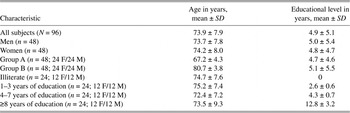
The sociodemographic characteristics of the sample are depicted in Table 1. Men and women were adequately matched for age and education. Age distribution across the four groups of education was also similar.
Sociodemographic characteristics of the participants

Note
F, female; M, male; SD, standard deviation.
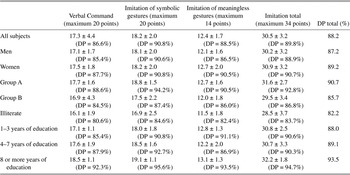
The overall performance results for the 96 subjects and for the age, gender, and educational subgroups are depicted in Table 2.
Performance of subjects on gesture production tests

Note
Values are mean ± standard deviation, except where indicated.
When comparing the performance of the 96 individuals on verbal command (86.6%) and on imitation (90.8%), considering only the same gestures, no significant difference emerged (p = .663).
There were no differences between men and women on verbal command and imitation (p = .144 and p = .278, respectively). When considering symbolic and meaningless gestures only on imitation, women and men performed similarly (p = .862 and p = .091, respectively). However, between age groups A and B, significant differences were observed for verbal command (p = .009) and imitation (p = .001) as well as for symbolic (p < .001) and meaningless (p < .001) gestures.
As for educational level, the mean score obtained by individuals with 8 or more years of schooling on verbal command was significantly higher than that obtained by the other three subgroups of education (p < .001), while illiterates performed significantly worse than the other three groups (p < .001). The scores obtained by the two intermediate schooling subgroups were not statistically different (p = .259).
Considering imitation of both symbolic and meaningless gestures, illiterates performed worse than the other three groups (p = .001). Considering only imitation of symbolic gestures, illiterates performed similarly to the group with 1–3 years of education but differently from the other two groups. Otherwise, groups with 1–3, 4–7, and ≥8 years of education had a similar performance. As for the meaningless gestures, illiterates had performance similar to individuals with 1–3 and 4–7 years of education, while those with ≥8 years of education were different.
On the total score, illiterate individuals had lower scores than the other three groups (p = .001). The group with 8 or more years of education obtained higher scores than the other three groups (p= .001), while the two intermediate schooling subgroups had similar performance (p = .707).
With regard to the weighted score, no significant difference was seen between the performance of women and men (p = .148), while between the different age and education subgroups, the difference was significant (p = .001 and p < .001, respectively). The influence of education was the same as that found for general performance. Individuals had a better performance in the imitation of symbolic gestures compared with meaningless ones (p = .05).
Interaction between age and gender on the performance under verbal command and imitation and on the overall test was not significant (p = .424, p = .885, and p = .832, respectively). Similarly, no interaction between education and gender for the three scores was observed (p = .474 on verbal command, p = .783 on imitation, and p = .664 on total score). The possibility of interaction between age and education was also rejected for the three scores (p = .422, p = .590, and p = .483, respectively).
Three transitive and three symbolic gestures were correctly performed by more than 90% of the sample, both on verbal command and on imitation: “Unlock the door,” “Put glasses on,” “Put a ring on finger,” “Military salute,” “Blow a kiss,” and “To pray.” Similarly, four meaningless gestures were correctly produced by more than 90% of the individuals on imitation: “Dorsal face of the right hand against the left ear,” “Index finger and middle finger in ‘V’,” “Hand perpendicular to the table with the palm facing the subject’s body,” and “Arms crossed with hands on the shoulders.”
Intraclass correlation coefficients for intrarater reliability were .65 for gestures on verbal command, .72 for imitation, and .56 for the total weighted score. As for inter-rater reliability, correlation coefficients were .81 for gestures on verbal command, .90 for imitation, and .81 for the total weighted score. The intrarater reliability figures of course reflect differences in both subject performance and rater scoring between two separate tests performed 15 days apart. Internal consistency values of the protocol were 0.52 on verbal command, 0.75 on imitation, and 0.80 for the total weighted score.
We also carried out a covariance analysis in order to evaluate the possible impact of cognitive performance (determined by the results in the brief cognitive tests) on praxis performance. No significant influences were detected in this analysis, both on verbal command and on imitation.
DISCUSSION
In the present study, a sample of cognitively healthy elderly subjects performed similarly in the production of gestures on verbal command and on imitation. The overall DP of the individuals was above 85%. Age and education had a significant influence on the performance. Older subjects (≥75 years) performed worse than younger individuals (60–74 years). As for education, the effects were even more prominent and three major subgroups emerged, namely, illiterates and 1–7 and ≥8 years of schooling.
Previous investigators also reported a significant influence of age on limb praxis performance on verbal command (Peigneux & van der Linden, Reference Peigneux and van der Linden1999; Ska & Nespoulous, Reference Ska and Nespoulous1987). In the present study, most of the mistakes made by the elderly individuals on verbal command were body part as tool errors (data not shown). According to Peigneux and van der Linden (Reference Peigneux and van der Linden1999), this type of error corresponds to a symbolic representation and is automatically activated when subjects are required to pantomime a transitive gesture. Hence, body part as tool errors might represent a deficit in inhibiting the activation of a more automatic gesture, suggesting a decline in this inhibitory function with aging.
With respect to imitation, given that this task does not require retrieval of the gesture from memory, any impairment in imitating the gestures could be interpreted as a difficulty in analyzing the visuospatial information by older individuals, as demonstrated previously (Manly et al., Reference Manly, Jacobs, Sano, Bell, Merchant, Small and Stern1999; Wiederholt et al., Reference Wiederholt, Cahn, Butters, Salmon, Kritz-Silverstein and Barrett-Connor1993).
The learning process of reading and writing can promote changes in the functional organization of the brain (Castro-Caldas et al., Reference Castro-Caldas, Petersson, Reis, Stone-Elander and Ingvar1998). According to Manly et al. (Reference Manly, Jacobs, Sano, Bell, Merchant, Small and Stern1999), literate individuals have more facility to organize and to analyze certain types of visuospatial information, ability that is not present in individuals who have not learned to read and write.
Peigneux et al. (Reference Peigneux, Van der Linden, Garraux, Laureys, Degueldre, Aerts, Del Fiore, Moonen, Luxen and Salmon2004) proposed that when making a gesture under verbal command, the action semantic system uses the information from the praxicon (action memory) in order to carry out the gesture. Illiteracy could generate a decrease not only in semantic memory related to language, but also in the action semantic system, impairing gesture production under verbal command, since without the real object the subject would encounter greater difficulty in accessing the action semantic system.
Peigneux et al. (Reference Peigneux, Van der Linden, Garraux, Laureys, Degueldre, Aerts, Del Fiore, Moonen, Luxen and Salmon2004) also proposed that there is a component of the praxis system dedicated to visual perception of body parts. The role of this component is very similar to the one played by visuogestural processing, promoting the analysis of static information about gestures. Activation of this component decreases during the imitation of familiar gestures. Maybe the limitation in visuospatial analysis of illiterate individuals goes beyond and also involves the static processing of movements. Indeed, it has been observed that elderly have more difficulties in the static component when compared with the dynamic one (Ska & Nespoulous, Reference Ska and Nespoulous1987).
The imitation of a novel gesture requires the transformation of vision into action, a process that is mediated by body parts knowledge (Goldenberg, Reference Goldenberg1995). Peigneux et al. (Reference Peigneux, Van der Linden, Garraux, Laureys, Degueldre, Aerts, Del Fiore, Moonen, Luxen and Salmon2004) postulated that the parietal cortex hosts the transformation processes linking perception to action and keeps an internal representation of the body space. Moreover, this is also an area activated during word recognition (Pereira et al., Reference Pereira, Reis and Magalhães2003). Hence, it is possible to conceive that among illiterates and low-educated individuals, there is a reduced engagement of this area, leading to worse performance during gesture imitation.
Nitrini et al. (Reference Nitrini, Caramelli, Herrera, Charchat-Fichman and Porto2005) proposed that highly educated individuals might use verbal and visual strategies to produce a motor sequence, while illiterates and individuals with low education have difficulties in dealing with verbal strategies. In this way, the repertoire of gestures might be smaller in illiterate individuals, a factor that generates more difficulty in evoking the correct representation of a hand posture during the accomplishment of this kind of task. However, more detailed studies should be carried out to explain why learning to read and write influences the production of gestures.
We did not observe any influence of gender on gesture production. This was an expected result since there are no apparent factors that could make the performance of men and women different in this kind of task.
In conclusion, we present evidence of a marked influence of age and education on gesture production. These variables should be taken into account during investigation of apraxia in elderly individuals and when devising new protocols for evaluation of limb praxis. Nonetheless, it is important to point out that several gestures were not influenced by these demographic variables, with more than 90% of the subjects exhibiting correct performance, making them natural candidates for use in routine clinical evaluation of apraxia.
ACKNOWLEDGMENT
The information in this manuscript and the manuscript itself has never been published either electronically or in print.
APPENDIX
Gestures included in the gesture production protocol (Ska et al., Reference Ska, Caramelli, Croisile, Fontaine, Gilbert and Pineau1997) are as follows:
• Drink glass of water
• Comb hair
• Unlock the door
• Hammer a nail
• Put glasses on
• Put a ring on finger
• Military salute
• Blow a kiss
• To sleep
• To pray
• Put the palm of the right hand over the right eye
• Dorsal face of the right hand against the left ear.
• Index finger and middle finger in “V”
• Hand perpendicular to the table with the palm facing the subject’s body
• Arms crossed with hands on the shoulders
• Double rings (formed by the index finger and the thumb of both hands)
• Palm of the right hand against the right ear and left hand on the right elbow.