Bruckner and the Third Reich
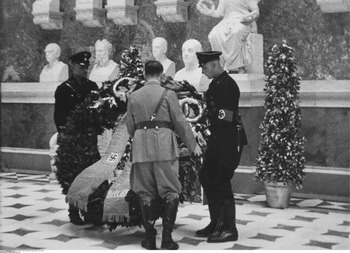
Anton Bruckner (1824–1896), the Austrian composer famous for his monumental and sophisticated symphonies, has never been among the most popular composers in the English-speaking world. However, the fact that his works became the favourites of the Nazis before and during WWII has been the subject of an ongoing scholarly debate since the 1990's. Not only did Hitler show personal approval of the symphonist (see figures 1 and 2), the National Socialist Party used the orchestral music of Bruckner to accompany a number of important party events. For example, in the 1939 video footage of Hitler's 50th birthday celebration, we hear the final climax of the Fifth Symphony accompanying images of the Führer. After the German radio announced the death of Hitler on 1st May 1945, the Adagio of the Seventh Symphony was played, perhaps as a kind of funeral music for the Nazi dictator.
German Chancellor Adolf Hitler placing a wreath at the bust of Austrian composer Anton Bruckner at the Walhalla temple in Bavaria, Germany, 6 June 1937. (Photo: Ullsteinbild, used with permission.)

Hitler with a bust of Bruckner. (Photo: Ullsteinbild, used with permission.)

What this phenomenon means is of course a matter of debate. Due to the fact that Bruckner had died decades before the Nazis seized power, one could easily make the point that what happened was simply a kind of Nazi ‘appropriation’ or ‘annexation’ of Bruckner's music. As Bruckner had no control over how his music was used after his death, the Nazis' interest in Bruckner could be taken as just a peculiar fact in history. Although it is tempting to subscribe to this view, it seems unable to do justice to such a complex phenomenon. In a recent article, the President of the International Bruckner Society, Thomas Leibnitz, argues that we could also try to understand the relationship between Bruckner and the Third Reich with reference to the immanent qualities of Bruckner's musical works. Leibnitz points out that the way people listen to Bruckner's music is itself an interesting phenomenon. For, a number of critics and musicians have compared listening to Bruckner to some kind of religious experience: the music of Bruckner requires the complete devotion of the audience. From this perspective, Bruckner's music shares something strikingly similar to many people's perception of Richard Wagner – both composers demand the submission of their audience while their experience of their music can often be described as subliminal and overwhelming. Leibnitz believes that this is no coincidence and he ventures to say that it is possible that certain qualities in Bruckner (and Wagner) allow the audience to have the experience of above and these qualities also contribute to the Nazi appropriation of Bruckner. From this perspective, the devotion towards Bruckner parallels the one demanded by the Third Reich: the individual should subordinate themselves to the state or the Volk.
Philosophy on taste and a thought-experiment
Examining which qualities in Bruckner stimulated the favour of the Nazis is no easy task. One might argue that the Nazis' preference towards Bruckner is ultimately what it is: a kind of preference. If this kind of preference is understood as liking or disliking certain things, or simply as ‘taste’, the Nazi preference for Bruckner may merit little attention. For, as the maxim ‘De gustibus non est disputandum’ (‘There is no disputing about tastes’) suggests, taste and preferences are mere subjective feelings. As such, they are not an appropriate topic for rational debate: a person's likes can be another's dislikes for no particular reason.
From a more philosophically informed point of view, it is not difficult to see why situations such as the relationship between Bruckner and the Third Reich do not receive serious philosophical treatment. Although what is known as aesthetics or the philosophy of art is meant to be the philosophical examination of notions such as beauty and other sorts of artistic values, the focus of the discussion is often placed on the nature and justification of ‘aesthetic judgements’. Kant, one of the most prominent writers in philosophical aesthetics, argues that a proper aesthetic judgement is characterized by disinterestedness: by basing one's judgement purely on the perceptual experience of an object, a subject adopts the attitude of disinterestedness. This allows the subject to judge that an object is beautiful or sublime. By contrast, the sensual experience that drives a subject to want to possess or consume an object, argues Kant, is based on desire or inclination. As a result, such a kind of experience is not disinterested and therefore not purely aesthetic. From this perspective, the tendency on the part of the Nazi to ‘use’ Bruckner for their own purposes seems to be propagandistic, rather than aesthetic in nature.
Even if one does not agree with Kant on the nature of aesthetic judgements, the common, though not universal, emphasis placed on objectivity by philosophers can also sideline the discussion of preferences and taste. From this perspective, the objective refers to the qualities and attributes pertaining to objects. As such, they are observable to all and open to public scrutiny. This in turn allows the application of standards of correctness. The subjective, by contrast, refers to what pertains to subjects and often their inner thoughts and feelings. Since these thoughts and feelings are often hidden from the outside world, the difficulties in examining them using publicly available means suggest that standards of correctness may not apply. While a person can get something right (or wrong) about objective qualities, there seems to be no right or wrong in relation to subjective matters. Now, if preferences or taste are seen as expressions of subjective feelings or desires, the apparent lack of consensus among subjective issues renders the discussions of preferences and taste speculative and superfluous.
The above philosophical perspectives may therefore reinforce the view that Bruckner's ‘appropriation’ by the Third Reich is purely a contingent and arbitrary outcome of history. We get the impression that nothing seems to be able to prevent the Nazis from developing a taste or preference in any types or genres of art. And the existence of this kind of taste or preference does not require explanation either. Furthermore, a judicious person may point out that the uncritical association of Bruckner with the Third Reich may involve the fallacy known as ‘guilt by association’. The fact that the Nazis liked Bruckner and that the Nazis liked evil is wrongly used to support the conclusion that Bruckner has some affinity to evil.
If the above perspectives represent the only way philosophical thinking can contribute to discussions about the relationship between art and taste, one may have the feeling that philosophy is actually doing a disservice to our critical reflection on the arts, as exemplified by the Bruckner case. In addition to an inkling that philosophy seems unable to deepen our understanding of the phenomenon in question, it seems to have dismissed something we find interesting as unimportant. While some sort of taste or preference may seem totally idiosyncratic, we have reasons to suspect that not all kinds of taste or preference are of a similar nature.
To highlight the philosophical significance of taste and preferences, I propose to use a thought-experiment. Imagine we have two persons in front of us and we have some very specific information about them. One of them is the infamous minister of culture of the Nazi regime. He is asked to accurately indicate to us his artistic taste resulting in a long detailed list of his preferred works of art: it includes some ‘masterpieces’ by Bach, Beethoven, Wagner, Bruckner and also a number of lesser known works. The inclusion of these lesser known works seems to be purely the product of idiosyncrasy. The other imaginary person is someone who has no tie whatsoever with the regime of the cultural minister; we might think of him simply as a harmless acquaintance we have in real life. Again, the same question is put to him and once more we end up with a long list of his preferred works of art to the last detail. For the sake of argument we make the assumption that these two lists do accurately reflect the artistic tastes of these two people. Now, for some unknown reason the taste of the second person corresponds exactly with the Nazi minister to the smallest, minutest details. A number of questions can now be raised: How do we feel about this hypothetical situation? Or, if you were the second person, how does it make you feel when you realize that your own taste completely matches that of a Nazi minister?
Like many other thought-experiments in philosophy, this thought-experiment is unlikely to generate unanimous responses. People's reaction to the scenario, however, should reveal something important about their attitudes and possibly their values. Without a doubt, there are people who are totally unmoved by the thought-experiment. They feel that the imaginary cases simply describe some contingent facts about two different people. For them, artistic tastes are no more grounded in reason than the preference for tea over coffee. Apart from this group, I believe that there are some who would feel some level of alarm or concern in relation to the imaginary scenario. For this kind of person, an individual's taste is not something that is always trivial or superficial. They may have in their mind situations where a person's taste or preferences can actually help to define the person. In other words, what kinds of things a person likes can at least partly constitute their identity. This affects not only how the person perceives himself, it also affects how other people see this person: whether he is a ‘sophisticated’, ‘refined’ or ‘vulgar’ person.
A lot depends on the nature of taste, preferences and likings. Are tastes, preferences or likings simply subjective or arbitrary? Or are taste, preferences and likings the products of some kind of process, rational or otherwise? The difficulty in grounding taste, preferences and likings with reasons is no doubt felt by many. To some such a demand is actually impossible or unnecessary. Although the view that taste, preferences and likings are purely subjective is a common one, it is by no means universal. At any rate, it is unable to explain why some people see their taste as connected to reason, no matter how reason is understood in this context. (Reason here could refer to a real reason or what the person perceives to be a reason.) In addition, we can see that the willingness to see taste as totally devoid of reason leads to some unacceptable consequences. A huge variety of human activities considered expressions of ‘taste’ are trivialised when, for example, taste in clothing or fashion is considered the product of subjective taste. It also makes unintelligible rational attempts to sway people's taste in specific contexts, say, in wine or tea tasting. Most importantly, this view fails to do justice to the original setting of the thought-experiment because the lists containing the works of art are thought to be the results of some conscious decision. (We can perhaps observe that this tendency to dismiss taste as subjective may lead to a paradoxical outcome. By insisting on the arbitrary nature of taste, it actually highlights the non-arbitrary nature of human activities considered to be expressions of taste.) I will now examine a number of arguments which suggest that taste, preferences and likings can be related to reason and human choice at least in some specific cases.
The willingness to see taste as something more substantial than mere personal likes and dislikes can perhaps be supported by a worldview which is characterized by the readiness to take the material conditions of life such as time, energy and resources seriously. From the perspective of this ‘materialistic’ worldview, taste can easily become an integral part of a person due to the simple fact that developing a particular taste requires time, effort and probably other resources such as money. To have one kind of taste instead of another always involves a period of immersion, very often in the form of upbringing. In materialistic terms, this amounts to a particular way of distributing resources which can take place on a personal or a social level: time and resources are ‘invested’ in a particular kind of activity as opposed to others. The tendency to accept taste as something more important can also find support in the studies of music or the arts in general. For example, preferences in music, exemplified by a situation where certain musical works are shared among people, create the impression of commonality and possibly solidarity. From this perspective taste can easily produce what psychologists call ‘in-groups’ and ‘out-groups’. This means that while the acceptance of certain pieces of music among a group of people may offer them a sense of belonging, those who do not share these pieces are easily excluded and seen as outsiders. (See M. Sorce Keller, ‘Why is Music so Ideological, and Why Do Totalitarian States Take It So Seriously? A Personal View from History and the Social Sciences’, Journal of Musicological Research, vol. 26 (2007), 91–122.)
The significance of taste in relation to music can also be examined with reference to the notion of meaning in music. Put simply, the more music partakes in creating meaning in human life, the more important musical taste will become. Meaning and music can be related in a number of ways, from people identifying themselves with the national anthem to the development of distinct musical ‘languages’ such as diatonicism, pentatonicism and dodecaphony (or twelve-tone music). It is suffice to notice that in many cases music can be something more than the mere production of pleasant sounds. Different forms of developments and practices in music can acquire political, historical, social and cultural meanings. A complete or near complete match in taste between two persons, from this perspective, can therefore signify a lot. Underlying the matching or correspondence is a minimal level of shared understanding and cultural heritage. For, music from radically different traditions can appear unintelligible to people unfamiliar with such traditions. As works of music are essentially works created within specific historical and cultural circumstances, a preference for works from a specific time and place need not be the result of purely subjective aesthetic preferences. At this point, one could even argue that aesthetic preferences are themselves products of specific ideologies or cultural climates.
A diagnosis: psychological and linguistic considerations
The above discussion highlights the existence of two opposing views. On the one hand, there is the philosophical tendency to sharply distinguish judgements of value from judgements of taste. On the other hand, there appears to be evidence showing that taste can mean more than innocuous likes and dislikes. The apparent conflict between these two positions deserves our further investigation.
A route of inquiry we haven't yet explored shifts our focus to investigate exactly why both the Nazi minister and the other person share the same list. As the thought-experiment assumes that the two people chose to include works of art in the lists after some conscious decision, we should now turn to investigate the reasons behind the decisions to include these works. If we grant the assumption that taste and preferences are not always arbitrary, it could still be maintained that despite sharing the same list, the reasons behind the identical choices can be different between these two people. Accordingly, the Nazi minister may express his taste for Bach, Beethoven, Wagner and Bruckner due to nationalistic sentiments and the pressure to conform to the prevailing taste of his peers but the other person may have developed likings to such works based on genuine understanding and a keen aesthetic sense. What this means is that while the same works may appear on the lists, they are put there for radically different reasons.
Responding to the same works in different ways is no doubt a commonplace experience. The fact that our responses towards works of art are subject to a variety of influences is not an exceptional claim either. From first-hand experience, many of us could confess that at some point in our lives we have professed a taste or preference towards something when we do not fully comprehend what this something is about. That is to say, at least to some people, to be swayed by fashion or forces unknown to us when it comes to taste is not that unusual an experience. Although this strategy seems defensible, it gets into difficult terrains when speculations are made about how other people get their motivation in developing a specific taste. Despite the fact that it is perfectly legitimate to suspect that we (or other people) have been snobbish or hypocritical when it comes to taste, the possibility that other people may share our taste for the same or very similar reasons cannot always be ruled out. To insist that other people can never appreciate things as deeply as ‘we’ do is therefore an arrogant stance. Such an attitude may also make rational dialogue on the same works of art difficult to take place.
The attempt to differentiate the reasons behind the taste of the Nazi minister and the other person can now be seen in a different light: it is probably an expression of the human tendency to avoid sharing the same taste in an explicit manner. If taste can help us to create an identity, the need to maintain our separatedness with other people puts us under the pressure to deny a share in other people's taste. No doubt this explains why some people are frightened by the prospect of wearing the same fashion item as others do. With regard to the case of the Nazi minister, the attempt to differentiate the reasons or grounds behind our taste and his taste seems to signal another deep feeling: we find it disconcerting to entertain the possibility that our taste can significantly resemble the taste of a person whom we despise. If the Nazi minister is seen as an evil person, the attempt to distant oneself from him in terms of taste can hint at a simple refusal to identify with evil. Sharing or resisting the same taste in a significant, non-superficial way can therefore indicate something quite important about us as human beings. Not only can a common or similar taste indicate a common cultural heritage, in some cases it can even suggest a similar kind of aspiration. If the original setup of the thought-experiment is understood to be an invitation to imagine precisely such a possibility, to insist on denying this possibility misses the point of the thought-experiment entirely.
The psychological need to maintain one's identity can no doubt obstruct our understanding of the important role of taste in human lives. In addition, the way we use language can also create a misleading picture of taste. Our language allows us to differentiate concepts into different categories. So, conceptually it is always possible to distinguish what is a judgement of value (backed by reasons) and what is a mere judgement of preference. The problem comes when we apply this distinction too readily in actual situations. For, the ability to make such a distinction conceptually does not mean that the variety of human phenomena related to taste and preferences are always susceptible to such a distinction. Undoubtedly, reasons and justifications can be related to taste in numerous ways. However, since human tastes are ultimately products found in specific historical contexts, how different tastes can be caught up by other historical, cultural or political contingencies is something which no a priori reasoning can predict. What this means is that a proper understanding of such judgements can take place only if the complex historical contexts surrounding the judgements in question are taken into account. As judgements of taste can acquire cultural, political or ideological meanings, to simply categorise such judgements as mere subjective judgements of taste does not do them justice. To some people, our artistic taste is seen to be contaminated by politics and ideologies when we feel an inability to disentangle such elements. But this need not be the case. Instead, we could interpret this phenomenon as reflecting the fact that human beings are social and political animals who are also capable of aesthetic activities such as creation and appreciation. If this picture is accepted, the connections between Bruckner and the Third Reich need not be seen as an anomaly: it shows us how taste can be caught up in the immense complexities of human life and it helps us to understand what kind of creatures we are.