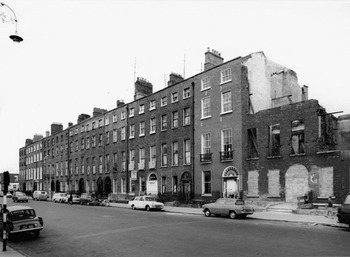
In 1947 the writer Frank O'Connor and his wife got on their bicycles to explore the hidden architectural curiosities of Ireland, an experience which he recorded in the little-remembered travelogue, Irish Miles. In Dublin, their passion for eighteenth-century plasterwork took them behind many closed doors, including into the headquarters of the Knights of Columbanus, and around the Department of Local Government in James Gandon's Custom House. They also went to Henrietta Street, located in the heart of the north inner city. Once the most prestigious street in Dublin, it had been in tenements for almost a hundred years. O'Connor described the scene:
tall houses, tall flights of steps, leading to tall narrow doorways too small for their frontages and with a heavy hooded air imparted by their plain pediments … One slum house attracted us because a first floor window had been lifted out body and bones, and through it you could see the staircase ceiling, heavy circles and strapwork which suggested a Jacobean hangover. The poor people sunning themselves on the steps drew aside to let us pass. The staircase had been many times coated with salmon-coloured wash which half obscured the rich plaster panelling, but a ray of light through a ruined window-frame lit a beautiful stair with carved treads and delicate Restoration newel posts. It would have been alright but for the smell.Footnote 1
O'Connor's description is highly suggestive of the layers of competing meanings embedded in Dublin's Georgian streets: the commodification of the material remains of the eighteenth century; the sense of discovery and exploration which characterized middle-class forays into the inner city; and the demands of working-class accommodation. When he wrote, the north inner city was understood to be an unknown world of crumbling tenements set against a jarring backdrop of opulent eighteenth-century architecture. One hundred years of slow decline and stasis would be ruptured from the early 1960s, however, as the character of the area was altered profoundly by urban modernization projects. But these changes were not wholly welcomed; preservationist groups, with a variety of motivations and tactics presaged by O'Connor, engaged in high-profile campaigns in the area, attracting considerable media attention and provoking debate about the nature of Irish society and the legacies of history.
This article examines these conflicts regarding the ownership, use, and appearance of the north inner city; first by examining Dublin Corporation policy in the area, and then by discussing three case-studies of broadly ‘preservationist’ campaigns. Drawing on a wider literature on the twentieth-century city by such historians as Peter Hall, Frank Mort, and Simon Gunn, it uses these urban conflicts to explore tensions generated by broader social and cultural change in the 1960s, focusing particularly on the role of voluntary bodies in shaping the urban environment and the problematic nature of Irish modernity in this period.Footnote 2 In using the built environment to explore the complexities of Ireland's relationship with its pasts during an era of modernization, it makes a fundamental contribution to our understanding of the 1960s, a period which received little historical analysis outside the realm of high politics.
The sixties have been characterized as the moment when a decisive break was made with the Ireland created at the time of independence.Footnote 3 Eamon de Valera stepped down as taoiseach in 1959, ending a thirty-year dominance of Irish politics, while his successor, Sean Lemass, introduced a new vocabulary into the lexicon of the state, which emphasized prosperity as the new benchmark for national success.Footnote 4 The economic reforms of the late 1950s removed the tariffs and restrictions on foreign ownership of business that had been crucial in cutting Ireland off from the outside world, renouncing the founding principles of Sinn Féin ideology, and leading to a limited form of prosperity and a decline in emigration.Footnote 5 However, this narrative, which constructs the sixties as the moment when Ireland found a new economic optimism, is not the whole story. Despite the upturn in the country's fortunes, many still lived in near-slum conditions, while the corruption and clientelism that characterized much economic progress meant that the changes of modernization were frequently bitterly contested. Moreover, although the embrace of foreign capital and the urbanization of the population were underway, the pillars of nineteenth-century cultural nationalism – the Irish language, the farmstead, and Catholicism – were still fundamental to political discourse. In response to these contradictions, both Joe Lee and Terence Brown have described the sixties as a time of widening divergence between the rhetoric and reality of Irishness as modernization clashed with tradition.Footnote 6
Indeed, much recent work has focused on the question of Irish modernity in the period since independence.Footnote 7 Most commentators have seen the arrival of ‘modern’ Ireland as occurring between the economic reforms of the late 1950s, and the accession to the EEC in January 1973, and have pointed to the dialogue between ideas of modernity and tradition between these two dates.Footnote 8 In a particularly subtle account, Patrick O'Mahony and Gerald Delanty have described Irish culture in the latter years of the twentieth century as consisting of ‘hesitant enclaves of modern values within the traditional, anti-modern order’ which ‘later began to take its present form with modern values in the ascendant but compromised by the power of tradition’.Footnote 9
The battles over Dublin's built form in the 1960s arose out of, and were shaped by, these shifts within Irish politics and culture. Moreover, the evolution of the capital's skyline also played an important role in framing and constituting these shifts. Indeed, they have already attracted interest from historians and cultural theorists, who, following O'Mahony and Delanty, have seen urban change in Dublin in the 1960s as part of Ireland's move towards modernity. Andrew Kincaid has argued that the destruction of the Georgian city and its rapid replacement with ersatz-modern buildings represented the rejection of the national ideals of the founders of the state and the embrace of the international sphere.Footnote 10 Similarly, Hugh Campbell has described the modern architecture of the sixties as indicative of a new ideology of progress and rationalism in Irish life.Footnote 11 However, both interpretations fail to acknowledge the problematic nature of ideas of ‘modernity’ and ‘tradition’ in Dublin due to the complex intersections of ideas of ‘Irish’ and ‘British’ culture with categories of ‘future’ and ‘past’. Indeed, I want to suggest a different reading of the changes which affected the city to those posited by Kincaid and Campbell and thus a more complex approach to Irish modernity in the period. Modern values embedded in changes to the city had unique significance in Ireland. The demolition of eighteenth-century streetscapes was described by property speculators and the government as the ‘reconquest’ of the city which had once been the nucleus of British rule. The reconstruction of the city was premised on modern values, but was also constructed as bringing the city closer to being a fitting capital for a new state based on an essentialized ideal of a pre-conquest Ireland. This elision of urban modernization, office building, and the totemic ‘de-Anglicization of Ireland’ I argue, revealed contradictions inherent in Irish modernity in this period. Not only was Ireland's modernity Janus-faced, but it only looked back to certain parts of the Irish past and excluded the history of the nation's capital. Thus Dublin extant built stock had an uneasy relationship to Ireland's national teleology, existing almost outside of history.
Arising from this ambivalent position of the Irish capital within the cultural imagination of the state, preservationism in Dublin assumed particular significances. Both central and local government were loath to set out a positive vision for the area, either in terms of renewal or historic preservation, and, with the exception of traffic plans, urban change was deferred to private investment. The combination of the arbitrary destruction of much of the inner city with Dublin's uneasy place within Irish history had a formative impact on the character of Irish urban preservationism. The deficit of both urban regulation and historical interpretation was filled by groups who rejected the state-sponsored teleology of Ireland's history. Protestants, republicans, and socialists were at the forefront of the preservationist movement in the sixties and thus used interventions into the inner city as a way of articulating their discontent with the nature of independence. Each group invested the cityscape with alternative conceptions of Irish nation and the Irish past. These sidelined histories played a fundamental role in their vision for the future of the area and were explicitly articulated in the manner in which they preserved and used the eighteenth-century built environment. The city, caught between multiple conceptions of modernization and tradition, became a forum where the anxieties and opportunities of Irish life in the 1960s were exposed and debated.
As this discussion suggests, a consideration of the debates over Dublin's Georgian streets provides a productive alternative perspective to ongoing debates around the nature of Irish society in the post-war years; Irish modernity; and the complex relationship between civil society, local government, and property speculation in the evolution of the city. To this end, the next section examines local government policy in the area, while the rest of the article explores the methods and motivations of three very different ‘preservationist’ campaigns in the north inner city. First, the efforts of the Irish Georgian Society in Mountjoy Square and North Great George's Street to recreate authentic eighteenth-century domestic spaces will be examined, then the efforts of Uinseann MacEoin, the editor of Ireland's leading construction journal, to preserve the large houses of Henrietta Street and simultaneously restore life to the inner city will be explored. Finally the actions of the Dublin Housing Action Committee (DHAC), which squatted in Mountjoy Square to protest against housing shortages will be discussed. Through the examination of a small area of the city this article uncovers the unique position of Dublin in the sixties, both within Ireland and the historiography of post-war urban change. In so doing, it makes a fundamental contribution to our understanding of the complexities of Irish cultural change during the 1960s.
I
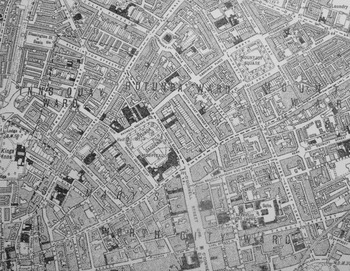
Developed by three generations of the Gardiner family throughout the eighteenth century, the north inner city was home to some of Dublin's most impressive streetscapes (see Figure 1). These included Henrietta Street, which was begun in the 1720s; the curved Hardwick Place; Mountjoy Square, Dublin's only square with four perpendicular sides of equal length; and some of Dublin's finest architecture, including Francis Johnston's St George's Church, William Chambers's Charlemont House, and Richard Castle's Rotunda Hospital. But this rapid development was halted at the end of the eighteenth century. Fashion moved south of the river, and by the mid-nineteenth century, many of the houses in the locale had been subdivided into tenements.Footnote 12 Indeed, due to the city's deposition as a capital in 1800, economic stasis during the nineteenth century, followed by the poverty of the first years of independence, and neutrality during the Second World War, the north inner city remained outside European trends in urban change, bypassing Victorian civic improvement, the bombs of the Second World War, and the large-scale urban renewal of the immediate post-war years. Thus the Gardiner estate – as the area was once known – remained architecturally intact, if socially deprived, until the late 1950s.Footnote 13 But in the sixties, this stasis was shattered as changes quickly came to the area's built environment. Indeed, the Gardiner estate was described by Uinseann MacEoin in 1965 as ‘a wasteland of dereliction stretch[ing] from the North Wall to Phibsboro’.Footnote 14 This was due to two policies of Dublin Corporation: road schemes and dangerous buildings provisions.
Map of the north inner city (1963). Copyright Ordnance Survey Ireland/Government of Ireland. Copyight permit No. MP 004010

When Patrick Abercrombie drew up his plan for Dublin in 1939, he based his scheme for the city on a series of circumferential road routes.Footnote 15 And from this point, the tangent route became a point of orthodoxy in Dublin town planning. When Karlheinz Schaechterle submitted his report on Dublin traffic to the Corporation in 1965, he proposed two ring roads close to the inner city which would have entailed widening many of the principal streets within the Gardiner area and the demolition of their buildings.Footnote 16 These plans were modified by the Travers Morgan Partnership in 1973, which envisaged a motorway along the line of the canals, with a ‘principal distributor’ running through Parnell Street and Summerhill.Footnote 17 Although some of these roads were not completed until the late 1970s, and some never at all, their spectre hung over the area leading to widespread planning blight, as no new construction or repairs took place along these principal streets and the buildings earmarked for demolition swiftly declined.
More influential even than road widening in the destruction of the fabric of the Gardiner estate was the dangerous buildings policy of Dublin Corporation. After severe storms in the first week of June 1963, two eighteenth-century tenements collapsed killing four people.Footnote 18 The day after the second collapse, the minister for local government, Neil Blaney, ordered a public inquiry while inspectors evacuated fifty houses for demolition as an emergency measure across the inner city. When the inquiry reported, it largely blamed the weather and unseen burnt-out chimney feathers for the collapses; hence, it suddenly became possible that any house in the city of a similar construction could have been equally affected.Footnote 19 Thus, during the eighteen months which followed the deaths in Fenian and Bolton Streets, around 1,200 of Dublin's Georgian terrace houses and mews were destroyed, predominantly in the north and west of the inner city. Longstanding residents were swiftly removed in a panicked fashion; notices were nailed on doorways informing residents that the buildings were condemned and they must leave within seven days.Footnote 20 This process was accelerated by the latterly notorious Exempted Development regulations of the Local Government (Sanitary Services) Act 1964, which, in an attempt to speed up the removal of dangerous buildings, removed planning permission requirements for demolition. The Sanitary Services Act also allowed landlords who had previously not been receiving an economic return on their property due to the provisions of the Rent Restrictions Act to remove longstanding tenants, clearing newly expensive sites of uneconomic buildings and their inhabitants, ready to be redeveloped as offices.Footnote 21 Much land in the Gardiner area was cleared of buildings and tenants in this way, in expectation of an office boom which never reached this part of the city.Footnote 22
The historiography of European town planning records the sixties as a time of bureaucratically imposed comprehensive development. While little work has been done on Irish town planning, it is nevertheless clear that Dublin did not follow this model.Footnote 23 This is not to say that plans were not drawn up, nor experts consulted, regarding Dublin's development. Indeed, reports were written on Dublin by some of the most famous town planners of the day, including Charles Abrams, Myles Wright, Colin Buchanan, and Nathaniel Lichfield.Footnote 24 Little came of any schemes, however, and there were large differences between the bureaucratic regulation of the urban environment which took place on paper and the actual changes taking place to Dublin's streets.Footnote 25 Indeed, no town plan was instituted at all until 1971. As a result, the impact of Corporation policy tended to be random, arbitrary, and speculative, while urban renewal was deferred to private interests.
The twin forces of the compulsory powers of civic governance and arbitrary destruction by private interests led to the collapse of urban structure in many western European and American cities. In Ireland, however, this post-war phenomenon took on uniquely parochial overtones, due to the fact that Dublin was positioned within Irish history as a colonial capital, built by a foreign elite. Louis MacNeice succinctly articulated these sentiments in his famous poem on Dublin, describing the city as ‘Fort of the Dane/Garrison of the Saxon/Augustan capital/Of a Gaelic nation/Appropriating all/the alien brought.’Footnote 26 These constructions of the past came to be fundamental to shaping the city's future. Indeed, many within government were visceral in their attacks on attempts to preserve the extant city, positioning arguments in terms of native and settler. For example, on 28 February 1968, during the Planning Appeals Bill, Kevin Boland, minister for local government, stated, in relation to the Irish Georgian Society's attempt to preserve Mountjoy Square,
I appreciate there are a number of people in this city and in this country who see these Georgian buildings as reminders of the days of gracious living – gracious living that was made possible by the fact that there were available to them as slaves the mere Irish who were living in insanitary and overcrowded hovels in the back-lanes or in the damp, concealed basements of these gracious houses. It was possible to live graciously in them. I can appreciate that these people have their nostalgic memories and would like to see these things retained … This campaign for the preservation of our national Georgian heritage would be much more impressive as far as I am concerned, if in many cases the people who are conducting it were not also activists in the campaign to destroy what the majority of the Irish people look upon as our real national heritage. I have no doubt it would be very pleasant if they could contemplate from outside the pleasant facades of these Georgian buildings and dream of the days when the lower orders knew their place and when it was possible to live graciously in these houses as a result of the financial resources supplied by the serfs on the land.Footnote 27
This attack was one of several that Boland made during his tenure as minister for local government on the Georgian Society's efforts to preserve the city. In many ways, it paralleled similarly derisive comments made by critics such as Reyner Banham were making in Britain regarding the preservationist movement.Footnote 28 But Boland's description of the ‘mere Irish’ and his suggestion that the architectural preservationists were also trying to destroy ‘our real national heritage’, by which he meant the Irish language, revealed a ‘national’ quality to debate regarding the future of the city which was particular to Ireland. The subtext of his speech was that the eighteenth-century city was not worth saving as it was a relic of British rule in Ireland; a foreign landscape on native soil. Indeed, Boland seemed to suggest that to mourn their loss was to mourn the loss of British rule. But he was not the only senior politician to hold such views; James Gibbons, parliamentary secretary to the minister for finance, with responsibility for the Office of Public Works, sardonically described the Georgian Society's efforts as ‘saving Ireland from the natives’.Footnote 29 Boland and Gibbons publicly articulated sentiments which were widely held. Many greeted the preservation of Georgian architecture with antipathy at best. At a time when the rural west and the Irish language were feared to be in a terminal state of decline, concerns for the eighteenth-century architecture of the city's capital was seen as minor in comparison with the disappearance of this ancient culture which was still understood to be the wellspring of national identity. Even in the 1960s, the urban, European experience of the nation's capital sat uneasily in official narratives of Irish history. Thus the rapid destruction of the city, which took place along modern, international lines was defended by the political elite by the use of traditional modes of discourse relating to the Irish nation.
The elision of these twin, contradictory forces – the rapid destruction of the city resulting from the half-embrace of modern norms of town planning alongside the retention of a national ideal based on the elevation of a traditional Gaelic way of life – gives the history of preservationism in Dublin its unique character. But the absence of both a positive plan for the Gardiner estate and a positive interpretation of the history of the city were filled by individuals and voluntary bodies, such as the Irish Georgian Society, the DHAC, and Uinseann MacEoin. These groups and individuals made private efforts not only to hold back the destructive agglomeration of looming road plans, speculative demolition, and dangerous buildings operations, but also to reinterpret the history of the capital.
II
The first group to become involved in the conservation of the Gardiner estate was the Irish Georgian Society. The society had been set up by Desmond Guinness of the Irish brewing family and his wife, Mariga, in 1958 after two eighteenth-century houses in Kildare Place in Dublin were demolished.Footnote 30 It was a revival – fifty years to the day – of the Georgian Society, founded by Sir John Pentland Mahaffy in 1908 to produce records of Ireland's eighteenth-century built environment. However, while the original society had focused solely on creating a record of architecture, the next incarnation was much more actively involved in campaigning and conservation. In the absence of a National Trust along British lines, the Irish Georgian Society focused its attention on the preservation of the former – usually eighteenth-century – ‘big houses’, by lobbying the government, organizing groups of volunteers to undertake restoration work, and fundraising.Footnote 31 Indeed, this restoration work also served a social function for a sidelined group. In this period, the Republic of Ireland had a Protestant population of only 5 per cent, who sometimes sat uneasily within the state's cultural ethos, and the society was certainly disproportionately, if not overwhelmingly, populated by this minority.Footnote 32
In the mid-sixties, in response to the accelerating destruction described above, the Georgian Society turned its attention to Dublin's inner city. Its aim was to preserve the eighteenth-century streetscapes and plasterwork by restoring the Georgian core as an area of middle-class living. To this end, in 1964 Mariga Guinness bought No. 50 Mountjoy Square and set up a group entitled the Friends of Mountjoy Square to organize the further purchase of houses in the area for owner-occupancy (see Figure 2).Footnote 33 The preservationists who joined the Friends were a mixed group and included Ivor Underwood, a property owner, or even slum landlord, who owned approximately seventy Georgian houses in the north inner city in various states of disrepair. Attracted by the glamour of the Georgian Society's crusade, Underwood committed himself to restoring the eleven properties he owned in the area.Footnote 34 The spirits distributor Edward Dillon and Co. purchased Nos. 25 and 26 Mountjoy Square, formerly occupied by the Church of Ireland Divinity School.Footnote 35 Five houses, along with three in Henrietta Street, were also purchased by Uinseann MacEoin, while Harold Clarke, the managing director of Easons, Ireland's largest chain of bookshops, was also recruited to buy a vacant house in nearby North Great Georges Street.Footnote 36 Finally, John and Ann Molloy moved into No. 47 in 1967, in the expectation that the area – situated between the city centre and the airport – would increase in value.Footnote 37
Mountjoy Square in the 1960s. Courtesy of Irish Architectural Archive

As preservationists moved into the houses, they not only restored the buildings structurally but also took pains in their decoration and furnishing. Harold Clarke's house was paradigmatic of their approach to interior design. He played heavily on eighteenth-century themes and furnishings and, moreover, was self-conscious in his acquisition and display of Irish eighteenth-century material culture.Footnote 38 But these domestic spaces were not wholly private worlds. John and Ann Molloy opened their house in 1967, causing a peak of media interest as ‘the first time a Dublin townhouse [had been] open to the public’.Footnote 39 From January 1968, Mariga Guinness's house was open daily as an architectural library and social space as the Dublin headquarters of the Irish Georgian Society; Harold Clarke's home also featured frequently in magazine articles and books on Irish interior design.Footnote 40 In 1949, Professor Thomas Bodkin had, in his Report on the Arts in Ireland, recommended that the state buy a Georgian townhouse to exhibit Irish eighteenth-century craftsmanship.Footnote 41 Indeed, throughout the sixties, the Georgian Society consistently devoted editorials to the need for a Georgian townhouse to be furnished and opened as a museum.Footnote 42 Thus the houses occupied by Georgian society members were more than just homes: each was also an amateur museum. The Georgians had renounced their effort to persuade the state to provide a museum to the eighteenth century, and had now taken it upon themselves to create their own spaces of display, and thus a contra-reading of the Irish past, which celebrated the legacy of the eighteenth century in the inner city.
But the Georgian Society's Marie Antoinette venture in Mountjoy Square did not remain undisturbed for long, as even the unfashionable north side was not immune to pressures of architectural and economic modernization. In 1964, the property developer, Matt Gallagher, also began to acquire houses in the locale, with the ultimate aim of acquiring the whole square for redevelopment as offices in a modern design.Footnote 43 When this ambition was stymied by the acquisition and refurbishment of property by the Georgian enthusiasts, the company instead lodged two planning permissions with Dublin Corporation for Nos. 34 to 45, a sizeable quantity of the south side: one application for an office block in a modern design and one for a block in a neo-Georgian idiom.Footnote 44 When plans for the pastiche block were permitted by Dublin Corporation, the Friends of Mountjoy Square took an unprecedented step, using loans to buy out Gallagher's interest in the square for £68,000 in the expectation that they could find twenty-two investors willing to take up the challenge of restoration.Footnote 45
To fulfil this aim, in 1970 the Georgian Society set up a company entitled Mountjoy Square Estates and put together a brochure detailing the specifications of each of the houses which they now owned and which they hoped to secure for restoration, offering to provide the ‘link between history and commerce’.Footnote 46 ‘Before’ and ‘after’ photographs of Harold Clarke's house were also provided to show the transformation from partitioned tenement into elegant and immaculate eighteenth-century property. Mountjoy Square Estates also offered potential purchasers from overseas a ‘package deal’ for the complete work required, including legal and architectural fees, and the entire construction costs, while additional work to the property, such as the restoration of decorative plasterwork and elaborate painting could also be commissioned at an extra cost.Footnote 47 Thus, limited by the constraints of the financial settlement reached with Matt Gallagher, the Georgian Society looked not to repopulating the north inner city with ‘sweat equity’ families from the south Dublin suburbs, but rather to creating prêt-à-porter second homes for wealthy Irish-Americans in one of Dublin's most notorious slums. Its interest in preserving the city rested, however, on a vision of the urban landscape which privileged the preservation of material culture over the retention of traditional communities. In its commitment to saving plasterwork and streetscape, it ignored the longstanding local population's sense of ownership of the area.
To the Georgian Society members, these eighteenth-century homes were islands of domesticity in a foreign, uncharted space. Mariga Guinness led guided tours to Georgian Society members around the area, even bringing groups into tenements to show her guests the plasterwork; Harold Clarke delightedly informed an interviewer that in his part of the city ‘the doors had no numbers’.Footnote 48 John and Ann Molloy's press release on the opening of their house read ‘It has been suggested that we are pioneers in this work. However, no pioneering spirit is required; the buffalo have long since left the parts. In fact, this is a very civilised area in close proximity to the City centre and with convenient access to the Airport, North and West’.Footnote 49 To the preservationists, the north inner city was an unknown, uncharted space; the destruction of the urban landscape only reinforced the dizzying otherworldliness of this part of the city. In moving into the inner city, which they perceived as a terra nullis, they were able to create a new world through islands of stylized domesticity in opposition to the perceived cultural monotheism of the Dáil, the suburbs, and the countryside. Due to the duality of Ireland's cultural heritages, they may have been looking to the past, but in so doing were also challenging ‘tradition’, embedded within the political and cultural underpinnings of the state.
III
The Georgian Society's campaign was not the only approach to conservation in the locality. By considering the individuals and groups with whom it both worked and came into conflict, we can develop a more subtle understanding of the contradictory meanings of preservationism invested in Dublin's eighteenth-century core. Uinseann MacEoin stood aloof from the Georgian Society's preservation effort of the late 1960s, although he worked closely alongside the group. Described in Hibernia magazine in 1969 as a ‘crank’ and ‘a rabid republican cum architect cum town planner of definite convictions cum determined preservationist and exposer of shady planning applications’, MacEoin stands outside the traditional image of the ‘gentrifier’, and was perhaps a surprising ally of the Georgian Society.Footnote 50 His father, Malachy MacEoin, was a close friend of the republican leader Sean MacDermott, and was interned during the War of Independence. Drawn like his father towards republican politics, MacEoin helped to produce an illegal newspaper in the 1930s, for which he was detained for three and a half years in the Curragh during the Second World War. On release, he remained politically active, and was involved in Clann na Poblacha, Sinn Féin, and the Workers' Party. Losing faith in the direction of republicanism during the Border Campaign of the late 1950s, he became a founding member of both the Northern Ireland Civil Rights Association and the Wolfe Tone Society.Footnote 51 MacEoin's place in post-war Irish history was, however, secured by his long-term editorship of Ireland's most important architecture and construction journal, the Irish Architect and Contractor (later Build and Plan), through this mouthpiece becoming a highly significant voice in shaping the reception of the modernization of Dublin in the sixties.
Despite his very different politics and background, MacEoin became one of the leading figures in the Georgian Society's campaign to preserve the Gardiner estate.Footnote 52 The first Georgian house he bought was No. 5 Henrietta Street. When he first visited the property in 1966, it was home to seventy-four people, twelve of whom were living in the former drawing room, while the whole house shared one toilet. The landlord no longer wanted the property as he could not afford its upkeep due to rent restrictions.Footnote 53 MacEoin bought it for a token sum, and converted the unmanageably large house into artists' workshops. During this period, he also acquired Nos. 6 and 7 Henrietta Street and five houses on the east side of Mountjoy Square. Unlike the Georgian Society members, however, MacEoin kept his properties as flats, and rented them to low-income families.
In the Irish Architect and Contractor, MacEoin condemned the destruction of the inner city as resulting from a combination of cultural myopia and the Corporation's policy of creating Catholic homes in the suburbs. More importantly, however, in terms of both short- and long-term impact, he was the first to note and campaign against the government's links to property developers and the related capitulation of the Corporation's responsibility towards the city in the face of private interests, views propounded to great effect and at length in his editorials.Footnote 54
The ‘property speculator’ was a new figure in Irish life in the decade, and alongside the ‘man in the mohair suit’ became one of the demons of modernization. Dublin, like London, experienced an office boom in the sixties, with eighty office blocks built in the twelve square miles of the inner city.Footnote 55 But after the ‘Taca’ scandal of 1967, it also became abundantly clear that figures from within the highest echelons of Fianna Fáil, particularly Charles Haughey, were profiting from this building boom, while also aiding property developers through re-zoning and the dismissal of planning appeals.Footnote 56 But this corruption had deeper political implications. Economic modernization of the late 1950s had cast aside entirely the substance of political economy based on the retention of a traditional way of life. In the sixties, however, speculators utilized the discourses of Gaelic culture to support their developments. MacEoin railed against the populist-cynical moves of development companies which were often given names derived from Irish mythology and which frequently published its planning notices solely in Irish, both in order to construct the property boom in terms of ‘national’ rejuvenation, and also, more pragmatically, because so few people could read the national language.
In 1965, for example, MacEoin described the destruction of the city which was occurring
on the best of patriotic motives of course – as instanced by Mr Blaney himself (the ESB houses), or his camp follower and faithful cohort, Mr Gallagher who has managed to collar one side of Mountjoy Square; or the unlettered nimcompoops who operate the Sanitary Services Act, and at the drop of a hat will pull out the centre house in any 18th Century terrace and bring down the lot if it accommodates one or more property speculator.Footnote 57
Regarding an office block on Nassau Street, being built by a developer named Setanta, MacEoin stated: ‘if ever a development group hiding under the patriotic name of the young Cuchulain, represented a powerful phalanx of wrap-the-green-flag-round-me boys Irish nationalism and the know-how of London finance this is one’.Footnote 58 For MacEoin, ‘national’ images were turned on their head as patriotic rhetoric was used for the profit of the political elite and the construction industry, while the destruction of the ‘foreign, colonial city’ was leading to unliveable landscapes, housing shortages, and the evacuation of inner-city populations.
The recreation of an Anglo-Irish material heritage was thus not the only excluded narrative to be rewritten and reified through the preservation of the streets of the inner city. MacEoin's involvement with the Georgian Society scheme can also be seen as arising from his disillusionment with national ideals. The use of patriotic rhetoric for the benefit of the few and the detriment of Dublin's inner-city population was, for MacEoin, part of a wider disillusionment with the governance and direction of the twenty-six county Republic; disillusionment which he explicitly articulated through his preservationist efforts. Not only did the houses he bought within the Gardiner estate act as a bulwark against speculative development, but through a conscious effort to rent them to low-income tenants and artists, he also aimed to challenge the reduction of low-income housing units in the inner city.Footnote 59
Furthermore, buying, preserving, and repopulating houses in the Gardiner estate allowed MacEoin to make broader political dissent publicly visible. He made these links explicit with plaques he placed on houses bought. For example, one plaque remains outside No. 6 Henrietta Street, put up by MacEoin in the late 1960s:
This five bay town house, the entrance of which has long been removed was commenced in 1730 by Nathaniel Clements Member of the Irish Parliament College Green, Teller of the Exchequer and ranger of Phoenix Park, who lived for many years here in Parisian luxury. In 1908 its fine doorcases and chimney pieces were removed by Alderman Meade who turned the houses into tenements in which more than 70 lived. Is saoranach Eireann anois e.
This seemingly disparate message, which condemned a nationalist lord mayor, while romantically describing an Anglo-Irish property developer, is united by its inversion of traditional norms of the narrative of Irish history. The last line translates as ‘it is now a citizen of Ireland’; a self-conscious integration of Ireland's two traditions and a symbolic baptism of the house into the nation's history. MacEoin's use of his Georgian buildings to make his political views tangible can also be seen even more explicitly next door, on No. 5 Henrietta Street. In 1973, MacEoin renamed this building ‘James Bryson House’, after a young member of the Provisional IRA shot dead by the British Army that year: using the eighteenth-century building to recall not so much a sidelined past as a rejected present, the plaque, with all its connotations of legitimacy and authority, giving weight to this alternative republic. MacEoin, stepped into a gap left by the lack of positive planning for the Gardiner estate. In so doing he preserved the houses of the Protestant nation, restored them for low-income accommodation, and used them to commemorate republican dead. His Georgian houses became symbols of an alternative secular, socialist, thirty-two county republic dreamed of at independence. He used the city not only to spatialize dissent, root his marginalized politics, but also to bring into being an alternate vision of civic and national governance.
IV
But architectural preservationists were not the only people who used the landscape of the Gardiner estate to articulate political dissent. Just as Gallagher had been dispatched and Mountjoy Square Estates had been set up, the Georgians once again were met by opposition to their ambitions: this time from the DHAC. The DHAC was set up by Sinn Féin in May 1967 as part of the party's new embrace of social issues, capitalizing on discontent regarding housing shortages and becoming a fertile recruiting ground for the IRA.Footnote 60 It was an amalgam of left-wing organizations, including the Irish Communist Organization, the Labour Party, the Workers' Party, and local housing groups. Its initial policy had been to picket Corporation housing meetings to call for the construction of more Corporation housing. In September 1968, however, the Committee moved to direct action: organizing homeless families to squat vacant property. Throughout 1968 and 1969, the DHAC was consistently in the press, for example, by helping families resist evictions resulting from Dangerous Buildings notices, hitting a member of Dublin Corporation in the face with a dead rat, and resisting office developments in Mount Street.Footnote 61
The DHAC is, however, best remembered for its campaign in Mountjoy Square. Dennis Dennehy, a member of the Irish Communist Organization and one of the leaders of the committee, became frustrated with Sinn Féin's dominance of the DHAC, and decided to act on his own to raise awareness of housing shortages in the city. Thus he squatted at No. 20 Mountjoy Square, the property of Ivor Underwood, with his wife and children during the summer of 1969. His choice of Mountjoy Square was significant. Indeed, the Square had symbolic resonances not only as an eighteenth-century site of Protestant culture, but also as a longstanding area of working-class accommodation, enshrined as the tenement setting of Sean O'Casey's famous Dublin trilogy. Dennehy also capitalized on the pre-existing dissent of residents of tenements in the square, whose desires for the area clearly differed markedly from those of the Georgian group. Prior to Dennehy's protest, the local residents had signed a petition demanding that the square be rebuilt as working-class housing, rather than be restored to single-family owner occupancy or turned into offices, and marched to the Custom House to raise awareness of their demands.Footnote 62 Indeed, both Michael Sweetman and Sean McCarron, high-profile Jesuit priests from Gardiner Street, spoke out in support of Dennehy's actions and, controversially, shared platforms with the DHAC.Footnote 63 Dennehy's aim was to get himself arrested, which indeed he was in January 1969, not for squatting, but for repeatedly ignoring court orders to vacate the property.
The effects of Dennehy's actions had wide ramifications. His imprisonment focused considerable media attention on the state's housing policy, and lit a fuse of popular discontent regarding housing shortages, social inequality, and office construction in the inner city. Although, in local terms, Dennehy's campaign was one against gentrification, this subtlety was not picked up on in its interpretation by the national press, which elided Dennehy's protest with wider narratives of urban change, and constructed his protest as one against the replacement of traditional low-income housing with office accommodation. Thus Dennehy's imprisonment was read in the media as a highly visible result of the physical modernization of the capital, which despite a spectacular building boom, had left 5,000 applicants, or 18,000 individuals on Dublin Corporation's ‘approved’ housing list, with housing activists claiming that the actual numbers were more than double this figure.Footnote 64 Indeed, curbs on social expenditure of the late 1950s meant that Dublin's housing problem actually worsened throughout the 1960s as prosperity increased. The failure to fulfil such a basic need as housing during a time of relative prosperity created highly significant dissent regarding the failings of Irish independence. Like Uinseann MacEoin, DHAC used the urban environment to articulate republican philosophy, in particular a new republicanism that focused on socio-economic as well as national issues. Indeed, these were more than just superficial similarities; MacEoin had been involved with DHAC's inception through his part in the Wolfe Tone Society, but came into conflict with the movement due to Dennehy's targeting of a preservationist.Footnote 65
Using the traditions of Irish protest to full effect, Dennehy went on hunger strike upon imprisonment, which led to a wave of violent protests across Dublin. There were nightly marches from the General Post Office to Mountjoy prison during his incarceration, while on Saturday 20 January, 400 people staged a sit down protest on O'Connell Street Bridge. Briefly, Dublin resembled Derry as chaotic protests filled the streets and violent conflicts with Gardai ensued. Indeed, explicitly linking the two campaigns, the People's Democracy, en route from Belfast to the General Post Office, held a meeting numbering 800 people outside No. 20 Mountjoy Square to protest about the housing situation in both parts of the island.Footnote 66 The fiftieth anniversary of the First Dáil, which fell in January 1969, was also exploited by Dennehy's supporters, highlighting Dermot Keogh's description of it as an ‘object lesson for the historically conscious of the vast difference between the revolutionary aspirations of the founders of the state and the political and social achievement of their successors’.Footnote 67 Outside celebrations in the Mansion House, students in support of Dennehy carried banners proclaiming, ‘Evictions: English landlords, 1868; Irish landlords, 1968–69’ and ‘50th anniversary of homeless families and enforced Divorce (emigration)’. Inside the building, the ceremony, conducted in stilted Irish, was interrupted by a veteran of the 1916 Battle of Mount Street Bridge, protesting at Dennehy's arrest. The old man, who had been present at the original ceremony was carried out by security guards. This was not the only instance where ghosts of the revolution arose in support of Dennehy. In a widely reproduced letter, Muriel MacSwiney, widow of Terence MacSwiney, mayor of Cork who had died on hunger strike in 1920, wrote to Dennehy's wife, stating,
It is nearly sixty years since my husband was on hunger strike. He often said and wrote that although we could certainly gain independence, would we be worthy? It is an anxious time for you: but you and your husband and some others have at last resurrected the old glory of Éire which was almost dead since the end of 1922 and the beginning of 1923. I cannot express to you how very grateful I am to you, your husband and the children. I had been living in despair for years.Footnote 68
Dennehy was eventually released and found housing by a supporter of the DHAC, but a considerable amount of damage had been done to the Georgian Society's campaign. Some houses were purchased, but, perhaps inevitably, not enough backers were found to finance the square's architectural renewal. In 1974, all the Georgian Society's interest in the square was sold on to a property developer, Patrick McCrea, who sought to redevelop the square sensitively, but as offices, little different to the scheme they so adamantly resisted in 1968.Footnote 69 McCrea, however, died shortly after, and as the office boom fizzled out in the mid-1970s, the square lay fallow. Indeed, more houses were destroyed. By 1979, almost all of the south and west sides had been demolished. But in the 1960s Mountjoy Square became a site where two sidelined visions of Ireland were articulated. The imagined narratives of an elite Protestant culture and of radical republicanism spatialized alternative visions of the nation in the gap left by local government policy. In competing for territory and for the overlaid pasts embodied in the square, however, they ultimately came into conflict.
V
When Lewis Mumford was invited to Dublin in 1971 by the National Institute for Physical Planning and Construction Research, he told the assembled delegates that he had previously only known the city through its writers, speaking familiarly of Joyce and George Russell, but the city he was now getting to know exhibited ‘the worst aspects of the collapse of twentieth-century urban structure and was on its way to becoming a non-city’. To reinforce his damning critique, Mumford described in detail the lifeless suburbs, the second-rate minds of the town planners, and the ‘boring’ architecture of office development.Footnote 70 To Mumford, Dublin was an extreme example of the global phenomena of technocratic rationality destroying urban environments. Three years earlier, however, Niall Montgomery, the Irish correspondent to the Architects' Journal, had apportioned blame for the sudden destruction of his native city on local factors. He described it as ‘the success of Fianna Fáil's cultural revolution – in which the Irish Petronius, Jimin Mhaire Thaidgh, is the analogue of Chairman Mao’ which forced the people of the city ‘to keep quiet about their history and traditions’.Footnote 71 Urban change assumed unique characteristics in Ireland due to the twin, contradictory, enmeshed forces diagnosed by Mumford and Montgomery.
The new-found interest in the preservation of the north inner city from individuals and voluntary groups was part of a wider European trend.Footnote 72 Although the word was not at this time part of an Irish lexicon, the changes to Dublin can be understood as part of the rise of ‘gentrification’, first witnessed in London in the later 1950s and throughout western Europe and north America by the end of the 1960s. This term, coined by Ruth Glass in 1964, was used to describe the inversion of the classic Chicago-school urban model as middle-class residents returned to inner-city areas which had been previously considered to be in a permanent state of decline.Footnote 73 In this period, young, usually university-educated, professionals began to relocate to the inner city, causing property prices to rise in long-established working-class neighbourhoods. In areas as diverse as Barnsbury in north London and SoHo in New York a similar pattern emerged; previously downmarket neighbourhoods were transformed by the arrival of middle-class residents and the amenities to cater for their needs. Indeed, more was done to preserve eighteenth-century London by an army of small investors than by any government initiative. This process, however, ultimately had negative effects on the longstanding population as they could no longer afford to remain in the locality.
In many respects, efforts to preserve the Gardiner estate conformed to these universal patterns of gentrification. Just as in London, New York, and Toronto, there were competing claims upon historic areas and multiple understandings of what was under threat and worth preserving in the urban environment. The differences of the case-study of north inner-city Dublin are, however, revealing. Unlike their British counterparts, the middle classes of Dublin's suburbs never developed a taste for living in the inner city. Factors which tended to force the middle classes back into the inner city, such as demographic pressure on the housing stock, the availability of loans for restoration, and a sprawling suburban landscape unsupported by a transport infrastructure, were not present in Dublin.Footnote 74 Moreover, in a country riven by national as well as social fissures, the built stock of the capital did not represent a unified cultural inheritance, and could not commend mass popular support for its preservation. The cultural capital of inner-city living in older property never gained enough adherents to secure the preservation of Georgian Dublin.
Despite the modern advances transforming the country's economic base and physical appearance of the streets of the city, the Yeatsian conception of the nation, which found Ireland in Innisfree rather than Gardiner Street, still retained an enormous hold on political and cultural discourse. Thus the preservation of Dublin, which simultaneously challenged both the modernization of the capital, and traditional ideals of Irishness, was far more radical, more political and more contentious than its British analogue. The issues raised by preservationists included housing shortages, social inequality, the paradoxes of the state's republican aspirations, and the limitations of a rigid adherence of a culture defined by the farmstead and the Irish language. The groups which became involved in the preservation of the north inner city – the Irish Georgian Society, the DHAC and Uinseann MacEoin – all had divergent, even oppositional, tactics, politics, and demands and differing interpretations of the history of the city. They were nevertheless united by using preservation to reinterpret the past, and therefore the future of the cityscape. In their use of the buildings of the capital, they challenged the contradictions of Ireland's Janus-faced modernity and raised fundamental questions about the form independence had taken.