Introduction
Propaganda promotes an image through the creation of a strong identity. Branding promotes an image through the creation of a soft identity, the brand. What happens when the promoter of a brand is the government of a country? What transformations does a national identity experience when it becomes a brand to export glocally? And, from a historical perspective, what is the connection of branding to propaganda? Is national branding a contemporary form of promoting national identities in a glocal world? To explore these questions, the article focuses on three phenomena of Italo-Peruvian mobilities.
First, the presentations of national propaganda/branding in two artefacts, the magazine Romana-Gens ne la Terra de ‘Los Incas’ (1934–1941) and the Peruvian ad-documentary Marca Perú (2012) and how both express the common interests and complex negotiations of a foreign population that seeks integration into its adoptive home (and/or desired market). Second, the reversal of the direction of migration: Latin America was a point of arrival for the Italian immigrants (from the nineteenth century until the 1970s); however, during the last decades of the twentieth century, it became a point of departure to Italy, which was seen as a place of economic progress. Third, how the two artefacts under discussion express a specific politics of affects through the identification of the Italian or Peruvian people with national identities built during the nineteenth and twentieth centuries. The comparison of different media will show the tensions and negotiations of Italians and Peruvians in the receiving countries.
It is important to mention the lack of comparative analyses of Italo-Peruvian mobilities. In general, analyses are unidirectional instead of being bidirectional. Bidirectional analysis reveals not only the tensions and negotiations of Italians in Peru and Peruvians in Italy, but the transformation of Italo-Peruvian relations in an increasingly interconnected world. For instance, in Roger Eatwell’s Fascism Outside Europe (Reference Eatwell2001), there are only five mentions of Peru in a discussion of how fascism became a mass movement during the 1930s. The volume, a collection of essays, deals with fascism in Argentina, Chile, Mexico, Spain and Uruguay, but not in Peru.
Even more surprising is the fact that the last chapter, which has a section dedicated to fascism in Latin America, contains not even one mention of the Peruvian case. These absences reveal much about the state of research. As Peruvian historians Tirso Molinari Morales (Reference Molinari Morales2006) and Antonio Zapata (Reference Zapata2016) have acknowledged, Peru had a fascist mass movement which was as politically strong as the Revolutionary and Popular American Alliance (APRA) and the Peruvian Communist Party (PCP). This article is an attempt not only to understand Peruvian fascisms through the analysis of a magazine but, above all, to reveal and understand the mobilities of Peruvians in Italy and Italians in Peru and their historical transformations.
From the Alps to the Andes: Romana-Gens ne la Terra de ‘Los Incas’
During the 1920s and 1930s, the institutions that had to promote internationally an idealised image of Fascist Italy were being built: Il Ministero per la Cultura Popolare (Ministry for Popular Culture) and Fasci italiani all’estero (Italian Fasci Abroad). The history of these institutions reveals the tensions and negotiations that Italian émigrés had to deal with in their adoptive countries. The Ministry for Popular Culture, whose purpose was ‘to impose absolute control over all areas of Italian cultural life and to establish a government monopoly on the dissemination of information’ (Arnold Reference Arnold1998, 16), experienced four transformations until it reached its final form.
The change of names of the Ministry reflected the growing need of the regime to control all spheres of popular culture. In this context, the adjective ‘popular’ acquired a particular sense since, from the perspective of the government, it did not mean culture that was produced by the people, but culture that was controlled and filtered by fascist ideology: the goal of fascist cultural politics (and policies) was a total identification of culture and the state. However, according to Vincent Arnold, the regime did not control all the mass media in Italy; in fact, newspapers and motion pictures ‘remained in private hands’ and the regime ‘only nominally controlled the radio’ (1998, 33).
The other body in charge of fascist propaganda, Italian Fasci Abroad, functioned from 1922 until 1928, when it was absorbed by the Direzione Generale degli Italiani all’Estero. Its goals were
a) to keep the Italian communities and their already existing social, cultural, and charity associations under control, by claiming the monopoly abroad for the fascist organisation as the sole representative of ‘Italianness’ (italianità);
b) to react to the policy of denationalisation and naturalisation of Italians, encouraging with huge propaganda the sense of Italian identity among Italian citizens and immigrants’ descendants abroad;
c) to oppose the propaganda and activities of the Italian anti-fascists abroad and reduce their influence on the Italian communities;
d) to advance the importance of economic and political measures which would create a public opinion favourable to fascism, encourage the celebration of Italian fascist ideology in the past, present and future, and the promotion of the regime as an expression of a renewed Italian glory (Gentile Reference Gentile2001, 97; my emphasis).
Italian Fasci Abroad depended directly on the Party and all its members were Fascists or favourable to the regime; however, as Emilio Gentile affirms (2001), it was the source of multiple tensions not only between the regime’s representatives abroad and the authorities in whose countries it sought to organise fascist groups and deploy propaganda, but also within the Italian émigré communities, who were more interested in integrating in to their adoptive countries than in being fascists.
The history of Italian Fasci Abroad was characterised by the tension of its relations with Italian diplomats, who were not necessarily fascists, during the 1920s. Progressively, the government appointed members of the Party to the highest positions in the body. However, having two apparatuses of propaganda abroad still created problems for the regime and its status in a foreign country. In this context, a report about Italian Fasci Abroad made by an Italian police commissioner in the US is revealing; according to him the organisation ‘could not provide a useful and practical program’ because the Italian community
will never be openly fascist though they may be fascists at heart. The vast majority of the Italians of a higher social and financial standing are American citizens and do not find it convenient to declare themselves fascist while as such they would risk to be said to belong to an American fascist movement (Gentile Reference Gentile2001, 102: my emphasis)Footnote 1 .
This passage is crucial for the analysis of Romana-Gens ne la Terra de ‘Los Incas’: first, it shows the problematic status of Fascist cultural or political initiatives in foreign countries; second, it reveals the pragmatic attitudes towards Fascism of two groups of Italian immigrants – the middle class and the Italians of a higher social and financial milieu who, despite their social differences, were not willing to risk their businesses in their adoptive country.
In a speech in 1923, Benito Mussolini gave ambiguous support to both institutions, but he seemed to prefer the official diplomats of the Ministry of Foreign Affairs (Gentile Reference Gentile2001, 110): throughout the 1920s, the directors of Italian Fasci Abroad were very aware of these difficulties. For that reason, during 1927–1928, the organisation became part of an official government institution. The relations between the Ministry for Popular Culture, the Ministry of Foreign Affairs and Italian Fasci Abroad reveal the pragmatic attitudes of the Italian population abroad towards the Fascist authorities. It was in this context that the first issue of Romana-Gens ne la Terra de ‘Los Incas’ appeared in 1934.
The 1930s were for Peru the decade of mass political parties. During the authoritarian and pro-US government of Fernando B. Leguía, whose regime is known as the ‘Oncenio’, since it lasted eleven years (1919–1930), a new actor had appeared, one that called into question the status quo and agitated against the political and economic crisis of Peru and the precarious labour conditions of the masses (Zapata Reference Zapata2016, 79). In this situation of popular discontent, Major Luis Sánchez Cerro (1889–1933) organised a coup d’état in 1931 and became the de facto president of Peru, with strong popular support. He was a right-wing politician; a Catholic nationalist, he exalted the values of the Fatherland (‘la Patria’). He promoted a protectionist economic model very close to corporativism. He led an authoritarian government which declared the APRA and the PCP illegal.
In 1931, Sánchez Cerro founded the Revolutionary Union Party (PUR) which had staunch support among the popular classes. However, he was assassinated in 1933 and General Óscar R. Benavides took over as president in 1936. Benavides had been installed as an emergency president to complete Cerro’s term of office, but through authoritarian manoeuvres and powerful politico-economic alliances he remained in power until 1939. With Benavides’ government something important happened regarding Peruvian Fascisms: although his politics were authoritarian and conservative, in terms of economics and social class, he was allied with wealthy Peruvian capitalists (and their agricultural, banking and commercial interests).
Consequently, Benavides supported the presidential candidacy of Manuel Prado y Ugarteche (1889–1967), a member of one of the wealthiest families and business groups in Peru, and Prado duly became the new president in 1939. The pragmatic negotiations of Benavides reflected not only his class and economic alliances, but also his knowledge of (and his gradual positioning on the side of) the Allies’ politics and economic model. In fact, Peru was on the side of the Allies from the beginning of the Second World War. Benavides’ stance caused a division inside the Revolutionary Union Party (PUR), whose legacy he had supposedly been going to assume.
The PUR divided into the Nationalist Party, which considered itself the continuator of Sánchez Cerro’s legacy, and a faction whose leader was Luis A. Flores. This faction broke with the government and decided to continue its political activities on its own. During this time (1933–1936), the PUR reinforced and hardened its fascist ideology with diverse actions: newspapers, blackshirts demonstrations, poetry and songs exalting PUR’s cause and its charismatic leader (transformed into a martyr), and an active women’s group (which had its own heroine). In 1936, the PUR published a complete list of its political intentions in the most important Peruvian newspaper, El Comercio. The manifesto contained 45 points: item 37stated: ‘Queremos que sea fomentado por el Estado la sindicalización de obreros, empleados, campesinos, patronos, clases profesionales, para preparar el tránsito al Estado corporativo y totalitario’ (We want the State to promote the unionisation of workers, employees, peasants, employers, and professional classes, to prepare the transition to the corporate and totalitarian state’) (14 July 1936; Molinari 2006, 454).
Peruvian Fascism became a complex issue after the PUR’s break with the government: from that moment (and this phenomenon has not been studied; there is not one mention of Romana-Gens ne la Terra de ‘Los Incas’ in Tirso Molinari’s classic book about Peruvian Fascism), two Peruvian Fascisms coexisted: on the one hand, the creole Fascism represented by the PUR and its popular support; on the other hand, the Italo-Peruvian Fascism (of which Romana-Gens is an expression) represented by a group of Italian immigrants in Peru who were mostly wealthy capitalists and middle-class owners of their own businesses. To understand the origin and transformation of a publication such as Romana- Gens, it is necessary to acknowledge the coexistence of these Fascisms whose social and economic identifications and alliances were different and sometimes contradictory. While the PUR had a popular base, promoted a totalitarian state, a conservative Catholicism and the cult of the charismatic leader, the fascist group of the Italian community in Peru, although favourable to the Fascist regime, attracted the upper or middle classes, was pragmatically liberal and more interested in maintaining the wellbeing and prosperity of its members’ businesses.
While the PUR’s fascists wanted to seize power and impose a totalitarian regime, Italo-Peruvian fascists were more pragmatic in their alliances with Italian and Peruvian authorities and, as we will see, it seems that their ultimate goal was to become integrated into Peruvian society instead of vindicating their (fascist) italianità; an ‘issue’ that had already been noticed by the authorities of the Ministry of Foreign Affairs regarding Italian Fasci Abroad.
Hence, as historian Antonio Zapata has recently written, something very peculiar happened in Peru: while the government negotiated and promoted an ‘official’ Italian Fascism (whose embassy had had more presence and power during Benavides’ government), it fought against creole Fascism represented by the PUR and its leader Luis A. Flores, who was, finally, deported: ‘thus, Benavides protected an imported Fascism while repressing the Peruvian one’ (Zapata Reference Zapata2016, 85). It is also in this Peruvian context that Romana-Gens ne la Terra de ‘Los Incas’ appeared.
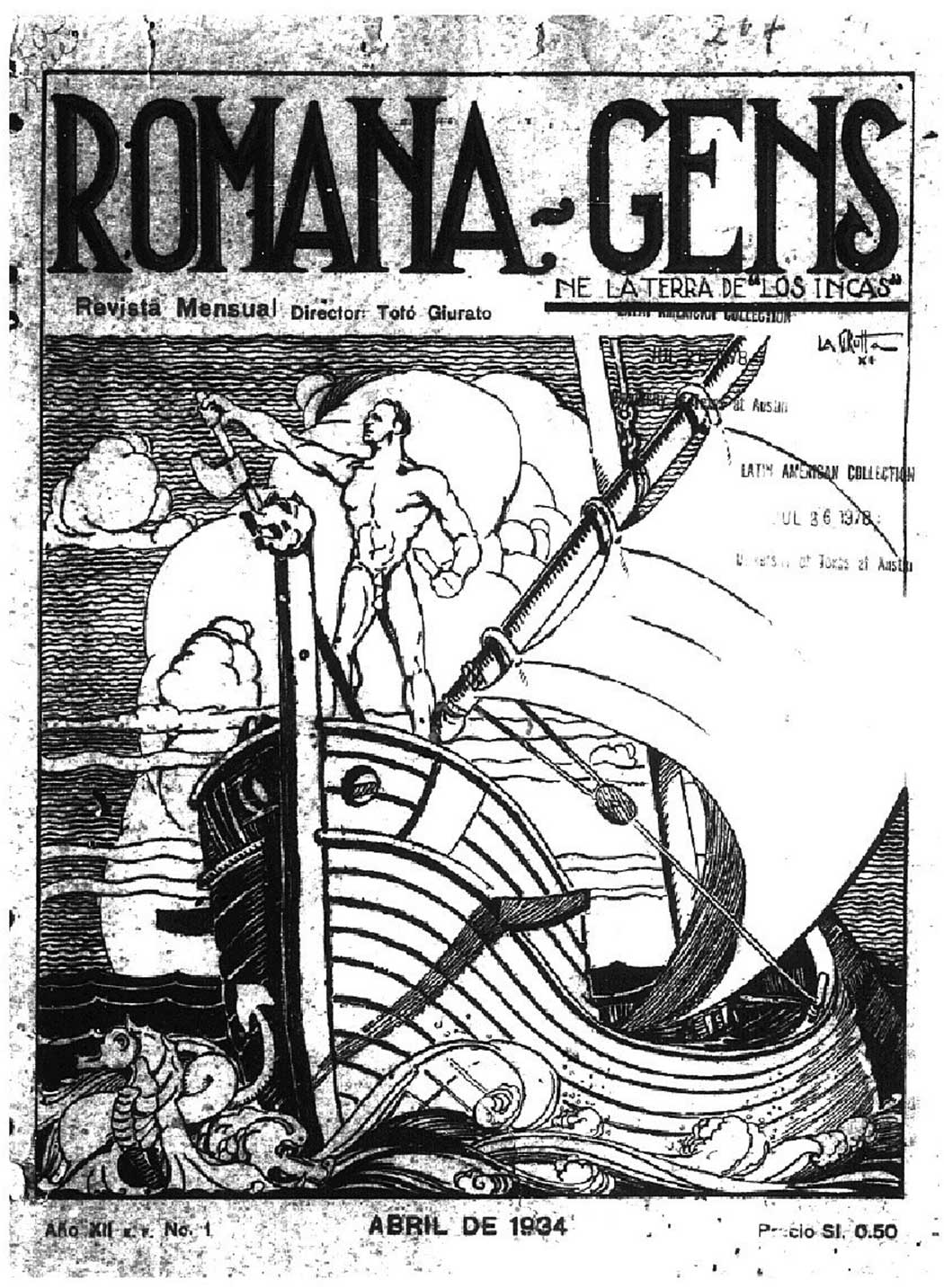
Romana-Gens Footnote 2 was published by the Fascist Ministry of Propaganda in Peru monthly from April 1934 to August 1941 (Figure 1); however, it was also funded by the wealthy Italian community in Peru, and an analysis of the publication reveals a range of diverse interests. As a case study, the periodical reveals the complexity and coexistence of the concepts of Italianness used by Fascist propaganda but also by the immigrants in Peru. No comprehensive study of Romana-Genshas yet been published: the most interesting paper on the subject is Orazio A. Ciccarelli’s ‘Fascist Propaganda and the Italian Community in Peru during the Benavides Regime, 1933–1939’ (1988). In this article, Ciccarelli describes the general aspects of the Italian community in Peru and shows the transformation of Fascist propaganda in Peruvian newspapers during the regime of President Benavides, an ambiguous ally of Fascist interests. However, since the article presents a panorama of Fascist propaganda, there is neither an analysis of newspaper articles and images nor an analysis of Romana-Gens, which is only mentioned as a propaganda instrument of the Nucleo di Propaganda Fascista (Nucleus of Fascist Propaganda) in Peru.
The first issue of Romana-Gens ne la Terra de ‘Los Incas’, April 1934

The relevance of the journal is revealed by the fact that it is studied today, the group claims, by Acción Legionaria (Legionary Action), a neo-fascist Peruvian organisation that wants to introduce fascist ideals into Peruvian politics and economy: it is radically opposed to liberalism and communism, and upholds the legacy of Luis Sánchez Cerro. From a scholarly perspective, analysis by this organisation is biased because of its interest in the resurgence, and eventual rise to power, of neo-fascism in Peru. However, it has preserved the complete collection of Romana-Gens, probably the best that could be found today (the reels of the University of Texas have some issues missing). Legionary Action frequently publicise the fact that they gave a complete collection, in a silver binding, to the Duce (Cabanillas 2013).
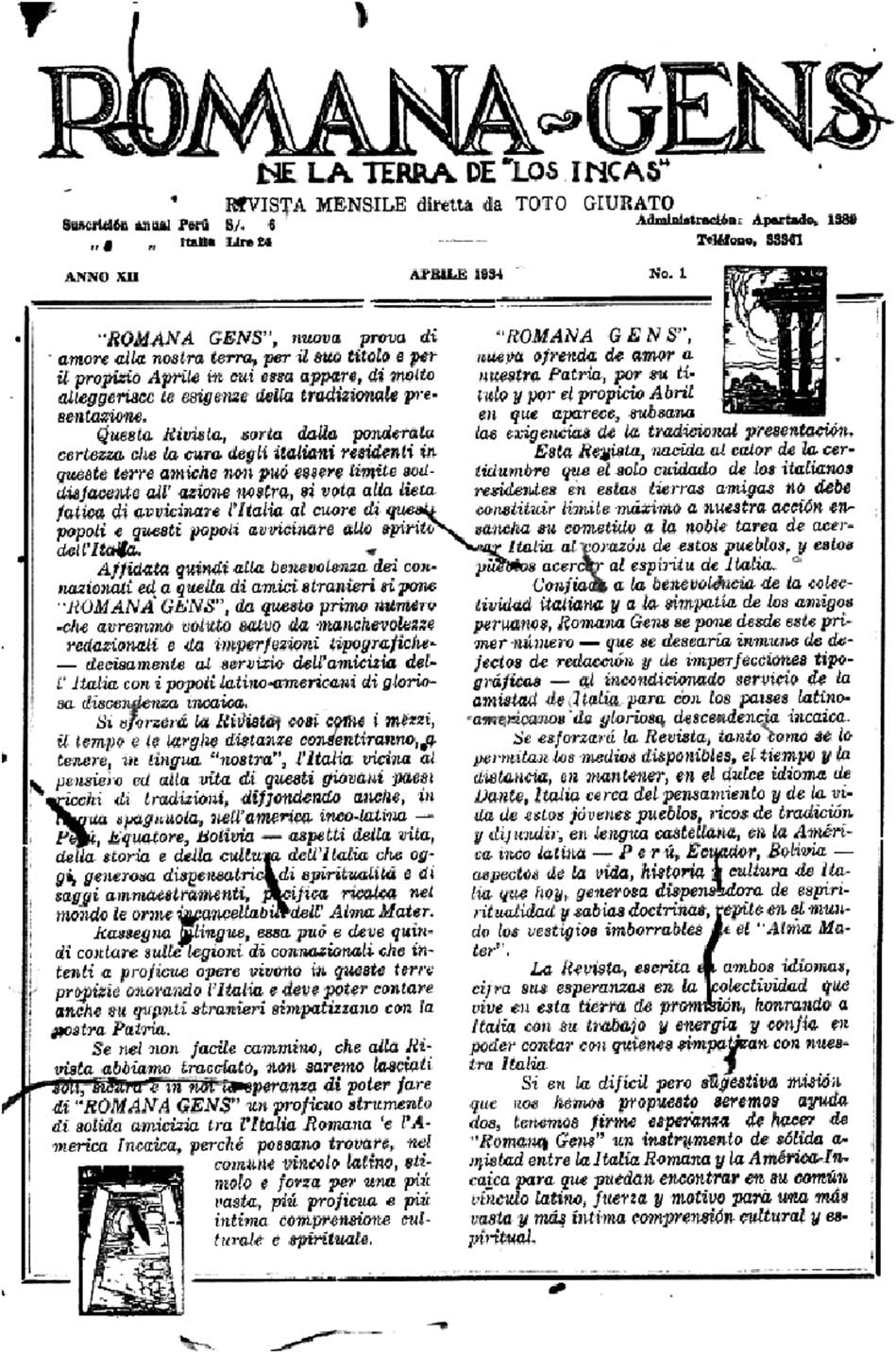
An exhaustive analysis of Romana-Gens is outside the scope of this article; consequently, I will describe and analyse briefly some of the features that show the coexistence of interests in the publication. The first element that reveals the transformation of the journal is the language it uses. In the beginning, it aimed to be bilingual; the editorials of its director Totò Giurato started as bilingual (Figure 2) but eventually appeared only in Spanish. This reveals the acknowledgement that many of its intended readers increasingly communicated only in Spanish.
Editorial in the first issue of Romana-Gens, printed in both Italian and Spanish

A very interesting aspect of the first editorial, April 1934, is that while being a publication founded by the Fascist regime, it did not once mention the word. In fact, a journal whose funding depended not only on the regime but also on the Italian (-Peruvian) capitalists could not assert emphatically an alliance that was not homogenous in the community of Italians in Peru: thus, the first editorial speaks of Italian identity only in the context of its secular and historical heritage – the Roman Empire and Dante, an imperial past and a common and prestigious literary language, the language of the empire.
However, this identity is problematic because of the bilingual character of Romana Gens. The Italian-Spanish version of the first editorial shows the decisions the editor had to take when translating from one language to another. Consequently, the intended reader of the journal is uncertain: is the Italian editorial directed to Italians (living in Peru?), and the Spanish version to Italo-Peruvians? Was it read by PUR members favourable to fascism?
The affective leitmotif that runs through the editorial is one of ‘amicizia’ (friendship). For instance, the Italian and Spanish versions read as follows:
Si sforzerá la Rivista, cosi come i mezzi, il tempo e la larghe distanzeconsentiranno, a tenere, in lingua ‘nostra’, l’Italia vicina al pensiero.
Se esforzará la Revista, tanto como se lo permitan los medios disponibles, el tiempo y la distancia, en mantener, en el dulce idioma de Dante, Italia cerca del pensamiento.
(The magazine will endeavour, as much as the available resources, time and distance allow, to keep Italy in our thoughts, in the sweet language of Dante.)
The Italian version emphasises with the quotation marks that the intended readers are Italians, but the Spanish version is directed to friendly foreigners who have at least heard the ‘sweet language of Dante’.
The question that this bilingual editorial raises is which version the second and even third generation of Italians in Peru would have read. Probably, the fact that Italian was becoming increasingly impractical obliged the magazine to publish only in Spanish; again, this shows the problematic status of italianità abroad. The editorial is therefore cautious and strategic, since it presents Italy as a country of strong cultural traditions whose legacy should be promoted by ‘italiani residenti in queste terre amiche’ (‘Italian residents in this friendly land’). The stance of the journal is a dual one, portraying Italians in Peru as happy guides to their culture and to the ‘soul’ of Italy: it speaks of the ‘lieta fatica di avvicinare l’Italia al cuore di questi popoli e questi popoli avvicinare allo spirito dell’Italia’ (pleasant task of bringing Italy to the heart of these people and these people to the soul of Italy).
The second element that the editorial shows is the link it establishes between the Roman and the Inca empires, and its emphasis on the Latin roots of both countries. Rome becomes for the publication a double signifier that connects Peru with Latin roots (language and character) and connects the Peruvian imperial past with the empire that Fascist Italy was striving for: they (the editor, Italians, the Fascist regime?) wanted to make of the magazine ‘un proficuo strumento de solida amicizia tra l’Italia Romana e l’America Incaica, perché possano trovare, nel comune vincolo latino, stimolo e forza per una piú proficua e piú intima comprensione culturale e spirituale’ (a fruitful instrument of solid friendship between Roman Italy and the America of the Incas, so that its readers can find through their common Latin bond, incentive and strength for more useful and more intimate cultural and spiritual understanding). Latin roots and empire are the linking elements of Fascist Italy’s present and the idealised Peruvian past.
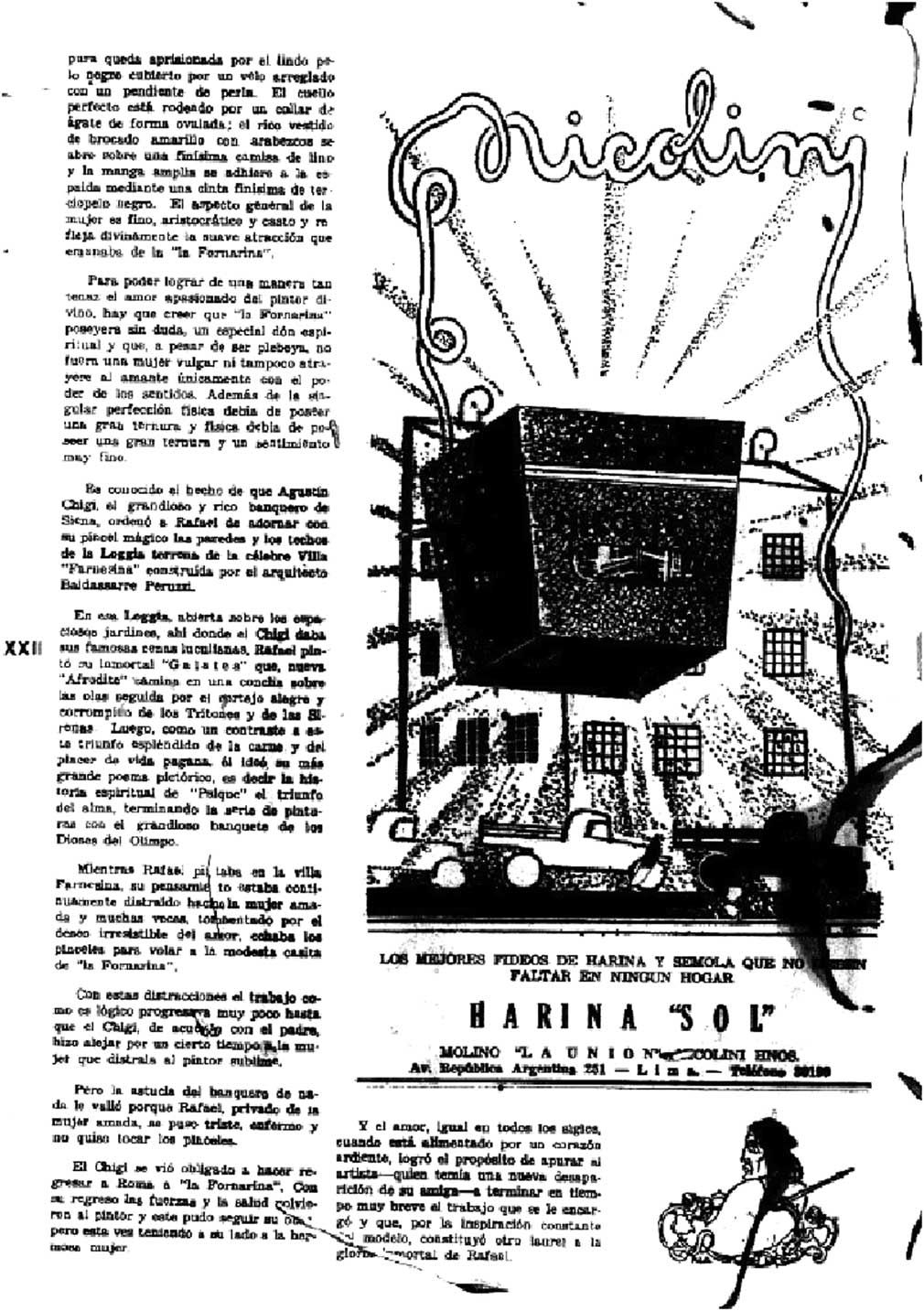
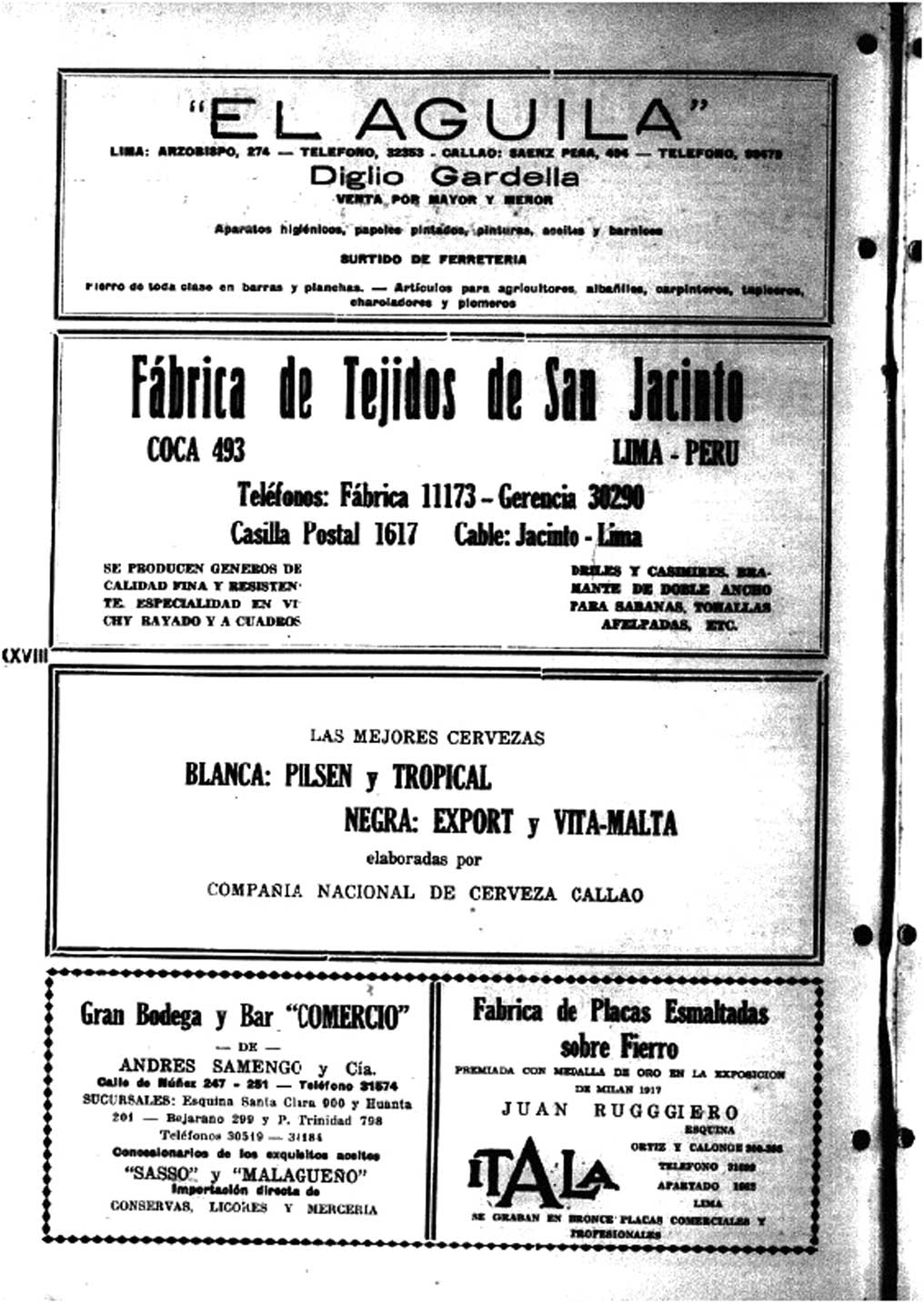
Another feature that shows the fluctuation of Italian identity in the Peru of the 1930s is the advertisements. Throughout the publication, fascist propaganda appears together with advertisements for Italo-Peruvian businesses such as the flour and pasta factory Nicolini (
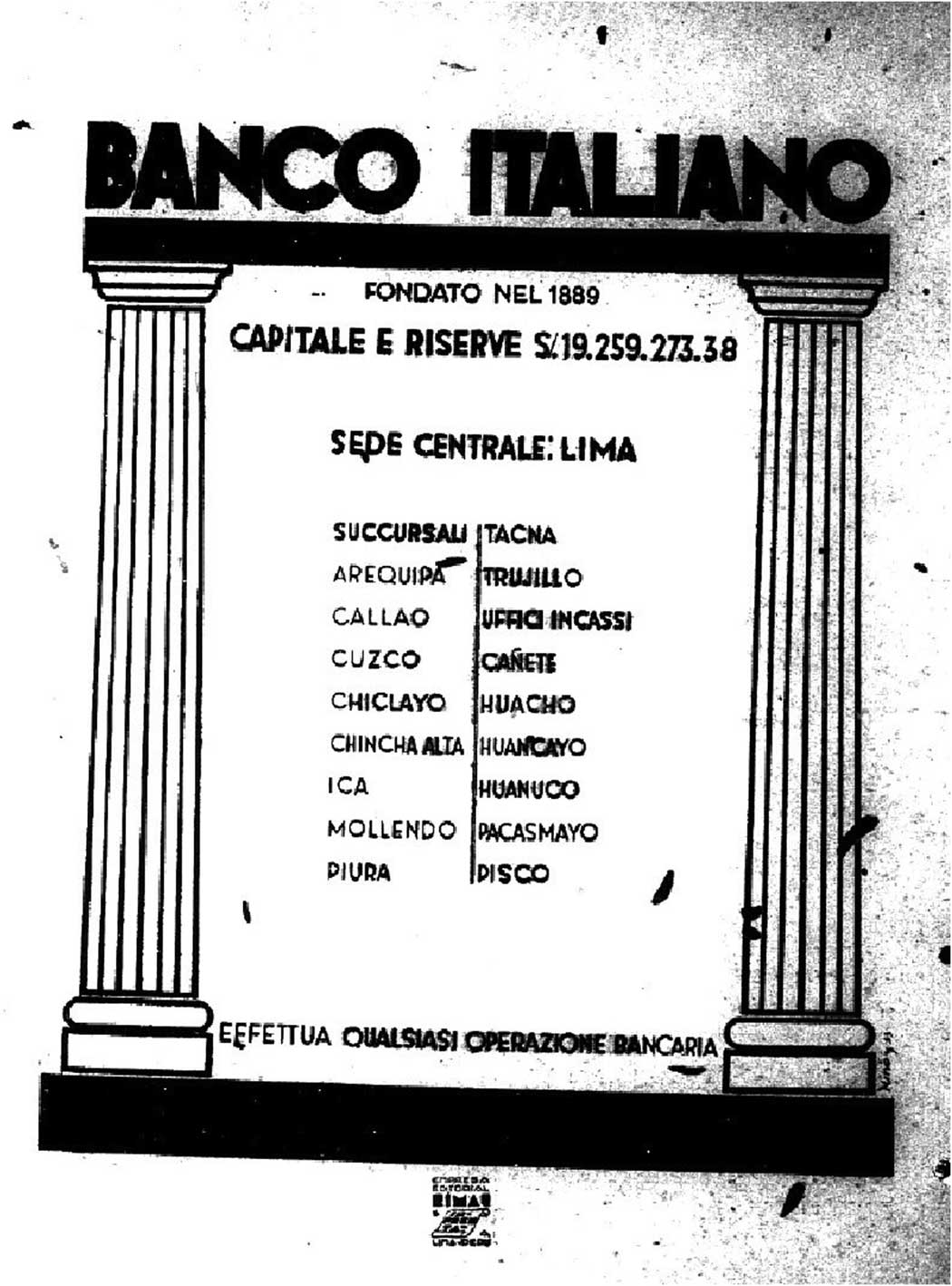
Figure 3, the Italian Bank (
Figure 4), travel agencies, textile and food smaller business (Figures 5 and 6). What is important regarding these advertisements is that they reflect the economic compromises that the director of the magazine, a Fascist representative, had to deal with when obtaining funding in a country where Italians were becoming increasingly integrated.
Figure 3

Figure 4

Figure 5

Figure 6

As Ciccarelli (Reference Ciccarelli1988) affirms, Italians had to weigh their loyalty towards their fatherland against the political situation in their adopted (and soon-to-be-their) land. Knowing that the Benavides’ successor would probably not be favourable to Fascism, and recognising the increasing presence of US industry and propaganda in the country, Italians in Peru were very cautious about their alliances: they accepted a Fascist magazine, they even funded and advertised in it; however, when Italy’s international reputation fell, they decided to stop the funding and eventually the magazine disappeared.
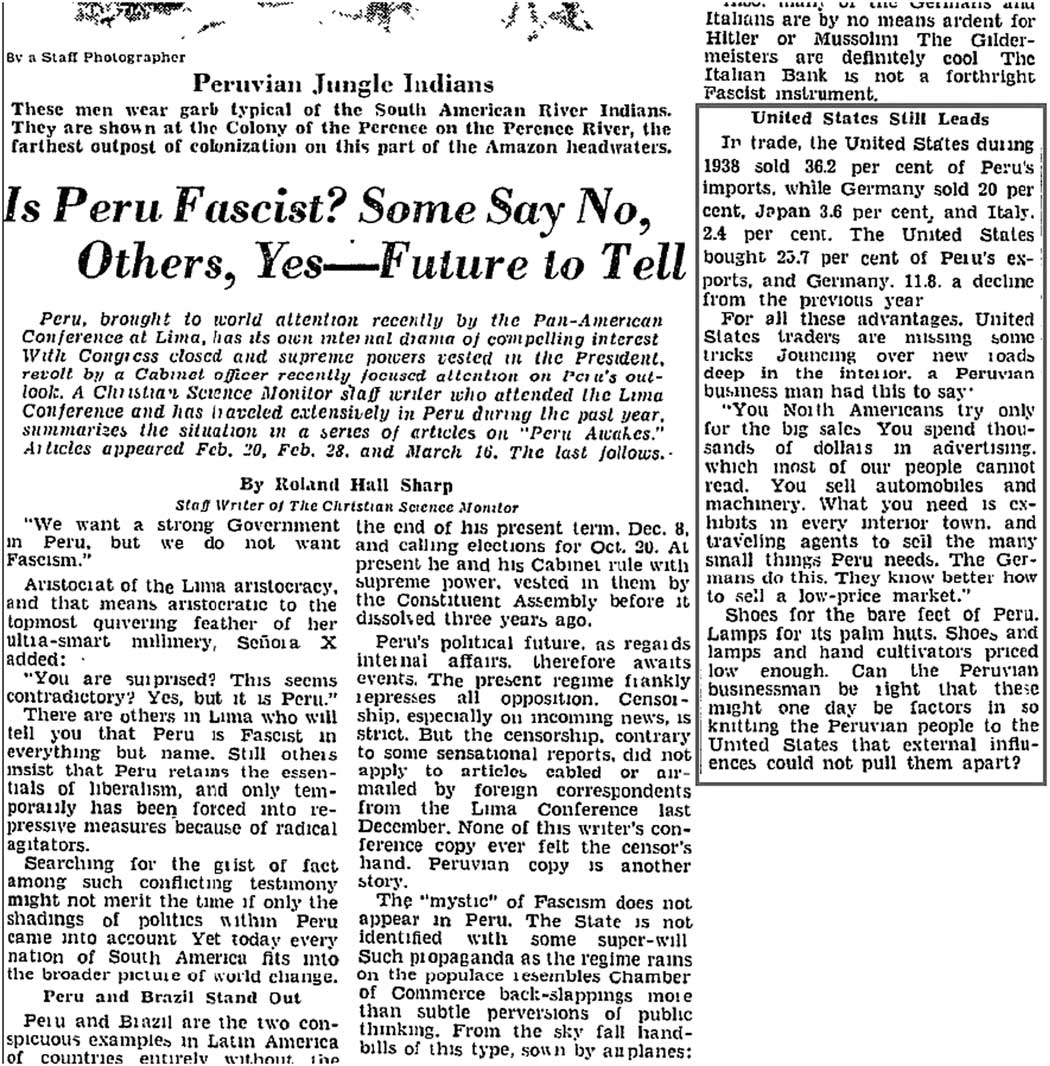
Another telling feature of Italians in Peru is their integration through the promotion and development of commerce. For instance, in a 1939 edition of the Christian Science Monitor (
Figure 7), a US journal that carried worldwide news, Roland Hall Sharp reports the testimony of a Peruvian businessman: ‘You North Americans try only for the big sales. You spend thousands of dollars in advertising, which most of our people cannot read. You sell automobiles and machinery. What you need is exhibits in every interior town, and travelling agents to sell the many small things Peru needs. The Germans do this. They know better how to sell a low-price market.’
Figure 7

Something similar occurred with the Italians in Peru: they gradually became more specialised in the low-price market – textiles, food, shops. The statistics of 1938 show that 36.2 per cent of Peru’s imports came from the United States, 20 per cent from Germany, 3.6 from Japan and 2.4 per cent from Italy. These figures refer to imports from Italy, the country, not sales by the Italo-Peruvians and their small, medium and big businesses. It is important to mention that the Italian community in Peru was the biggest from Europe, consisting of very well-integrated middle-class Italians, above all from the commercial region of Liguria (Ciccarelli 1998).
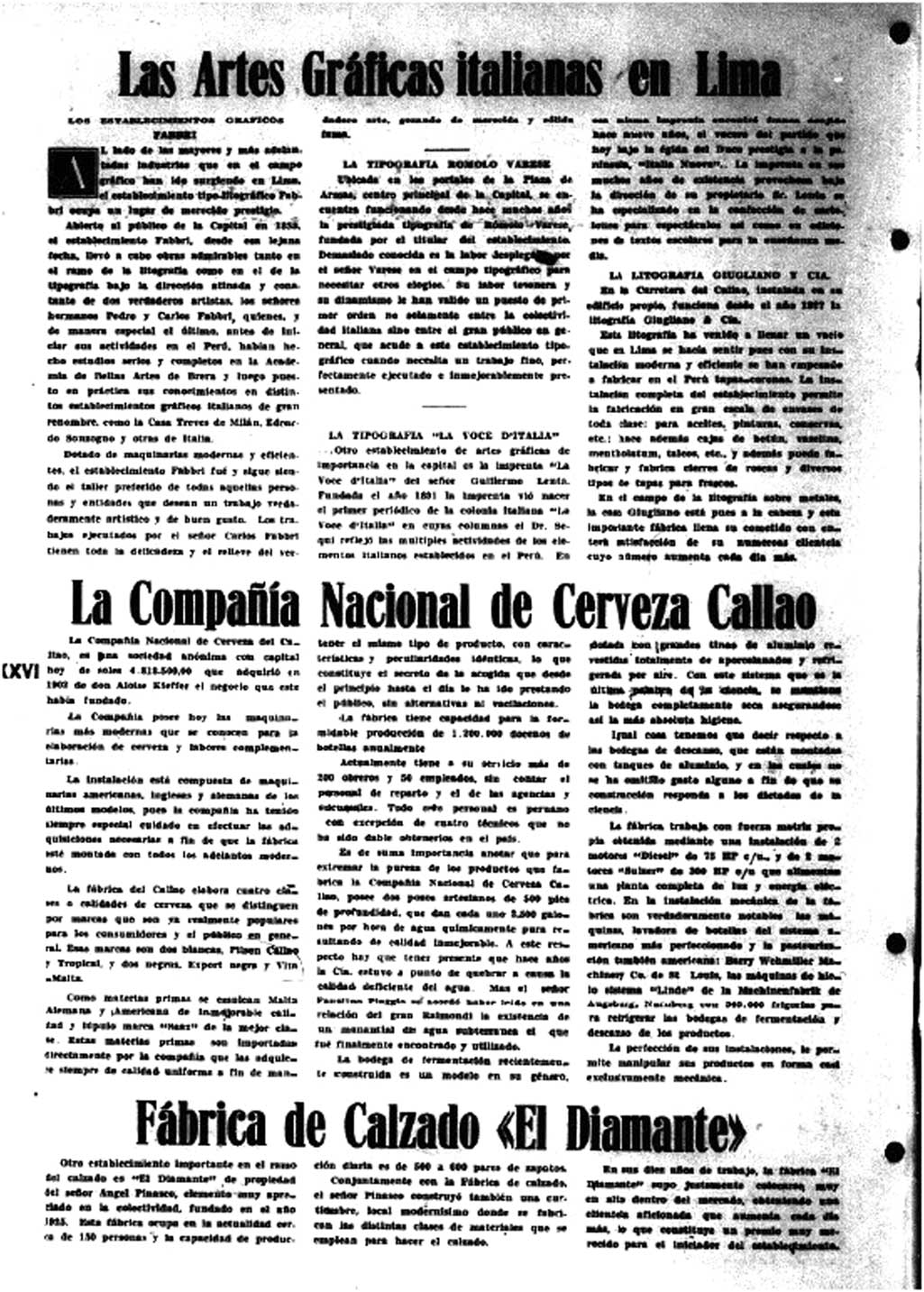
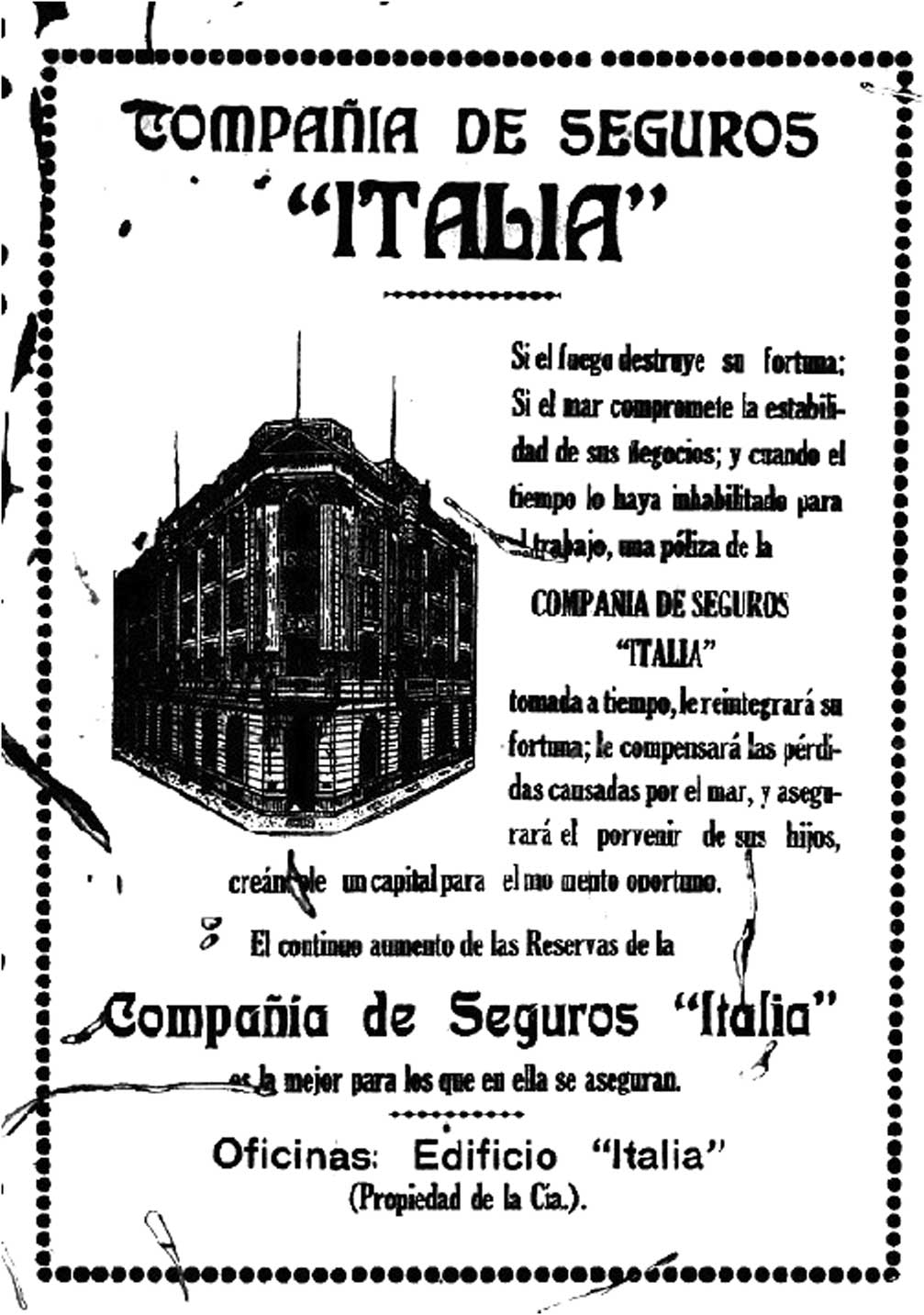
Romana-Gens shows the strong integration of the Italians in Peruvian society through its abundant advertisements. The issue of January and February 1935, dedicated to Lima on the anniversary of its foundation, shows profuse evidence of the Italians’ activities in Peru – in industry, food, sports, fire brigades, schools, banking, insurance agencies (
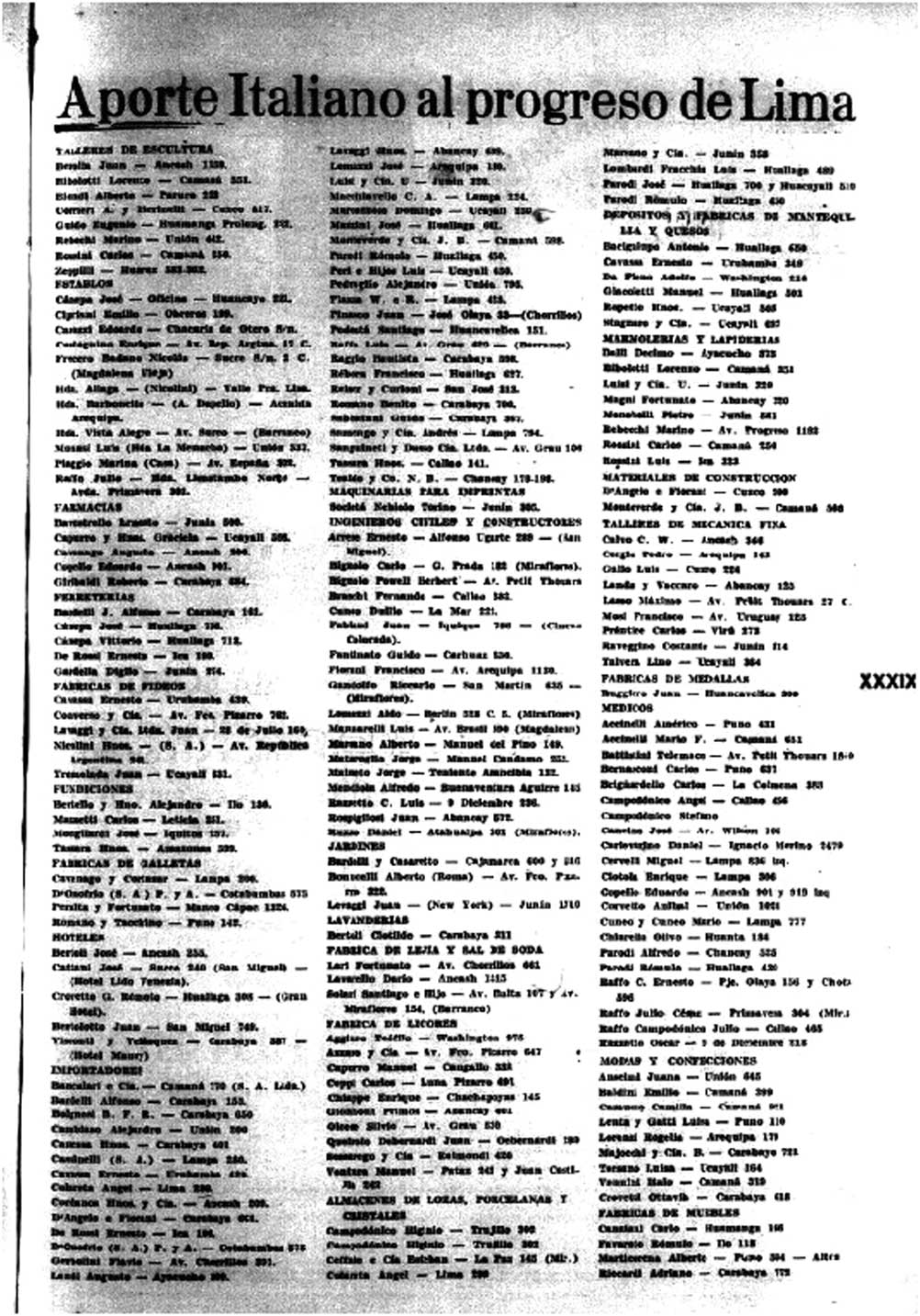
Figure 8), architecture, hospitals and welfare houses, travelling, etc. There is even one page listing the ‘Aportes italianos al progreso de Lima’ (Italian contributions to the progress of Lima) (
Figure 9).
Figure 8

Figure 9

All these elements show the coexistence of diverse interests in Romana-Gens, a Fascist journal of propaganda and advertisement; our analysis demonstrates the gradual strengthening of the Italian émigrés, whose second and third generations would eventually consider themselves Peruvian-Italians or simply Peruvians. The magazine illustrates a process of negotiation that transformed Italian identity in Peru.
From the Andes to the Alps: Marca Perú in Loreto, Italy
According to Perfil migratorio del Perù (Migratory Profile of Peru, Sánchez Aguilar Reference Sánchez Aguilar2012), Peruvians in Italy are the largest Latin American group and the fourth largest community outside Peru after those in the US, Spain and Argentina: 10.1 per cent of the Peruvians that live abroad are in Italy and 41.1 per cent of the 101,711 residents have permission to remain there indefinitely, making them the second largest Spanish-speaking community in Italy. Most Peruvian immigrants reside in Lombardy, especially in Milan and Turin, and in Rome and Florence; they are mainly women (61.3 per cent) who generally work in the area of senior care. The principal reasons for Peruvian immigration are employment and family reunification (Sánchez Aguilar Reference Sánchez Aguilar2012, 88, 106, 108).
As in Argentina, during the last decades of the twentieth century there was a reversal in the direction of immigration: throughout the nineteenth century and the first years of the twentieth, there was a diaspora ‘from the Alps to the Andes’ (Baldi e Cagiano de Azevedo Reference Baldi and Cagiano de Azevedo2005; Ambrosetti and Strangio Reference Ambrosetti and Strangio2015, 35). In Peru, this reversal ‘from the Andes to the Alps’ occurred because of the economic crisis and political instability that Peru experienced from the 1970s (inflation and corruption, authoritarianism and terrorism). The first Peruvian immigrants in Italy were industrial technicians, professionals or entrepreneurs, who had a good image and social status. However, from the 1980s, something changed: Peruvians from the Andes region and poor urban areas started to emigrate.
The economic and political crisis of the 1980s and 1990s made two million Peruvians emigrate. A large part of that population went to Italy due to the high salaries the country offered. From 2005 onwards, Peruvian immigration decreased because of the political and economic crisis in Italy. However, many Italian cities could no longer ignore Peruvian immigration: hence, many government and local policies have been enacted dealing with the health and education of the children of Peruvians who decided not to return to their home country: this has caused many of them (just like Italians in Peru more than 70 years ago) to consider themselves Italo-Peruvians. Finally, it is important to mention that since 2016 Peruvians have not needed a Schengen visa to stay for a period of up to 90 days in any country of the European Union.
It is in this context of Peruvians seeking integration and of the negotiations for the Commercial Agreement between Peru and the European Community (Brussels, February 28, 2010) that the campaign Marca Perú (Brand Peru) begun. National branding is ‘the application of corporate marketing concepts and techniques to countries, in the interests of enhancing their reputation in international relations’ (Kerr and Wiseman Reference Kerr and Wiseman2013, 354). Many countries create national brands to build relationships between different actors, not only to nations, but also encompassing the public and private sectors. This simultaneously needs and reinforces national(ist) discourses.
The increasing symbolic value of cultural products has led countries to emphasise their distinctive characteristics. The branding and image of a country ‘and the successful transference of this image to its exports is just as important as what they actually produce and sell’ (True Reference True2006, 74). Scholars such as Evan H. Potter (Reference Potter2009) understand national brands as a form of national soft power. All efforts by government (at any level) to support the national brand – either directly or indirectly – becomes public diplomacy. Antiglobalisation proponents often claim that globalisation diminishes and threatens diversity, but there is evidence that to compete against the backdrop of global cultural homogeneity, nations strive to accentuate and promote local distinctiveness as a competitive advantage (True Reference True2006, 73–74).
According to its website, administered by the Ministry of Foreign Commerce and Tourism, Brand Perú is ‘un símbolo que une a todo el país’ (a symbol that unites all the country) and that ‘aquellos países que logran una marca país fuerte, cohesionadora y positiva tendrán una ventaja competitiva para lograr una mayor recordación en las audiencias claves’ (those countries that achieve a strong, unifying and positive national brand will have a competitive advantage in gaining a better recollection in the key audiences). The intersection of image (symbol) and memory (recollection) at the service of national branding reminds us of the uses of propaganda. The webpage logo is the word ‘Perú’ written with a Nazca-lines calligraphy. In the background, a long red bus with the logo on it is captured by a professional HD camera.
Below that image, information about the tasks of Marca Perú reads as follows: it is ‘a tool that aims to encourage and promote tourism and exports and to attract investment; additionally, it is an effective way of transmitting the valuable assets of the country’. Then we are informed that there are two programmes of Brand Peru: one is ‘Licenciatarios’ (Licensees), that is, the possibility for individuals or enterprises/businesses to use the national brand to promote and publicise Peruvian exports, tourism and investment; and the other is called ‘Embajadores’ (Ambassadors), intended for individuals whose personal and professional achievements are outstanding locally and internationally: ‘son líderes, ejemplos de excelencia y gestores de una buena reputación’ (they are leaders of excellence and designers/producers of a good reputation’.
To understand this campaign the notion of global marketing is not enough because, since the last decade of the twentieth century, the concept of globalisation as a process of homogenisation of societies and cultures through powerful multinationals (from McDonald’s to Coca Cola) has been called into question by what has been called glocalisation. A ‘glocal’ approach to business performs marketing strategies that think and act from the local to the global, preserving local identities; its strategy ‘comprises local, international, multinational, and global strategy approaches. It differs from the global strategy approach, since it explicitly recognises the importance of local adaptations and tailoring in the marketplace of business activities’ (Svensson Reference Svensson2001, 15)Footnote 3 . This is the strategy carried out by Brand Peru, promoting unexpected encounters between Italian and Peruvian national discourses (in Peru and Italy).
Brand Peru was an initiative of the Ministry of Foreign Trade and Tourism (MINCETUR) launched in 2011. In the tourism sector, it promotes, orientates and regulates tourist activities with the goal of promoting sustainable development for tourism, and it includes the promotion, orientation, and regulation of arts and crafts directed towards tourists. It promotes free trade agreements, as well as managing the tourism entity PromPeru, a government organisation responsible for promoting Peru around the world.
Brand Peru’s video set in Loreto is a 15-minute advertisement-documentary that records the adventure of a group of Peruvian cultural and economic ambassadors in Italy. The video was officially released by the Youtube account of Brand Peru, part of MINCETUR, on 19 July 2012. It has so far clocked up approximately 1,200,000 visits, almost 12,000 likes and 300 dislikes. It has been commented on by approximately 3,600 people: most of the comments are positive, and they express pride in the cultural heritage and natural richness of Peru (the majority of these comments are made by Peruvians). There is one comment complaining about the presentation of Peru as an exotic country; comments by people from other countries are in the minority.
The documentary was released in full HD with subtitles in English and Italian. Brand Peru also released a ‘behind the scenes’ video, described in this way (in Spanish and English, (not Italian):
¿A dónde nos llevará el bus rojo de la Marca Perú en su segunda incursión por el mundo? ¿Qué pueblo será bendecido esta vez con una inolvidable explosión de color, calor ... y sabor a peruanidad? Pon play y abórdalo ya, porque el Perú es una gran marca ... ¡y todos estamos invitados a ser sus embajadores!
(Where will Marca Peru’s red bus take us on its second expedition around the world? Which town will be blessed this time with a memorable explosion of colour, warmth ... and taste of Peruvian culture? Click here and hop on, for Peru is a great brand ... and we are all invited to be its ambassadors!)
Three elements define the beginning of the video: a long red bus moving, wide panoramic views of Loreto in Italy, and the non-diegetic voice that tells us what is happening (at first, the voice seems to belong to a native Peruvian of the Amazon region, also called Loreto; then the voice uses a standard Spanish accent). The narrative starts with the ‘penetration’ of the bus through the stone gateway of Loreto: however, the long phallic bus is so big that it cannot penetrate the town. Consequently, the people get off the bus and enter Loreto on foot, amicably and joyfully.
As we have seen, Italianness is malleable depending on the interests of the enunciators: Fascist ideology, the Italo-Peruvian community, the Italians of Loreto or the Peruvians that go to Loreto. Moreover, the economic and geopolitical context redefined and redefines today the meaning of national discourses: in the first half of the twentieth century, Fascist industrial corporatism with global intentions served nationalist purposes; nowadays Peruvian service-exporting economy and ecological tourism in the context of glocal capitalism reinforce a nation which has become, simultaneously, identity and brand.
In Brand Peru’s video, the promoting of Peru abroad has been taken up by a national(istic) discourse whose goal seems to be to reshape ‘peruanidad’ around an ecological consumerism based on the country’s hyperbolic and hyper-generous natural and cultural resources whose synecdoche is the Amazon river located in the Peruvian Loreto; its mighty waters will revive the tiny Italian river where Gino, a loretano child, at the end of the video, places a replica of a big boat of the Amazon as a symbol of hope.
The video, from the beginning, locates the spectator in a global, if not glocal, context. The non-diegetic voice, which seems to belong to a native Peruvian of the Amazon region, affirms that ‘Peru is full of wonders’; meanwhile, a 3D map of South America appears and we zoom in to the Amazon region, all in green, whose heart, we are told, is the region of Loreto, the Peruvian rainforest. Immediately after, cumbia, a tropical Peruvian and Latin American music, is heard and we see the big red bus and the Italian landscapes I have described: the Peruvian ambassadors will ‘conquer’, through an ecological and glocal capitalism, the Italian and European markets.
The voice, now in standard Spanish, shapes the story. The cinematic rhetoric of the video uses hyperbole and accumulation as tropes. Peruvian Loreto is incredibly generous; Italian Loreto is incredibly tiny compared to its Peruvian twin. We cannot avoid seeing this in terms of the gendering of Peru and Italy – the long red bus is a phallic and dynamic power which travels through Italian soil to penetrate it economically and symbolically. Even the act of penetration emphasises the ‘generosity’ of Peruvian resources and the deficiency of Italian Loreto. In this sense, when the red bus arrives at the town, it cannot enter through its gates because it is too big: penetration would thus imply force.
On the contrary, the Peruvian ambassadors decide to get off the bus and enter the town with their products, and with a megaphone, their hyperbolic voice, they will give their ‘authentic’ identity to the loretani. What is really telling about the documentary is that the first people to get off the bus are the native Peruvians and they speak their Amazon language. This gesture performs a reversal of history, where the historically conquered are the new ecological and non-violent ‘conquerors’ but their transportation is completely capitalist – a red phallic bus representing Peru not as a nation but as a national brand. The revealing element in this context is that the economic conquest, reminding us of the ‘discovery/conquest of the New World’ by Spanish and Italian travellers and conquerors, is not made in the name of the sword and the cross but with the intention of sharing cultural and natural products.
Consequently, the conquest will be festive and generous where national symbols are just, at a first glance, instrumental to the economic interests of Peru. The first portrait of the Italian Loreto is one of scarcity compared to the abundance of Peruvian Loreto: four palm trees versus an abundant jungle, ‘four wild beasts but one of them not so fierce’ versus the Amazon anaconda; and a ‘navigable river just for Gino’s little paper boat’ versus the Amazon river. The landscape of Italy is rendered as one of loneliness and characterised by ageing and neutral colours. When the Peruvian ambassadors arrive, it seems that there is nobody in the city: they are really ‘discovering’ a new land for their products that they literally carry in their hands.
The megaphone functions to introduce Italian Loreto to a new phase of capitalism: glocal. While we hear a declamation that the locals have the right to enjoy a more vibrant life, the camera alternately covers the monochromatic and ancient (if not ageing or sleeping) landscapes of the Italian town on the one hand, and Peruvian colours flooding Italian soil, on the other. Particularly revealing is that the video shows an old Loreto: most of the Italians that we see are adult or old people. The video is aware of its intended public: not the young Italians, but the adult and retired people with enough income and time to travel to Peru or to consume exotic and delicious Peruvian products.
The video relates two areas glocally – the Italian and Peruvian Loretos. The former, a hill town, is a comune of the Italian province of Ancona, in the Marche, and most commonly known as the seat of the Basilica della Santa Casa, a popular Catholic pilgrimage site. The latter is the country’s northernmost region. Covering almost one-third of Peru’s territory, Loreto is the nation’s largest region; it is also one of the most sparsely populated, due to its location in the Amazon rainforest. Its capital is Iquitos and it is known in Peru as a place where people (especially women) have ‘sangre caliente’ (hot blood) alluding to their sensual and sexual attributes, in part reflected in the exuberance of the Amazonian territory. One of the main goals of the video is thus to contrast the unexciting (Catholic?) atmosphere of Italian Loreto with the promising exuberance (heathen?) of the Peruvian one. But there is more.
The native Peruvian, Rafael Flores, leader of the Loreto community in Peru, has as his mission to ‘avoid the isolation of his [Italian] brothers’. He steers his canoe (on wheels) through the streets of Loreto, which is described as a ‘brick and cement jungle’. The figure of Rafael Flores becomes the symbol of the regenerating power of this glocal (and ecological) marketing. Indeed, after this scene, two old Italian men complain about the health services in their town. In the next scene, we see the Peruvian beverages regarded as natural medicines that can heal many of the diseases produced by contemporary, technological and industrial societies. Again, another figure becomes the saviour of these men: Luis Culquitón, great shaman of Manacamiri, in the Amazon region. This rhetoric is reproduced again and again in the video.
I end this analysis with two cinematic tropes that are helpful to the glocal marketing strategies the video performs: the first is the notion of Peruvian aesthetic fulfilment, and the second is the notion of natural brotherhood. Regarding the first, it seems that we are in Loreto’s art museum. A fictional Peruvian art historian, Christian Bendayán, in front of Italian visitors, shows how one of the most famous Italian artworks is fulfilled by Peruvian contemporary and popular art. The first painting is Botticelli’s ‘Three Graces’ (part of La Primavera): Bendayán’s reinterpretation of this art classic asserts that ‘three gracious friends (are) frisking in the Renaissance spring; to the right, [we see a Peruvian painting] our friends have travelled into the Amazon night in a process called “Sweat, Heat and Colour”.’
Something similar happen with the next painting where two Italian lovers have fulfilled their probably prohibited love with a kiss in the Peruvian Loreto, the land of free desire. Bendayán’s exposition finishes with a sigh of satisfaction. The logic of aesthetic fulfilment performs two functions: it connects Peruvian art and beauty to classic Italian art, destabilising the canonic supremacy of the latter (in a subtle way, Bendayán’s task as art historian is to affirm the equality of Peruvian art within a glocal narrative) and, at the same time, it aims (I am not sure if successfully) to fulfill the Italian (European, global) desires for natural freedom, love and even sensuality: sweat, heat and colour are the offers of the Peruvian brand to potential tourists.
The second notion, the one of brotherhood, reaffirms the gentle conquest of the beginning. In other words, the video has two goals: the aggressive campaign of a national brand to sell its products and promote tourism and, at the same time, its integration into a glocal market based on ecological and service-exporting economies; this is seen when the non-diegetic voice says that the Amazon will share some of its popular abundance with its Italian brothers.
In the next scene, we see a cumbia singer and an Italian musician singing together what can be called a glocal fusion of traditional Peruvian cumbia and traditional Italian tarantella: cumbiatella. Emphasising the idea of fusion and brotherhood, the cumbia and the tarantella are not sung in standard Spanish or Italian, but instead the singers introduce many dialectal traits: phonetic, lexical, syntactic. This technique of fusion and mixture, hybridisation, shows how national branding reshapes national discourse when advertising needs it.
The video ends with a traditional Amazonian ritual next to Loreto’s small river: Italians and Peruvians form a circle, shaking hands, and they pray to the Amazon gods to preserve and take care of the Italian Loreto; the Amazon leader shakes hands with the Italian mayor, and at the end we see butterflies flying as a sign of hope, and an Amazon-like house and a toy boat, a replica of the Amazon boats, being placed by the boy Gino in the Italian river. The Peruvian Amazon region has cinematically, albeit via a small replica, transformed the Italian natural and cultural landscape in a Peruvian one: when this goal, full of ecological hope but also of glocal interests, is fulfilled, the Peruvians must go to another town in their phallic red bus to spread the Peruvian Gospel of an environmentally friendly and touristic glocalisation.
From a Peruvian and Latin American perspective, Italianness acquires multiple meanings which destabilise the traditional commonplaces about italianità and offer a sense of the complexity of Italian identity when seen from a non-European and non-American (US) perspective, and certainly from different economic interests. But what is most important is how a video, whose goal was to promote Peru as brand abroad, has also become a landscape of affections that is reshaping Peruvian history (giving voice, though branding, to what has been historically the most forgotten area of Peru, the Amazon region) and identities (promoting the feeling of Peruvians’ national identification). In that sense, national branding seems to fulfil a double and apparently contradictory function: promoting glocal consumerism and, simultaneously, strengthening national identities.
Conclusion: a story of rovesciamenti
The notions of italianità and peruanidad have been used historically as images that promote a historical identity: a nation. An analysis of Romana-Gens demonstrates how multiple Italian interests, Peruvian and/or Fascist, coexisted. The journal’s articles built an exemplary image of Fascist Italy and justified the imperial intentions of the regime in Africa. The goal of Romana-Gens was to make Peruvian, and ultimately Latin American, public opinion favourable to Fascism in the context of the struggle for global hegemony that led to the Second World War. At the same time, however, the advertisements in the journal represented the economic interests of Italian businesses in Peru whose owners, second and third generation immigrants, were not (at least not openly) fascist.
This duality of Italian interests shows how mobility transforms radically the relationship of a community with its ‘nation’. Indeed, Italians had integrated deeply in Peruvian society; this explains why they were ‘not touched’ as Japanese or Germans were during the war. The relations of Italians in Peru with Fascism were mediated by their pragmatic interests; in other words, they could fund a Fascist journal as long as it served as a commercial advertisement, but when the Fascist regime became unpopular within Peru they decided strategically to stop funding the journal and avoided any connection with Fascism. Hence, the image of Italy they built in the Peru of the 1930s was strongly determined by their politico-economic interests but also by the affective relations towards ‘their’ two countries.
Almost one century later, it is Peru, through an intense and affective campaign of national branding, which tries to ‘conquer’ Italian (as a metonym of European) markets through a cinematic rhetoric of regenerative excess. In other words, Peru offers Italy a regenerating cultural and natural spontaneity (to consume). It is revealing that, in the video we discussed, the traits that are ascribed to Peru are similar to those that have been historically attributed to italianità: the amazingly rich historical past (Roman and Incan Empire), the astonishing gastronomical richness, and the endless and tireless creativity (resourcefulness) of the Peruvian ‘buena gente’ (good people). In fact, from the last decades of the twentieth century, national propaganda for a global world seems to have become national branding for a glocal market.
The analysis of these artefacts raises many questions about national identities. Indeed, is it possible to suggest that Italy is the European Peru or that Peru is the Latin American Italy? Propaganda and branding have portrayed them as countries marked by an excess of beauty, history and food. National branding functions today not only as an economic campaign directed towards tourists but also as a landscape of affects whose effects are dual: on the one side, it offers international markets an idealised image of Italy and Peru; on the other hand, however, national branding triggers affections towards one’s nation (especially for immigrants) and reveals its potential in moments of crisis. The power of national branding (and its ancestor, propaganda) should be re-envisaged not only as an emotional strategy run by economic powers. Instead, the analysis should be broadened to see the complexities of a phenomenon that has been useful to the economy but also to people’s identities.
Throughout the discussion of Romana-Gens ne la Terra de ‘Los Incas’ and the video of Marca Perú, I have demonstrated the utility of a comparative analysis in a synchronic dimension (close reading) and diachronic dimension (historical reading) of cultural artefacts. These types of approaches reveal the similarities and differences of the complex, and generally pragmatic, process of adaptation of Italian and Peruvian immigrants during the era of Fascist international propaganda in the 1930s and the capitalist glocal branding in the first decade of the twenty-first century. In other words, it has been shown that a synchronic-diachronic analysis offers possibilities of finding persistent continuities in Peruvian history (for example, between Presidents Sánchez Cerro and Alberto Fujimori).
Secondly, the comparative analysis has shown the rhetorical and audiovisual tools that propaganda/branding has used and still use to promote the integration of populations and markets. The historical reversal of migrations’ directionality (from ‘the Alps to the Andes’ to ‘the Andes to the Alps’) shows how national economy and culture intersect as a form of promoting national identities which are in tension with the interests of specific communities. In the case of Romana-Gens, the official Fascist representatives in Peru supported the magazine but it was, at the end, the pragmatic interests of the Italians in Peru (some of them Fascist) that decided the future of the magazine as a symbol of the desire of the Italian community to become integrated in the Peruvian nation.
In contrast, the Ministry of Tourism and the documentary Marca Perú in Loreto was intended for Peruvian businessmen and for people who could promote Peru internationally (included the Peruvian community in Italy); hence the documentary is, likewise, a symbol of the desire of the Peruvians, related economically or culturally to Italy (and the world), to become integrated into a glocalised world. Finally, the comparison has shown how propaganda and branding both use the national discourse built during the nineteenth and twentieth centuries to create affective, and effective, identifications of/from the Italian and Peruvian communities abroad. However, the comparison of these artefacts makes it possible to hypothesise a discourse that overcomes the national hard power of Fascist and/or nationalist ideologies and promotes, instead, the soft/plastic national power of a glocal country that desires to be an active agent in a glocalised world. Is this possible?
Acknowledgements
I would like to thank Professor Federica Pedriali and Professor Jeffrey Schnapp for their expert advice and encouragement throughout my PhD programme.
Javier Suárez Trejo studied Literature at the Pontifical Catholic University of Peru and Philosophy at the National University of San Marcos. He is a PhD candidate in Italian and Hispanic American Literature at Harvard University. He is founder of LAVAPERU, an interdisciplinary laboratory which promotes education design through the arts and the humanities (www.lavaperu.com). His research and publication interests include education and cultural policies, avant-garde poetry and pedagogy, gender and queer studies. In the Italian field, he is interested in the late works of Pier Paolo Pasolini and Federico Fellini, the narratives of the South and Italian philosophy. He is currently preparing his doctoral thesis on the relationship between historical urgency and aesthetic pedagogy in the late style of José María Arguedas, Pier Paolo Pasolini and José Revueltas.