Introduction
Psychosis is a mental state that is characterized by impaired perceptions and interpretation of the environment, false beliefs, and/or and disorganized patterns of speech and behavior.
Psychotic symptoms are common among older adults and are seen in a wide range of conditions. These include delirium secondary to a medical condition (metabolic encephalopathies, brain tumors), primary psychotic disorders (schizophrenia, delusional disorders), neurodegenerative disorders (dementia and Parkinson's disease), and chronic medical conditions (thyroid disease) (Karim and Byrne, Reference Karim and Byrne2005).
Population studies report the prevalence of psychotic symptoms in non-demented older adults as ranging from 1% to 9% (Livingston et al., Reference Livingston, Kitchen, Manela, Katona and Copeland2001; Sigström et al., Reference Sigström2009; Östling et al., Reference Östling2013; Soares et al., Reference Soares, Ribeiz, Bassitt, De Oliveira and Bottino2015) while prevalence among those with dementia has been reported to be as high as 25% (Leroi et al., Reference Leroi, Voulgari, Breitner and Lyketsos2003). Psychotic symptoms which are often associated with physically aggressive behavior (Gilley et al., Reference Gilley, Wilson, Becket and Evan1997; Shaji et al., Reference Shaji, Smitha, Lal and Prince2003) are a source of distress to caregivers (Mourik et al., Reference Mourik, Rosso, Niermeijer, Duivenvoorden, Van Swieten and Tibben2004) and are associated with functional decline (Scarmeas et al., Reference Scarmeas2005) and institutionalization (Gilley, Reference Gilley, Bienias, Wilson, Bennett, Beck and Evans2004) in the older adult. It has been suggested that the prevalence of psychotic symptoms increases with age in clinical samples (van Os et al., Reference van Os, Howard, Takei and Murray1995), with some evidence for the same in population samples (Östling et al., Reference Östling2013). Studies have identified depressed mood, being single, fewer years of schooling, lower socioeconomic status, and cognitive decline to be associated with psychotic symptoms (Östling et al., Reference Östling2013; Soares et al., Reference Soares, Ribeiz, Bassitt, De Oliveira and Bottino2015).
Most studies examining the prevalence and correlates of psychotic symptoms among older adults have been conducted in Western populations. There is a dearth of population studies of psychotic symptoms among older adults in Asian settings. Using data from the WiSE study, a population-based epidemiological study among those aged 60 years and above, we established the prevalence of psychotic symptoms and paranoid ideation within a community sample of older adults without dementia in an Asian population. We also examined the relationship of socio-demographic factors, visual and hearing impairments, depression, irritability, cognitive ability, well-being, and functional disability with psychotic symptoms and paranoid ideation.
Methods
Sample
Singapore is a multi-ethnic country in Southeast Asia, with a resident population of 3.8 million (Statistics Singapore, 2014) of which 74.2% are Chinese, 13.3% are Malays, 9.1% are Indians, and 3.3% belong to Other ethnic groups. The WiSE study population consisted of Singapore Residents (Singapore Citizens and Permanent Residents) aged 60 years and above who were living in Singapore at the time of the survey. While the main intent of the study was to establish the prevalence of dementia among older adults in Singapore, secondary objectives included establishment of other psychiatric disorders like depression, anxiety, and psychotic symptoms in this population. Statistical power calculations for binary proportions after adjusting for design effect were estimated to determine the sample sizes for the overall prevalence estimate of dementia, as well as for sub-groups by age and ethnicity, with precision of 5% (Kish, Reference Kish1965). Using the dementia prevalence estimate of 5.2% in the population as previously reported in an earlier study (Ng et al., Reference Ng, Leong, Chiam and Kua2010), realistic sample sizes were assumed (e.g. n = 1500, 2000, 2500) and the margin of error was then computed for dementia. A target sample size of 2500 was estimated to be adequate to provide sufficient precision to measure the prevalence of dementia.
The WiSE study was a comprehensive single phase, cross-sectional survey. All respondents in the study received the full assessment, lasting approximately 2–3 hours. The 10/66 protocol (Prince et al., Reference Prince2007) was adopted for this study. For each selected individual, an informant was chosen and both were administered the culturally adapted version of the 10/66 questionnaires. The study has been described in greater detail in a previous article (Subramaniam et al., Reference Subramaniam2015).
The study was approved by the institutional ethics review boards of participating institutions (National Healthcare Group Domain Specific Review Board (DSRB) and the SingHealth Centralised Institutional Review Board (CIRB)). All respondents provided written informed consent and in the case of respondents who were unable to provide informed consent, written informed consent was taken from their legally acceptable representative/next of kin.
Main instruments
-
1. GMS: a semi-structured questionnaire which applies a computer algorithm (Automated Geriatric Examination for Computer Assisted Taxonomy (AGECAT)) (Copeland et al., Reference Copeland, Kelleher and Kellett1976), generates four syndrome clusters: organicity (dementia); schizophrenia and related paranoia; depression; and anxiety neurosis across five levels of psychopathology from 0 (non-case) to 5 (severe case). GMS was administered by trained interviewers to the older adult using face to face interviews.
Psychotic and other psychiatric symptoms were rated according to the GMS to identify people who had symptoms in the month prior to the interview. All information on psychotic symptoms was categorized according to the Glossary of Technical Terms in DSM-IV (APA, 1994). According to the GMS scale, hallucinations were only rated when they were clearly abnormal or puzzling experiences. Persecutory delusions were rated when the subject had unrealistic belief that someone was trying to annoy or harm him or her or were convinced that people were laughing or talking about him or her. Individuals having either hallucinations or persecutory delusions or both were labeled as having “any psychotic symptoms”. Paranoid ideation was rated when the subject had the feeling but thought it probably was not true or only considered it might be true that people were laughing or talking about him or her (Östling et al., Reference Östling2013).
-
2. A cognitive test battery comprising the Community Screening Instrument for Dementia (CSI'D) (Hall et al., Reference Hall1993) which incorporated the Consortium to Establish a Registry for Alzheimer's Dementia (CERAD) animal naming verbal fluency task, and the modified CERAD 10 word list learning task with delayed recall (Welsh et al., Reference Welsh1994) were also administered. This generated the global cognitive score (COGSCORE), an item-weighted total score from the participant cognitive test.
-
3. Health status questionnaires which included the World Health Organisation disability assessment schedule (WHO-DAS II) (Rehm et al., Reference Rehm, Ustun and Saxena2000) were used to collect data on health status and disability.
-
4. Resource utilization was obtained from respondents and their informants using an adapted version of the Client Service Receipt Inventory (CSRI) (Beecham and Knapp, Reference Beecham, Knapp, Thornicroft, Brewin and Wing1992). The instrument asks whether respondents had used specific services during the three month period prior to the interview.
-
5. Socio-demographic questionnaire collected information on the age, gender, ethnicity, marital status, educational qualification, and employment status of the older adult.
Statistical analysis
Statistical analyses were carried out using the SAS System version 9.3. To ensure that the survey findings were representative of the Singapore population, the data were weighted to adjust for oversampling and post-stratified by age and ethnicity between the survey sample and the Singapore resident population in 2010.
All data analyses were performed using weighted data. A series of multiple logistic regression models were used to examine socio-demographic correlates of paranoid ideation, persecutory delusions, hallucinations, and any psychotic symptoms. We also examined the associations between paranoid ideation, persecutory delusions, hallucinations, and any psychotic symptoms with other health outcomes using multivariate regression analyses with adjustment for socio-demographic correlates. To account for the effects of complex sample design due to stratification and weighting, standard errors and significance tests were estimated using the Taylor series linearization method. Multivariate significance was evaluated using the Wald test based on design corrected coefficient variance-covariance matrices. Statistical significance was set at the conventional level of p < 0.05, using two-sided tests.
Results
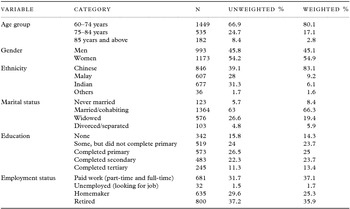
A total of 2,565 respondents completed the study giving a response rate of 65.6%. Two thousand one hundred and sixty six older people without dementia (diagnosed by the 10/66 criteria) were included in the present study. The socio-demographic characteristics of the respondents are shown in Table 1. The sample comprised 54.9% female and 45.1% male respondents. Majority of the sample was aged between 60–74 years (80.1%), of Chinese ethnicity (83.1%), and currently married (66.3%).
Socio-demographic characteristics of the respondents

The prevalence of paranoid ideation, persecutory delusions and hallucinations were 2.7%, 2.8% and 2.7%, respectively in the month prior to the interview. The prevalence of any psychotic symptoms was 5.2% in the past month. The prevalence of hallucinations by specific type was as follows – 1.4% olfactory hallucinations, 1.2% auditory hallucinations, 0.8% visual hallucinations, 0.05% gustatory hallucinations, and 0.04% somatic hallucinations.
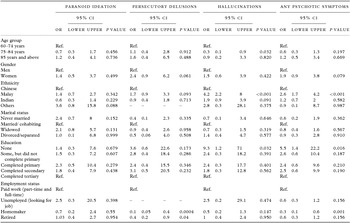
Table 2 shows the socio-demographic correlates of psychotic symptoms of the sample. The odds of persecutory delusions were significantly lower among those who were homemakers and retired (vs. employed). The odds of hallucinations and any psychotic symptoms were significantly higher among those of Malay ethnicity, and those who had no formal education. Older adults aged 75–84 years were significantly associated with lower odds of having hallucinations (vs. older adult aged 60–74 years), while homemaker status was significantly associated with lower odds of having any psychotic symptoms.
Socio-demographic correlates of paranoid ideation, persecutory delusions, hallucinations, and psychotic symptoms in older adults without dementia

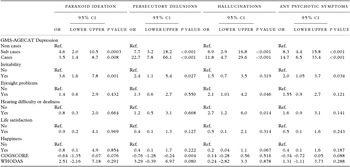
Table 3 shows the relationship between psychotic symptoms and other outcomes. The odds of having GMS-AGECAT depression were significantly higher among those with paranoid ideation, persecutory delusions, hallucinations and any psychotic symptoms. Those with paranoid ideation, persecutory delusions, hallucinations, and any psychotic symptoms were significantly associated with higher odds of having irritability, while those with persecutory delusions were significantly associated with lower COGSCORE. Those with hallucinations were also significantly associated with higher odds of having eyesight problems and hearing difficulty or deafness.
Clinical and health status correlates of paranoid ideation, persecutory delusions, hallucinations and psychotic symptoms in older adults without dementia

Note: Odds Ratios (OR) were derived using multivariate regression analysis after adjusting socio-demographic variables.
Unstandardized beta coefficients (B) were derived using multiple linear regression analysis after adjusting socio-demographic variables.
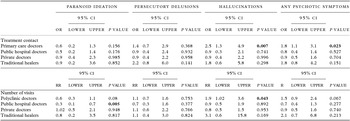
We also found that those who had hallucinations were more likely to have higher number of visits to primary care doctors, while those with paranoid ideations had lower number of visits to public hospital doctors (Table 4). 77.5% of those with any psychotic symptoms and 82.5% of those with hallucinations had seen a medical doctor in primary care or specialized care setting in the three month period preceding the study. However, we did not establish the specific reasons for seeking care (data available on request).
Resource utilization among those with paranoid ideation, persecutory delusions, hallucinations, and any psychotic symptoms in older adults without dementia

Note: Odds Ratios (OR) were derived using multivariate regression analysis after adjusting for socio-demographic variables.
Risk Ratios (RR) were derived using Poisson regression analysis after adjusting socio-demographic variables.
Discussion
The prevalence of any psychotic symptoms in this population of older adults was 5.2% in the past month. This figure was higher than that reported by Östling et al. (Reference Östling2013) (2.6%) who had used a similar methodology, but lower than the rate of 9% (lifetime prevalence) that was reported by Soares et al. (Reference Soares, Ribeiz, Bassitt, De Oliveira and Bottino2015) in a Brazilian community sample using questions from the Cambridge Mental Disorders of the Elderly Examination. A previous study (Subramaniam et al., Reference Subramaniam, Abdin, Vaingankar, Verma and Chong2014) conducted among the adult population (those aged 18 years and above) in Singapore reported a lower overall weighted lifetime prevalence of any psychotic experience (3.8%) than that observed in this current older adult population.
Our study found that the prevalence of paranoid ideation, persecutory delusions and hallucinations were almost similar, however an earlier study in Singapore that assessed the characteristics and psychopathology of elderly patients presenting with their first episode of psychosis to a tertiary mental health hospital found that paranoid delusions were more frequent than hallucinations (93% and 64% respectively) (Tan and Seng, Reference Tan and Seng2012).
Malay ethnicity was significantly associated with psychotic symptoms. Few studies have examined racial/ethnic differences in psychotic symptoms. Cohen et al. (Reference Cohen, Magai, Yaffee and Walcott-Brown2004) reported substantial racial differences in their study. Blacks were three times more likely to report psychotic symptoms than Whites. Acute stressors, lifetime traumatic events, beliefs about causes of mental illness, and belief in or use of spiritualists were found to be associated with paranoid ideation or psychotic symptoms. The authors suggested that psychotic symptoms may be a manifestation of distress or ways of coping with adverse events in this population. It is also possible that psychotic symptoms reflect prevailing belief systems rather than abnormal psychiatric symptoms among older adults. While local studies have not studied the differences among the three ethnicities, Haque (Reference Haque2008) has discussed the phenomena of culture bound syndromes among Malays. It is possible that these culturally specific psychiatric and somatic symptoms have some overlap with psychotic symptoms. In line with this, Ng et al. (Reference Ng, Wee, Lee, Johari, Hassan Nudin and Omar2014) have emphasized the need to acquire “a phenomenological understanding” of symptoms and disorders from local patients in non-Western cultures for developing relevant and valid screening instruments for the population. There is thus a need for further in-depth research into both the phenomenology of the disorder as well as culture bound syndromes.
The odds of psychotic symptoms were significantly higher among those with lower education. Our findings were consistent with Soares et al. (Reference Soares, Ribeiz, Bassitt, De Oliveira and Bottino2015) who found that individuals with psychotic symptoms had fewer years of schooling than controls. Henderson et al. (Reference Henderson1998) suggested the “breeder hypothesis” as a likely explanation for this finding, whereby limited education or some variable linked to it could be a risk factor for developing psychotic symptoms. Based on their longitudinal study, the authors also suggested that limited education level could raise the risk of developing psychotic symptoms in older people, in the same manner as it raises the risk for dementia.
Our study also identified a significantly lower association of persecutory delusions among those who were homemakers and retired (vs. employed) and housewives as having a lower odds of any psychotic symptoms as compared to those who were employed. We are unable to explain these findings but it merits further research.
Paranoid ideation, persecutory delusions, hallucinations, and psychotic symptoms were associated with depression in the past month which is in line with other studies (Cohen et al., Reference Cohen, Magai, Yaffee and Walcott-Brown2004; Östling et al., Reference Östling2013; Soares et al., Reference Soares, Ribeiz, Bassitt, De Oliveira and Bottino2015). It is plausible that the experience of psychotic symptoms may lead to depressive symptoms however Blazer et al. (Reference Blazer, Hays and Salive1996) found that depressive symptoms were significant predictors of paranoid symptoms in a longitudinal study. Thus, causality may be bidirectional, with paranoid ideation and psychotic symptoms inducing depressive symptoms and vice versa. It is also possible that both psychotic symptoms and depression could have resulted from a common pathophysiology, such as degenerative brain changes in older adults (Henderson and Kay, Reference Henderson and Kay1997).
Those with paranoid ideation, persecutory delusions, hallucinations, and psychotic symptoms were significantly associated with irritability. It has been previously reported that psychotic symptoms are associated with observed irritability/anger in very old persons (Östling et al., Reference Ostling, Gustafson and Waern2009; Reference Östling2013) though not much supportive evidence exists among older populations per se. Those with hallucinations were also significantly associated with higher odds of having eyesight problems and hearing difficulty or deafness. Previous studies have reported an association between sensorial impairment and psychotic symptoms in older adults (Livingston et al., Reference Livingston, Kitchen, Manela, Katona and Copeland2001; Ostling and Skoog, Reference Ostling and Skoog2002; Tan and Seng, Reference Tan and Seng2012). A number of hypotheses have been proposed to explain this association. In those with hearing impairment, the auditory stimuli may be misperceived leading to inappropriate associations and paranoid psychosis over a prolonged period of time (Cooper and Curry, Reference Cooper and Curry1976). Stefanis et al. (Reference Stefanis, Thewissen, Bakoula, van Os and Myin-Germeys2006) suggest that subjects with both long lasting and recent hearing impairments are at risk of developing source monitoring failures and, by consequence, at risk to develop psychotic experiences.
Persecutory delusions were significantly associated with lower cognitive scores in our population. A number of studies have found cognitive impairment to be associated with psychotic symptoms (Ostling and Skoog, Reference Ostling and Skoog2002; Östling et al., Reference Östling2013; Soares et al., Reference Soares, Ribeiz, Bassitt, De Oliveira and Bottino2015). Research suggests that psychotic symptoms are a prodromal symptom of dementia (Ostling et al., Reference Ostling, Palsson and Skoog2007), thus a more thorough study of cognitive and functional performance in older people with these symptoms over time is extremely important. In our study persecutory delusions were related to both lower education and lower cognitive scores and thus may be an indicator of poor cognitive reserve which constitutes a possible risk factor for dementia.
Surprisingly, our study did not find a significant association between paranoid ideation or psychotic symptoms and functional disability, which suggests that these symptoms did not substantially affect daily living. These findings are different from that reported by Soares et al. (Reference Soares, Ribeiz, Bassitt, De Oliveira and Bottino2015) but similar to that of Cohen et al. (Reference Cohen, Magai, Yaffee and Walcott-Brown2004). A number of studies have postulated that psychosis exists in a continuum in the general population (Johns, 2015). Studies have also found that hallucinations are experienced by individuals from nonclinical samples although these hallucinations differ qualitatively from those observed in clinical samples (Chang et al., Reference Chang2015). The sample for the current study was a population based sample and it is possible that a significant number of older adults did not meet criteria for a clinical disorder which may have resulted in the absence of functional decline. However, service utilization in terms of visits to primary care clinicians was higher among those with hallucinations which is understandable as hallucinations at any stage of life are extremely distressing. Soares et al. (2015) similarly reported a higher use of public health system among those with hallucinations in their Brazilian sample. Ostling et al. (Reference Ostling, Gustafson and Waern2009) in their study on older adults (age 85 years and above) found that severe behavioral disturbances including both anxious agitation and irritability/anger simultaneously were associated with hallucinations and paranoid symptoms in both demented and non-demented older adults. Thus, the distress and disability caused by hallucinations in both the older adult and their caregiver may have resulted in higher help seeking although the study did not specifically establish the reasons for treatment contact. Majority of those with hallucinations, persecutory delusions, and any psychotic symptoms had seen a medical doctor in the past three months although the study did not determine if treatment contact was related to these symptoms. The previous study in Singapore among older adults with psychosis found that a large majority of the subjects did not have insight with regard to the need for treatment and it was their relatives (usually children) were the ones who sought care on their behalf (Tan and Seng, Reference Tan and Seng2012). This study further reported a very long duration of untreated illness from the onset of psychotic symptoms, thus there is a need for longitudinal studies to understand the progression of the symptoms if any and the role of early diagnosis and treatment.
The findings of the study should be interpreted in the context of certain limitations. First, access to those residents residing in a nursing home was limited. Few interviews were conducted in the nursing home setting. Prevalence of psychotic symptoms could be higher in that population as reported by some studies (Zayas and Grossberg, Reference Zayas and Grossberg1998). Second, our response rate was 65.6% and it is possible that those who refused to participate in our study were more suspicious and withdrawn and psychotic symptoms could have been higher in this group. It is also possible that there was some under-reporting as some of the older adults may have felt stigmatized and reluctant to talk about experiencing psychotic symptoms to strangers. Lastly, as this is a cross-sectional study, we are unable to establish any temporal relationships between paranoid ideation, psychotic symptoms and their associated factors. The strengths of the study include its large sample size, single phase assessment, use of widely accepted assessments and questionnaires, inclusion of a representative sample of the general population that includes those who could speak only local dialects and superior quality control processes that ensured collection of valid information with minimal missing data.
In conclusion, the prevalence of psychotic symptoms among older Asian adults without dementia was higher than that reported from Western studies using similar methodology. Psychotic symptoms were associated with Malay ethnicity, poor cognitive performance and fewer years of schooling, visual and hearing impairment as well as depression and irritability. There is a need for both qualitative and longitudinal studies to understand the phenomena with further clarity.
Conflict of interest
None.
Description of author's roles:
Mythily Subramaniam: Wrote the first draft of the article. Provided input into the study protocol and conduct of the study. Edimansyah Abdin: Conducted the statistical analyses. Provided input into the study protocol. Janhavi Vaingankar: Provided input into study protocol and was involved in the conduct of the study and data management. Provided intellectual input into the article. Louisa Picco: Provided intellectual input into the article. Shazana Shahwan: Was involved in conducting the study and provided intellectual input into the article. Anitha Jeyagurunathan: Was involved in conducting the study and provided intellectual input into the article. Zhang Yunjue: Was involved in conducting the study and provided intellectual input into the article. Swapna Verma: Provided intellectual input into the article. Siow Ann Chong: Provided intellectual input on the article and was the PI of the WiSE Study.
Acknowledgment
This study was funded by the Ministry of Health, Singapore and the Singapore Millennium Foundation of the Temasek Trust.