Introduction
The 22q11.2 deletion syndrome (22q11DS), also known as velo-cardio-facial syndrome (VCFS), is a neurogenetic syndrome most commonly resulting from a congenital microdeletion on the long arm of chromosome 22. Its prevalence is approximately one in 4300–7000 live births (Oskarsdottir et al. Reference Oskarsdottir, Vujic and Fasth2004). Psychotic symptoms such as auditory hallucinations can appear during childhood (Debbané et al. Reference Debbané, Glaser, David, Feinstein and Eliez2006a), and half of the adolescents with the syndrome report having experienced positive symptoms (Baker & Skuse, Reference Baker and Skuse2005). Almost 30% of affected individuals will meet the diagnosis of schizophrenia during adulthood (Murphy et al. Reference Murphy, Jones and Owen1999), making 22q11DS a potent risk factor for the development of schizophreniform disorders in adulthood (Bassett et al. Reference Bassett, Chow, AbdelMalik, Gheorghiu, Husted and Weksberg2003; Murphy, Reference Murphy2005).
Very little is known about the cognitive characteristics that underlie risk for schizophrenia in 22q11DS. Cognitive development in this syndrome may include learning difficulties (Swillen et al. Reference Swillen, Vandeputte, Cracco, Maes, Ghesquiere, Devriendt and Fryns1999), speech and language difficulties (Moss et al. Reference Moss, Batshaw, Solot, Gerdes, McDonald-McGinn, Driscoll, Emanuel, Zackai and Wang1999; Glaser et al. Reference Glaser, Mumme, Blasey, Morris, Dahoun, Antonarakis, Reiss and Eliez2002), and below-average IQ (Golding-Kushner et al. Reference Golding-Kushner, Weller and Shprintzen1985; Swillen et al. Reference Swillen, Devriendt, Legius, Eyskens, Dumoulin, Gewillig and Fryns1997). Verbal and executive deficits in youngsters with the deletion resemble those of other groups that at high risk for schizophrenia (Cornblatt et al. Reference Cornblatt, Obuchowski, Roberts, Pollack and Erlenmeyer-Kimling1999). Two studies suggest that a decrease in verbal IQ accompanies the onset of positive symptoms in adolescents with 22q11DS (Gothelf et al. Reference Gothelf, Eliez, Thompson, Hinard, Penniman, Feinstein, Kwon, Jin, Jo, Antonarakis, Morris and Reiss2005; Debbané et al. Reference Debbané, Glaser, David, Feinstein and Eliez2006a), and one study suggests that executive function deficits in affected children and adolescents could reflect genetic risk for schizophrenia (Lewandowski et al. Reference Lewandowski, Shashi, Berry and Kwapil2006). Although these studies inform us about the cognitive similarities between adolescents with 22q11DS and high risk for schizophrenia adolescents, finer cognitive testing such as that performed in research on schizophrenia may provide specific information about the actual cognitive processes that contribute to the development and/or maintenance of positive symptoms such as delusions and hallucinations. Cognitive scientists studying schizophrenia have focused on the relationship between hallucinations and source monitoring mechanisms (Bentall et al. Reference Bentall, Baker and Havers1991; Frith, Reference Frith1992; Brébion et al. Reference Brébion, Gorman, Malaspina and Amador2005). Source monitoring refers to the processes by which we can successfully infer the origin of mental events such as memories (Johnson et al. Reference Johnson, Hashtroudi and Lindsay1993). Because memories are created through the binding of features into a more or less distinct event, we require monitoring processes that will infer the exact origin or source of this event (Johnson & Raye, Reference Johnson, Raye, Schacter and Scarry2000). Current accounts of source monitoring deficits in schizophrenia suggest that the process of attributing a source to internally generated material (such as thoughts, memories or voluntary actions) is prone to confusion between internal and external sources (Bentall et al. Reference Bentall, Kinderman and Kaney1994; Franck et al. Reference Franck, Rouby, Daprati, Dalery, Marie-Cardine and Georgieff2000; Brébion et al. Reference Brébion, Gorman, Amador, Malaspina and Sharif2002). For example, we may put the blame on our partner for not turning off the oven, when in fact we were responsible for leaving it heating. This represents a common example of attributing an external source to an internally generated mental event. A pathological extreme of such misattributions could be, for example, the attribution of internal speech to an external source, thereby constituting an unusual perceptual experience such as ‘hearing voices’. The association between source monitoring deficits and positive symptoms comes from studies reporting increased source monitoring confusions in schizophrenic patients who report auditory hallucinations (Allen et al. Reference Allen, Johns, Fu, Broome, Vythelingum and McGuire2004; Brunelin et al. Reference Brunelin, Combris, Poulet, Kallel, D'Amato, Dalery and Saoud2006). Therefore, altered source monitoring could represent a cognitive process underlying the positive symptoms exhibited by patients with schizophrenia.
Traditional source monitoring paradigms involve both the participant and the experimenter generating material that is subsequently used in the recognition and source attribution procedures. For example, Brébion et al. (Reference Brébion, Amador, David, Malaspina, Sharif and Gorman2000) present a task where the participant and the examiner generate items belonging to categories (e.g. FRUITS). The experimenter verbally produced an example item (e.g. apple), and then showed a picture of a second example (e.g. cherry), after which the participant provided a third example (e.g. grapes), thus constituting a group of three target items (verbal and picture from experimenter, verbal from the participant) for each category. After a 5-min delay, the recognition procedure consisted in attributing the source of production (self versus experimenter) for recognized category items. This task showed that schizophrenic participants with hallucinations demonstrate an increased tendency to report self-produced items as items produced by the experimenter. Misattributions to an external source (experimenter) of internally generated material (self-produced items) correspond to an external attribution bias; that is, a tendency to attribute the origin of a mental event generated by the self to an external source.
Most external attribution biases observed in schizophrenic patients correspond to confusions between internal and external events, where events produced by the self (internal) are recalled as having been produced by a non-self agent (external). However, patients with schizophrenia may also confuse two types of events both generated within the self (internal–internal confusions) (Franck et al. Reference Franck, Rouby, Daprati, Dalery, Marie-Cardine and Georgieff2000). A recent study on source monitoring performances in hallucination-prone college students included both internal–external (self versus experimenter) and internal–internal (self versus self) source discrimination in their experimental design (Larøi et al. Reference Larøi, Collignon and Van der Linden2005). Using an original action monitoring task, the authors proposed five conditions in which participants were to study simple action statements such as ‘Opening a car door’ by either (1) miming the action; (2) watching the experimenter mime the action; (3) imagining themselves performing the action; (4) imagining the experimenter performing the action; or (5) repeating the action statement without miming or imagining the performance of the action. Therefore, conditions 1 and 2 examined possible internal–external confusions, while conditions 3, 4 and 5 examined possible internal–internal confusions. Conditions 3–5 introduce another level of analysis in internal–internal source discrimination, which consists in differentiating between ‘personal’ (imagining myself opening a door) and extra-personal or ‘exterior’ sources (imagining the experimenter opening a door; repeating the statement opening a door). In the subsequent recognition phase, participants were presented with a list combining the previously studied action statements with new action statements. Upon source attribution of previously studied action statements, the authors found that hallucination-prone participants committed more internal–internal source confusions; that is, they showed an increased tendency to report actions they imagined themselves performing as actions they imagined the experimenter perform. However, they did not show more external attribution errors in the internal–external condition (self versus experimenter), which would relate more closely to source monitoring tasks such as those used by Brébion and colleagues (Reference Brébion, Amador, David, Malaspina, Sharif and Gorman2000, Reference Brébion, Gorman, Amador, Malaspina and Sharif2002, Reference Brébion, Gorman, Malaspina and Amador2005) with schizophrenic patients. The internal–internal confusions committed by hallucination-prone students represent another type of external attribution bias, consisting in recalling ‘personal’ events (imagining myself opening a door) as ‘exterior’ events (imagining the experimenter opening a door). This type of external attribution bias resembles the findings by Franck et al. (Reference Franck, Rouby, Daprati, Dalery, Marie-Cardine and Georgieff2000), where silent words (personal events) were more often recalled as overtly read words (exterior events) by schizophrenic patients with hallucinations. Therefore, external attribution biases also concern ‘personal’ versus ‘exterior’ sources in self-generated events.
In brief, source attribution confusions in schizophrenia can occur between self-generated and non-self-generated material (internal–external confusions), as well as between two sources of self-generated materials (internal–internal confusions). In the latter, the source closer to the self (personal event) is more prone to an external attribution (recalled as exterior event) (Franck et al. Reference Franck, Rouby, Daprati, Dalery, Marie-Cardine and Georgieff2000; Larøi et al. Reference Larøi, Collignon and Van der Linden2005). The only study examining source monitoring in non-clinical participants suggests that hallucination proneness is associated with specific internal–internal source confusions (Larøi et al. Reference Larøi, Collignon and Van der Linden2005). However, it is not clear whether source monitoring deficits precede, co-occur or result from positive symptoms. Indeed, studies examining source monitoring deficits are performed with adult populations, involving individuals within or beyond the crucial period of psychotic unfolding. The examination of source monitoring skills during adolescence could provide evidence for a continuum of source monitoring deficits along the clinical symptomatic continuum for psychosis (Johns & van Os, Reference Johns and van Os2001). In providing important information on source monitoring skills in the early stages of vulnerability to schizophrenia, such investigations may assist in the identification of early cognitive processes that set the stage for more pathological source attributions such as those observed in auditory hallucinations.
The current study describes the first examination of source monitoring in adolescents with 22q11DS, a neurogenetic syndrome associated with very high risk for schizophrenia. Based on the only high-risk study exploring source monitoring in young adults (Larøi et al. Reference Larøi, Collignon and Van der Linden2005), we chose to specifically examine internal–internal source monitoring. We used the corresponding experimental conditions that led high-risk individuals to the most source confusions in Larøi et al.'s (Reference Larøi, Collignon and Van der Linden2005) action monitoring task. We therefore adapted our action monitoring paradigm to include only Larøi et al.'s conditions 3–5, in which the material is generated exclusively by the participant. Given the lower intellectual profile associated with 22q11DS, we included comparison participants matched for IQ, age and gender, as well as another group of healthy controls matched only for age and gender. Limiting the cognitive demand as well as testing time with cognitively impaired participants (22q11DS participants and IQ-matched controls) further motivated our decision to focus on internal–internal source monitoring. On the action monitoring task, we first expected that recognition performances from participants with 22q11DS would be comparable to that of both control groups (Debbané et al. Reference Debbané, Glaser and Eliezin press). Second, given the very high risk for schizophrenia in this population, we expected to find increased source monitoring confusions in adolescents with 22q11DS. Third, following Larøi et al. (Reference Larøi, Collignon and Van der Linden2005), we expected to observe an external attribution bias in the 22q11DS group, expressed through an increased tendency to report actions that participants imagine themselves performing as actions they imagined the experimenter perform. Fourth, we explored possible linear correlations between source monitoring confusions and levels of symptom expression quantified through self-rated measures of schizotypy, depression and anxiety.
Method
Participants
Eighteen participants with 22q11DS (22q group), 17 age- and IQ-matched controls (IQcontrol group), and 17 age-matched healthy controls (AGEcontrol group) were enrolled in this study. Participants with 22q11DS (11 females, seven males) were recruited through announcements in parent association newsletters and by word of mouth. Three participants were receiving methylphenidate at time of participation. All members of the IQcontrol group (11 females, six males) were recruited through a child and adolescent out-patient service (Service Médico-Pédagogique) affiliated to the University of Geneva's Psychiatry Department and to the Canton of Geneva Education Department. All members of the AGEcontrol group (nine females, eight males) were screened for neurological and psychiatric disorders. They were recruited through a newsletter distributed at public schools and in the community near the research centre. Written informed consent was obtained from participants and their parents under protocols approved by the Institutional Review Board of the Department of Psychiatry of the University of Geneva Medical School. All participants underwent an intellectual evaluation, using the Wechsler Intelligence Scale for Children-III (WISC-III) short form (Kaufman et al. Reference Kaufman, Kaufman, Balgopal and McLean1996). Using age-appropriate self-report instruments, all participants were screened for levels of anxiety [Revised Children's Manifest Anxiety Scale (R-CMAS); Turgeon & Chartrand, Reference Turgeon and Chartrand2003; French version, 1999] and depression [Children's Depression Inventory (CDI); Saint-Laurent, Reference Saint-Laurent1990].
To assess psychotic symptoms and their dimensions, subjects filled out the Schizotypal Personality Questionnaire (SPQ; Raine, Reference Raine1991), translated into French and validated by Dumas et al. (Reference Dumas, Bouafia, Gutknecht, Saoud, Dalery and d'Amato2000). To ensure that all subjects understood the items, a trained clinical psychologist (M.D.) supervised the questionnaire process. The participants were instructed that the questions they did not understand could be left blank and answered during the questionnaire review period performed with the clinical psychologist after they had finished filling out the self-reports. The instrument yields three main factor scores (Cognitive-Perceptual, Interpersonal and Disorganization) and nine subscale scores (Ideas of Reference, Social Anxiety, Odd Beliefs/Magical Thinking, Unusual Perceptual Experiences, Eccentric/Odd Behaviour and Appearance, No Close Friends, Odd Speech, Constricted Affect, Suspiciousness/Paranoid Ideation). It also lends itself to multiple dimensional analyses in the context of a dimensional approach to schizotypy (Rossi & Daneluzzo, Reference Rossi and Daneluzzo2002), and is appropriate for use with adolescents (Axelrod et al. Reference Axelrod, Grilo, Sanislow and McGlashan2001).
Source monitoring task
Source monitoring was examined using an action monitoring task adapted from Larøi et al. (Reference Larøi, Collignon and Van der Linden2005), that excluded the miming conditions and retained the verbal presentation conditions of the original task, as these yield the most misattributions. We therefore retained conditions 3–5 in which the subject imagines the performance of actions in either self, experimenter or verbal repetition conditions. Specifically, participants were asked to mentally visualize actions that involved either themselves or the experimenter. Thus, during the initial study phase, participants were asked to actively imagine the action read by the experimenter, by (1) imagining themselves performing the action, or (2) imagining the experimenter performing the action. To encourage subjects to actively monitor their visualization activity, they were asked to refer to a visual analogue scale from 1 to 5 and rate the degree of difficulty to perform each visualization (1=easy, 5=difficult). A third control condition consisted in (3) mentally repeating the action statement, and judging the degree of difficulty required to silently repeat the statement. Practice trials for each of the three conditions preceded the start of the study phase.
The experimenter read a total of 61 action statements in fixed random order blocks: four blocks of imagine-self items (20 S-items in total), four blocks of imagine-experimenter items (20 E-items in total), and seven blocks of repeat items (21 R-items in total). Each block was preceded by an instruction stating the condition in which visualizations should occur. For example: ‘In the next trials, please imagine “the experimenter” performing the actions.’ To minimize contamination between conditions, repeat-item blocks were inserted in between imagine-self and imagine-experimenter blocks. The actions that were included in this task were chosen for simplicity, universality and gender neutrality (see Larøi et al. Reference Larøi, Collignon and Van der Linden2005 for more details on action statements). The incidental nature of this procedure was preferred for its naturalistic quality, as source monitoring skills act upon day-to-day mental activity that typically is free from instructions inciting a subject to remember specific events.
After a 10–15-min visuospatial filler task, the recognition phase was introduced by a brief summary of the study phase, reminding to participants of the three conditions in which the action statements were encoded (imagine-self, imagine-experimenter, repeat). The experimenter then read out a list of actions that included all the items from the study phase, as well as new action statements acting as distractors, in a fixed random order. The participant had to recognize whether the action statement belonged to the study phase (recognition test), and for those that did, demonstrate source monitoring skills by attributing the recognized action statements to their respective condition: imagine-self, imagine-experimenter or repeat item.
Statistical analyses
Simple ANOVAs were performed for all clinical characteristics except the CDI t score (depression score), for which single group comparisons were performed using Mann–Whitney tests. The ANOVAs were followed by post-hoc group comparisons using Tukey's correction to identify significant group differences. One-way ANOVAs were performed to examine group differences on recognition and source monitoring performances. False recognition group comparisons were performed using the Kruskal–Wallis test because of the data's non-parametric distribution. Recognition performances were tested using the Total correct recognition score (hits), which represented the total number of correct recognitions of previously studied action statements. For action statements recognized correctly, source monitoring performances were collected by tabulating the total number of source monitoring confusions for each participant. The Total Confusion score was therefore used to compare source monitoring performances between groups. Total False Recognition scores consisted of the total number of distractor action statements recognized as previously studied action statements. Post-hoc comparisons using Tukey's correction were then performed to identify which experimental condition(s) yielded significant contrasts.
Results
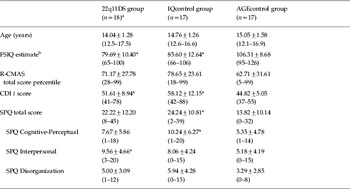
Group comparisons for clinical characteristics are summarized in Table 1. Globally, the 22q11DS and IQcontrol groups did not differ significantly on any clinical characteristic measure. Significant differences were found between the AGEcontrol group in comparison to both 22q11DS and IQcontrol groups on the depression measure (z=−2.42, p=0.016; z=−3.61, p<0.001, respectively) and on the full-scale IQ (FSIQ) estimate measure (F=19.1, df=2, p<0.001). Follow-up Tukey HSD pairwise tests revealed that the 22q11DS group further differed from the AGEcontrol group on the Interpersonal factor score from the SPQ (p=0.033), and the IQcontrol group differed from the AGEcontrol group on the Total SPQ score (p=0.023) and Cognitive-Perceptual factor score (p=0.04).
Clinical characteristics for each group including mean values, standard deviations and ranges

FSIQ, Full-scale IQ; R-CMAS, Revised Children's Manifest Anxiety Scale; CDI, Children's Depression Inventory; SPQ, Schizotypal Personality Questionnaire.
a 22q11DS and IQcontrol groups do not differ significantly on any clinical characteristic measures.
b Estimate derived from the recommended the Wechsler Intelligence Scale for Children-III (WISC-III) short form by Kaufman et al. (Reference Kaufman, Kaufman, Balgopal and McLean1996), which includes Similarities, Arithmetic, Picture Completion and Block Design subtests.
* p<0.05 on group comparisons with AGEcontrols.
For performance on the action monitoring paradigm, group comparisons yielded no significant differences on the total number of hits (F=0.03, df=2, p=0.974) or false recognitions (χ2=4.03, df=2, p=0.13). However, significant differences were found on the total confusions score (F=5.22, df=2, p=0.009). Follow-up Tukey HSD pairwise tests revealed significant group differences on 22q11DS and IQcontrols (p=0.039) and 22q11DS and AGEcontrols (p=0.012) contrasts, indicating that participants with 22q11DS made significantly more source monitoring confusion errors than both comparison groups (Table 2).
Group performances on action monitoring task in terms of total correct recognitions, total false recognitions and total source monitoring confusions

* p<0.05 on group comparisons with IQcontrol and AGEcontrol groups.
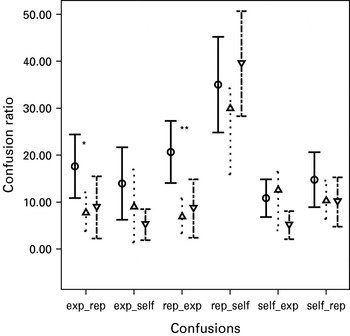
We proceeded to examine which experimental condition(s) might account for these significant differences. Individual condition contrasts were based on the number of confusions divided by the number of correct recognitions, yielding an individual source monitoring ratio for each participant. For each condition, there were two possible source monitoring confusions: actions imagined as performed by self but remembered as being performed by the experimenter (self_exp) or repeated (self_rep); actions imagined as performed by the experimenter but remembered as performed by self (exp_self) or repeated (exp_rep); and repeated actions remembered as performed by self (rep_self) or the experimenter (rep_exp). We performed a MANOVA including all six source monitoring confusion ratios, illustrated in Fig. 1. The model yielded an overall group effect (F=2.64, df=5, p=0.005). Follow-up ANOVAs for each confusion type indicated significant differences for exp_rep (F=3.63, df=2, p=0.034) and rep_exp confusions (F=7.63, df=2, p=0.001). Finally, post-hoc Tukey HSD pairwise tests yielded a significant contrast between 22q11DS and AGEcontrols (p=0.048) for the exp_rep confusions, and two significant contrasts between 22q11DS and both IQcontrols (p=0.008) and AGEcontrols (p=0.002) for the rep_exp contrast. These contrasts indicated that adolescents from the 22q11DS group committed more exp_rep mistakes compared to adolescents from the AGEcontrols group, and more rep_exp mistakes compared to both control groups.
Groups' confusion ratios for the six source monitoring confusion types. exp_rep, remembering imagine-experimenter items as repeat items; exp_self, remembering imagine-experimenter items as imagine-self items; rep_exp, remembering repeat items as imagine-experimenter items; rep_self, remembering repeat items as imagine-self items; self_exp, remembering imagine-self items as imagine-experimenter items; self_rep, remembering imagine-self items as repeat items. * 22q11DS v. AGEcontrols (––○––; p<0.05); ** 22q11DS v. IQcontrols (–– ––; p<0.01) and AGEcontrols (––; p<0.005). Error bars show 95% confidence intervals of the mean.

Follow-up correlations were performed to identify any possible relationship between psychological variables and source monitoring performances. Pearson correlations between psychological variables (R-CMAS total percentile score, CDI t score, SPQ total score and SPQ Cognitive-Perceptual score) and source monitoring variables (Total Confusions score, exp_rep ratio and rep_exp ratio) in 22q11DS did not yield any significant relationship (r<0.31, p>0.23).
Discussion
This study is the first to report source monitoring deficits in adolescents with 22q11DS, a neurogenetic condition associated with elevated risk for schizophrenia. Using an action monitoring paradigm, the results show that the adolescents with 22q11DS presented average recognition performances (hits) but committed more source confusion errors than both IQcontrols and AGEcontrols. Post-hoc analyses revealed that confusion errors mainly occurred in the ‘exterior’ sources conditions. Specifically, adolescents with 22q11DS committed more source confusions by recalling imagine-experimenter actions as actions they repeated mentally, and vice versa, by recalling repeat-actions as actions they imagined the experimenter perform. Differences in source confusions involving a ‘personal’ source, in which they imagined themselves performing an action, were not significantly greater than controls. It could be argued that concrete thought processes in 22q11DS might contribute to deficits in tasks examining mental imagery of action performance. Imagining the experimenter perform an action might be too abstract, in comparison to repeating an action statement. However, the nature of the 22q11DS group's confusions between repeated and experimenter items in both directions (mistaking mentally repeated actions for imagine experimenter actions, but also mistaking experimenter actions for mentally repeated actions) suggests that source confusions are more pronounced in ‘external’ source monitoring conditions. Furthermore, concrete thought processes may also characterize the adolescents matched for IQ (IQcontrol group), who do not exhibit such source confusions. Therefore, the performances on the action monitoring task suggest that ‘external’ source confusions are characteristic of adolescents with 22q11DS. Unexpectedly, the external attribution bias, consisting in recalling as experimenter-performed actions that had been imagined as performed by the self, was not observed in the 22q11DS group. We first discuss how experimental procedures and symptom profile may contribute to the present findings. Second, we discuss how these results may be articulated with current cognitive models. Finally, we conclude by discussing how cerebral alterations in 22q11DS, namely hippocampal volume reduction, may be involved in source monitoring skills.
The action monitoring task used in this study, which made use of material generated exclusively by the participant, reproduced part of the experimental procedure from Larøi et al. (Reference Larøi, Collignon and Van der Linden2005). The present results do not replicate the findings obtained with hallucination-prone college students, who were more likely to attribute to the experimenter actions that they had imagined themselves perform, thus exhibiting the characteristic external attribution bias. Discrepancies between the two studies may be accounted for by differences in the experimental procedures, which excluded the actual miming performance of an action in this study. The present paradigm included a unique ‘personal’ condition involving the self, which may have increased its distinctiveness in comparison to the two ‘exterior’ conditions, thus favouring source monitoring performances on ‘personal’ trials (Johnson et al. Reference Johnson, Hashtroudi and Lindsay1993). Age differences between the participants from both studies must also be considered. This is especially relevant to individuals with 22q11DS, who report schizotypal manifestations more frequently as they get older, reaching around 80% of the individuals in their late teens (Baker & Skuse, Reference Baker and Skuse2005). It is also possible that source monitoring confusions appear earlier in development, as observed in the current study, and then only polarize themselves around an external attribution during the transition between adolescence and adulthood. Finally, it is possible that external attribution biases are specifically related to hallucination proneness, which could not be measured specifically in the present study. Indeed, we cannot rule out that a more homogeneous group of adolescents recruited specifically for hallucination proneness or expression would exhibit external attribution biases. It should be noted that internal source monitoring paradigms used with symptomatic populations are not systematically associated with external attribution biases. Although two studies (Franck et al. Reference Franck, Rouby, Daprati, Dalery, Marie-Cardine and Georgieff2000; Larøi et al. Reference Larøi, Collignon and Van der Linden2005) found evidence for such a bias in schizophrenic patients and hallucination-prone college students, Henquet et al. (Reference Henquet, Krabbendam, Dautzenberg, Jolles and Merckelbach2005) failed to present such evidence using an internal monitoring paradigm with schizophrenic subjects. Similarly, the adolescents with 22q11DS enrolled in the current study showed no evidence of exaggerated external attribution for ‘personal’ events. Therefore, although the current findings do not suggest external attribution biases during monitoring of internally generated events in adolescents, they do indicate the presence of increased source monitoring confusions for action monitoring involving ‘exterior’ sources in high risk for schizophrenia adolescents with 22q11DS.
One of the limitations of this study was to use a schizotypy scale (SPQ), which does not yield a score for hallucination proneness. Unlike previous reports on source monitoring specifically recruiting individuals with increased hallucination proneness (Larøi et al. Reference Larøi, Van der Linden and Marczewski2004), or participants with schizophrenia still experiencing hallucinations (Brébion et al. Reference Brébion, Amador, David, Malaspina, Sharif and Gorman2000; Franck et al. Reference Franck, Rouby, Daprati, Dalery, Marie-Cardine and Georgieff2000), the present study involved adolescents with heterogeneous expressions of schizotypal dimensions. As with schizophrenia, schizotypy is a construct that relates to a triad of symptom dimensions (Rossi & Daneluzzo, Reference Rossi and Daneluzzo2002) and, as such, can be fairly heterogeneous in terms of its expression in both clinical and non-clinical populations (Kendler et al. Reference Kendler, McGuire, Gruenberg and Walsh1994). This heterogeneity in symptom profile may also be characteristic of cognitive performances (Joyce & Roiser, Reference Joyce and Roiser2007). The cognitive-perceptual subscale of the SPQ is itself heterogeneous, as it includes not only domains of auditory and visual hallucinations but also those of magical thinking, ideas of reference and suspiciousness. Thus, we may not exclude the possibility that heterogeneity of the measures used may conceal finer associations between source memory performances and hallucination proneness during adolescence, which could not be evidenced in our correlational analyses.
Along these lines, we can interpret the performances of the 22q11DS and IQcontrol groups. In the 22q11DS group, increased scores on the interpersonal schizotypy subscale score (which translates excessive social anxiety, constricted affect and social isolation) suggest that ‘negative schizotypy’ may contribute to source monitoring confusions. This is consistent with a recent study suggesting that adolescents with high negative or mixed schizotypy profiles were related to poor source monitoring performances, especially in the high psycho-social risk group (Lemos Giraldez et al. Reference Lemos Giraldez, Caro, Lopez Rodrigo, Pineiro and Gonzalez2000). Concerning group comparisons between IQcontrols and AGEcontrols, increased levels of positive schizotypy and depression could be observed in the cognitively impaired controls. However, no significant differences were found in their source monitoring performances, except for trend-like differences in confusing repeated actions as though they were imagine-self (see Fig. 1 rep_self column). While this may be surprising, we must consider the impact of depressive symptoms in the IQcontrols, which may exert an increased influence on their source monitoring performance at this stage. Indeed, literature on memory performance in depression suggests that depressed individuals display a preferential bias for self-related information (Taylor & John, Reference Taylor and John2004). Our instruments also limit the characterization of specific proneness to hallucinations in this group. These considerations point to the necessity of using assessment tools sensitive to differences between hallucination types and delusion ideations. Finally, it should be noted that, to the best of our knowledge, there are no data directly correlating positive symptom intensity and source monitoring memory deficits in the current literature, which further stresses the importance of sensitivity in both the assessment instruments used and the source monitoring paradigms.
The theoretical implications of the current results and their potential neuroanatomical underpinnings remain to be considered. Cognitive models of psychosis draw upon cognitive biases such as source monitoring deficits to explain the psychological phenomena of positive symptoms in schizophrenia (Frith, Reference Frith1992; Freeman et al. Reference Freeman, Garety, Kuipers, Fowler and Bebbington2002). In particular, Frith (Reference Frith1992) suggests that self-monitoring deficits may yield uncertainty in determining the source of mental events, and lead to feelings of alien control. Conversely, feelings of persecution and paranoia may be associated with deficits in the monitoring of people's intentions, involving reality monitoring skills (Frith & Done, Reference Frith and Done1989; Frith, Reference Frith1992). Results from the action monitoring task suggest that internal representations of ‘exterior’ sources are prone to confusions in adolescents with 22q11DS. Further research is needed to assess how these confusions contribute to the development of delusional schemas and abnormal perceptual experiences reported by these adolescents, who report both delusions and auditory hallucinations in childhood and adolescence (Baker & Skuse, Reference Baker and Skuse2005; Debbané et al. Reference Debbané, Glaser, David, Feinstein and Eliez2006a), and high rates of schizophrenia during adulthood (Murphy et al. Reference Murphy, Jones and Owen1999).
From a neuroanatomical standpoint, source monitoring deficits may also relate to hippocampal volume reduction reported in 22q11DS (Debbané et al. Reference Debbané, Schaer, Farhoumand, Glaser and Eliez2006b). Functionally, the hippocampus helps in binding an item to its contextual information, namely source information (Yonelinas, Reference Yonelinas2001). Inconsistencies in binding actions with source information may be related to hippocampal alterations in 22q11DS, and increase potential for source attribution confusions. The action monitoring of ‘personal’ events may be encoded from a first-person perspective, which further benefits from mesial prefrontal cortex, posterior cingulate cortex and superior temporal cortex activity (Vogeley et al. Reference Vogeley, May, Ritzl, Falkai, Zilles and Fink2004), regions that are all relatively spared in cerebral development of youngsters with 22q11DS (Kates et al. Reference Kates, Burnette, Jabs, Rutberg, Murphy, Grados, Geraghty, Kaufmann and Pearlson2001; Simon et al. Reference Simon, Ding, Bish, McDonald-McGinn, Zackai and Gee2005b). On the contrary, faulty binding from a third-person perspective, presumably corresponding to the ‘exterior’ event conditions, may rely on other regions such as the mesial superior parietal and right premotor cortex (Vogeley et al. Reference Vogeley, May, Ritzl, Falkai, Zilles and Fink2004), but in the case of 22q11DS, midline and parietal cerebral alterations associated with the neurogenetic syndrome (Simon et al. Reference Simon, Bish, Bearden, Ding, Ferrante, Nguyen, Gee, McDonald-McGinn, Zackai and Emanuel2005a) may hinder efficient processing in these conditions. Consequently, cerebral alterations linked to the microdeletion on chromosome 22 may contribute to increased source monitoring deficits involving ‘exterior’ events. These results are preliminary, and further investigations involving structural and functional magnetic resonance imaging are needed to determine the extent to which cerebral structure alterations impede source monitoring functions in this population.
In conclusion, we find that similarly to adults with schizophrenia, adolescents affected by 22q11DS exhibit source monitoring deficits. These monitoring confusions do not correlate directly with schizotypal manifestations, but may set the stage for further development of psychotic symptomatology (Freeman et al. Reference Freeman, Garety, Kuipers, Fowler and Bebbington2002). While source monitoring deficits constitute characteristic memory deficits observed in diagnosed schizophrenia (Bentall et al. Reference Bentall, Baker and Havers1991; Vinogradov et al. Reference Vinogradov, Willis-Shore, Poole, Marten, Ober and Shenaut1997), it appears that such deficits can be found in adolescents at very high risk for schizophrenia. Further examination of the complex relationships between genetic risk for psychosis, cerebral development, source monitoring and psychotic symptoms is necessary to better understand the unfolding of psychosis in 22q11DS and other high-risk adolescent populations. This may provide information on the different pathways leading to the illness of schizophrenia, and may assist in the elaboration of preventive strategies with adolescents at high risk for schizophrenia.
Acknowledgements
We thank all the participants who kindly volunteered for this study. We extend our special thanks to Frank Larøi for consultations on the experimental design, and to Anne-Laure Bortoli, Christelle Crépin and Sylvie Güller for help in data collection. This work was supported by research grants to Stephan Eliez from the Swiss National Fund for Research (PP00B-102864), the NARSAD Foundation (2002 Lieber Investigator Award) and the Academic Society of Geneva.
Declaration of Interest
None.