

1. INTRODUCTION
Biologically inspired design (BID), also called biomimetic design or biomimicry, refers to the use of biological systems as a source of inspiration for improving or developing new technical systems (Vincent et al., Reference Vincent, Bogatyreva, Bogatyrev, Bowyer and Pahl2006; Shu et al., Reference Shu, Ueda, Chiu and Cheong2011).
Numerous examples of biomimetic design are found in different fields, such as materials, artificial intelligence, construction, or transportation (Bhushan, Reference Bhushan2009; Bar-Cohen, Reference Bar-Cohen2012). According to the Velcro company website, George de Mestral, a Swiss engineer, developed Velcro® based on the observation of burdock plants that attached to his dog's fur. Genetic and ant colony optimization algorithms were inspired by natural selection and ant foraging, respectively. The Mercedes Bionic Car, a concept car presented in 2005, had the boxfish as a model for improving aerodynamic performance and the bioinspired optimization methods such as Soft Kill Option (Baumgartner et al., Reference Baumgartner, Harzheim and Mattheck1992) for improving the vehicle structure (Vincent et al., Reference Vincent, Bogatyreva, Bogatyrev, Bowyer and Pahl2006). In addition, some researchers consider that natural systems are potential analogies for designing more sustainable systems, as they are submitted to natural selection and evolve in conditions respecting life (Benyus, Reference Benyus1997).
These examples of innovative designs and the need for more sustainable products motivate research and development to integrate the BID approach to their new product development process, mainly in the ideas-generation phase. This trend is reflected in the growing number of patents (Bonser, Reference Bonser2006) and articles (Lepora et al., Reference Lepora, Verschure and Prescott2013) in this field. Understanding the advantages and limitations of adding biological knowledge into the design process, together with the organization of this process, acquires a new significance: which interactions will be established between the different actors of the process (biologists, engineers, and researchers), and what will bring these dialogues between the different knowledge bases involved?
Literature has studied the BID from the analogical transfer perspective. The BID is interpreted as an analogical transfer between biology and engineering for problem solving (Mak & Shu, Reference Mak and Shu2008; Helms et al., Reference Helms, Vattam and Goel2009; Sartori et al., Reference Sartori, Pal and Chakrabarti2010; Vattam et al., Reference Vattam, Helms and Goel2010). Helms and Goel (Reference Helms, Goel and Gero2012) recognize that these analogies can also provoke an evolution of the problem. However, this analogical transfer does not allow disentangling the roles of biological knowledge in the BID process: is it only used as an analogue model or has it effects on the creativity of the generated ideas? Where does this creativity come from? In this paper, concept–knowledge (C-K) theory is used to model the BID process of selected biomimetic development examples. The aim of this modeling is to provide a framework for understanding not only the analogical processes taking place on biologically inspired design but also the roles of biological knowledge and scientific knowledge in the process. Here, “scientific knowledge” refers to the nonbiological knowledge used in the design process, such as engineering knowledge. This better understanding of the process can contribute to a more systematic application of BID in the ideas-generation phase of new product development.
The remainder of the paper is organized as follows: Section 2 provides an overview of the BID process theories and tools, identifying the points for which a general design theory could bring some new insights. Section 3 describes the methodology used to analyze BID with a design theory. Section 4 presents the analysis of bioinspired examples from literature using the C-K framework. Section 5 discusses the outcomes from this modeling process, and Section 6 concludes the paper.
2. THEORETICAL BACKGROUND
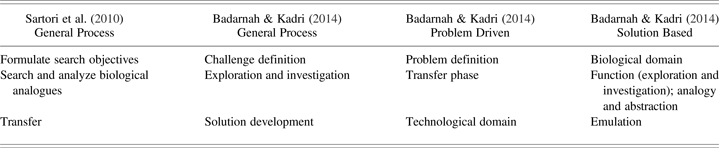
By definition, BID bridges two domains: biology and design. Two directions, or “high-level analogical processes for biologically inspired design” (Goel et al., Reference Goel, Vattam, Wiltgen, Helms and Goel2014), were identified for biologically inspired design. These directions refer to the motivations for seeking analogies between nature and design. If the analogical transfer is triggered by an existing design problem, the process is called top-down (Speck & Speck, Reference Speck and Speck2008), problem-driven (Helms et al., Reference Helms, Vattam and Goel2009; Nagel et al., Reference Nagel, Stone, McAdams and Goel2014), or challenge-to-biology (Biomimicry 3.8, 2014). In contrast, if a biological phenomenon allows the identification of a design problem that could be solved using an analogy to this phenomenon, the process is named bottom-up (Speck & Speck, Reference Speck and Speck2008), solutions-based (Helms et al., Reference Helms, Vattam and Goel2009; Nagel et al., Reference Nagel, Stone, McAdams and Goel2014) or biology-to-design (Biomimicry 3.8, 2014).
Sartori et al. (2010) and Badarnah and Kadri (Reference Badarnah and Kadri2014) compared studies discussing these approaches, identifying the main steps for each direction, summarized in Table 1. These comparisons highlight the interpretation of BID as an analogical transfer process. The search for biological analogues and transfer are steps found in both directions.
General steps for the biologically inspired design process

Different studies about the BID process characterized this bridge as an “analogical transfer” or “cross-domain analogies” between biology and engineering (Helms et al., Reference Helms, Vattam and Goel2009; Cheong & Shu, Reference Cheong and Shu2013). The search for biological analogues and the transfer of attributes from the source to the target domain (in the case of BID from biology to design) constitute the two main foci of the research about the BID process (Shu et al., Reference Shu, Ueda, Chiu and Cheong2011).
In the search for biological analogues, tools such as databases (Deldin & Schuknecht, Reference Deldin, Schuknecht and Goel2014), ontologies (Vincent, Reference Vincent and Goel2014), research on texts written in natural-language format (Chiu & Shu, Reference Chiu and Shu2007; Shu, Reference Shu2010), computational tools such as webcrawling (Vandevenne et al., Reference Vandevenne, Caicedo, Verhaegen, Dewulf, Duflou and Chakrabarti2013), and the functional basis (an organized search tool and engineering to biology thesaurus; Nagel & Stone, Reference Nagel and Stone2012) have been proposed. These tools depend on the contents of the databases and the designers’ ability in manipulating the data sources that will be used during the BID process.
For improving the analogical transfer outcome, representations of biological systems in a structure–behavior–function model were developed using a platform that has algorithms for indexing and retrieving these models: design by analogy to nature engine (DANE; Wiltgen et al., Reference Wiltgen, Goel, Vattam, Ram and Wiratunga2011). The SAPPhIRE model has also been studied for facilitating the analogical transfer in bioinspired design (Sartori et al., Reference Sartori, Pal and Chakrabarti2010). Other authors proposed functional decomposition to facilitate the identification of transferable attributes (Nagel et al., Reference Nagel, Nagel, Stone and McAdams2010; Helfman Cohen et al., Reference Helfman Cohen, Reich and Greenberg2014). Causal relation templates were proposed by (Cheong & Shu, Reference Cheong and Shu2013) in order to facilitate the analogical reasoning when designers use text descriptions of biological phenomena. The bio-TRIZ approach (Vincent et al., Reference Vincent, Bogatyreva, Bogatyrev, Bowyer and Pahl2006) uses a modified TRIZ matrix of contradictions, made from the analysis of numerous biological phenomena to identify relevant principles in natural systems that could be used for solving a problem contradiction. Considering the whole BID process, Goel et al. (Reference Goel, Zhang, Wiltgen, Zhang, Vattam, Yen and Gero2015), elaborated a Design Study Library, containing case studies of BID from the initial idea until the conceptual design, which could be useful for helping novice designers learning about the BID process.
2.1. The role of “anomalies” in biologically inspired design
Mak and Shu (Reference Mak and Shu2008) identified four similarity types between the source (a biological phenomenon) and the target (the design) in the BID process: (1) analogy: “implementation of the strategies found in the biological phenomenon without transferring biological forms”; (2) literal implementation of biological forms and behaviors; (3) biological transfer, which keeps the form, using it with a different purpose; and (4) anomaly, when there is no apparent similarity between the concept and the source biological phenomena. Apart from analogy, the other similarity types are considered “errors” (Helms et al., Reference Helms, Vattam and Goel2009; Shu et al., Reference Shu, Ueda, Chiu and Cheong2011). However, Wilson et al. (Reference Wilson, Rosen, Nelson and Yen2010) observed that the novelty of designers’ ideas was increased when they were exposed to biological examples and only half of these designs had an attribute transferred from the biological system. This may indicate that the biological example has provoked a cognitive stimulation on designers, which was useful to increase novelty. This represents an additional role of the biological knowledge in BID.
2.2. Problem evolution in BID and the role of analogies
Helms and Goel (Reference Helms, Goel and Gero2012) proposed a model of analogical problem evolution that takes place during the BID process: a problem definition may evolve (extending or expanding) with the help of an analogy to an already existing solution. Analogies are then able to expand a problem, by adding other dimensions to the problem. Nevertheless, a biological phenomenon could provide the designer analogies that are not useful for his problem, but that could be valuable for solving another problem for which solutions were not specifically being searched. This case can be found in companies covering large innovation fields, such as the automotive industry, for example.
2.3. BID goes beyond analogies?
Analogical transfer is a part of the BID process. Many of the bioinspired developments have clear analogies to the biological systems from which they drew inspiration, namely, when they are inspired by forms or “more visible” properties. However, as some studies in literature have pointed out, the BID may go beyond analogies: explaining the increase in novelty provoked by the exposure to biological examples (Wilson et al., Reference Wilson, Rosen, Nelson and Yen2010) or explaining how the misapplied analogies that involve identification of other knowledge bases not originally related to the problem to be solved are also useful for stimulating creativity and innovation require the use of a more general design theory, capable of modeling creativity and cognitive stimulation processes.
Design theories have different levels of generativity, the ability to go beyond the search in a fixed set of solutions, and robustness capacity, the ability of producing robust designs (designs that have the expected performances). In order to model generativity and robustness, the tools used by formal design theories can change. To capture generativity, it is important to model the expansion process, linked to searching outside a fixed set of solutions, while robustness is described by the ability of the design to resist a disturbance (Hatchuel, Le Masson, Reich, et al., Reference Hatchuel, Le Masson, Reich, Weil, Culley, Hicks, McAloone, Howard and Reich2011). The C-K theory (Hatchuel & Weil, Reference Hatchuel and Weil2009) allows a general interpretation of the design process, taking into account the generativeness and robustness capacities. This theory has already been used to disentangle properties from other design theories or methods, such as the creation of creative solutions using advanced systematic inventive thinking (Reich et al., Reference Reich, Hatchuel, Shai and Subrahmanian2012), the creativity process of infused design (Shai et al., Reference Shai, Reich, Hatchuel and Subrahmanian2013), or the innovative properties of parameter analysis (Kroll et al., Reference Kroll, Le Masson and Weil2014). In the creativity domain, it has been used to explain fixation effects (Hatchuel, Le Masson, & Weil, Reference Hatchuel, Le Masson and Weil2011; Agogué et al., Reference Agogué, Kazakçi, Hatchuel, Le Masson, Weil, Poirel and Cassotti2014).
3. RESEARCH METHODOLOGY: ANALYSIS OF BID EXAMPLES WITH C-K THEORY
Our research methodology involves the search for examples of BID developments (products or processes) in literature. The descriptive accounts of the BID process were used to model the bioinspiration process using the C-K theory framework and operators. This modeling of the case examples with the C-K theory required a full description of the design process, including the concept paths not followed and the usual design paths and knowledge bases accessed.
The examples were identified using systematic research in scientific databases such as Scopus® and journals and books dedicated to biological inspiration such as Bioinspiration & Biomimetics (IOP Publishing); Biomimetics: Nature Based Innovations (Bar-Cohen, Reference Bar-Cohen2012); and Design and Nature Conference Proceedings (such as Speck & Speck, Reference Speck and Speck2008). The search queries were bioinspir*, biologically inspired, and biomim*. Among the numerous examples of biologically inspired developments, we chose five examples, in which the bioinspiration process was clear and fully explained.
The C-K theory (Hatchuel and Weil, Reference Hatchuel and Weil2003) defines design as an “interplay between two interdependent spaces,” the space of concepts C and the space of knowledge K. The space K contains the available knowledge of designers. The space C contains concepts, propositions that are neither true nor false considering the available knowledge in K. Design proceeds by the expansion of the initial concept into other concepts (concept partitioning) and/or into new knowledge, until a partitioned concept becomes a true proposition in K. These two spaces can expand and have different structures. In C space only partitioning (which means adding or subtracting properties) is allowed, giving it a treelike structure, in which each node represents a partition into several subconcepts. The K space grows like an “archipelago,” with new propositions being added without following an order or a direct connection (Hatchuel & Weil, Reference Hatchuel and Weil2009).
The transformations between and inside spaces are called operators in C-K. These operators have different functions (Hatchuel & Weil, Reference Hatchuel and Weil2009). The C → K operator searches attributes in K that can be used to partition concepts in C or that contribute to the generation of new propositions in K. The modification of an initial concept by a new attribute must be followed by a verification determining whether the new proposition is still a concept or has become knowledge. The K → C operator generates new concepts by assigning new attributes to the existing concepts. The C → C operator allows the analysis of design paths, and the K → K operator represents the classic types of reasoning.
The key notion of C-K theory for the analysis of the BID process is the notion of expanding partitions. These partitions expand the definition of an object, by introducing properties that are not known properties of the object. In addition to the revision of the identity of the object, expanding partitions guide the expansion of knowledge in new directions. Using the example of conceiving new car tires (Hatchuel et al., Reference Hatchuel, Weil and Masson2012), the partition “tires without rubber” is considered expansive. If the partition was already known in K, “tires with white rubber,” it would be considered a restricting partition, because it only selects knowledge without simultaneously allowing knowledge expansion. The expanding partitions capture usual processes of creativity, such as inspiration, imagination, analogies, and metaphors.
4. RESULTS: A C-K MODEL FOR BIOLOGICAL INSPIRATION
From our initial screening of examples in literature on biologically inspired design, we selected five examples to interpret using the C-K framework, operators and the expanding partitioning notion. These five examples are Flectofin®, developed by the Institute of Building Structures and Structural Design (IKTE) of the University of Stuttgart and the Plants Biomechanic Group of the University of Freiburg, in Germany; WhalePower technology, conceived by Dr. Frank Fish and Dr. Philip Watts from West Chester University in the United States; the textiles inspired by the Pine-Cone effect developed by Julian Vincent of the University of Bath and Veronika Kapsali from the London College of Fashion; the Gecko Effect, that allowed the development of different bioinspired designs, studied in many laboratories around the world; and the Lotus-Effect, first characterized by (Barthlott & Neinhuis, Reference Barthlott and Neinhuis1997) and used in self-cleaning coatings and surfaces.
4.1. Cases overview
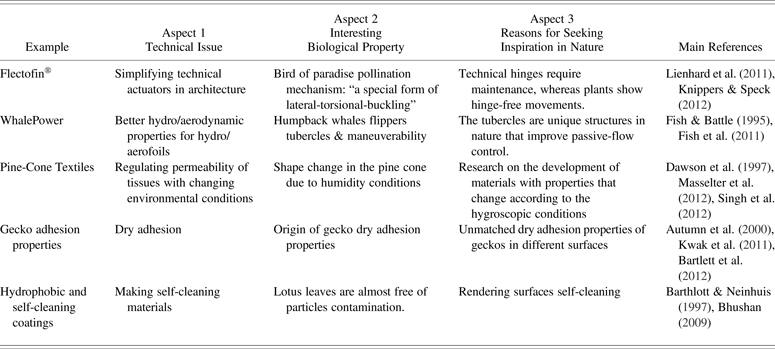
Modeling each case using a C-K framework required the identification of the following aspects of the design process:
• Aspect 1: the technical issue addressed by the biomimetic development (first concept or design path),
• Aspect 2: the biological property observed that could bring some insight for this issue (the biological inspiration). and
• Aspect 3: the reasons for using inspiration from nature (how the biological inspiration was used during the design process).
Table 2 summarizes these three aspects for each case. These aspects were used in the construction of the C-K representation of each design process. In this article, we detail two of these representations, the WhalePower case and the Flectofin case. This last C-K framework, along with the framework of the Gecko and Lotus cases, was presented in a previous study (Freitas Salgueiredo & Hatchuel, Reference Freitas Salgueiredo and Hatchuel2014), and is now revised and expanded with a clear identification of the expanding partitions and the construction of the knowledge base. With respect to the two directions for biological inspiration, WhalePower represents a case of bottom-up bioinspiration process and Flectofin a case of top-down process.
Main aspects identified in each of the case examples of biologically inspired design
4.2. C-K modeling of BID examples
The construction of the C-K framework begins with the formulation of concepts linked to the technical issues identified in each case (Aspect 1). Using the information about the biological properties observed, we identified the general biological bases mobilized during the design process (Aspect 2) and the properties from these biological knowledge bases that triggered concept partitioning with the K → C operator (Aspect 3). We observed that in each case this partitioning had an expanding effect: the concept partitioned using biological knowledge stimulated a revision of the scientific knowledge bases and of the biological knowledge bases.
4.2.1. Flectofin
First concept formulation (K → C)
Deployable structures with simpler technical actuators are an issue for architects and engineers (Knippers & Speck, Reference Knippers and Speck2012). This is a concept in C-K theory: “design of a deployable system with simpler technical actuators,” because it cannot be defined only using knowledge available to architects and engineers.
Concepts partitioning (K → C)
The usual actuators for deployability use hinges and rollers that require constant maintenance (Lienhard et al., Reference Lienhard, Schleicher, Poppinga, Masselter, Milwich, Speck and Knippers2011). One partition for the first concept, formulated using this knowledge about hinges and rollers, would be “improving hinges and rollers to require less maintenance.”
Biological knowledge activation (C → K) and concept partitioning
Previous research of this group had shown that plants have some deployability mechanisms that do not require hinges, and are based on elastic deformations (Matini & Knippers, Reference Matini and Knippers2008; Lienhard et al., Reference Lienhard, Poppinga, Schleicher, Masselter, Speck and Knippers2009). The activation of this knowledge base partitions the first concept with “deployable systems in architecture without hinges and rollers” and “using elastic deformations” as it adds new properties to the first concept.
Exploration of biological and scientific knowledge (K → K) and concept partitioning
The research group tried to identify deployability phenomena in plants that could be useful for improving deployability in architecture. They explored the biological knowledge on plants deformation without hinges. In parallel, scientific knowledge was also explored: they built prototypes that helped explaining and understanding the physical phenomena behind these deformations (Matini & Knippers, Reference Matini and Knippers2008; Lienhard et al., Reference Lienhard, Poppinga, Schleicher, Masselter, Speck and Knippers2009). They identified that elastic deformations could be useful for these deployability properties. One of these deployability phenomena, the bird of paradise flower pollination mechanism, was identified as particularly interesting to these researchers because it was “actuated externally,” making use of “a special form of lateral torsional buckling … not unfamiliar to engineers but mainly perceived as an undesirable failure mode to be avoided when planning architectural constructions” (Lienhard et al., Reference Lienhard, Schleicher, Poppinga, Masselter, Milwich, Speck and Knippers2011). According to Knippers and Speck (Reference Knippers and Speck2012), the external actuation in the bird of paradise flower refers to the opening of the two adnate petals that form a perch in which birds can land when searching for the plant's nectar. The mechanical pressure exerted on the perch by the bird causes the bending of the two adnate petals, which exposes the flower pollen. The pollen is attached to the bird's feet, helping the pollination mechanism. When the birds fly away, the perch returns to the closed position.
Scientific knowledge revision (K → K) and final design path (C → K)
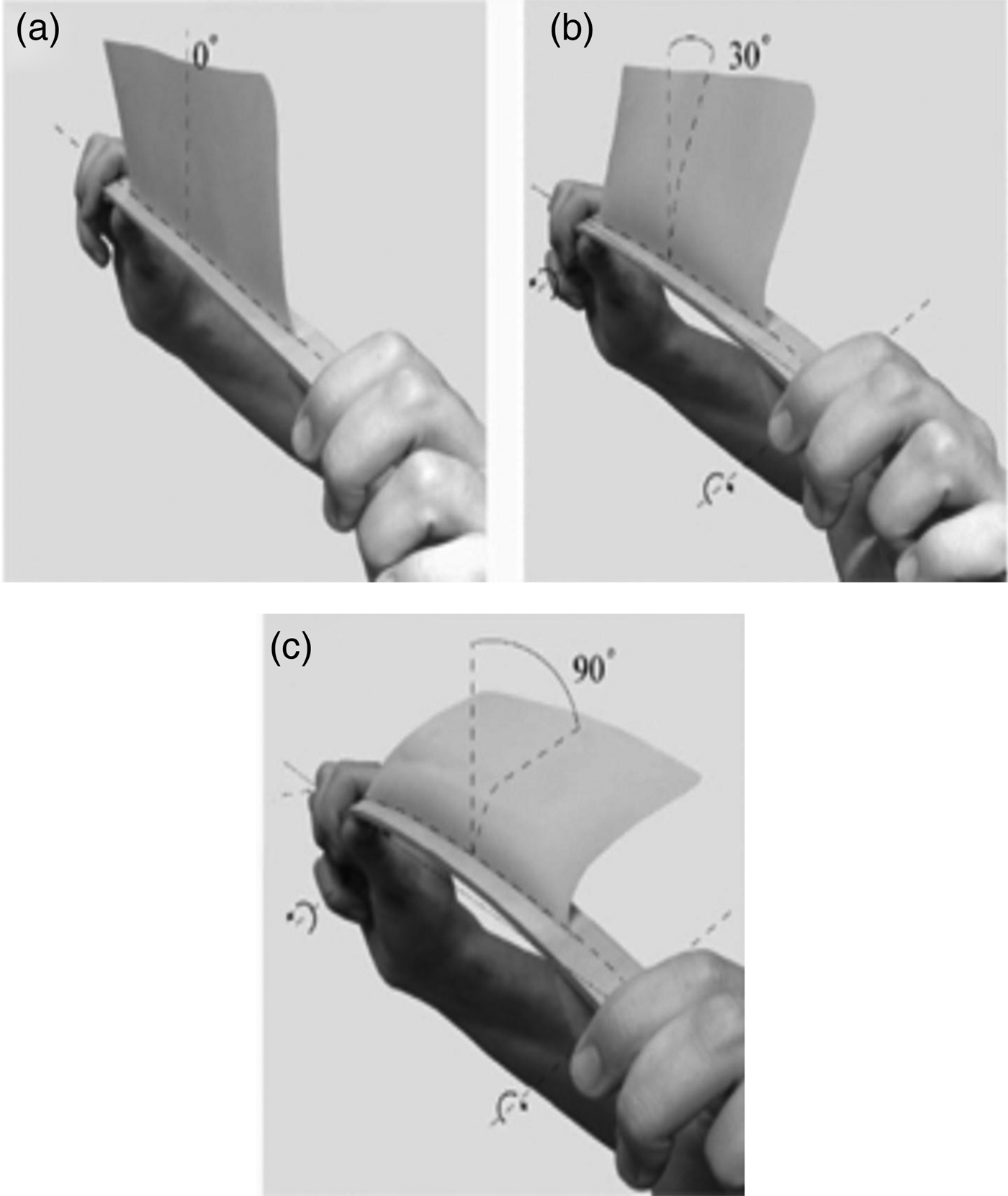
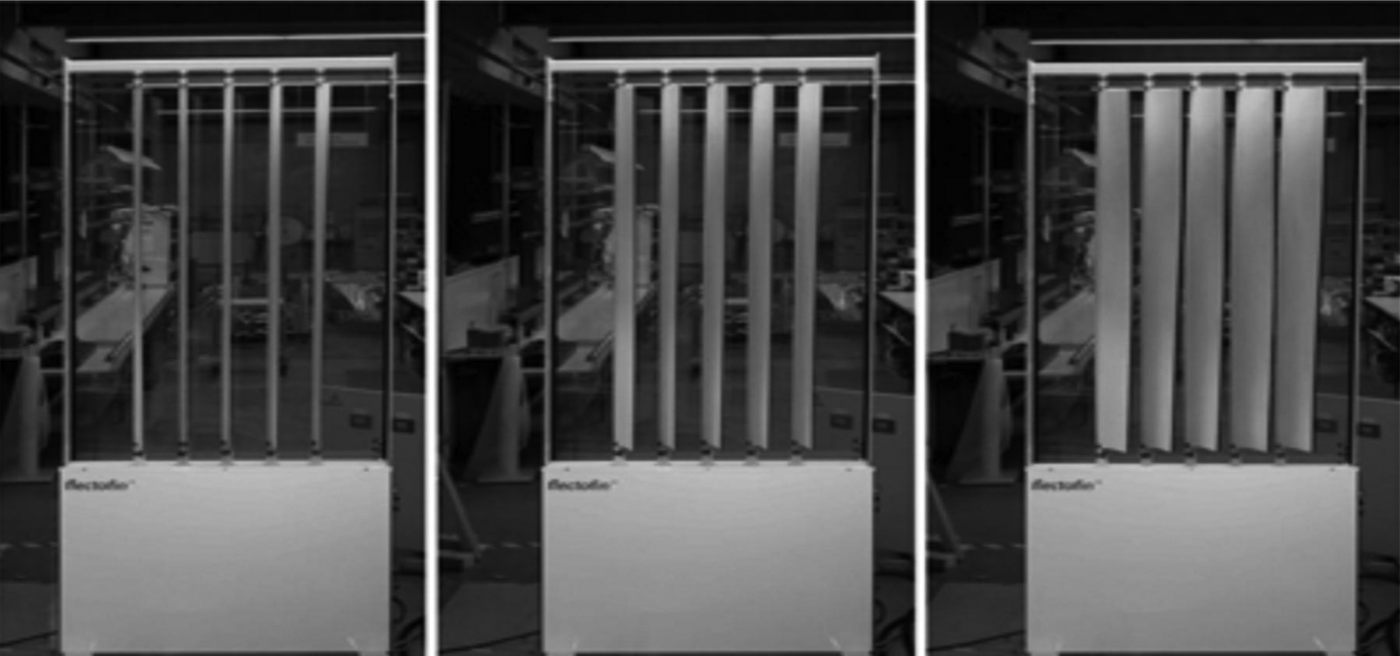
Researchers revised their knowledge about this phenomenon, in order to understand how this failure mode could turn useful for deployable structures. They identified that “attaching a thin shell element to a rib” allowed obtaining this special form of lateral torsional buckling (Fig. 1) and studied materials most appropriate for the technical realization. Flectofin, a façade shading system without hinges, has vertical backbones and laminae attached to each backbone (Fig. 2). Moving the lower support of the system up and down causes the bending of the backbones and the opening/closing of the laminae (Lienhard et al., Reference Lienhard, Schleicher, Poppinga, Masselter, Milwich, Speck and Knippers2011; Knippers & Speck, Reference Knippers and Speck2012). In this case, the two expanding partitions “without using hinges” and “using lateral torsional buckling” came clearly from the biological knowledge about plants movements and the bird of paradise pollination mechanisms. The C-K framework for this case is summarized in Figure 3.
The deformation principle of the bird of paradise flower realized with a physical model. The backbone bends by the action of (a) the hands, and this deflects the (b) lamina or (c) fin. Reprinted from “Flectofin: A Hingeless Flapping Mechanism Inspired by Nature,” by J. Lienhard, S. Schleicher, S. Poppinga, T. Masselter, M. Milwich, T. Speck, and J. Knippers, Reference Lienhard, Schleicher, Poppinga, Masselter, Milwich, Speck and Knippers2011, Bioinspiration & Biomimetics 6(4), 045001, fig. 2. Copyright 2011 by IOP Publishing. Reprinted with permission.
Prototype of the Flectofin® façade shading system. Reprinted from “Flectofin: A Hingeless Flapping Mechanism Inspired by Nature,” by J. Lienhard, S. Schleicher, S. Poppinga, T. Masselter, M. Milwich, T. Speck, and J. Knippers, Reference Lienhard, Schleicher, Poppinga, Masselter, Milwich, Speck and Knippers2011, Bioinspiration & Biomimetics 6(4), 045001, fig. 6. Copyright 2011 by IOP Publishing. Reprinted with permission.
Concept–knowledge (C-K) framework for the Flectofin® case.
4.2.2. WhalePower
First concept formulation (K → C)
Humpback whales’ superior maneuverability properties compared to other whales seemed to be linked to their flippers hydrodynamic performance. These flippers have protuberances, called tubercles, on their leading edge, contrasting with the “well-streamlined, engineered hydro and air foils” (Bushnell & Moore, Reference Bushnell and Moore1991; Fish & Battle, Reference Fish and Battle1995). We hypothesize, based on the information presented in the article of Fish and Battle (Reference Fish and Battle1995), that this contrast between engineering and biology was the starting point for this case. The first concept could then be formulated as the design of hydro- and airfoils with improved hydro/aerodynamics properties.
Concepts partitioning (K → C)
The contrast between engineered and biological systems partitions this first concept: “by improving well-streamlined leading edges” and “without using well-streamlined leading edges.”
Exploration of biological and scientific knowledge (K → K) and concept partitioning
In order to better understand the whales’ flippers hydrodynamic properties, researchers activated knowledge about fluid mechanics and hydrodynamics of foils. The concept “without using well-streamlined leading edges” is an expanding partition that allows scientific knowledge about fluid dynamics expansion and revision. Using this newly activated knowledge base, researchers understood the reasons for the improved performance of the tubercles in the leading edges of the whales’ flippers (Miklosovic et al., Reference Miklosovic, Murray, Howle and Fish2004; Johari et al., Reference Johari, Henoch, Custodio and Levshin2007) and linked tubercles to passive control around a winglike structure (Fish et al., Reference Fish, Weber, Murray and Howle2011). The presence of tubercles was claimed to “delay stall and both increase lift and reduce drag at the same time” (Fish et al., Reference Fish, Weber, Murray and Howle2011). This was an unexpected property of these structures that could be applied in the design of hydro- and airfoils, partitioning the concept of “without well-streamlined leading edges” into “introducing tubercles to the leading edge,” not to increase maneuverability (as in whales) but to improve hydro- and aerodynamics of fan blades and air turbines.
Scientific knowledge revision (K → K) and final design path (C → K)
The introduction of tubercles in blades of ceiling fans as those currently commercialized by Envira-North (Altra-air fans) represents the final design path. There also current possibilities for applying the bumps in turbines (Fig. 4) or in aviation (Fish et al., Reference Fish, Weber, Murray and Howle2011). The C-K framework for this case is summarized in Figure 5.
WhalePower technology applied to a turbine blade. Reprinted from the work of Dr. Frank Fish. Copyright Dr. Frank Fish and WhalePower Corporation. Reprinted with permission.
Concept–knowledge (C-K) framework for the WhalePower case.
4.3. A general C-K framework for biologically inspired design
The previous two examples modeled with the C-K framework and operators show some similarities. First, the identification of interesting properties in a biological knowledge base allows the partitioning of concepts of the existing design paths. Second, these bioinspired concepts are expansive concepts: they provoke a revision of the existing knowledge about an object or a phenomena (as in the buckling properties of materials or the aerodynamic properties of foils) and guide the expansion of the knowledge in new directions, activating knowledge bases that would not otherwise be activated.
A general model for BID using the C-K framework should then be composed of the two spaces and the knowledge bases. These knowledge bases are the scientific knowledge bases, that is, the initial knowledge bases available to designers and the biological knowledge bases, which can exist initially (in the case of WhalePower, biologists were studying the hydrodynamic properties of whales), or not (in the Flectofin case, architects did not have the biological knowledge at the beginning, but established a partnership with plants biomechanics experts to get access to this knowledge).
The activation of biological knowledge during the design process guides the knowledge expansion phenomena and partitions concepts:
• Scientific knowledge bases are activated to explain or better understand the properties observed in biological phenomena.
• The properties of biological knowledge that activate scientific knowledge bases not spontaneously activated guide the knowledge revision and expansion and can be conceptualized in the C-space, forming expanding partitions.
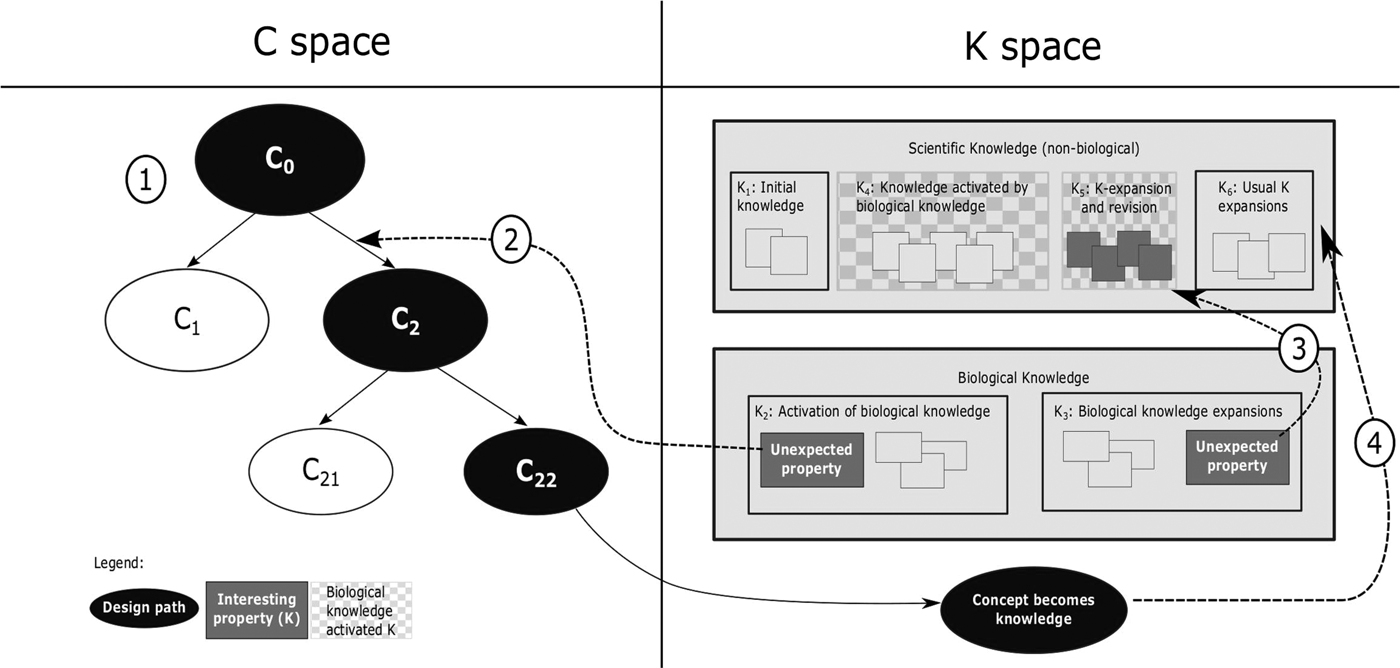
These elements can be summarized in the following four general steps, as shown in Figure 6:
1. Identification of design paths for which concept partitioning is required: This identification corresponds to the conceptualization of a design issue that will trigger the activation of scientific knowledge bases for clarifying this issue.
2. Activation of biological knowledge related to the first concept: The choice of the biological knowledge base can be guided by the existing methods for retrieving biological phenomena, such as functional decomposition (Nagel et al., Reference Nagel, Nagel, Stone and McAdams2010; Helfman Cohen et al., Reference Hatchuel, Le Masson and Weil2014), structure–behavior–function modeling (Wiltgen et al., Reference Wiltgen, Goel, Vattam, Ram and Wiratunga2011), the SAPPhIRE model (Sartori et al., Reference Sartori, Pal and Chakrabarti2010), or search in natural language (Shu, Reference Shu2010). Identifying interesting properties partitions the first concept and guides a deeper exploration of the biological knowledge base. If the observation of an interesting property in a biological system is the starting point of the design process, then the first step becomes the identification of a design path that could benefit from this property.
3. Expansions in both biological and scientific knowledge bases: These expansions represent the activation of biological knowledge (screening process of different plant movements in the case of Flectofin) and of scientific knowledge related to these interesting biological properties being explored (the modeling and simulations of flipper hydrodynamic properties in the WhalePower case). With these expansions in both knowledge bases, interesting properties allowing concepts partitioning are identified.
4. Return to the scientific knowledge bases: Once a design path becomes knowledge, its development does not depend on the biological knowledge anymore: the pollination mechanism of the bird-of-paradise flower was useful for understanding how to apply the buckling phenomena, but once researchers understood how to reproduce this phenomena with existing materials and techniques, the development of the product only used scientific knowledge. Similarly, in the WhalePower case, the identification of flipper properties allowed the bumps to be installed in fans, independently from research on whales’ movements.
General concept–knowledge (C-K) framework for the biologically inspired design process.
5. DISCUSSION
The modeling of the bioinspired design process with the C-K theory aimed at disentangling the reasons for using biological knowledge during the design process.
The two directions pointed out in literature for the BID process, top-down and bottom-up, are retrieved in the C-K framework: the two examples, Flectofin and WhalePower, belong to each one of these directions. The C-K framework gives a more general interpretation to these two directions, not only encompassing the operations in the K space (search for analogues, transfer, and emulation), but also relating these operations to the concepts space, showing that biological knowledge stimulates concepts partitioning and that these partitions are expanding partitions: they guide the exploration and revision of knowledge. These expansions and revisions of both knowledge bases are easily visualized in the C-K framework, facilitating the exploration of the design paths shown in the C space and the associated knowledge bases.
The creative power of BID comes from these expanding partitions it generates, as they stimulate the activation of scientific knowledge bases that would not otherwise be activated. The “interesting” character of biological knowledge is a consequence of this ability to generate expansive concept partitioning. This aspect was not easily visualized with the analogical transfer interpretation of the BID process, because it does not show how the analogous properties found in biological systems interact with the existing knowledge and if this interaction stimulates the search of new knowledge bases or if it leads to remaining in the same knowledge bases.
The C-K model for BID also provides some insights about the organization of this process in practice. It indicates that the use of biological knowledge in the design process requires more than a superficial knowledge about biological systems. For example, when designing a novel multienergy system for vehicles, it is not sufficient to know that nature also has multienergy systems. Engineers must also understand details about the design of these natural systems and reinterpret this biological knowledge using their own knowledge bases, and possibly new ones that they will have to acquire. This collaboration between engineering and biology differs from a simple knowledge sharing or transfer process: biology specialists must work together with engineers, also revising their knowledge with the revisions engineers are making, while engineers should be able to accurately identify the knowledge bases that biological knowledge is revising and the new ones being activated.
This C-K framework offers a representation of the design process, including the design paths and the use of knowledge bases. It provides designers with a representation of the design paths and how the knowledge bases being activated can interact. Designers can easily see, using this framework, that the BID process involves not only finding an interesting property in biology. It implies relating these properties to existing knowledge bases, which can lead to revisions and expansions in these scientific knowledge bases.
One limitation of this C-K model is that it does not indicate how the suitable biological knowledge bases should be found. The methods and tools proposed in literature for the BID analogical transfer could represent a solution to this aspect. For example, functional decomposition (Nagel et al., Reference Nagel, Stone, McAdams and Goel2014) can be used to expand and revise both biological and nonbiological knowledge bases, helping in the identification of nonspontaneously activated knowledge bases while natural language (Shu, Reference Shu2010) can help in the identification of other biological bases to explore during the design process. However, it is important to notice that while classic analogical transfer methods consider misapplied analogies as errors in analogical transfer, the C-K framework shows that the most important role of biological knowledge is concept partitioning, independently of these properties being used or not in the final design path.
6. CONCLUSIONS AND PERSPECTIVES
The interpretation of the BID process with the C-K theory framework presented in this article highlights two main aspects of this process. The first one refers to the knowledge base construction that takes place during the BID process. Two knowledge bases, biological and scientific (nonbiological), are expanded and revised during the process. The identification of interesting properties in the knowledge space allowing concept partitioning is made possible only with the expansions in both knowledge bases. The second one is related to the organizational aspects of the BID process. Expanding and revising these two knowledge bases requires a collaboration between biology and traditional engineering; this collaboration is “mutually inspirational” because both knowledge bases are expanded using the interesting properties. Therefore, these interesting properties can only be identified by making connections between the two knowledge bases.
This initial modeling of the BID process using the C-K theory framework and operators is based on a limited number of case examples. This model constitutes a first step toward the comprehensive and systematic inclusion of other process besides analogy into the design process. Future work will elaborate on these findings and explore practical conditions for applying these two findings in a real industrial context.
ACKNOWLEDGMENTS
The authors thank the researchers of the Design Theory and Methods for Innovation Research and Teaching Chair; Philippe Doublet from Renault; Drs. Sébastien Glaser, Olivier Orfila, and Guillaume Saint Pierre from the LIVIC-IFSTTAR laboratory; Professor Stéphane Doncieux from ISIR-UPMC; and Professor Véronique Billat from UBIAE for their support and feedback throughout this work.
Camila Freitas Salgueiredo is a PhD Student at the University of Evry and at the LIVIC-IFSTTAR and ISIR-UPMC laboratories. Her research is a part of the CIFRE program conducted in collaboration with Renault. She worked on the application of BID for developing concepts that allow the reduction of carbon dioxide emissions in cars.
Armand Hatchuel is a Professor and Co-Head of the Chair of Design Theory and Methods for Innovation at Mines ParisTech–PSL Research University. He has published extensively, is a member of journal and scientific boards, and has received several awards. Dr. Hatchuel is a Fellow of the National Academy of Technologies and the Design Society.