Dialogue is everywhere in the Middle Ages. It is found as a central device in numerous literary genres: pedagogy, scholastic texts and narrative hagiography, to name but a few. Dialogue was a fact in texts because it was a fact in life: in the practice of scholastic disputation, in the rituals of court whose scripts are royal diplomata, and above all in the liturgy. Dialogue also has an ancient role in education, including religious education. We think of Platonic dialogues, of course, and some college classrooms still aspire to the Socratic method. Dialogue has retained a central role in religious education in traditions as disparate as Buddhism and Judaism. Dialogue in the Middle Ages continued to be a technique of pedagogy, whether the dialogue was between two adversaries, or between a master who instructed and a student or disciple who questioned and learned. Dialogue might be something that happened in a schoolroom or monastery, or it might be read, silently or aloud, from a written text.Footnote 1 But why has dialogue been such a key part of religious education? What advantages does it offer over other potential modes of instruction, such as the lecture or the treatise? The task of this article is to begin to answer these questions.
I will argue that when read or heard, the dialogue of the text was meant in turn to cue an internal dialogue, a response within the self, and a transformation. The written dialogues themselves are often explicit about this intent. While meditative religious reading of all kinds was thought of as producing this inner reflection and debate, the dialogue format is thought to be especially effective for inculcating in beginners a mode of internal reflection and questioning, inspired by an outside source. Finally, although the content and even the message of the dialogue that is written or overheard may be fixed and clear, its effect on those who read or hear it remains open and provisional. It is up to them to draw their own conclusions and absorb their own lessons from the dialogue.
The primary examples of the way dialogue serves a pedagogical function will be taken from a series of hagiographical texts, copied in tenth-century Spain and used in women's monastic contexts. I begin, however, by introducing the important precedent set by Gregory the Great's Dialogues for the use of dialogue in a didactic context during the medieval period. Petrus Alfonsi's Dialogue against the Jews, a popular example of the likewise popular genre of interreligious dialogues between Christians and Jews, will offer a different model of the didactic intent and effect of a dialogue format. By starting with these more obviously didactic texts and discussing how they use dialogue to teach with, it will more easily become apparent that the dialogues in my hagiographical texts likewise serve more than a strictly narrative function. Dialogue in these hagiographies invites the reader into a process of engagement with the text, the goal of which is her own self-transformation.
Gregory the Great's Dialogues exemplifies the dialogue format. It was ubiquitous in libraries in the medieval Latin West, and its influence was felt particularly early in Spain.Footnote 2 The text unfolds as a private conversation between Gregory and a student, the deacon Peter, about whether the age of saints has passed. Peter suggests to Gregory that there are no longer men in Italy who are famed for virtue, as there were in the early church, and moreover miracles are no longer performed.Footnote 3 Gregory takes four books to show him that this is not the case. Peter intervenes, albeit briefly, throughout, expressing wonder, asking for clarification and, most of all, pointing out biblical parallels for the miracles Gregory describes. For example, after hearing some of the miracles of St Benedict, Peter says:
The things you report be strange, and much to be wondered at: for in making the rock to yield forth water, I see Moses; and in the iron, which came from the bottom of the lake, I behold Elisha; in the walking [of Maurus] upon the water, I perceive Peter; in the obedience of the crow, I contemplate Elijah; and in lamenting the death of his enemy, I acknowledge David: and therefore, in my opinion, [Benedict] was full of the spirit of all good men.Footnote 4
We might question why Gregory needs Peter at all. Why was he moved to describe the deeds of the saints in a dialogue, when he could simply have described their deeds and miracles, and then made the biblical parallels himself? And why have named figures in the text at all? Why not simply present the ideas and stories in it from the perspective of a distant third-person narrator?
The people make the dialogue a drama, and the drama connects ideas to embodied practice or exercise, and thence to the reader. Peter, the student who questions his master face to face, stands in this text in the place of the reader. Readers who wish to learn from Gregory's text identify with his student Peter, model themselves on him and learn alongside him as he passes from foolishness to wisdom. It is a dialogue between scriptural texts that Peter knows and cites and the contemporary lives of the saints that Gregory relates, connecting the two and showing that the good days are not all behind us. It is a dialogue that teaches its readers how to read the Bible, and to read the events and lives of their own day through the light of the Scriptures. The reading or hearing of written dialogue becomes a tool of formation, education and cultivation of the devotional self in the monastery.
In this respect, this dialogue has a great deal in common with the numerous Christian dialogues that describe conversations between a Christian and a Jew.Footnote 5 These are often criticized by modern standards for giving short shrift to the Jew, for not allowing him to speak much and for not allowing him to make the arguments a ‘real’ Jew would have made, for instance, in response to accusations that Jews read only the letter of the Old Testament, while Christians understand the spirit. The Dialogue against the Jews of the twelfth-century Jewish convert to Christianity Petrus Alfonsi is a case in point. Educated in Islamic Spain, where he received a broad education, Petrus was baptized as a Christian in 1106 in the city of Huesca, at the time ruled by the king of Aragón, before travelling as a teacher to England and northern France. His Dialogue explains his adoption of Christianity to his unconverted self, the character Moses.Footnote 6 Moses does little more in the text than pose questions and ask for clarification, despite the fact that Petrus, above all people, would have known genuine Jewish objections to the Christian positions, as well as Jewish defences against the points he makes; had he wished, he could have articulated them through the persona of Moses.Footnote 7 But this text and the many other dialogi, altercationes and disputatione s that precede and follow it were not written to present an accurate depiction of the Christian-Jewish debate. They were written for the most part in Latin, and thus for a learned Christian audience. They took Christian readings of the Bible, especially the Old Testament, but also of events such as the fall of Jerusalem to the Romans and the destruction of the Temple, and the meaning of the Roman empire, and contrasted them with readings labelled ‘Jewish’ of the same texts and events in a dialogue format to show the truth of the Christian readings and the falsity of the Jewish ones.
This Jew who serves as a sparring partner for Christian theology has been called a hermeneutical Jew, a Jew who may only poorly overlap with real Jews, but who was a crucial tool in Christian self-understanding and definition.Footnote 8 Whereas the Christian reader identifies with Peter in Gregory's Dialogues and learns alongside him, when reading Christian-Jewish dialogue, the Christian reader learns by aversion. The perspective that is Jewish is already automatically labelled as wrong, and the Christian learns what errors to avoid.
On the other hand, whilst polemic is part of Petrus Alfonsi's purpose, it is not his whole purpose. Some of what he teaches bears little on Christian-Jewish debate, but demonstrates a different way in which these dialogues served a didactic purpose. Book 1 of his Dialogue treats of the nature of God and his unity. But a good part of it is given over to recounting astronomical information about the shape of the world, its divisions, the way the sun passes over its surface and so forth, complete with diagrams. Petrus uses biblical authority as a support for these observations, but they have only tangential relevance to his intention to explain his conversion. Moses's interventions in these sections are simply to ask for clarification and to demonstrate that he has understood Petrus's explanations. This is ironic because it was while he was still Moses, the Spanish Jew, that Petrus had learned what he knew about astronomy, information he now shares with his Christian world, which stands with Moses, reading and learning.Footnote 9 Knowledge which had come to Christian Europe from Jewish and Muslim sources has been repackaged as inherently Christian.
Why is this a part of the Dialogue? If we take Petrus at his word in his preface that his intention in writing is to explain the reasons why, as he puts it, ‘[t]he Christian law is superior to all others’, this astronomy is a pointless digression.Footnote 10 But if we see the Dialogue more broadly as a teaching text, then it makes perfect sense. Our clue to his intentions here is found in another text by Petrus, the so-called ‘letter to the peripatetics’ addressed to the wandering scholars of France who sought out the best masters in the subjects that interested them. Called an apologia for astronomy, it is really an advertisement for Petrus's own expertise in the subject:
It has come to our ears that some of those who investigate wisdom … prepare to traverse distant provinces and exile themselves in remote regions in order to acquire a fuller knowledge of astronomy. To them I reply without hesitation that since the truth is what they desire to see, they will soon have what they wish, and that which they prepare to seek in remote places is close at hand, unless they have some doubt that we are somewhat gifted in this art.Footnote 11
Petrus's contribution to Christian thought was not that he came up with definitive arguments against Jews. Rather it was as a teacher, a conduit of knowledge from the non-Christian world about Jewish exegetical traditions, but also about such little-related subjects as astronomy. Above all, we must remember the device of Petrus Alfonsi literally speaking to himself, to his alter ego Moses, representing on the page the kind of internal dialogue in which the reader is meant to engage. This highlights the importance of voice and of who is speaking what parts in this dialogue. Who voices a given perspective or discloses particular information is as important as the perspective or information itself.
We move now from considering these placeless, plotless, explicitly didactic dialogues to examining how dialogue is used within a collection of narratives about holy women. Here too, more unexpectedly, dialogue does not merely further the plot of the narrative; it also plays a didactic role. Five manuscripts copied in medieval Spain during the tenth century transmit all or part of a collection of eight Latin lives of female holy women: El Escorial, Real Biblioteca del Monasterio de San Lorenzo, MSS a.II.9 and a.I.13; Madrid, Biblioteca Nacional de España (hereafter: BNE), MS 10007; Madrid, Biblioteca de la Real Academia de la Historia (hereafter: BAH), MS 13; and Paris, BN, nouv. acq. lat., MS 2178. The women are Constantina, Helia, Melania the Younger, Castissima, an anonymous virgin, Egeria, Pelagia and Mary of Egypt. I class these under the rubric of hagiography, using that term loosely to describe narrative accounts of holy women, intended as models of right thought and behaviour. Taken individually, a couple of them, like the dialogue of the anonymous virgin or the life of Helia, might not seem to fit the genre understood more strictly, as they are about women for whom no cult is attested. However, as I will argue, they must be read together as a corpus and interpreted within the context of the lives that travel with them and the manuscripts that contain them and what all that may tell us about how they were intended to be used.Footnote 12 No manuscript transmits only these lives; the bulk of the codices are filled with additional texts, hagiographic, monastic or both. At least one, El Escorial, MS a.I.13, was copied for a religious community of women.Footnote 13
The whole collection of eight lives is worthy of further attention. A large amount of documentary evidence exists showing women before 1100 in Spain who entered the religious life under vows, but we have found very little to this point that would help us understand what religious life meant to them, what they feared and dreamed of, or how they hoped to be transformed by it. This corpus offers a chance to shed light on that question. Here, I will introduce three of the eight: the Life of Constantina, the Life of Helia and the Dialogue of the Virgin, a conversation between an anonymous virgin and an old man. Hagiography (both the passio or martyrdom account and the vita or saint's life) conventionally includes dialogical elements, but I will argue that these three texts, in different ways, use dialogue not merely to advance the narrative but as a form of pedagogy intended to help form its audience through a kind of internal cultivation of the self. As we shall see, the Life of Constantina melds new dialogues to an older hagiographic tradition to expand greatly on the late antique story of Constantina, and the text on the anonymous virgin is wholly constructed from inter-nested conversations. I begin, however, with the Life of Helia.
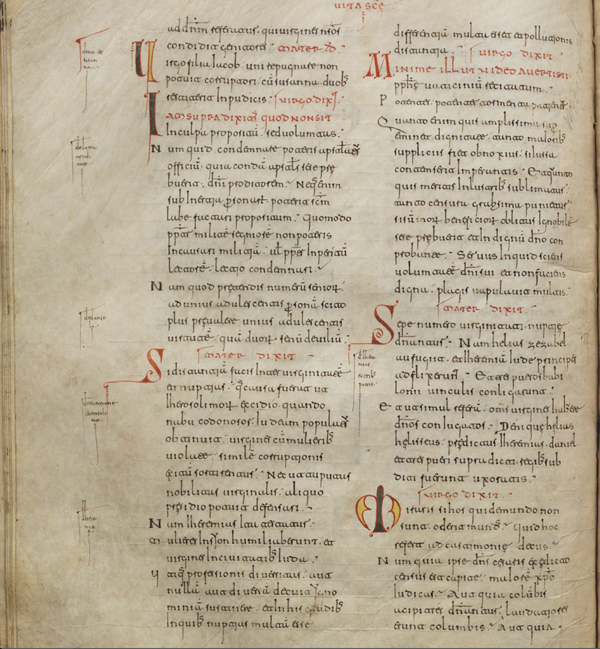
The story of ‘St Helia’ is unusual not only because it recounts the story of a woman for whom we have no other evidence of a cult, but even more because it was written as a series of dialogues strung together with only enough narrative to provide them with the barest of a frame. The dialogical elements are so important to the text that the different speeches are marked out with character cues, as we would find in the script of a play (Fig. 1).Footnote 14 It is divided into three books. The first involves a debate between Helia (‘The Virgin’) and her mother over whether it is better to marry or to remain a virgin, as the mother attempts to persuade her daughter into marriage. They continue their debate in the second book, until the mother decides that dialogue is not working on her recalcitrant daughter, and moves to physical punishment to convince her of the error of her position. Helia escapes to the local bishop, whom she persuades, with another speech, to take up her cause. He hides her and debates with her furious mother. In the third book, after her paternal aunt has raised a peasant army in support of her niece and been defeated by the emperor, Helia is summoned to a public trial and debates with the civic judge. The account ends with no clear resolution, but Helia gets the last word in a speech that asserts her ability as a woman to gain salvation by means other than having children, and a poem that affirms the biblical foundation of her identity as a virgin.Footnote 15
El Escorial, Real Biblioteca del Monasterio de San Lorenzo, MS a.II.9, fol. 78v, Vita Sancte Helie. © Patrimonio Nacional.

Even before the mother uses physical punishment on Helia, their conversation is acrimonious. The mother opens their debate by asking:
Why, being forgetful of our discipline, do you oppose the doctrine of your fathers and follow the path of a new superstition? Abandon your devotion to this empty religious observance and comply with the wishes of your parents, before you experience the severity of your mother's judgment and suffer the shame of your most grave error.Footnote 16
Before she turns on her daughter with switches, the mother calls her ‘[v]erbose girl, profaner of the divine laws, insolent towards maternal admonitions, oblivious of our favors, rebellious, reckless, presumptuous, irresponsible, inconsiderate, foolish-talking, and unrestrained.’Footnote 17 Not all dialogue will be civil, and founded in reason and evidence alone.
The Life of Saint Helia exists somewhere between the two poles that are dialogue between master and student and dialogue between religious antagonists. In Gregory's Dialogues, Peter and Gregory are on the same ‘team’, as it were, each at different stages of the same path of spiritual growth. In the numerous Christian dialogues that feature a Christian and a Jew, like that between Petrus Alfonso and Moses, the two sides are positioned on opposite sides – faith versus infidelity; the spirit versus the letter – although the intent remains both exegetical and transformative for the reader. All the characters in the Life of Helia are Christians, albeit perhaps of different sorts. Still, it has in common with both Gregory's Dialogues and the Christian-Jewish debate deep attention to problems of biblical interpretation. Helia and her mother, her mother and the bishop, and finally Helia and the judge all cite biblical verses to support their positions and use biblical exegesis against each other, and the debate turns on which one is reading the Bible correctly, especially the commandment to obey one's parents.Footnote 18 Helia herself even embodies biblical dialogue, as when, committed to the virginal life but unsure of how to pursue it, she paraphrases to herself Mary's dialogue with the angel at the Annunciation (Luke 1: 34): ‘How will this be done, since I do not know the order?’Footnote 19 Moreover, the mother presents a challenge to Helia and the reader, in that her arguments in favour of marriage are not weak ones but are drawn from the same Bible from which Helia draws her own counter-arguments in favour of virginity. It is up to the reader to sift and discern what a right reading might be, to internalize the correct possible readings of the Scriptures and their application to lived life, and to choose virginity for herself.
Even the more narrative elements of the Life have a strong dialogical quality. The dialogue of the narrative is with those who stand outside the text, reading or hearing the Life. In the prologue, the narrator addresses the man who commissioned the Life, his own master, improbably named Macedonius, promising this spiritual father the obedience Helia refuses to her physical mother.Footnote 20 At the opening of the first book, he addresses a second audience, of female virgins, who are expected to benefit from the image he paints them of Helia and her debates, and who reward him with their powerful prayers on his behalf: ‘The painting of this living tablet will benefit you in no small measure, O blessed virgins, if only you may procure for us divine approbation through your prayers, by imploring the Lord plainly.’Footnote 21 The text that reveals Helia becomes a portrait at which the virgins may gaze, to measure their own performance. This audience is imagined as one not of readers but of listeners, encountering this text as an oral performance, as suggested by the direction that follows the author's address to them: ‘Thus if it now pleases the one who is here to speak the life of Saint Helia, let the discourse begin to be disclosed.’Footnote 22 And although the dialogue itself ends without explicit resolution, the text as a whole concludes with a prayer in the first person in which St Helia and her audience of virgins become one, a single ‘I’ who is a virgin, and whose life is modelled on the Bible:
The virgin who can speak the ‘I’ of this poem becomes one with Helia, and also with the Scriptures.
The second text to be discussed from this collection, which I refer to as the Dialogue of the Virgin, is a brief exchange between an anonymous virgin and an old man, in which he enquires about the events that led her to seek a life of virtue, and she answers him by relating a series of nested dialogues that explain the transformation of her life.Footnote 24 She tells him how her parents modelled different ways of life for her before their deaths. Her father was ill most of the time, and spoke so little you might think he had no voice, while her mother was so talkative you might think she was all tongue.Footnote 25 The mother fought with everyone, and lived a life of drunken luxury and adultery. After their deaths, the virgin had an internal dialogue about which mode of life she should follow: her father's suffering seemed to show he was disfavoured by God, while her mother's happiness implied God's favour. The virgin tells the old man that, resolving to follow the ways of her mother, she then fell asleep and experienced a vision of a man of magnificent appearance. The virgin recounts the conversation she had with this man, and how he showed her the fates after death of her virtuous father and wicked mother. Within this vision, she then speaks to her parents. Her father calls her ‘daughter’ and promises her that his reward of peace and comfort will be hers if she follows his ways, while her mother, suffering the tortures of the damned, begs the girl to release her from her torments.
The internal dialogues within the text conclude with a second-person imperative admonition directed outside the text, to its reader. This urges its audience:
Despise all transitory things. Have no care for the world, as if you were dead. Despise in living what you will not be able to have after death. Behold, a way of living has been given to you; you have an orderly law which you ought to follow. You already know what it is to live rightly. Take care, lest what you learn by reading, you despise in living. Fulfil through deeds what you have learned by seeing.Footnote 26
This admonition recalls Helia’s author's address to the virgins at the opening of that text, and the identification of the virgin who listens to or reads the text with Helia in its concluding poem.
The Dialogue of the Virgin is a variation on a passage with the incipit Narravit quidam senex (‘A certain old man recounted’). It is found in the Verba seniorum (Sayings of the Fathers), said to be a translation of apophthegmata from Greek into Latin, attributed to John the subdeacon, who may be Pope John III (561–74).Footnote 27 The Verba seniorum forms part of the Vitae patrum (Lives of the Fathers) tradition. This particular passage is found in numerous medieval manuscripts.Footnote 28 The version in El Escorial, MS a.II.9 makes important changes to the original, however. In the original version, the content of what here are nested dialogues is all related by the old man who is named first and who questions the virgin, who is herself also old.Footnote 29 In our version, the virgin, whose age is not mentioned, speaks for herself and is named first, putting the focus on her experiences and her first-person speech, rather than on the old man's account of her story.Footnote 30 Likewise, the admonition directed outside the text toward its reader that is in our version is wholly missing from the original. These changes heighten the dialogic qualities of the text that are designed to draw in the reader, especially the female reader, and encourage a process of self-transformation alongside the woman at the heart of the story.
The dialogues of the virgin with her father and mother, with the old man, with herself and with the splendid man of her vision become a dialogue between the text and the reader in which the reader is asked to perform an act of internal reflection and transformation that matches the transformation of the virgin in the text. The text plays with paradox. The father's silence is rewarded and the mother's loquacity punished, but it is only through dialogue that the daughter herself is saved. The reader must consider options and choose wisely, but what any reader's actual response will be remains an open question. The text highlights a gap between text and lived life, a gap that is bridged by correct reading.
Constantina, daughter of Emperor Constantine, is the subject of the Life of Constantina, the only text discussed here whose subject is securely historically attested. Constantina, or Constantia as she is sometimes known, appears as a supporting character in a number of early saints’ lives. She is a recipient of a healing miracle that leads her to a life of consecrated virginity in the fifth-century Passio of St Agnes, in whose name she builds a basilica and near whose tomb she establishes her own mausoleum.Footnote 31 In the intertwined Passiones of Gallicanus and of John and Paul, she is sought as bride by the pagan, Gallicanus, her father's general. She refuses to give him an answer right away, but sends her servants, John and Paul, on campaign with him, while she educates his two daughters, Attica and Artemia. She persuades the girls to adopt a life of Christian virginity, while her servants convert Gallicanus. After she and her father die, and Julian the Apostate becomes emperor, Gallicanus, John and Paul are all martyred.Footnote 32 These stories are related by (among others) Aldhelm in his Carmen de virginitate, which was known in ninth-century Spain.Footnote 33
The Life of Constantina, preserved, in whole or in part, in four of the five Spanish manuscripts discussed here, takes the Passiones of Agnes, Gallicanus, and John and Paul and compiles them into a tale that makes Constantina the heroine.Footnote 34 It accomplishes this by adding significant new material to the corpus, which has not yet received sufficient attention. A large part of this new material is dialogical in nature, and bears a close relationship in theme and concerns to the dialogues of Helia and of the anonymous virgin. Like the other two texts, the narrator of this new material has a strong authorial presence and directly addresses an audience made up of virgin readers or listeners: ‘O how blessed are you, virgins of Christ, who strive to follow the example of Constantina Augusta.’Footnote 35 Likewise, it speaks in several places of what the virgins who will read the text may learn from the example of Constantina.Footnote 36
In its newly expanded form, the longest part of the Life concerns Constantina's efforts to educate Attica and Artemia about the truth of Christianity and the value of virginity. The dialogues in which this takes place are introduced by Constantina's own prayer to God that her efforts to convert the girls be successful, a kind of dialogue between herself and God, in which God's response is shown in the success of her project.Footnote 37 The girls themselves engage in an epistolary dialogue with their aunt, Octavia, who, like Helia's mother, is Christian, but thinks that they ought to be married. In support of her position, Octavia adduces the Old Testament examples of Abraham and Sarah, Isaac and Rebecca and the other patriarchs, as Helia's mother had done.Footnote 38
Constantina then plays host to a full-fledged three-day symposium with all the virgins who live with her, ‘not just noble but wise’, on the nature of the highest good and the ultimate evil for humankind.Footnote 39 Constantina asks the virgins to write a few sentences on what each believes to be the highest good and ultimate evil, and she then addresses each woman's argument in turn. The first virgin suggests the highest good is the law that teaches us to do what profits us, while the ultimate evil is the one who does not wish us to know that law. The second says that life is the highest good and death is the ultimate evil; another says the highest good is a clear conscience and the ultimate evil is guilt; a fourth opposes peace and war, and so on. Constantina responds to each one, every time turning their arguments around to argue that the highest good is virginity and the ultimate evil is concupiscence.
Her symposium is not notable for its philosophical acuity, but the author's decision to present arguments in favour of virginity using the device of a formal debate, which the text calls a convivium and colloquium, is a strikingly unusual choice in this time and place (i.e., in Spain any time between the Visigothic period and the early tenth century, when the text appears in its earliest manuscript). Its closest parallel is Methodius's late third-century Symposium in Greek, which features ten women who compete to offer speeches in praise of virginity.Footnote 40 In Methodius's work, we only hear the words of the women as mediated through the conversation of the two female figures Euboulion and Gregorion, avatars of Methodius and his female patron.Footnote 41 However, as in the dialogue of the virgin above, there is no intermediary reporting the symposium in the Life of Constantina, so that the reader is the immediate audience for the debate. Constantina's symposium is so similar in form, yet so completely different in content to Methodius's, that it is tempting to speculate that the author of the former knew about the latter but was perhaps unable to read its Greek.
The narrator of the dialogues that form the symposium repeatedly stresses its mood of affability and openness. In El Escorial, MS a.I.13, the Life of Constantina is immediately preceded by a short passage from Gregory the Great's Pastoral Rule, which foreshadows the emphasis of the narrator of the Life on friendly dialogue as a means of instruction:
It means this, when the Lord speaks to Moses, saying: ‘If a man go in all innocence with his friend into the forest to chop wood, and the wood of the axe fly from his hand, or the iron slip from the handle and strike his friend and slay him, let him flee to one of the aforesaid cities and live; lest by chance the next of kin to him whose blood has been shed, goaded by grief, pursue him, and overtake him and strike him, killing him’ (Deut. 19: 5–6). For indeed we go with a friend into the wood as often as we turn ourselves towards looking into the delinquencies of subordinates. And we chop wood in all innocence, when with pious intention we cut off the vices of delinquents. But the axe flies from the hand when rebuke is drawn on to asperity more than is necessary. And the iron leaps from the handle, when out of reproof issues speech too hard. But he who, chopping, kills his friend, must needs fly to three cities, that in one of them he may live; since if someone turns to penance, he is hidden under hope, faith and charity in sacramental unity, and he is not held guilty of the homicide he committed. And the next of kin to the slain man will not kill him when he finds him because, when the strict Judge comes, who has joined himself to us by sharing in our nature, he without doubt does not require the penalty of his fault from him whom faith, hope and charity hide under the shelter of his pardon.Footnote 42
This lesson in the powers of peaceable dialogue and the dangers of ‘immoderate reproof’ harmonizes with the irenic course of Constantina's symposium. Both the symposium and the passage from Gregory focus responsibility for the success or failure of a dialogue with the master (or mistress) who initiates and guides it. The placement of this passage in the manuscript serves to emphasize the pedagogical aims and intent of the saints’ lives that follow it.
The disposition towards friendly debate provides a sharp contrast, however, to the violence and acrimony of Helia's Life. This pushes us to consider another dialogue experienced by the audience of these texts: that of the different texts with each other. The reader must adjudicate, not only between different sides in a debate, but also between modes of debating. These texts likewise exist alongside the entire world of texts, spoken and read, that would be familiar to a woman vowed to religious life and dedicated to liturgical observance. We should think of these texts being read as part of a regime of spiritual exercises within the context of the dramatic and embodied performance of monastic liturgy.
My reading of these texts and the dialogues in them assumes the existence of a notion of a self in the Middle Ages, and of a reader who is self-conscious and can engage in inner dialogue in relationship to a text, who can be transformed through contemplation of a text. Augustine crystallized these notions for medieval readers, but they have a long pre- and post-history; among others, the Desert Fathers and their monastic successors connected transformation of the self with disciplined life and meditative reading.Footnote 43 It is in that light that the works discussed in this article are especially interesting. We can posit a reading or hearing self who is transformed when she encounters Gregory and Peter speaking to each other in the closed circuit of Gregory's Dialogues, or any other text in which speakers turn towards each other and the reader reads or hears read their speech to each other from the outside, as a witness or, better, an audience. We can posit it, and we are right to do so. But the hagiographical texts discussed are of special interest because at the same time as their characters speak to each other, the texts in various ways break the fourth wall, so to speak, between actors and audience. The transformation of the audience or readers is not concealed beyond or outside the text; it is invited on stage.
How does this happen? Enormous work is done in the texts by the use of, and shifts in, point of view or perspective. If you want to tell a story, you need plot, characters, setting and story. If you want to tell a story to someone, the point of view you choose is critical, because it creates the relationship with the story's audience. Gregory's Dialogues would not provide the same experience for the reader if Gregory had told us about Benedict and the other saints as, for example, an omniscient or absent third-person narrator, or in the form of a first-person memoir in the voice of the saints. It is what it is because of the ‘I’ and ‘you’ of the dialogue between Gregory and Peter. The fact that teachings about astronomy in the Dialogue against the Jews are put in the mouth of the Christian Petrus, rather than the Jew Moses, changes how the reader is supposed to view this science. And it is in the way the hagiographical texts layer and embed dialogue, and shift point of view, that they show the most creativity. We find in them multiple layers of dialogue, including between two characters in the text; between the scriptural account of the past, the now of the text and the now of the reader; between the lived life of the audience and the model in the text; and between the self of the reader and the desired, idealized or transcendent self. The characters speak to each other, the narrator speaks to us, and at times we read along with the first-person ‘I’ of the saint. The characters describe earlier dialogues to each other. The characters speak through written letters, and in formal disputation with an audience inside and outside the text.
The stakes of this reading work were high for the readers of these hagiographical dialogues. They sought to address the problem of what kind of Christian the reader was going be and to help the reader answer such questions as the best way of being a Christian. The Christian readers of these texts thought of themselves as engaged in an ongoing process of conversion, and these texts were self-consciously part of that process. A Christian life involved the development of discernment, but how could one learn to discern as a Christian before one was capable of discernment? This was a paradox of being and becoming that reading the right kinds of texts and meditating on them was meant to overcome.Footnote 44
These texts are also of special interest because they are both about and directed towards women, inviting women through dramatic dialogue to embody the lessons of the texts in their own practice. It may be no accident that these texts that stage themselves so creatively have both female performers and audience. There may be a special affinity and interest of women religious for modes of devotion and transformation that involved drama; in particular women religious seem to have been concerned not just with dialogue as text but dialogue specifically as drama.Footnote 45 We see this in particular in contemporary Ottonian Germany. The dialogue of the nuns and Agius on the death of Hathumoda of Gandersheim is an early example.Footnote 46 More famous, from the same monastery, are the plays of Hrotsvit of Gandersheim, which form the second part of her collected writings in the only manuscript to transmit them. The first part consists of poems, the last of which relates the passion of Agnes, although it omits the role played by Constantina in promoting her cult.Footnote 47 The first of the plays is about Gallicanus, and Constantina (here called Constantia) plays a role in the conversion of her would-be suitor, although this play does not include the epistolary debate of his daughters with their aunt or the extended symposium.Footnote 48 It is significant that Hrotsvit, like the hagiographer who wrote the Life of Constantina copied in the Spanish manuscripts, found dramatic inspiration in the story of Gallicanus, Constantina, John and Paul. Moreover, there is an additional suggestive parallel between Hrotsvit's writing and the women religious of Christian Spain. Hrotsvit's poem about St Pelagius concerns the titular saint of the Leonese royal female monastery, founded in the tenth century.Footnote 49
The editors of the Life of Helia suggest that it may be situated in a context of fourth-century Iberian Priscillianist asceticism.Footnote 50 Questions of the provenance of this particular text cannot be answered, however, without considering Helia in the context of the other lives with which it is transmitted in this corpus of manuscripts. Moreover, such questions of origins may in the end prove to be no more interesting than understanding how all of these texts were used in dialogue with each other. The reader must sort through the differences between them, such as the way the antagonistic dialogues in the Life of Helia contrast with the irenic debate in Life of Constantina, and the admonition in the passage from Gregory's Pastoral Rule that masters should be careful when they instruct. We need to consider not only when these texts were written and (as far as we can know) by whom, but also who collected them together and what governed their choices of what to include and exclude. We have a corpus of lives that dates in its origins to Late Antiquity,Footnote 51 but which was added to and modified between the sixth and tenth centuries, then copied and recopied. We need to ask who copied the collection, and for whom. What was the history of the manuscript copies we have, who might have read them, and how were they used in the monastic communities that produced them?
Even at this early stage of research, however, it is possible to make some preliminary observations. The authors of these texts showed a striking creativity and originality in their use of dialogue within the genre of hagiography. The goals of these dialogues were both exegetical and pedagogical. Finally, in all three of the texts I have concentrated on here, the dialogues do not merely exist within the frame of the saint's life. Dialogue slips the bonds of the text, to engage the one who reads or hears the text read and by so doing to transform its audience.