The extensive collections of Carboniferous vertebrate fossils housed in museums across the UK were largely made during the second half of the 19th century. For much of the 20th Century, little new material was added to them. Specimens first studied in the 1860s, were re-described in the 1920s and 1930s, and re-described again in the 1960s. Advances in our understanding of these fossils were largely contingent on developments in the way they could be studied, first with improved microscopy and then with improved preparation. Stan Wood changed that. During a collecting career of more than 40 years, he provided British palaeontology with an abundance and variety of new Carboniferous fossils, the like of which had not been collected since Victorian times. He provided palaeontologists with opportunities to study new material, to test old hypotheses and helped elucidate a fuller picture of the history of life on earth (Anon 2012; Jackson 2012; Pendreigh 2012; Smithson 2012).
Stan Wood began his fossil collecting career in 1969, at the age of 29. What attracted Stan to fossil collecting is not well understood but it seems to have been by a rather roundabout route. As John Dick explains:
“Stan first became involved in palaeontology having watched a programme about the Antonine Wall. He learnt that the Romans had built forts at regular intervals along the wall, but not every one of them had been located. He decided he would calculate where one of these missing forts should be and see if he could find anything. I believe his first search was unsuccessful because he had misunderstood how to calculate the intervals between the forts. When he had allowed for this on his next expedition, he found pieces of Roman pottery. He showed this to a friend, Ivor Henrichsen, who then worked in the Geology Department at the Royal Scottish Museum, where among other things he had catalogued some of the fossil fish collections. Ivor suggested that Stan should have a try at searching for fossil fish. He may even have suggested that he see what he could find at Wardie. So, palaeontology's gain was possibly archaeology's loss…”
Maggie Wood also confirmed that:
“Stan had been hoarding a piece of fossilised wood he had found in a coal yard and showed it to Ivor, who told him it was not of any scientific interest but that vertebrate fossils would be and that they had been found at Wardie in Victorian times.”
With almost limitless enthusiasm but no experience or training, he began to explore the long-neglected locality of Wardie, a coastal exposure of oil shales north of the city of Edinburgh, on the Firth of Forth (Wood 1975). Nothing had been found there in years. Stan visited it regularly in his spare time, and for two years he found nothing either. It was only after he discovered that he had been looking in the wrong lithology that his luck changed. He found his first fossil in 1971 (Wood 1992). Over the next few years, he juggled the challenges of his day job as a successful insurance salesman with the desire to go collecting at Wardie.
Eventually, he reached a time when he was earning more from finding and selling fossils than he was from selling insurance and at that point, in 1974, he decided to become a full time, self-employed fossil hunter. It was a bold step, but in the following decade he had astonishing success with major new discoveries (Rolfe 1986), first at the Dora Opencast Site, near Cowdenbeath, Fife, in 1974 (Andrews et al. 1977); at Bearsden, near Glasgow in 1981 (Wood 1982); and at East Kirkton, near Bathgate, West Lothian, in 1984 (Wood et al. 1985). He relocated old localities such as Foulden (Wood & Rolfe 1985, Wood 1988) and lost fossil horizons such as the Granton (Briggs & Clarkson 1983; Clarkson 1986) and Gullane Cheese Bay (Briggs & Clarkson 1985, p. 200; McAdam 1986, p. 107) ‘shrimp beds'. In the 1990s, he fulfilled a long-held ambition to excavate new exposures of the well-known Glencartholm fish beds (Wood 2018 [this volume]), and he capped his career in 2008 with yet another major new discovery at Willie's Hole on Whiteadder Water, near Chirnside in Berwickshire (Smithson et al. 2012; Clack et al. 2016; Smithson & Clack 2018 [this volume]). So, what made Stan a great collector? Here, with the help of friends and colleagues who knew Stan and worked with him, we try to provide the answer.
1. Methods
Although the authors had known Stan and worked with him since the 1970s, we didn't feel uniquely placed to answer the question and so we sought answers from Stan's family, his friends and colleagues. Their responses were both generous and insightful, and we have drawn on them extensively (quotes shown in italics) in our attempt to identify the characteristics of a very successful fossil collector. As expected, there is no single factor that stands out, but a complex mixture of both innate and learned behaviours that, together, produced the unique talent that was Stan.
2. Results
2.1. Persistence, tenacity and optimism
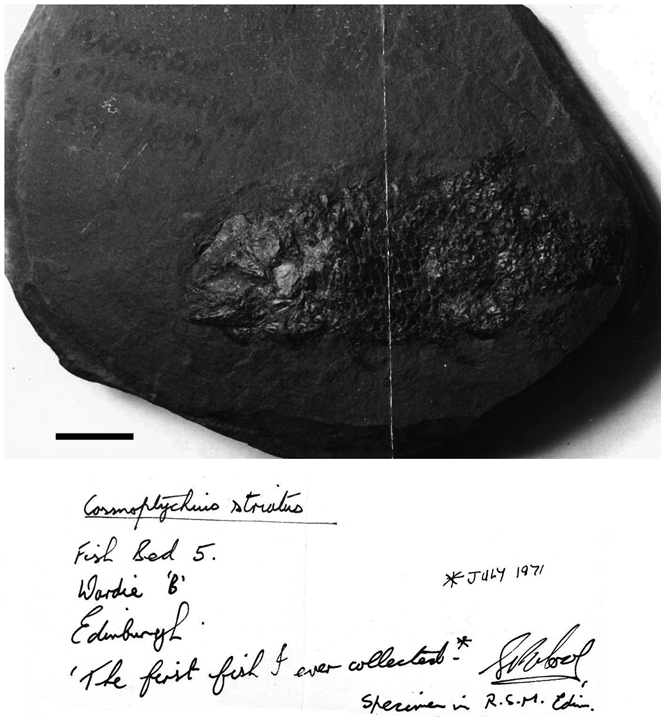
From the start of his investigations at Wardie in 1969, Stan showed the persistence and optimism that was to characterise his searches over the next 40 years. Although he was directed to Wardie by staff at the Royal Scottish Museum, now National Museums Scotland (NMS), he had not been schooled in what to look for. He therefore spent many fruitless months looking for fossils in the oil shales exposed on the foreshore. Undaunted by his lack of success, he eventually went back to the museum for further guidance. It was only then that he learned that the fossils are not preserved in the shale but in the ironstone concretions that erode out of the shale. Forearmed with this nugget of information, he experienced the joy of finding his first fossil (Fig. 1). In his memoir ‘A challenging Edinburgh fossil site' (Wood 1992), Stan recalls that it took him two years to find his first fossil fish at Wardie. As he put it, “At this demanding locality frustration should be considered but a prologue to elation: the more intense the former the more excessive the latter” (Wood 1992, p. 1). His experiences at Wardie had taught Stan an important lesson: do your homework. In the years that followed, he put this lesson to good effect again and again.
Stan's first fish, register number National Museum of Scotland Geology Catalogue, NMS G 1971.62.6. Originally identified as Cosmoptichius striatus; now recognised as Elonichthys robisoni. Scale bar = 10 mm.

By the mid-1970s, Stan was clear in his own mind that he wanted to make a career in palaeontology. He became self-employed in 1974 to complete the recovery of the Dora Bone Bed, but he was keen to find something more permanent. Fortunately, Dr Alec Panchen, at the University of Newcastle upon Tyne, successfully applied for a Natural Environment Research Council (NERC) grant to study the tetrapod fossils from Dora, and he hired Stan as his research technician for three years from 1976 to 1979.
During this time, Stan suggested to Alec that it might be useful to relocate the Early Carboniferous locality at Foulden, near Berwick upon Tweed, that had originally been discovered in 1910 by a young local collector, Thomas Middlemis Ovens. For two years, Ovens had collected at the site and accumulated an important collection of fishes that at the time were the oldest known from the UK Carboniferous. Ovens died in 1912, at the young age of 19 (Long 1959), and the precise location of the fossil site was lost. His collection was donated by his parents to the Natural History Museum, London, and the fishes were subsequently described by White (1927). Although the site had been officially scheduled in 1961, it still proved difficult for Stan to relocate the exact position of the Foulden Fish Bed within the large area designated for the Site of Special Scientific Interest (SSSI). White provided limited locality information, but it was enough to help Stan track down the fish bed.
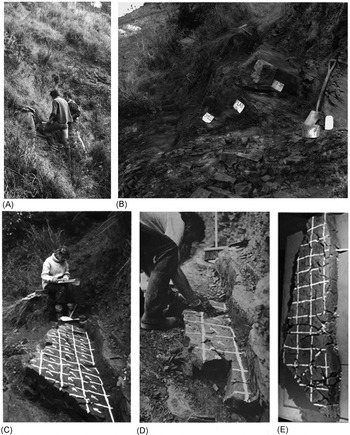
As John Dick remembered, “Stan used to drive like the wind”, so it is no surprise that in the spring of 1979 he had temporarily lost his driving licence, having clocked up too many speeding points. Undaunted, Stan would take his pick and shovel on the train from Edinburgh to Berwick on Tweed and then on the bus from Berwick to Foulden. He made the trip many times before eventually finding what he was looking for. This rediscovery eventually formed the basis of a multidisciplinary research project, by a team of specialists assembled by Dr Charles D. Waterston, which investigated the geology and palaeoecology of Foulden (Fig. 2) and undertook a detailed description of its fauna and flora (Wood & Rolfe 1985).
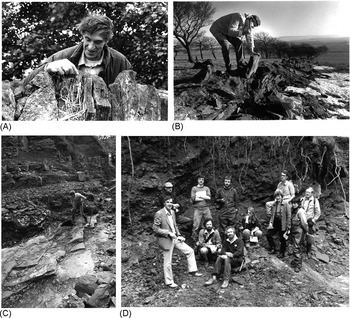
Stan at Foulden: (A) Stan with Ian Rolfe on site prior to the excavation; (B) overburden removed, fish bed (top), plant bed (middle) and shell bed (bottom) exposed; (C) Maggie Rowlands from the Nature Conservancy Council recording the fish bed; (D) Stan recovering the fish bed; (E) fish bed reassembled in the Hunterian Museum.

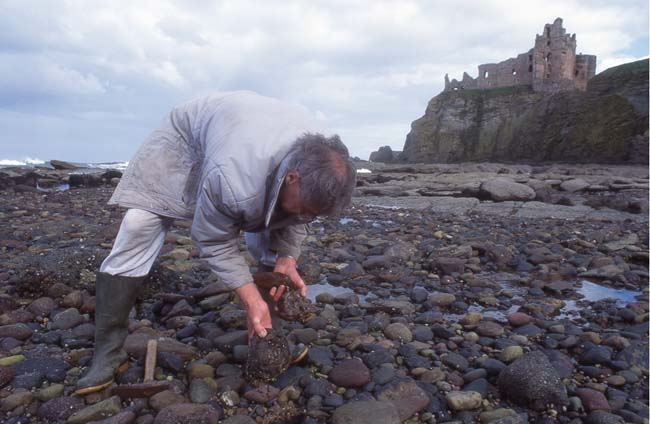
In the late 1990s, Stan was asked by National Museums Scotland to try to relocate a fossil bed in the early Carboniferous on the East Lothian coast near Tantallon Castle, east of North Berwick (Fig. 3). This was the second time the Museum had asked Stan to relocate a lost locality. The first time was in the early 1980s, during excitement of the discovery of the conodont animal in pieces of the Granton Shrimp Bed in the collection of the British Geological Survey, Edinburgh (Briggs et al. 1983). The exact location of the Shrimp Bed was not known; but with his encyclopaedic knowledge of the rocks on the Wardie foreshore, Stan was able to relocate it in an afternoon.
Stan on the foreshore below Tantallon Castle, 1999.

The original Tantallon material had been collected in the 1970s, and included a partial tetrapod jaw (Chen et al. 2018 [this volume]), but little was known about the site and there was no record of where the specimens had been collected. Armed with a sample of the very distinctive red conglomerate, he went in search. Matt Dale, who accompanied Stan on a couple of visits, explains:
“To get to where the fossil-bearing boulders could be reached, we had to wait for low tide, scramble down a steep grassy bank and walk around a headland to a small bay. There, we had to spend a couple of hours shifting a vast amount of heavy pebble shingle to one side to find the larger rocks underneath. Finds were loaded into rucksacks. By the time we finished we had to wade through deep water on slippery rocks to reach the bank. Getting back up the hill with the groaning rucksacks was far more difficult than the slippery descent. On the following day, the sea had shifted the shingle firmly back in place and the process started from scratch.”
2.2. A great curiosity
After spending two years looking in the wrong rocks at Wardie, Stan became a skilled researcher, following up leads and finding out as much about a locality as he could. He usually started with the geology, and over time developed an extensive collection of geological maps. He would then follow this up with anything that had been published on the palaeontology. In the days before the internet, he would call on the help of friends and colleagues to track down an obscure reference. As Maggie recalls:
“Stan read extensively about locations of interest, going right back to original papers and not relying on how others had interpreted them. His reading would include not just publications but minutes of local geological society meetings. He had a large library of papers at home”.
A report in the Scotsman newspaper on Thursday 13 December 1973, regarding plans to open an open-cast coal mine at Dora, on the outskirts of Cowdenbeath, Fife, provided Stan with his first opportunity to strike out and discover a completely new locality. His researches on the early Carboniferous fish fauna of Scotland had revealed that the Lochgelly Black Band Ironstone was a potential source of new fossils. From his study of the geological maps of the area, he discovered that the ironstone would be exposed at the new open-cast site and so, after gaining permission from the National Coal Board (NCB), in November 1974 he went looking. He found the ironstone and collected a number of fossils.
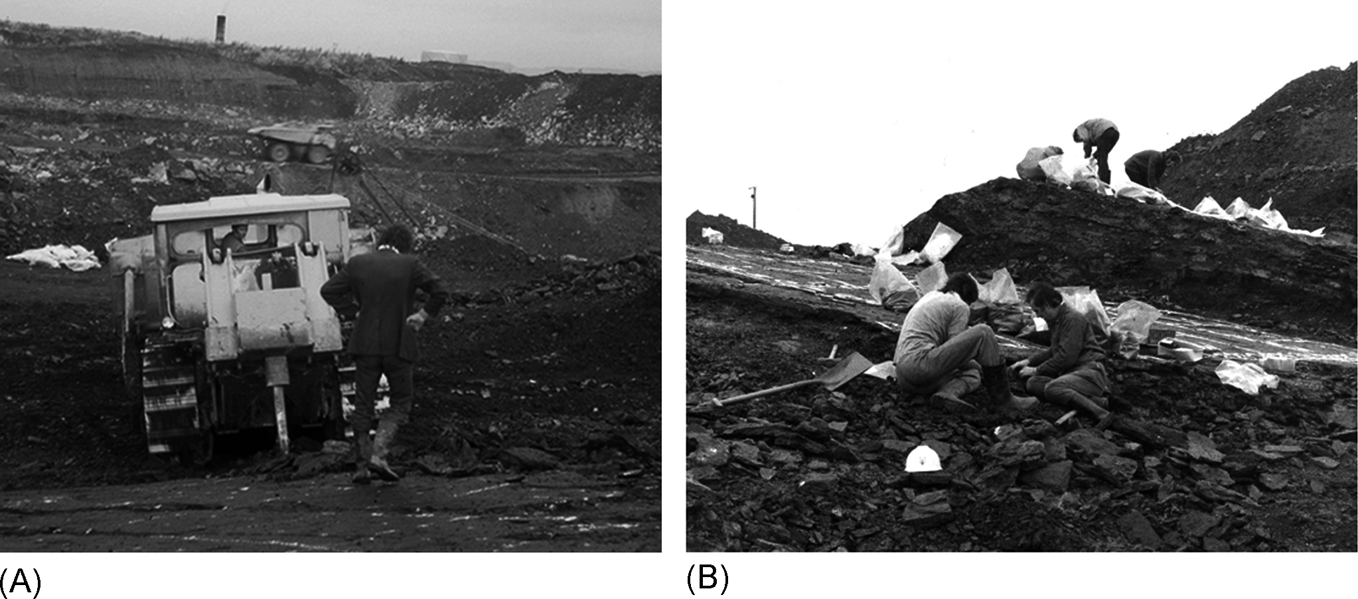
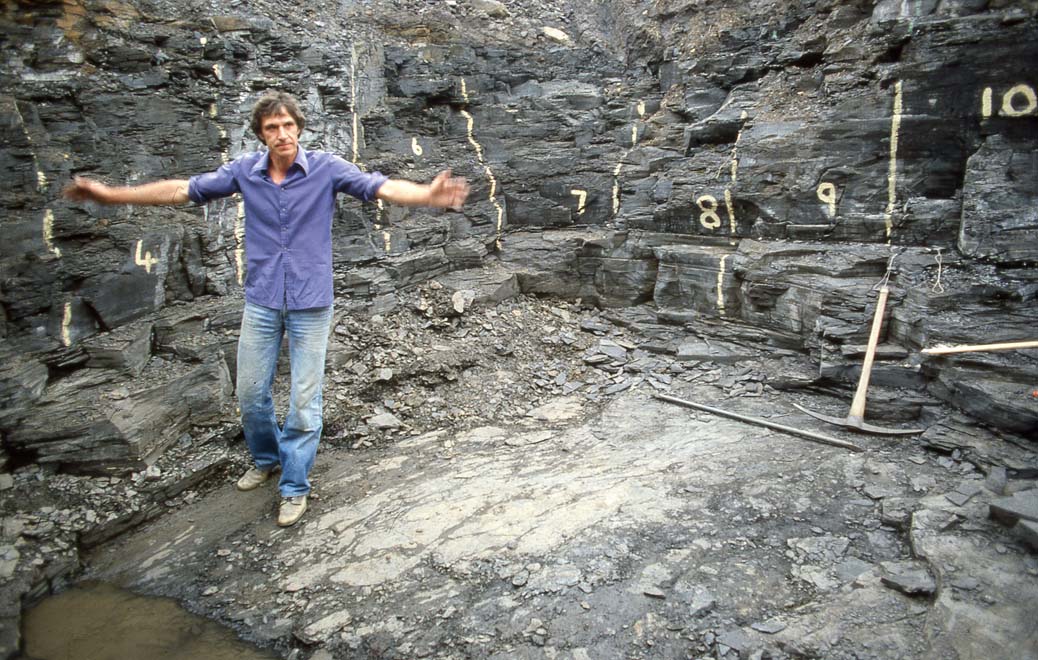
But his natural curiosity led him to discover a much bigger prize, the Dora Bone Bed. In the spoil removed to reveal the coal, Stan found tetrapod bones. These were purchased by the NMS and have register numbers beginning NMS G 1975.48. They were the first Carboniferous tetrapod fossils found in Scotland in nearly 100 years. Stan traced the bed from which they had come to a rock face in the site and, with the help of the contractors to the NCB, the Murphy Group, in the autumn of 1975 removed the overburden and exposed an area of some 600 m2 (Fig. 4). He gridded the exposed bed into 0.33 m squares and working largely on his own, lifted and bagged more than three tons of bone bed over a period of a few weeks (Andrews et al. 1977).
Stan at Dora: (A) supervising the clearance, October 1975; (B) foreground, collecting with Alec Panchen, 4 November 1975.

He was rewarded for all this hard effort with the discovery of the only articulated specimen recovered from the site, the skull and skeleton of the early tetrapod Crassigyrinus scoticus (Panchen 1985). This was one of the few specimens collected in situ at Dora and during the winter months 1975/76, Stan carefully prepared it. Recognising both its scientific value and its commercial value, he offered it to the NMS. At the time, senior staff were away so a decision was delayed. In Stan's eyes, the museum was dithering about the purchase so he offered it to the Natural History Museum in London instead. They snapped it up, met the asking price and registered the specimen R10000, the first large articulated Carboniferous tetrapod to be found in the UK since the discovery of the skeleton of Pholiderpeton scutigerum at Toftshaw, near Bradford, in 1869 (Huxley 1869; Clack 1987).
Stan's close liaison with the Murphy Group reveals another aspect of his character that probably played a big part in his success as a collector; his ability to enthuse others and get them involved in his ventures. Land owners, contractors such as the Murphy Group, and the local community, were nearly always involved at some stage in securing a successful outcome of a project. Furthermore, as Mike Coates observed:
“another key factor in his success was his consistent, ongoing, liaison with interested museum and university based researchers, from students to Profs”.
When Stan relocated to Selkirk in the Scottish Borders in 2006, he was curious to explore the early Carboniferous rocks close to his new home. The nearest were exposed in the hills and dales between Hawick and Newcastleton. Stan knew that fossils had been found in rocks of a similar age on the Berwickshire coast, but that at the time vertebrate fossils had not been found on the western side of the Borders. He began by exploring the Whitrope Burn. Although there are few exposures in the upper parts of the burn, Stan found tantalising scraps in the weathered stones and boulders in the bed of the river. This was good enough for Stan and he carried on looking.
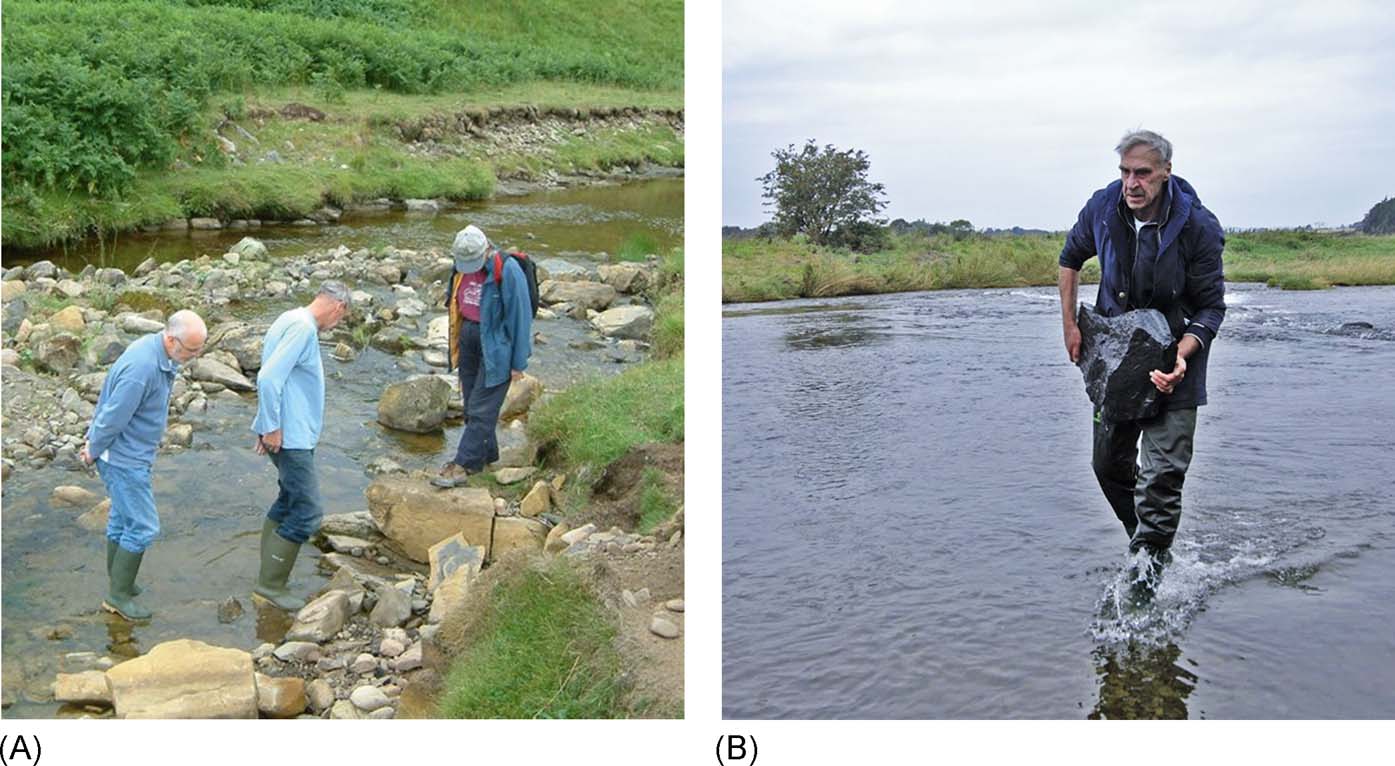
Eventually, in the lower reaches of the burn, before it joins Hermitage Water, he found in situ a bone bed rich in shark teeth. This important discovery now forms the basis of major study of early Carboniferous sharks led by Kelly Richards (Richards et al. 2018 [this volume]), but curiously, after showing the new locality to Jenny Clack and Tim Smithson in August 2006 (Fig. 11A), Stan never went back. Instead, he looked east and two years later was rewarded with the spectacular finds at Willie's Hole.
2.3. A seeing eye and a photographic memory
Stan was a keen observer. As Graham Durant noted, “he not only looked but he saw.” He saw things others had missed. At new localities he would spend a long time looking, walking, stopping, looking again, until he was satisfied he had a feel for the rocks. Maggie Wood suggested he had
“a photographic memory for certain things – maybe pattern recognition was one of his innate attributes. He remembered quite effortlessly the number and details of every engine he had ever [train] spotted. I actually tested him once using his spotter's notebook and he was 100 % accurate”.
Andy Jeram also suggested that Stan
“must have had an innate sense of statistical probability… Stan's eye for the anomalous and his understanding that if scratching the surface yielded something of moderate interest, then picking through a whole lot of dirt would produce the rare and exotic, gave him confidence to commit to prospects in a way that few other collectors have done. Although there may have been an element of serendipity about the discovery of some sites, Stan understood exactly what it was that gave each site potential, whether a history of previous finds, a preservational mode, or a distinctive facies; he knew when the odds were stacked in his favour”.
Maggie Wood also noted that his flair for statistical probability was put to use in other fields:
“namely, playing snooker and on the horses, though the latter was augmented by his betting system which he started after his OU course on statistics!”
On other occasions, Stan would spot something fleetingly, often out driving, and would stop to take a look. Perhaps the best example of this is the story told about the discovery of the East Kirkton material. While refereeing a football match at Bathgate, West Lothian, he spotted laminated rocks in the wall around the playing field. After the game he went for a closer look and was intrigued by what he saw (Fig. 5A). These rocks were like nothing he had seen before: they held the promise of something new. He found the same laminated rocks in other walls. Some of these walls were no longer being used as field boundaries and had begun to collapse. The individual stones had spilled out, so he split them and found fossils. His first finds were poor, with little detail, but one in particular looked promising. Although the bone was rotted, the specimen appeared to be bilaterally symmetrical and have orbits. At a push it looked like a small skull. Encouraged, Stan purchased the collapsing walls from the land owner and “mined” them for their fossils (Fig. 5B) (Wood speaking on Science Now in 1992; BBC 1992). And what a trove. These specimens, including tetrapods, scorpions, myriapods and a harvestman, formed the basis of Stan's announcement of the discovery in Nature in 1985 (Wood et al. 1985).
Stan at East Kirkton: (A) Stan at a wall in the Bathgate Hills, spring 1989; (B) Stan exploring a wall in the Bathgate Hills, winter 1985; (C) Stan at East Kirkton Quarry, summer 1985; (D) initial on-site meeting at East Kirkton Quarry, summer 1985. Left to right: Stan Wood; unknown; John Cater; Andrew Milner (squatting); Tim Smithson; Euan Clarkson (sitting); Maggie Rowlands (squatting); Mahala Andrews; Ian Rolfe; Jenny Clack; Norman Butcher.

With the help of colleagues from the Hunterian Museum, he was able to trace the wall stones to their origin in the East Kirkton Quarry. Fortunately, the quarry was still open, unlike its contemporary, the West Kirkton Quarry, that had been filled in. Although greatly overgrown, it held the promise of many more fossils to come. Following negotiations with the quarry owner, West Lothian District Council, and assistance from the Nature Conservancy Council, in summer 1985 the site was cleared and fenced off and a major excavation at the quarry began (Fig. 5C, D). Stan worked at the quarry for the next five years and made some spectacular discoveries (Figs 6, 7).
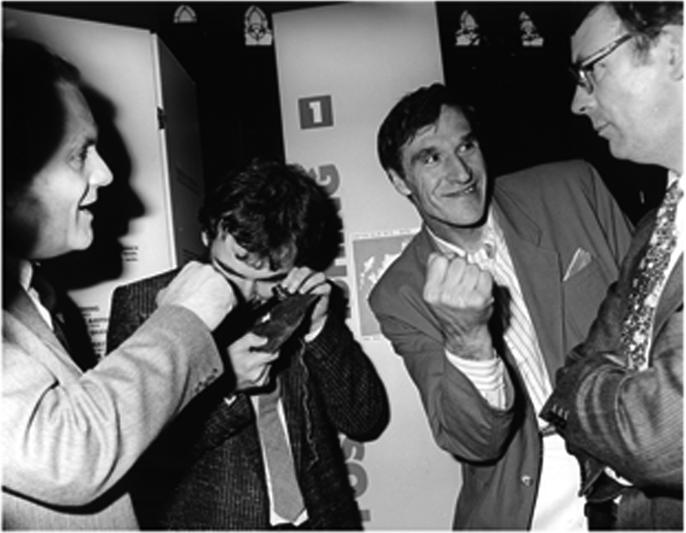
Stan receiving good news about a specimen at the opening of Mr Wood's Fossils exhibition, 29 April 1986. Left to right: Alec Panchen; Tim Smithson; Stan Wood; Ian Rolfe.

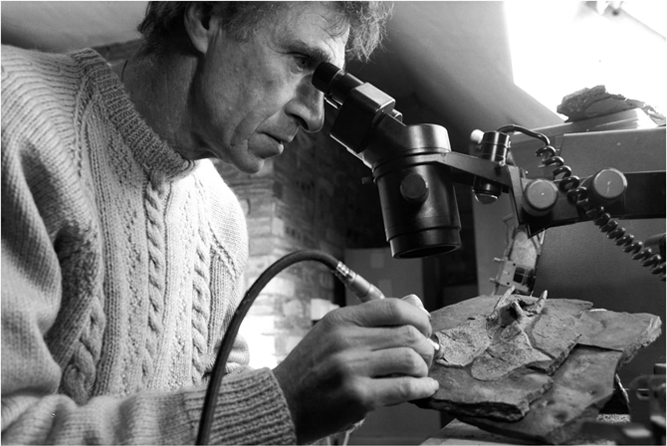
Stan preparing a large tetrapod pelvis from East Kirkton Quarry.

A research team was assembled in 1987 by Ian Rolfe to work on the site and, subsequently, on the resultant collection and in 1992, they presented their results at an international conference in Edinburgh (Rolfe et al. 1994). Stan demonstrated to Sir David Attenborough how he went about finding fossils at the quarry in the first episode of the documentary series Lost Worlds, Vanished Lives (BBC 1989). After lifting a slab of rock from the quarry floor Stan drew attention to a very thin trace of bone in cross-section. Following a few judicious strikes with a hammer and chisel, and to the genuine amazement of the presenter, this was revealed to be the skull of the temnospondyl Balanerpeton. It pays tribute to Stan's intimate knowledge of that difficult material.
2.4. Hard physical work
Stan seemed to enjoy the hard work that went with most of his fossil collecting. He was tough and physically very strong. He would put in long days lifting and bagging, as he did at Dora, Bearsden and East Kirkton, or removing the shingle at Tantallon and Burnmouth. As Emma Durie, Stan's daughter, recalled:
“he would frequently come home utterly exhausted from day upon day of hard manual labour”.
Stan began his exploration of Willie's Hole when he was approaching his 70th birthday. He recovered bulk samples of matrix from the bed of Whiteadder Water, carried them to the bank (Fig 10B) and then hauled them up to his car. It was very hard work. Stan was a tall man with big feet and wore big Wellington boots, but there were times when the water was just too deep. Most of us would have given up at that point, but not Stan. Off came the wellies, off came the trousers and Stan continued to recover his precious fossils in his briefs. Eventually, Maggie bought him a pair of waders (much to the relief, no doubt, of the local farmers and fishermen!) For Stan, collecting fossils was not something you did in the summer. It was an all year-round occupation. Specimens from Broomhouse, another site he visited along Whiteadder Water, have field labels showing they were collected on 5th January 2009.
2.5. Inventive and unorthodox
Stan was a great problem solver and he rarely let things get in the way of finding fossils. As Mike Coates observed he had a
“healthy disrespect for authority, at least in terms of received wisdom (e.g., Wood 1988). Hence his determination to persist in supposedly worked-out sites or to search where he was told professionals had searched and declared barren”.
But alongside his collecting, Stan was also a patient and innovative preparator. In the late 1960s, the Wardie foreshore was not a salubrious place to be. Raw sewage from Edinburgh was pumped into the Forth at Wardie, making collecting there both unpleasant and hazardous. On returning home with the catch of the day, Stan would use the household utensils to boil the nodules to ensure they were safe to handle. This did not go down well at home. As Emma explains:
“after many months of [him] using her pots and pans, Mum became completely exasperated with Dad and concluded that she could no longer hygienically cook using them, hence Dad being given his own set! Mum recalls being envious of other housewives whose kitchen sinks remained spotless or merely held a tea cup, whereas ours would consistently contain rocks and sediment”.
Not only did boiling sterilise the nodules, Stan discovered that they opened more easily. He experimented with hot water again when preparing the heavily ornamented Gyracanthus spines from Dora and found that after boiling them, the matrix could easily be removed with a mounted needle. He also brought his experience of working the Wardie nodules to the preparation of the tough concretions from Gogo in Western Australia to extract the Upper Devonian crustaceans, when employed at the Hunterian Museum. He eschewed the previous time-consuming vibrotool chipping in favour of the bold further breaking and reassembling. This initially startling approach yielded rapid results, freeing Stan to take on extra assignments at the Museum.
2.6. Risk taker and entrepreneur
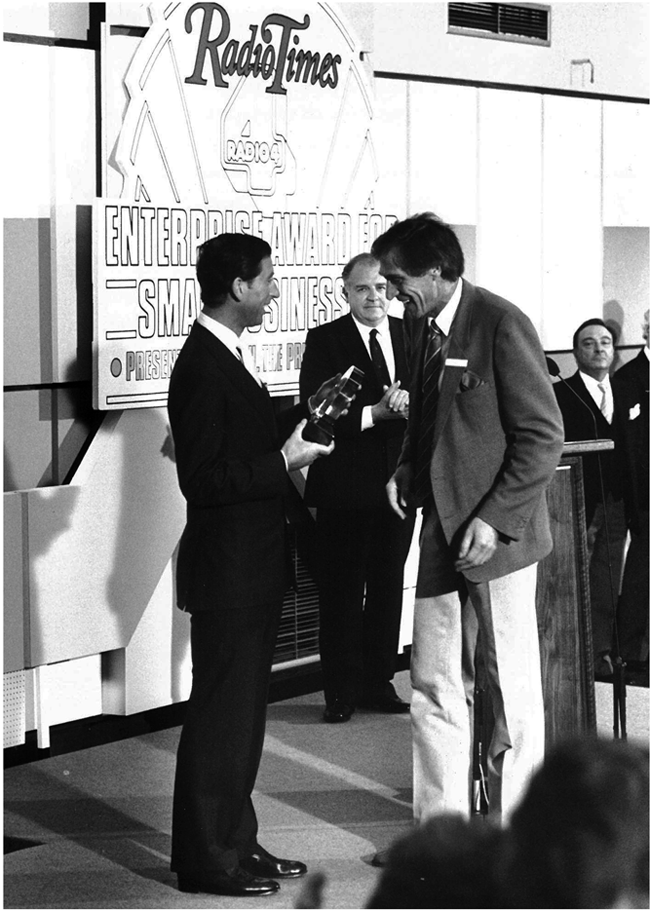
Stan was a canny businessman. As part of the terms of his employment at the Hunterian Museum from 1979 to 1981, funded by the Manpower Services Commission, Stan was required to attend a course run by the Scottish Business School at the University of Glasgow. The expectation was that Stan would then set up his own small business. He established Mr Wood's Fossils in 1983 and in 1986, Mr Wood's Fossils was nominated for the BBC Enterprise Awards for Small Business. In this UK competition Stan came fourth (Fig. 8).
Stan receiving a BBC Enterprise Award presented by HRH Prince Charles, 25 June 1986.

Mr Woods Fossils was a big success, and over the years the business made substantial sums from the sale of fossils. The profits were reinvested in further prospecting. Perhaps the best example of this is the excavation of Mumbie Quarry. As he learned about the diversity of early Carboniferous fishes, particularly through the writings of Ramsay Heatley Traquair, Stan became fascinated by what had been discovered at Glencartholm, on the River Esk in Dumfries and Galloway.
The site was originally discovered in 1879 by Arthur Macconochie, collector for the Geological Survey, and it yielded a great variety of beautifully preserved fish. It is described by Dineley (1999) as “one of the most important Palaeozoic fossil fish sites in the world… and has produced some of the finest specimens of fossil fishes in the Carboniferous. The fauna is remarkable because of the number of complete fishes discovered, and the variety of forms, over 30 species, which are contained within the assemblage.” Further collecting in the 1930s by Moy-Thomas, using explosives, was thought to have worked out the exposure (Lumsden et al. 1967, p. 116) but, on a visit to the site in 1974, Stan relocated the beds. As Schram (1983, p. 3) notes “exploration of the east bank of the Esk by Mr S. Wood of the Hunterian Museum revealed a very fossiliferous site some 20 paces north of the classic locality”. Stan therefore sought permission to collect.
The site is an SSSI and permission to undertake a major excavation was refused. After exploring the area and applying all his geological skills, Stan predicted that the fossiliferous beds were not limited to the exposures in the bank of the river, but could be uncovered elsewhere. He planned to undertake a major excavation beside the original exposure, in a heavily wooded area on the east side of the river. This time, permission was refused by the factor of the land owner, the Duke of Buccleuch. Eventually, in the early 1990s, a new factor did give permission and Stan began a major excavation in 1994. Entirely self-funded, he arranged for the land on Mumbie Banks to be cleared of trees, overburden removed and a large quarry opened (Fig. 9).
Stan photographing the section at Mumbie quarry, summer 1995.

As Stan had predicted, he found the continuation of the Glencartholm fossil beds and then spent three summers, working mainly on his own, recording the geology, logging the section and collecting fossils. He systematically retrieved a large collection of fishes, crustaceans and other invertebrates, carefully noting their location in the succession. Sadly, this excavation never produced a Eureka moment that had characterised so many of his previous enterprises. He recovered more specimens of what had been found before and although the shark fossils and horseshoe crabs were quickly bought by the NMS, the rest of the collection languished in boxes for 15 years in the basement of his shop in the Grassmarket in Edinburgh. It wasn't until the last few months of his life that he returned to the collection, cataloguing and preparing the specimens with an energy that astonished his carers (Wood 2018 (this volume)).
2.7. A scientific method
Stan approached his field work with the assurance of a seasoned scientist. He maintained detailed records of where specimens had been found, prepared measured sections of his sites, and related his findings to the broader geology of the area. It is evident from his early work at Wardie (Wood 1975) that analysis of the records he kept allowed him to draw conclusions from his observations and contribute to the bigger picture. Mike Coates suggested that it might have been his “interest in archaeology that drove him to be rather more organised than many vertebrate palaeontology colleagues”.
At his biggest excavations at Dora and Bearsden, the exposures were gridded to allow the spatial relationship between areas to be recorded. This was particularly important at Dora, where individual fossils were not normally excavated in situ, but the entire bone bed was lifted and taken off site and studied a few years later. But the gridding allowed a partial skeleton of the tetrapod Eoherpeton, which had been scattered over an area of some 12 square metres, to be assembled with confidence (Smithson 1985). At Bearsden, gridding enabled Stan to record the discovery of finds very accurately. As Mike Coates noted:
“his Bearsden day-book makes it possible to locate [each] specimen to the date, time of day, and grid square (a good example being the complete Deltoptychius) – evidence of his dogged attention to detail.”
Stan also gridded the excavation at Foulden. This allowed the entire section to be reassembled back at the Hunterian Museum (Fig. 2C–E).
When Stan decided to become a full-time palaeontologist in 1975, he also enrolled onto a science degree programme with the Open University, majoring in Geology. Paul Selden recalls:
“I first met him when he was an OU student, at a summer school for S23 Geology in Durham in the late 70s. He was in my lab, and cut a dramatic figure, with Elvis hairdo, drainpipe jeans, bootlace tie and frock jacket. These, with the strong accent and genial personality, made him a hit with the other students. Someone got him to do an impromptu talk about his fossil finds which, at the time, were mostly Carboniferous spiny sharks. The most memorable part of this was when he described the forked spine of one species as resembling a “Harvey Smith salute”.
Stan was a magpie when it came to useful knowledge. He would draw on all sorts of different information to help him plan a collecting campaign. His development of a site was not small scale; if he was digging a hole in the ground it was always a big one. This was not just to increase the likelihood of finding fossils, but based on simple ecological principles: animals at the top of a food chain, the largest predators, are rare. So, the bigger the exposure the greater the chance there is of finding the rare stuff.
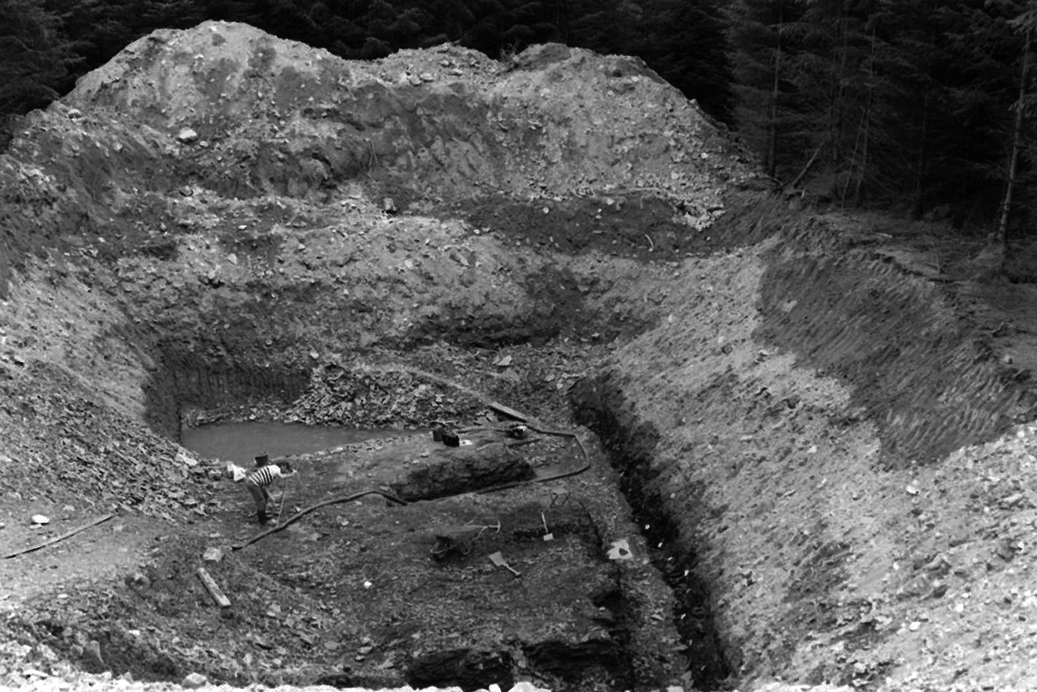
He first tested this idea at the Manse Burn site, Bearsden, Glasgow. The quarry that he opened (Fig. 10) drew in the crowds and Stan was rewarded with the spectacular Bearsden shark Akmonistion (Coates & Sequiera 2001) and the first complete specimen of the holocephalan Deltoptychius (Dick et al. 1986), alongside the much smaller shrimps and bony fishes (Wood 1982, 1983). Stan's discoveries at Bearsden were celebrated in the BBC1 Scotland documentary Stan, Stan the Fossils Man (BBC 1983). Stan did not enjoy the filming. The waiting around between shots and the numerous takes kept him from what he wanted to do: finding fossils (Fig. 11).
Stan at Bearsden, 31 July 1982.

Stan in the Scottish Borders: (A) at Whitrope Burn with Tim Smithson (left) and Jenny Clack (right), 4 August 2006; (B) at Willie's Hole, 2009.

Stan was an accomplished and confident field geologist and enjoyed the challenge of relocating important horizons such as the Granton Shrimp Bed, the Cheese Bay Shrimp Bed and the Tantallon fossil bed. Tim Smithson introduced Stan to Burnmouth, on the Berwickshire coast, in 2006. They explored the exposures together for a number of years and have fossil beds informally named after them. At the time, Tim was working in Bristol and was only able to visit the Borders a couple of times a year. Therefore, in December 2007, he asked Stan to investigate other potential localities in the Tweed Basin. Armed with Tim's notes and references, the following spring Stan undertook a thorough search of a number of sites along Whiteadder Water. He reported back on 18th April 2008, having explored: Crumble Edge; Kilnick Plantation; East Balerne Farm; Chirnside Bridge; Steeple Haugh; and Willie's Hole.
Although little was found at five of the sites, Willie's Hole more than made up for it. Stan recognised its significance straight away. Describing the different fossil beds and some of the fossils he found there he noted:
“here, we have been very lucky and two beautiful little fishes are in the bag. Separate genera are easily confirmed from the state of almost perfect preservation. One is “Bull nosed” type, the other is much more elongate in head type. The latter is naked, the former not. Both occur at Foulden, but not in this fine form!”
He was reticent about identifying any of his new material as tetrapod, despite his knowledge from Dora and East Kirkton, suggesting that one of his early finds
“has to be some sort of rhizodont or something new between that and amphib. stock. But rhizodonts have long lepidotrichia, this doesn't?”
This specimen was ‘Ribbo' and the first of many tetrapod fossils Stan found at Willie's Hole (Fig. 11B) subsequently acquired by National Museums Scotland and the University Museum of Zoology, Cambridge. He concluded his report with something of an understatement: “All in all a damned good find for our net.”
3. Conclusions
Stan had no formal training as a collector. He never went into the field in his early days with experienced palaeontologists to be shown the ropes. He appears to have been entirely self-taught. He had a highly developed natural curiosity, was very observant, and didn't give up. He was tough and very strong and enjoyed the hard, physical work of collecting. Stan was congenial, unorthodox, and a risk taker. He asked questions and tested hypotheses. He kept detailed records and shared his discoveries. He became a scientist (Fig. 12).
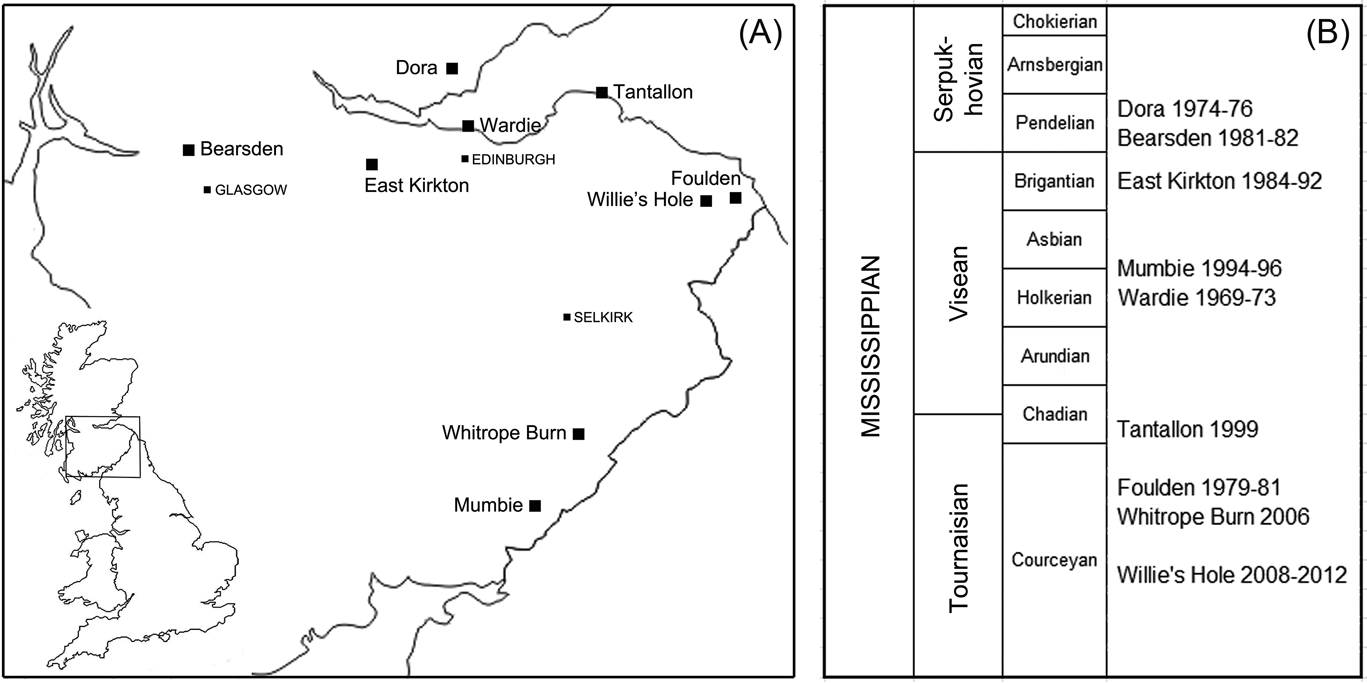
(A) Map of southern half of Scotland showing Stan's key sites. (B) Sites placed in geological column according to age.

But perhaps in the end, the reason for Stan's success is much simpler than this. As Emma says:
“Mum feels that a large part of Dad's determination came from being forced to leave school at 15 by his father, and it was almost as if he never wanted to waste a moment to expand his horizons.”
4. Acknowledgements
We thank Nick Fraser and organisers of the Symposium of Vertebrate Palaeontology and Comparative Anatomy held in Edinburgh in 2013 for the invitation to contribute to the Stan Wood Symposium. We are very grateful to the family (Mary and Maggie Wood, daughter Emma Durie), and to the friends and colleagues of Stan who responded so generously to our request for their insight into his extraordinary talent for finding fossils: Matt Dale, the proprietor of Mr Wood's Fossils; Mike Coates; John Dick; Graham Durant; Andy Jeram; and Paul Selden. We thank Marius Alexander, Robert Clack, Graham Gauld, Andrew Milner, Glyn Satterley, Murrie Thomson, Maggie Wood, the Hunterian Museum and the BBC for permission to reproduce the photographs. Neil Clark kindly scanned the photographs held at the Hunterian Museum and Kelly Richards helpfully converted numerous 2×2 transparencies into digital images. We thank Mike Coates, Kelly Richards and Maggie Wood for reading and commenting on early drafts of the manuscript and Nick Fraser and Andy Ross for their constructive reviews of the paper.