Background
Obesity is a major public health problem, with at least 20 million overweight children under the age of 5 years and 1.6 billion overweight adults globally in 2005. 1 Although obesity has traditionally been considered a problem of high-income countries, it is now being recorded at increased levels across high-, middle- and low-income countries.Reference Hill, Peters, Catenacci and Wyatt 2
Obesity increases the risk of coronary heart disease, the metabolic syndrome, some cancers, stroke, liver and gallbladder disease, sleep apnoea and respiratory problems, osteoarthritis and gynaecological problems. 3 Intervention programmes have traditionally targeted the individual at the onset of disease-precursors; however, the principles underlying the Developmental Origins of Health and Disease suggest that there may be critical windows earlier in the developmental continuum (including pregnancy, infancy and childhood) that may offer greater opportunities for obesity prevention.Reference Field 4 , Reference Newnham, Pennell, Lye, Rampono and Challis 5
The discovery of the fat mass and obesity-associated (FTO) gene is a notable success story from the recent explosion in knowledge resulting from genome-wide association studies (GWAS). In 2007, Frayling et al.Reference Frayling, Timpson and Weedon 6 identified a common variant in the FTO gene (rs9939609) that predisposes to diabetes through an effect on body mass index (BMI). The results were initially replicated in 13 cohorts with 38,759 participants and further replicated by Dina et al.Reference Dina, Meyre, Gallina and Durand 7 and Scuteri et al.Reference Scuteri, Sanna and Chen 8 Since these initial reports, there have been eight published GWAS replicating the association of FTO and obesity, utilising more than 178,144 samples with replication in a further 193,437 samples.Reference Hindorff, Junkins, Mehta and Manolio 9 Adults of European-descent homozygous for the minor (A) allele of rs9939609, the most consistently and strongly associated FTO single nucleotide polymorphism (SNP), weigh on average 3–4 kg more, and have a 1.67-fold increase in the odds of obesity compared with those not inheriting a risk allele.Reference Bouchard 10 The population-attributable risks for FTO have been estimated for overweight and obesity in European populations to be 13% and 20%, respectively.Reference Bouchard 10 FTO variants have been reported to be associated with BMI from age 7Reference Frayling, Timpson and Weedon 6 , Reference Bouchard 10 – Reference Haworth, Carnell and Meaburn 12 years to late adult life.Reference Frayling, Timpson and Weedon 6 – Reference Scuteri, Sanna and Chen 8 , Reference Jess, Zimmermann and Kring 13 One small study of 2-week neonates suggested a role for FTO in early stages of fat accretion in humans;Reference Lopez-Bermejo, Petry and Diaz 14 however, previous studies have failed to detect an association between FTO and birth weight,Reference Frayling, Timpson and Weedon 6 and the association of FTO gene variants with foetal growth is unknown. However, foetal growth is strongly associated with the maternal environment and complications of pregnancy such as diabetes, hypertension and anaemia, in addition to lifestyle choices such as alcohol intake and smoking status, have the potential to mask smaller genetic associations.
The primary aim of this study was to investigate the gene × environment interaction between the rs9939609 SNP and maternal smoking with foetal growth in the Western Australian Pregnancy (Raine) cohort.Reference Newnham, Evans, Michael, Stanley and Landau 15 Replication analyses were performed in the Generation R Pregnancy cohort.Reference Hofman, Jaddoe and Mackenbach 16 , Reference Jaddoe, Mackenbach and Moll 17
Methods
Western australian pregnancy (Raine) cohort
Recruitment of the Western Australian Pregnancy (Raine) cohort has previously been described in detail.Reference Newnham, Evans, Michael, Stanley and Landau 15 , Reference Williams, Evans and Newnham 18 , Reference Evans, Newnham, MacDonald and Hall 19 In brief, between 1989 and 1991, 2900 pregnant women were recruited before 18-week gestation into a randomised controlled trial to evaluate the effects of repeated ultrasound in pregnancy. Recruitment predominantly took place at the King Edward Memorial Hospital (Perth, Western Australia). Women were randomised to repeat ultrasound measurements at 18, 24, 28, 34 and 38 weeks of gestation or to a single routine ultrasound assessment at 18 weeks. Children have been comprehensively phenotyped from birth to 18 years of age by trained members of the Raine research team. DNA was collected at the year-14 follow-up, in addition to data on dietary intake from food frequency questionnaire and frequency and duration of exercise undertaken outside school hours. Month and year of the first menstrual period for girls were recorded. The study was conducted with appropriate institutional ethics approval, and written informed consent was obtained from all the participants. The cohort has been shown to be representative of the population presenting to the antenatal tertiary referral centre in Western Australia.Reference Newnham, Evans, Michael, Stanley and Landau 15
Generation R cohort
Recruitment of the Generation R cohort has previously been described in detail.Reference Hofman, Jaddoe and Mackenbach 16 , Reference Jaddoe, Mackenbach and Moll 17 , Reference Jaddoe, Bakker and van Duijn 20 , Reference Jaddoe, van Duijn and van der Heijden 21 In brief, following the local ethics board's approval, 9778 mothers with a delivery date between April 2002 and January 2006 were recruited from two hospitals, eight midwifery practices and 16 child health centres in Rotterdam (the Netherlands) to identify early environmental and genetic causes of normal and abnormal growth, development and health. The study was conducted with appropriate institutional ethics approval, and written informed consent was obtained from all participants. Repeat ultrasound measurements were made at 12, 20 and 30 weeks of gestation. Children have been assessed up to 4 years of age at routine child health centres, and thereafter at two research centres. The cohort has been shown to be representative of the antenatal population in Rotterdam.Reference Jaddoe, Mackenbach and Moll 17
Ultrasound assessment in both cohorts
In both cohorts, gestational age (GA) was based on the date of the last menstrual period unless there was discordance with ultrasound biometry at the dating scan.Reference Jaddoe, Mackenbach and Moll 17 , Reference Evans, Newnham, MacDonald and Hall 19 Maternal and paternal characteristics and breast-feeding duration were self-reported by questionnaire. Research midwives recorded concurrent maternal medical conditions during pregnancy. Ultrasound biometry including foetal head circumference (HC), abdominal circumference (AC), femur length (FL) and umbilico-placental and utero-placental Doppler flow velocity waveforms were measured in triplicate using standard techniques. Estimated foetal weight (EFW) was calculated based on the formula by Hadlock et al.Reference Hadlock, Harrist, Carpenter, Deter and Park 22 Umbilico-placental function was assessed by a single obstetrician and classed as ‘normal’ (systolic/diastolic ratio less than 95th percentile for GA) or ‘impaired’ (systolic/diastolic ratio greater than 95th percentile or absent or reverse end diastolic flow).
Genotyping
DNA was extracted from 5 ml samples of EDTA-anticoagulated blood using a Puregene DNA isolation kit based on a simple salting out technique.Reference Miller, Dykes and Polesky 23 The rs9939609 SNP was genotyped using the tetra-primer Amplification Refractory Mutation System (ARMS) polymerase chain reaction (PCR). PCR reactions for rs9939609 were carried out in a total volume of 20 μl, containing 20 ng of template DNA, a final concentration of 0.4 pmol of both primers, 200 μM dNTP, 3.0 mM MgCl2 and 0.4 U AmpliTaq Gold® DNA Polymerase. All reactions were incubated for 10 min at 95°C, followed by 35 cycles of 45 s denaturation (95°C), 1 min annealing (60°C) and 1 min extension (72°C) and an additional 7 min extension at 72°C at the end of the 35 cycles.
Statistical analysis
Linear mixed effects modelsReference Laird and Ware 24 were used for the longitudinal analysis of ultrasound biometry, including intercept and GA as random effects. Sex and maternal smoking were included as binary covariates. The rs9939609 genotype was included as a categorical covariate (TT = 0, TA = 1, AA = 2) and analysed under a codominant model. Consistent with previous statistical research in the Raine cohort,Reference Gurrin, Blake, Evans and Newnham 25 ultrasound measurements were power transformed (HC0.5, AC0.4, FL0.7, log10EFW) before the analysis to ensure homoscedastic residuals. P-values and 95% confidence intervals were calculated using the Monte Carlo Markov Chain methods (100,000 simulations), which is conservative compared with the likelihood ratio test.
Cross-sectional analyses of birth anthropometrics, percentage change in weight (loge transformed) and height from birth to 1 year of age, in addition to BMI at age 14 years stratified by sex and maternal pregnancy weight gain between gestation weeks 16 and 34 in the Raine cohort alone, were performed using multivariate linear regression.
All continuous covariates were mean-centered to minimise potential correlations between model coefficients. Parity and breast-feeding duration were coded as ordered categorical variables. Covariates were selected for multivariate models using both forwards and backwards stepwise procedures. Potential covariates included: maternal and paternal age, height, weight and BMI; maternal smoking indicator (at any time during the pregnancy); socioeconomic status; mother's parity; placental weight and function; GA at birth and sex. Dietary intake, exercise and puberty variables were included in the BMI analysis at 14 years of age.
All analyses were performed using the statistical graphics software R version 2.6.2. 26 No corrections were made for multiple testing because of the highly correlated nature of the outcome measurements. Clinical relevance was determined by consistency of effect size and direction.
Results
Analyses were based on 1079 Raine and 3512 Generation R children who met the criteria of Caucasian, unrelated, singleton birth, with no congenital disorders and available FTO genotype. The minor allele frequencies for rs9939609 in the Raine (A = 0.39) and Generation R (A = 0.39) cohorts were similar to those quoted in HapMapReference Frazer, Ballinger and Cox 27 (CEU: A = 0.45).
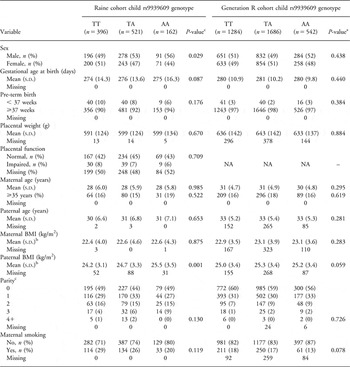
Table 1 demonstrates the similarity in the distribution of obstetric, maternal and paternal characteristics across rs9939609 genotypes in both cohorts. No clinically important differences were seen between the cohorts, with the exception of maternal smoking and small differences in maternal and paternal age. Both the proportion of mothers smoking and the quantity of cigarettes consumed during pregnancy were lower in the contemporary Generation R cohort. Non-smoking mothers were on average slightly higher educated with higher socioeconomic status. For the index pregnancy, the Generation R parents were, on average, 3 years older than the parents in the Raine cohort. Placental weight was not associated with rs9939609 genotype; however, placental weights were reduced in smoking mothers (P = 0.04). In the Raine cohort, the average (standard deviation) placental weight was 600 g (126 g) in non-smoking mothers and 582 g (123 g) in smoking mothers.
Obstetric, maternal and paternal characteristics in the Raine and Generation R cohorts
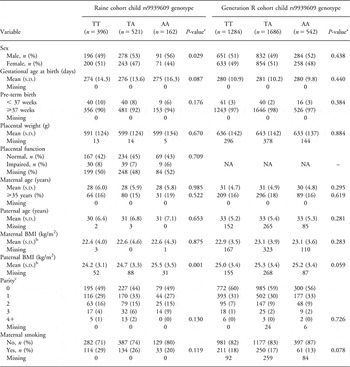
BMI, body mass index; NA, not available.
aUnivariate analysis of variance or Chi-square.
bMaternal/paternal weight pre-pregnancy recalled at 18 weeks gestation. BMI derived from recalled weight.
cParity assessed at time of recruitment (pregnancy).
Foetal growth trajectories
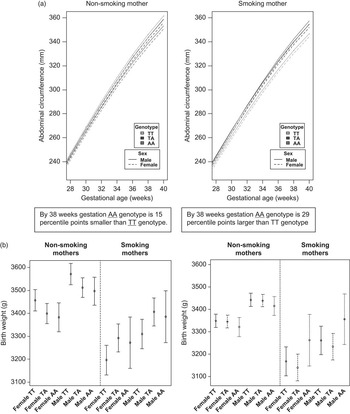
Figure 1a graphically presents the results of the longitudinal analyses of AC in the Raine cohort. Similar analyses for HC, FL and EFW are shown in the Supplementary Appendix. There was no evidence of any difference in the growth trajectories between foetal gender and rs9939609 genotype up to 28-week gestation. Consistent with this finding, in the Generation R cohort there was no significant association between rs9939609 genotype and foetal growth up to the final antenatal ultrasound measurement at 30-week gestation; AC (P = 0.34), HC (P = 0.87) and FL (P = 0.71). However, after 28-week gestation, the rs9939609 AA genotype was associated with foetal growth restriction in non-smoking Raine mothers, an association, which was reversed in mothers who smoked during pregnancy. The estimated effect, although small, accumulated over time and was modified consistently by maternal smoking for AC (P = 0.007), HC (P = 0.007), FL (P = 0.017) and EFW (P = 0.001; displayed in Supplementary Appendix). No association was detected between the rs9939609 AA genotype and the ratio HC/AC, suggesting that the growth restriction was symmetric. Similar, but smaller, effects were observed for the rs9939609 TA genotype, indicating that this association may be a dose–response relationship and dependent upon the number of A obesity-risk alleles of the foetus.
(a) Longitudinal association of rs9939609 genotype (codominant model) and maternal smoking with foetal growth in the Raine cohort. (b) Cross-sectional association of rs9939609 genotype (codominant model) and maternal smoking with birth weight in the Raine (left) and Generation R (right) cohorts.

Birth anthropometry
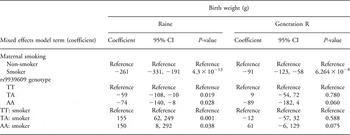
Table 2 and Fig. 1b display the abridged results of the cross-sectional analysis of birth weight in the Raine and Generation R cohorts. All Raine birth anthropometric results, with the exception of ponderal index, demonstrated a consistent association with the rs9939609 AA genotype, which was modified by maternal smoking during pregnancy. The AA genotype was associated with smaller stature and smaller skinfold thickness in infants from non-smoking mothers; however, this relationship was reversed in infants from smoking mothers. The analysis of measurements taken at birth for HC, AC, chest circumference, foot length and all skinfold thicknesses reached only marginal levels of statistical significance; in all cases either the effect size was smaller in magnitude or the underlying data had greater variability. Ponderal index at birth was not associated with rs9939609 genotype. In the Generation R cohort, the association between the interaction of rs9939609 AA genotype and maternal smoking with birth weight tended towards significance (P = 0.075); the size and direction of effect observed in this interaction was consistent with that seen in the Raine cohort. A similar effect was observed for the rs9939609 TA genotype in the Raine cohort, but this was not consistently replicated in the Generation R cohort.
Abridged results: cross-sectional analyses of association between rs9939609 and birth anthropometry in the Raine and Generation R Cohorts
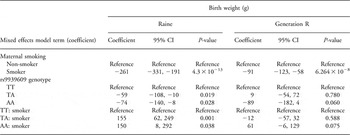
CI, confidence interval; NS, no significant (P > 0.05) association between covariate and birth weight.
Analyses adjusted for parity from time of recruitment, foetal sex and centred gestational age and placental weight. Adjusted R 2: Raine: 0.701; Generation R: 0.560.
Postnatal growth
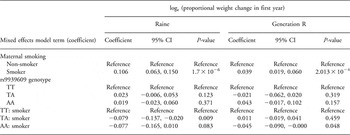
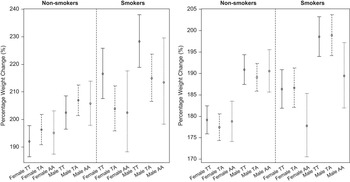
Table 3 and Fig. 2 display the abridged results of the analysis of proportional change in weight from birth to 1 year of age. The loss of restriction from the intrauterine environment had a marked effect on growth. A trend was observed over the first year of life in infants with the rs9939609 AA genotype; proportional change in weight was greatest in those infants from non-smoking mothers. A similar effect was not observed in proportional change in height over the first year. A similar effect was observed for the rs9939609 TA genotype in the Raine cohort, but this was not consistently replicated in the Generation R cohort.
Abridged results: cross-sectional analyses of association between rs9939609 and growth over the first year in the Raine and Generation R cohorts
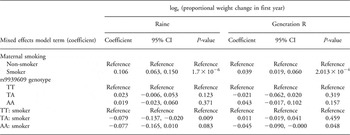
CI, confidence interval; NS, no significant (P > 0.05) association between covariate and postnatal weight change 0–1 year.
Analyses adjusted for parity from time of recruitment, foetal sex, duration of breast feeding, pregnancy diabetes and centred gestational age and placental weight. Adjusted R2: Raine postnatal weight change 0‐1year: 0.488, Generation R postnatal weight change 0‐1 year: 0.364.
Cross-sectional association of rs9939609 genotype (codominant model) and maternal smoking with change in weight over the first year in the Raine (left) and Generation R (right) cohorts.

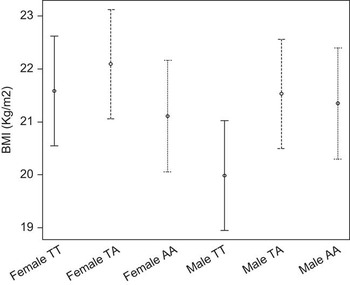
No association was detected, in either males or females, between rs9939609 and either frequency or duration of exercise in the Raine cohort at 14 years of age. The rs9939609 obesity-risk allele (A) was associated with lower fat intake in males (P = 0.012) and females (P = 0.032). Lower protein (P = 0.039) and carbohydrate intake (P = 0.015) was also associated with the rs9939609 obesity-risk allele (A) in males, and a similar trend was observed in females. However, in males, fat intake was positively correlated with exercise, suggesting that these covariates are confounded, a relationship that was not mirrored in the females. The cross-sectional analysis of BMI at 14 years of age in the Raine cohort indicated that the A allele of rs9939609 was associated with increased BMI-adjusted-for-age, although the effect was only detected in males (likelihood ratio test: P = 0.00009 in males and P = 0.542 in females; Fig. 3 and Supplemental Appendix). A similar effect was observed for the rs9939609 TA genotype in the Raine cohort
Cross-sectional association of rs9939609 genotype (codominant model) and gender with BMI at age 14 years in the Raine cohort.

Maternal pregnancy weight gain
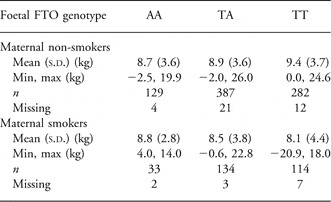
Maternal pregnancy weight gain between gestation weeks 16 and 34 was associated with the interaction between foetal FTO genotype and maternal smoking during pregnancy (P = 0.01; Table 4). With respect to non-smoking mothers, those with AA genotype foetuses had less weight gain than those with TT genotype foetuses between 16 and 34 weeks of gestation (8.7 v. 9.4 kg). Conversely for smoking mothers, those with AA genotype foetuses had more weight gain than those with TT genotype foetuses between 16 and 34 weeks of gestation (8.8 v. 8.1 kg). This pattern of maternal pregnancy weight gain matched the pattern of average birth weight and was independent of placental weight.
Association between rs9939609 and maternal weight gain between 16 and 34 weeks of gestation stratified by maternal smoking status: Raine cohort
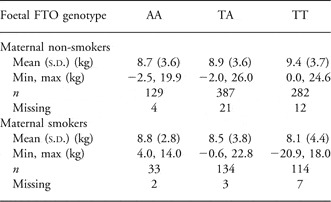
FTO, fat mass and obesity-associated.
Analysis of foetal FTO genotype by maternal smoking status P-value = 0.01.
Socioeconomic factors, including family income, maternal education and job type, were explored in sensitivity analyses to investigate potential confounders in all antenatal, birth and postnatal analyses. There was no evidence of an independent association between socioeconomic factors and foetal growth trajectories or birth anthropometry or postnatal BMI-adjusted-for-age. Further details of the statistical analyses are available by contacting the authors.
Discussion
Consistent with the findings of a number of previous GWASReference Frayling, Timpson and Weedon 6 , Reference Scuteri, Sanna and Chen 8 , Reference Hindorff, Junkins, Mehta and Manolio 9 and a growing number of case–control studies,Reference Dina, Meyre, Gallina and Durand 7 , Reference Cha, Choi and Kim 28 , Reference Chang, Liu and Lee 29 we have reported associations between an FTO variant and childhood obesity. We have also shown for the first time in humans that the rs9939609 SNP is associated with symmetric foetal growth restriction and significantly interacts with maternal smoking during pregnancy.
In the offspring of non-smoking mothers, the AA genotype was associated with symmetric growth restriction in utero from 28-week gestation that progressively accumulated throughout the third trimester. By 38-week gestation, the AA genotype was associated with an HC 11 percentile points smaller, an AC that was 15 percentile points smaller and an FL that was 8 percentile points smaller than the TT genotype on clinical percentile charts. Although the effects of the single base-pair change in the FTO gene are relatively small during foetal growth (−74 g in birth weight for offspring from non-smoking mothers), this effect equates to one third of the well-established effect of maternal smoking on birth weight (approximately −10 g/cigarette per day or an average of −261 g in birth weight in the Raine cohort). There was a consistent reduction in foetal HC, AC, FL and EFW trajectories and postnatal birth weight, birth length, HC, AC, chest circumference, foot length, triceps, parascapular and infrascapular skinfold thickness associated with the rs9939609 AA genotype. These data suggest that the AA genotype is associated with symmetric growth restriction in early life, as no relationship was demonstrated with in utero HC/AC ratio or postnatal ponderal index. Similar effects on foetal growth were often, although not consistently, observed for the rs9939609 TA genotype, supporting the possibility that the effect may be additive and dependent upon the number of A obesity-risk alleles that an individual carries. Previous studies have failed to demonstrate a relationship between FTO genetic variants and birth weight or birth anthropometry.Reference Frayling, Timpson and Weedon 6 , Reference Lopez-Bermejo, Petry and Diaz 14 However, these studies did not examine possible interactions with smoking or adjust for GA at birth. There is a universal agreement that maternal smoking is associated with a reduction in birth weight of approximately 175–200 g with a consistent and dose–dependent negative effect of smoking on birth weight.Reference Newnham 30 Since the original report in 1957Reference Simpson 31 of the association between maternal smoking during pregnancy and reduced birth weight, this observation has been replicated in more than 100 published studies, which have included evaluation of more than 500,000 births.Reference Lumley 32 The positive findings in our study suggest that consideration of the effects of maternal smoking during pregnancy may be crucial when attempting to uncover modest genetic effects on foetal growth and birth weight. The findings also highlight the importance of accurate and objective assessment of GA and growth in utero by ultrasonography.
A key question that arises from our findings is why does FTO have opposite effects on intrauterine and postnatal growth? Common variants in the first intron of FTO have been consistently associated with obesity and with increased BMI and fat, but not with lean mass.Reference Frayling, Timpson and Weedon 6 Further, the rs9939609 at-risk A allele has been shown to be associated with increased resting and total energy expenditure, increased energy intake, hyperphagia with a preference for energy rich foods and diminished satiety.Reference Bouchard 10 , Reference Haworth, Carnell and Meaburn 12 , Reference Cecil, Tavendale, Watt, Hetherington and Palmer 33 Moreover, it has recently been shown that inactivation of the FTO gene in an FTO-deficient mouse has no effect on birth weight; however, results in postnatal growth retardation and a significant reduction in adipose tissue and lean body mass.Reference Fischer, Koch and Emmerling 34 The expression of FTO has been shown to be influenced by nutrition with expression in the hypothalamus reduced by 60% in fasting mice and not rescued by leptin supplementation.Reference Fischer, Koch and Emmerling 34 Further, in a large population of predominantly lean Gambians, living a traditional lifestyle in an environment where little excess food is available, FTO genotype did not influence measures of body mass, or had a smaller effect than detected in Europeans.Reference Hennig, Fulford and Sirugo 35
Foetal nutrition is not exclusive, but closely related, to maternal nutrition given that the foetus is at the end of a nutritional supply chain. Both placental FTO genotype and FTO expression may also influence foetal weight. In both the cohorts in this study, there was no detectable association between rs9939609 genotype and placental weight (see Table 1; P = 0.670 and P = 0.884), suggesting that the association of FTO rs9939609 genotype with birth weight is independent of placental weight. These results are consistent with those recently published in a study by Bassols et al.,Reference Bassols, Prats-Puig and Vazquez-Ruiz 36 who reported that placental FTO expression and foetal FTO rs9939609 genotype was not associated with placental weight. Taken together, these data suggest that the association between rs9939609 genotype and birth weight relates to nutrient supply or placental transfer of nutrients. This hypothesis is supported by data from the Raine cohort where non-smoking mothers of AA genotype foetuses had less pregnancy weight gain than non-smoking mothers of TT genotype foetuses between 16 and 34 weeks of gestation (8.7 v. 9.4 kg; Table 4). These data provide some evidence to suggest that there may be less nutrients available to the AA genotype foetuses of non-smoking mothers than the TT genotype foetuses, with concomitant reduced birth weight but no corresponding difference in placental size.
The association between the FTO risk allele and foetal growth restriction suggest reduced expression of FTO in utero. This may be because the foetal hypothalamus perceives ‘reduced nutrition in utero’. The sequence of FTO is highly conserved from humans to algae and encodes a 2-oxoglutarate (2-OG) dependent nucleic acid demethylase.Reference Gerken, Girard and Tung 37 2-OG oxygenases are involved in diverse processes, including DNA repair, fatty acid metabolism and post translational modifications including proline hydroxylation and histone lysine demethylation.Reference Clifton, McDonough and Ehrismann 38 , Reference Hausinger 39 They require non-heme iron [Fe(II)] as a cofactor, use oxygen and, almost always, 2OG as co-substrates.Reference Gerken, Girard and Tung 37 The hypoxic intrauterine environment (pO2 18–44 mmHg) is likely to be associated with reduced expression or function of FTO in utero as 2-OG oxygenases utilise oxygen as a substrate. In addition, the primary effect of FTO appears to be through hyperphagia and in utero the foetus has limited abilities to regulate its nutritional supply. These factors may result in a similar foetal growth pattern to that seen in the FTO-deficient mouse during the postnatal period. However, once birth occurs, the neonate and child are normoxic and can regulate (to some extent) their own nutrition. Children can thus increase their energy intake, partly through poor food choicesReference Cecil, Tavendale, Watt, Hetherington and Palmer 33 and exposure to an obesogenic environment, which may result in obesity as early as 8 years of age as seen in the Raine cohort. We have presented some data to support this postulate with the AA genotype in infants from non-smoking mothers demonstrating the highest proportional growth during the first year of life (Fig. 2).
An alternative hypothesis to explain our findings relates to the maternal genotype. For a foetus to be homozygous for the at-risk allele, the mother must be either homozygous or heterozygous for the same allele. Given the potential role of FTO in controlling food intake and lipid metabolism, it would be expected that during pregnancy mothers who are homozygous or heterozygous for the at-risk allele conserve their energy to lay down fat (at the expense of the foetus), resulting in reduced nutrient supply for the foetus and growth restriction. This hypothesis was not supported by the maternal pregnancy weight gain results in either non-smoking or smoking mothers. Further research is required to elucidate why non-smoking mothers have an inverse relationship between the foetal rs9939609 A allele (a surrogate for maternal rs9939609 A allele) and energy intake.
Twin studies have shown that the heritability of BMI increases across early-to-middle childhood, an effect that is mirrored in the strengthening association between the FTO rs9939609 genotype and BMI across childhood. These observations may be explained by the increasing expression of FTO across childhood or the self-selection of environments correlated with genetic propensities, such as increased frequency and opportunities to overeat.Reference Frayling, Timpson and Weedon 6 , Reference Haworth, Carnell and Meaburn 12 The FTO rs9939609 genotype in children was associated with pre-pregnancy paternal BMI in the Raine and Generation R studies. The lack of association between the FTO rs9939609 genotype and pre-pregnancy maternal BMI may reflect reporting or recall bias. However, women may lose weight before pregnancy if they are overweight or have issues with fertility.
The observation that maternal smoking interacts with the FTO risk allele to reverse the effects of foetal growth was an unexpected finding. This observation requires further replication and evaluation to uncover the mechanisms responsible for this finding. We have postulated a number of potential mechanisms to explain this observation. In the Raine cohort, we have demonstrated that the patterns of maternal weight gain in pregnancy are different in smokers and non-smokers with smokers having less weight gain between 16 and 34 weeks than non-smokers (8.4 v. 9.0 kg; Table 4). These results are consistent with previous publications, suggesting that smokers have suppressed appetite.Reference Murphy, Smith, Giles and and Clifton 40 Moreover, maternal weight gain in pregnancy is associated with foetal FTO rs9939609 genotype, with a reversal of the effect in smokers to that seen in non-smokers. With respect to non-smoking mothers, those with AA genotype foetuses had less weight gain than mothers of TT genotype foetuses between 16 and 34 weeks of gestation (8.7 v. 9.4 kg; Table 4). Conversely, for smoking mothers, those with AA genotype foetuses had more weight gain than mothers of TT genotype foetuses between 16 and 34 weeks of gestation (8.8 v. 8.1 kg; Table 4). These data suggest that smoking mothers of AA genotype foetuses had similar weight gain between 16 and 34 weeks of gestation compared with non-smoking mothers of AA genotype foetuses; the similar maternal nutrient supply was reflected in similar birth weights. The smoking mothers of the TT genotype foetuses had the least weight gain between 16 and 34 weeks of gestation (8.2 kg) of all maternal smoking-foetal genotype combinations. This was reflected in this group also having the lowest average birth weight. Taken together these data suggest that a potential mechanism through which maternal smoking may interact with the foetal FTO risk allele may be through maternal nutrition and its subsequent effects on the maternal nutrition supply chain to the foetus. This hypothesis requires further exploration, such as investigating the association of maternal rs9939609 genotype with maternal weight gain during pregnancy in smokers and non-smokers. Similarly, further exploration is required to determine whether foetal FTO expression is involved in the regulation of maternal metabolism and energy intake and whether maternal smoking disrupts related signalling pathways. We do not rule out that the interaction between FTO genotype and maternal smoking may be because of one or more of the approximate 1000 compounds present in cigarette smoke.
The consistent size and direction of the interaction between the rs9939609 SNP and maternal smoking seen in Generation R is reassuring (Table 2). Interestingly, the biggest effect of the interaction between rs9939609 genotype and maternal smoking on foetal growth was seen in smoking mothers, where the foetal TT genotype was associated with a 261 g reduction in birth weight compared with the TT genotype foetuses of non-smoking mothers. In European populations such as the Raine or Generation R cohorts, 20 cigarettes per day results in a reduction in birth weight of approximately 250 g. In Chinese–Asian populations, where the T-allele is at a much higher prevalence,Reference Frazer, Ballinger and Cox 27 a mean of nine cigarettes per day results in a reduction in birth weight of 200 g, almost double the effect size seen in European populations.Reference Lam, To, Duthie and Ma 41 The mechanisms responsible for the greater impact of maternal smoking on foetal growth in Asian populations are unknown; however, gene × environment interactions such as those demonstrated in this study with FTO require evaluation in future studies across different ethnic populations. Polymorphisms in other genes such as the metabolic genes CYP1A1 (cytochrome P450 family 1, subfamily A, polypeptide 1), GSTT1 (glutathione S-transferase Theta-1) and GSTM1 (glutathione S-transferase Mu-1) also require further evaluation after the recent publication of interactions between maternal genotype and foetal growth with these specific variants, increasing the odds of foetal growth restriction in smokers 1.5- to 1.9-fold.Reference Delpisheh, Brabin, Topping, Reyad, Tang and Brabin 42 These three genes are thought to influence an individual's susceptibility to carcinogens and toxins and may have an important role in the adverse health effects of cigarette smoking.Reference Hayashi, Watanabe and Kawaijiri 43 – Reference Aagaard-Tillery, Spong, Thorm and Wapner 46
At 14 years of age, in male offspring, BMI is independently, positively associated with maternal smoking during pregnancy, birth weight, change in weight during the first year of life and protein intake at age 14 years and is negatively associated with duration of breast feeding and current carbohydrate and fat intake. Despite the males exercising, on average, more often and for longer than females, exercise frequency and duration were not independently associated with BMI at 14 years of age. In males, both the TA and AA rs9939609 genotypes were associated with increased BMI at 14 years of age, and there was limited evidence of a protective effect of increased duration of exercise in individuals with these genotypes. In addition, the increased birth weight, observed in the offspring of smokers with the rs9939609 AA and TA genotypes, contributed to increased fat mass in adolescence, although this effect was only partially offset by a smaller weight gain over the first year of life in these individuals. This would suggest that obesity prevention programmes for males may benefit from a focus on increased exercise rather than reduced dietary intake during adolescence, in addition to the prevention of maternal smoking during pregnancy. In contrast, in female adolescents, only birth weight and change in weight during the first year of life are independently, positively associated with BMI. These results provide limited insight into the formation of obesity prevention programmes in females.
Foetal growth is a complex trait associated with potentially hundreds of genetic variants, across a range of functional pathways, each conferring a small effect on foetal growth. Cumulatively, the effect of multiple genetic variants may produce clinically relevant differences in growth. The detection of new genetic variants associated with foetal growth has the potential to identify novel molecular mechanisms underlying growth and can yield insights of biological importance. The important challenge over the next decade is the identification of critical windows for intervention to influence the progressive increase in prevalence of childhood and adult obesity and related diseases such as type-2 diabetes. Characteristisation of the interactions between genes and the environment, which are related to foetal and postnatal growth, may pave the way for more sensitive analysis of the early childhood environment and may allow better targeting of future interventions and health promotion.
Acknowledgements
The authors are grateful to the Raine Foundation, to the Raine Study Families and to the Raine Study research staff. The authors gratefully acknowledge the assistance of the Western Australian Genetic Epidemiology Resource and the Western Australian DNA Bank (both National Health and Medical Research Council of Australia National Enabling Facilities). The authors also acknowledge the support of the Healthway Western Australia, the National Health and Medical Research Council of Australia (Grant 572613) and the Canadian Institutes of Health Research (Grant MOP 82893). We gratefully acknowledge the assistance of the Wind Over Water Foundation, the Telethon Institute for Child Health Research and the Raine Medical Research Foundation of the University of Western Australia. The Generation R Study is conducted by the Erasmus Medical Center in close collaboration with the School of Law and Faculty of Social Sciences of the Erasmus University Rotterdam, the Municipal Health Service of Rotterdam, the Rotterdam Homecare Foundation and the Stichting Trombosedienst and Artsenlaboratorium Rijnmond (STAR) Rotterdam. The first phase of the Generation R Study is made possible by additional financial support from the Netherlands Organization for Health Research and Development (ZonMw). We acknowledge the contribution of general practitioners, hospitals, midwives and pharmacies in Rotterdam, the Netherlands. JAM is supported by a War Widows’ Guild of Western Australia PhD Scholarship grant.
Supplementary material
The supplementary material referred to in this article is available online at http://www.journals.Cambridge.org/doh