Background
Reductions in executive functioning and automatic, impulsive responding to food-related cues have both been implicated in the maintenance of obesity and eating disorders (ED). Executive functioning is strongly related to self-regulatory capacity; inhibition, in particular, is a strong predictor of healthy dietary choice (Hall, Fong, Epp, & Elias, Reference Hall, Fong, Epp and Elias2008) and has been consistently found to be lower in persons with obesity than in those without (Lavagnino, Arnone, Cao, Soares, & Selvaraj, Reference Lavagnino, Arnone, Cao, Soares and Selvaraj2016; Yang, Shields, Guo, & Liu, Reference Yang, Shields, Guo and Liu2018). Automatic responding to cues may either implicate a strong habitual behaviour system formed through extended repetition, where food-related cues in the environment elicit eating, or a reduction in a goal-directed behavioural system, which is able to flexibly adapt behaviour in line with changing circumstances such as altered value of a goal, or altered likelihood of obtaining a goal through instrumental action (Griffiths, Morris, & Balleine, Reference Griffiths, Morris and Balleine2014). A shift away from flexible, goal-directed behaviour has been observed in obesity and ED (Horstmann et al., Reference Horstmann, Dietrich, Mathar, Possel, Villringer and Neumann2015; Janssen et al., Reference Janssen, Duif, Loon, Wegman, de Vries, Cools and Aarts2017; Voon, Reference Voon2015).
Several recent theories and models have proposed a relationship between executive functioning and habit/reductions in goal-directed behaviour in the context of health behaviours including eating behaviours. Hall & Fong's temporal self-regulation theory of health behaviour (Reference Hall and Fong2007) posits that prepotent default (potentially habitual) responses take precedence over intended actions unless they are willfully resisted through effortful self-control; in support of this theory, Gardner, Corbridge, and McGowan (Reference Gardner, Corbridge and McGowan2015) proposed an interaction between intention, self-control, and habit strength in enacting health behaviours (or in preventing the enactment of unhealthy behaviours). Along similar lines, Hofmann, Schmeichel, and Baddeley (Reference Hofmann, Schmeichel and Baddeley2012) argued that behavioural inhibition actively stops prepotent responses and habitual, ‘mindless’ eating behaviour. Dohle, Diel, and Hofmann (Reference Dohle, Diel and Hofmann2018) suggest that both lower inhibition and unregulated eating are predisposing risks for higher weight, and executive functioning is proposed to moderate or mediate the relationship between intentions, desires or automatic attitudes, and behaviour. Within the obesity and weight loss field, research has suggested that inhibition can override impulses for unhealthy choices (Gettens & Gorin, Reference Gettens and Gorin2017), and that reward-driven feeding is prompted by cues and influenced by inhibitory control (Appelhans, Reference Appelhans2009). Shields, Moons, and Slavich (Reference Shields, Moons and Slavich2017) have proposed a link between aberrant immune system activity (as present in obesity) and poor self-regulation, with impulse strength/reward and executive control as the most proximal factors in determining self-regulatory success or failure, while very recently Kakoschke, Aarts, and Verdejo-García (Reference Kakoschke, Aarts and Verdejo-García2019) have hypothesised links between cognitive performance deficits such as set-shifting, attentional bias, contingency-related cognitive flexibility and habit learning and the development and maintenance of compulsive eating behaviours in both obesity and obesity with binge eating disorder.
Grazing, an eating pattern, which has only recently started to receive clinical and research interest, is characterised by unplanned, repetitive eating of small amounts of food, and/or eating not in response to hunger/satiety sensations (Conceição et al., Reference Conceição, Mitchell, Engel, Machado, Lancaster and Wonderlich2014). Given these characteristics, grazing can be theoretically conceptualised as a habitual, ‘mindless’ behaviour, prompted by the availability of food-related cues in the environment (Davis et al., Reference Davis, Levitan, Carter, Kaplan, Reid, Curtis and Kennedy2008; Raman, Smith, & Hay, Reference Raman, Smith and Hay2013), potentially resulting from self-regulatory failures. Grazing is common in obesity, binge-type ED, and at their overlap (Heriseanu, Hay, Corbit, & Touyz, Reference Heriseanu, Hay, Corbit and Touyz2017; Heriseanu, Hay, & Touyz, Reference Heriseanu, Hay and Touyz2019).
Where grazing incorporates a sense of loss of control over eating, it has been associated with lower mental health-related quality of life, higher body mass index (BMI), and more severe ED psychopathology (Heriseanu et al., Reference Heriseanu, Hay, Corbit and Touyz2017, Reference Heriseanu, Hay and Touyz2019).
To date, one model incorporates habit and executive functioning as influencing eating behaviours including grazing specifically, in the context of obesity: the Clinical Obesity Maintenance Model (COMM; Raman et al., Reference Raman, Smith and Hay2013). This model posits that habit strength influences unhelpful eating behaviour such as grazing via an autonomic, implicit, and habitual pathway, with executive functioning exerting influence both on habit strength and on unhelpful eating behaviours. This model has been evaluated (Raman, Hay, & Smith, Reference Raman, Hay and Smith2014) using a self-report measure of habit strength, the Self-Report Habit Index (SRHI; Verplanken & Orbell, Reference Verplanken and Orbell2003), but not using implicit tasks of habit strength, which constitute an essential alternative, given that habits are considered to be reflexive, automatically enacted and often outside of conscious self-awareness (Killcross & Coutureau, Reference Killcross and Coutureau2003).
In summary, several theories have proposed that a weak self-regulatory system characterised by deficits in executive functions such as cognitive flexibility, attentional bias and inhibition can be overwhelmed by intense, habitual, or impulsive responses to food cues, whereas robust self-regulation may keep impulsive or compulsive unhelpful eating in check (Gardner et al., Reference Gardner, Corbridge and McGowan2015; Hofmann, Friese, & Roefs, Reference Hofmann, Friese and Roefs2009; Jones, Hardman, Lawrence, & Field, Reference Jones, Hardman, Lawrence and Field2018). The aim of the current study is to test the theoretically driven relationships between inhibition (a central aspect of self-regulation), strength of goal-directed behaviour (measured implicitly, as a proxy for habit strength) and grazing, in a group of participants with obesity with and without significant ED features compared to a healthy control group.
Method
Participants
A total of 87 participants were recruited from community and university settings. Participants consisted of three groups: participants with obesity and without significant ED psychopathology (OB group; n = 25; BMI M (SD) = 33.98 (3.11) kg/m2; age M (SD) = 30.17 (10.82) years; 52.0% female); participants with obesity and with significant ED psychopathology (OBED group; n = 19; BMI M (SD) = 38.44 (5.73) kg/m2; age M (SD) = 28.20 (8.25) years; 73.7% female); and healthy control participants with a BMI between 18.5 and 25 kg/m2 and without ED psychopathology (HC group; n = 43; BMI M (SD) = 22.31 (2.07) kg/m2; age M (SD) = 27.81 (7.53) years; 74.4% female). Inclusion criteria were a BMI in either the ‘healthy’ (18.5 ≤ BMI ≤ 25) range or the ‘obese’ (BMI ≥ 30) range, and the completion of ≥10 years of education in English. Exclusion criteria were history of psychosis or manic symptoms, neurological injuries or disorders, learning disorders, hearing or visual impairment, regular sedative or stimulant use, substance use problems, or current participation in a weight loss program. Community participants received a $20 shopping card as reimbursement and university participants received course credit. The study was approved by the University of Sydney Human Research Ethics Committee (Approval No.: 2014/936), and written informed consent was obtained from all participants.
Measures
Demographic information
Data were collected on age, sex, education, residential postcode (for estimating household income), ethnicity, country of birth, and marital status.
Anthropometric measurements
Height in metres and weight in kilograms were measured using Tanita Wedderburn BWB-700 scales and stadiometer for calculating BMI (kg/m2).
Presence of significant ED features
Participants completed the Eating Disorder Examination-Questionnaire (EDE-Q; Fairburn & Beglin, Reference Fairburn and Beglin1994), a 28-item self-report questionnaire of ED psychopathology. Participants were classified as likely and not likely to have an ED, based on the method described by Mond, Hay, Rodgers, Owen, and Beumont (Reference Mond, Hay, Rodgers, Owen and Beumont2004): (1) EDE-Q Global Score ≥ 2.3 AND (2) the occurrence of any objective binge episodes OR exercising for weight or shape reasons at least once per week.
Grazing severity
The Grazing Questionnaire (GQ; Lane & Szabó, Reference Lane and Szabó2013) was used to measure severity of grazing. The GQ is a 7-item self-report instrument with responses rated on a 5-point scale, ranging from ‘0 – Never’ to ‘4 – All of the time’. The GQ generates a total score, where a higher score indicates higher grazing severity.
Sensitivity to contingency
The Contingency Variation Task was used to determine this aspect of goal-directed behaviour. The Contingency Variation Task aims to test whether behaviour can flexibly adapt to respond for a higher action-outcome contingency over a lower contingency. A detailed description of the task can be found in Supplementary Appendix A. The outcome consisted of the Contingency Sensitivity Index (CSI), calculated as the number of keypresses performed for the high contingency outcome divided by the total number of presses. For a detailed exploration of goal-directed behaviour in this sample, please see Heriseanu et al. (Reference Heriseanu, Hay, Corbit and Touyzin press).
Response inhibition
This was assessed using the Hayling Sentence Completion Test (Burgess & Shallice, Reference Burgess and Shallice1997). Part A reflects response initiation; participants had to complete 15 sentences with a word which was clearly expected in the context. Part B reflects the inhibition of a prepotent response; participants had to produce a word that did not fit in the context of 15 different sentences. Errors produced in Part B were used as the measure of inhibition.
Depression severity
The 7-item Depression subscale from the DASS-21 (a short version of the original DASS-42 questionnaire (Lovibond & Lovibond, Reference Lovibond and Lovibond1995)) was used to collect self-reported depression severity over the past week. Ratings are made on a five-point Likert scale ranging from 0 (Did not apply to me at all) to 4 (Applied to me very much, or most of the time). Responses as summed for calculating subscale scores, with higher scores indicating higher severity.
Estimated overall intellectual functioning
Full-scale IQ was estimated using the Test of Premorbid Functioning (Wechsler, Reference Wechsler2009). This test comprises a list of 70 words with atypical grapheme to phoneme translations, which participants read aloud. The total raw score consists of the total number of words pronounced correctly, ranging from 0 to 70. This was converted to a standard score using age group norms.
Procedure
Participants were screened over the phone for eligibility. Following screening, a face-to-face session took place during which anthropometric and demographic data were obtained, and participants completed neuropsychological tests and instrumental decision-making tasks.
Data Analysis
To determine whether group differences in grazing severity were affected by the degree to which behaviour was goal-directed, which in turn is theoretically mediated by inhibition, serial mediation analyses were conducted using the PROCESS macro for SPSS (Hayes, Reference Hayes2017) with 10,000 bootstrap samples and using heteroscedasticity-consistent standard error estimators (HC3). Multiple serial mediator models were used to test the indirect effects of group on grazing behaviour via contingency sensitivity (M1) and inhibition (M2). Age, sex, years of education, estimated overall intellectual functioning, and depression severity were included as covariates. An α-level of .05 was used.
Results
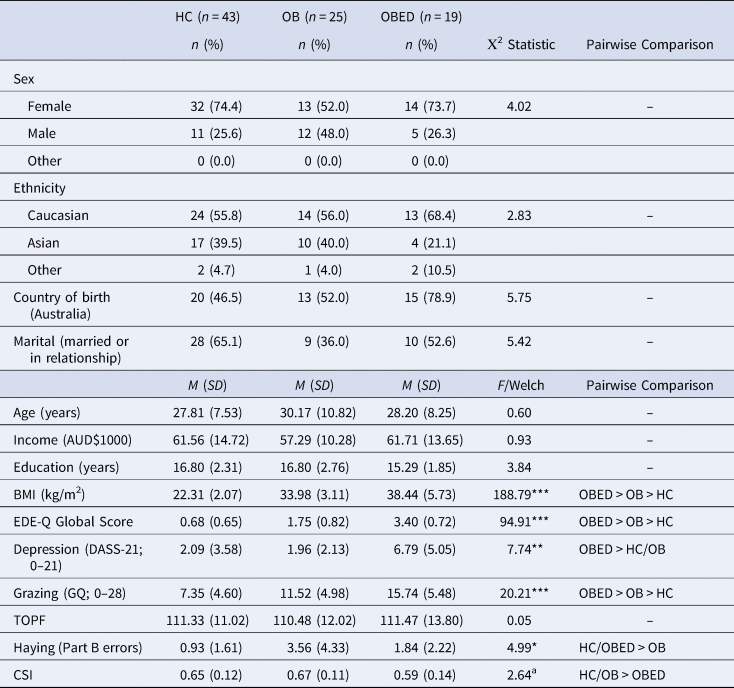
No significant between-group differences were observed between the three groups in terms of age, sex, or other demographics (all ps > .05). There were differences in terms of BMI, grazing, depression, and ED symptoms, generally with the OBED group being highest, followed by the OB group and then the HC group. CSI was marginally lower in the OBED group than the HC/OB groups (p = .067 and p = .029, respectively), while inhibition was lower in the OB group than in the HC/OBED groups (p < .001 and p = .045, respectively). See Table 1 for demographic and clinical data.
Demographic and Clinical Characteristics

Note: *p < .05; **p < .01; ***p < .001.
a p = .078.
Mediation Analysis
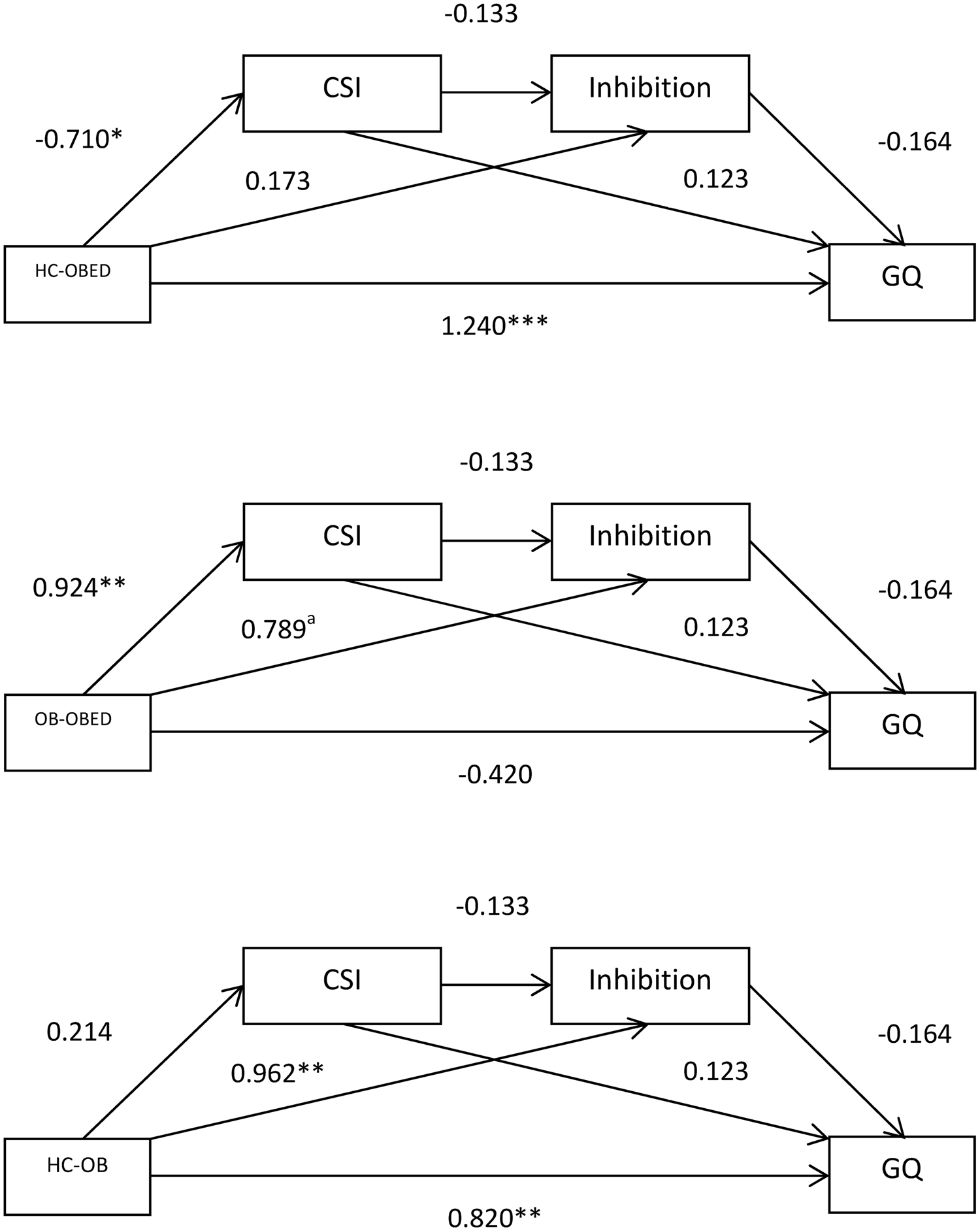
The indirect effect of group on grazing through contingency sensitivity was not significant (HC-OB β = 0.16, 95% CI [−0.24, 0.90]; HC-OBED β = −0.52, 95% CI [−1.74, 0.50]; OB-OBED β = 0.67, 95% CI [−0.63, 2.33]). The indirect effect of group on grazing through inhibition was also not significant (HC-OB β = −0.93, 95% CI [−2.33, 0.12]; HC-OBED β = −0.17, 95% CI [−1.00, 0.37]; OB-OBED β = −0.76, 95% CI [−2.24, 0.15]). The indirect effect of group on grazing severity mediated by strength of goal-directed behaviour and inhibition was not significant for any of the between-group comparisons (HC-OB β = 0.03, 95% CI [−0.06, 0.15]; HC-OBED β = −0.09, 95% CI [−0.43, 0.09]; OB-OBED β = 0.12, 95% CI [−0.12, 0.48]; Figure 1).
Multiple mediation models showing the indirect effect of weight group on grazing severity through contingency sensitivity and inhibitory performance. Standardised β coefficients are shown. ***Significant at .001 level. **Significant at .01 level. aMarginally significant: p = .074.

Discussion
This represents the first study to examine the effects of high weight with and without ED features on grazing via the theoretically linked constructs of inhibition and goal-directed behaviour measured implicitly rather than through a self-report measure. Following on from evidence that grazing is a clinically significant eating pattern in obesity and in ED (Conceição et al., Reference Conceição, de Lourdes, Pinto-Bastos, Vaz, Brandão and Ramalho2018; Heriseanu et al., Reference Heriseanu, Hay, Corbit and Touyz2017, Reference Heriseanu, Hay and Touyz2019), and that executive functioning is reduced in obesity (Yang et al., Reference Yang, Shields, Guo and Liu2018) with inhibition as one of the most consistent findings (Lavagnino et al., Reference Lavagnino, Arnone, Cao, Soares and Selvaraj2016), combined with existing evidence of reductions in goal-directed behaviour in obesity (Horstmann, Reference Horstmann2017), it was hypothesised that the effects of high weight and/or ED features on grazing would be effected through a reduction in goal-directedness of behaviour (as a proxy of habit strength), in turn influenced through the degree of executive functioning resources. The current analysis found that the effect of group on grazing was not mediated by either contingency sensitivity or by inhibition, or serially by both. This is a surprising finding, given the sound theoretical relationship between the examined constructs.
There are several reasons for the observed lack of mediation. It is possible that a relationship does not exist between response inhibition these variables, at least as operationalised in the current study. The type of inhibition measured in this study is response inhibition, reflecting late-stage inhibition of responses to eat, whereas contingency sensitivity may be more closely related to task-switching and to cognitive/behavioural flexibility, which allows one to abandon suboptimal means in order to pursue more effective methods to obtain a goal (Dohle et al., Reference Dohle, Diel and Hofmann2018) than purely to the late-stage inhibition of an impulse to eat. There is also the possibility that impulsivity (or lack of inhibitory function) may transition to compulsivity (lack of flexibility in behaviour) over a longer time, similar to models of addiction (Voon, Reference Voon2015), which adds a temporal dimension which is not tested in the current model.
Additionally, grazing behaviour itself may not be as strongly related to late/response inhibition as measured by the Hayling task but to other forms of inhibition such as earlier, proactive or interference inhibition (i.e. preparation for inhibition in anticipation of a stimulus) or decisional inhibition (emphasising better consequences in the long term) (Preuss, Leister, Pinnow, & Legenbauer, Reference Preuss, Leister, Pinnow and Legenbauer2019; Voon, Reference Voon2015). Furthermore, response inhibition has been found to be impaired in participants with binge eating disorder when tasks incorporated ED-specific stimuli (food or body cues), which was not the case for the inhibition task used in the current study; the CVT task did, however, use food-relevant stimuli; this may represent a mismatch in terms of task stimuli which may also account for the non-significant mediation results. A further possibility is that the OBED group reflected heterogeneity in terms of inhibition abilities; this group contained both bulimia nervosa-type and binge eating disorder-type ED psychopathology, and some studies have found more pronounced impairments in impulsivity in bulimia nervosa than in binge eating disorder (Voon, Reference Voon2015). It is also possible that the null findings are due to the presence of Type II error, given the relatively small number of participants and the exploratory nature of this research.
Strengths of the study include the use of an implicit measure of goal-directed behaviour/habit, which may better capture this dimension of behaviour, the use of a theoretically derived model, and adequate accounting for potential confounds through sampling and statistical control. Study limitations include the relatively small sample size, the lack of dimensionality for the inhibition construct, and the stimulus mismatch discussed above; additionally, one problem with currently available tasks of instrumental decision-making is that they lack the ability to differentiate between high habit strength overriding goal-directed behaviour, or a suppression of goal-directed behaviour allowing for behaviour that is more automatic and reflexive to occur (de Wit et al., Reference de Wit, Kindt, Knot, Verhoeven, Robbins, Gasull-Camos and Gillan2018; Gillan, Robbins, Sahakian, van den Heuvel, & van Wingen, Reference Gillan, Robbins, Sahakian, van den Heuvel and van Wingen2015).
Future research testing similar models incorporating both inhibition and goal-directed behaviour/habit should consider incorporating multiple facets of inhibition and should employ tasks incorporating the same stimulus type (i.e. either neutral stimuli or food-related stimuli). Additionally, this model should be tested in persons with clinically determined ED diagnoses, and in persons with different durations of ED or obesity onset to examine if there is a temporal gradient between impulsivity and compulsivity in these groups.
In conclusion, the current research did not find evidence for the notion that between-group differences in grazing severity are accounted for by poorer response inhibition, or by a lower degree of goal-directed behaviour in persons with high weight with and without ED features compared to a healthy control group.
Supplementary material
The supplementary material for this article can be found at https://doi.org/10.1017/bec.2020.12.
Acknowledgements
The authors wish to thank Dr Amy L. Burton, who assisted in the proofreading of the manuscript, and Stephanie Quail for providing assistance with the instrumental task used.
Funding
This research was supported by two internal Postgraduate Research Grants from the University of Sydney (PRG 2014 and 2015) which were used to purchase shopping cards used as participant reimbursement. The University of Sydney did not have any involvement in the study design; in the collection, analysis, and interpretation of data; in the writing of the manuscript; and in the decision to submit the article for publication.
Author Contribution
A.I.H., P.H., and S.T. designed the study. A.I.H. conducted literature searches, data collection, statistical analysis, and drafted the manuscript. P.H. provided input into the statistical analysis interpretations. All authors contributed to and have approved the final manuscript.
Declaration of interest
A.I.H. has no competing interests to declare.
P.H. has received in sessional fees and lecture fees from the Australian Medical Council, Therapeutic Guidelines publication, and New South Wales Institute of Psychiatry and royalties from Hogrefe and Huber, McGraw Hill Education, and Blackwell Scientific Publications, and she has received research grants from the NHMRC and ARC. She is a Chair of the National Eating Disorders Collaboration in Australia (2012–2013). In July 2017, she provided a commissioned report for Shire Pharmaceuticals on lisdexamfetamine and binge eating disorder and in 2018 received honoraria for the education of Psychiatrists.
S.T. has received royalties from Hogrefe and Huber, McGraw Hill Education, and Routledge for the publication of books/chapters. He is the Chair of the Shire (Australian) BED Advisory Committee and has received travel grants, research grants, and honoraria from Shire for commissioned reports and is a consultant to Weight Watchers International.
Ethical standards
The authors assert that all procedures contributing to this work comply with the ethical standards of the relevant national and institutional committees on human experimentation and with the Helsinki Declaration of 1975, as revised in 2008. The study was approved by the University of Sydney Human Research Ethics Committee (Approval No.: 2014/936), and written informed consent was obtained from all participants.