Introduction
In the past few years, an argument has emerged that the nature of community self-help varies across affluent and deprived populations. Drawing upon extensive national surveys, it has been revealed that whilst community participation in affluent populations is more likely to be in community-based groups, deprived populations are more oriented towards one-to-one aid (Merrill, Reference Merrill2006; Milligan, Reference Milligan2007; Williams, Reference Williams2003a, Reference Williams2003b, Reference Williams2005, Reference Williams2008). The intention of this article is to further advance this emergent understanding of the socio-spatial variations in community self-help. To capture the multifarious kinds of community self-help and how they vary socio-spatially, a ‘total social organisation of labour’ perspective is used as a lens for analysing the results of 811 face-to-face interviews carried out in deprived and affluent English urban and rural localities.
The first section, therefore, reviews the previous literature on the socio-spatial variations in the nature of community self-help. This will uncover how previous studies have depicted its uneven contours in terms of how participation in community-based groups (‘formal’ community self-help) and the provision of one-to-one help (‘informal’ community self-help) vary socio-spatially. To transcend this simplistic dichotomous depiction and enable a more complex multi-layered comprehension of the nature of community self-help and how participatory cultures vary socio-spatially, a finer-grained typology of the array of kinds of community self-help is here adopted grounded in a ‘total social organisation of labour’ (TSOL) approach. The second section then introduces an English Localities Survey involving 861 face-to-face interviews in deprived and affluent urban and rural English localities, while the third section uses this TSOL lens to present a more multi-layered portrait of community self-help and how participatory cultures differ socio-spatially. The final section will then evaluate the implications for theory, policy and practice of this more socially and spatially nuanced mapping of community self-help and call for further studies to evaluate whether similar findings are applicable in other countries across not only the western world but also in post-socialist societies and the majority (‘third’) world.
Socio-spatial variations in community self-help
Community self-help involves not-for-profit help provided for and by kin, friends, neighbours or other members of one's community, either on an individual basis or through more organised collective groups and associations. The only difference between this and conventional definitions is that the term ‘not-for-profit’ is used rather than ‘unpaid’ help for reasons which will become apparent below (e.g., Field and Hedges, Reference Field and Hedges1984; Davis Smith, Reference Davis Smith1998; Lynn and Davis Smith, Reference Lynn and Davis Smith1992). To unravel the diverse activities covered by this definition, the convention has been to divide community self-help into two broad types, often depicted as a spectrum or hierarchy (e.g., Field and Hedges, Reference Field and Hedges1984; Lynn and Davis Smith, Reference Lynn and Davis Smith1992; Davis Smith, Reference Davis Smith1998; Home Office, 1999; Kershaw et al., Reference Kershaw, Budd, Kinshott, Mattinson, Mayhew and Myhill2000; Krishnamurthy et al., Reference Krishnamurthy, Prime and Zimmeck2001, Coulthard et al., Reference Coulthard, Walker and Morgan2002, Prime et al., Reference Prime, Zimmeck and Zurawin2002; Choi et al., Reference Choi, Burr and Caro2007). At one end lies participation in formal or ‘third sector’ community-based organisations, defined as engagement in formal organisations having an institutionalised character, constitutionally independent of the state and self-governing, non-profit distributing and involving some degree of voluntarism (Salamon et al., Reference Salamon, Anheier, List, Toepler and Wojcieck Sokolowoski1999). At the other end lie informal or ‘fourth sector’ activities, which involves providing aid on a one-to-one basis to members of households other than one's own, such as friends, neighbours and acquaintances.
Most UK surveys investigating formal and informal community self-help, however, tend to read such activity not as a continuum but as separate realms, not least due to the way in which the survey treats them as separate realms. This includes the British Crime Survey, Home Office Citizenship Survey, General Household Survey and National Adult Learning Survey (e.g., Krishnamurthy et al., Reference Krishnamurthy, Prime and Zimmeck2001; La Valle and Blake, Reference La Valle and Blake2001; Coulthard et al., Reference Coulthard, Walker and Morgan2002; Prime et al., Reference Prime, Zimmeck and Zurawin2002; Murphy et al., Reference Murphy, Wedlock and King2005; Pennant, Reference Pennant2005; Kitchen et al., Reference Kitchen, Michaelson, Wood and John2006; DCLG, 2008). Adopting this dichotomous depiction of separate formal and informal varieties of community self-help, these surveys reveal firstly, that both formal and informal community self-help is higher in affluent than deprived areas and, secondly, that community self-help in affluent populations revolves more around ‘formal’ voluntary endeavour, whilst in deprived populations it is more orientated towards ‘informal’ one-to-one aid (Williams, Reference Williams2003a, Reference Williams2003b, Reference Williams2005, Reference Williams2008). The resultant argument has been that the current policy approach, which nurtures engagement in community-based groups and neglects one-to-one aid (DETR, 1999; DSS, 1999; Countryside Agency, 2001; Social Exclusion Unit, 1998 and 2000; Home Office, 1999 and 2003; HM Treasury and Home Office, 2002), means that the participatory culture of affluent populations is being not only privileged but also imposed on to deprived populations (Williams, Reference Williams2005 and Reference Williams2008).
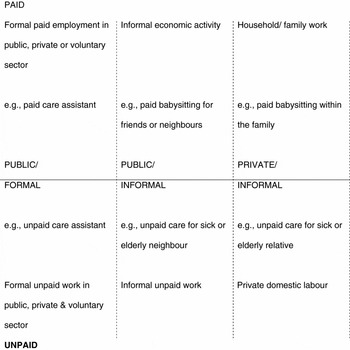
Instead of depicting formal and informal community self-help as unified discrete realms, a finer-grained understanding of the multifarious kinds of community self-help is here developed. This draws on Glucksmann's (Reference Glucksmann1995, Reference Glucksmann2000 and Reference Glucksmann2005) concept of the ‘total social organisation of labour’ (TSOL), which reveals how labour in any society is divided up between, and allocated to, different structures, institutions and activities, and views ‘the economy as a “multiplex” combination of modes, rather than as a dualism’ (Glucksmann, Reference Glucksmann2005: 8). So far, and in the realm of community self-help, Taylor (Reference Taylor2004) has applied this approach and as Figure 1 shows, has replaced the simplistic formal/informal dichotomy with a variety of different types of labour practice along a formal/informal spectrum cross-cut by whether the activity is paid or not.
Framework of the total social organisation of labour.

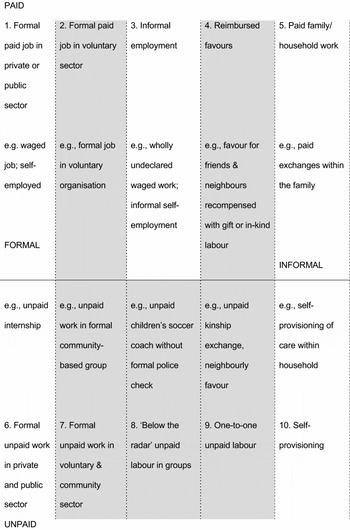
In this article, this transcendence of the informal/formal dichotomy is further extended. Figure 2 portrays a continuum of forms of economic activity along a formal-to-informal spectrum on the x-axis divided by a further continuum on the vertical y-axis ranging from wholly non-monetised through gift exchange and in-kind labour contributions to wholly monetised exchanges. The result is a series of ten labour practices with fuzzy boundaries that, moving from left to right, shift from more formal to more informal practices and, moving from the bottom to the top, from wholly non-monetised to wholly monetised practices. The hatched boundaries dividing each zone signify that these are not discrete and that they blur into one another. Each practice, therefore, is part of a borderless continuum, rather than separate realms, which seamlessly overlap and merge into each other.
Typology of kinds of community self-help in the total social organisation of labour.

The shaded practices in Figure 2 are the different kinds of community self-help, and display how ‘formal’ and ‘informal’ community self-help are neither discrete spheres nor unified wholes. Instead, a range of different kinds of formal-oriented (group-based) engagement are shown to exist, ranging from holding a formal paid job in the Voluntary and Community Sector (labelled 2 in Figure 2) through unpaid engagement in community-based groups (labelled 7) to ‘below-the-radar’ participation in community-based groups (labelled 8). Informal-oriented community self-help, meanwhile, is again revealed to be multifarious in character, ranging from wholly unpaid one-to-one endeavour for kin, friends, neighbours and acquaintances (labelled 9) through aid provided to others but with unsolicited gifts given or in-kind labour provided, to one-to-one not-for-profit favours for friends, neighbours and acquaintances with monetary payments involved (labelled 4). The remaining non-shaded zones involve labour practices that are not community self-help but are nevertheless alternative forms of delivering goods and services in contemporary society and form the remaining activities in the ‘total social organisation of labour’. These include formal paid employment in the public and private sectors (labelled 1), formal unpaid employment in the public and private sectors (labelled 6), informal employment (labelled 3), paid household work by household members (labelled 5) and unpaid domestic work (labelled 10).
Given this finer-grained depiction of community self-help in particular, and labour practices in general, using this ‘total social organisation of labour’ conceptual framework, attention now turns to employing it to provide a finer-grained understanding of the socio-spatial variations in the nature of community self-help in English localities so as to map the different cultures of community self-help in different populations and areas.
Evaluating community self-help in English localities
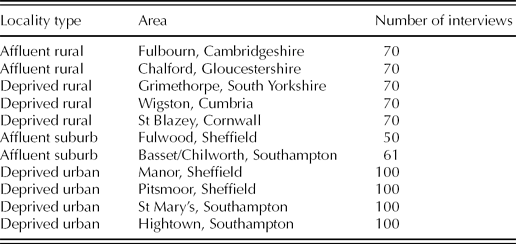
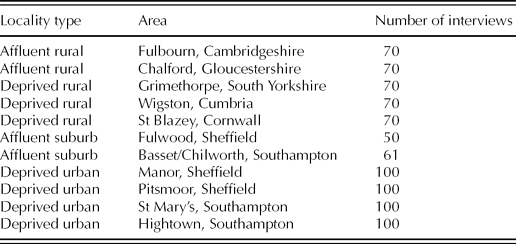
To advance understanding of the socio-spatial variations in the nature of community self-help, evidence is here analysed collected between 1998 and 2002 during 861 face-to-face interviews in deprived and affluent urban and rural English communities. Using data from the UK government's Index of Multiple Deprivation (ODPM, 2000), maximum variation sampling was used to select localities amongst the highest and lowest ranked in terms of multiple deprivation in both urban and rural English localities (see Table 1), whilst households were selected for interview in each locality using a spatially stratified sampling technique (Kitchin and Tate, Reference Kitchin and Tate2001).
Localities studied
The evidence on the extent and nature of engagement in community self-help was gathered as part of a wider survey on household work practices using a relatively structured face-to-face interview schedule. This firstly gathered background information on their age, gender, employment status, work history and gross household income. The interviewer then asked about the type of labour the household last used to complete forty-four common domestic tasksFootnote 1 and whether they had conducted any of these tasks for other households. This explored which of the ten labour practices outlined in Figure 2 had been used to undertake these forty-four tasks along with their motives for using each of them and engaging in such a practice. To ensure that the survey covered all types of community self-help, furthermore, a series of open-ended questions with prompts were used to elicit any other engagement in each form of community self-help over the past twelve months.
This resulted in the collection of comparative survey data on the prevalence and character of the different kinds of community self-help in Figure 2 as well as the participatory cultures in different populations. Below, the results are reported. Firstly, however, a brief caveat is required. These data do not provide a representative sample of England. However, this was not the point of the survey. It was to analyse the socio-spatial variations in the nature of community self-help and it is precisely this comparative evidence that is analysed below.
Socio-spatial variations in community self-help
This English Localities Survey reinforces previous national government surveys which find that unpaid community self-help is higher in affluent than deprived populations and that affluent populations and areas have a more formally orientated participatory culture, whilst deprived populations and areas are more orientated towards informal one-to-one aid (Merrill, Reference Merrill2006; Milligan, Reference Milligan2007; Williams, Reference Williams2003a, Reference Williams2003b, Reference Williams2005 and Reference Williams2008). Some 72 per cent of the respondents living in affluent areas had engaged in unpaid one-to-one aid in the past year compared with just 53 per cent in deprived areas, and 42 per cent had participated in community-based groups in the affluent areas but just 18 per cent in the deprived areas. This indicates not only the higher level of participation in both formal and informal community self-help in affluent areas, but also the existence of a more informal participatory culture in deprived localities and how formal engagement is a relatively foreign form of engagement for most people living in such areas.
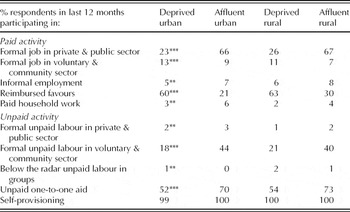
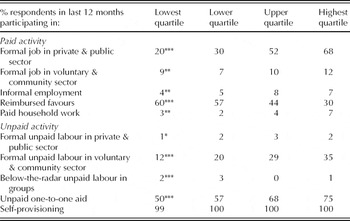
The value of this survey, however, is that it investigates a wider array of forms of community self-help and how they vary socio-spatially. Starting with the spatial variations, Table 2 shows that in deprived localities, although participation in unpaid engagement in community-based groups and one-to-one aid is higher in more affluent localities (in both the rural and urban areas), reinforcing previous national government surveys, those in deprived communities engage to a greater extent in below-the-radar forms of participation in community-based groups (e.g., caring for groups of children without registering to do so) and in favours for kin, friends, neighbours and acquaintances that are reimbursed with gifts, in-kind labour or money. People living in affluent localities therefore do not have higher participation rates in all forms of community self-help. Their participation rates are greater in unpaid and legitimate forms of community self-help. People living in deprived localities, meanwhile, have higher participation rates in reimbursed (in terms of gifts, in-kind labour or money) and ‘below-the-radar’ forms of engagement. Until now, this has gone largely unnoticed because the concentration has been near enough solely on unpaid and legitimate forms of community self-help in the literature.
Participation rates in different types of community self-help: by locality type

Notes: Statistical significance: * = 0.05 (5% probability), ** = 0.01 (1%) and *** = 0.001 (0.1%).
Source: author's English Localities Survey.
Turning to how participation in community self-help varies according to household gross income, Table 3 reveals that those living in households in the highest income quartile engage in greater amounts of both unpaid and legitimate kinds of community self-help, whilst those living in the lowest income quartile of households tend to engage to a greater extent in both reimbursed forms of community self-help and beneath-the-radar kinds of activity in community-based groups.
Participation rates in community self-help: by household income

Notes: Statistical significance: * = 0.05 (5% probability), ** = 0.01 (1%) and *** = 0.001 (0.1%).
Source: author's English Localities Survey.
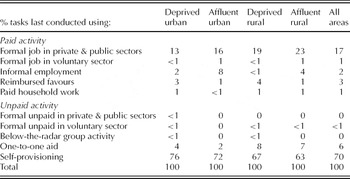
Deprived communities also more heavily rely on community self-help in their overall coping practices. Table 4 examines the labour practices last used to conduct forty-four common domestic service tasks in different localities. It reveals how households in deprived communities rely more heavily both on formal unpaid community self-help in groups, below-the-radar unpaid community self-help in groups and one-to-one unpaid aid, as well as reimbursed favours, to get tasks completed than households in affluent areas. The implication is that even if participation in community self-help is higher in affluent areas, people in deprived communities rely more on such activity for material support in getting everyday domestic services completed than those living in affluent areas.
Use of community self-help in household coping practices: by locality type

Notes: p < 0.05 (5% probability) in all cases leading us to reject Ho within a 99.5 per cent confidence interval that there are no spatial variations in the sources of labour used.
Source: author's English Localities Survey.
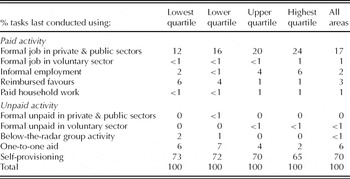
It is similarly the case, as Table 5 reveals, that households in the higher-income quartiles rely more on monetised exchange than those in lower-income quartiles. They are also more likely to draw upon formal employment and paid informal labour, whilst lower-income households depend more on self-provisioning, unpaid one-to-one aid, below-the-radar group activity and reimbursed favours to get tasks completed.
Use of community self-help in household coping practices: by household income

Notes: p < 0.05 (5% probability) in all cases leading us to reject Ho within a 99.5 per cent confidence interval that there are no variations in the sources of labour used by household income.
Source: author's English Localities Survey.
Socio-spatial variations exist not just in the different work cultures adopted but also in terms of the nature of each labour practice. Across populations, each and every labour practice varies both in terms of its prevalence as well as the work relations and motives involved. To begin to understand this, the five different kinds of community self-help are now evaluated in turn.
One-to-one unpaid labour
Examining one-to-one unpaid labour provided by or for kin, friends, neighbours or acquaintances, and akin to previous national surveys (Krishnamurthy et al., Reference Krishnamurthy, Prime and Zimmeck2001; La Valle and Blake, Reference La Valle and Blake2001; Coulthard et al., Reference Coulthard, Walker and Morgan2002; Prime et al., Reference Prime, Zimmeck and Zurawin2002; Murphy et al., Reference Murphy, Wedlock and King2005; Pennant, Reference Pennant2005; Kitchen et al., Reference Kitchen, Michaelson, Wood and John2006; DCLG, 2008; Williams, Reference Williams2003a, Reference Williams2003b, Reference Williams2005, Reference Williams2008), this study reveals that although participation rates are greater in affluent than deprived areas and populations, those in deprived communities more commonly use this practice as a source of material support (see Table 5).
Nevertheless, it is not always a chosen practice. Whilst help provided for and by kin was widely supported and frequently referred to as ‘done out of love’, providing unpaid support for others beyond kin was less a matter of choice and more conducted due to a lack of choice. On the one hand, there was a widespread unwillingness to receive unpaid material help from others beyond kin, mostly so as to avoid owing favours. Respondents expressed worry about accumulating such ‘debts’ and instead preferred to reimburse help received so that they owed nothing. Many perceived themselves as potentially unable to reimburse favours through gifts or in-kind labour, such as due to their ill health, caring responsibilities or perceived lack of ability to offer anything in return so always tried to keep a ‘clean slate’.
On the other hand, respondents were frequently unwilling to offer unpaid help. Firstly, many understood that recipients would not accept ‘charity’, or one-way giving, as Kempson (Reference Kempson1996) has previously argued, so one-way support was seldom offered for fear of ‘insulting’ the recipient. Secondly, reimbursement was often seen as preferable because the widespread perception was that you could never trust people to repay a favour. The resultant norm in deprived communities is therefore to reimburse friends and/or neighbours (via either gifts, in-kind or cash) so as to avoid any souring of their relationship if a favour is not returned, reflecting how such reimbursement oils social networks in situations where trust is lacking or absent. Reimbursement thus acts as a lubricant for community exchanges that would otherwise not occur. To what extent, therefore, has reimbursement permeated one-to-one aid?
Reimbursed favours
Reimbursed favours occur when one-to-one help is provided on a not-for-profit basis to kin living outside the household, friends, neighbours or acquaintances and either monetary payment, a gift or in-kind labour is involved. Until now, whether a culture of reimbursing favours exists and how this varies geographically has been seldom analysed. The finding of this survey of English localities is that in deprived areas, some 40 per cent of one-to-one aid involves reimbursement in deprived areas, but less than one-fifth (19 per cent) in more affluent localities. As such, a culture of reimbursing favours is more prevalent in deprived than affluent populations.
However, this includes kinship as well as non-kinship exchanges and as shown above, there is a greater willingness to provide and receive help without the expectation of return when kin are involved. Examining only favours where friends, neighbours and acquaintances are involved, in deprived areas over three-quarters (77 per cent) involved reimbursement and even in affluent urban areas, reimbursement prevailed in around half (49 per cent) of all such instances, although in affluent rural areas this figure was lower at just 8 per cent. In consequence, reimbursement is common for favours. This, however, does not signify the commodification of community self-help. The chief rationale underpinning such endeavour, as discussed, is not profit but redistribution and/or social support.
Formal unpaid labour in community-based groups
Akin to previous national surveys, this study reveals that engagement in community-based groups is greater in affluent than deprived communities across both urban and rural areas. Around one-fifth of respondents in deprived areas conduct such labour compared with two-fifths in affluent areas. Such labour, however, is not largely used to deliver material aid. As Table 3 displays, less than 1 per cent of the forty-four common domestic services are sourced unpaid from community-based groups. This is the case in all the areas studied.
If such formal unpaid labour is not providing material support to households, then what is it doing? In some 93 per cent of cases where interviewees participated in such groups (e.g., in sports clubs, hobby groups, campaign organisations or various types of social club), the primary purpose was to receive social or emotional support. Just 7 per cent was for the primary purpose of providing material aid to others. This raises a crucial issue. If the intention of promoting community self-help is to provide more material, rather than social, support to deprived populations, then nurturing participation in community-based groups is inappropriate. It is hardly ever used for such a purpose and few engage in community-based groups to deliver material support to others.
‘Below-the-radar’ unpaid labour in community-based groups
In some cases, those participating unpaid in community-based groups do so on an informal or ‘below-the-radar’ basis. One example recounted more than once was where childcare was provided to groups of children without being registered. A typical example in the contemporary period would be where people are involved as coaches, managers, drivers or medics of children's football teams but have not submitted themselves for the requisite police checks, which now involve an Enhanced Criminal Records Bureau (CRB) check, as required under the Safeguarding Vulnerable Groups Act 2006. On the whole, instances of such ‘below-the-radar’ unpaid engagement in community-based groups was rare, albeit more frequent in deprived communities. In future, further research might usefully investigate this, especially around the paid/unpaid nexus, since there was frequently confusion about whether or not one was responsible, such as when caring for others children, if unpaid, and whether the various current legal responsibilities only applied to those reimbursed.
Formal employment in the Voluntary and Community Sector
Some people engaged in Voluntary and Community Sector activity do so as a formal paid job. This survey reveals that although participation in formal employment is much higher in affluent than deprived localities (see Table 2), holding a formal job in the voluntary sector is more evenly spread. Whilst just over one-third of respondents in the deprived areas held a formal job compared with three-quarters in affluent areas, a higher proportion of those in jobs are in the not-for-profit sector in deprived than affluent areas (12 per cent compared with 8 per cent). However, this is but a small sample and further research could usefully analyse how the characteristics of formal jobs in the Voluntary and Community Sector vary spatially.
Conclusions
Previous studies of the socio-spatial variations in community self-help portrayed those living in affluent areas as more involved in community-based groups and those in deprived areas as more involved in one-to-one aid. This article has transcended this dichotomous representation. Identifying a wider range of types of community self-help and drawing upon an English localities survey, it has unravelled a finer-grained picture. Although reinforcing the view that people in affluent localities have higher participation rates in unpaid legitimate forms of community self-help (of both the group-based and one-to-one variety), it reveals for the first time that those in deprived populations have higher participation rates in forms of community self-help that are reimbursed and those ‘below-the-radar’ forms of engagement in community-based groups. Until now, this has gone unrecognised in the vast majority of literature on community self-help which has focused on unpaid legitimate endeavour.
It also reveals that despite participation in community self-help being lower in deprived areas, such communities nevertheless rely more on community self-help for the provision of material support. In affluent areas, meanwhile, community self-help is much more undertaken to access social or emotional support rather than to provide material support.
This finer-grained portrait of the geographies of community self-help has implications for theory, policy and practice. Firstly, and with regard to theorising community self-help, this article displays the need to move beyond the conventional formal/informal dichotomy as well as the assumption that this is always wholly unpaid and legitimate. Instead, a focus upon wholly unpaid legitimate forms of community self-help has been here shown to result in representations more in keeping with affluent cultures of community self-help, and that expanding community self-help to include reimbursed (either in money, gifts or kind) and ‘below-the-radar’ activity leads to more nuanced understandings of community self-help that better enable the participatory of deprived populations to be portrayed. What is now required is for further studies to evaluate whether similar findings are applicable in other regions of the western world as well as in post-socialist societies and the majority (‘third’) world.
Secondly, these findings have implications for social policy. The finding that the participatory culture of deprived populations is one-to-one oriented and skewed towards remunerated and ‘below-the-radar’ endeavour intimates a need to reconsider policy approaches. Whilst the current approach towards the Voluntary and Community Sector of fostering unpaid labour in community-based groups remains applicable to relatively affluent areas (Williams, Reference Williams2003b, Reference Williams2005 and Reference Williams2008), in relatively deprived neighbourhoods, a different twin-track approach is seemingly required that seeks on the one hand to nurture to a greater extent one-to-one aid and on the other hand to formalise reimbursed (either in cash, gifts or kind) and ‘below-the-radar’ forms of community self-help. To achieve this, one option is to develop mutual exchange systems that reflect the existing participatory culture of deprived areas by using a tally/payment system when people conduct favours for each other. Two relevant systems in this regard are local exchange and trading schemes (e.g., Williams et al., Reference Williams, Aldridge, Lee, Leyshon, Thrift and Tooke2001) and time banks (e.g., Seyfang and Smith, Reference Seyfang and Smith2002). Whether these schemes are suited to the participatory cultures of deprived areas, nevertheless, is not clear-cut. Their focus upon developing one-to-one reciprocity suggests that this is the case, although the formal institutional framework used to nurture such reciprocity is not perhaps the most ideal organisational structure. Whether looser organisational forms could be designed to nurture one-to-one reciprocity in such deprived areas thus needs to be further explored.
Third and finally, these findings have potential implications for practitioners. Until now, the focus of governments when fostering community self-help, as well as for community practitioners, has been upon harnessing legitimate unpaid labour in community-based groups. However, this article uncovers the need for greater consideration to be given to fostering one-to-one aid and formalising reimbursed and ‘below-the-radar’ activities in deprived populations and areas.
In conclusion, the result of developing this finer-grained understanding of how the nature of community self-help varies socio-spatially in English localities has been a call for a broader geographically nuanced theoretical, policy and practice comprehension which appreciates the different styles of community self-help in varying locality types. Now required are further studies of whether this is also applicable in other spatial contexts and also greater exploration of how policy and practice might respond to this plurality of types of community self-help. If this article therefore encourages greater recognition of the socio-spatial variations in the nature of community self-help and more deliberation over what precise form a spatially nuanced approach might take, then it will have achieved its objectives.