Background
Health systems have been under pressure to evolve against a changing policy environment (Reference Belloni, Morgan and Paris1;Reference Figueras, McKee, Cain and Lessof2). Now, health systems are struggling with increasing pharmaceutical expenditure due to marketing authorization of very highly priced new drugs prescribed for a limited number of patients (Reference Ferrario and Kanavos3–Reference Lorenzoni, Belloni and Sassi5). Given such very high prices of these newly marketed drugs, cost containment and budget impact have been considered by government authorities to balance the need for these drugs at the patient level against their cost at the societal level (Reference Mossialos and Le Grand6–Reference Granlund, Rudholm and Wikström8). Furthermore, scientific advance and regulatory evolution such as accelerated approvals have led to early marketing authorization of new drugs with uncertainties about their safety and effectiveness (Reference Fleming9–Reference Chuk, Chang, Theoret, Sampene, He and Weis11). Limited clinical data and the absence of real-world data such as clinical effectiveness of these very highly priced new drugs make challenges even more difficult (Reference Sherman, Anderson, Dal Pan, Gray, Gross and Hunter12;Reference Demets13). At the center of these challenges lies the health technology assessment (Reference Auraaen, Fujisawa, De Lagasnerie and Paris14;Reference Svensson, Nilsson and Arnberg15).
Academia in South Korea has discussed health technology assessment in the 1990s as a cost management measure (Reference Kim16). Since 31 December 2006, health technology assessment has been essential for adopting new drugs under the National Health Insurance system in South Korea (Reference Bae and Lee17;Reference Bae, Hong, Kwon, Jang, Lee and Bae18). The Health Insurance Review and Assessment Service (HIRA) assesses the appropriateness of new drugs for reimbursement. The price of a new drug is determined after negotiations between the National Health Insurance Service (NHIS) and the manufacturer (Reference Bae, Hong, Kwon, Jang, Lee and Bae18;19). More specifically, once a manufacturer submits an application for reimbursement of a new drug, staffs at the HIRA will review the dossiers and assess the clinical usefulness and cost-effectiveness of the drug (Reference Park, Lim, Choi, Lee, Kim and Yim20;Reference Yang, Bae and Kim21). Based on such assessments, the Pharmaceutical Benefits Committee (PBC) then appraises the appropriateness of the new drug for reimbursement. The PBC considers various criteria to recommend whether a new drug should be listed, including clinical usefulness, cost-effectiveness, budget impact, reimbursement, and prices of the drug in other countries (22). No explicit threshold has been reported for the cost-effectiveness of a new drug (Reference Son and Lee23). The HIRA then determines whether the new drug is suitable for reimbursement (Reference Son24).
Health technology assessment in South Korea seems to establish a system for collecting opinions from various stakeholders and for making accountable decisions. The HIRA operates an advisory committee and a subcommittee to ensure expertise in decision making. Committees have members with various backgrounds. The PBC includes 100 committee members consisting of physicians, scientific experts, consumer groups, and government authorities (25). Participation from various groups enables the PBC to collect comprehensive and diverse opinions and to make accountable decisions. Furthermore, reading materials for the committee prepared by the HIRA and the appraisal summary conducted by the PBC are publicly accessible in the Web Site of the HIRA (26). On the other hand, manufacturers and some academia have argued that health technology assessment in South Korea could be improved to make “more informed, transparent, and politically legitimate decisions” (Reference Oortwijn, Determann, Schiffers, Tan and van der Tuin27). More specifically, manufacturers have pointed out that complicated procedures and excessively low reimbursed prices of new drugs are major problems when performing health technology assessment (Reference Yoo, Kim, Lee, Kang, Kim and Lee28). Sometimes, manufacturers have warned that low reimbursed prices would cause delayed and/or limited access to new medicines (Reference Yoo, Kim, Lee, Kang, Kim and Lee28). In a similar vein, the health technology assessment system in South Korea is considered to be at an early stage in terms of stakeholder consultation and transparency of the decision-making process (Reference Oortwijn, Determann, Schiffers, Tan and van der Tuin27).
This study began with diverging views when performing a health technology assessment in South Korea. We aimed to provide manufacturers' perceptions of the decision-making process for reimbursement of a new drug and to formulate implications when performing a health technology assessment. Manufacturers are major stakeholders for health technology assessment. However, their perceptions of health technology assessment have not been comprehensively analyzed yet. Findings of this study could provide implications for establishing more informed, transparent, and politically legitimate decision-making processes to achieve timely assessments for new medicines.
Methods
Study Design and Participant Recruitment
We conducted a questionnaire survey and a semistructured group interview for domestic and foreign manufacturers with vast experience in introducing new medicines into the market through health technology assessments. Note that the number of manufacturers who had introduced new medicines into the South Korean market through health technology assessments was limited.
Two groups were chosen for the survey and group interview: employees working for domestic pharmaceutical companies and those working for foreign pharmaceutical companies. Interviewees were contacted through emails and asked to participate in the survey and group interview. If they could not participate, they were asked to recommend an appropriate person from their organizations. A total of fifteen interviewees from different organizations were recruited and interviewed from 4 June 2019 to 14 June 2019. These interviewees had at least 10 years of working experience in the related area. The number of interviewees in each group and their interview dates are presented in Supplementary Appendix 1. This study was approved by the Institutional Review Board (IRB) of Ewha Woman's University (IRB No. ewha-201904-0010-01).
Survey Questionnaire
The survey questionnaire consisted of seven sections that were closely related to issues when adopting new drugs. The first section collected information regarding the criteria for reimbursement decisions. We proposed sixteen criteria to understand the principles for making reimbursement decisions and asked about their relevance and priority. These sixteen criteria were categorized into three groups: characteristics of drugs, target diseases, and their status in other countries. The second section asked various stakeholders for their participation. A total of thirteen stakeholders were categorized into three groups: interest group, expert group, and government authorities. We asked about their interests in and influence on reimbursement decisions. We also asked about the relevance of their participation in reimbursement decisions. In the third section, we created several scenarios regarding the clinical- and cost-effectiveness of a new drug and asked the appropriateness of the new drug for reimbursement. The fourth section asked about the decision structure. Given the current decision-making structure, we separated the structure into a HIRA (a decision body) and a PBC (an advisory board) and asked about their expertise and conflicts of interest. The fifth section collected information regarding transparency. In particular, we asked about the following: (i) noticing the reimbursement decision, (ii) noticing the underlying reasons behind the reimbursement decision, (iii) explaining the reimbursement decision, and (iv) explaining the underlying reasons behind the reimbursement decision. The sixth section asked about the regulation to address new issues regarding the introduction of highly priced new drugs with uncertainties about their clinical effectiveness and budget impact. The seventh section asked about the stability, predictability, and consistency of reimbursement decisions. A 5-point Likert scale (from −2 = “never relevant” to 2 = “very relevant”) was used to rate each item. The results of the survey are presented in average values.
Results
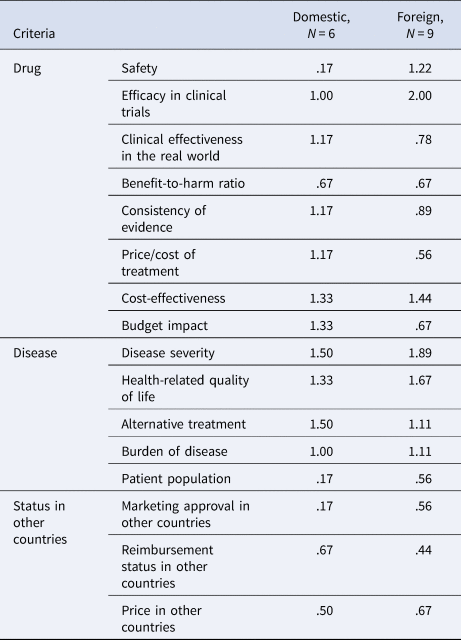
Table 1 presents the relevance of suggested criteria for reimbursement decisions. All items scored more than 0, indicating that respondents perceived proposed criteria as being appropriate for reimbursement decisions. Responses from the representatives of foreign manufacturers indicated that the efficacy of a drug was a relevant criterion, whereas those of domestic manufacturers indicated that disease severity and presence of alternative treatment were relevant criteria. We asked for the first, second, and third most important criteria for reimbursement decisions and assigned them 3 points, 2 points, and 1 point, respectively. Domestic manufacturers perceived clinical effectiveness (8 pts), efficacy (5 pts), and disease severity (5 pts) as the three most important criteria, whereas foreign manufacturers responded that disease severity (19 pts), efficacy (11 pts), and health-related quality of life (9 pts) were the three most important criteria. Cost effectiveness as the core value of health technology assessment was not one of the most important criteria for domestic or foreign manufacturers.
Relevance of criteria in making reimbursement decisions

Supplementary Appendix 2 shows perceived interest and influence of various stakeholders in reimbursement decisions. A value of more than 1 point was assumed to be strong. Based on these values, we categorized stakeholders into three types: a group with strong interests and strong influence, a group with strong interests but weak influence, and a group with weak interests and weak influence. Domestic and foreign manufacturers perceived the HIRA, NHIS, MOH and physicians as a group that had strong interests and strong influence. They perceived manufacturers and patients as a group that had strong interest but weak influence. A difference was also noted between domestic and foreign manufacturers. Foreign manufacturers responded that consumers and experts in public health had strong interest and strong influence. However, domestic manufacturers perceived consumers as a group with strong interests but weak influence, whereas they perceived experts in public health as a group with weak interest and weak influence.
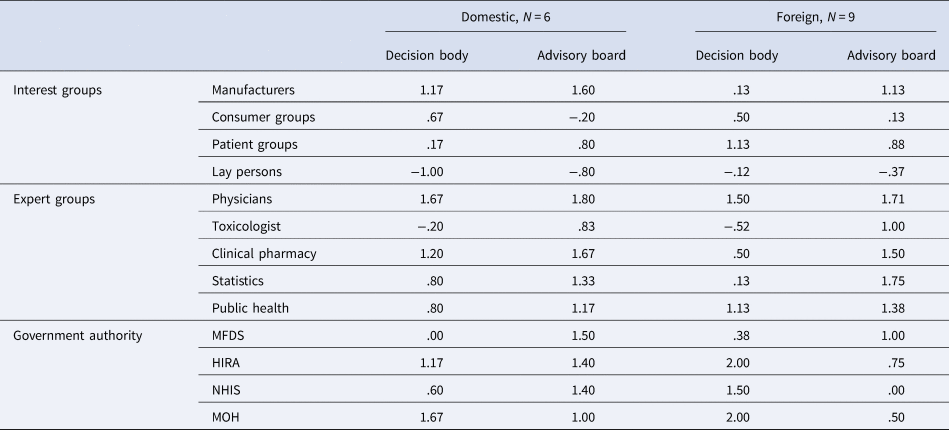
Table 2 presents the relevance for the participation of various stakeholders in health technology assessment. Domestic manufacturers responded that the Ministry of Health and Welfare (MOH), physicians, and clinical pharmacists were relevant members in a decision-making body. They responded that physicians, clinical pharmacists, manufacturers, and the Ministry of Food and Drug Safety (MFDS) were relevant members in an advisory board. Similarly, foreign manufacturers reported that the MOH, HIRA, and physicians were relevant members in a decision-making body. They reported that experts in statistics and clinical pharmacists were relevant members in an advisory board. We also compared the value of a certain stakeholder between being a member of a decision body and being a member of an advisory board. Domestic manufacturers perceived that it was more appropriate for the MOH and consumers to be members of a decision-making body than to be members of an advisory board.
Relevance for the participation of various stakeholders in a decision-making body and an advisory board

Note: MFDS, Ministry of Food and Drug Safety; HIRA, Health Insurance Review and Assessment Service; NHIS, National Health Insurance Service; MOH, Ministry of Health and Welfare.
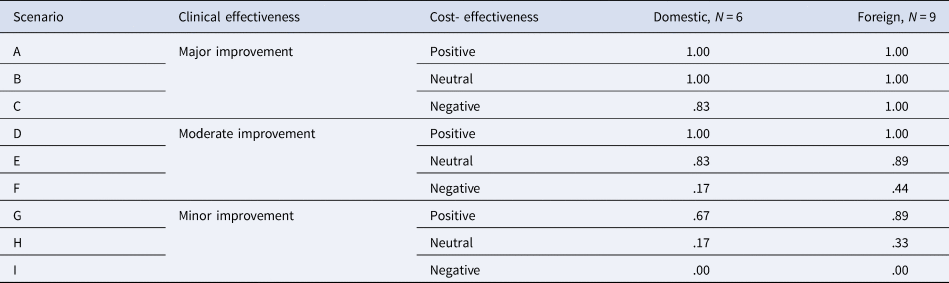
Table 3 describes opinions about the appropriateness of reimbursement decisions with nine scenarios in clinical and cost-effectiveness. Clinical effectiveness was categorized into major, moderate, and minor improvement groups. Cost-effectiveness was grouped into positive, neutral, and negative groups. The position in reimbursement decision was measured as a binary variable (1: reimbursement; and 0: nonreimbursement). All respondents agreed that a drug with major or moderate improvements and positive cost-effectiveness would be eligible for reimbursement. They disagreed that a drug with minor improvements and negative cost-effectiveness was eligible for reimbursement. Notably, all reported values were higher for foreign manufacturers than for domestic manufacturers.
Opinions about reimbursement decisions with various scenarios in clinical- and cost-effectiveness

Note: 1: reimbursement, 0: nonreimbursement.
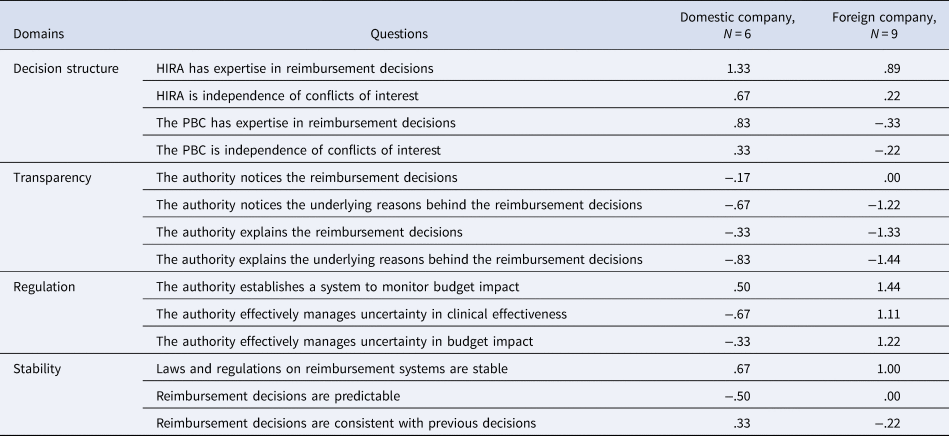
Table 4 presents survey results for decision structure, transparency, regulation, and stability. We separated the decision structure into HIRA (a decision body) and PBC (an advisory board) and asked about their expertise and conflicts of interest. Domestic and foreign manufacturers perceived that HIRA had expertise in reimbursement decisions and independence from conflicts of interest. However, they presented different stances on PBC. Domestic manufacturers rated higher scores for expertise and independence from conflicts of interest for PBC than foreign manufacturers. We asked about the transparency in terms of noticing and explaining reimbursement decisions and the underlying reasons behind such decisions. The respondents were negative about explaining reimbursement decisions and the underlying reasons.
Survey results on decision structure, transparency, regulation, and stability

Note: HIRA, Health Insurance Review and Assessment Service; PBC, Pharmaceutical Benefits Committee.
Discussion
For over a decade, health technology assessment has been under pressure to evolve in a changing policy environment. New drugs that have uncertainties in clinical effectiveness make health technology assessment more complex and debatable (Reference Sherman, Anderson, Dal Pan, Gray, Gross and Hunter12;Reference Demets13). Furthermore, various stakeholders with strong interests consistently requested “more informed, transparent, and politically legitimate decisions” for health technology assessment (Reference Siddiqi, Masud, Nishtar, Peters, Sabri and Bile29). Health technology assessment systems have developed an integrated/comprehensive reimbursement decision-making process to draw up accountable reimbursement decisions. However, gaps between regulations and perceptions of various stakeholders still exist.
Manufacturers’ Perceptions of Health Technology Assessment
Researchers have argued that health technology assessment should go beyond safety, efficacy, and cost-effectiveness and include various elements, such as budget impact, financial protection, and equity (Reference Tanios, Wagner, Tony, Baltussen, van Till and Rindress30–Reference Goetghebeur, Wagner, Samaha, O'Neil, Badgley and Castro-Jaramillo32). In line with this concept, representatives of manufacturers responded that disease severity, budget impact, existence of alternative treatment, and health-related quality of life were relevant criteria when making reimbursement decisions besides efficacy and cost-effectiveness. Interestingly, although cost-effectiveness was assumed as an essential component of health technology assessment, it was not one of the most important criteria for making reimbursement decisions according to manufacturers. These findings imply that manufacturers agree that an integrated/comprehensive health technology assessment plays an important role in reimbursement decision making.
The difference between foreign and domestic manufacturers in terms of managing the risk was noteworthy. Compared with domestic manufacturers, foreign manufacturers were risk takers when making reimbursement decisions. Foreign manufacturers were more likely to present positive reimbursement decisions on a new drug with minor improvements and neutral or negative cost-effectiveness. In a similar vein, they gave a lower score to budget impact as a relevant criterion, implying that foreign manufacturers were less conscious of pharmaceutical expenditure. Finally, foreign manufacturers perceived that uncertainties of clinical effectiveness and budget impact of new medicines had been positively managed by the government authority, whereas domestic manufacturers responded that such uncertainties had not been positively managed by the government authority. The difference between foreign and domestic manufacturers seemed to be associated with their product portfolios. Compared with domestic manufacturers, foreign manufacturers had more negative experiences such as denial of reimbursement and/or price cut during a health technology assessment. Furthermore, a majority of highly priced new drugs with uncertainties would be introduced by foreign manufacturers in the foreseeable future.
Globally, there is a growing interest in using real-world data and real-world evidence (RWD/RWE) for health technology assessment (Reference Oortwijn, Sampietro-Colom and Trowman33). In particular, countries in Asian could benefit from RWD/RWE because Asian populations are not well represented or recruited in clinical trials (Reference Lou, Sarin, Toh, Dabak, Adler and Ahn34). Furthermore, marketing authorization does not guarantee reimbursement decision in South Korea, allowing RWD/RWE to be used in health technology assessment to provide more certainty when making reimbursement decisions (Reference Lou, Sarin, Toh, Dabak, Adler and Ahn34). However, foreign manufacturers were risk-averse when evaluating new drugs with uncertainties using RWD/RWE. This negative perception of foreign manufacturers toward the utilization of clinical effectiveness in reimbursement decisions could be explained by various factors. First, health systems to utilize RWD/RWE in health technology assessment have not been well established in South Korea (Reference Byun35). A systematic framework to collect relevant data, to standardize analysis, and to draw a consistency decision has not been introduced yet. Second, the health technology assessment system itself has a lot of room for improvement in South Korea from the perspective of manufacturers (Reference Oortwijn, Determann, Schiffers, Tan and van der Tuin27). For instance, foreign manufacturers argued that the current health technology system emphasized financial issues rather than access to valuable medicines (Reference Yoo, Kim, Lee, Kang, Kim and Lee28). Thus, foreign manufacturers might expect that the government would utilize clinical effectiveness in health technology assessment to manage price and pharmaceutical expenditure.
Room for Improvement in Health Technology Assessment
From the view of manufacturers, we found room for improvement in the decision-making process. The scope and meaning of accountability have been extended (Reference Brinkerhoff36;Reference Mulgan37). However, the core value of accountability involves informing and explaining. Representatives of manufacturers described that the reimbursement decision process was a black box of policy making. Foreign manufacturers argue that the HIRA sets the general direction of the reimbursement decision through coordination with the MOH during an internal review process. The PBC then appraises the appropriateness of reimbursement within the general direction. Finally, the HIRA determines the reimbursement decision (Reference Bae and Lee17;Reference Bae, Hong, Kwon, Jang, Lee and Bae18). Manufacturers described that the internal review process as the first stage was a black box of policy making. In particular, foreign manufacturers argued that the appropriateness of a new drug for reimbursement would be predetermined during an internal review process before appraisal by the PBC. This perception of foreign manufacturers seemed to be partially associated with their negative opinions about the role of the PBC in terms of expertise and conflicts of interest. To address these issues, foreign manufacturers requested explanation for the underlying reasons behind the reimbursement decision.
The unbiased participation of various stakeholders during a decision-making process is essential in terms of accountability (Reference Thurston, MacKean, Vollman, Casebeer, Weber and Maloff38). Manufacturers perceived reimbursement decisions as a social value judgment and emphasized the participation of various stakeholders in the decision-making process. In particular, manufacturers requested their active roles in the decision-making process, although current regulations ensured that manufacturers could participate and voice their opinions during the reimbursement process. Gaps between regulations and perceptions of manufacturers when evaluating health technology assessment are noteworthy. In addition to their participation in the decision-making process, manufacturers also pointed out gaps in the appeal process (Reference Oortwijn, Determann, Schiffers, Tan and van der Tuin27). Regarding regulations, several opportunities exist to appeal reimbursement decisions through a face-to-face meeting with the HIRA, requesting reconsideration, and an independent review process. However, manufacturers perceived that appeals would be accepted rarely in practice (Reference Oortwijn, Determann, Schiffers, Tan and van der Tuin27).
For over a decade, the involvement of the public in making health policy has received great attention (Reference Mitton, Smith, Peacock, Evoy and Abelson39;Reference Keeney, Von Winterfeldt and Eppel40). Measures to involve the public in making policy range from the representatives of lay persons in an advisory board and/or decision-making body to their consultative roles solicited through surveys or interviews (Reference Abelson, Bombard, Gauvin, Simeonov and Boesveld41;Reference Oortwijn and Klein42). Furthermore, the participation of lay persons has been recommended in various areas to strengthen the legitimacy of the policy. South Korea had policy experience in the participation of lay persons, named the Citizen Committee for Participation, to make recommendations for forty-five medical service items with potential benefit expansion (Reference Oh, Ko, Baer Alley and Kwon43). However, manufacturers were against any roles of lay persons in the decision-making process for reimbursement. They perceived that lay persons were not relevant members for informing decisions or making decisions due to their lack of interest and expertise. These negative opinions might partially reflect characteristics of the study topics investigated in the present study. This study had a primary interest in making reimbursement decisions for a certain new drug that required very specific knowledge about the drug and diseases. Lay persons can participate in overall issues, including goals of reimbursement decisions and priority setting among competing drugs, rather than a certain specific issue. However, the majority of new drugs will require specific knowledge to understand their adoption in the health systems. In this context, the embedded role of lay persons in decision making such as informing decisions or making decisions should be discussed further. Several literatures have discussed the role of lay persons in health technology assessment (Reference Abelson, Bombard, Gauvin, Simeonov and Boesveld41;Reference Oortwijn and Klein42). In particular, a deliberative process with informed citizens in health technology assessment can improve the legitimacy of reimbursement decisions (Reference Abelson, Bombard, Gauvin, Simeonov and Boesveld41;Reference Oortwijn and Klein42).
Study Limitations
This study has some limitations. First, this study performed health technology assessment in South Korea. Its findings and implications to strengthen systems could not be generalized to other countries with different settings and contexts. However, the perceptions of manufacturers about health technology assessment are likely to be similar across countries. The implications suggested in this study will provide insights for developing an accountable and legitimate health technology assessment system. Second, this study conducted surveys and interviews of domestic and foreign manufacturers, whereas other groups such as members of academia, government authorities, and patients were excluded. Thus, the majority of our results were solely based on perceptions of manufacturers. Third, the findings of this study should be interpreted cautiously, given that pharmaceutical governance might be a target for those who undermine the system in pursuit of private interests in these countries. Finally, this study included a limited number of survey samples. Further research with a larger sample size is needed to explore interesting topics raised in this research and fully understand manufacturers’ perceptions of health technology assessment. For instance, the lack of enthusiasm from manufacturers for RWD/RWE as a means to address uncertainties and ambiguities regarding public participation and their embedded roles in decision making could benefit from further research.
Conclusions
This study evaluated manufacturers’ perceptions of the decision-making process for new drug reimbursement. They perceived the importance of an integrated/comprehensive health technology assessment in reimbursement decision making. Compared with domestic manufacturers, foreign manufacturers were risk takers when making reimbursement decisions in terms of adopting a new drug and managing pharmaceutical expenditure. However, foreign manufacturers were risk-averse when evaluating new drugs with uncertainties such as clinical effectiveness using real-world data. Based on manufacturers’ perceptions, we found room for improvement in health technology assessment systems. Explaining the underlying reasons behind reimbursement decisions, unbiased participation by various stakeholders and their embedded roles in the decision-making process are prioritized areas to be addressed. However, suggested measures should be introduced with caution. The process of health technology assessment might be a target for those who try to undermine the system in pursuit of their private interests.
Supplementary material
The supplementary material for this article can be found at https://doi.org/10.1017/S0266462321000489.
Acknowledgments
We acknowledge research support from the Korea Institute for Health and Social Affairs. The funding source had no involvement in the study design, the collection, analysis, and interpretation of data, in the writing of the report, and in the decision to submit the article for publication.
Funding
This work was supported by the Ministry of Education of the Republic of Korea and the National Research Foundation of Korea (NRF-2019S1A5A8032445).
Conflict of Interest
The authors declare no conflicts of interest.