Introduction
The coffee leafminer, Leucoptera (=Perileucoptera) coffeella (Guérin-Méneville & Perrottet) (Lepidoptera: Lyonetiidae), is an important and widely distributed pest among the main coffee-producing countries in the Neotropical region (Green, Reference Green1984; Sanchez-De Leon, Reference Sanchez-De Leon1984; Souza et al., Reference Souza, Reis and Rigitano1998). Consumption of palisade parenchyma by L. coffeella larvae reduces the photosynthetic leaf area and causes early senescence of infested coffee leaves. This leads to a reduction in yield and quality of coffee beans, also reducing plant longevity. In Brazil, the world's biggest coffee producer, yield losses caused by L. coffeella average 40% annually, but they can reach up to 80% under high population densities of L. coffeella and if control tactics are not properly employed (Reis & Souza, Reference Reis and Souza1996; Gallo et al., Reference Gallo, Nakano, Silveira-Neto, Carvalho, Baptista, Berti-Filho, Parra, Alves, Vendramin, Marchini, Lopes and Omoto2002). The economic importance of L. coffeella has increased since the expansion of coffee plantations in Brazil during the 1970s due to changes in the cultural practices, and it is currently considered the main coffee pest in the country (Souza et al., Reference Souza, Reis and Rigitano1998; Fragoso et al., Reference Fragoso, Guedes, Picanço and Zambolim2002a, Reference Fragoso, Guedes and Ladeira2003).
Because of the perennial nature of the coffee crop and the relatively recent increase in the importance of L. coffeella, resistant varieties of Coffea arabica are not available to aid in the leafminer management. As a result, coffee producers rely mainly on insecticides to control leafminer populations, especially organophosphates and pyrethroids, which is not desirable due to their high toxicity to non-target arthropods (Gusmão et al., Reference Gusmão, Picanço, Gonring and Moura2000; Fragoso et al., Reference Fragoso, Jusselino-Filho, Guedes and Proque2001, Reference Fragoso, Jusselino Filho, Pallini Filho and Badji2002b), potentially leading to resurgence and secondary pest outbreaks. Insecticide resistance in populations of L. coffeella has already been reported and is related to high rates of insecticide application (Fragoso et al., Reference Fragoso, Guedes, Picanço and Zambolim2002a, Reference Fragoso, Guedes and Ladeira2003). Resurgence and insecticide resistance may induce coffee producers to increase rates of insecticide use against the leafminer, which raises concerns of residues in the final product. Thus, development of a robust integrated management system is essential to avoid these problems.
A key step in devising sound pest management programmes is to understand how the components of the agroecosystem interfere with the attack intensity of a pest species to the host crop. Among these components, natural enemies, weather conditions and host-plant attributes are the most important factors affecting population dynamics of pest species. Multiple abiotic and biotic mortality factors act on L. coffeella populations. These factors may be naturally occurring (e.g. natural enemies, host-plant effects and weather) or man-made (e.g. cultural manipulations and insecticide use). These factors interact in coffee agroecosystems, and an understanding of the timing and magnitude of these factors is central to the study of population dynamics and development of suitable pest management systems.
Occurrence of natural enemies of L. coffeella has been reported in coffee agroecosystems (Gravena, Reference Gravena1983; Campos et al., Reference Campos, Decazy and Carrillo1989; Souza et al., Reference Souza, Reis and Rigitano1998), but their relative importance remains unknown. Correlation between weather variables and fluctuation of population density of the coffee leafminer has also been observed (Souza et al., Reference Souza, Reis and Rigitano1998; Bacca et al., Reference Bacca, Lima, Picanço, Guedes and Viana2006). The attack of the coffee leafminer intensifies in periods of limited rain, which was attributed to the lack of impact of rainfall on the insect populations (Villacorta, Reference Villacorta1980); but the relative importance of this factor in the natural mortality of L. coffeella has yet to be assessed. Host-plant attributes such as morphological traits, nutrients and chemical agents of plant defence can affect the performance and mortality of L. coffeella and may play an important role in its population dynamics. These factors can reduce the egg viability and affect physiological processes during moulting and metamorphosis, thus increasing insect mortality during its development (Awmack & Leather, Reference Awmack and Leather2002).
Natural mortality is an important determinant of the population dynamics of a species, and an understanding of mortality forces should aid in the development of management strategies for insect pests. One of the main tools used in studies of population dynamics is the construction of ecological life tables, which allow qualitative and quantitative assessment of the mortality factors (Harcourt, Reference Harcourt1969; Miranda et al., Reference Miranda, Picanço, Zanuncio and Guedes1998; Gonring et al., Reference Gonring, Picanço, Guedes and Silva2003). By identifying and quantifying the causes of death, the key factors and critical stages of mortality of the insect under study can be identified, aiding in the development of suitable management strategies. The objective of this study was to build and analyze ecological life tables for the coffee leafminer in different seasons, aiming to identify the key factors and critical stages of L. coffeella mortality in each season.
Material and methods
Study site and periods of the year studied
This research was carried out in Viçosa county (20°48′45″S; 42°56′15″W; altitude 600 m), State of Minas Gerais, Brazil. Life-table data were colleted from insecticide-free plots within a 3 ha coffee plantation of Coffea arabica cultivar, Catuaí, in the phenological stage of production. Apart from the absence of any artificial control method against L. coffeella, standard agronomic practices were carried out in the area (Zambolim, Reference Zambolim2001).
Factors affecting the natural mortality of the coffee leafminer were studied in two periods in 2001/2002 and in three parts of the canopy. The periods were December to January (high rainfall, 750 mm) and May to June (low rainfall, 42 mm); the three parts of the coffee tree canopy were the upper, median and lower thirds. The periods were chosen to represent seasons of distinct rainfall, which was monitored by the Central Weather Station of the Federal University of Viçosa.
Leafminer life history
Moths of L. coffeella colonise only coffee plants. The eggs are laid singly, or in small groups, on the upper leaf surface. Hatching occurs within 7–12 days through the egg side in contact with the leaf surface, and neonates initiate the feeding on the palisade parenchyma. The larvae are unable to move to another leaf and do not leave their mines until close to pupate. The epidermis turns yellowish, then brown, and eventually forms a fragile scab with continued larva feeding. The eggs remain permanently on the scab, and this gives an easy method of estimating the number of larvae present. Upon completion of the larval stage, which lasts 9–40 days, the larvae leave the communal mine and pupate on the lower surfaces of the leaves, mainly in the lower canopy. Metamorphosis completes within 4–26 days, resulting in a satiny-white, 2-mm-long moth that lives about 15 days. Eight to twelve continuous and overlapping generations occur per year in the field, but up to 17 generations have been reported in the laboratory (Box, Reference Box1923; Speer, Reference Speer1949; Parra et al., Reference Parra, Lara and Silveira Neto1995; Souza et al., Reference Souza, Reis and Rigitano1998).
Cohort establishment and assessment of mortality factors
Three plots (blocks) of the coffee plantation were used to study the natural mortality of L. coffeella in each period of the year and part of the coffee tree canopy. Cohorts of eggs were identified on the upper sides of coffee leaves from each experimental plot. Newly-laid eggs were identified by their shiny, pale-yellow colour. A circle was drawn around the egg groups using a fine-point permanent marker. A numbered tag was placed around the petiole of the leaf and a flag fixed around the main stem of the plant to allow recognition. The canopy of each plant was divided into three thirds. Four leaves per third of the canopy were used, each one spaced about 90° from another. Plants were evenly spaced along the central 10–12 rows of each plot. A minimum of 150 eggs was marked in each plot for each third of the canopy. One set of cohorts was established in mid-December 2001 (rainy season) and the other in late May 2002 (dry season). Following cohort establishment, causes of death were monitored daily until the individuals had died or emerged as adults (Miranda et al., Reference Miranda, Picanço, Zanuncio and Guedes1998).
Egg mortality was assessed with the aid of a 10× magnifier. The eggs not found on the marked leaves were considered eaten by predators, as were larvae in mines with signs of predation. Mines attacked by predatory wasps are easily distinguishable by their torn surfaces. In addition, the mines were examined for the presence of remaining larvae when signs of predation were found. Exit holes of parasitoids are also visible on the upper surfaces of mines; but, to assign mortality to particular parasitoid species, host samples were drawn from the field population and reared in the laboratory. A similar procedure was used to assign mortality to other sources as described below.
Egg inviability and larval mortality by rainfall and entomopathogens
Egg inviability was difficult to determine in the field even with a lens; thus, 30–40 leaves containing eggs were collected from each third of the canopy in each plot after 10–12 days of cohort establishment and examined under a dissecting microscope of 40×magnification in the laboratory.
Because of the endophytic feeding behaviour of L. coffeella, it was difficult to assign mortality caused by rainfall to the individuals from the original cohorts. To address this issue, whenever rainfall occurred during the period that the cohorts were in the larval stage, 360 leaves mined by L. coffeella were collected (40 per third of the canopy in each plot) for evaluation of the rainfall impact on larval mortality. The leaves were taken to the laboratory where mines were dissected under the microscope. Larvae found dead in mines flooded with water from rainfall were considered dead due to this factor. This procedure was tested in the absence of rainfall and more than 95% of the larvae were alive. Therefore, when dead larvae were found after rainfall, and no signs of entomopathogens were found, the cause of death was assigned to rainfall. The larvae showing signs or symptoms of disease by fungi, bacteria or viruses, according to the symptoms described by Poinar & Thomas (Reference Poinar and Thomas1978) and Alves (Reference Alves1986), were considered dead by these agents.
Parasitoidism and death by incomplete moulting and metamorphosis
An attempt was made to estimate the generational mortality by parasitoids following Van Driesche (Reference Van Driesche1983). When the cohorts were approaching the end of the larval stage, recognized by the mine shape and aspect, 100 leaves containing mines of age comparable to those of the marked leaves were collected from each third of the canopy in each plot. The leaves were taken to the laboratory, and the percent of larvae attacked was determined by incubation until parasitoid emergence or larvae pupation, as adapted from Reis et al. (Reference Reis, Lima, Vilela and Barros2000b). Briefly, the leaves were maintained under conditions of temperature, relative humidity and photoperiod similar to those they face in the field. Cups were checked daily and emerging parasitoids were removed, keyed to genus or species (Zucchi et al., Reference Zucchi, Precetti and Parra1979) and compared with descriptions (Penteado-Dias, Reference Penteado-Dias1999); and a collection of L. coffeella parasitoids was identified by Dr. Penteado-Dias (Federal University of São Carlos, Brazil). Leafminers that pupated were individually placed into 10-ml glass containers covered with vented parafilm. All mines were dissected after seven days. Dead larvae, from which no parasitoid emerged, were checked for the presence of signs and symptoms of entomopathogens using a light microscope of 400× magnification (Poinar & Thomas, Reference Poinar and Thomas1978; Alves, Reference Alves1986); and those found attached to their exuviae were assigned mortality by malformation during moulting. Glass containers with pupae were checked after 15 days, time sufficient for emergence of either moths or parasitoids. The emerged parasitoids were identified as described above. Leafminer pupal cocoons were examined for the presence of parasitoids that did not emerge and for malformation during metamorphosis.
Pupa samples were also drawn from the field population to verify emergence of parasitoids in this stage and determine mortality by malformation (non-emergence). The procedures used were similar to those described for larval parasitism.
Construction and analyses of life tables
Egg mortality was measured in the field, allowing the calculation of the number of neonate larvae in each cohort. In the larval stage, mortality by rainfall, parasitism, diseases and malformation during moulting, and metamorphosis was estimated from the samples drawn from the field population. Mortality by predaceous wasps was directly measured in the field since attacked mines are easily recognised by their torn surfaces. By combining data obtained in the field and laboratory, mortality caused by each agent was calculated, allowing estimation of the number of individuals dying in the larval stage and numbers entering the pupal stage. Finally, pupa mortality by malformation and parasitism was estimated from samples drawn from the field, allowing the number of adults produced from the initial cohorts to be obtained.
Standard methods were used to construct life tables (Southwood & Henderson, Reference Southwood and Henderson2000). For comparative purposes, net reproductive rates (R 0) were estimated by dividing the number of eggs expected to be produced in the next generation by the original number of eggs in the cohort [R 0=(number of adults surviving from the original egg cohort×sex ratio×fecundity)/original number of eggs in cohort]. A sex ratio of 1:1 and a fecundity of 36 eggs per female were assumed (Speer, Reference Speer1949).
Mortality due to egg inviability, rainfall, predation, para-sitism, incomplete moulting and metamorphosis occurred contemporaneously in the field. The concepts proposed by Royama (Reference Royama1981), and later elaborated by Buonaccorsi & Elkinton (Reference Buonaccorsi and Elkinton1990) and Elkinton et al. (Reference Elkinton, Buonaccorsi, Bellows and Van Driesche1992), were used to estimate stage-specific, marginal rates of mortality for each factor based on observed (i.e. apparent) stage-specific mortalities. The marginal rate estimates the level of mortality arising from a single factor as if it were the only factor operating. For each mortality factor, it was assumed that there is an underlying distribution for time to death due to that factor (Elkinton et al., Reference Elkinton, Buonaccorsi, Bellows and Van Driesche1992). Rainfall mortality was not obscured by any other factor; and, therefore, its marginal mortality equals the apparent mortality. Incubation of collected mines and pupae in the laboratory allowed measurement of apparent rates of parasitism and post-collection mortality due to other factors. Because the disappearance of eggs (associated with rainfall in the rainy season and predation in the dry season) was directly measured and because no egg parasitism was detected, the marginal death rate of disappearance was equal to its measured apparent mortality. It was assumed that the probability of predation was equal for parasitized and non-parasitized larvae. For all other mortality factors, marginal rates of death were estimated from the standard equations (Buonaccorsi & Elkinton, Reference Buonaccorsi and Elkinton1990; Elkinton et al., Reference Elkinton, Buonaccorsi, Bellows and Van Driesche1992). For most subsequent analyses, mortalities were expressed as k-values (k=−log (1−m)), where m is the marginal rate of mortality for a given factor in a given developmental stage. The use of k-values is convenient because they are additive across stages and mortality factors. Also k-values can be converted back into proportional mortality rates by (1−10−k).
Irreplaceable or indispensable mortality is that portion of total generational mortality that would not occur if a given mortality factor were eliminated (Southwood & Henderson, Reference Southwood and Henderson2000). Irreplaceable mortality was estimated for each mortality factor and each developmental stage following Carey (Reference Carey1989) and Naranjo & Ellsworth (Reference Naranjo and Ellsworth2005). The effect of irreplaceable mortality on R 0 was estimated as the difference between R 0 without the irreplaceable mortality in question, and with all mortality.
A two-way analysis of variance (anova) was carried out to test the main effects season, canopy and the season×canopy interaction on the total life cycle mortality and mortality of each immature stage of L. coffeella (proc mixed; SAS Institute, 2002). The assumptions of the analysis of variance were checked using the univariate and qplot procedures (proc univariate, proc gplot; SAS Institute, 2002). Critical stages and key mortality factors were identified through correlation analyses between partial stage-specific mortality and total mortality of all stages combined (Varley et al., Reference Varley, Gradwell and Hassell1973). When more than one stage or key mortality factors showed significant correlation, linear regression analysis of partial or total mortality were performed; and the critical stage, or key mortality factor, was the one which displayed a steeper slope at P<0.10 (Podoler & Rogers, Reference Podoler and Rogers1975).
Results
Seasonal variation in mortality of L. coffeella
Analysis of variance indicated that the total life cycle morality of L. coffeella during the rainy season was higher than during the dry season (F 1,12=16.19, P=0.002), as was the egg and larval mortality (F 1,12=49.19, P<0.001 and F 1,12=26.35, P<0.001, respectively). Pupal mortality, however, was higher during the dry season (F 1,12=11.93, P=0.005). No significant variation in mortality (P>0.10) was observed among the thirds of coffee tree canopy, and the effect of the interaction season of the year×third of the canopy on the leafminer mortality was also not significant.
Characterizing mortality in the rainy and dry seasons
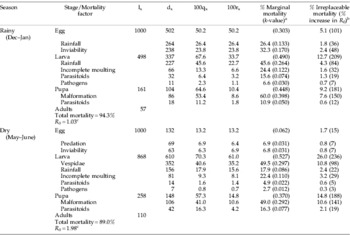
Summary life tables for L. coffeella in the rainy and dry seasons are presented in table 1. Values for each season represent the average of nine life tables (from three plots and three parts of the canopy). During the rainy season, the total natural mortality of immature stages averaged 94.3% with 50.2, 33.7 and 10.4% occurring during egg, larval and pupal stages, respectively. During the dry season, however, total mortality was 89% with 13.2, 61.0 and 14.8% occurring during egg, larva and pupa stages, respectively. Because of the difference in natural mortality during the two seasons, only 57 moths emerged out of 1000 eggs in the rainy season, whereas 110 adults emerged in the dry season. Assuming a sex ratio of 1:1 and average fecundity of 36 eggs per female (Speer, Reference Speer1949), the net replacement rate (R 0) of L. coffeella during the rainy season was 1.03 while during the dry season it reached 1.98 females/female.
Summary life table for Leucoptera coffeella in the rainy and dry seasons of 2001/2002 in Viçosa county, State of Minas Gerais, Brazil.

lx, number of insects alive at the beginning of each stage; dx, number of insects killed by a factor; 100qx, apparent percent mortality or the percent of insects killed by a factor in a stage (100qx=100×dx lx−1); 100rx, real percent mortality (100rx=100×dx l0−1).
Values for each season represent the mean of nine life tables. Each cohort was initiated with >150 newly laid eggs; results were normalised by setting l0=1000.
a Marginal mortality is the percent of insects in a given stage attacked by a given mortality factor. The k-values represent the marginal mortality expressed in logarithm scale (k=−log [1−(M/100)]), where M is the marginal mortality for a given factor in a given stage; k-values are additive across stages and mortality factors.
b Irreplaceable or indispensable mortality is the percent of total generational mortality that would not occur if a given mortality factor were eliminated. The effect of irreplaceable mortality on R 0 was estimated as the percent increase in R 0 without the irreplaceable mortality in question.
c Average fecundity was set to 36 eggs per female and the sex ratio to 50:50 (Speer, Reference Speer1949).
No egg parasitism was detected in this study, but egg inviability and disappearance were observed. Egg disappearance was associated with rainfall in the rainy season, but associated with predation by arthropods in the dry season. Multiple abiotic and biotic mortality factors acted on the larval stage of L. coffeella. These factors included rainfall, predators (vespid wasps), parasitoids, pathogens and physiological factors (observed as incomplete moulting and malformation). In the rainy season, mortality factors with the highest marginal mortality rates were malformation during metamorphosis (60%), rainfall (45.6%) and egg inviability (32.3%); in contrast, during the dry season, the main mortality factors were vespid wasps (49.5%), malformation during metamorphosis (49%), and incomplete moulting (22.4%) (table 1).
Estimated marginal mortality by parasitic wasps was 15.6% in the rainy season and 4.9% in the dry season (table 1). In the rainy season, the parasitoid species recorded and their respective marginal mortalities were Centistidea striata Penteado-Dias (6.8%) and Orgilus niger Penteado-Dias (1.5%) (both Braconidae), and Horismenus sp. (4.8%), Cirrospilus sp. (1.0%), Closterocerus coffeellae Inhering (1.2%) and Proacrias coffeae Inhering (0.3%) (all Eulophidae). In the dry season, the recorded parasitoids were Horismenus sp. (2.9%), C. striata (1.6%) and C. coffeellae (0.4%). Parasitoid species parasitizing L. coffeella larvae were also observed emerging from pupae. In the rainy period, 10.9% of pupae were killed by the parasitoids, C. striata (6.2%), Horismenus sp. (4.1%), O. niger (0.4%), C. coffeellae (0.2%) and Cirrospilus sp. (0.1%). In the dry period, pupal mortality by parasitoidism was higher, averaging 16.3%, and was caused by C. striata (11.6%) and Horismenus sp. (4.7%). Pooled across life stages, hymenopteran parasitoids were responsible for 26.5% of marginal mortality during the rainy season (17.3% of apparent mortality) and for 21.3% of marginal mortality during the dry season (17.9% of apparent mortality). If parasitoids were eliminated from the life system and no compensation in mortality occurred due to other factors, there would be a 31% increase in the population growth (R 0) of the leafminer in the rainy season and a 24% increase in R 0 in the dry season (table 1, last column).
Main life stages contributing to variation in L. coffeella mortality
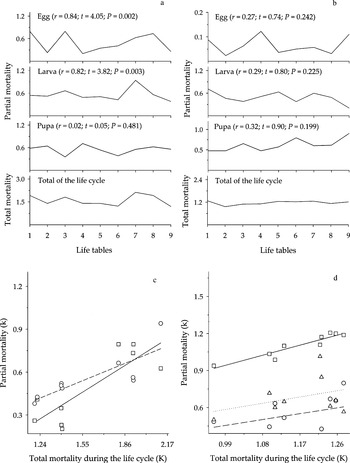
Mortality curves of L. coffeella during the egg and larval stages were those which displayed greater similarity to the total mortality curve in the rainy season, as indicated by the positive and significant correlation coefficients (fig. 1a). The slopes of egg and larval mortality were similar as indicated by overlapping 90% confidence intervals (fig. 1c); and, therefore, both stages determined the population size of the leafminer.
Correlation of partial, stage-specific mortalities with the total generational mortality of Leucoptera coffeella in the rainy season (a) and the dry season (b), and regression of stage-specific mortality on total mortality in the rainy season (–□——□–) Egg (k=−0.47+0.60K; CI=0.32−0.89) F=16.43; P=0.005; (–○——○–) Larva (k=−0.07+0.39K; CI=0.20−0.59) F=14.57; P=0.007 (c) and the dry season (–□——□–) Larva+Pupa (k=0.04+0.91K; CI=0.64−1.14) F=52.64; P<0.001; (–○——○–) Egg+Larva (k=−0.07+0.53K; CI=−0.46–1.52) F=1.03; P=0.345; (··△····△) Egg+Pupa (k=0.03+0.56K; CI=−0.47–1.60) F=1.07; P=0.336 (d). CI represents 90% confidence interval for slopes.

None of the stage mortality curves displayed significant similarity to the total mortality curve in the dry season (fig. 1b). Nevertheless, when larval and pupal mortality curves were combined, they showed a significant relationship with the total mortality curves (fig. 1d), indicating that the combination of larval and pupal mortality determined the population size of the coffee leafminer in the dry period of the year.
Factors contributing to variation in egg mortality
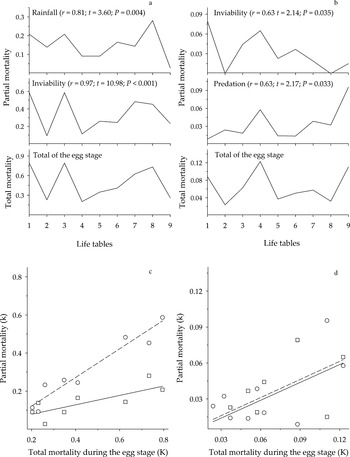
Mortality curves caused by egg inviability and rainfall showed significant similarity to the egg mortality curve during the rainy season (fig. 2a). Egg inviability displayed higher slope in the regression analysis, as indicated by the non-overlapping 90% confidence intervals (fig. 2c); and, therefore, it is the primary factor responsible for variation in egg mortality. For the dry period of the year, however, both predation and egg inviability were responsible for variation in egg mortality as they both correlated significantly with egg morality (fig. 2b) and showed similar slopes (fig. 2d).
Correlation of partial mortality by each factor with total egg mortality of Leucoptera coffeella in the rainy season (a) and the dry season (b), and regression of partial mortality due to different causes (k) on total egg mortality (K) in the rainy season (–□——□–) Rainfall (k=0.03+0.25K; CI=0.12–0.38) F=12.97; P=0.009; (–○——○–) Inviability (k=−0.03+0.75K; CI=0.62–0.88) F=120.61; P<0.001 (c) and the dry season (–□——□–) Inviability (k=0.00+0.50K; CI=0.06−0.94) F=4.57; P=0.070; (–○——○–) Predation (k=0.00+0.75K; CI=0.06–0.94) F=4.70; P=0.067 (d). CI represents 90% confidence interval for slopes.

Factors contributing to variation in larval mortality
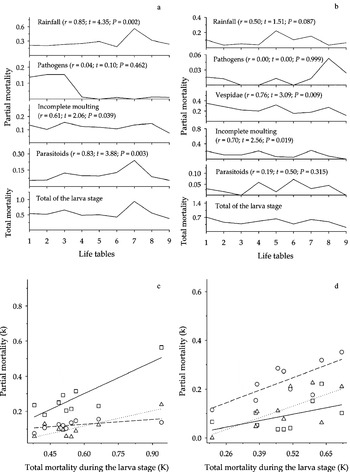
During the rainy period of the year, mortality due to rainfall, parasitism and incomplete moulting correlated significantly with the larval mortality of L. coffeella (fig. 3a). The slope of the rainfall curve was steeper than those of the other factors (fig. 3c), indicating that it is a key factor of larval mortality in the rainy season. Among the parasitoids recorded, P. coffeae, Horismenus sp., C. striata, C. coffeellae and O. niger contributed similarly to variation in larval mortality by parasitism, as indicated by the similar correlation and regression coefficients obtained between their partial mortalities and the total mortality by parasitism.
Correlation of partial mortality by each factor with total larva mortality of Leucoptera coffeella in the rainy season (a) and the dry season (b), and regression of partial mortality due to different causes (k) on total larva mortality (K) in the rainy season (–□——□–) Rainfall (k=−0.06+0.60K; CI=0.34–0.87) F=18.88; P=0.003; (–○——○–) Inc. moulting (k=0.07+0.09K; CI=0.0−0.18) F=4.25; P=0.078; (··△····△··) Parasitoids (k=−0.06+0.29K; CI=0.15–0.43) F=15.06; P=0.006 (c) and the dry season (–□——□–) Rainfall (k=−0.01+0.21K; CI=−0.05–0.46) F=2.29; P=0.174; (–○——○–) Vespidae (k=0.04+0.40K; CI=0.15−0.64) F=9.58; P=0.017; (·△····△·) Inc. moulting (k=−0.06+0.37K; CI=0.09–0.64) F=6.53; P=0.038 (d). CI represents 90% confidence interval for slopes.

In the dry season, predation by Vespidae, incomplete moulting and rainfall correlated with larval mortality (fig. 3b). Regression analysis eliminated rainfall (P>0.10) and indicated a similar contribution of Vespidae and incomplete moulting to variation in larval mortality (fig. 3d). Horismenus sp. was the most important parasitoid in the variation of mortality by parasitism, as mortality by this parasitoid correlated with larval mortality by parasitism.
Factors contributing to variation in mortality of pupae
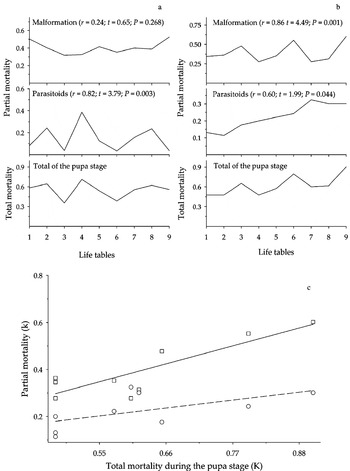
In the rainy season, hymenopteran parasitoids were the main mortality factors contributing to variation in pupal mortality (fig. 4a), with Horismenus sp. and C. striata being the primary species responsible for the variation (r=0.81, t=3.67, P=0.004 and r=0.91 t=5.75, P<0.001, respectively).
Correlation of partial mortality by each factor with the total pupa mortality of Leucoptera coffeella in the rainy season (a) and the dry season (b), and regression of partial mortality due to different causes (k) on total pupa mortality (K) in dry season (–□——□–) Malformation (k=−0.03+0.69K; CI=0.40–0.99; F=20.13; P=0.003); (–○——○–) Parasitoids (k=0.03+0.31K; CI=0.01–0.60; F=3.95; P=0.087) (c). CI represents 90% confidence interval for slopes.

In the dry season, mortality curves caused by incomplete metamorphosis and wasp parasitoids displayed significant similarity with the pupal mortality curve (fig. 4b). Regression of their partial mortality against the total pupal mortality showed that malformation had greater relative importance over parasitoids, as indicated by the non-overlapping 90% confidence intervals for the slopes (fig. 4c). Centistidea striata was the parasitoid species of greater relative importance based on its significant correlation with pupal mortality by parasitism (r=0.64, t=2.17, P=0.033). Therefore, in the dry period of the year, the key mortality factor of pupae of L. coffeella was incomplete metamorphosis, followed by parasitoids. Centistidea striata was the most important parasitoid associated with the variation in pupal mortality by parasitism.
Discussion
Higher mortality of L. coffeella was observed during the rainy season relative to the dry season, and rainfall was one of the main mortality factors observed in the present study. Additionally, the leafminer population growth was close to null (R 0=1) in the rainy season as opposed to the dry season when the estimated net reproductive rate was nearly two, implying an increasing population. These results are in agreement with the fluctuation pattern of L. coffeella populations observed in the Neotropical region (Villacorta, Reference Villacorta1980; Nestel et al., Reference Nestel, Dickschen and Altieri1994; Souza et al., Reference Souza, Reis and Rigitano1998) and reinforce the importance of rainfall as a mortality factor. Moreover, mortality by egg inviability was higher in the rainy season, suggesting that factors and mechanisms leading to egg inviability are associated with weather conditions. The temperature drop associated with rainfall in tropical regions may cause asynchrony of adult emergence leading to a delay in mating, which is known to reduce oviposition and egg viability of L. coffeella (Michereff et al., Reference Michereff, Vilela, Michereff Fillho, Nery and Thiebaut2004). Moth flight and mate finding for reproduction may also be impaired by rainy conditions causing a mating delay as well (Bacca et al., Reference Bacca, Lima, Picanço, Guedes and Viana2006). Therefore, in addition to affecting the natural mortality of the leafminer, weather conditions could also be affecting its reproductive potential, thus playing an important role in the population dynamics of the coffee leafminer.
Key-factor analysis is widely used as the first step in analyzing life table data to identify key factors responsible for population change. Despite the conceptual difficulties in the key-factor analysis outlined by Royama (Reference Royama1996), these analyses showed consistency with the life table data. Rainfall was identified as a key factor of mortality in the rainy season, and indeed it was a major mortality factor (table 1). As expected, the stages vulnerable to this factor (egg and larva) were critical stages of mortality in the rainy season. Likewise, predatory wasps and incomplete moulting and metamorphosis were major mortality factors in the dry season (table 1); and, therefore, the stages in which they exerted their effect were the critical stages of mortality in the dry season, as indicated by the key-factor analysis.
Identification of developmental stages in which the majority of mortality occurs, as well as the primary mortality factors in these stages, have practical implications for pest management. In the dry season, when the coffee leafminer usually displays high population density, pest management programmes should be planned to target stages in which most mortality occurs (i.e. larva and pupa). Since natural enemies are an important source of mortality, conservation biological control is a tactic to be considered. Thus, the population level of key natural enemies should be taken into account when making control decisions, and control practices should be employed to preserve or enhance their activity. If necessary, the use of insecticides should be selective to avoid the elimination of natural enemies of the life system (Reis & Souza, Reference Reis and Souza1996; Gusmão et al., Reference Gusmão, Picanço, Gonring and Moura2000; Fragoso et al., Reference Fragoso, Jusselino-Filho, Guedes and Proque2001), especially predaceous wasps, which were associated with 10% of irreplaceable mortality and an increase of almost 100% in the population growth of the leafminer if eliminated (table 1). Perhaps the use of behaviour-modifying chemicals and host-plant resistance is also appropriate because of their usual compatibility with natural biological control. Regarding that, synthesis of sexual pheromones and the discovery of resistance genes has been pursued (Guerreiro et al., Reference Guerreiro, Denolf, Peferoen, Decazy, Eskes and Frutos1998; Moreira & Correa, Reference Moreira and Correa2003; Mondego et al., Reference Mondego, Guerreiro-Filho, Bengtson, Drummond, Felix, Duarte, Ramiro, Maluf, Sogayar and Menossi2005), but more studies investigating their feasibility are necessary (Leroy et al., Reference Leroy, Henry, Royer, Altosaar, Frutos, Duris and Philippe2000; Michereff et al., Reference Michereff, Vilela, Michereff Fillho, Nery and Thiebaut2004; Bacca et al., Reference Bacca, Lima, Picanço, Guedes and Viana2006).
In the present study, mortality of L. coffeella was similar in all thirds of the canopy of coffee plants. This result suggests that factors other than differential mortality should be responsible for the higher attack intensity of the leafminer to coffee leaves from the upper third of the canopy observed in previous studies (Batista, Reference Batista1987; Souza et al., Reference Souza, Reis and Rigitano1998). Perhaps L. coffeella moths have a preference for oviposition on some parts of the host plant determined by chemical cues in the usually younger leaves that prevail at the upper canopy.
In the rainy season, egg disappearance was associated with rainfall and, in the dry season, with predation by arthropods. The phytoseid mite, Iphiseiodes zuluagai, and thrips of the family Phlaeothripidae occurred in high numbers on leaves where eggs disappeared and remains of egg chorion were found, indicating predation by arthropods. Egg predation was observed only in the dry season, possibly because of the longer duration of the egg stage at this time of the year (Speer, Reference Speer1949). To our knowledge, no report on egg predation by these arthropods is available for L. coffeella, but it has been reported in the tomato leafminer (Miranda et al., Reference Miranda, Picanço, Zanuncio and Guedes1998).
Seasonal variation in rates of predation by vespid wasps and parasitism by hymenopteran parasitoids was observed. No predation by Vespidae was recorded in the rainy season as opposed to the dry season, when it was the major mortality factor (table 1). Wasps are sensitive to weather conditions since their flight in rainy conditions is difficult, and the temperature drop usually associated with rain may force them to stay in the nest to maintain their body temperature (Heinrich, Reference Heinrich1996). Additionally, during the rainy season, more availability of prey types is expected and wasps may prefer other prey rather than the larvae of L. coffeella. If we consider the larval and pupal stages, the mortality of L. coffeella by parasitoids seems higher in the dry season relative to the rainy season (table 1). Host-search ability by parasitoids could be affected by weather conditions. The apparently higher parasitoidism in the dry season could also be the result of density-dependence, as leafminer abundance is high during this time of the year. Seasonal variation in availability and the quantity of plant resources that provide food for adult parasitoids may also contribute to the variation in parasitism rates.
It is possible that food web interactions play a role in the population dynamics of L. coffeella. Reis et al. (Reference Reis, De Souza and Vilela2000a) hypothesised that predatory wasps may be impairing the action of parasitoids in keeping the population of L. coffeella below the economic threshold. In fact, we reared several parasitoid species from the larvae and pupae of L. coffeella; and at least three Vespidae species were observed preying on the coffee leafminer, including Protonectarina sylveirae, Polybia scutellaris and Brachygastra lecheguana. Other authors have also reported the occurrence of these predators in coffee agroecosystems (Souza et al., Reference Souza, Reis and Rigitano1998; Reis et al., Reference Reis, De Souza and Vilela2000a). It is surprising, therefore, that the leafminer often reaches population levels that exceed the economic threshold in spite of having numerous natural enemies. A more detailed study on the interaction between these natural enemies and its effect on population dynamics of L. coffeella is necessary. Future studies should also try to assess other types of parasitoid-induced mortality, including stinging without oviposition, reduction in fertility due to sterilization and disruption of normal leafminer behaviour to a point of suffering higher mortality from predators or environmental conditions. These types of parasitoid effects have been shown to contribute to a large portion of all parasitoid-induced mortality for a variety of hosts (Van Driesche, Reference Van Driesche1983). They were not assessed in this study; and, therefore, the role of parasitoids in the population dynamics of L. coffeella could still be underestimated despite the use of marginal rate analyses.
Physiological disturbances, such as incomplete moulting and metamorphosis, were variable in the two periods studied. Overall, these physiological disturbances were higher in the rainy season (table 1). The occurrence of such disturbances is possibly associated with variable plant quality for the leafminer. Chemical composition in terms of both nutritional value and phytochemical defences can affect physiological processes in the insect, leading to mortality and reduced fecundity (Auerbach et al., Reference Auerbach, Connor, Mopper, Cappucino and Price1995; Chapman, Reference Chapman1998; Awmack & Leather, Reference Awmack and Leather2002). The existence of host-plant attributes affecting survival and fecundity of L. coffeella deserves investigation in future studies.
In summary, this research shows that the natural mortality of L. coffeella was variable between the dry and rainy seasons of the year but not among strata of the coffee plant canopy. Critical stages of mortality were egg and larva during the rainy season and larva and pupae during the dry season. Rainfall is an important mortality factor, as well as predatory wasps and hymenopteran parasitoids. These natural enemies should be favoured by pest management tactics and their population levels considered when making control decisions. This study demonstrates the role of multiple mortality factors in managing L. coffella and represents the first step towards a better understanding of its population dynamics. Our analyses generated insight into the factors and mechanisms affecting the annual fluctuation of the leafminer population and identified points to be addressed in follow-up studies in order to develop better management strategies for the coffee leafminer.
Acknowledgements
We thank Dr Carvalho Ecole for providing a collection of parasitoids of L. coffeella. We also thank the research assistants Adilson Antônio, Altair Semeão, Elisangela Fidelis, Ézio da Silva, Flávio Fernandes, Jander Rosado, Jardel Pereira and Lessando Gontijo for their help in conducting this study. Funding was provided by the Brazilian Ministry of Education through the CAPES Foundation and by the National Consortium for Coffee Research and Development (CNP&D–Café).