1 Introduction
The Old English (OE) sentence in (1) illustrates two uses of a demonstrative pronoun that became impossible sometime in Middle English (ME):Footnote 2

Both instances of the masculine singular demonstrative pronoun se refer to a human being. The first se heads a relative clause, and the second serves as the subject of the main clause.Footnote 3
The focus of this article is on the (distal) demonstrative pronoun in the first of these uses, i.e. the head of a relative clause. The article documents demonstrative pronouns in this use in texts in OE and Early Middle English (EME) and compares them with the use of personal pronouns in the same function, e.g. (2):

Cole (Reference Cole2017) compares OE se-demonstratives and personal pronouns in anaphoric functions, but excludes ‘indefinite relative clauses involving se forms’ in which the pronoun has an indefinite or generic reference, since she was looking specifically at the textual antecedents for the two types of pronouns (Cole Reference Cole2017: 386). Her study therefore did not cover demonstrative-headed relative constructions, whether left-dislocated like (1) or integrated into the clause like (3):

The findings of the present study of pronominally headed relative clauses will add to Cole's findings on the use of personal and demonstrative pronouns in simple clauses. As Cole (Reference Cole2017: 386–7) notes, although excluded from her study, such relative clauses are of interest because they substantiate the claim of Bosch & Umbach (Reference Bosch, Umbach, Bittner and Gargarina2007: 48) that ‘demonstratives as well as personal pronouns can function perfectly well without antecedent expressions’.
A major aim of this article is to provide data comparing the two types of pronouns heading relative clauses, most importantly, in the type of reference these pronouns can have. As part of an investigation into the typology of pronouns, Kiparsky (Reference Kiparsky, Kaufmann and Stiebels2002: 205) has a brief discussion of OE in which he notes some differences between personal and demonstrative pronouns in simple sentences, including the tendency to use personal pronouns in reference to the primary discourse topic and demonstratives for a change in topic. Of most importance to this investigation are Kiparsky's observations concerning the two types of pronouns as heads of relative clauses. He notes that while traditional grammars of OE do not seem to note any difference between the two types of pronominal heads, it appears that personal pronouns must have a contextually identifiable referent, while demonstrative pronouns could have generic reference. The present corpus-based investigation adds details to Kiparsky's general observations and shows that some modification of his claims is needed.
A second aim of the article is to establish an empirical basis for hypotheses concerning how the personal pronouns encroached upon the territory of demonstratives in EME. Specifically, it presents data on the advent of personal pronouns as the heads of generalizing/generic relative clauses and the replacement of the third-person singular demonstrative pronouns with personal pronouns in this construction. Allen (Reference Allen, Vikner, Jorgensen and Gelderen2016) presents some data bearing on the use of demonstrative pronouns as the heads of relative clauses in EME, but does not compare personal pronoun heads with demonstrative ones in OE or present any statistics on ME. Van Gelderen (Reference Gelderen, Lohndal and Faarlund2013: 213) sketches a scenario in which the demonstrative se lost its interpretable deictic features and was replaced by personal pronouns, but does not offer details about these pronouns as heads of relative clauses. Los & van Kemenade (Reference Los, van Kemenade, Coniglio, Murphy, Schlacter and Venstra2018) suggest that the disappearance of gender distinctions in ME played a key role in the loss in of the use of singular demonstrative pronouns as independent pronouns to refer to human beings. This article presents data from relative clauses relevant to assessing this hypothesis.
While the focus of this article is on pronominal heads of relatives, it is necessary to give some background on the use of se-demonstratives with human reference in OE more generally. This is done in section 2. The methodology and scope of the study are set out in section 3. Sections 4 and 5 detail the findings for OE and EME, respectively, and section 6 draws together some conclusions.
2 Background: demonstrative pronouns with human reference in Old English
2.1 Simple clauses
In the main clause of (1), the se-demonstrative is a resumptive pronoun, but these pronouns could also be used as pure anaphors in simple clauses like (4), where seo is referring to a character who has been introduced into the narrative as the direct object of the preceding sentence:

The topic-shifting function of demonstrative pronouns in OE has long been recognized, e.g. by Mitchell (Reference Mitchell1985: 320). More recently, Los & van Kemenade (Reference Los, van Kemenade, Coniglio, Murphy, Schlacter and Venstra2018) offer further observations about similarities between OE and Dutch and German and some quantitative support (from a single text) for some hitherto impressionistic observations about this use of demonstrative pronouns. Cole (Reference Cole2017) adds to our understanding of the factors determining the use of the two types of pronoun in OE, presenting statistics from a larger number of texts. She convincingly demonstrates that the most important determinant of which type of pronoun is used involves information structure, rather than grammatical relation, which has been suggested as decisive by some observers. Cole follows Bosch & Umbach (Reference Bosch, Umbach, Bittner and Gargarina2007: 50) in using ‘discourse topic’ to refer to a referent previously mentioned in the discourse, not as a new referent in the preceding sentence, and concludes that ‘se pronouns generally avoid discourse topics’ (Reference Cole2017: 404–5). As Cole notes, this generalization does not explain every example, but it is a strong one, contrasting with the greater flexibility of personal pronouns, which tend to favour discourse-old topics but show considerable overlap with demonstrative pronouns for non-topics.
2.2 Independent pronoun or relative pronoun?
As is often noted, it is frequently difficult to determine whether a se-demonstrative should be treated as an anaphoric pronoun or a relative pronoun; see Mitchell (Reference Mitchell1985: §§2109–21) for an extensive discussion. (5) is one of the examples Cole (Reference Cole2017) gives to illustrate the problem:

The se could be interpreted as a relative pronoun or an anaphoric pronoun beginning an independent clause, and the punctuation of the manuscripts is no help here. Cole treats all instances of se-demonstratives not followed by the relative marker þe as anaphoric pronouns, arguing that clauses introduced by these pronouns behave like main clauses in their word order.Footnote 4 Such examples are naturally not included in the present study, which only includes se-demonstratives that are potentially heads of relative clauses. An analysis as the head of a relative clause is not plausible for a se-demonstrative not followed by the relative particle þe, because unambiguous relative clauses with an overt antecedent did not normally lack a relative marker in OE.Footnote 5
While se forms occurring on their own do not raise any issues for demonstrative-headed relatives, the fact that relative se could combine with the indeclinable particle þe in so-called se þe relatives does. The problem is illustrated in (6) and (7):

The translations given in (6) and (7) treat the relative clauses as headed by the demonstratives se and þone, rather than by the nominal phrases se soða scyppend and þone hælynd. In (6), however, we could analyse se þe ana is God as an appositive relative clause ‘who alone is God’ headed by se soða scyppend. Case marking is no help in deciding the issue.Footnote 6 In (7), the accusative case marking of þone is consistent with an analysis of this pronoun being an appositive to the object of the verb and the head of a relative clause that has only þe as its relative marker, as my translation suggests. However, an analysis of þone as a relative pronoun is also possible. While the relative pronoun would usually have the case required by its role in the relative clause, the accusative case of þone is not a difficulty because of the widely acknowledged phenomenon of ‘case attraction’ in se þe relatives, whereby the case of a relative pronoun is sometimes the case of the antecedent; see for example Traugott (Reference Traugott and Hogg1992: 225), Allen (Reference Allen1980: 270, n. 15), van Kemenade (Reference Kemenade1987: 150) and Taylor (Reference Taylor, Ringe and Taylor2014: 470–1).
Because of this ambiguity of se forms, the systematic data collection excluded all examples with a noun that is potentially the antecedent of the relative clause, e.g. (6) and (7). Also excluded are examples which involve a personal pronoun as a potential head followed by a demonstrative, either combined with þe, as in (8) or on its own, as in (9):

In summary, this study covers only examples of relative clauses, either adjacent to the pronominal head or extraposed, with a personal or se-demonstrative head followed by a relative particle. In what follows, demonstrative will be used to refer to a se-demonstrative or its later equivalent, without further specifying the type of demonstrative unless the proximal demonstrative is being referred to. I will use relative construction to refer to the combination of the relative pronoun and the relative clause.
2.3 Relative clauses: where is the pronoun?
As a preliminary to discussing relative clauses introduced by a demonstrative pronoun, I sketch the structure currently most widely assumed by generative syntacticians of ‘ordinary’ relative clauses, i.e. relative clauses with a nominal head. This structure is illustrated by Taylor (Reference Taylor, Ringe and Taylor2014: 467), who assumes the same basic structure for headed relative clauses in both OE and Present-day English (PDE). Gisborne & Truswell (Reference Gisborne, Truswell, Truswell, Érik and Mathieu2017), in their discussion of the development of relative specifiers in EME, assume essentially the same structure for PDE:
(10) [dp [np head i [cp (RP i) [c (comp) [tp …gapi…]]]]]
The relative construction is a DP containing a subordinate clause with a relative pronoun (RP, which may be non-overt) residing in its specifier. In PDE, either the RP or the complementizer may be overt, but not both. OE differs from PDE in allowing the combination of a relative pronoun and a relative particle (the se þe type).
As discussed, the fact that demonstrative pronouns served as relative pronouns in OE causes structural ambiguity. Even excluding examples with a potential nominal head there is more than one possibility for the position of the demonstrative pronoun. One possibility is a ‘headless’ structure in which the demonstrative is a relative pronoun in the specifier of the CP of the relative clause. This is the only possibility for the ‘free relative’ of (11), in which pied piping shows that be ðam must be within the relative clause, rather than in the matrix clause:Footnote 7

However, there are numerous examples where the demonstrative pronoun must be the head, i.e. external to the relative clause. This is the case when there is extraposition of the relative clause but not the pronoun, e.g. (3). The preposition stranding found in (12) also necessitates treating the pronoun ða as external to the relative clause rather than as a relative pronoun within it, since it is well documented that preposition stranding was not possible with indisputable se þe relatives:Footnote 8

Taylor (Reference Taylor, Ringe and Taylor2014: 476) concludes that both structures need to be assumed for OE, and both are implemented in the parsing in the parsed electronic corpora used, as further detailed in the Appendix, part B.
3 Methodology and scope
This investigation is mainly qualitative, looking at the existence or not of types of examples, rather than comparing the frequency of demonstrative versus personal pronominal heads in different periods. The statistics that will be presented are aimed at supporting statements that examples of particular types are common or uncommon.
All OE examples presented in this article are taken from Taylor et al.'s (Reference Taylor, Warner, Pintzuk and Beths2003) York–Toronto–Helsinki Parsed Corpus of OE Prose (YCOE), using queries written for CorpusSearch (http://corpussearch.sourceforge.net/). This corpus is a very valuable tool, but must be used with some caution and awareness of the variability of the texts in their reliability as evidence for the syntax of earlier and later OE and of different dialects. A small number of YCOE texts are better seen as representing EME rather than OE, since they are of probable twelfth-century composition, and I have excluded them from the OE investigations; for details, see the Appendix, part A. This slightly modified corpus is valuable for extracting a large number of examples and giving an overall picture of the frequency of the two types of pronominal heads in OE generally. However, the texts come from different times and dialects, and some of them contain material composed in early OE but only found as copies in manuscripts of a century or more later. Some of the standard editions that form the basis of the YCOE texts also use more than one manuscript to piece together a text, manuscripts sometimes separated by so much time as to raise the possibility that scribes have changed the syntax of their originals in some respects. For example, YCOE's information on the text coaelhom.o3 notes that the text comes from various manuscripts, but the .o3 extension, indicating the period 950–1050, does not reflect the fact that while Ælfric composed these homilies around the end of the tenth century, some of the texts are based on manuscripts from as late as the third quarter of the eleventh century (see Allen Reference Allen and Colman1992 for details). The scribes who produced copies of these manuscripts made morphological changes, but we do not know whether they made changes that might be relevant to syntactic investigations generally.Footnote 9 The evidence suggests that some changes in the use of the pronouns were taking place when these late copies were made, so this is an aspect of the language that copyists might have changed.
A second problem is that the corpus is unavoidably dominated by West Saxon, and the number of words in the texts written by one author, Ælfric, forms a disproportionate part of the corpus. Because of the problems just discussed, after an initial look at overall frequencies in OE, the OE data presented in this article will be limited to a smaller and more targeted corpus of texts of different periods and dialects to serve as a check on whether any obvious diatopic or temporal differences emerge. This smaller corpus will be briefly discussed in section 4, with further details given in the Appendix, part A, and the queries used to identify relative clauses with pronominal heads are discussed in part B of the Appendix.
A final problem has to do with the parsing of some examples in the YCOE. The parsing is not intended as a definitive analysis and more than one query, along with culling of non-target examples thrown up by the queries, was necessary. See the Appendix, part B, for a discussion of this parsing and how the examples were collected.
For EME, I used the texts of the m1 (1150–1250) period in Kroch et al. (Reference Kroch, Santorini and Diertani2004) Penn–Helsinki Parsed Corpus of Middle English 2 (PPCME2) and three versions of the Poema Morale found in Laing's (Reference Laing2013–) Linguistic Atlas of Early Middle English (LAEME).Footnote 10 The PPCME2 consists of prose texts, apart from the Ormulum, a verse text with a particularly important place in the study of a period when few texts composed in English are available.
4 Findings: Old English
4.1 Frequency
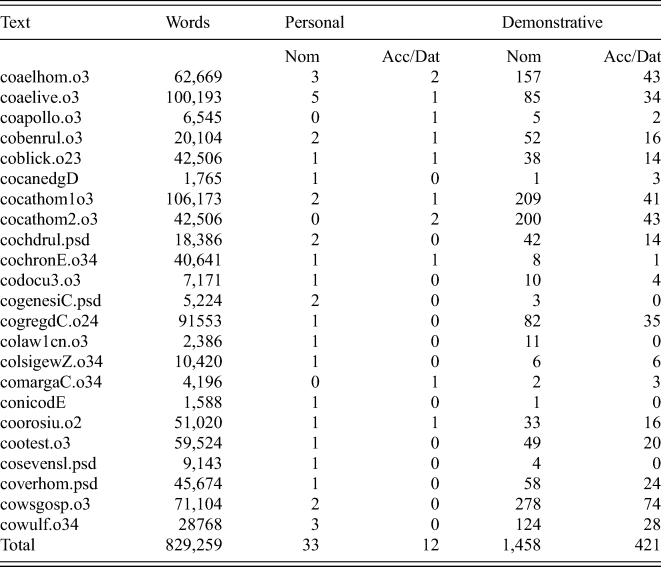
Demonstrative pronouns are much more frequent than third-person personal pronouns as heads of relative clauses in OE. Nearly all the texts of the YCOE corpus have some examples of relative clauses with se-demonstrative heads, with numbers so large that it is impractical to cull the examples that do not conform to the restrictions outlined in section 3. The comparison of overall frequency of the two types of pronouns here will therefore be limited to texts that have at least one instance of a personal pronoun head, i.e. where we have some variation.Footnote 11 The figures in table 1 do not distinguish left-dislocated relative constructions from ones that are integrated into the clause, but they distinguish pronouns in the nominative case from ones in either the accusative or dative case.
Personal vs demonstrative pronouns as heads of relative clauses

4.2 Reference type
Examination of the tokens tabulated in table 1 reveals similarities and differences between what has been observed for how personal and demonstrative pronouns are used in simple clauses and their use as the heads of relative clauses. Kiparsky (Reference Kiparsky, Kaufmann and Stiebels2002: 205) notes that that personal pronouns as heads of relative clauses in OE ‘seem to require specific contextually identifiable referents’, and further says that this restriction prevents the use of these pronouns for restrictive relatives. This is not quite correct; a head of a restrictive relative clause may not have an antecedent but a contextually identifiable referent, i.e. when it refers to a person or set of people whose existence can be inferred from the context. Restrictive relative clauses of this sort are found in OE:

In (13) the emperor's command is conveyed using the indefinite pronoun man ‘one’, so no mention of the minions who are to carry out the action is made, but the context makes the use of the personal pronoun hie ‘they’ possible.
It is difficult in several of the 45 examples with a personal pronoun of table 1 to be certain whether the relative clause should be given a restrictive or non-restrictive interpretation. However, setting aside some uncertain examples, I judge that a restrictive interpretation is probable for 26 of the examples.Footnote 12
Matters are different when we look at the (necessarily restrictive) examples in which the pronoun has generic reference. Kiparsky was correct in observing that demonstrative, rather than personal, pronouns were usual as heads of generic relatives; such examples with demonstratives are very numerous, as we shall see. In contrast, of the 45 examples of personal pronouns tabulated in table 1, only four have generic reference. These examples are all from the first half of the eleventh century, that is, towards the end of the OE period. Two are presented in (14) and (15):

(14) is from a mid-eleventh-century charter, written in Harold's reign, and (15) is from Cnut's laws, so not composed earlier than 1016. The third example was also composed during Cnut's reign, by Wulfstan. It is identical in its wording to (15), as is the fourth, from a homily by Wulfstan, who often used the same formulas in different works.
In addition to the late truly generalizing examples just discussed, which make statements about the nature or fate of a type of person, we have some earlier examples that talk about a hypothetical person who has been the topic of the preceding discourse but that do not refer to actual individuals, but to representatives of a particular class:

(16) is part of a discussion about how the typical monk in a monastery should behave and be treated. It seems likely that such sentences about hypothetical people who are representatives of a previously introduced class formed a bridge between the specific references to individuals and generic statements about types of people.
At this point, we can compare Cole's (Reference Cole2017) findings about the anaphoric use of the two kinds of pronouns in simple sentences with the findings just discussed about relative clauses. The strong preference for demonstrative pronouns in generalizing relatives fits in well with Cole's finding that se pronouns usually referred to discourse-new referents. A relative clause with generic reference introduces a new set of people into the discourse. Cole found more flexibility with personal pronouns than with demonstratives; personal pronouns tended to refer to discourse topics, but their use with discourse-new referents was not unusual. This flexibility with personal pronouns in simple sentences contrasts with their very restricted use as heads of relative clauses. This follows from the ‘referentially dependent’ nature of these pronouns in OE that Kiparsky (Reference Kiparsky, Kaufmann and Stiebels2002) noted. In saying that a pronoun referred to a ‘discourse-new’ referent, Cole is referring to a referent that is not an established topic, not one without a discourse antecedent. In their anaphoric use in simple clauses, personal pronouns are referentially dependent. Personal pronouns could be used as heads of relative clauses with specific reference when the referent was at least inferable from the preceding discourse, even without an explicit antecedent, but were not generally used to introduce new topics.
As Cole (Reference Cole2017) discusses, the discourse status of the pronoun in simple clauses is not an absolute regulator of choice of pronoun, but a strong tendency. This is true as well for the heads of relative clauses. The most striking fact here is that while personal pronouns were almost completely limited to heads of specific relative clauses, demonstrative pronouns were also freely used in this function. For example, it is not clear why a demonstrative is used in (17) but a personal pronoun is used in a similar situation in (18):Footnote 13

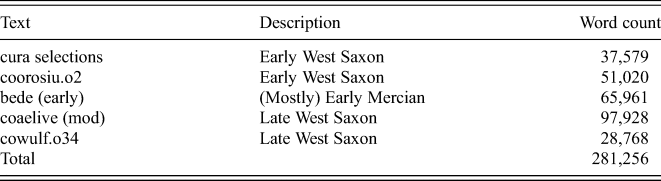
We turn now to the question of how frequent the use of a demonstrative pronoun for specific reference was. Little would be gained by examining the huge number of demonstrative heads in the heterogeneous larger corpus for reference type, but it is useful to get some idea of how common demonstrative pronouns were referring to specific versus generic referents in a more homogeneous smaller corpus, set out in table 2, that is tailored to represent different periods and dialects. Of course it must be kept in mind that data from one or two texts from one period and dialect cannot be extrapolated to all writers of the same times and region.
Smaller corpus texts

Orosius and the Cura Pastoralis (CP) are two of the four texts that form the basis of our understanding of Early West Saxon (Bately Reference Bately1980: xxxix). These two texts are useful in illustrating how differences in genre show substantial differences in the frequency of pronominally headed relatives. Orosius, YCOE file coorosiu.o2, is a history, concerned mostly with the actions of individuals rather than generic statements about types of people, and does not have a large number of demonstrative-headed relatives. In contrast, CP is concerned with how various types of people should be advised by their priest, and has such a large number of demonstrative-headed relatives that I have restricted my study to large samples from the beginning, middle and end of YCOE cocura.o2, namely sections 1–12, 21–29, 36–41, 46–51 and 58–65. The texts that remain to us from OE are dominated by West Saxon, but Mercian authorship of the OE translation of Bede's Ecclesiastical History is generally accepted (Bately Reference Bately1988). Unfortunately, the oldest manuscript is incomplete, and a later manuscript is used as the base manuscript for a large portion of the standard edition. In order to maintain as much homogeneity of time and dialect as possible, I have extracted the portion based on Tanner 10 from YCOE's cobede.o2 into a file I have named bede (early). For more discussion, see the Appendix, part A.
To compare two later West Saxon texts with the two earlier West Saxon texts, I have used Ælfric's Lives of Saints and Wulfstan's homilies. The text I have labelled coaelive (mod) is a slight adaptation of the YCOE's coaelive.o3, since I have removed the Life of St Vincent, which comes from a much later manuscript than the other lives; it was added by the editor (Skeat Reference Skeat1881–90) to complete Ælfric's work. Like CP, Wulfstan's homilies are full of generic references to types of people, while Ælfric's Lives contain both narrative and homiletic material. It should be noted that a comparison of Ælfric's and Wulfstan's writings is complicated by the fact that the YCOE file cowulf.o34 is based on an edition that contains homilies from considerably later than Wulfstan's death in 1023.Footnote 14 Given that these copies are from a time when it is likely that changes in the use of the pronouns were taking place, it is possible that scribes made some changes to the pronouns used by Wulfstan.Footnote 15
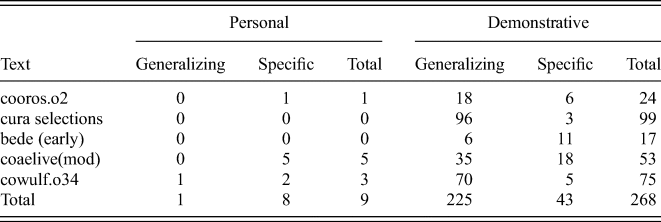
Table 3 presents my findings for the reference type of the nominative demonstrative and personal pronominal heads of relative clauses, excluding left-dislocated structures. This table, which is limited to pronouns in the nominative case, both singular and plural, divides examples in the smaller corpus into specific and generalizing. To reduce the number of variables, it is furthermore limited to the non-left-dislocated examples.
Reference type of nominative pronominal heads of relative clauses, smaller corpus

In table 3, we see striking differences in the texts in the frequency of the relative constructions overall, but these do not seem to be due to diachronic or diatopic differences, but to genre differences, with generalizing relatives, and therefore demonstratives, more frequent in works with frequent moralizing statements, and specific relatives, where personal pronouns were more usual, more frequent in narratives. What all of the texts have in common is a preference for demonstratives compared to personal pronouns even for specific reference. Other than the single example in Wulfstan's homilies, which has already been mentioned, there is a lack of any examples of personal pronouns with generic reference. To summarize, the demonstrative seems to be the usual pronoun as a head of a relative clause, whatever the type of reference, while personal pronouns were restricted to specific reference, with the late exceptions discussed above.
4.3 Left-dislocated relative constructions
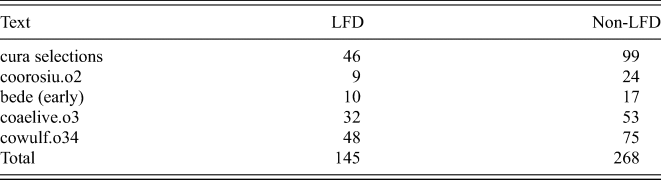
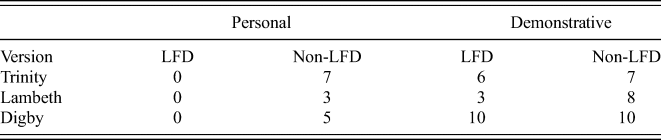
None of the relative constructions with a third-person personal pronoun head are found in a left-dislocated position, while left-dislocated demonstrative pronouns are frequent, e.g. (1) above. Table 4, which is limited to demonstratives in the nominative case in our smaller corpus, gives an idea of how frequent left-dislocated demonstrative heads are.Footnote 16 In this table, LFD = left dislocation and Non-LFD means that the relative construction is not left-dislocated.
Left dislocation of nominative demonstrative-headed relatives, smaller corpus

The complete absence of left-dislocation with personal pronouns is unsurprising given the function of left dislocation in introducing new topics or bringing the reader's attention to topics not referred to in the immediately preceding discourse. Examples of left dislocation with a first- or second-person pronoun, where the referent does not need to be identified, are not rare.
Left-dislocated relatives involve pronouns in the matrix clause also, namely resumptive pronouns. In OE, these pronouns vary between a demonstrative pronoun, as in (1), and a personal one, as in (19):

This appears to be a point of difference between OE and German, since Lambrecht (Reference Lambrecht2001: 1075) says that in German, it is only possible to use a pronoun from the d- series (i.e. a demonstrative pronoun) in this resumptive function, because the personal pronouns can only be used for an established discourse topic. In OE, personal pronouns could clearly be used for topics being introduced by left dislocation. A thorough study of the use of the two types of pronouns as resumptive pronouns would require a study of their use with ‘ordinary’ headed relative clauses as well as with pronominally headed ones, and so there is little to be gained by giving any comparative figures here. However, it is useful to give some figures from one text, our selections from the Cura Pastoralis. Of the 46 left-dislocated demonstrative-headed relative clauses in the selections, 41 are generalizing, i.e. likely to be introducing a new discourse topic. The pronoun following these up was a personal one in 36 of examples. Of course, we cannot assume that one Early West Saxon text reflects OE generally, but it is enough to show that OE differed from German as reported by Lambrecht.
4.4 Interim summary
In OE, personal pronouns were more restricted in their occurrence as heads of relative clauses than demonstrative pronouns. Personal pronouns were not normally generalizing, but referred to a specific person, although a small number of exceptions are found towards the end of the OE period. Personal pronouns were not found heading left-dislocated relative constructions, but could be used as resumptive pronouns.
5 Findings: Early Middle English
By the end of the twelfth century, the spread of personal pronominal heads of relative clauses into the earlier territory of demonstrative pronouns was underway. The old relative particle þe/ðe was in variation with, or totally replaced by, (variants of) þat in this period. We first look at three versions of a verse text that was composed in the late twelfth century, then at the findings for the PPCME2's texts of the m1 period (1150–1250).
5.1 Poema Morale
If we had lengthy prose texts composed in the twelfth century, we would use those to investigate English syntax in that period, but we do not, and we must work with what we have. Fortunately, while the drawbacks of using verse texts for some syntactic studies are obvious, they are minimal for this investigation; the choice of which pronoun to use would not affect the metre, and the old rules of alliteration, which might have affected the choice of pronoun based on the initial sound, no longer applied. It should become apparent in the following discussion that the Poema Morale does not appear to be conservative in its use of demonstrative pronouns, since that use is similar to prose of a later period, as will be shown.
The Poema Morale is a rich source of generalizing relatives with pronominal heads. According to Laing (Reference Laing, Rissanenen, Ihalainen, Nevalainen and Taavitsainen1992), the Poema was probably composed around 1170–90. Three of the seven existing versions will be discussed here, starting with a brief description of the dates and language of the manuscripts, followed by a comparison of relative clauses headed by third-person singular demonstrative and personal pronouns, based on LAEME materials.Footnote 17
Cambridge Trinity College Manuscript B 14.52 (henceforth, T) is dated C12b2 by LAEME, meaning the last quarter of the twelfth century, with a localization of western Essex. The other two versions discussed here are from slightly later manuscripts. According to LAEME, Lambeth Palace Library Manuscript 487 (L) is from around 1200, with a localization of northwest Worcestershire. L ends imperfectly and so is shorter than the other versions discussed here. Oxford, Bodleian Library Manuscript Digby 4 (D) is from west central Kent, dated C13a1 (first quarter of the thirteenth century).
Laing (Reference Laing, Rissanenen, Ihalainen, Nevalainen and Taavitsainen1992) comments that although T is the earliest of the seven manuscripts of the Poema, it is linguistically less conservative than some later manuscripts. This is unsurprising, since T comes from an area where many of the changes of ME proceeded more quickly than in the southwestern dialect of L, and the conservatism of Kent in the loss of case marking distinctions is well known.
I compared third-person singular personal subject pronouns with third-person singular demonstratives as heads of relatives in these three versions. The results are presented in table 5. The versions show differences in the form of the third-person masculine singular distal demonstrative pronoun.Footnote 18 Specifically, the old form se is the only one used in D, but the replacement of se by þe is well underway in the other two versions. Se and þe are in variation in T, while L has only þe as the form of the demonstrative pronoun as the head of a relative. This means that in L and T, we find examples of the sequence þe þe:Footnote 19

Relative clauses with third-person nominative singular pronoun heads in three versions of the Poema Morale

As in OE, none of the relative constructions headed by the personal pronouns appears left-dislocated, whereas left dislocation is frequent with demonstrative heads, as table 4, which is limited to nominative third-person singular pronouns, shows.
The continuing lack of left dislocation with personal pronouns is consistent with a continuation of the use of demonstrative rather than personal pronouns for introducing new participants into the discourse. However, the encroachment of personal pronouns into the traditional territory of demonstratives in generalizing over sets of people seems to have begun in late OE, and in the Poema, we find that although the demonstrative pronouns are favoured for generic statement, personal pronouns are occasionally used for this, as in (21):

The fact that such examples show up in all three versions of the Poema Morale, and, as we shall see in section 5.2, other texts of the m1 EME period, indicates that the restriction of examples to later OE is not coincidental; we are dealing with a real change here. The nature of this moralizing text, which predicts the fates of people who do and do not follow God's will, accounts for the generic reference of all the personal pronouns of table 5.
A second notable difference from OE is that singular demonstrative pronouns now appear to be an alternative to personal pronouns only when used as heads of relative clauses. The non-narrative genre of the Poema limits the use of anaphoric reference to individuals, but it is striking that although demonstratives are used as heads of relative clauses, they are not used as resumptive pronouns with left-dislocated structures. This contrasts with OE, where demonstratives resumptive pronouns, as in (1), were common, but it makes the Poema similar to later ME texts, as discussed in section 5.2.
To summarize, the Poema Morale shows that the use of the third-person singular personal pronoun as the head of a relative clause with a generalized reference was firmly established, at least in some dialects, by the end of the twelfth century. Since this poem is one of the few extant texts composed in English in the late twelfth century, it helps pinpoint the timing of the disappearance of the third-person singular demonstrative referring to persons except in its use in heading relative clauses.
5.2 PPCME2 texts
Middle English was the time when the greatest dialect diversity in English is recorded in texts, and it is generally interesting to ask to what extent the morphological differences found in m1 texts of the PPCME2 correlate with syntactic differences.Footnote 21 We address this question after surveying pronominally headed relatives in these texts.
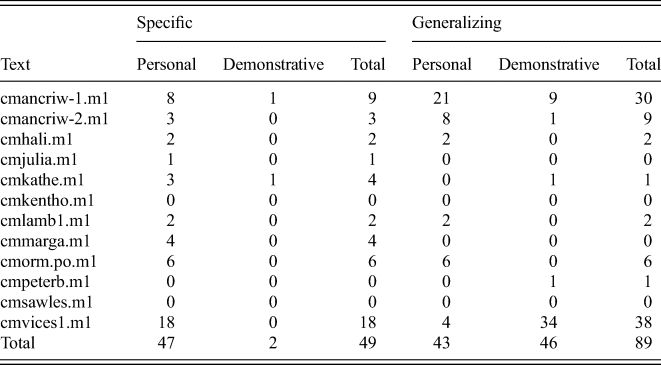
As with the Poema Morale, the investigation of the m1 texts in the PPCME2 was limited to singular pronouns. The PPCME marks NPs for grammatical function, rather than case, in contrast to the YCOE, and so the figures given in table 6 are for subjects. We find that even a text that favours demonstrative pronouns for generic statements sometimes uses a personal pronoun, as in (22):

Singular personal and demonstrative pronouns in subject function, PPCME2 m1 texts

Table 6 shows that personal pronouns were used with a generalizing sense nearly as often as demonstrative pronouns in the m1 texts overall. See the Appendix, part A, for short titles that identify the texts more clearly than the identifiers assigned by the PPCME2.
Table 6 records only non-left-dislocated relatives, since the PPCME2 does not assign grammatical relations to dislocated constituents. Queries searching for left-dislocated relative constructions headed by pronouns or determiners reveal eleven examples of singular personal pronouns heading left-dislocated relatives in the PPCME2 texts. In (23), we have a personal pronoun that is both generalizing and left-dislocated:

However, singular demonstratives continued to be common for this generalizing use:

I found 18 examples, most of them from the Vices and Virtues.
Relative clauses headed by singular demonstratives to refer to specific individuals still occur in the m1 texts, but only infrequently:

In sum, the role of the demonstrative pronoun in introducing new singular human referents is giving way to personal pronouns in the m1 period.
5.3 The interaction of deflexion and the retreat of the demonstrative pronoun
We can now consider how the loss of inflection for grammatical categories on the demonstrative pronouns might have triggered or contributed to their disappearance as heads of relative clauses. We first observe that demonstrative pronouns remained longer as the heads of relative clauses than they did as pronouns with anaphoric reference in simple clauses, a fact noted by Millar (Reference Millar2000: 329), with Allen (Reference Allen, Vikner, Jorgensen and Gelderen2016) documenting the declining functions of the demonstrative pronoun in more detail. This fact seems to present complications for any simple link between deflexion and the replacement of demonstrative pronouns by personal ones where this has happened.
One specific suggestion that has been forwarded is that of Los & van Kemenade (Reference Los, van Kemenade, Coniglio, Murphy, Schlacter and Venstra2018), who argue that the marking of topic shift is the typical function of demonstratives in OE and link the loss of demonstrative pronouns referring to humans with the loss of gender marking. They further suggest that the retention of the plural demonstratives as independent pronouns referring to humans is due to the fact that plural demonstratives and personal pronouns were not gendered in OE – the loss of gender in singular demonstratives made them less useful than personal pronouns as discourse reference trackers, but substituting personal pronouns for the plurals would not improve discourse tracking. Note, however, that the use of plural demonstratives as independent pronouns in PDE is more restricted than it was in OE. The demonstrative pronoun is not used as a discourse-tracking device; Those are coming early is only deictic and is not a substitute for They are coming early. As in EME, the plural demonstrative pronoun can head a relative clause: Those who apply will be eligible for a refund. Further research is needed into the loss of plural demonstratives as anaphoric pronouns, but the fact that they are now restricted to relative clauses (and other complements such as those with a ticket) suggests that they have travelled a parallel path, with some lag, perhaps, to singulars.
Gender marking on the demonstrative pronouns was lost at different times in different dialects, and if Los & van Kemenade's suggestion is correct, we would expect a correlation between the presence of such gender marking in a text and the use of demonstratives with anaphoric reference. It is in fact true that the pronominal uses of the demonstratives seem to be the same as in OE in the ‘Kentish Homilies’ found in Cotton Vespasian D.xiv, a southeastern manuscript that Laing (Reference Laing1993: 83) dates as c12a2–b1, i.e. the second part of the first half of the twelfth century to the first part of the second half of that century.Footnote 23 These homilies, which essentially retain the OE inflectional system, have full inflection of the demonstratives:

However, the retention of gender as an inflectional category was not sufficient to guarantee the continued use of demonstrative pronouns in anaphoric function. Let us turn our attention to two EME texts that retained gender marking in different ways.
The texts of the West Midlands dialect AB show considerable loss of inflected forms, but maintained distinctions according to natural gender, with masculine þe, neuter þet and feminine (as well as general plural) þeo, as d'Ardenne (Reference d'Ardenne1961: §90) details. The Ancrene Riwle will be discussed here as the longest of these texts in the PPCME2.Footnote 24 Since the Ancrene Riwle was written for nuns, we find plenty of examples of the feminine form. D'Ardenne comments that the use of the demonstratives as pronouns referring to humans is nearly limited to heads of relative clauses and other postmodifiers, e.g. þe wið þe bront ‘the one with the brand’.Footnote 25 This is in line with findings for other EME texts, as discussed above. The retention of gender with the demonstratives in dialect AB but general loss of their ability to refer to singular humans does not seem to fit well with the idea that their restriction was a simple result of the loss of gender.
A second relevant text is the Vices and Virtues of British Library Manuscript Stowe 34, which LAEME assigns to the first quarter of the thirteenth century in southwest Essex. Grammatical gender is well preserved and mostly systematic in this text as a category, as is morphological case, although there appears to be some of the use of old gender markers to mark case that Jones (Reference Jones1988) noticed.Footnote 26 The categories are still systematically at work despite a good deal of syncretism of forms; the indeclinable ðe is used as an alternative form for nearly all combinations of case and genders. In this text, we find that only one form of the demonstrative, the nominative masculine singular se, is used as the head of relative clauses, and this is the only function in which it is found as a pronoun.Footnote 27 Thus the Vices and Virtues was more limited in its inventory of demonstrative pronouns heading relative clauses than the Ancrene Riwle, even though it had a fuller system of inflection of the demonstrative. Table 6 does not distinguish the gender of the pronouns, but it turns out that while se is the only form of the demonstrative used with relative clauses, it is not the only masculine pronoun so used; in (22) we have the less common nominative masculine singular personal pronoun.
In sum, it may be that gender was a necessary feature to retain the discourse-tracking functions of demonstrative pronouns, but it was not a sufficient one. That is not to say that there was no connection between the two changes. It is striking that the only EME texts studied here that retain the old referential use of the demonstratives, the Kentish Homilies of the early twelfth century, also retain the old inflectional categories, including gender marking, while all the other texts either no longer have gender marking or only mark it optionally. Noting that similar changes to postnominal genitives took place around the same time in different dialects in EME regardless of the very different state of case categories, in Allen (Reference Allen2008: 184) I suggest that it was the new optionality of overt inflection, not the loss of inflectional categories, that was decisive in the disappearance of postnominal genitives and genitive objects. It seems possible that the non-obligatory status of overt inflection for grammatical features was also the key to the retreat of the demonstratives to their more central deictic functions, ceding discourse tracking to the personal pronouns, where anaphora was the central function and where gender continued to be obligatorily marked. We do not have enough texts from the area retaining obligatory marking of the old grammatical features in the late twelfth or early thirteenth century to be certain of this conclusion.
The continued use of demonstrative pronouns as the heads of relative clauses is a result of the fact that they are not tracking a previous referent, but defining one – the relative clauses headed by these demonstratives are all restrictive. Why they did not remain in this use is not clear, but what is clear is that they did not disappear suddenly; personal pronouns were in variation with demonstratives in their last territory before ousting them.
6 Conclusions
The primary focus of this article has been to document the use of personal versus demonstrative pronouns as the heads of relative clauses, but the use of demonstrative pronouns as resumptive pronouns has also been discussed. The findings of this investigation add to our understanding of how singular demonstrative pronouns became more restricted in their ability to refer to humans in early English.
Cole (Reference Cole2017) and Los & van Kemenade (Reference Los, van Kemenade, Coniglio, Murphy, Schlacter and Venstra2018) are in agreement that demonstrative pronouns were most likely to be used for less well-established referents in OE. The great majority of pronominally headed relatives did not refer to an established topic in the discourse, and so demonstratives greatly outnumbered personal pronouns as heads in that period. Although the use of the two types of pronouns as discourse-tracking devices was strikingly similar to modern Dutch and German, it was not identical with those languages. Personal pronouns were not restricted in OE to referents who had been referred to in the previous discourse, since they could be used as the heads of relative clauses introducing a new referent whose existence could be inferred from that discourse. Also, although personal pronouns do not appear in left-dislocated relatives, which introduce new discourse topics, they were in variation with demonstratives as resumptive pronouns following up left dislocation, and by the end of the OE period at least, personal pronouns were sometimes used as the heads of generic relative clauses.
While there is no direct correlation between the disappearance of the demonstrative in all of the old functions and the loss of the possibility of marking gender on the demonstratives, the correlation between the restriction of the demonstratives in anaphoric functions and the optionality of the expression of gender is good. This optionality made demonstrative pronouns less reliable as discourse reference trackers than personal pronouns, which became used frequently for this tracking even when a gender-specific demonstrative pronoun was still available as an alternative. As heads of relative clauses defining referents, however, singular demonstrative pronouns remained longer.
This study focused on relative clauses in subject function, and further research might reveal some differences with object pronouns. Further research is needed too into plural demonstratives. Finally, we cannot assume that any modern Germanic variety reflected the Common Germanic situation, and the fact that English has changed so markedly does not rule out the possibility that German and Dutch have changed less dramatically. The developments in those languages may involve a sharpening of earlier tendencies to arrive at the modern situation in which no variation between the two pronouns is possible in some uses. It would be good to look at the history of the two types of pronouns in German and Dutch, including in non-standard varieties.
Appendix
A. Electronic corpora
Three YCOE files were excluded from all OE investigations, namely coeluc1, coeluc2, and coneot. These texts were identified as of probable twelfth century composition by Clemoes (Reference Clemoes1997: 17), so they belong to the EME period. The first two of these are included in cmkentho.m1.psd in the PPCME2 and are used in the study of the m1 period.
The YCOE file cobede.o2 is based on an edition which presents a text based on different manuscripts. The following discussion of these manuscripts is based on Bately (Reference Bately1988). The two main manuscripts are from two substantially different periods. The oldest is the Oxford manuscript Bodleian Tanner 10, written in the early tenth century. The second is from the second half of the eleventh century and represents a much later form of OE. The Tanner manuscript can be used for the study of the Mercian dialect at a fairly early stage. Substantial amounts of material from the beginning and end are missing from Tanner, and so this text is supplied from the later manuscript. To restrict the study to a more homogeneous time and dialect, I have limited my data to the portion of the text found in the Tanner manuscript, which I have designated as bede (early).
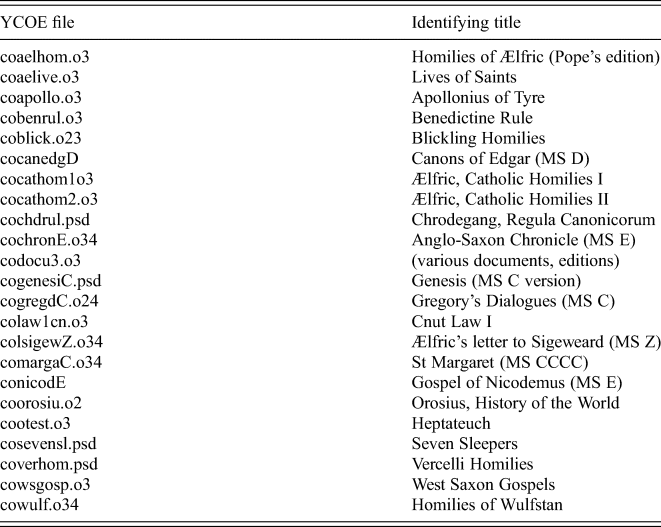
For information on all texts included in the YCOE, the reader is directed to www-users.york.ac.uk/~lang22/YCOE/YcoeHome.htm. Table A1 supplies short titles for all the YCOE files appearing in tables and examples in this article. Most of these titles are based on Mitchell et al. (Reference Mitchell, Ball and Cameron1975), but some YCOE files contain texts from more than one edition, e.g. codocu.o3, so no single short title is applicable.
Identifying titles for YCOE text files

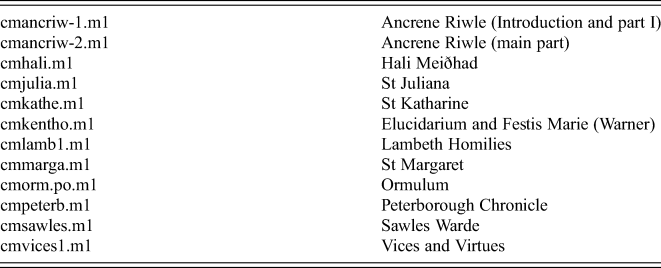
Table A2 presents identifying titles for the PPCME2 texts of table 6. For full information, consult the PPCME2 website at www.ling.upenn.edu/hist-corpora/PPCME2-RELEASE-4/index.html
Identifying titles for PPCME2 text files

B. Some notes on data gathering
When a head can be identified for a relative clause, that relative clause is parsed as CP-REL by the YCOE. A CP-REL may have either a nominal or a pronominal head. The main queries I used searched for CP-REL with a personal or demonstrative pronoun as the head. The majority of the sentences caught by these searches were ones where I would agree in treating the pronoun as the head of the relative clause, but as noted in section 2.2, problems arise in deciding whether we are dealing with a relative clause or an independent clause in some instances, and the figures in this article exclude sentences in which I judged that a nominal NP might be the head, and the se form therefore a relative pronoun, even though the YCOE treats the demonstrative as the head, e.g. (7). Such examples were too few to affect the overall picture; using these searches with CP-REL limited did a good job of identifying most examples where no other analysis than as a pronominally headed relative clause was plausible. ‘Most’ because the YCOE assumes the existence of ‘free relatives’, labelled CP-FRL. In CP-FRL, the structure presented in (10) is assumed, with the head missing, and a relative pronoun in the specifier of the relative clause. The guide provided by YCOE states that ‘relative clauses headed by a determiner with no other possible antecedent and no complementizer are treated as free relatives’. It appears that CP-REL, rather than CP-FRL, is the parsing most commonly used by YCOE when a particle is present. However, the CP-FRL parsing is sometimes used when there is a particle, as in (27), where þam is parsed as internal to a CP-FRL:

Presumably, the dative case marking of the þam caused the parser to decide that it should be treated as internal to the clause that governs this case marking. An alternative analysis is that þam is in the matrix clause, and this is an instance of ‘upward’ case attraction. For a discussion of these free relatives, see Allen (Reference Allen2020). To determine how frequent such parsing is, and whether it might affect the overall picture, I have searched for non-left-dislocated CP-FRL with a relative particle, and found only six examples, which I have not included in any figures. None of these examples comes from the smaller corpus.
I refined the queries looking for demonstrative-headed relative clauses in a couple of ways. First, to reduce the number of non-target ‘hits’, specifically neuter forms were excluded. Because of the grammatical gender of OE, the non-neuter forms do not necessarily refer to humans, nor do all neuter forms refer to inanimates. Masculine and feminine demonstratives not referring to animate beings were caught by the query because OE had grammatical gender; these were easily excluded from the data by hand. It was of course not possible to recover any examples of human beings referred to by neuter pronouns, but this is unlikely to have affected the results, since neuter pronouns for people usually referred to women and girls, and pronominally headed relatives referring specifically to females were uncommon.
The figures for demonstrative versus personal pronouns presented in table 1 include plural examples, and the highly ambiguous plural form þa|ða raises the problem that it covers all genders in the nominative and accusative. Given that inspection of the output shows that most of the examples involve humans, the inclusion of a small number of neuters does not affect the general picture, and so I have made no attempt to remove the neuter examples from these figures, which are only indicative at any rate. The investigations of the smaller corpus involve only singulars, so this problem does not arise.
The searches of the Poema Morale versions in LAEME, which are not syntactically annotated but are tagged for various features, required a different technique. I searched for the grammel DatpnRTA, the tag for a relative clause in subject function with an animate singular demonstrative antecedent. It was easier to collect the examples of personal pronoun heads by hand than to execute a search looking for possible examples, and so I did this using the html versions of the text provided by LAEME.