INTRODUCTION
The earliest surviving Anglo-Saxon footwear was found in 1939 in Mound 1 at Sutton Hoo, in Suffolk. The fragmentary remains were part of a mass of organic material that had been placed under the ‘great silver dish’, known as the Anastasius dish. These shoe remains were studied in detail and reported on in 1983,Footnote 1 some forty years after their discovery. No further study of the leather or skin-based remains from the burial has been carried out since this time. A brief summary of what is currently understood about Anglo-Saxon leatherworking in Britain,Footnote 2 published more recently, suggests that evidence of leather of early medieval date remains scarce and that the Sutton Hoo find continues to be pivotal to the understanding of leather technology of this date.
What remains today are small fragments of leather along with a variety of textiles and other organic material including compressed soft feathers/down (henceforth referred to here as ‘flock’ in the sense of a material used for stuffing) and wood. The leather has all the appearance of being vegetable tanned and it is unlikely that other types of skin-based products that may originally have been present would have survived the burial conditions. The conservation treatments undertaken in the pastFootnote 3 have ensured that the leather has survived and, although it is fragile, it is sufficiently robust for careful examination. For many fragments it is difficult to distinguish the grain from the flesh side of the leather and much of it has delaminated, as is common with some leather tannages of this period. The leather has clearly shrunk, probably quite significantly, so that the stitching now appears much smaller and, consequently, the seams much finer than they may have been originally. This shrinkage is illustrated by the left shoe sole: documented as being 26cm in length when examined by East, it now measures 23.1cm with no visible signs of material loss. In some cases, the leather is black, a little ‘sticky’ and surface details are obscured by waxy residues of conservation leather dressing that sometimes fill individual stitch holes. A photographic record was made of each fragment, both upper and lower faces, and drawings of salient pieces were made at the same time documenting those features not easily seen in photographs, namely pore direction, breakage, colour, wrinkles and stitch holes. The observations and descriptions made by East in Reference East1983 were found to be well judged and accurate, and any fragments separated over time in storage or previous handling could be reunited. In consultation with the surviving paper records and excavation photographs, an attempt was made to establish where these items had been located within the heap of organic material found beneath the ‘great silver dish’. One had to proceed alongside the other in order to make sense of what proved to be a highly complicated, three-dimensional ‘jigsaw puzzle’. This re-examination of the material has resulted in an interpretation that differs from that proposed by East, yet is in keeping with the initial excavation reports.
THE ARRANGEMENT OF ITEMS BELOW THE ‘GREAT SILVER DISH’
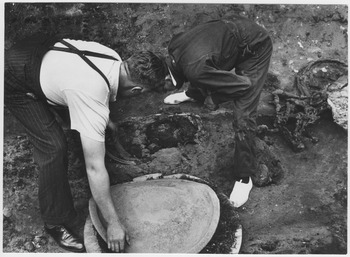
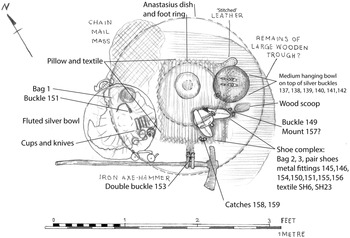
Among the group of material beneath the Anastasius dish, which included the silver fluted dish, the medium hanging bowl, an axe-hammer, buckles, other small metal fittings and much organic material, were areas of leather, one of which was described when excavated as a pair of shoes (fig 1). A theoretical plan of this ‘shoe complex’, within the mass of organic material below the Anastasius dish, was compiled from plans and archive photographsFootnote 4 made at the time of excavation (fig 2). To the information taken from Piggott’s 1939 field plans and Phillips’ Reference Phillips1940 plan were added details of the locations of the metal fittings and other items given in the subsequent Bruce-Mitford publications. The aim of this theoretical plan was to understand how the surrounding objects might have influenced the taphonomicFootnote 5 conditions in the shoe complex. The base layer appears to have been a large wooden trough into which the various clothing and dining items were placed, where they seem to have been preserved in a benign microclimate, possibly created by the Anastasius dish covering the top. The outer limits and the foot ring are marked in fig 2, the dish above covering nearly the same area as the wooden trough below.
W F Grimes (right) examines organic remains beneath the ‘great silver dish’. Image: Print 2.32, O G S Crawford Photographic Archive, courtesy of the Institute of Archaeology, Oxford.

Reconstruction of the shoe complex beneath the great silver dish, based on the Crawford archive photographs, Piggott’s plan and journal entries. Drawing: the authors.

The plan also helped to locate some of the metal fittings beyond the shoe complex, thus eliminating them from the possible reconstructions. The double buckles (inv. 153) appear to be on straps around the handle of the iron axe-hammer, presumably part of a carrying strap, visible only in Crawford’s photograph 2:117 and not mentioned in any of the reports. The buckle (inv. 151) clearly stated to have been found in the fluted silver dish, along with the unidentified ‘slider’ and leather strap,Footnote 6 is associated with the large leather layer covering the fluted dish, which is interpreted here as Bag 1.Footnote 7 Two sets of silver buckles and strap-ends for cross gartering were found under the medium-sized hanging bowl that was lying upside down.Footnote 8 Their placement beneath the bowl and on the lowest layer excavated shows that these buckles and strap-ends were not directly associated with the current pair of shoes. Visible in Piggott’s plan (and retained here) is an oblong shape identified as ‘leather’, with dots along the edge indicating stitching. This leather, or group of fragments, has not been identified among the current collection, nor has the remains of Bag 1. The shoe complex consists of leather labelled by East as Shoe 1, 2, 3, 4, along with many of the metal fittings, of which a ‘silver’ mount (inv. 157) and buckle (inv. 149) were documented as being found near the toe of one of the shoes. The catches (inv. 158 and 159) were found near ‘shoe 3’.Footnote 9 The hypothetical plan produced here for the reassessment of the leather items, though not exhaustive in including every item in the area, appears sufficient for understanding the shoe complex.
WHY TWO PAIRS OF SHOES MAY HAVE BEEN IDENTIFIED PREVIOUSLY
Today the leather and associated organic material, excluding that associated with buckles and other metal fittings, is stored in a series of thirty-seven small boxes labelled Shoe I, II, 3, 4 and X. Part of an early record of the material survives; written in pencil, it itemises material called Shoe 3 and Shoe 4 coming from the upper, middle and bottom layers of a box or boxes (not named or numbered). This record was made by a member of the Research Laboratory either when the leather was being unpacked from the wet paper and moss in which it had been packed on site in September 1939, or, less likely, re-packed for wartime storage a short time later. From this, and East’s account,Footnote 10 it seems that the concept of four shoes dates to the earliest days of the material’s entry to the Research Laboratory and it may well be a construct of the Laboratory’s staff at that time, as it cannot be traced directly to the excavation record.
The earliest published description of the recovery of the find was made by Phillips shortly after the event.Footnote 11 Leather is mentioned when Phillips recounts his observations of the excavation of the complex of material below the ‘great silver dish’. Among the complex were the remains of two leather bagsFootnote 12 and two other folded masses of leather. It is the remains of these two folded masses that concern us here:
Two folded masses of leather were found, one on each side of the impression of the foot ring of the great dish. One was certainly a pair of shoes in bad condition but showing signs of bronze tags and fittings. The other showed signs of stitching. Both were very rotten. By the shoes were the remains of a wooden object like a scoop.Footnote 13
This is shown in plan and captioned ‘general arrangements of the objects under the great silver dish’.Footnote 14 On the plan, ‘shoes’, ‘small bronze buckle’, ‘wooden scoop’ and ‘silver mount of leather bag II’ are labelled to one side of the foot ring, and ‘stitched leather’ on the opposite side: by this means the two masses can be located. East mentions an entry on 26 July 1939 in Phillips’ diary,Footnote 15 the date when work on the excavation of the burial was brought to a close: ‘On the northern and southern edges of the mass were arrangements of folded stitched leather, the remains of shoes.’
It appears that the seeds of the idea of two pairs of shoes were sown very early and it is likely that the actual observation of the two masses of leather and the idea of two pairs of shoes were soon conflated. The waters were muddied further, however, when at least four areas of leather were proposed when the material was subsequently studied around forty years later. East’s report includes an explanatory diagram of a photograph of the area revealed when the ‘great silver dish’ was lifted.Footnote 16 Scrutiny of the excavation photographs suggests that East’s figure 564a is a cropped version of Crawford’s photograph 2.117.Footnote 17 The diagram shows four groups of ‘possible leather fragments’. However, this is a later interpretation of the photograph as these four groups are not shown on the field plan made at the time. The four groups of leather – labelled a, b, c and d in the explanatory diagram – include a likely pair of shoes at position ‘a’, so giving at least five potential leather items being recognised. This may account for the appearance of the mysterious Shoe X that occurs on the labels on three of the small boxes (174.20, 174.21, 174.22), the contents of which were recorded by East as ‘Miscellaneous fragments’.Footnote 18
Currently, while the remains of one pair of shoes can be identified, scattered through the numerous boxes labelled variously Shoe I, II, 3, 4 and X, there is little evidence for a second pair in the surviving leather. While the present suggestion, made below, of a single pair of shoes together with two bags disagrees with the earlier conclusions made by East when the leather was initially studied, it is compatible with the original records where two masses of leather are described and shown on plan, one to either side of the impression made by the foot ring of the ‘great silver dish’. The leather from the shoe complex to the southern side of the foot ring appears to have survived among the present collection, but the possible second pair of shoes located to the eastern side of the foot ring has not. It would seem the desire to find two pairs of shoes in the surviving leather fragments forced the interpretation of a second pair of shoes onto the fragments of the two bags within the shoe complex.
METHODS USED IN THIS REASSESSMENT OF THE LEATHER FRAGMENTS
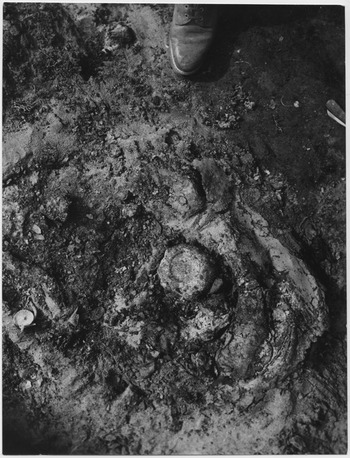
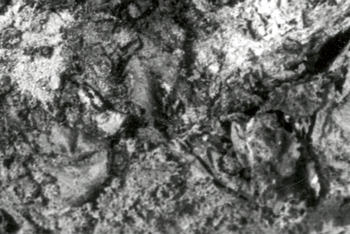
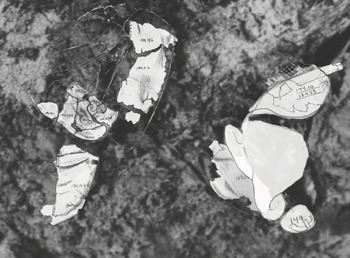
To escape the preconceptions described above, an attempt was made to reconstruct the deposit of leatherwork as found in 1939. In doing so, Phillips’ account and Piggott’s field plans were invaluable, but the most important diagnostic tool was Crawford’s photograph 2.117, ostensibly taken after the ‘great silver dish’ had been removed (figs 3 and 4). Interestingly, close inspection of this image suggests that there was an interval between the removal of the dish and the photograph being taken, during which some of the flock was cleared from the central area, revealing Bag 2, which, judging by its ruffled appearance was then lifted and moved to the right, where it is shown in the photograph overlapping one of the shoes. Meanwhile, buckle inv. 149, which originally may have been associated with Bag 2, probably dropped to the floor, where it is recorded beside the toe of the left shoe, on a soil-surface that seems to have been recently cleaned.
Crawford’s image of the organic deposits revealed after the removal of the ‘great silver dish’. Image: 2.117, O G S Crawford Photographic Archive, courtesy of the Institute of Archaeology, Oxford.

Cropped section from Crawford’s photograph 2.117, showing the shoe complex partially uncovered with light-coloured areas of ‘flock’ (top left and right). Image: O G S Crawford Photographic Archive, courtesy of the Institute of Archaeology, Oxford.

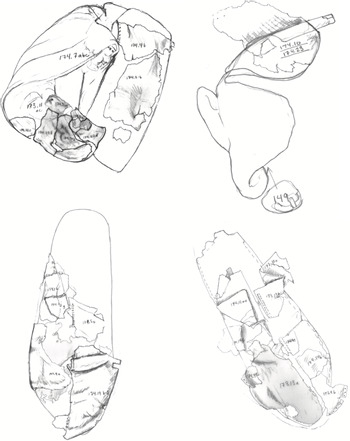
With these observations in mind, the first task was to match the surviving fragments with those in Crawford’s image. Photography of the fragments at the British Museum using a Nikon D3300 camera and 18–55mm lens enabled close-up examination of surface detail. Creases were evaluated as to whether they were either original, reflecting the crushed positions of the leatherwork in the deposit, or possibly introduced later in the post-excavation process. Variations in surface texture and colour from deposits of ‘flock’, textile, metal oxides and soil particles provided further clues in reconstructing the stratigraphy of finds beneath the dish. Initially, paper outlines of the fragments were positioned on a scaled image of photo 2.117. Then, semi-transparent images of the fragments were manipulated digitally using Adobe Illustrator (fig 5). Finally, 3D paper models were constructed combining all the evidence from photos, sketches and observations (fig 6). This process is detailed in appendix 1 of the supplementary material accompanying this paper.
Cropped section from Crawford’s photograph 2.117 overlaid with drawings of the visible fragments from Bag 3 (top left), the right shoe (bottom left), and the displaced Bag 2 above the left shoe (right). Image: O G S Crawford Photographic Archive, courtesy of the Institute of Archaeology, Oxford. Drawings: Marquita Volken.

Drawings from fig 5, plus the concealed fragments, recreating how they may have been in situ. Drawings: Marquita Volken.

RESULTS OF THE REASSESSMENT
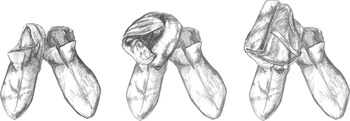
Close examination of the surviving leatherwork has produced evidence of a pair of shoes and two bags. Additionally, a deposit sequence has emerged, which suggests that the shoes were placed upright, side by side, with Bags 2 and 3 above and partially covering them; Bag 2 lying on top of Bag 3 (fig 7). In Crawford’s photo 113, Bag 1 is visible as a smooth surface covering the fluted silver bowl and described as a ‘fair sized leather bag’.Footnote 19 No leather equating with Bag 1 could be identified among the existing collection and the conclusion drawn is that Bag 1 is lost entirely. Observations made while examining the leatherwork are detailed in appendix 2 of the supplementary material accompanying this paper.
Reconstruction of the placement of shoes and bags in sequence from left to right; the pair of shoes, shoes with Bag 3, shoes and Bag 3 covered by Bag 2. Drawing: Marquita Volken.

Bag 2 and the wooden pick
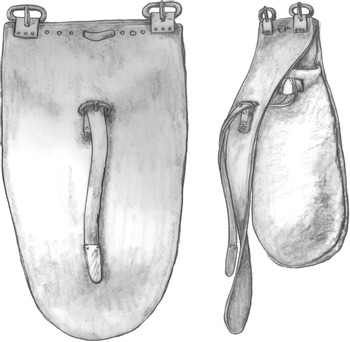
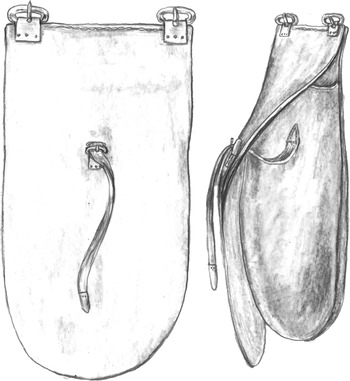
Bag 2 has a long front flap, approximately 250 × 150mm, covering and extending below the bag section (fig 8). The fastening strap, fixed in place by mount inv. 155, would have passed through a slot in the flap to fasten to buckle inv. 149. The precise bronze strap-end is not identifiable among the metal finds from the shoe complex.
Reconstruction drawing of Bag 2, frontal view (left), three-quarters view (right). Hypothetically, the curved mount inv. 157 may have been a centre top decoration. Drawing: Marquita Volken.

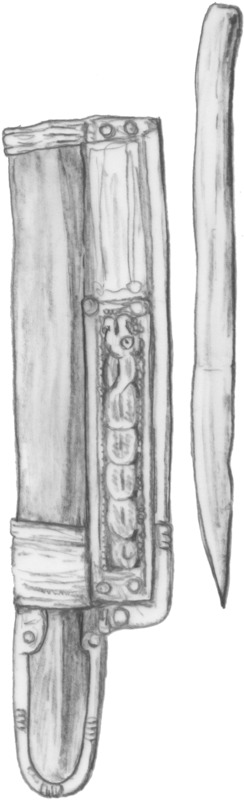
Wood fragments associated with Bag 2 were described by East in association with the leather fragment inv. 174.23a (the back panel of Bag 2). When quoting the inventory of the leather made by the Research Laboratory when unpacking the material from the site in September 1939, East cites a sketch of a fragment (inv. 174.23b) across which lies a narrow strip (174.23a)Footnote 20 without identifying the material. Later, when discussing Shoe 3, inv. 174.23a is described as ‘a narrow strip of wood’.Footnote 21 A second fragment from the middle of the stick is included in inv. 173.7h and a third fragment is attached to inv. 174.10, the flap to Bag 2. This piece also has the impression of an angled point on the leather surface. It is probable that these three fragments together represent a dining pick, the current total dimensions being L 155mm, W 13mm, Th 6mm. Similar picks are found in Frankish contexts of late sixth- and early seventh-century date. The most complete example of a dining set – a pick and knife in a leather sheath – is from a grave at Saint Quentin in France.Footnote 22 That sheath, which was decorated with gold plates, comprised a single layer of leather folded in half, divided into a main pocket for a small knife and a narrow pocket for the wooden pick (fig 9). A similar dining set from the Merovingian tombs at Saint-Denis, Paris, was decorated with impressed lines.Footnote 23
Reconstruction drawing of the leather dining-set case with gold mounts and the wooden pick from Saint Quentin, in France (after France-Lanord Reference France-Lanord1961). Drawing: Marquita Volken.

If the authors’ identification is correct, the occurrence of dining picks in this context is entirely in keeping with the mass of feasting equipment occupying the central space in the burial tableau, which included drinking horns and bottles, bowls made of silver, copper alloy and wood, a ladle, four knives and the ‘great silver dish’.Footnote 24
Bag 3
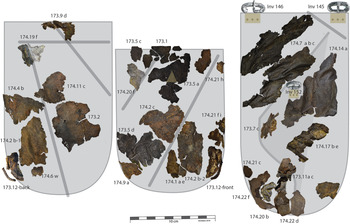
Bag 3 was identified from two groups of leather fragments representing the front and back panels, and another group with the distinctive folds of the front flap visible in Crawford’s photograph 2.117 (fig 10).Footnote 25 This bag is made in the same way as Bag 2 but is slightly smaller (fig 11). A second pair of buckles (inv. nos 145 and 146Footnote 26) found in the shoe complex may be the suspension buckles for Bag 3.
Bag 3 fragments, grain side (from left to right): the back panel, front panel and flap. Photographs: Esther Cameron. Montage: Marquita Volken.

Reconstruction drawing of Bag 3, front view (left), three-quarters view (right). Drawing: Marquita Volken.

Similar finds of flap-fronted bags
Archaeological evidence of leather bags has rarely been found in Anglo-Saxon contexts. Ephemeral traces of leather and textile on and around groups of material in graves, often referred to as ‘bag complexes’, suggest bags were present. Even the most cited example, a satchel with a large front flap from the seventh-century burial at Swallowcliffe Down, in Wiltshire,Footnote 27 is an interpretation of metal fittings, dark organic staining and wood.
Leather bags with a pair of suspension buckles and a single buckle on an elaborate front flap are known from late sixth- and seventh-century graves in north-west Europe. The most complete example, from a woman’s grave dating c ad 589 at Krefeld-Gellep, in Germany, consists of a round-bottomed bag with a rectangular flap.Footnote 28 The bag has two suspension buckles fixed by short straps and square mounts to each corner of the bag’s top edge. The suspension strap, with silver strap-ends, survives only as short lengths of leather passing through the buckles. The fastening strap, also with a silver strap-end, is riveted to the front panel of the bag and passes through a slot to a buckle riveted to the front of the flap. The flap is composed of five leather panels: a central piece flanked by four embroidered bands. A second bag from the same site survives as only a fragment of the flap with a central buckle.Footnote 29
Leatherwork tentatively identified as a mitten from a sixth-century female grave in Cologne Cathedral is most probably a bag similar to the complete example from Krefeld-Gellep.Footnote 30 At Augsburg, in Germany, a male burial dated c 620–40 contained traces of a bag consisting of a decorated rectangular flap associated with a small rounded panel and remains of a bead strip.Footnote 31 At Lich-Steinstrasse, in Germany, a woman’s grave dating from the first half of the seventh century contained leather fragments and decorated mounts found on the shins,Footnote 32 their placement suggesting a rectangular bag with a central buckle on the flap and a single suspension strap. At Sutton Hoo, Bags 2 and 3 have plain flaps but otherwise appear to have the same configuration as these continental examples.
The pair of shoes
Among the leather fragments were several that clearly belonged to shoes, such as the nearly complete left sole (inv. 173.6). The right shoe’s toe (inv. 174.19b-1), visible in Crawford’s photograph 2.117, and the left shoe’s medial side/frontFootnote 33 (inv. 174.9e, inv. 173.13a) can also be identified. Both front fragments show the decorative centre seam on the grain side.
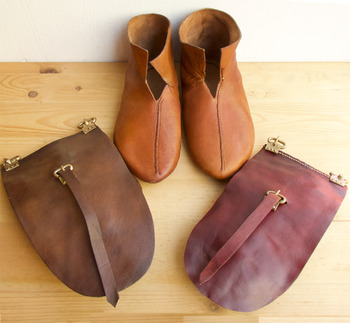
As East has already established, the shoes are of turn-shoe constructionFootnote 34 with separate soles and uppers. However, the sole/upper seam does not have a randFootnote 35 as had been previously thought. Whether the sole seat (the heel area of the sole) was rounded or pointed is unknown as this area is damaged. The shoes are of slip-on style (Sutton Hoo -Js).Footnote 36 The uppers are each made of one main piece, with a small ‘completion’ pieceFootnote 37 on the right shoe only, joining with a vertical closing seamFootnote 38 at the middle of the medial (inner) side. They have a short centre slit at the instep point and an open leg front, extending to about ankle height with a straight top edge. The opening edges are plain cut. A decorative non-functional seam runs up the front of each shoe, the stitching passing through the grain layer of the leather only (fig 12).
Reconstructions of the shoes and bags. Reconstructions and photograph: Marquita Volken.

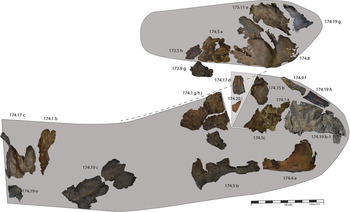
Fragments of the right shoe and sole show much damage, but a few pieces provide important clues (fig 13). Inv. 174.5c, an instep fragment from the right shoe, has the end of the medial side of the centre slit and the beginning of the decorative centre seam; these details are covered by a fragment of a fastening strap, probably from Bag 3, conserved in situ. Inv. 174.17d and inv. 174.20i represent the remains of a triangular completion piece at the medial front of the closing seam. When the shoe pattern was cut out of the leather, the top line must have been aligned on a previous long straight cut, thus the full medial front could not be made in one piece (dashed line in fig 13). The completion piece is joined to the front edge (inv. 174.15b) and the medial back (inv. 174.17c, inv. 174.19e) by butted seams.Footnote 39 The butted seam on inv. 174.19c stops 5cm from the top edge since this is the plain cut edge of the leg opening. Only a third of the right sole survives, in fragments.
Fragments of right shoe; upper (grain side) and sole (flesh side). Photographs: Esther Cameron. Montage: Marquita Volken.

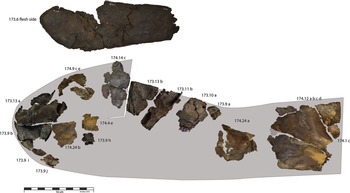
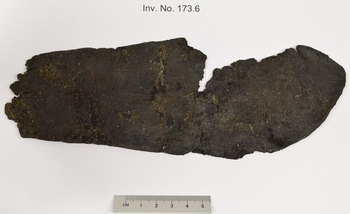
The left shoe lay partially under the pile of bags, which seems to have contributed to its preservation (fig 14). The breakage at the toe and centre back on the nearly complete left sole was interpreted by East as wear,Footnote 40 but closer examination suggests that the break was caused by conditions in the burial as the grain is uniformly good in all areas (fig 15). In fact, no sign of wear or the typical wrinkles from the movement of the foot can be seen on any of the fragments, which suggests that the shoes may have been new and never worn. The medial side/back (inv. 174.12a–d) is complete from the top edge to the sole/upper seam, and shows no lace slots, thus it is a slip-on shoe lacking a lace fastening. The decorative stitch is also visible along the plain cut edge of the leg front corner (inv. 174.12a–b discussed above) which joins the lateralFootnote 41 middle sections (inv. 173.11b and inv. 173.10a); all have the tablet-woven band SH 6 adhering to the flesh side. The front half of the butted closing seam is contained on the flesh side of inv. 174.14c; the corresponding area on the back section is missing due to fragmentation (inv. 174.12a–d).
Fragments of the left shoe’s upper, placed grain side visible within a grey shape of the cutting pattern; (above) the sole shown with the flesh side visible. Photographs: Esther Cameron. Montage: Marquita Volken.

Left shoe sole inv. 173.6 seen from the grain side, showing taphonomic damage at the back and side. Photograph: Esther Cameron.

Comparative examples of shoes
Since the publication of the Sutton Hoo leather in 1983,Footnote 42 further evidence of Anglo-Saxon footwear has been discovered in England. Miniscule pieces of a left slip-on shoe and leg binding were uncovered at Gally Hills in Surrey (dated to c 675–725);Footnote 43 a single shoe was found at Burlescombe in Devon (640–760);Footnote 44 fragments of six shoes were found at St Martin’s Courtyard in London (730–850);Footnote 45 and small fragments were found from behind a waterfront at nearby John Adam Street (c 600–700).Footnote 46 The St Martin’s Courtyard fragments contain raised centre back elements, similar to the shoes found at Iona.Footnote 47 Among this tally of Anglo-Saxon footwear, only the Burlescombe shoe provides a relatively complete example. But none of these finds resemble the Sutton Hoo shoes; for the time being this pair remains unique.
Evidence of shoes with separate soled construction from the late sixth to mid seventh century is also extremely rare on the Continent and none provides a parallel example.Footnote 48 The previously mentioned burial in Cologne Cathedral, containing a bag, also provides an example of funerary offerings of new shoes in addition to those worn by the deceased. These shoes were contained in a box, while fragments of shoes were on the body. The Augsburg burial contained a pair of boots with leather leg bindings, but these show no similarity to the Sutton Hoo shoes apart from being of a turn-shoe construction.Footnote 49 The relic shoes attributed to Saint Césaire of Arles show similar toe/sole shapes to the Sutton Hoo shoes, but as these appear to have an insole with tread sole construction, normally associated with shoes of the post medieval period, they are unlikely to be sixth-century.Footnote 50
An unidentified object
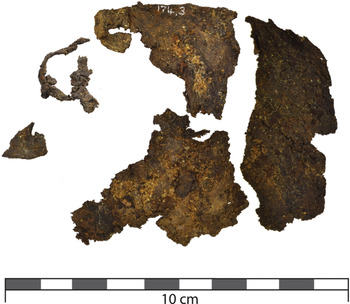
Apart from the shoes and bags, a group of fragments from a fifth item, as yet unidentified, has been recognised (fig 16). Three calf leather fragments (inv. 174.3b, c, d) and a short piece of leather lace (174.11e) appear to form a group. The lace was tied through a slot in inv. 174.3c. No stitches are visible, and the edges appear to be plain cut. The unidentified object is covered on both the flesh and grain side by a thick layer of grit and detritus. This is probably not the enigmatic leather found to the east of the foot ring, beyond the shoe complex, because that piece was identified in 1940 as ‘stitched leather’ in the plan.Footnote 51
Fragments of the unidentified item. Photographs: Esther Cameron. Montage: Marquita Volken.

INTRIGUING POSSIBILITIES RAISED BY THE REASSESSMENT OF THE LEATHER
The reassessment of the Sutton Hoo leather finds allowed the re-establishment of the bags among the shoe complex originally identified during the 1939 excavation. Reconstructions of Bags 2 and 3 also provide an explanation for the small buckles and mounts (inv. nos 145, 146, 149, 150, 151, 154). The strap-ends (inv. 143 and inv. 156) could not be securely identified as belonging to either one of the bags, though these bags certainly had strap-ends on their fastening straps. The numerous bronze pins (inv. 148),Footnote 52 the electrum loopFootnote 53 and the ‘metal remains of a shoe’,Footnote 54 recorded as coming from the shoe complex, were not examined during the reassessment and their functions remain to be established. The pair of bronze hooked catches (inv. 158 and 159)Footnote 55 associated with the textile tape SH 23Footnote 56 were also present within this complex. If SH 6, the tablet-woven bands found tucked inside the left shoe, are in fact cross-gartering bands, then these hooked catches may come from the tapes used to secure the bands below the knee. The pair of shoes, wool tablet-woven bands and pair of catches on securing straps present a coherent group for a man’s costume.
The hinged plate silver buckle setFootnote 57 and the silver strap-endsFootnote 58 from the lowest level of the deposit below the medium-sized hanging bowlFootnote 59 are not directly associated with the pair of shoes or the bags. On the Continent, these types of cross-gartering fittings are associated with female burials.Footnote 60 The only set with surviving leather straps was found in the grave of Arnegund at Saint-Denis in France.Footnote 61 If one were to consider these garter fittings to be gender specific, the Sutton Hoo finds raise the intriguing possibility of a female companion in the burial, although it contained no female-related items of jewellery. If Bags 2 and 3 were intended for carrying personal items and dining sets, represented by the two different wooden picks that appear to have been in the shoe complex (the lost round worked hazel stick and the flat wooden stick associated with Bag 2, evidence for which is given in appendix 2 of the supplementary material), then these might also suggest the presence of two people in the grave. The lost ‘stitched leather’ lying partially beneath the medium-sized hanging bowl might represent the second pair of shoes originally identified during the excavation. Their proximity to the hinged silver buckle set does suggest a relationship. Consideration of the location of the shoe and gartering bands within the burial allows further scope for speculation. While the male group is aligned with the presumed placement of the king’s body surrounded by his panoply, there is a second empty place, the size of a smaller body to his left and slightly lower, that aligns directly with the small hanging bowl, silver buckles and potentially lost ‘stitched leather’ shoes. The wish to consider such tentative re-imaginings as a possible companion burial offered here, whether to confirm or deny, may serve to inspire future study.
The placement of apparently unworn shoes beneath the bags contributes to our understanding of Anglo-Saxon burial practice for high-ranking individuals. New shoes – a spare pair for the afterlife – such as those previously mentioned from Cologne Cathedral, can be seen as being equally valid for Mound 1. The crumpled condition of the bags, however, raises questions about the manner in which these items were deposited. Two potential scenarios are possible: a ritual associated with opening and discarding the bags, or grave robbing. In the first, the shoes are placed neatly together, the bags dropped casually on top of them (both bags open, straps undone) with garments and a pillow piled on top, covered by the Anastasius dish. In the second, the items – placed neatly and covered by the pillow – were then disturbed, the bags emptied and hastily dropped on the shoes; the garments, pillow and dish replaced, concealing the act of robbery. This could have happened before the burial chamber was finally sealed, as concealment would otherwise have been pointless. The small knives usually associated with dining sets were not recognised in proximity to Bags 2 and 3 during the excavation, nor do we know what else these bags may have contained originally. Four knives with horn handles were associated with the fluted silver bowl thought to have been covered by the remains of Bag 1, and these seem to have been placed as a group.
LIMITATIONS OF THE PRESENT RECONSTRUCTIONS
The theoretical reconstruction of the excavation plan and the shoe complex has been useful for understanding the taphonomic condition of the leather, but it is limited by being based primarily on drawings from a few key fragments and photographs and a lack of the parallel examination of the textiles and ‘flock’ layers. It is always beneficial to return to the original fragments for confirmation of their relationships. A further examination might allow not only confirmation of the virtually reconstructed objects but also the placement of many of the smaller pieces. Questions remain about the order in which the objects were deposited, such as the role of the medium-sized hanging bowl, which appears to have been placed, inverted, on top of the silver cross-gartering buckles. The area covered by the textiles and feather ‘flock’ layer pose further questions and these other organic materials in the complex also deserve detailed study. These reconstructions of the two bags and pair of shoes represent our present understanding of the evidence.
SUPPLEMENTARY MATERIAL
Supplementary material accompanying this paper is available online at https://doi.org/10.1017/S0003581520000426.
ACKNOWLEDGEMENTS
The authors wish to thank the following for facilitating the study of the material: Sue Brunning, Curator, Insular Early Medieval Collections and Sutton Hoo at the British Museum; Barbara Wills, Organic Conservator, British Museum; Fleur Shearman, Metals Conservator, British Museum; Monique Pullan, Head of Organic Artefact Conservation; and Ian Cartwright, Photographer, the Institute of Archaeology, University of Oxford. The authors are most grateful to have received a Janet Arnold Grant from the Society of Antiquaries of London towards the cost of travel to examine and photograph the surviving leather at the British Museum.