A decade of empirical research has provided convincing evidence that deliberation has the ability to change opinions and increase factual knowledge, and sometimes even to improve formal policy making.Footnote 1 These successes notwithstanding, empirical research on deliberation is still in its early stages and many foundational issues are still to be addressed.
One of these issues concerns the determinants and normative significance of opinion change – an empirical finding of most deliberative events. With regard to determinants, Luskin et al. have argued that knowledge gain is an important driver of opinion change.Footnote 2 However, in a recent study based on a pan-European deliberative poll (Europolis), Sanders was unable to identify any robust predictor of opinion change.Footnote 3 With regard to normative significance, most deliberative democrats regard opinion change as a desirable outcome. Some would argue that failing to change one’s mind when one is presented with better arguments or relevant new information would amount to a sort of ‘epistemic arrogance’.Footnote 4 Yet there is also general agreement that opinion change is valid only if it is generated under normatively desirable conditions, especially good procedural deliberative quality. Otherwise opinion stability may be preferable.
This article addresses both the determinants and the normative significance of opinion change through an experimental design. It compares three ‘discussion modalities’, i.e. different procedural ways to structure deliberation: ‘Position taken’, ‘No position taken’ and ‘Reflection first’. Participants in the ‘Position taken’ modality are asked to take a stance at the beginning of the debate and to justify it. In the ‘No position taken’ modality participants are asked not to take a stance at the beginning. Participants in the ‘Reflection first’ modality are encouraged to reflect first and only later to take a stance. We expect these three modalities to have different effects on opinion change, knowledge gains and a number of deliberative quality standards such as justification rationality or the relevance of facts provided, for reasons we have articulated below. Furthermore, we consider the impact of group influence on deliberation outcomes. Substantively, the study deals with an important and timely issue: the extension of political rights to foreigners.
We begin by reviewing the emerging literature on discussion modalities. We then describe the experimental design. We continue by presenting our findings on opinion change, knowledge gains, deliberative quality and group influences. A discussion section follows. We conclude by considering the main implications for future research.
Discussion Modalities And Deliberative Outcomes
Many empirical researchers and practitioners of deliberation have adopted the template of James Fishkin’s deliberative polls (2009) or a variant thereof.Footnote 5 The deliberative poll (DP) is a package treatment, consisting of balanced information, the questioning of experts and policy makers, and small group discussions. While the DP format regularly produces opinion changes and the participants gain knowledge, it is difficult to identify the exact causal effect of the deliberative process, as opposed to other elements.Footnote 6 This makes it imperative to unpack the DP package and to disentangle the impact of discussion from information and expert effects. In our study, we focus solely on the discussion component, omitting the provision of information and expert questioning altogether.
Another shortcoming of the DP format is that, unlike that which is typically found in parliamentary settings, it does not have a codified structure of debate. Therefore, one does not know whether small changes in the process of debate make a difference. The goal of the DP is to attain what James Fishkin calls ‘systematic discussion’,Footnote 7 i.e. a thorough and balanced evaluation of the issue under consideration whereby ‘competing considerations’ – presented to participants in the information material in the form of pros and cons – are put to discursive scrutiny. Facilitation ensures that discussions are on-topic, civil and not dominated by specific individuals. However, the process of discussion itself is left rather unstructured.
DP is not alone in disregarding the effects of small procedural differences on the process and outcomes of deliberation. To date, deliberative scholars have been either concerned with the ‘ideal deliberative procedure’Footnote 8 and its normative guidelines for good discussion (such as ‘all shall have the same opportunities to question and/or assert’); or, alternatively, they have tried to identify broad background institutional conditions (such as consensus institutions) that facilitate deliberation in the political sphere.Footnote 9 Procedural details have largely been neglected.
This is unfortunate since there is evidence to suggest that debating rules may matter for the way deliberation works and for the outcomes it produces. Using experimental data with many groups, Karpowitz et al. found that group composition and decision rules mattered strongly for egalitarian deliberative ideals.Footnote 10 Gender gaps in voice and influence disappeared when there were few women and unanimous rule, or when there were many women and majority rule. In a deliberative citizen experiment on nuclear energy in Finland, Setälä et al. analysed the impact of different decision-making methods on outcomes.Footnote 11 They compared groups making decisions through a secret ballot with groups asked to formulate a common statement. Setälä et al. did not find systematic differences between the two decision modes in terms of opinion change; yet participants’ knowledge increased more in the common statement groups than in the secret ballot groups.
Drawing on these findings about the importance of the rules of the game our focus here is on discussion modalities. By discussion modalities, we understand procedural rules similar to the Robert’s Rules of Order in parliamentary proceedings.Footnote 12 These set out procedures for facilitating discussions when a group is deliberating over a complex issue.Footnote 13
We distinguish between three different discussion modalities: ‘Position taken’, ‘No position taken’ and ‘Reflection first’. In the first discussion modality, the moderator asks participants at the beginning of the debate ‘to take a position on the question [of foreigners’ political rights] in the first introductory speeches and to justify [their] positions’. This modality is related to parliamentary deliberation, where there is generally an entrance debate in which participants present their positions, followed by a detail debate where specific aspects of a topic are put to deliberative scrutiny. The idea is that the revelation of positions and presentation of arguments at the beginning facilitates deliberation in the second stage. By hearing other viewpoints and arguments, participants not only know where other participants stand, they also obtain rich knowledge of why certain viewpoints and positions are held.
By asking participants to justify their positions, our first discussion modality also tries to encourage a classic, Habermasian-inspired conception of deliberation. Initial elaborate justifications should not only enhance the rationality of the process, they should also facilitate knowledge gains in so far as participants hear relevant facts and achieve a better understanding of the causal links between premises and conclusions. Moreover, having to justify one’s position publicly to the group may have a civilizing and ‘laundering’ effect whereby participants more frequently utter arguments that are orientated towards the common good and politically correct.Footnote 14 However, from a psychological point of view, this modality may hinder opinion change. An important finding in social psychology is that the public commitment to a position leads to a freezing of the initial distribution of opinions.Footnote 15 Negotiation theorists and mediation practitioners have stressed that a strong initial focus on positions may undermine creative problem solving and the identification of common ground in negotiations.Footnote 16 When participants are asked to justify their position at the beginning of the debate, they may fear losing face to the other members of the group if they change position afterwards. In addition, the early rationalization of positions may amplify the well-known tendency of people to give greater weight to information supporting their position (the confirmation bias effect). For all these reasons, our expectation is that while the ‘Position taken’ modality may advance procedural deliberative ideals (by producing good quality argumentation) and induce knowledge gains, it may stifle opinion change. A preliminary study conducted by our research team provided initial evidence for this hypothesis.Footnote 17
In the second discussion modality, dubbed ‘No position taken’, the moderator begins the session by asking participants ‘not to take a stance on the question in the first introductory speeches, but to introduce themselves only’. We expect the impact on opinion change to be greatest in this modality. Here participants may be more likely to ‘try out ideas out of the blue with the risk of having to abandon them straightaway …, to show hesitation, to reconsider the issues again and again with a fresh eye’.Footnote 18 The discussion may come to resemble what negotiation theorists call ‘brainstorming’, in which the taking of positions is temporarily suspended.Footnote 19 In the ‘No position taken’ modality the quality of speech acts may not necessarily conform to the ideal of rational discourse since this modality leaves it to participants to decide whether to engage in rational argumentation or only to share experiences and tell stories. If rational arguments and proper reasons are not offered in discussion (or offered only sporadically) the deliberative quality of discussion may be compromised. Current deliberative scholarship strongly emphasizes the importance of alternative forms of communication – such as storytelling – for equalizing people’s unequal deliberative capacities. At the same time, there is also broad agreement that the admission of alternative forms of communication should not replace rational argument.Footnote 20 Therefore, we expect that while the ‘No position taken’ modality may spur opinion change, it may undermine procedural deliberative ideals. Moreover, hearing fewer elaborated arguments may restrict knowledge gains.
A third discussion modality, dubbed ‘Reflection first’, tries to combine the hypothetical virtues of the ‘Position taken’ and ‘No position taken’ modalities while reducing their hypothetical downsides. Here the moderator asks participants ‘not to take a stance explicitly on the issue in the first introductory speech but to discuss instead from the point of view of the values, principles and facts that could be relevant for the decision’. The moderator also announces that after about 40 minutes he will ask them to consider the implications of the discussion for the issue at play and take a stance and justify it. This modality seeks to prime reflection, which some scholars have argued is really at the core of deliberative opinion change.Footnote 21 Our expectation is that the ‘Reflection first’ modality should promote both good quality arguments and opinion change, since it would avoid the early ‘freezing’ of opinions.
By focusing on discussion modalities that link opinion change to normatively desirable features of the deliberative process we shed light on the normative significance of opinion change. Deliberative theory requires opinion change to occur under conditions ‘specified in normative theory’.Footnote 22 Most deliberative theorists agree that the argumentative and epistemic quality of the deliberative process is of paramount importance for the normative assessment of opinion change. Psychologists and critics of deliberation have argued that several non-deliberative mechanisms may be responsible for the observed opinion change, ranging from group conformity to group polarization.Footnote 23 Opinion shifts based on non-cognitive group influences or conformity pressures are to be regarded with suspicion from a deliberative vantage point.
We explicitly assess the impact of group influence on individual opinion change in the three discussion modalities. Like Fishkin et al., we hypothesize that when the individual participant’s post-deliberative opinions are overly affected by the pre-deliberative opinions of other participants, the observed opinion change is less likely to reflect rational persuasion and more likely to be the result of non-cognitive and non-deliberative adaptation to group norms.Footnote 24 True deliberative opinion change should not be heavily dependent on the way the group feels about the issue before the deliberation begins.
In real-world deliberative events (such as deliberative opinion polls and other mini-publics), it would be difficult (if not impossible) to disentangle the effects of the three discussion modalities described above. Therefore, we choose an experimental approach, which we discuss below. Notice that we are only interested in the effects of the various discussion modalities on opinion change, not in other mechanisms such as prior knowledge or salience. Of course, these factors may play a role for opinion change and knowledge gains, but random assignment enables us to consider the effects of discussion modalities in isolation.
THE EXPERIMENT
A word on the topic of deliberation – the political rights of foreigners – is in order before we explain the experimental structure. The topic is an important and timely issue, both from a political and normative vantage point. Politically, countries and cities are increasingly inhabited by disenfranchised long-term immigrants. In the Swiss city of Geneva, where the experiment takes place, a full 40 per cent of the legally resident population of voting age (18 years and older) is excluded from the franchise at the cantonal and federal levels (including second-generation and third-generation foreigners) because of alien status. Normatively, scholars debate whether foreigners should be given rights on the basis of an ‘all affected interests’ – or ‘non-coercion’– principle,Footnote 25 or whether citizenship should be a precondition for granting political rights.Footnote 26 Although there are different normative positions, there is general agreement among theorists that the hurdles for obtaining political rights should not be overly burdensome. With regard to citizenship criteria, Geneva has a restrictive immigration regime (as is true for the whole of Switzerland): a twelve-year period of residency is required before an application for ordinary naturalization can be made,Footnote 27 and in addition the naturalization process takes on average four years from beginning to end.Footnote 28 This long period for obtaining political rights is considered normatively problematic even by those philosophers making citizenship a precondition for political rights.Footnote 29
Some might see deliberation as a mechanism aligning participants’ opinions with philosophers’ reasoning: when all affected interests are included and a strong focus on generalizable reasons is taken (as we did in our experiment, see below), participants in deliberative processes will have incentives to make their claims persuasive to those who do not currently have political rights. As it may be difficult to justify continued exclusion to those who will themselves be excluded, post-deliberative opinions of participants might be pushed in the direction of more political rights. We refrain from formulating such an expectation. A communitarian variant of deliberation emphasizes that ‘good reasons’ are not identified in an ethical void, but on the basis of communal values and self-understandings that mirror local and temporal circumstances.Footnote 30 Consequently, the outcomes of deliberation cannot be anticipated, but may reflect something like a ‘local truth’ which is arrived at in the deliberative process. But this communitarian variant, too, presupposes that the quality of the deliberative process is good. Therefore, we concentrate on internal standards of deliberative quality (e.g. quality of argumentation) to judge whether deliberation lived up to its ideals.
On the evenings of the 1 and 6 March 2012 a total of 122 students – sixty on the 1 March and sixty-two on the 6 March – gathered to deliberate about the political rights of foreigners in Geneva. Specifically, they discussed whether or not foreigners legally resident in the Canton of Geneva for at least eight years should be given voting and eligibility rights at the cantonal level, as well as at the municipal and federal levels. In the same period the Geneva Constitutional Assembly was completing its discussions on foreigners’ political rights as part of an overall revision of the cantonal constitution.Footnote 31 Thus the student discussions were framed against the backdrop of a real political process and this arguably increased the realism of the experiment. The majority of participants (56 per cent) were Swiss citizens; the rest (44 per cent) were foreign citizens; as such, all-affected interests were included in the deliberative process.
Participants received a standardized welcome address, which introduced the topic of discussion, invited them to consider the issue from the point of view of principles and of the general interest, and to make an effort to justify propositions and considerations. The introductory address also emphasized the importance of respect and mutual listening.
While participants filled in a baseline questionnaire, they were randomly assigned to the three discussion modalities discussed above: (1) ‘Position taken’; (2) ‘No position taken’; and (3) ‘Reflection first’. Aside from these three procedural differences, everything else was kept as constant as possible. In particular, the moderator role was standardized. All moderators played an exclusive chairperson role consisting in managing requests for the floor. They had been trained by the research group for this role. They were all men of comparable age (mid-to-late 20s).
There were twelve discussion groups of nine to eleven people in total and four discussion groups for each treatment condition. Participants discussed for approximately 75 minutes. Then they had 15 minutes to fill in a recommendation form. We introduced this recommendation requirement because we wanted participants to discuss with a view to making a decision as opposed to simply expressing opinions. Before leaving, participants filled in a second questionnaire.
The measure of foreigners’ political rights was constructed by averaging responses to six questions capturing the attitude to voting and eligibility rights for foreigners at the municipal, cantonal and federal level, respectively, on a 0–10 scale. The scale had excellent internal consistency (Cronbach’s alpha=0.93 at T0 and 0.91 at T1). Visual inspection of plots of the pre-deliberative distribution of opinions across treatment conditions (not shown here) suggests that, although the median participants was always above 5 on the 0–10 attitude scale, in all groups there was a wide distribution of opinions on the issue. At T0, before the deliberation began, the average participant’s opinion regarding foreigners’ political rights were 6.3 on a 0–10 scale, i.e. rather favourable but not overwhelmingly so. This moderately average favourable attitude rules out the possibility of a ceiling effect (i.e. that participants were so clearly in favour of a proposition at the start of discussion that no significant upward shift was possible). Thanks to the randomization process there were no systematic differences in various observable characteristics of participants across groups, including perceived salience of the issue, prior information, political orientation and pre-deliberative favourable attitudes.Footnote 32
EFFECTS ON OPINIONS AND KNOWLEDGE
The analysis of outcomes relies on a first-difference model.Footnote 33 This model hypothesizes that the opinion of an individual at T0 or T1 is a function of a set of both observable and non-observable characteristics as well as the treatment variable. Under the plausible assumption that the only factor that varies between T0 and T1 for an individual participant is participation in the treatment, by taking first differences the observable and unobservable determinants drop out of the equation, making the change in outcome a function of the treatment variable only.Footnote 34
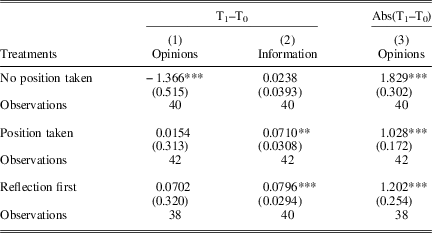
Results are reported in Table 1. The models distinguish between a directional change in opinion, i.e. test whether the median participant has become more or less favourable and by how much (column 1), and an absolute change in opinion (column 3). One model tests whether deliberation induced a learning effect by checking whether a measure of factual knowledge had improved between T0 and T1 (column 2).Footnote 35
Effects of Different Modalities of Deliberation on Net Change in Opinions, Absolute Change in Opinions and Knowledge Gains

Notes: Mixed-level models with random intercepts at the discussion group level, random intercepts not shown. Standard errors in parentheses.
***p<0.01, **p<0.05, *p<0.1
There was significant absolute opinion change in all three modalities (column 3). However, the ‘No position taken’ modality stands out relative to the other two.Footnote 36 It is the one in which there is the greatest absolute change of opinions (column 3) and a significantly negative directional change in opinions (column 1). The point estimates suggest that the average participant in this procedural condition becomes less favourable to granting political rights to foreigners by 1.4 points on a 0–10 scale. The magnitude of the average change as a percentage of the group mean at T0 is almost -24 per cent, which is non-negligible. The ‘Position taken’ and ‘Reflection first’ modalities seem to have no significant effect on individual favour on average (column 1). In addition, while participants in the ‘Position taken’ and ‘Reflection first’ conditions register a significant learning effect, those in the ‘No position taken’ condition do not (column 2).Footnote 37
SPEECH ACT ANALYSIS
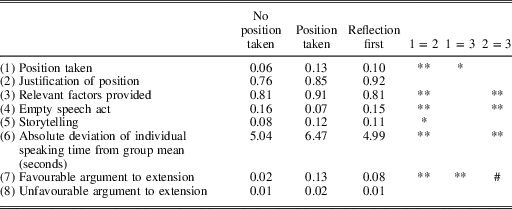
In order to detect differences in ‘deliberative quality’ across the three conditions we conducted an analysis of the 1,361 speech acts uttered by participants. We focused on a number of measures of deliberative quality, including justification rationality,Footnote 38 relevance of arguments provided during discussion,Footnote 39 alternative forms of communication (storytelling),Footnote 40 and participation equality.Footnote 41 While justification rationality and relevance refer to an epistemic dimension of deliberative quality, story-telling and participation equality refer to an inclusionary dimension. We also focused on the substantive content of argument, by analysing whether there were explicit arguments in favour of the extension of political rights to foreigners (or against it). In so doing, we checked for other-regardingness, with the expectation that extension and foreigner-friendly arguments better correspond to social norms in a student population with a high proportion of foreign students. This analysis is summarized in Table 2. The table reports the averages of various indicators (columns 1, 2 and 3) and the significance levels of t-tests of equality of means across treatment conditions.Footnote 42 An intercoder reliability test with three coders yielded satisfactory to good results. Cohen’s kappa, which controls for inter-coder agreements by chance, ranges between 0.65 (for arguments regarding the extension of political rights) and 0.90 (for storytelling).
Analysis of Speech Acts: Averages by Treatment Condition and t-Tests

#p-value<0.1 (two-tailed); *p-value<0.05 (two-tailed); **p-value<0.01 (two-tailed)
Before turning to deliberative quality, we first tested whether position-taking worked as intended in the three conditions. Participants in the ‘Position taken’ condition were asked to take a position right at the beginning, whereas participants in the ‘Reflection first’ condition were asked to do this only after about 40 minutes, and participants in the ‘No position taken’ condition were instructed not to take a position at the beginning of the debate. Consistent with these instructions, the speech acts produced in the ‘Position taken’ groups and to a lesser extent in the ‘Reflection first’ groups involved the more frequent taking of positions on the foreigners’ political rights than those of the ‘No position taken’ group (row 1). The fact that the ‘No position taken’ group did not catch up afterwards points to a certain amount of path dependence in the debates.Footnote 43
With regard to justification rationality, among participants who did take a stance those in the ‘Reflection first’ group seemed more likely to provide a justification for it, even though the differences across treatments are not statistically significant (row 2). Notice, however, that participants were university students who are generally quite good at formulating proper arguments.
Participants in the ‘Position taken’ modality contributed relevant factors to the debate more frequently than those in the other groups (row 3). Furthermore, they were less likely to produce empty speech acts, i.e. speech acts that neither involved a proposition, nor a relevant factor, nor a question, nor a reframing of the debate (row 4). They asked a slightly higher number of questions; used storytelling a bit more frequently (row 5); and were marginally more likely to approve of other members’ speech acts.
The fact that participants in the ‘Position taken’ mode used storytelling more often than others seems puzzling at first glance, given the argument in the normative literature that rational argumentation and storytelling are different communication modes. However, there is increasing evidence that people who are well versed in rational argumentation also use narratives and stories to make abstract reasoning more accessible to others.Footnote 44 Thus, the classic dividing line between rational argumentation and narratives may be overdrawn in practice.
Next, the distribution of speaking time across individuals was slightly more equal in the ‘No position taken’ and ‘Reflection first’ modalities than in the ‘Position taken’ one. However, while the difference was statistically significantly different from zero, its magnitude (1.5 seconds) was negligible (see row 6).
Finally, explicit arguments in favour of the extension of political rights to foreigners were heard more frequently in the ‘Position taken’ condition than in both the ‘Reflection first’ condition and especially the ‘No position taken’ condition (row 7). This is in line with our expectation that in a situation in which participants have to defend their positions publicly, more other-regarding arguments will be uttered. Speech acts expressing explicit opposition to the extension of political rights to foreigners were rarely present in any of the three treatments and there were no significant differences among the three conditions (row 8).
In synthesis, the best epistemic deliberative quality, as well as a higher proportion of foreigner-friendly statements, seem to have been produced in the ‘Position taken’ treatment and, to a lower extent, the ‘Reflection first’ one. By contrast, the ‘No position taken’ treatment had a slightly more egalitarian pattern of debate (which is desirable from an inclusionary perspective), but a worse epistemic quality (lower proportion of relevant facts and higher proportion of empty speech acts). Since many deliberative democrats tend to privilege epistemic quality as long as inequality of participation is not extreme,Footnote 45 which it is not in this case, we conclude that deliberative quality was better in the ‘Position taken’ and ‘Reflection first’ groups. These were also the groups where opinion change was lowest.
GROUP INFLUENCES
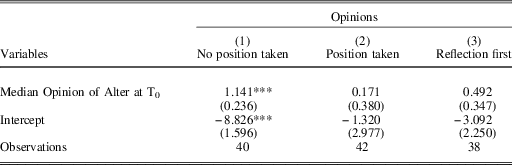
The process of random assignment produced groups that were balanced across treatment conditions.Footnote 46 However, it could not exclude that by sheer chance discussion tables were on average more or less favourably orientated towards the extension of political rights to foreigners. In this section we examine whether these differences in the composition of discussion tables mattered. For each participant (Ego) we calculate the opinion of the median other member of the discussion group (Alter) before the deliberation began (excluding the individual in question). We then estimate regression models in which individual opinion change depends on the median pre-deliberative opinion of Alter and examine how this dependence may change across treatment conditions.Footnote 47 Table 3 reports the regression results.
Effects of Group Influences on Change in Opinions (Mixed-Level Model with Random Intercepts at the Discussion Group Level, Random Intercepts Not Shown)

***p<0.01, **p<0.05, *p<0.1
The pre-deliberative opinions of Alter seem to have a large and significant impact on the opinion change of Ego only in the ‘No position taken’ condition but not also in the other two. In other words, when deliberating in the ‘No position taken’ discussion modality, the opinion change of the individual participant becomes strongly dependent on the way other group members feel about the issue before the deliberation begins.
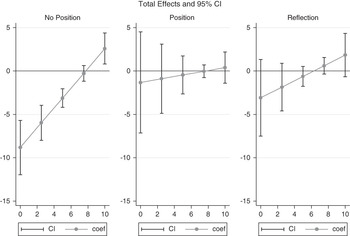
Figure 1 displays the average individual’s predicted change in opinions (vertical axis) as the median pre-deliberative opinion of Alter increases from 0 to 10 in intervals of 2.5 points (horizontal axis). Some of the estimated effects, particularly those close to the left-hand margin of the graphs, are out-of-sample extrapolations and hence should be taken with a grain of salt.Footnote 48 Nonetheless, the patterns are interesting. They show that in the ‘No position taken’ condition (left-hand graph), opinion change is negative and significant for most levels of pre-deliberative opinion of Alter, but grows strongly as pre-deliberative opinion of Alter increases. The regression results suggest that the opinion change becomes positive if pre-deliberative opinion of Alter is greater than 7.7. In other words, in the ‘No position taken’ modality if the median Alter at T0 is less than fully convinced that foreigners should have political rights, the individual becomes less favourably orientated. Vice versa, if the median Alter is strongly in favour at T0, the individual becomes more favourably-orientated. There are no significant effects for the other two discussion modalities, even though they show a similar pattern with a flatter slope.
Expected change in opinion for foreigners’ political rights at different levels of pre-deliberative opinions of Alter (0-2.5-5-7.5-10) in different communication modalities: total effects and 95 per cent confidence intervals Notes: The graphs are based on columns 1, 2 and 3, respectively, of Table 3.

DISCUSSION OF RESULTS
The above pattern of results suggests that small procedural differences in communication modalities affect both the process and the outcomes of deliberation. As we expected, asking people to declare their position at the outset and to justify it, which is typical of parliamentary debates, was least conducive to opinion change. This modality may have led to the premature rationalization of participants’ positions and to a freezing effect on opinions. However, it also produced the best epistemic deliberative quality in combination with the greatest proportion of foreigner-friendly arguments. Furthermore, it insulated the individual deliberator from group influence: there was no statistically significant relationship between the opinion change of the average individual and the median pre-deliberative opinions of the rest of group.
The ‘No position taken’ modality seems to have been the most conducive to opinion change, both absolute and directional. However, it also had the worst epistemic deliberative quality and the least foreigner-friendly arguments. In addition, it was the only modality in which participants failed to increase their factual knowledge. Furthermore, individual opinion change was heavily influenced by the group’s pre-deliberative opinions. A situation in which the estimated response of randomly selected individuals can go in opposite directions depending on the prior attitudes of the other group members seems suspicious from a deliberative point of view and suggests that pressures to conform played a role.
Finally, the ‘Reflection first’ modality produced an intermediate pattern of results. We had hypothesized that it would avoid the premature blocking of opinions and would simultaneously stimulate reflection, which we consider a key driver of deliberative opinion change.Footnote 49 However, results were mixed. Opinion change was greater than in the ‘Position taken’ modality, but its magnitude was smaller than in the ‘No position taken’ one. We thought this modality could represent a sort of optimal deliberation design, but our expectations, particularly with regard to the quality of argumentation, were not entirely fulfilled. A possible reason is that being asked by a moderator to reflect on the issue of discussion is not enough to generate significant reflection. Perhaps more engaging cognitive tasks would be required to stimulate it.
Our research suggests there may be a trade-off between opinion change and high-quality deliberation. Features of the deliberation procedure that stimulate the former seem to hinder the latter and vice versa. Furthermore, our results challenge the high status attributed to opinion change in deliberation theory. Many deliberation scholars consider it as one of the cornerstones – if not the main empirical marker – of deliberative success.Footnote 50 The importance of opinion change arises from the fact that in many cases people’s policy attitudes rest on very little reflection and information. Consequently, participants in deliberation who hear different opinions and are confronted with new information are expected to modify their views.Footnote 51 Moreover, if participants do not change their minds the practical value of deliberation becomes questionable:Footnote 52 why would one invest time, money and energy into deliberative events if nothing new comes out of it?
Yet one may wonder whether opinion change is always a desirable outcome of deliberation. Converse, one of the pioneers of modern opinion research, would not agree that it is: he considered opinion stability – and not opinion change – a welcome sign of ‘considerateness’.Footnote 53 More recently, Knight and Johnson have forcefully argued that democratic deliberation is about issue clarification rather than opinion change.Footnote 54 Many classic deliberative theorists, too, would be unwilling to value opinion change per se.Footnote 55 In their view, it would be entirely possible that after serious reflection participants would find out that their original opinions and beliefs were fully justified, and consequently would not change their minds. Argumentative rationality and the epistemic quality of the process are more important than opinion change for classic deliberation theorists. Fishkin, too, concurs on this point: ‘the question for the DP is whether or not the moves [opinion changes] are based on reasoned argument with good information considered under good conditions’.Footnote 56 But to date, only a few attempts have been made to verify this in empirical research.Footnote 57 Our experimental data break new ground on this topic: the communication modalities with better epistemic deliberative quality, more learning, more extension-friendly and foreigner-friendly arguments, and fewer social influences (the ‘Position taken’ and, to a lesser extent, the ‘Reflection first’ modality) had markedly less opinion change than the one with worse epistemic deliberative quality, no learning, less foreigner-friendly arguments, and more social influences (the ‘No position taken’ modality).
It is also striking that when significant aggregate opinion change could be detected, it led to less favourable attitudes towards the political rights of foreigners. While we have refrained from formulating expectations about the directionality of opinion change, we nonetheless note that this type of opinion change is in tension with the conclusions of most current philosophical literature on political rights. As has been argued by Lopez-Guerra, ‘perhaps all contemporary democratic theorists’ accept the notion ‘that long-term residency in a democratic state is what should entitle people to full political rights, regardless of their ethnicity and national origin’.Footnote 58
An alternative interpretation of our findings for the ‘No position taken’ modality is that the presence of opinion change signals an openness of mind which may bring fruit later on, perhaps after exposure to additional stages of deliberation. Participants whose opinions are more malleable may eventually end up with ‘good’ deliberative outcomes such as relaxation of pre-commitments and genuine reflection over alternative points of view. Similarly, failure to change opinions in the course of a single deliberative event does not rule out the possibility of opinion change after the deliberation is over as a result of individual reflection.Footnote 59
Given the time frame of our study, we are unable to rule out this alternative interpretation fully. However, we are able to throw some light on the topic of reflection by analysing the content of the recommendations produced in the different communication modalities. Participants were asked to fill in and sign a standardized recommendation form after the deliberation phase, either as a group or as a sub-group of participants or even as individuals. On the form they indicated whether or not they recommended the extension of voting/eligibility rights at different levels, and were given an opportunity to qualify or expand on their recommendations by using an open field. We would expect that if a particular deliberation modality has set in motion a process of reflection, this would be associated with more cognitively complex recommendations in this consecutive phase. A rough indicator of complexity is the number of open-ended remarks written in the recommendation sheets.
The ‘Reflection first’ modality produced both the most recommendation sheets and the most remarks (seventeen and seventeen, respectively). The ‘Position taken’ modality produced an intermediate number of recommendation sheets (12) and the least remarks (7). The ‘No position taken’ modality produced the least recommendation sheets (10) (i.e. the most consensual outcome) and an intermediate number of remarks (10). Thus, we find no evidence that poor epistemic quality, absence of learning and social conformity effects in the ‘No position taken’ group were counterbalanced by more reflective recommendations than in the other groups.
CONCLUDING REMARKS
Based on an experimental study, this article has argued that small procedural differences in communication modalities produce stark differences in the process and outcomes of deliberation. In particular, asking participants not to take a stance at the beginning of the debate facilitated opinion change but reduced knowledge gains, lowered epistemic deliberative quality and led to strong social influences on individual opinions. Conversely, asking participants to take a position, and justify it, discouraged opinion change but simultaneously also reduced the impact of the pre-deliberative opinions of the other group members and encouraged better epistemic deliberative quality. When opinion change was significantly different from zero (in the ‘No position taken’ group) it went against the extension of political rights to foreigners. This finding is troubling, since most normative literature seems to agree that the exclusion of residents from suffrage, based on alien status, when combined with a restrictive naturalization regime, is difficult to reconcile with the idea of democracy. It suggests that all opinion change is not necessarily good, especially if it reflects poor deliberative quality, non-cognitive group influence and normatively questionable post-deliberative opinions.
These findings emphasize the importance of examining the effects of the various constitutive elements of a deliberative process. So far, most empirical deliberation studies have either directly applied Fishkin’s Deliberative Poll design, or they have been heavily influenced by it. Yet, the deliberative poll format is a package treatment combining discussion with balanced information material and expert questioning, which makes it impossible to assess empirically how these various elements affect outcomes. Our focus on discussion modalities represents an attempt to move beyond the Deliberative Poll format with the goal of organizing deliberation optimally, i.e. combining good procedural deliberative quality with opinion change in normatively attractive directions.
Far from being able to propose an optimal structure, at this stage we seem only to have identified a potential trade-off between good procedural quality and opinion change. Obviously, this result would need to be confirmed by further studies focusing on different populations and different issues. Nonetheless, it raises important questions both about the proper organization of deliberative events and the desirable outcomes of a deliberative process.