




No CrossRef data available.
Article contents
Assessing hope at the end of life: Validation of an experience of hope scale in advanced cancer patients
Published online by Cambridge University Press: 12 May 2005
Abstract
Objective: The purpose of this study was to gather validity evidence for an innovative experience of hope scale, the Hope Differential-Short (HDS), and evaluate its clinical utility for assessing hope in advanced cancer patients.
Methods: A consecutive sampling approach was used to recruit 96 patients from an inpatient tertiary palliative care unit and three hospice settings. Each participant completed an in-person survey interview, consisting of the following measures: HDS (nine items), Herth Hope Index (HHI), hope visual analog scale (Hope-VAS) and Edmonton Symptom Assessment System (ESAS).
Results: Using factor analytic procedures, a two-factor structure for the HDS was identified, consisting of authentic spirit (Factor I) and comfort (Factor II). The HDS factors had good overall internal consistency (α = 0.83), with Factor I (α = 0.83) being higher than Factor II (α = 0.69). The two factors positively correlated with the HHI, Hope-VAS, and one of the ESAS visual analog scales, well-being (range: 0.38 to 0.64) and negatively correlated with depression and anxiety, as measured by the ESAS (range: −0.25 to −0.42).
Significance of results: This is the first validation study of the HDS in advanced cancer patients. Its promising psychometric properties and brief patient-oriented nature provide a solid initial foundation for its future use as a clinical assessment measure in oncology and palliative care. Additional studies are warranted to gather further validity evidence for the HDS before its routine use in clinical practice.
Information
- Type
- Research Article
- Information
- Copyright
- © 2004 Cambridge University Press
INTRODUCTION
The concept of hope plays an important role in advanced cancer, yet it is neither well understood nor well researched. Patients and clinicians acknowledge the importance of hope when facing a life-threatening illness (Scanlon, 1989; Good et al., 1990; Kodish & Post, 1995; Moadel et al., 1999). Hope may be positively linked to effective coping (Herth, 1989; Elliott et al., 1991), enhanced quality of life (Staats, 1991), and improvements in the immune system (Udelman & Udelman, 1985a, 1985b, 1991). In contrast, hopelessness may be associated with depression (Beck et al., 1974; Chochinov et al., 1998) and suicidal intent (Beck et al., 1985).
A number of studies have explored the role of hope in cancer across the illness spectrum, ranging from the newly diagnosed (Rustoen & Wiklund, 2000) to cancer survivors (Little & Sayers, 2004) to end stage disease (Hall, 1990; Flemming, 1997; Benzein et al., 2001). Within the health care community, however, there is a strong tendency to link hope with a cure: If there is no cure, then there is no hope (Perakyla, 1991; Nuland, 1994). This curative perspective may restrict the view of advanced cancer patients as being hopeless, given the incurable nature of the disease (Hall, 1990). To enhance our understanding, it is important to consider the complexity of the hope experience in progressive illness.
Most studies in advanced cancer have focused on specific, tangible dimensions of hope, such as goal-setting or hope-enhancing strategies (Miller, 1989; Herth, 1990; Hall, 1994). A few recent studies have attempted to explore the meaning of hope from the patients' (Flemming, 1997; Benzein et al., 2001) or caregivers' perspectives (Benzein & Saveman, 1998). In a study of elderly advanced cancer patients, Dufault and Martocchio (1985) described two types of hope: particularized hope and generalized hope. Particularized hopes are specific goal-directed hopes. As the illness progresses, patients may express different kinds of hopes, for example, hope for a cure, hope for relief from pain, hope to accomplish a specific task before dying, hope for a peaceful death (Scanlon, 1989; Miyaji, 1993). Generalized hopes are less tangible, representing a personal inner experience of hope. It is this part of the hope experience that is important to enhance within patients, particularly as their ability to engage in goal-oriented hopes wanes with advancing disease (Herth, 1990; Jevne, 1991, 1994; Nekolaichuk et al., 1999).
To better understand the role of hope in advanced cancer, clinically relevant hope assessment frameworks focusing on the inner experience of hope need to be developed. These assessments could assist with complex clinical decision making, such as patients' participation in aggressive treatment and clinical trial protocols, as well as requests for resuscitation. They could also help identify patients at risk, with the goal of developing individualized hope-enhancing interventions for coping with a progressive illness. The integration of hope assessment with other approaches, such as symptom assessment, would further enhance our understanding of the biological, psychological, social, and spiritual complexities of advanced cancer, with an ultimate goal of improving patients' comfort and quality of life.
Development of an Experience of Hope Scale
In an attempt to capture the intangible nature of hope, Nekolaichuk et al. (1999) developed a hope model, which focuses on the subjective inner experience of hope. This model suggests that people experience hope along three interrelated dimensions: personal spirit, risk, and authentic caring. Personal spirit is a personal dimension, revolving around a core theme of meaning. Risk is a situational dimension that is characterized by a common theme of uncertainty. Authentic caring represents a relational dimension, with underlying themes of credibility and caring. Thus, a person's experience of hope may be associated with finding meaning in life, taking risks in spite of uncertainty, and experiencing credible and caring relationships. This model was derived from a sample of 550 healthy and ill people, using factor analytic procedures. A detailed description of this derivation is given elsewhere (Nekolaichuk et al., 1999).
Using this model, it is possible to explore an individual's personal experience of hope. Based on this three-factor model, a measure for assessing the personal experience of hope, the Hope Differential (HD) was developed (Nekolaichuk et al., 1999). The HD is based on Osgood's semantic differential technique, a well-validated and commonly used approach for quantifying connotative or personal meaning (Osgood et al., 1957). It consists of 24 bipolar adjective items that may be used to rate different concepts relevant to the hope domain. Although the concepts may vary, the 24 items remain invariant. The HD consists of three subscales, representing the three distinctive dimensions of hope: personal spirit (personal dimension), risk (situational dimension), and authentic caring (interpersonal dimension).
The length of the HD may limit its use in certain populations, such as advanced cancer. In response to this concern, an abbreviated nine-item measure, the Hope Differential-Short (HDS), was developed (see Fig. 1). Nine bipolar adjective pairs were selected from the original 24, based on factor loadings (i.e., high loadings were selected) and factor representation (i.e., three items were chosen from each of the three factors). Although the HDS appears to have good clinical utility, it has not been previously studied in an advanced cancer population.
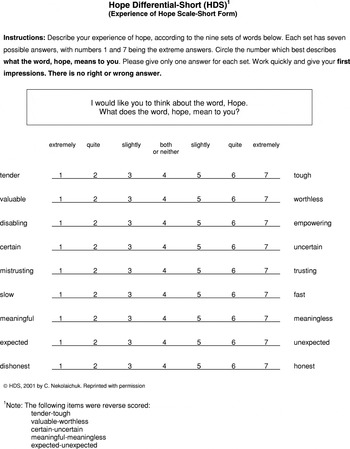
The Hope Differential-Short (HDS) instrument.
To develop a validation design in this population, a pilot study was conducted (Nekolaichuk & Bruera, 1999). A total of 35 advanced cancer patients completed an in-person survey interview, consisting of four hope measures and a symptom assessment tool. A subsample of eight patients participated in a follow-up semi-structured interview. The pilot study supported the feasibility of this study, through the development of field entry methods, identification of patient accrual patterns across the collection sites, and refinement of data collection methods. In the pilot study, both the HD (24 items) and the HDS (9 items) were administered. Given the patients' difficulty in completing the HD (due to fatigue levels and altered cognitive functioning), only the HDS was included in this full-scale study design.
The primary purpose of this study was to gather validity evidence for the HDS within the context of advanced cancer. Three specific objectives were identified: (1) to assess the internal structure of the HDS using the three-factor HD model as a framework, (2) to estimate the internal consistency of the HDS, and (3) to gather convergent and divergent validity evidence regarding the external relationships of the HDS. This validation study was part of a larger study, involving a qualitative component focusing on the patient's experience of hope when confronted with a progressive life-threatening illness. This article will focus on the validation findings of the HDS. Ideally, the HDS should be combined with a qualitative assessment framework. Through further refinement, a clinically relevant framework for assessing hope, which integrates quantitative and qualitative approaches, could eventually be developed.
METHOD
Participants
Ninety-six patients were recruited from a tertiary palliative care unit (n = 42) and three hospice sites (n = 54) in the Edmonton Regional Palliative Care (ERPC) program. General admission criteria to these sites include a progressive disease, requiring active care to alleviate distressing physical, psychosocial, and spiritual issues. Approximately 85–90% of patients would have a cancer diagnosis.
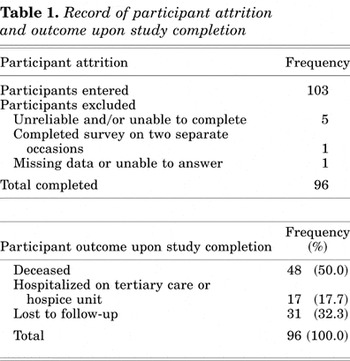
The following criteria were used for participant selection: (1) English-speaking, (2) cognitively able to complete the questionnaire, and (3) willingness to participate. In terms of cognitive functioning, the decision to include patients was based on their ability to complete the assessment tools, as opposed to their level of cognitive functioning, which more closely approximates the assessment process in clinical practice. All participants, apart from one individual, had advanced cancer, which was either locally recurrent or metastatic in nature. A total of 103 participants were recruited for an initial interview. Of this total, seven patients withdrew from the study, resulting in a completion rate of 96 (see Table 1).
Record of participant attrition and outcome upon study completion

Measures
Demographic Profile
A number of demographic variables were collected for each patient, including age, gender, marital status, and type and length of diagnosis. This information was obtained from the patient, the patient's medical record, and the ERPC clinical database.
Mini-Mental Status Examination
The Mini-Mental Status Examination (MMSE; Folstein et al., 1975) is a well-recognized and widely used measure for assessing five separate domains of cognitive functioning: orientation, memory, attention and calculation, recall, and language. Scores range from 0/30 (severe cognitive impairment) to 30/30 (cognitively intact). The MMSE was administered as a cognitive screening tool, as well as to obtain demographic information about cognitive status.
Hope Differential–Short (HDS)
The HDS is a nine-item measure for assessing the personal experience of hope. These nine items were derived from the three subscales of the original 24-item Hope Differential (HD): three items were selected from each of the 8-item subscales of personal spirit, risk, and authentic caring (Nekolaichuk et al., 1999). Based on the original HD, a score can be calculated for each of the three subscales, ranging from 1 to 7. Higher scores indicate an enhanced hope experience. There is no total scale score for this measure. In a pilot study of elderly patients (n = 35), the personal spirit and risk HDS subscales were positively correlated with a measure of integrity and a hope numerical rating scale (range: r = 0.62–0.71); whereas the risk subscale was negatively correlated with depression (r = −0.62) (Chimich & Nekolaichuk, 2004). The three-subscale solution for the HDS, although clinically relevant, has not been validated through factor analysis, which was one of the purposes of this study.
The HDS can be used to rate different domains of the hope experience. For this study, participants were asked to rate two specific domains, abstract hope and experiential hope, by responding to the following questions:
a. I would like you to think about the word “hope.” What does the word “hope” mean to you? (abstract hope)
b. How would you describe your hope at this time? (experiential hope)
Herth Hope Index
The Herth Hope Index (HHI; Herth, 1992) is a 12-item abbreviated form of the Herth Hope Scale. It was developed specifically to assess hope in adult illness populations in the clinical setting and has been used with palliative patients (Herth, 1990). It has a high degree of internal consistency (coefficient α = 0.97), a 2-week test–retest reliability of 0.91, and high correlations with related measures: Herth Hope Scale (r = 0.92), Existential Well-Being Scale (r = 0.84), and the Nowotny Hope Scale (r = 0.81). The HHI was included in this study to gather convergent validity evidence for the HDS. It was expected that this measure would be positively correlated with the HDS. Given that the HHI and HDS measure different aspects of the hope domain, however, these correlations were expected to be moderate, rather than high.
Hope Visual Analog Scale
The Hope Visual Analog Scale (Hope-VAS) consists of a 100-mm visual analog scale, ranging from 0 (no hope) to 100 (great deal of hope). Participants were asked to describe their level of hope, using this scale. This measure was included to gather further convergent validity evidence, with the expectation that the correlations between the HDS and the Hope-VAS would be moderately positive.
Edmonton Symptom Assessment System
The Edmonton Symptom Assessment System (ESAS; Bruera et al., 1991) is a brief symptom assessment tool designed specifically for use in advanced cancer and palliative patients. It consists of nine visual analog scales for assessing the symptoms of pain, activity, nausea, depression, anxiety, drowsiness, appetite, sense of well-being, and shortness of breath. Each visual analog is a premeasured 100-mm scale that can be used to visually represent symptom intensity. A number of reliability and validity studies have been conducted to evaluate the usefulness of visual analog scales for symptom assessment. The majority of studies have focused on gathering validity evidence for the use of visual analog scales for pain assessment (Huskisson, 1983; Price et al., 1983; Ahles et al., 1984; Grossman et al., 1992). Other studies have focused on using these types of scales for the assessment of related symptoms, such as nausea (Bruera et al., 1984), asthenia (Bruera et al., 1989), mood (Hurny et al., 1996), quality of life (Boyd et al., 1988), depression (Ahles et al., 1984), and psychological distress (Sutherland et al., 1989). This measure was included in this study to provide additional participant demographics, as well as divergent validity evidence. It was expected that the HDS subscales would correlate positively with well-being and negatively with depression and anxiety.
Procedure
The appropriate research ethics boards approved the study design. A consecutive sampling approach was used to recruit participants, in which all new patients admitted to the designated tertiary palliative care unit and hospice sites were screened within the first week of admission. Upon initial screening, an interview was scheduled with eligible participants. Informed written consent was obtained prior to initiating an in-person interview, conducted by the principal investigator or a research assistant. The patient's level of cognitive functioning was assessed using the MMSE. Participants were asked to complete a survey consisting of the three hope measures (HDS, HHI, Hope-VAS) and a symptom assessment scale (ESAS). To reduce the potential for order effect, administration of the HDS and the HHI was counterbalanced (i.e., half of the participants were administered the HDS first followed by the HHI; the order was reversed for the other half of the sample). Participants were given an opportunity to provide general comments at the end of the survey. In most cases, the interviewer read the statements to the participant and recorded the participant's verbal responses. The approximate time to complete the survey was 30 min.
Data Analysis
Demographic variables were analyzed, using descriptive statistics. A test for homogeneity of variance (Levene test) and t tests were used to compare the tertiary palliative care (n = 42) and hospice subsamples (n = 54) on the three hope measures. Based on these findings, the two subsamples were pooled to conduct further validation analyses.
To assess the internal structure of the HDS, an exploratory factor analysis was conducted with the total sample, based on the HDS ratings of the abstract concept of hope, which was the same concept used in the original factor analytic study (Nekolaichuk et al., 1999). Pearson correlations were calculated among the items. An unweighted least squares extraction procedure with an oblique rotation was applied to the resulting correlation matrix. To conduct a factor analysis, Gorsuch (1983) recommends a sample size 5 to 10 times the number of variables. Using this guideline, an appropriate sample size would be 45 to 90 (for nine variables or items). Thus, the proposed sample size of 96 was adequate for analyzing the data using factor analysis. To further assess the internal structure of the HDS, Cronbach's alpha coefficients were calculated.
To assess the external relationships of the HDS, Pearson correlations were calculated between the HDS subscales and the HHI; the Hope-VAS; and ESAS visual analogs for well-being, depression and anxiety.
RESULTS
Description of the Sample
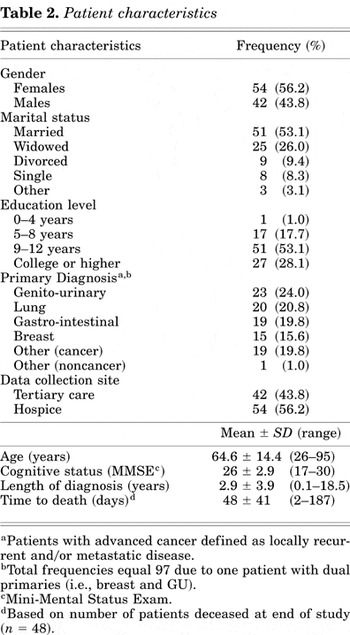
The majority of participants were female (56.2%), married (53.1%), and had a Grade 9 to 12 education (53.1%). The three most common primary cancer diagnoses were genito-urinary (24.0%), lung (20.8%), and gastro-intestinal (19.8%). Slightly more than half of the participants were residing in a hospice unit at the time of the study (56.2%). Most participants were older (average age 64.6 years ± 14.4 SD) and all were cognitively intact (average MMSE 26 ± 2.9 SD). At the end of the data collection period, 50% of the participants were deceased, 17.7% were hospitalized on either a tertiary palliative care or hospice unit, and the remainder was lost to follow-up. Of the participants who had died (n = 48), the average time to death from the interview date was 48 days (±41 SD; see Tables 1 and 2).
Patient characteristics

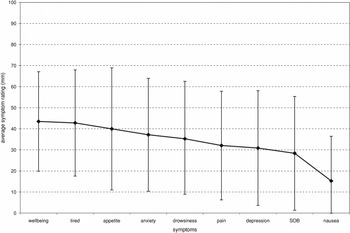
In terms of symptom expression, the average symptom scores ranged from 15.3 (nausea) to 43.5 (well-being), as measured on the ESAS ranging from 0 (no symptom) to 100 (worst possible symptom; see Fig. 2). It is important to note the wide range of scores for each symptom, as indicated by the standard deviation bars in Figure 2.

Summary of Edmonton Symptom Assessment System (ESAS) scores (means and standard deviations).
The participants residing in hospice settings did not differ significantly from those admitted to the tertiary palliative care unit in terms of their hope scores on all three hope measures. The Levene tests were also nonsignificant, suggesting that these two groups had equal variances.
Internal Structure of the HDS
To validate the internal structure of the HDS, a series of exploratory factor analyses was conducted with the data for the abstract hope concept, using various extraction and rotation procedures. A scree test was used to identify the number of factors. HDS ratings of the abstract concept of hope were used for these analyses. Results will be limited to the analyses based on an unweighted least squares extraction procedure with oblique rotation, as this procedure yielded the most interpretable findings.
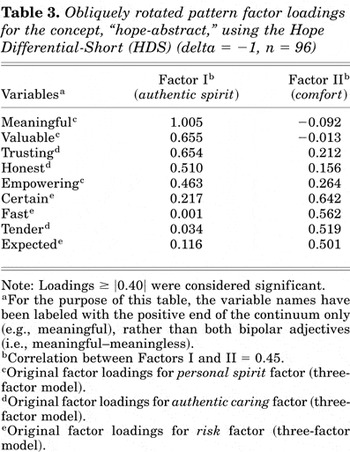
The results of the factor analysis appear in Table 3. As shown in this table, two primary factors were identified, using a |0.40| cutoff for pattern loadings. Factor I had five variables with pattern loadings greater than |0.40|: meaningful, valuable, trusting, honest, empowering. Factor II had four variables with pattern loadings greater than |0.40|: certain, fast, tender, expected.
Obliquely rotated pattern factor loadings for the concept, “hope-abstract,” using the Hope Differential-Short (HDS) (delta = −1, n = 96)

As highlighted in Table 3, the pattern loadings for Factor I included all three variables from the personal spirit factor (i.e., meaningful, valuable, empowering) and two variables from the authentic caring factor (i.e., trusting, honest) of the original three-factor model. To reflect this difference from the original model, this factor was labeled authentic spirit. The pattern loadings on Factor II included all three variables from the risk factor (i.e., certain, fast, expected) and one variable from the authentic caring factor (i.e., tender). This second factor was labeled comfort. The correlation between the two factors was 0.45, suggesting that these two factors were not totally independent of each other. This finding is in contrast to the original three-factor solution in which a principal components with varimax rotation suggested that the three factors were essentially independent.
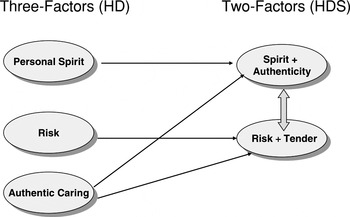
Figure 3 illustrates the differences between the two-factor solution, based on the analysis of the HDS, and the original three-factor model (Nekolaichuk et al., 1999). As shown in this figure, the personal spirit and risk factors of the original model were retained in the two-factor solution (i.e., Factors I and II, respectively). The authentic caring factor of the original model, however, could not retain its independence in the two-factor solution: the authenticity component of authentic caring (i.e., trusting, honest) loaded on the first factor, whereas the caring component (i.e., tender) loaded on the second factor.

Comparison of the two-factor model for the Hope Differential-Short (HDS) with the three-factor model for the Hope Differential (HD).
Cronbach's α, which is a measure of internal consistency, was calculated for each of the two factors, as well as for all nine items. The items had a high internal consistency for Factor I (r = 0.83) and a moderate internal consistency for Factor II (r = 0.69). The overall consistency of all nine items was high (r = 0.83).
External Relationships of the HDS
On average, patients scored toward the more hopeful end of the continuum on all three hope measures, although there was a wide variability in scores. The average score for the Hope-VAS was 62 (±30 SD), with 0 representing no hope and 100 representing a great deal of hope. The average score for the HHI was 37 (±5 SD, range: 25–48), with the higher scores representing greater hopefulness. The scores for the HDS subscales were 5.8 (±1.1 SD) for Factor I (authentic spirit) and 4.3 (±1.4 SD) for Factor II (comfort), with 1 representing the negative end of the continuum (e.g., meaningless) and 7 representing the positive end of the continuum (e.g., meaningful).
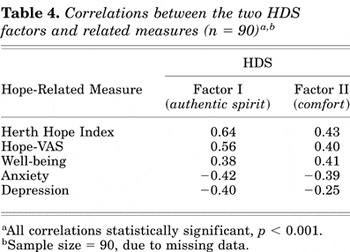
Pearson correlations between the two HDS factors (i.e., authentic spirit, comfort), HHI, Hope-VAS, and the ESAS scores for well-being, depression, and anxiety were calculated (see Table 4 and Fig. 4). As shown in Table 4, the correlations between the two HDS factors, the two hope measures, and well-being were moderately positive, ranging from 0.38 to 0.64. In contrast, the correlations between the two HDS factors, depression, and anxiety were moderately negative, ranging from −0.25 to −0.42. As shown in Figure 4, the correlations among all three hope measures were moderately positive, ranging from 0.40 to 0.64.
Correlations between the two HDS factors and related measures (n = 90)a,b


Correlations between the two factors of the Hope Differential-Short (HDS), the Herth Hope Index (HHI), and the Hope Visual Analog Scale (Hope VAS) (n = 90).
Participants' Reactions to the Survey
Most participants completed the questionnaire with minimal assistance and acknowledged the therapeutic value of hope in their lives. In some cases, participants described how the bipolar nature of the HDS adjective pairs (e.g., meaningful–meaningless) mirrored their experience of maintaining hope while living with advanced cancer. As one participant said, “My hope comes and goes. Some days, I have more than others.” Another participant reinforced the fragility of this experience by saying, “From one minute to the next, it (my hope) could change, from one end of the scale to the other.” A third participant described the experience in terms of its extremities: “Hope is being at both extremes.” Other participants rated their experience at the midpoint of the adjective pair continuums, again reflecting the experience of being caught in the middle between varying states.
In describing their hope experiences, participants provided a vast range of responses, ranging from an unwavering belief in the power of hope to fluctuating states of hope to the belief that hope was a negative force. This extreme negative perspective was rarely expressed. In contrast, most participants emphasized the value of hope in dealing with advanced cancer. Many participants suggested that they were not always 100% hopeful, recognizing that their hope sometimes fluctuated with their physical or emotional state. Despite this fluctuation, most participants endorsed the value of hope, succinctly summarized by the following participant's comment: “You have to have hope. There isn't anything if you haven't got hope. You know, even if it's a small percentage … you have to have it.”
DISCUSSION
Validity Evidence for the HDS
In terms of its internal structure, a two-factor solution appears to be a better representation of the HDS than a three-factor solution. This two-factor solution has moderately high internal consistency. It retains some of the structure of the original model, in which the personal spirit and risk factors remain essentially intact. There are a number of possible explanations for these findings. In the original three-factor model, the authentic caring factor accounted for the smallest amount of total variance of the three factors (i.e., 3.9%). It is possible that when the items were reduced from 24 (HD) to 9 (HDS), there may not have been enough variability in the three variables originally loading on authentic caring to retain an independent factor. It is also possible that the three variables selected for the HDS did not adequately represent this third factor, as had the original eight variables. Only one variable was selected to represent the caring component of authentic caring (i.e., tender) in place of the original five variables (i.e. tender, warm, happy, connected, accepting). Similarly, only two variables were selected to represent the authenticity component of authentic caring (i.e., trusting, honest) in place of the original three variables (i.e., honest, realistic, trusting).
In terms of the external relationships of the HDS, the findings are consistent with what would be expected. The fact that the correlations among the hope measures were only moderate suggests that the HDS may be measuring a qualitatively different component of the hope experience than the other two measures. Similarly, it makes sense that the concept of well-being would be positively correlated with hope, as both of these concepts generally represent positive indicators of health. The negative correlations between the HDS and depression are supported by research that indicates strong positive relationships between depression, hopelessness, and suicidality (Beck et al., 1974, 1985; Chochinov et al., 1998). The fact that the correlations with depression and anxiety were moderately negative suggests that these concepts are related but that they are not identical. Thus, hope is more than a measure of mood. Further research regarding the nature of these relationships is warranted.
These findings provide good initial psychometric evidence for the HDS. Given the relatively small sample size (n = 96), it would be important to gather further validity evidence using a larger sample of advanced cancer patients. It may also be important to consider the possibility of increasing the number of items to provide a better representation of the three-factor model (e.g., 12 items, with 4 items per factor). Future validation studies could focus on gathering additional evidence across different contexts (e.g., different health care settings), clinical populations, interventions, and time (Messick, 1989).
Clinical Implications
In general, the concept of hope appears to have a positive therapeutic value in advanced cancer patients. Participants' descriptions of living along a continuum of contrasting experiences poignantly reflect the paradox in which many advanced cancer patients live: a paradox of both living and dying. Health care providers need to be open to a patient's ability to hold what may appear to be very disparate views of hope, for example, a hope to attend a young daughter's high school graduation and a hope for a peaceful death. The wide variability in participants' descriptions further reinforces the unique nature of the hope experience, supporting the need for individualized, patient-specific hope-enhancing interventions.
As the majority of the participants were older (average age: 64.6 years) and had an education level similar to the average population, the HDS could potentially have clinical applications for the cancer population at large. The approximate time to complete the HDS was less than 10 min, which would further support its use as a brief, psychometrically sound measure in the clinical setting.
Clinically, the HDS could be used most effectively at an individual level for assessing the patient's experience of hope over time. To enhance its clinical utility, the HDS should be combined with a qualitative assessment framework. Based on the original work of the HD, clinical frameworks for assessing hope in palliative (Nekolaichuk & Bruera, 1998) and cancer patients (Jevne & Nekolaichuk, 2003) have been proposed. Regardless of which psychometric model is selected, there are some key clinical questions revolving around the themes of meaning, uncertainty, authenticity and caring that are common to both models: What is meaningful in this person's life? How has this person learned to deal with the uncertainty of living with advanced cancer? Who and/or what does this person care about? How might I, as a health care provider, enhance this person's experience of hope in a credible and caring way? These questions reinforce the need to provide comfort and credible caring within the uncertainty of advanced cancer, while at the same time, preserving a patient's personal or authentic spirit.
Additional questions focusing on hope in advanced cancer warrant further research. What types of interventions might enhance a patient's hope? How does the patient's experience of hope compare with other family members? How might different health care professionals influence a patient's hope by their communication styles? How stable is a patient's hope over time? What is the relationship between hope and other positive health indicators, such as well-being, quality of life, and dignity? To properly address these questions, well-validated measures, such as the HDS, need to be developed.
This is the first validation study of the HDS in advanced cancer patients. The findings provide important preliminary psychometric evidence for it use in this population. Its brief, patient-oriented nature further supports its future clinical use in advanced cancer. Additional studies are warranted, however, to gather further validity evidence before the HDS may be implemented in clinical practice. This study also clearly demonstrates the value of assessing hope in advanced cancer. Despite having a progressive illness, patients were able to identify with the concept of hope, supporting the view that hope can be measured. With further refinement, instruments, such as the HDS, should become part of routine assessments in advanced cancer patients. Through these consistent approaches, hope-enhancing strategies can be developed to ultimately improve patients' quality of life.
ACKNOWLEDGMENTS
This study was supported by a grant from the Alberta Cancer Board (Bridge and Pilot Funding Program). The authors also acknowledge the support and assistance from the following people and organizations: Nili Talmor, Terry Scholer, Edmonton Regional Palliative Care Program, Caritas Health Group, The Capital Care Group, St. Joseph's Auxiliary Care Centre, Edmonton, Alberta, Canada.
References
REFERENCES
Ahles, T.A.,
Ruckdeschel, J.C., &
Blanchard, E.B.
(1984).
Cancer-related pain: II. Assessment with visual analogue
scales.
Journal of Psychosomatic Research,
28,
121–124.Google Scholar
Beck, A.T.,
Steer, R.A.,
Kovacs, & M.,
et al.
(1985).
Hopelessness and eventual suicide: A 10-year prospective study of
patients hospitalized with suicidal ideation.
American Journal of Psychiatry,
142,
559–563.Google Scholar
Beck, A.T.,
Weissman, A.,
Lester, & D.,
et al.
(1974).
The measurement of pessimism: The hopelessness scale.
Journal of Consulting and Clinical Psychology,
42,
861–865.Google Scholar
Benzein, E.,
Norberg, A., &
Saveman, B.I.
(2001).
The meaning of the lived experience of hope in patients with cancer
in palliative home care.
Palliative Medicine,
15,
117–126.Google Scholar
Benzein, E. &
Saveman, B.
(1998).
Nurses' perception of hope in patients with cancer: A
palliative care perspective.
Cancer Nursing,
21,
10–16.Google Scholar
Boyd, N.F.,
Selby, P.J.,
Sutherland, & H.J.,
et al.
(1988).
Measurement of the clinical status of patients with breast cancer:
Evidence for the validity of self-assessment with linear analogue
scales.
Journal of Clinical Epidemiology,
41,
243–250.Google Scholar
Bruera, E.,
Brenneis, C.,
Michaud, & M.,
et al.
(1989).
Association between asthenia and nutritional status, lean body mass,
anemia, psychological status, and tumor mass in patients with advanced
breast cancer.
Journal of Pain & Symptom Management,
4,
59–63.Google Scholar
Bruera, E.,
Carraro, S.,
Roca, & E.,
et al.
(1984).
Association between malnutrition and caloric intake, emesis,
psychological depression, glucose taste, and tumor mass.
Cancer Treatment Reports,
68,
873–876.Google Scholar
Bruera, E.,
Kuehn, N.,
Miller, & M.J.,
et al.
(1991).
The Edmonton Symptom Assessment System (ESAS): A simple method for
the assessment of palliative care patients.
Journal of Palliative Care,
7,
6–9.Google Scholar
Chimich, W.T. &
Nekolaichuk, C.L.
(2004).
Exploring the links between depression, integrity, and hope in the
elderly.
Canadian Journal of Psychiatry,
49,
169–174.Google Scholar
Chochinov, H.M.,
Wilson, K.G.,
Enns, M., &
Lander, S.
(1998).
Depression, hopelessness, and suicidal ideation in the terminally
ill.
Psychosomatics,
39,
366–370.Google Scholar
Dufault, K. &
Martocchio, B.C.
(1985).
Hope: Its spheres and dimensions.
Nursing Clinics of North America,
20,
379–391.Google Scholar
Elliott, T.R.,
Witty, T.E.,
Herrick, & S.,
et al.
(1991).
Negotiating reality after physical loss: Hope, depression and
disability.
Journal of Personality & Social Psychology,
61,
608–613.Google Scholar
Flemming, K.
(1997).
The meaning of hope to palliative care cancer patients.
International Journal of Palliative Nursing,
3,
14–18.Google Scholar
Folstein, M.F.,
Folstein, S., &
McHugh, P.R.
(1975).
“Mini-mental state”: A practical method for grading the
cognitive state of patients for the clinician.
Journal of Psychiatric Research,
12,
189–198.Google Scholar
Good, M.D.,
Good, B.J.,
Schaffer, & C.,
et al.
(1990).
American oncology and the discourse on hope.
Culture, Medicine, and Psychiatry,
14,
59–79.Google Scholar
Gorsuch, R.L.
(1983).
Factor Analysis,
2nd ed.
Hillsdale, NJ:
Erlbaum.
Grossman, S.A.,
Sheidler, V.R.,
McGuire, & D.B.,
et al.
(1992).
A comparison of the Hopkins Pain Rating Instrument with standard
visual analogue and verbal descriptor scales in patients with cancer
pain.
Journal of Pain & Symptom Management,
7,
196–203.Google Scholar
Hall, B.A.
(1990).
The struggle of the diagnosed terminally ill person to maintain
hope.
Nursing Science Quarterly,
3,
177–184.Google Scholar
Hall, B.A.
(1994).
Ways of maintaining hope in HIV disease.
Research in Nursing & Health,
17,
283–293.Google Scholar
Herth, K.A.
(1989).
The relationship between level of hope and level of coping response
and other variables in patients with cancer.
Oncology Nursing Forum,
16,
67–72.Google Scholar
Herth, K.
(1990).
Fostering hope in terminally-ill people.
Journal of Advanced Nursing,
15,
1250–1259.Google Scholar
Herth, K.
(1992).
Abbreviated instrument to measure hope: Development and psychometric
evaluation.
Journal of Advanced Nursing,
17,
1251–1259.Google Scholar
Hurny, C.,
Bernhard, J.,
Coates, & A.,
et al.
(1996).
Responsiveness of a single-item indicator versus a multi-item scale:
Assessment of emotional well-being in an international adjuvant breast
cancer trial.
Medical Care,
34,
234–248.Google Scholar
Huskisson, E.C.
(1983).
Visual analogue scales. In
Pain Measurement and Assessment,
Melzack, R. (ed.), pp.
33–37.
New York:
Raven Press.
Jevne, R.F.
(1991).
It All Begins with Hope: Patients, Caregivers & the Bereaved
Speak Out.
San Diego, CA:
LuraMedia.
Jevne, R.F.
(1994).
The Voice of Hope: Heard across the Heart of Life.
San Diego, CA:
LuraMedia.
Jevne, R.F. &
Nekolaichuk, C.L.
(2003).
Threat and hope in coping with cancer for health care
professionals. In
Between Stress and Hope,
Jacoby, R. &
Keinan, G. (eds.), pp.
187–212.
Westport, CT:
Greenwood Publishers.
Kodish, E. &
Post, S.G.
(1995).
Oncology and hope.
Journal of Clinical Oncology,
13,
1817–1822.Google Scholar
Little, M. &
Sayers, E.J.
(2004).
While there's life … hope and the experience of
cancer.
Social Science & Medicine,
59,
1329–1337.Google Scholar
Messick, S.
(1989).
Validity. In
Educational Measurement,
3rd ed.,
Linn, R.L. (ed.), pp.
13–103.
New York:
American Council on Education/Macmillan.
Miller, J.F.
(1989).
Hope-inspiring strategies of the critically ill.
Applied Nursing Research,
2,
23–29.Google Scholar
Miyaji, N.T.
(1993).
The power of compassion: Truth-telling among American doctors in the
care of dying patients.
Social Science & Medicine,
36,
249–264.Google Scholar
Moadel, A.,
Morgan, C.,
Fatone, & A.,
et al.
(1999).
Seeking meaning and hope: Self-reported spiritual and existential
needs among an ethnically-diverse cancer patient population.
Psycho-Oncology,
8,
378–385.Google Scholar
Nekolaichuk, C.L. &
Bruera, E.
(1998).
On the nature of hope in palliative care.
Journal of Palliative Care,
14,
36–42.Google Scholar
Nekolaichuk, C.L. &
Bruera, E.
(1999).
Assessing the experience of hope in palliative care patients
[Abstract].
Psycho-Oncology,
8(6,
Suppl.),
15.Google Scholar
Nekolaichuk, C.L,
Jevne, R.F., &
Maguire, T.O.
(1999).
Structuring the meaning of hope in health and illness.
Social Science & Medicine,
48,
591–605.Google Scholar
Nuland, S.B.
(1994).
How We Die: Reflections on Life's Final Chapter.
New York:
Knopf.
Osgood, C.E.,
Suci, G.J., &
Tannenbaum, P.H.
(1957).
The Measurement of Meaning.
Urbana, IL:
University of Illinois Press.
Perakyla, A.
(1991).
Hope work in the care of seriously ill patients.
Qualitative Health Research,
1,
407–433.Google Scholar
Price, D.D.,
McGrath, P.A.,
Rafii, & A.,
et al.
(1983).
The validation of visual analogue scales as ratio scale measures for
chronic and experimental pain.
Pain,
17,
45–56.Google Scholar
Rustoen, T. &
Wiklund, I.
(2000).
Hope in newly diagnosed patients with cancer.
Cancer Nursing,
23,
214–219.Google Scholar
Scanlon, C.
(1989).
Creating a vision of hope: The challenge of palliative care.
Oncology Nursing Forum,
16,
491–496.Google Scholar
Staats, S.
(1991).
Quality of life and affect in older persons: Hope, time frames and
training effects.
Current Psychology: Research & Reviews,
10,
21–30.Google Scholar
Sutherland, H.J.,
Lockwood, G.A., &
Cunningham, A.J.
(1989).
A simple, rapid method for assessing psychological distress in
cancer patients: Evidence of validity for linear analog scales.
Journal of Psychosocial Oncology,
7,
31–43.Google Scholar
Udelman, D.L. &
Udelman, H.D.
(1985a).
A preliminary report on anti-depressant therapy and its effects on
hope and immunity.
Social Science & Medicine,
20,
1069–1072.Google Scholar
Udelman, H.D. &
Udelman, D.L.
(1985b).
Hope as a factor in remission of illness.
Stress Medicine,
1,
291–294.Google Scholar
Udelman, D.L. &
Udelman, H.D.
(1991).
Affects, neurotransmitters, and immunocompetence.
Stress Medicine,
7,
159–162.Google Scholar
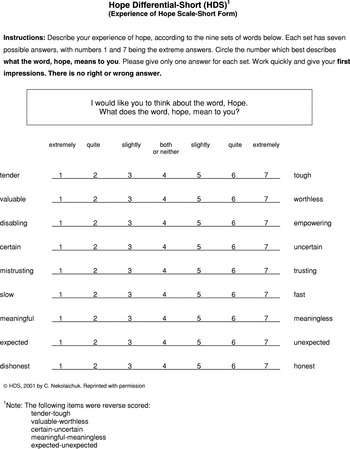
The Hope Differential-Short (HDS) instrument.
Record of participant attrition and outcome upon study completion
Patient characteristics
Summary of Edmonton Symptom Assessment System (ESAS) scores (means and standard deviations).
Obliquely rotated pattern factor loadings for the concept, “hope-abstract,” using the Hope Differential-Short (HDS) (delta = −1, n = 96)
Comparison of the two-factor model for the Hope Differential-Short (HDS) with the three-factor model for the Hope Differential (HD).
Correlations between the two HDS factors and related measures (n = 90)a,b
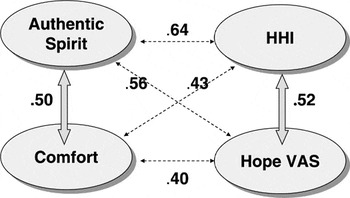
Correlations between the two factors of the Hope Differential-Short (HDS), the Herth Hope Index (HHI), and the Hope Visual Analog Scale (Hope VAS) (n = 90).
 You have
Access
- 34
- Cited by