In March 1840, Wilford Woodruff, one of the twelve apostles in the Church of Jesus Christ of Latter-day Saints, ventured into the county of Herefordshire in western England. Woodruff had traveled to England with many of the other Mormon apostles to follow up on the success that Mormon missionaries had begun in Lancashire and its neighboring counties a few years earlier. Mormonism had been remarkably successful in these counties, and Woodruff, who arrived ahead of the other apostles, soon began to expand on the success, particularly in Staffordshire. Not long after, Woodruff ventured south to begin one of the truly remarkable episodes in early Mormon proselytizing. The day after Woodruff began preaching in Herefordshire, he baptized six people; two days later, he baptized another seven. After one month, Woodruff had one hundred sixty converts, and after four months and help from other Mormon missionaries, Woodruff had between five hundred and six hundred converts. So receptive to Mormonism were these people that “frequently we have baptized from eight to twelve the first time of meeting with the people in new places,” reported Woodruff.Footnote 1
By October, the work Woodruff began in Herefordshire now stretched to areas of Worcestershire and Gloucestershire and numbered one thousand seven converts.Footnote 2 Of these converts, six hundred had belonged to a highly enthusiastic splinter group of the Primitive Methodists called the United Brethren; thus the United Brethren acted as the principal mechanism of Mormonism's success in the region. The United Brethren broke with the Primitive Methodists on the same grounds on which the Primitives had broken with the Wesleyan Methodists: the original body had become too formal and worldly. The United Brethren practiced simplistic and ecstatic worship until Woodruff arrived. Eventually all but one of their number joined the Mormons, making the United Brethren the most receptive group that the early Mormon proselytized among.Footnote 3
Scholars tend primarily to examine Joseph Smith to understand the genesis of Mormonism. Rather than listing Smith's characteristics and then making assumptions about those who followed him, this study looks to the bigger question of who Smith's followers were in order to give greater context to Smith and his religious movement. Starting the discussion with the United Brethren forces the issue of Mormon success into a larger context by raising the question of what was held in common by this enthusiastic English sect and Smith's followers in the United States. Understanding who joined Mormonism and the appeal that the religion had for its converts illuminates the nature of the larger cultural milieu from which Mormonism sprang. Early Mormonism gained converts rapidly; singular attention to Joseph Smith and his family provides only some of the answers as to why. Understanding what qualities among the United Brethren enabled such a smooth and eager transition into Mormonism sheds light on what factors made early Mormonism successful generally.
In addition to their enthusiastic religious practice, a member of the United Brethren described the sect's economic circumstances as follows: “It had a great many very poor people as its members, and a few working men in fairly good circumstances, and one man who might be called wealthy.”Footnote 4 Poverty as a cause for early Mormon conversions had been a popular theory among historians, but such as these have been too quick to make assumptions based on very little evidence.Footnote 5 A breakdown of the British converts' occupations indicates that the Mormons were quite similar to the general populace of the counties from which they principally came.Footnote 6 While the data on the early British Mormons suggest that they were principally “working class,” the data do not indicate that the converts were lower class than British society generally. My study of the relative wealth of early Mormon converts in the Delaware Valley in the United States actually suggested that those converts may have been somewhat wealthier than their neighbors.Footnote 7 Though the issue of early Mormonism and class merits further study, no evidence yet suggests that poverty was a distinguishing characteristic among the converts, British or American.
Instead, the United Brethren made such easy converts to Mormonism because of a shared religious expectation of the active presence of the divine in everyday life. The early Mormons, Joseph Smith included, were products of a British subculture that held to this worldview despite the disenchantment of much of the broader society. Thus Mormonism demonstrates the persistence of this culture, which stretched back well beyond the nineteenth century and its social conditions. This study concurs with John Brooke that Mormonism was “shaped by strands of culture inherited from the past” but argues for a different orientation to that heritage.Footnote 8 Rather than being rooted primarily in popular manifestations of Renaissance Hermeticism, Mormonism was in many ways the fruition of the radical edge of centuries of Anglo-American religious awakenings among peoples seeking the direct divine experience that orthodox Protestantism generally suppressed. Though what Brooke calls Hermeticism became a tool in this quest, Mormonism came out of a broader cultural milieu that found its roots within particular regions of Great Britain. These regions witnessed several centuries of revivals in the quest for divine experience—the quest I call the “great revival.” Mormonism as a successful religion eventually made converts among diverse peoples, but to understand the original context of the rise of the movement, this study focuses on the earliest converts (the first twenty years), who came principally from Great Britain and North America. With the extensive geographical and temporal scope that this paper suggests for understanding the sources of Mormonism, the conclusions presented here are naturally of a preliminary nature. Nevertheless, the data presented here suggest the persistence of religious heritage over many generations and across considerable distance, and informs the question of the sources of religious behavior.
I. Methodism
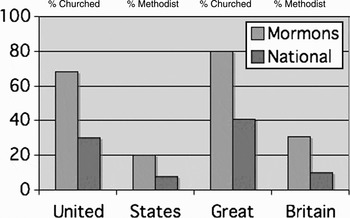
Relative to the United Brethren's religious practice, scholars have often assumed that early Mormon converts felt alienated from organized religion before joining the Mormons, an idea put most succinctly by Marvin Hill, who called early Mormons “casualties of the Protestant conversion process, of sectarianism, and especially revivalism.”Footnote 9 Yet the data do not support such claims. Three studies of early Mormon journals and autobiographies indicate that the converts' churched rates before joining the Mormons were much higher than the general society (a fact missed due to lack of comparison).Footnote 10 The following chart (fig. 1) compares both the churched rates and the Methodist rates among the Mormon converts before conversion to that of the general populaces in both the United States and Great Britain.
Comparison of Mormon convert church membership status.13

Thus the American Mormons were more than twice as churched and twice as Methodist before conversion than was the general populace; the British Mormons were twice as churched and three times as Methodist.Footnote 11 Rather than being “casualties of the Protestant conversion process, of sectarianism, and especially revivalism,” as Marvin Hill suggested, the early Mormon converts were disproportionately devoted to all such tendencies before conversion.Footnote 12
Although the Methodists only represented about a quarter of the early Mormon converts, the fact that the plurality of early Mormons came out of Methodism and the fact that a much higher percentage of early converts were Methodist than was the general populace of Great Britain and the United States suggests that Methodism is a useful starting place for understanding preconditions in Mormon conversions. Methodist connections with Mormonism certainly both are supported by and also help to explain the mass conversion of the United Brethren. Why the United Brethren were particularly willing to embrace Mormonism can be found in the early histories of both Methodism and Mormonism. John Kent's recent interpretation of early Methodism is particularly useful in shedding light on the links between the two movements. Kent argues, “By the early eighteenth century there could be a wide gap between what ordinary people wanted from religion and what different religious bodies offered.” This gap, Kent argues, was created by the English Reformation, which suppressed what Kent calls “primary religion,” or seeking “some kind of extra-human power, either for personal protection, including the cure of diseases, or for the sake of ecstatic experience, and possibly prophetic guidance.”Footnote 14 Indeed, rejecting both modern miracles and revelation was central to the Reformers' program: said Luther, “Now that the apostles have preached the Word and have given their writings, and nothing more than what they have written remains to be revealed, no new and special revelation or miracle is necessary.”Footnote 15 The English Reformers held this position also.Footnote 16 Says Kent,
The reformed Church of England, supported by the state, not only rejected the view that miraculous powers had continued in the Church down to the present, but swept away the whole visible Catholic apparatus of supernatural assistance: local shrines and pilgrimage centres, with all their furniture of statues, pictures, relics and ex-votos, the theatre in which primary religion and theology had overlapped and interacted for centuries, disappeared.Footnote 17
“What got Wesleyan Methodism off the ground in the 1740s was the Wesleys' encounter with and response to the demands of primary religion,” argues John Kent.Footnote 18 Wesley rejected the Reformers' claim that miracles were no longer necessary after the apostles: “The grand reason why the miraculous gifts were so soon withdrawn was not only that faith and holiness were well nigh lost, but that dry, formal, orthodox men began even then to ridicule whatever gifts they had not themselves, and to decry them all as with madness or imposture.”Footnote 19 At the heart of the movement was what Wesley called “experimental” religion, or religion that one experienced; one needed to “feel” that he or she had been forgiven of his or her sins. Wesley himself had this experience and encouraged his followers through open-air preaching to do the same. Yet many of his followers had experiences beyond the inward manifestation of forgiveness: Methodists reported falling, trances, visions, prophesying, and even healings. The pinnacle experience, Kent argues, was the vision of the Father or the Son or both.Footnote 20 John Wigger calls this religious form “supernaturalism,” which he defines as “a more interactive faith in which the believer and God actively work together to meet life's daily challenges and in which God communicates directly with the believer or community of believers.”Footnote 21 It was this supernaturalism, particularly in the form of miracles and revelation, that the Reformation suppressed and that popular movements like Methodism and Mormonism sought to recover.
Methodist supernaturalism took on a new life in the American colonies where, according to John Wigger, Methodists “took advantage of the revolutionary religious freedoms of the early republic to release, and in a sense institutionalize, elements of popular religious enthusiasm long latent in American and European Protestantism.”Footnote 22 Jon Butler calls this mix of folk beliefs and evangelical religion “syncretism” that “revolved around the figures of [Methodism's] itinerants, who manifested divine attributes in their being, bearing, dreams, and rituals.” “In fact,” declares Butler, “early Methodist itinerancy in America bore an intriguingly Catholic character,” due to its miracle working and encouragement of celibacy.Footnote 23 One particularly dramatic preacher was the fiery Benjamin Abbott, who had remarkable visions of heaven and hell that led to his conversion to Methodism. Abbott's conversion was capped by a vision of the Father and Son: after an unusual dream about crossing a river, he awoke and “saw, by faith, the Lord Jesus Christ standing by me, with his arms extended wide saying to me, ‘I died for you.’ I then looked up and by faith saw the Ancient of Days, and he said to me, ‘I freely forgive you for what Christ has done.’ ” Abbott's pinnacle Methodist experience was capped by Christ telling him to join the Methodists, “for they are my people.”Footnote 24
Lorenzo Dow, perhaps the early republic's most popular itinerant, had similar experiences: vivid dreams of heaven and hell, as well as dreams of visitations of the post-mortal John Wesley.Footnote 25 “This kind of supernaturalism often works to circumvent established patterns of hierarchy,” declares Wigger, and Abbot and Dow often found themselves in conflict with such structures.Footnote 26 Abbott's wife encouraged him to meet with her Presbyterian preacher, “whereupon I related my conviction and my conversion; he paid strict attention until I had done, and then told me that I was under strong delusions of the devil.”Footnote 27 Dow was often referred to as “Crazy” Dow by detractors. Dow even found himself in conflict with other Methodists, finding the doors closed against him among the Wesleyan Methodists in England.Footnote 28 Nevertheless, Dow remained immensely popular in the United States, with more children named after him than anyone save George Washington in the early republic.Footnote 29 Thus what the “people” wanted and what the “orthodoxy” tolerated came into stark contrast in the life of Lorenzo Dow.
Born in 1805, Joseph Smith was raised during Methodism's tremendous growth fueled by its supernaturalism. Smith's parents were themselves avid practitioners of supernatural religion, with both manifesting high anxiety about their own salvation as well as practicing folk magic.Footnote 30 With such a background, Smith soon found himself attracted to the Methodists, diverging from his family (his mother joined the Presbyterians, and his father was unaffiliated). Convinced of his sins and bothered by the confusion of the religious world, Smith
cried unto the Lord for mercy for there was none else to whom I could go to obtain mercy and the Lord heard my cry in the wilderness and while in the attitude of calling upon the Lord in the 16th year of my age a pillar of light above the brightness of the Sun at noon day come down from above and rested upon me and I was filld with the Spirit of God and the Lord opened the heavens upon me and I Saw the Lord and he Spake unto me Saying Joseph my Son thy Sins are forgiven thee.Footnote 31
Under the tutelage of Methodist preachers, Smith had the pinnacle Methodist experience of having the Father and the Son tell him personally that his sins were forgiven. Smith records that at the time he mentioned what is known to Mormons as the First Vision to one person, a local Methodist preacher. “I was greatly surprised by his behavior, he treated my communication not only lightly but with great contempt, saying it was all of the devil, that there were no such things as visions or revelations in these days; that all such had ceased with the apostles, and there would never be any more of them.”Footnote 32 This rejection is certainly surprising considering Methodism's heritage of such visions. As Jon Butler notes, “The Methodists' distinctive and popular syncretism faded after 1820,” the year of Smith's vision. “Memoirs of second-generation itinerants say little or nothing about dreams,” notes Butler; “Methodist revivals of the 1830s paled in comparison to those that Abbott led in the 1790s.”Footnote 33
Nathan Bangs, the Methodist bishop in New York City, is often cited as a major force behind Methodism's refinement; Bangs also serves as an indicator of Methodism's shifting attitudes toward supernaturalism.Footnote 34 In Bangs's early career as a Methodist itinerant, he experienced much of the supernaturalism common to Methodism's early years but seems to have shed such beliefs as he led Methodism into its refined future. A nineteenth-century Methodist historian recorded a story about Nathan Bangs that illustrates the point. Bangs was working as a Methodist itinerant preacher one winter when he came to a settlement where he intended to visit each house “for prayer and conversation.” One house had no pathway to it through the snow, so Bangs decided to skip it. Yet, he felt impressed to visit it as well, “until the impression became intolerable.” The historian recorded that “he turned back, waded through the snow and found not a soul there. He never again trusted impressions.”Footnote 35 Interestingly, Bangs's biographer, writing in the 1860s, not only removed Bangs's early supernatural experiences but also declared that Lorenzo Dow suffered from “the infirmities of partial insanity.”Footnote 36
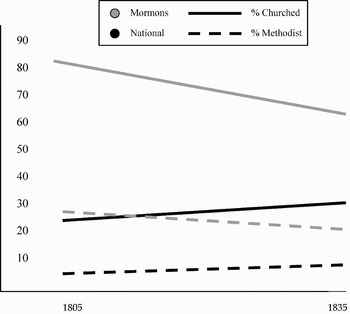
The rejection of Smith's vision by the Methodist preacher, an event that Smith described with more pathos than any other event of his young life, suggests that those looking for the kind of supernaturalism Smith sought, and which had been accepted on the edges of Methodism decades earlier, would now have to look elsewhere. Many other early Mormons felt this way; an examination of the change in rates of religious affiliation between the Mormon converts and their parents demonstrates this trend. The following chart (fig. 2) compares the Methodist and churched rates for the converts and their parents to those of the general populace of the United States. The parents are compared with the rates for 1805 and the converts to those for 1835.
Comparison of changes in affiliation rates between Mormon converts and the nation.37

Thus the converts' parents were even more churched than the converts, suggesting both that the converts' upbringing was even more disproportionately churched (their parents being four times as churched and ten times as Methodist as other Americans of their generation) and that the converts themselves had grown dissatisfied. As certain Mormons explained to a Methodist visitor at Nauvoo, “The Methodists were right as far as they had gone, and next to the Latter-day Saints … were the best people in the land, but they had stopped short of their grand and glorious mission; … they were afraid of persecution, and had shrunk from their duty.”Footnote 38
Not surprisingly, Smith not only created an environment fully immersed in supernaturalism but also gathered up those who felt similar. The fact that the United Brethren, an enthusiastic Methodist schismatic group, so eagerly converted to Mormonism is further evidence of this trend. Smith even explained his perceived relationship to Methodism to the frontier preacher Peter Cartwright:
He believed that among all the Churches in the world the Methodists was the nearest right. But they had stopped short by not claiming the gift of tongues, of prophecy, and of miracles, and then quoted a batch of Scriptures to prove his position correct. …
“Indeed,” said Joe, “if the Methodists would only advance a step or two further, they would take the world. We Latter-day Saints are Methodists, as far as they have gone, only have advanced further.”Footnote 39
II. The British Northwest
The above helps to explain Mormon success among the United Brethren and why Mormonism did so well among Methodists generally, but the fact that only about 25 percent of early Mormon converts came out of Methodism suggests that Methodism is only part of the story. Furthermore, though the Mormons were tremendously successful among the United Brethren, this group was only part of Mormonism's tremendous success throughout the British Northwest. The Mormons were also quite successful in North America, but their particular success in the British Northwest, what one scholar referred to as “the most spectacular harvest of souls since Wesley's time,”Footnote 40 is particularly striking considering the Mormons' meager success in the British South and East. This contrast is best demonstrated by the Mormons' first attempt to proselytize in London. With two companions, Wilford Woodruff passed through Herefordshire and Worcestershire and baptized many, including forty in one day. London was different. The clergy shut their doors, and the common people were indifferent. After two months, all their efforts resulted in eleven baptisms and the following summation from one missionary: “We are willing to acknowledge, that in our travels, either in America or Europe, we have never before found a people, from whose minds we have had to remove a greater multiplicity of objections, or combination of obstacles, in order to excite an interest in the subject and prepare the heart for the reception of the word of God, than in the city of London.”Footnote 41
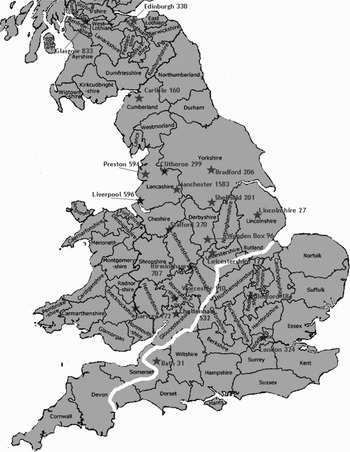
Thus the Northwest and the Southeast represented the areas of greatest and least receptivity to Mormonism throughout Great Britain. The Mormons did establish a presence in many areas throughout the Southeast, including London, but Mormon success in the Southeast always paled in comparison to their success in the Northwest. As Willard Richards remarked of his efforts in the Northwest, “We find the people of this land much more ready to receive the gospel than those of America. … We have not to labor with a people month after month to break down their old notions.”Footnote 42 In contrast, Wilford Woodruff described London as “the hardest place for a mission that we had ever undertaken.”Footnote 43 Indeed, the line from the Wash to Bristol (called the Wash-Severn line) that divides Great Britain between its Northwest and Southeast was the dividing line between the Mormons' most and least receptive proselytizing areas in the Anglo world. The apostles added six thousand converts during their year in Britain, and at their departure 98 percent of British Mormons were in the Northwest.Footnote 44 In 1844, 93 percent of British Mormons resided in the North and West, the numbers of which are displayed in the following map (fig. 3).
Location and size of Mormon conferences in Great Britain, April 6, 1844.47

By 1851 the numbers were less stark, down to 77 percent; however, over seven thousand British Mormons had left for America by 1850, and the numbers suggest that these individuals were overwhelmingly Northwesterners.Footnote 45 Thus the percentage of total Northwestern British Mormons in 1851, the year Mormonism reached its peak in Britain, was likely higher than the percentage still remaining in Britain.Footnote 46 While the Wash-Severn line presents no absolute dividing line between areas of Mormon success and subregional variance certainly occurred, the line does indicate a larger trend in early Mormon British conversions.
I should note that Mormonism's areas of greatest success were the areas of their earliest efforts, starting in Lancashire. Yet the Mormons did not randomly choose Lancashire to start their British proselytizing but went there at the urging of British immigrants who converted in North America and who wanted to share their newfound faith with family members in the old country. The most influential people in this process were a group of converts in and around Toronto that was converted by Parley P. Pratt. Pratt had struggled in Toronto but did find some interest among a study group with Irvingite sympathies. Pratt soon made converts among the group, including John Taylor from Westmorland and Isabella Russell Walton from Liverpool. These converts directed Pratt to Isaac Russell of Cumberland and Scotsmen Samuel Mulliner and Alexander Wright, who joined shortly afterward.Footnote 48 Perhaps the most influential of these converts in bringing Mormonism to Great Britain was Joseph Fielding, who, though born in Bedfordshire, had a family history that went back for generations in Yorkshire.Footnote 49 Fielding was particularly insistent that the Mormons go to Britain, and he accompanied the first group of missionaries to England where they began their efforts among Fielding's brother's congregation in Preston, Lancashire (Wright became the first Mormon missionary to Scotland). Thus it was through the conversion of Northwesterners in North America that the Mormons began proselytizing where they did.
These Canadian Mormons were part of a larger trend of Mormon conversions among Northwesterners in North America. Two recent works illustrate this point: one a study of persistent localism's influence on the Great Awakening and another on the heritage of the early Mormon converts. Cedric Cowing's The Saving Remnant: Religion and the Settling of New England (1995) argues that colonial New England was divided culturally between a three-fourths majority hailing from Southeastern England and the remaining one-fourth from the Northwest.Footnote 50 Cowing finds that the Northwestern/Southeastern division was central to the antinomian crisis, the Salem witch trials, and the New Light/Old Light controversy during the Great Awakening. “In New England,” declares Cowing, “the awakening was great where the Northwest stock set the tone and not really ‘great,’ only moderate, transitory, or minimal elsewhere.”Footnote 51 Finding numerous colonial religious radicals in his own family line, Val D. Rust explores the degree to which this trait was common among the earliest Mormon converts. Through a massive genealogical study of the early Mormons, Rust discovers that the early Mormon converts had significantly descended from radical colonial New England individuals and towns.Footnote 52
For my purposes, it is remarkable to what degree Cowing and Rust speak of the same people and places. Indeed, disproportionate numbers of both Mormon ancestors and British Northwesterners are found among the Pilgrim Fathers,Footnote 53 the followers of Anne Hutchinson and John Wheelwright,Footnote 54 the founders of New Haven,Footnote 55 the early New England Quakers,Footnote 56 and the accused and accusers in the Salem witch trials.Footnote 57 Most striking is the fact that Cowing's quintessential Northwestern town and Rust's ultimate Mormon-ancestor town were one and the same: Rowley, Massachusetts.Footnote 58 The antithesis of both of their paradigms was also the same: Hingham, Massachusetts.Footnote 59 Eleven out of eighteen, or 61 percent, of Joseph Smith's traceable ancestors came from the Northwest—significant considering that three-quarters of early New Englanders came from the Southeast.Footnote 60 In sum, Cowing states, “The religious sectionalism of Britain in the seventeenth century was imported to New England with the first settlers. The distinction between the evangelical Northwest and the Puritan Southeast was passed down through the descendants of the original colonists.”Footnote 61
Northwestern religiosity was characterized by “prophecy, continuing revelation, spiritual equality, congregationalism, [and] anticlericalism.” “Those with roots in the Northwest,” declares Cowing, “were predisposed to believe, because of their traditions, that they could know the immediacy of the other world, that is, they could feel, taste, and savor God's presence.”Footnote 62 These factors more than social conditions are what shaped the various radical and evangelical movements that Cowing notes. As Michael Crawford argues, “In America, as in England, a background in strict piety seems to have predisposed many toward the [eighteenth-century] Revival,” much more so than current social factors.Footnote 63 Said Brigham Young to his followers in Utah, “My ancestors were some of the most strict religionists that lived upon the earth. You no doubt can say the same about yours.”Footnote 64 Cowing and Rust suggest that many indeed could have, and that their religiosity was rooted in very particular traditions.
The “nether regions of the land,” as the Stuart Puritans referred to the British North and West, were set apart from the South and East by their differing geography. The Northwest was less arable and more pastoral, leading to sparser settlement and fewer ecclesiastical institutions.Footnote 65 Furthermore, the North and West were converted to Christianity by the Irish, who were less concerned with establishing ecclesiastical boundaries than was Roman Christianity, which Christianized the Southeast from Canterbury. These two factors led to larger parishes in the Northwest than the Southeast, which created a fundamentally different religious culture between the two regions. In small parishes, the church was at the center of community life. In larger parishes, the local clerics struggled to administer to their flocks, and the greater distance created space for alternate religious systems and various forms of itinerant preachers.Footnote 66 Furthermore, the Northwest long had a tributary relationship to the South and East beginning with the reconquest of the Danish Kingdom in the North by the Anglo-Saxon kings. This relationship was solidified in many ways by William the Conqueror, who laid waste to the North, particularly Yorkshire, to quell any revolt that the Northerners sought to hatch. In the centuries that followed, the North and West lagged behind the South and East economically and remained more sparsely populated. To Southeasterners, the Northerners long maintained a reputation of a proud people, given to rebellion.Footnote 67
North England was the heart of the Industrial Revolution, which had tumultuous effects on British society. The poverty of the northern industrial cities was famous, but Michael Watts's tabulation of the professional ranks of the various counties in mid-nineteenth-century Great Britain demonstrates that the South and East had higher percentages of unskilled labor than did the North and West.Footnote 68 The Industrial Revolution created considerable geographic displacement, and Susan Fales's study of early Mormonism in Leeds suggests that the Mormons there had moved greater distances than any other religious group.Footnote 69 Thus geographical mobility seems to have been a bigger factor than poverty in explaining Mormon success in the Northwest (though my study of early Mormonism in the Delaware Valley found little geographical movement among the converts there).Footnote 70 Yet as Mormon success among Northwesterners in North America indicates, religious culture persists despite significant geographical movement.
The nature of the Northwest's religiosity is perhaps best illuminated by the English people's reaction to the Reformation. Protestantism spread much more rapidly in the Southeast than in the Northwest; in fact, a number of Catholic-oriented revolts broke out in the Northwest during the Tudor period.Footnote 71 Yet the rebellions were crushed and the Old Religion was outlawed. Many Northwesterners continued to practice Catholicism as recusants—recusancy being much stronger in the Northwest than in the Southeast—but maintaining Catholic practice was difficult for those other than gentry, who could maintain a Catholic household.Footnote 72 Thus to most Northwesterners, supernatural religion was officially lost with the Elizabethan settlement. As Keith Thomas notes, “The Anglican Church had rejected holy water, the sign of the cross, and all the paraphernalia of the Roman Catholic exorcists, but they had nothing to put in their place.”Footnote 73 Resistance to this supernatural impotency became the defining feature of Northwestern religiosity.
As Alexandra Walsham demonstrates, early English Protestantism maintained a supernatural worldview, particularly with its strong belief in providence.Footnote 74 Furthermore, Walsham demonstrates that rather than there being a divide between Protestantism and the religion of the folk, Protestantism could draw on the beliefs and practices “of unlettered lay people … a religious culture conventionally described as residually Catholic, ‘superstitious,’ and ‘magical.’ ”Footnote 75 Yet the Puritan leaders always maintained that full-blown miracles had ceased with the apostles;Footnote 76 early Puritans who engaged in such practices—particularly miracle working, prophecy, and exorcism—tended to come out of and attract followings in the Northwest. The Elizabethan prophet William Hackett, though from Northamptonshire, itinerated in Yorkshire and Lincolnshire, where he declared himself to be “a second John the Baptist.”Footnote 77 John Darrell, the famed Puritan exorcist, was from Nottinghamshire and performed his most famous exorcisms in that county, in Lancashire, and in Staffordshire.Footnote 78 The early Stuart prophet Edward Wightman was from Leicestershire and had connections in Staffordshire where he played an important role in investigating and promoting one of Darrell's exorcisms before Wightman proclaimed himself to be the Holy Spirit.Footnote 79 Christopher Hill argues that Puritanism generally took radical forms in the North and West.Footnote 80 Furthermore, such characters were always on the fringe of both Protestant and Puritan society: the “godly” denounced Hackett before his execution in London; Darrell, though supported by Puritan communities in the North, was tried by order of the archbishop of Canterbury and convicted of fraud; and Wightman was the last heretic to be burned at the stake in England.Footnote 81 Though such practices thrived on the radical Puritan fringe, the British state church eventually suppressed such supernaturalism.
The tension between Northwestern and Southeastern religiosity played out in Puritan New England as well. Anne Hutchinson, colonial New England's most famous prophet, was from Lincolnshire; radical Samuel Gorton was from Lancashire; and Edward Wightman's descendants became prominent Baptist leaders in the New World.Footnote 82 All of these were rejected by the predominantly Southeastern hierarchy and driven into Rhode Island; likewise, all these had descendants who joined the Mormons.Footnote 83
Thus the post-Reformation Northwest showed two dominant religious trends: various forms of crypto-Catholicism and radical Puritanism. Though the two positions could have fundamental theological differences, an insistence on supernaturalism ran through both ideologies, and as Walsham notes, the two could easily overlap. Such was the case with the largest “indigenous” movement to come out of the post-Reformation Northwest: the Quakers. Not only was supernaturalism at the heart of Quaker conversion by the inner light, but also early Quakerism was “marked by healing miracles on the scale comparable to those of the early church.”Footnote 84 The reinstitution of such miracles brought accusations of popery; as Keith Thomas explains, “Healing and exorcism of this kind involved a reverse to the very type of religion which the Reformation had endeavored to overthrow. The sectaries, observed William Prynne, made recruits by ‘working miracles and casting devils out of men possessed, by their exorcism, as the Jesuits and Papists do.’” Ultimately, Thomas states, “The sects revived the miracle-working aspect of medieval Catholicism without its Roman and hierarchical features.”Footnote 85 Yet with the Quakers' need to impose their own denominational order, supernaturalism diminished among them. “It was perhaps inevitable,” argues Barry Reay, “that the anarchical implications of the doctrine of the light within would have to be tempered by some form of group control if the movement was to avoid fragmentation into a thousand competing faiths.” “By the end of the seventeenth century,” explains Reay, “fasting was forbidden; dreams and ‘pretended visions’ had to be approved by meetings[; and] Thomas Ellwood spent his final years scrubbing George Fox's more enthusiastic reminiscences out of the first edition of the Journal.”Footnote 86
Just as early Mormonism was successful among enthusiastic Methodists, the Mormons also did well among lapsed Quakers. My own study of Mormon success in the Delaware Valley in the United States found that significant numbers of converts were one or two generations removed from Quaker ancestors.Footnote 87 This trend likely continued into the twentieth century: a study of Mormons in Hereford, England, in 1971 found that 8 percent were lapsed Quakers, second only to the Church of England.Footnote 88 Such a rate at a time when the Quakers only constituted 0.005 percent of British society made the Hereford congregation 1,600 times as Quaker as the general British populace.Footnote 89 Thus Mormon success among lapsed Quakers in the mid-twentieth century was as remarkable as its success among the United Brethren had been in the mid-nineteenth century.
Methodism's links to the British Northwest were distinct. By 1767, 83 percent of Methodists were located there.Footnote 90 The 1851 census demonstrated that Britain had two religious zones, the Anglican and Old Dissent Southeast and the Methodist Northwest.Footnote 91 Furthermore, the Methodists were likened to Catholics all Wesley's life.Footnote 92 John Kent himself notes, “One can make an extended parallel between Catholic visions of the Virgin Mary and the Wesleyan attachment to visions of the crucified Jesus, and even of the Father. In both cases the images or pictures supplied a new and apparently decisive context for the text itself.”Footnote 93 Thus Joseph Smith's visions would have fit the same pattern.
Methodism was just one piece of the great eighteenth-century revival in Britain and North America that placed divine experience at the center of religion. The great revivalist George Whitefield, from Gloucestershire, did not create an organization like the Wesleys, and thus tracing his influence is more difficult. Yet Whitefield set in motion the larger cultural movement that was even more central to the birth of Mormonism than was Methodism. What Alan Taylor terms the “Yankee diaspora,” or the movement of New Englanders to the frontier, “was dominated by people influenced by the radical implications of the First Great Awakening” because it was those individuals who wanted to separate from the New England orthodoxy.Footnote 94 Thus, “between 1770 and 1815,” declares Stephen Marini, “the frontier became a stronghold … for Radical Evangelical dissent.” Marini defines Radical Evangelicalism as the “extreme wing of the Great Awakening [that] was shaped and lastingly influenced by Whitefield's leadership,” and Cedric Cowing argues that such individuals were disproportionately of Northwestern descent.Footnote 95 Shortly after the turn of the century, these Yankees began to move from this frontier to upstate New York, making the “burned-over district” the new locus of Radical Evangelicalism. The Smiths themselves followed this migratory pattern and, by the time they had, the remnants of Northwestern religiosity came to fruition in Joseph Smith the prophet.
While the various forms of radical evangelicalism were attempts to recapture the supernaturalism that Northwesterners longed for, as Jon Butler argues, evangelical religion tended to draw on supernatural folk beliefs and practices. Butler sets up a dichotomy between the “occult,” which he defines as magic, astrology, and divining, and “Christianity,” defined as institutional Protestantism.Footnote 96 After the American Revolution, “A dramatic American religious syncretism … wedded popular supernaturalism with Christianity,” declares Butler, with Methodism and Mormonism being two of the chief examples.Footnote 97 In the case of Methodism, Butler notes the degree to which the religion drew on popular forms such as hymn singing, revivalism, and divine communication through dreams. Butler argues that Mormonism “borrowed from even broader religious sources” in its syncretism, noting Smith's use of seer stones and numerous Mormon miracle stories.Footnote 98 Thus, in Butler's grand narrative of how the American people became “Christianized,” Butler argues that it was precisely these folk practices that the clergy persuaded the laity to abandon in order to accomplish this “Christianization.” Yet Butler's dichotomy between the Protestant clergy and the occult folk is a problematic designation, since it simply reifies the view of the clergy.Footnote 99 Michael Snape's study of popular religious practice in eighteenth- and nineteenth-century Lancashire highlights this issue:
Although a tiny amount of allusory evidence exists to suggest a peripheral belief in astrology and in “Faery mythology,” … the more conspicuous beliefs [of these people] could easily be accommodated within a broadly Christian, albeit non-Anglican, framework, many being survivals and developments of pre-Reformation beliefs.… Far from being informed by paganism, the primacy of Christianity in popular religiosity was reflected in a firm and overarching belief in the Christian moral order, in the immanence of the Devil and in the sovereignty and activity of God in the world. This conviction in turn informed belief in demonic possession, in ghosts, in maleficium, and it even influenced the charms and incantations of the cunning folk. Hybrid, heterodox and mutable folk Christianity may have been, but evidence from the parish of Whalley should suggest that the primacy of its Christian component was both clear and emphatic.Footnote 100
Indeed, what Butler terms “Christianization” would be better designated “Protestantization.” As Snape notes, much of the folk practices that the clergy hoped to eradicate were survivals of pre-Reformation beliefs. Though the Protestant clergy clearly saw medieval Christianity as superstitious, pagan, and magical, Eamon Duffy contends, “This ‘magical’ dimension of late medieval religion can best be understood in the context of official liturgy, from which it borrowed most of its rhetoric and ritual strategies: in this perspective it represents not superstition, a largely meaningless pejorative term, but lay Christianity.”Footnote 101
The same rubric could be applied to the Smiths' folk practices. Though many historians, Butler included, have placed the Smiths' folk practices in terms of non-Christian “magic” or “occult,” these were terms that the Smiths themselves never used. As Mark Ashurst-McGee demonstrates, Joseph Smith always saw his early supernatural experiences clearly within a Christian context.Footnote 102 Smith's father described Smith's glass-looking ability as “this wonderful power which God has so miraculously given him,” and Smith's mother declared that the family was involved in “magical” practices because “we endeavored to remember the service & the welfare of our souls.”Footnote 103
Keith Thomas argues that there was a popular shift toward folk magic after the Reformation because “devout Catholics could pray to St Vincent or St Anthony of Padua for the recovery of goods which had been lost or stolen; the Protestants only had the cunning man.”Footnote 104 Thus those looking to continue to practice lay medieval Christianity often turned to local cunning men and women, who in many ways filled the role of the lost parish priest.Footnote 105 Young Joseph Smith himself played the role of the village seer prior to the founding of Mormonism, finding lost objects and searching for lost treasure.Footnote 106
Though no statistics on the rates of such practices are available, anecdotal evidence suggests that the continuance of lay medieval Christianity was stronger in the Northwest than the Southeast. In 1604 in Lancashire, the people were said to have continued to cross themselves “in all their actions,” and Sir Benjamin Rudyerd declared in 1628 that in “the utmost skirts of the North, … the prayers of the common people are more like spells and charms than devotions.”Footnote 107 Snape's study shows how such pre-Reformation beliefs persisted in Lancashire. Ronald Hutton has demonstrated that many aspects of the medieval liturgical cycle survived well into the nineteenth century, including rituals associated with Candlemas, Palm Sunday, Good Friday, and Easter.Footnote 108 Most striking were the survivals from All Saints: particularly in the North, the English continued to ring bells, light bonfires, and give out cakes to the poor as rituals to aid the souls of the dead.Footnote 109 Michael Watts's summation of the persistence of “superstition”—beliefs that fit under Snape's pre-Reformation rubric—in nineteenth-century Britain finds that such instances occurred almost entirely in the Northwest.Footnote 110 Watts declares that “there is a mass of evidence to suggest that Methodism in particular both reinforced and was itself sustained by such popular superstition.”Footnote 111 John Wesley's childhood home was haunted by a ghost named “old Jeffrey,” and Watts cites numerous examples of nineteenth-century Methodist belief in witchcraft and “boggards.”Footnote 112
The lineage and practices of some of young Joseph Smith's immediate associates demonstrate this continuity. Martin Harris, one of Smith's first converts who paid for the printing of the Book of Mormon, had a Quaker heritage, took interest in Methodism, and was described by a neighbor as “a firm believer in dreams, and vision, and supernatural appearances.”Footnote 113 The Chases, Smith's associates in treasure seeking, also had a Quaker heritage, and Willard Chase was a Methodist exhorter at the time of his involvement with Smith.Footnote 114
Through both the survivals of the Old Religion and the various religious awakenings from the “Quaker Awakening”Footnote 115 to the rise of Mormonism, Northwestern religiosity sought to retain and restore the primacy of the divine in everyday life. Having chafed under the imposition of Protestantism and the outlawing of lay medieval Christianity, Northwesterners were eager to follow those among themselves who sought to lead their kinfolk in an effort to recapture that which was lost. Of course, the Reformation had a fundamental impact on the religions of the Northwest, and neither Quakers, Methodists, nor Mormons had any desire to reunite with Catholicism. In the words of Richard Bushman, “It was the power of the Bible that Joseph and the visionaries sought to recover. Not getting it from the ministry, they looked for it themselves.”Footnote 116 Thus the English Reformation set Northwesterners on a course that produced many of the most energized movements in modern Christianity. In light of this data, the words that the Quaker Edward Burrough offered in 1655 look prophetic:
O thou North of England who are accounted as desolate and barren and reckoned the least of the nations, yet out of thee did the branch spring, and the Star arise which gives light unto all the Regions round about … and out of thee the terror of the Lord proceeded, which makes the earth to tremble and be removed; out of thee Kings, Princes and Prophets did come forth in the name and power of the most High.Footnote 117
III. Mormonism and the Culture of the Northwest
Mormonism was in many ways a fruition of Northwestern religiosity, led by a prophet who institutionalized supernaturalism and aggressive proselytizing. As an early Mormon missionary explained, the validity of Mormonism was based on “experimental knowledge; such as visions, prophecies, revelations, healing etc.”Footnote 118 Indeed, supernaturalism became the central rationale of the Mormon movement. During the First Vision, Smith said that Christ told him to join none of the churches because “they teach for doctrines the commandments of men, having a form of godliness, but they deny the power thereof.”Footnote 119 Mormonism explicitly rejected the Reformers' doctrine of no modern miracles. The Book of Mormon declares, “Who shall say that Jesus Christ did not do many mighty miracles? And there were many mighty miracles wrought by the hand of the apostles. And if there were miracles wrought then, why has God ceased to be a God of miracles?” And later, “If these things have ceased wo be unto the children of men, for it is because of unbelief and all is vain.”Footnote 120
Wilford Woodruff's summation of his first year proselytizing in England demonstrates this tendency: “The baptisms of the year were 336 persons under my own hand, and I assisted at the baptism of 86 others … blessed 120 children, and administered to 120 sick, by prayers, anointing and the laying on of hands, and in many instances the sick were healed and devils cast out.”Footnote 121 Also indicative is the response Woodruff received from the Mormon converts in Herefordshire when he informed them that he was leaving for the United States: “The multitudes of the Saints crowded around me, and hands were presented on every side to bid me farewell. Many called out for me to bless them before I departed; others cried out, ‘Lay hands upon me and heal me before you go.’”Footnote 122
The Northwesterners' heritage had spawned such practices, but as the radical sects of the Northwest went through their own institutionalization, supernaturalism invariably was suppressed. There were reasons why few denominations embraced supernaturalism to the degree Mormonism did and why those who originally did tended to suppress it over time. Supernaturalism took its toll on religious denominations both in social marginalization and the centripetal forces that a visionary congregation created.Footnote 123 The functions of church order and supernaturalism tend to be antithetical. Mormonism's success in promoting supernaturalism among its adherents was a result of its ability to manage supernaturalism. Mormonism had the initial advantage of a text that predated the movement. Before Mormonism was institutionalized, Smith could offer his followers a text with definitive answers to many questions that had plagued the radical evangelicals for centuries, matters such as the manner of baptism, a lay priesthood, and, fundamentally, the necessity of miracles. More than anything, the Book of Mormon established Smith's prophethood in the eyes of his followers. His prophethood held the movement together as he became the source of his adherents' desired access to God.
In this charismatic leadership role, Smith took a definitive stance on enthusiasm. Enthusiasm could be defined as a dual entity—both miraculous claims and erratic behavior—and Smith himself made this distinction. Smith imposed decorum on these experiences: falling, shouting, and other such disorders were not tolerated, unless done in an orderly fashion. Thus religious groups that were immersed in such practices were nevertheless able to make a smooth transition into Mormonism because the new movement channeled this enthusiasm into more institutionalized forms. The United Brethren provide such an example. When Woodruff began baptizing the United Brethren into Mormonism, “some young persons who previously had been often affected in this ecstatic delirium, would, after baptism, abandon themselves voluntarily into this condition, whereupon the elder followed the instruction given, and the practice forever ended.”Footnote 124 The United Brethren were willing to follow a new religion that put an end to their ecstatic practices because of the institutionalization of spiritual gifts that Mormonism delivered.
Smith created numerous institutions that governed the supernaturalism within Mormonism; according to Richard Bushman, “Joseph thought institutionally more than any other visionary of his time, and the survival of his movement can largely be attributed to this gift.”Footnote 125 At the heart of Smith's institutions was a priesthood that Smith claimed he received from the postmortal apostles Peter, James, and John. As Bushman notes, “The idea of priesthood descending in a line of authority was Roman, not Puritan.”Footnote 126 So similar was Mormonism's hierarchy and the theology that undergirded it to Catholicism that a nineteenth-century cardinal, Karl August von Reisach, claimed that Mormonism proved the legitimacy of Catholicism over Protestantism. “Mormonism,” Reisach declared, “is a reaction against the fundamental errors of the Reformation,” and therefore, “this very odd system carries a bright testimony of the truth of the principles of the Catholic Church.”Footnote 127 Reisach first drew parallels between Smith's prophet role and the papacy: “Recognizing a living, authoritative, infallible leader entrusted to guide men, recognizing him as necessary in order to receive divine revelation so that all men can be united in a spiritual society with similar thoughts and desires—this is the same as recognizing Catholic beliefs.”Footnote 128 Observing Mormon priesthood and hierarchy, Reisach declared, “In all of this, Mormonism closely resembles the Catholic Church and therefore bears clear testimony that these principles, according to which God has established his true church, are fully conformed to the nature of a true and genuine organization.”Footnote 129 Thus in a quest to both contain and sustain the supernaturalism that Northwesterners like Smith and his followers sought, the Mormons put in place a charismatic hierarchy greatly resembling that of the Old Religion.
With the belief in an apostolic priesthood came the belief that there could be no salvation without this restored priesthood. Thus the first Mormon missionaries in Ohio urged their listeners to “be baptized by them for the remission of them [sins], for they said that if they had been baptized it was of no avail, for there was no legal administrator, neither had been for fourteen hundred years.”Footnote 130 The Mormons taught that the priesthood had been lost with the original apostles, and this lack of saving priesthood among all the people since that time troubled Joseph Smith. “If the Mormon doctrine is true,” asked Smith in 1838, “what has become of all those who have died since the days of the apostles? All those who have not had an opportunity of hearing the gospel, and being administered to by an inspired man in the flesh,must have it hereafter before they can be finally judged.”Footnote 131 Two years later, Smith introduced the practice of baptisms for the dead, in which proxies stand in for the dead, to his followers at Nauvoo. Whereas Eamon Duffy claims that “the Reformation attack on the cult of the dead … was an attempt to redefine the boundaries of the human community, and, in an act of exorcism, to limit the claims of the past, and the people of the past, on the people of the present,”Footnote 132 Smith, with the institution of a Catholic-looking priesthood, eventually sought to restore these claims between past and present. As Smith exhorted his followers after citing biblical verses on the matter, “Let me assure you that these principles in relations to the dead and the living cannot be lightly passed over, as pertaining to our salvation. For their salvation is necessary and essential to our salvation.”Footnote 133
Interestingly, Orestes Brownson, Roman Catholicism's most prominent antebellum American convert, was from a town in Vermont where the Smiths had lived, where he “was warned in 1815 by an old woman to avoid all churches except that persisting from apostolic times.”Footnote 134 Brownson's brother, Oran, wrote him in 1846, stating, “You inform me you and family are Catholics[.] The reason assigned I understand to be because no other church possessed proper authority[.] I have changed my opinions for the same reason because I consider the proper authority rests among the Mormons.”Footnote 135
Though Mormonism in its quest to promote supernaturalism produced a number of structures and practices remarkably similar to Catholicism, it was not Smith's intent to do so. Smith was on a quest that was an outgrowth of the continued heritage of the British Northwest that carried him beyond traditional structures. Cardinal Reisach himself noted that Mormonism's concept of continuing revelation differed from that of Catholicism: “According to the Mormons, this continuing revelation is the reason why their knowledge of spiritual and heavenly things supersedes that of all other Christians. The prophet is not even bound by tradition. … His authority is living and his inspiration is a constant gift; at every moment he has the ability to proclaim the will of God with complete independence from the past.”Footnote 136 The Mormons were in the same spirit as the Separatist Congregationalist apologist Ebenezer Frothingham, who felt that his reforming predecessors were guilty of “stopping in the light first brought into, and so not duly pressing forward to further attainments.”Footnote 137 As Brigham Young, whose family was on the radical edge of Methodism, said of his youth:
I, although young in years and lacking experience, had thought a great many times that I would like to hear some man who could tell me something, when he opened the Bible, about the Son of God, the will of God, what the ancients did and received, saw and heard and knew pertaining to God and heaven. So I went to hear Lorenzo Dow … and when he got through I asked myself, “what have you learned from Lorenzo Dow?” and my answer was, “Nothing, nothing but morals.” He could tell the people they should not work in the Sabbath day; they should not lie, swear, steal, commit adultery, &c., but when he came to teaching the things of God he was as dark as midnight.Footnote 138
Young, like many of the early Mormon converts, had been indoctrinated with the fundamental tenets of revivalism from birth and was eager to know more. Joseph Smith, the embodiment of this desire, best summarizes this yearning: “I cannot believe in any of the creeds of the different denominations, because all have some things in them I cannot subscribe to, though all of them have some truth. I want to come into the presence of God, and learn all things; but the creeds set up stakes and say, ‘Hitherto shalt thou come, and no further’; which I cannot subscribe to.”Footnote 139 Indeed, the Smiths' occult activities can be seen in this light: a search not only for greater supernatural manifestations but also a continued quest for additional celestial knowledge.Footnote 140 John Brooke claimed that Smith constructed Hermetic doctrines by “reassembling scattered doctrines available in dissenting and hermetic sources,” or, in the words of Catherine Albanese, Smith “picked up the scattered pieces of light in his world in order to repair and reconstruct a Hermetic whole.”Footnote 141 Though Smith certainly made use of such sources, his scope was even broader. “Mormonism is truth,” Smith declared, “the First Fundamental principal of our holy religion is, that we believe that we have a right to embrace all, and every item of truth, without limitation or without being circumscribed or prohibited by the creeds or superstitious notions of men.”Footnote 142 Thus Mormonism continually brought in further elements of “truth,” a process by which, in the words of Richard Hughes, “they drew from Judaism, Christianity, Masonry, and the American experience, fusing their selections into a grand perspective that pointed beyond all its singular components to the infinite that embraced them all.”Footnote 143 As Joseph Smith declared in his last sermon, ending a life of a religious quest whose innovations brought increasing criticism, “I never hear[d] of a man being d[amne]d for bel[ievin]g too much but they are d[amne]d for unbel[ief].”Footnote 144
Though Smith's vision of the Father and the Son operated in an evangelical context, it also began the process of moving beyond the bounds of such; that is, Smith began his own process of gaining “further light” that became central to the Mormon spiritual quest. This assenting to further light became the Mormon conversion experience. Thus Mormon conversions generally did not have the elements of guilt followed by a sense of forgiveness typical of evangelical conversions; Douglas Davies goes so far as to put Mormon conversion in William James's “once-born” category.Footnote 145 For Smith's followers, Mormon conversion became a two-step process: believing that Mormonism was true and “obeying the gospel,” or joining the Mormons by being baptized. Often a great deal of time and emotional difficulty passed between the two steps. Andrew Hunter Scott records that he began preaching Mormonism before he was baptized.Footnote 146 David Dutton Yearsley moved to Nauvoo before he was baptized.Footnote 147 Perhaps the ultimate slow joiner was Henry Vallette, who, thirty years after he began believing in Mormonism, wrote a letter to a former neighbor in which he expressed his continued inner conflict over his desire to be baptized.Footnote 148
The Mormon conversion experience was not a rejection of the converts' evangelical conversion experience (if they had one). Job Smith, a member of the United Brethren, said his evangelical conversion experience “had the effect to make me a very anxious candidate for baptism when Apostle Woodruff afterwards arrived.”Footnote 149 Interestingly, William Appleby, who was not religiously affiliated or inclined before his conversion to Mormonism, actually had an evangelical conversion experience in the process of converting to Mormonism. Appleby was praying with some friends who had joined the Mormons when “such a sensation came over me as I never experience before, My sins appeared as it were before me with anguish in my bosom, that I fell upon my knees and wept and prayed before the Lord. After some time a calmness and serenity of feeling came over me, and peace tranquility and love pervaded my bosom.” Seemingly, Appleby, who had not yet had an evangelical conversion experience, had one at this time in preparation for his Mormon conversion. At this point, Appleby continued to struggle with his desire to be baptized by the Mormons, “when the tempter taking the advantage says, There is no need of you being baptized, only live a moral life &c that is all that is required, you have been converted, that is sufficient, but is you go to be Baptized the people will laugh at you.” Appleby put off being baptized but did attend a Mormon meeting where the preacher spoke on the necessity of baptism. Appleby recorded, “It appears that I had been born again, or converted, But not of water.” After counseling with his mother, a Mormon convert who had previously been a Methodist, Appleby finally resolved to take the second step in the Mormon conversion process and was baptized by a Mormon elder.Footnote 150
Thus Mormonism did not delegitimize the converts' evangelical conversion experiences, but it did diminish their significance. As Alfred Wilson told William Appleby, “‘I enjoyed myself somewhat and received a certain portion of the Spirit of the Lord while in the Methodist Church,’ But said he, ‘I never knew what true religion or the spirit of the Lord was until I became a member of the Church to which I belong.’ ‘I enjoy more peace, knowledge &c in one day now than I ever knew before.’”Footnote 151 While Joseph Smith records being forgiven his sins in his earliest account of the First Vision, he does not mention it in his later accounts. The evangelical nature of the First Vision seems to have lost its significance, and the “further light” aspect became more important as Smith received more and more “light.” A preacher for the United Brethren recalled that just before the arrival of Wilford Woodruff, he and another preacher
were walking a distance to fill an appointment for preaching when one said to the other:
Thus the Mormons were a people thoroughly immersed in revivalism and greatly affected by its implications. Joseph Smith gathered a burned-over people who were looking either to continue or restore the presence of the divine in their everyday lives. At the same time, these people sought to move beyond the confines of their past experience in the hope that God would provide them with further light. Many Northwesterners felt that Mormonism provided such and were therefore happy to go with the prophet where the further light led him.
IV. Conclusion
Thus Mormonism was in many ways the institutionalization of survivals of pre-Reformation religiosity that persisted among British Northwesterners in both the United States and Great Britain. Northwesterners in particular maintained an enchanted worldview of a very active God and the possibility of modern miracles that had gone out of fashion in elite Western society. Mormonism's rejection of the Protestant no-modern-miracle doctrine gave voice to an indigenous yearning that had persisted for generations. Such was the assertion of the Quaker poet John Greenleaf Whittier upon visiting a Mormon congregation in Massachusetts:
In listening to these modern prophets, I discovered, as I think, the great secret of their success in making converts. They speak to a common feeling; they minister to a universal want. They contrast strongly the miraculous power of the gospel in the apostolic time with the present state of our nominal Christianity. They ask for the signs of divine power; the faith, overcoming all things, which opened the prison doors of the apostles, gave them power over the elements, which rebuked disease and death itself, and made visible to all the presence of the living God. They ask for any declaration in the Scriptures that this miraculous power of faith was to be confined to the first confessors of Christianity. They speak a language of hope and promise to weak, weary hearts, tossed and troubled, who have wandered from sect to sect, seeking in vain for the primal manifestation of the divine power.Footnote 153
Whittier's own involvement in one of the British Northwest's religious manifestations accounts for his assumption that such supernatural desires were “universal.” In reality, only a select group of North Americans and British found Mormonism appealing. Yet for those who did, Mormonism served as the fulfillment of a religious quest that Northwesterners had undertaken since the destruction of the Old Religion.