Introduction
Research has demonstrated that Holocaust survivors report increased post-traumatic symptoms (PTS) relative to comparisons (e.g., Barel et al., Reference Barel, Van IJzendoorn, Sagi-Schwartz and Bakermans-Kranenburg2010; see also Lapp et al., Reference Lapp, Agbokou and Ferreri2011). Moreover, such individuals are at risk for increased depression and anxiety (Carmel et al., Reference Carmel, King, O’Rourke and Bachner2017; Greenblatt-Kimron and Cohen, Reference Greenblatt-Kimron and Cohen2020). Interestingly, Holocaust survivors often demonstrate enhanced adjustment in several life aspects, which led Shmotkin (Reference Shmotkin, Jacoby and Keinan2003) to suggest that together with specific vulnerabilities to certain life events, survivors display a general resilience, which assists them in maintaining a productive and meaningful life. This theoretical assumption was corroborated by research, as a meta-analysis found that while survivors do indeed report increased PTS and psychological distress, they displayed resilience in other life domains (Barel et al., Reference Barel, Van IJzendoorn, Sagi-Schwartz and Bakermans-Kranenburg2010; see also Ohana et al., Reference Ohana, Golander and Barak2014). In this regard, Barel et al. (Reference Barel, Van IJzendoorn, Sagi-Schwartz and Bakermans-Kranenburg2010) report that across 71 samples, Holocaust survivors, despite the abovementioned studies, did not differ from nonsurvivors as far as physical health, cognitive functioning, and stress-related physiology are concerned. However, recent large-scale epidemiological studies report higher levels of medical and cognitive morbidity among survivors on the one hand and higher life expectancy on the other hand (see Shrira, Reference Shrira2020). According to Barel et al. (Reference Barel, Van IJzendoorn, Sagi-Schwartz and Bakermans-Kranenburg2010), survivors’ motivation to rebuild their lives and to invest in their families and in social activities play an important role in imbuing meaning to their lives, thereby promoting resilience (see also Shmotkin, Reference Shmotkin, Jacoby and Keinan2003).
It seems that one aspect of the specific vulnerability among Holocaust survivors relates to the psychological effects of external negative events, which may be perceived as threatening to one’s current and/or future life. For example, following the 9/11 attacks, survivors demonstrated increased PTS relative to comparisons, but no significant group differences were found with regard to resilience (Lamet et al., Reference Lamet, Szuchman, Perkel and Walsh2008). Similar results were found in an earlier research examining the effects of the 1991 Gulf war (Solomon and Prager, Reference Solomon and Prager1992). This pattern also seems to be portrayed when medical concerns are examined, as Holocaust survivors diagnosed with cancer demonstrated elevated PTS relative to comparison patients (Hantman and Solomon, Reference Hantman and Solomon2007).
It is suggested that Holocaust survivors may be particularly vulnerable to the effects of COVID-19 (Cohn-Schwartz et al., Reference Cohn-Schwartz, Sagi, O’Rourke and Bachner2020). According to the Conservation of Resources Theory (Gerhart et al., Reference Gerhart, Canetti, Hobfoll and Cherry2015), the threat of losing one’s personal resources (e.g., sense of control, available social support) is associated with stress, and Holocaust survivors who experience such losses report increased levels of psychological distress (Dekel and Hobfoll, Reference Dekel and Hobfoll2007). Survivors showing an ongoing preoccupation with their focal trauma were found to be particularly sensitive to loss of resource (cf. Hantman and Solomon, Reference Hantman and Solomon2007). In the context of COVID-19, recent studies have demonstrated that survivors who reported that they had contracted an infectious disease (e.g., tuberculosis; dysentery) during the Holocaust reported higher levels of loneliness, COVID-19 worries, and PTS in comparison with survivors who did not contract such diseases (Shrira, Maytles, et al., Reference Shrira, Maytles and Frenkel-Yosef2020). Moreover, survivors with high levels of PTS reported feeling older, more lonely, and increased worries when compared with low-PTS-level survivors and comparisons (Maytles et al., Reference Maytles, Frenkel-Yosef and Shrira2021). However, although the COVID-19 pandemic may pose a threat to many resources, it is not yet clear how the current crisis is associated with general psychological distress among survivors versus older adults who were not directly exposed to the Holocaust. Accordingly, the first aim of the current study is to examine psychological distress among Holocaust survivors, and we hypothesized that relative to comparisons, psychological distress will be high among Holocaust survivors, especially among those who suffer from high PTS.
An additional aim of the current study is to examine how the ability to engage in daily activities is associated with psychological distress among the study groups. Research has demonstrated that problem-focused coping (i.e., channeling resources to deal with a stressful situation) is associated with reduced psychological distress (Hansen and Ghafoori, Reference Hansen and Ghafoori2017). As far as Holocaust survivors are concerned, planful problem solving is a prominent feature in the narratives of survivors both during and after the Holocaust (Suedfeld et al., Reference Suedfeld, Krell, Wiebe and Steel1997). Interestingly, there are discrepancies regarding activity levels among survivors in comparison with non-survivors, with some studies reporting higher levels of activity among survivors (Yaari et al., Reference Yaari, Eisenberg, Adler and Birkhan1999), and others demonstrating the opposite direction (Stessman et al., Reference Stessman2008). Nevertheless, it seems that survivors’ activity level did not diminish significantly over time when compared with non-survivors (Stessman et al., Reference Stessman2008), and it is suggested that remaining active enables survivors to fight back against physical pain and psychological distress (Yaari et al., Reference Yaari, Eisenberg, Adler and Birkhan1999).
In light of the aforementioned importance of maintaining survivors’ social environment for their psychological well-being, it is not clear whether engaging in plan-oriented activities interacts with the effects of Holocaust experiences on psychological distress during the COVID-19 pandemic. Accordingly, we aimed to explore whether engaging in endeavors such as physical activity or daily planning may mitigate the effects of the Holocaust and ensuing PTS on psychological distress. In this regard, we hypothesized that activity engagement would mitigate the effect of the Holocaust and ensuing PTS on psychological distress.
Method
Participants and procedure
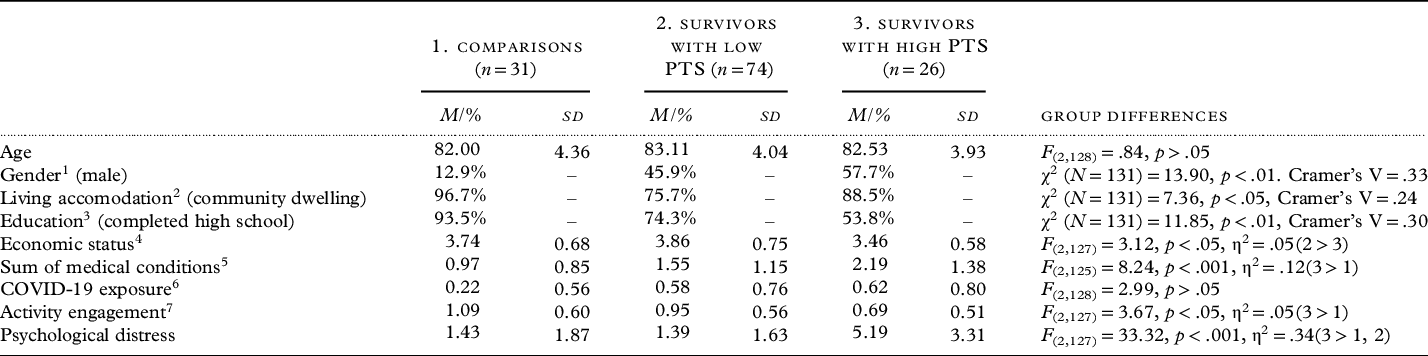
Data were collected from 131 older Jewish Israelis, born before 1945 (age range 76–94, M = 82.73, SD = 4.09), between April 23 and June 17, 2020. During this time period, COVID-19 restrictions were gradually lifted (i.e., citizens were allowed to leave their homes for increasing distances; social gatherings were permitted) and were not re-introduced until July, 2020. Eligible participants were located through contact lists provided by organizations related to older adults and survivors and were interviewed face-to-face, by phone, or were requested to complete web-based questionnaires when possible. Participants provided informed consent to procedures approved by the institutional review board at Bar-Ilan University. Based on their responses to the PTS scale (see below), we divided the cohort into three groups: (1) comparisons who were not directly exposed to the Holocaust (n = 31); (2) Holocaust survivors with low levels of PTS (n = 74); (3) Holocaust survivors with high levels of PTS (n = 26; see Table 1 for group means, SDs, and group differences for the study variables).
Study group means, standard deviations, and group differences for the study variables

Notes: 1 1 = male, 2 = female; 2 1 = community dwelling, 2 = assisted living facilities; 3 1 = did not complete high school, 2 = completed high school. 4 Rating ranged from 1 (not good at all) to 5 (very good); 5 sum of five possible medical conditions suspected to increase the risk of death due to COVID-19 complications (i.e., cardiovascular disease, hypertension, diabetes, chronic respiratory disease, and cancer); 6 sum of exposure to the following experiences: currently in isolation, was in isolation, and contracted the coronavirus; 7 mean of ratings for engaged activities during the previous two weeks: physical, recreational (e.g., reading, listening to music), daily planning, implementation of daily planning. PTS = post-traumatic stress. Scheffe’s post hoc tests were conducted for all significant ANOVAs.
Measures
PTS were assessed by the six PTS items in the International Trauma Questionnaire (Cloitre et al., Reference Cloitre2018). Survivors completed all symptoms while referring to the Holocaust, while comparisons referred to the most traumatic event they had experienced (α = .73). In line with Maytles et al. (Reference Maytles, Frenkel-Yosef and Shrira2021), individuals who indicated experiencing three or more symptoms at least moderately (≥2 on a 4-point scale) were included in the high-PTS group. It should be noted that all comparisons did not display high-PTS levels.
Psychological distress was assessed by the PHQ-4 scale (Kroenke et al., Reference Kroenke, Spitzer, Williams and Löwe2009), which consists of four items, two for anxiety (see also Kroenke et al., Reference Kroenke, Spitzer, Williams, Monahan and Löwe2007) and two for depressive symptoms (see also Kroenke et al., Reference Kroenke, Spitzer and Williams2003). This short scale, a reliable alternative to longer scales, was chosen in order to reduce the length of the study questionnaires. Moreover, it has been previously used among older populations (e.g., Bruine de Bruin, Reference Bruine de Bruin2021). A sum score was calculated, and high scores indicate high levels of distress in the previous two weeks (α = .84). Participants also provided sociodemographic information, exposure to COVID-19 (Shrira, Hoffman, et al., Reference Shrira, Hoffman, Bodner and Palgi2020), and medical conditions (see Table 1).
Activity engagement was assessed by a four-item scale constructed for the current study, which measures the extent to which participants engaged in the following activities during the preceding weeks: physical activity, leisure activities (e.g., reading; listening to music), daily planning, and executing their plans for the day. Answers were coded on a scale ranging from 0 (“not at all or engaging but engagement is not helpful”) to 2 (“engaging, which greatly helps in coping with COVID-19”). An exploratory factor analysis with varimax rotation yielded one factor (Eigenvalue = 2.26), which accounted for 56.53% of the variance. Accordingly, a mean score was calculated, and higher scores reflect higher coping due to activities (α = .73).
Data analysis
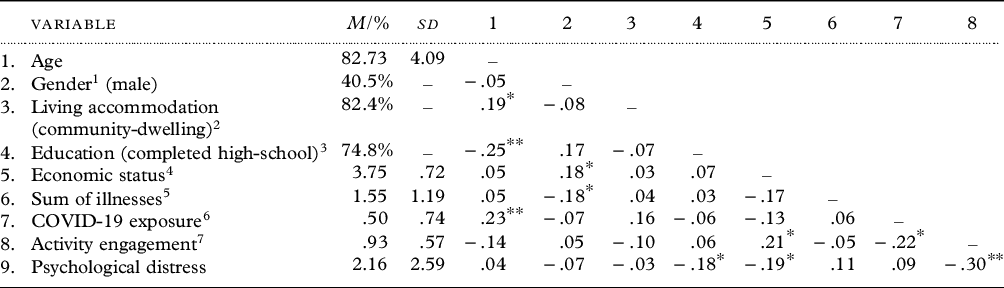
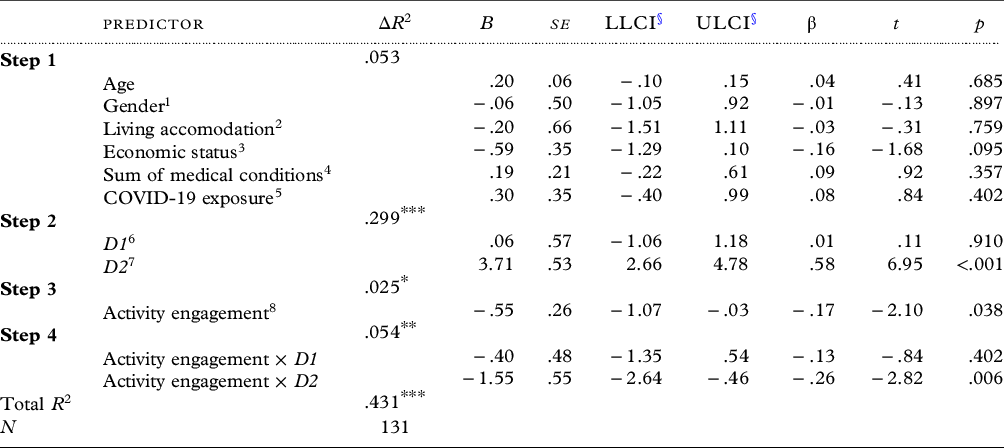
Data were analyzed using the SPSS 24 software, and significant interactions were probed using Model 1 of the PROCESS 3.4 macro for SPSS (Hayes, Reference Hayes2018). Initial group differences for the study variables were examined (see Table 1), and correlations between the study variables were calculated (see Table 2 for means, SDs, and correlation matrix for study variables). The hypotheses were examined by a hierarchical regression, with psychological distress as the outcome variable. The hierarchical regression consisted of four steps. The first step included age, gender, living accommodation, economic status, sum of medical conditions, and COVID-19 exposure. It should be noted that while group differences were found in education level, we did not control for it in the analyses, as we considered this difference to be a direct effect of the Holocaust. The second step included the three study groups (comparisons, low-PTS survivors, high-PTS survivors). As this variable is an ordinal variable with three categories, it cannot be inserted as-is to the regression analysis. Accordingly, and in line with Hayes and Montoya (Reference Hayes and Montoya2017), we used sequential coding, which generates two dummy variables. The first, D1, quantifies the differences between comparisons (Group 1) and survivors with low/high PTS (Groups 2 and 3, respectively). The second, D2, quantifies the differences between high-PTS survivors (Group 3) and low-PTS participants (Groups 1 and 2; for a complete description of how to generate sequential codes, see Darlington and Hayes Reference Darlington and Hayes2017). The two dummy variables were regressed in the second step and activity engagement in the third step. The fourth step included the interactions between study groups (the dummy variables) and activity engagement variable (see Table 3 regression coefficients). A power analysis for detecting a medium to strong effect size (0.20) with 11 predictors required a sample size of 91, indicating that the current sample is sufficient for the study model.
Means, SDs, and Pearson correlations among study variables for the cohort

Notes: n = 131; 1 1 = male, 2 = female; 2 1 = community dwelling, 2 = assisted living facilities; 3 1 = did not complete high school, 2 = completed high school. 4 Rating ranged from 1 (not good at all) to 5 (very good); 5 sum of five possible medical conditions suspected to increase the risk of death due to COVID-19 complications (i.e., cardiovascular disease, hypertension, diabetes, chronic respiratory disease, and cancer); 6 the sum of exposure to the following experiences: currently in isolation, was in isolation, and contracted the coronavirus; 7 mean of ratings for engaged activities during the previous two weeks: physical, recreational (e.g., reading, listening to music), daily planning, implementation of daily planning.
*p < .05; **p < .01
Regression coefficients for predicting psychological distress

Notes: 1 1 = male, 2=female; 2 1 = community dwelling, 2 = assisted living facilities; 3 rating ranged from 1 (not good at all) to 5 (very good); 4 sum of five possible medical conditions suspected to increase the risk of death due to COVID-19 complications (i.e., cardiovascular disease, hypertension, diabetes, chronic respiratory disease, and cancer); 5 the sum of exposure to the following experiences: currently in isolation, was in isolation, and contracted the coronavirus; 6 sequential coding for study groups: 0 = comparisons, 1 = survivors with high/with low PTS; 7 sequential coding for study groups: 0 = comparisons/survivors with low PTS, 1 = survivors with high PTS; 8 mean of ratings for engaged activities during the previous two weeks: physical, recreational (e.g., reading, listening to music), daily planning, and implementation of daily planning.
§ - Lower/upper limit for 95% confidence interval
**p < .01, ***p < .001
Results
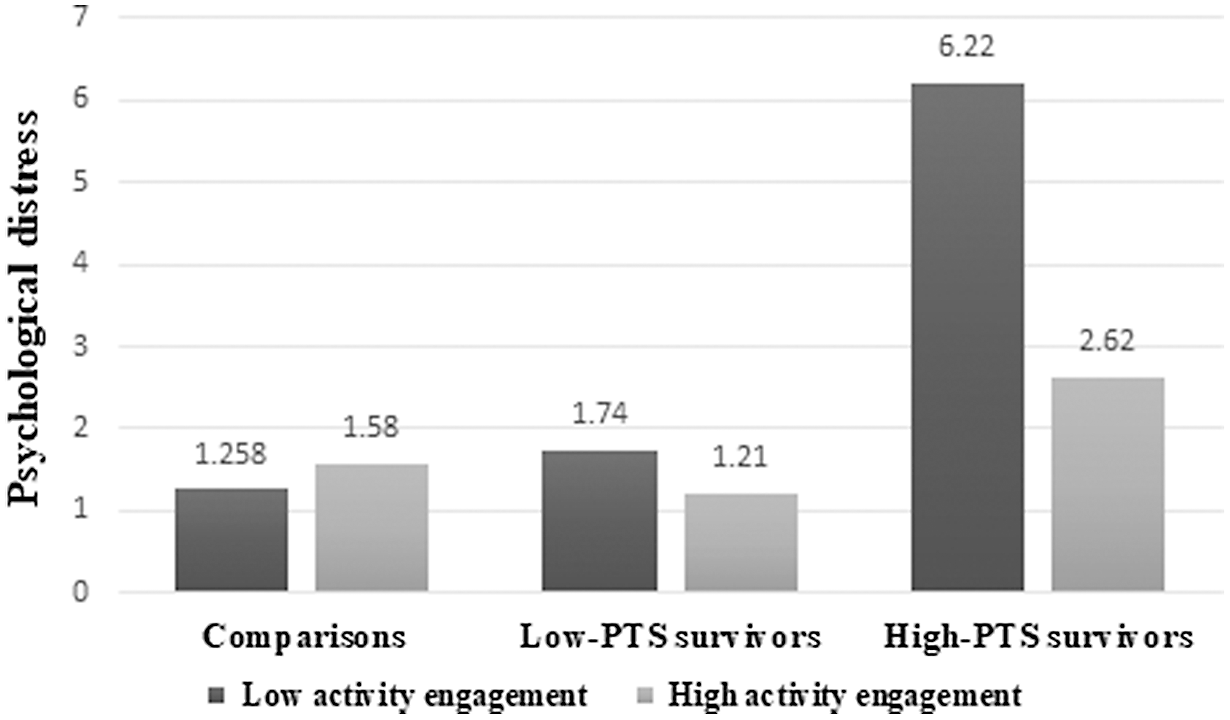
When testing the effect of Holocaust exposure per se, i.e., Holocaust survivors vs. comparisons, on distress, there was no significant difference (B = .06, SE = .57, β = .01, p > .05). However, relative to the other groups, high-PTS survivors reported increased psychological distress (B = 3.71, SE = .53, β = .58, p < .001; see Table 3). Moreover, high activity engagement was associated with reduced psychological distress (B = −.55, SE = .26, β = −.17, p < .05). The interaction between activity engagement and Holocaust exposure was not significant (B = −.40, SE = .48, β = −.13, p > .05). However, a significant interaction of activity engagement × PTS within the survivors was discovered (B = −1.55, SE = .55, β = −.26, p < .01). Upon probing this interaction using PROCESS (Hayes, Reference Hayes2018), we discovered that the negative association between activity engagement and psychological distress was significant only for high-PTS survivors (B = −3.13, SE = .83, β = −.69, p < .001), so that these survivors displayed extremely high levels of psychological distress when activity engagement was low but significantly lower levels of distress when activity was high (see Figure 1) It should be noted that the results remained significant when the model was examined when excluding participants reporting that they did not engage in activities. Moreover, we examined the hypotheses separately for planning activities and actual engagement and discovered that the significant main effects and interactions remained unaltered for both constructs (additional details can be provided upon request from the authors).
Group differences in psychological distress for low and high activity engagement. PTS = Post-traumatic stress.

Discussion
The COVID-19 pandemic has significantly impacted the world, and it seems that older adults in general, and Holocaust survivors in particular, may be markedly at risk for its negative physical and psychological consequences (Cohn-Schwartz et al., Reference Cohn-Schwartz, Sagi, O’Rourke and Bachner2020). Our results demonstrate that while survivors per se did not differ in psychological distress relative to comparisons, high-PTS level survivors nevertheless reported increased distress. These findings add to previous research indicating that the loss of available resources during times of crisis (cf. Gerhart et al., Reference Gerhart, Canetti, Hobfoll and Cherry2015) may be detrimental to survivors’ psychological distress (Dekel and Hobfoll, Reference Dekel and Hobfoll2007), especially for those who are highly engrossed in thoughts about the traumatic past (Hantman and Solomon, Reference Hantman and Solomon2007). It should nevertheless be emphasized that most survivors (those not suffering from high-PTS level) reported psychological distress similar to that of comparisons, thereby displaying resilience which may have assisted them in dealing with the current threat, which is in line with Shmotkin’s (Reference Shmotkin, Jacoby and Keinan2003) theoretical stipulation.
In line with previous research (Hansen and Ghafoori, Reference Hansen and Ghafoori2017), our results demonstrate that engaging in activities, both physical and cognitive, is associated with reduced psychological distress. Coping activities were also showed to correlate with lower psychological distress during the current pandemic (Fullana et al., Reference Fullana, Hidalgo-Mazzei, Vieta and Radua2020). However, this connection was found to differ between the current study groups. More specifically, it seems that engaging in such activities was linked with reduced distress only among survivors with high PTS. Upon close examination of Figure 1, it appears that both comparisons and low-PTS survivors displayed low levels of distress regardless of activity engagement, and therefore, it is possible that they found little need to alleviate their distress by planning their daily activities. However, high-PTS survivors demonstrated higher distress levels in comparison to the other groups, and accordingly, could highly benefit from coping strategies which included active planning. This point could bear important implications for clinicians dealing with the psychological consequences of COVID-19 among older adults, as it seems that encouraging older adults to plan their days and to adopt a daily schedule for coping with the uncertainties of the current times may be beneficial especially among those with high levels of PTS. Although generalizing our results onto additional traumatized populations should be done with caution due to the unique nature of the Holocaust as a traumatic event, it provides important information to the growing evidence of the vulnerability of such populations to COVID-19-related distress (e.g., Lahav, Reference Lahav2020).
Several limitations should be noted. First, the convenience sample may limit generalizability, and the cross-sectional design precluded us from taking into account pre-COVID-19 PTS levels. Moreover, as the study focused on whether activity engagement assists in coping with the pandemic, we did not take into account participants’ levels of activity, and this issue requires additional attention in future studies. Furthermore, as individuals in the comparison group did not display high PTS, future research should examine the study model with additional clinical populations. In this regard, it should be noted that our cutoff point for high-PTS, while requiring at least three symptoms, does not comply with the requirements of ICD-11 for the clinical diagnosis of PTSD (Cloitre et al., Reference Cloitre2018), due to the minute number of participants who achieve the clinical threshold of PTSD (see also Maytles et al., Reference Maytles, Frenkel-Yosef and Shrira2021). Moreover, we employed relatively short measures in order to maximize the response rate, and it is important to replicate our findings using more elaborate scales. Finally, some participants were interviewed directly, whereas others filled out the study scales via phone or online, and we cannot account for possible confounding effects of the manner by which data were collected. Despite these limitations, our findings present a preliminary understanding of how psychological distress during the COVID-19 pandemic is potentially reduced by the ability to benefit from active planning and activity engagement among Holocaust survivors with high PTS levels. While recent research has pointed out how COVID-19 affects Holocaust survivors (e.g., Maytles et al., Reference Maytles, Frenkel-Yosef and Shrira2021; Shrira, Maytles, et al., Reference Shrira, Maytles and Frenkel-Yosef2020), this work demonstrates how planning and engaging in activities during the pandemic is particularly beneficial to survivors displaying high levels of PTS.
Conflict of interest
None.
Description of authors’ roles
Dr. Bergman wrote the paper. Prof. Shrira provided the method and results sections. Dr. Maytles and Ms. Frenkel-Yosef collected the data and provided important contributions to the paper.
Acknowledgments
The authors wish to express their deepest gratitude to Mr. Gerard Kreisberg, who provided invaluable advice in the process of formulating the study questionnaire.