INTRODUCTION
Farms, ranches, and timberlands are increasingly recognized for their integral role in producing ecosystem services important to society (Daily et al. Reference Daily, Ehrlich and Sanchez-Azofeifa2001), and the diversity of species found on these lands plays a crucial role in the production of these services (Zavaleta et al. Reference Zavaleta, Pasari, Hulvey and Tilman2010; Maestre et al. Reference Maestre, Quero, Gotelli, Escudero, Ochoa, Delgado-Baquerizo and García-Gómez2012). Biodiversity is currently undersupplied by private landowners in the USA, largely because the prohibitive mandate of the Endangered Species Act of 1973 (ESA) to protect endangered species over other land uses, combined with a strong private property rights orientation in the USA, has led landowners to prioritize concerns about property and livelihoods over participation in species or habitat recovery actions (see for example Norris Reference Norris2004). This is important, as 72% of land in the USA is privately owned (Sanford Reference Sanford2006). More recently, prelisting programmes have begun to emerge that focus on conserving declining species before the restrictions of the ESA are triggered (Donlan et al. Reference Donlan, Gartner, Male and Li2013). These programmes foster early action that may lead to reduced costs of species recovery, restore or protect wildlife habitat on multifunctional private lands, and ideally, prevent species from being added to the endangered species list.
Financial incentives have become a core component of most conservation programmes because they can be highly effective in motivating stewardship behaviour (Derissen & Martin Reference Derissen and Quaas2013). Paying landowners to engage in species recovery efforts aligns the interests of the landowner (such as income from land use) and society (for example increased biodiversity and improved ecosystem function). Although incentives can motivate and reward conservation activities on private lands, their use further positions conservation as a voluntary pursuit that necessitates compensation, instead of a responsibility inherent to land ownership. As such, there is potential that direct payments to landowners may fundamentally undermine a landowner's stewardship ethos and internal motivation to engage in biodiversity conservation (Muradian et al. Reference Muradian, Corbera, Pascual, Kosoy and May2010; Sorice & Donlan Reference Sorice and Donlan2015).
Although payments are effective behaviour-change agents in the short term, there may be unintended consequences associated with their use (Muradian et al. Reference Muradian, Arsel, Pellegrini, Adaman, Aguilar, Agarwal, Corbera, Ezzine de Blas, Farley and Froger2013). Of primary concern is the failure of direct payments to ensure that individuals sustain the conservation behaviour after a financial incentive is removed because compensation can erode an individual's motivation to conserve over the long term. This hidden cost has been identified in the psychological and behavioural economics literature (Dwyer et al. Reference Dwyer, Leeming, Cobern, Porter and Jackson1993; Heyman & Ariely Reference Heyman and Ariely2004; Bowles Reference Bowles2008), and questioned on moral grounds (Sandel Reference Sandel2012). Concerns about hidden costs of environmental conservation programmes also have been highlighted in research on programmes from Europe, Australia, South America, and Asia (see for example Siebert et al. Reference Siebert, Toogood and Knierim2006; Clements et al. Reference Clements, John, Nielsen, An, Tan and Milner-Gulland2010; Hayes Reference Hayes2012; Blackmore & Doole Reference Blackmore and Doole2013). Consequently, conservation programmes that offer financial incentives may need to continuously provide payments to sustain the target conservation behaviours. These hidden costs, however, are not inevitable and conservation behaviours can be sustained by designing programmes that are perceived as supporting a landowner's internal motivation to help the species rather than as controlling their behaviour through financial incentives (Ryan & Deci Reference Ryan and Deci2000; Frey & Jegen Reference Frey and Jegen2001).
In light of the challenges and opportunities stemming from conserving biodiversity on private lands, our study explores the influence of financial incentives in either sustaining or hindering the future protection of an at-risk species through participation in a prelisting conservation programme. We employed self-determination theory and crowding-out theory (Ryan & Deci Reference Ryan and Deci2000; Frey & Jegen Reference Frey and Jegen2001) as a framework for investigating the motivation of farmers in south-west Nebraska currently participating in a conservation incentive programme for the mountain plover (Charadrius montanus). Specifically, we were interested in exploring the relationship between programme participation with and without the financial incentive as a motivator. Self-determination theory suggests that financial payments are extrinsic motivators that can undermine a farmer's internal motivation to participate when the programme is perceived as controlling their stewardship behaviour. However, programmes that are perceived as supporting a farmer's basic needs for autonomy, competence and social relatedness are likely to promote a farmer's perception that protecting the plover and programme participation is internally motivated (such as engaging in the behaviour because it is the right thing to do) even in the presence of a financial incentive. Landowners with a greater perception that their effort is internally motivated, or self-directed, were expected to indicate a greater likelihood of continuation in protecting the plover once the financial incentive is removed. We examined three key questions related to financial incentives and pre-listing conservation programme participation:
-
(1) Does the current prelisting conservation programme adequately support farmers' needs?
-
(2) How do participating farmers view their own reasons for their behaviour on a continuum from extrinsic to intrinsic motivation?
-
(3) How does extrinsic or intrinsic motivation relate to current involvement with and intent to continue participating if the financial incentive is removed?
Conceptual framework
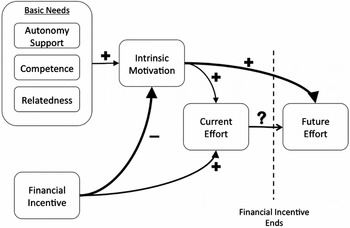
Self-determination theory has broad empirical support as an explanation for the potential problems associated with external incentives (Deci et al. Reference Deci, Koestner and Ryan1999). Individuals are more likely to engage in behaviours that are perceived as being personally caused (i.e., self-determined) because they are integrated with one's sense of self. Further, this integration of the behaviour with one's sense of self increases the likelihood that an individual will continue the behaviour over time (see for example Osbaldiston & Sheldon Reference Osbaldiston and Sheldon2003). That is, to the degree that farmers feel an incentive programme helps them realize their stewardship ideal, they will be more likely to perceive they are engaging in the programme for the self-directed (internally motivated) reason that it is the ‘right thing to do’. This perception should be positively related to their current engagement in the programme, as well as their intention to continue in the programme if the financial incentive ends (Fig. 1).
Conceptual model of conservation effort for participants in a programme that provides direct payments. Basic needs promote self-determined motivation (Ryan & Deci Reference Ryan and Deci2000), while payments potentially undermine it and future effort (Frey & Jegen Reference Frey and Jegen2001). Note: + = positive relationship; − = negative relationship.

In contrast, farmers who are externally motivated, participating primarily ‘for the money’, will be likely to engage in the programme only in the presence of the financial incentive. Further, Frey and Jengen (Reference Frey and Jegen2001) argued that this motivation erodes an individual's feeling of self-directed motivation for the behaviour. Thus, a profit motivation should be positively related to current engagement but, indirectly, it will be negatively related to future engagement once the financial incentive is gone.
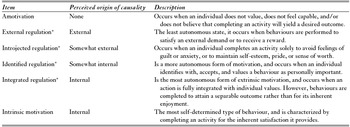
A continuum exists from behaviours that are completely extrinsically motivated to those that are intrinsically motivated, or done for the inherent satisfaction provided by the behaviour (Table 1). Three of these, identified, integrated, and intrinsic, have been identified in the literature as forms of motivation that can be integrated with an individual's sense of self, and form a basis for future self-directed behaviour (see Ryan & Deci Reference Ryan and Deci2000). Further, when basic psychological needs for autonomy (such as freedom and choice), competence (for example mastery and achievement), and relatedness (such as social connection) are met, an individual will be more likely to perceive the motivation for their behaviour to be integrated and thus internally motivated (self-directed).
Forms of external and internal motivation (Ryan & Deci Reference Ryan and Deci2000). *Types of extrinsic motivation.

Mountain plover nest protection programme
In North America, agricultural production, urbanization, and energy development has altered approximately 80% of the native grassland and prairie ecosystems (White et al. Reference White, Murray and Rohweder2000). This conversion of grassland habitat has imperilled 57 species of prairie wildlife (Green et al. Reference Green, Cornell, Scharlemann and Balmford2005; IUCN [International Union for the Conservation of Nature] 2011). Additionally, the alteration of historic grazing and fire regimes (Knopf & Wunder Reference Knopf, Wunder and Poole2006) has led to greater declines in grassland birds compared to any other bird assemblage in the past 40 years (Vickery & Herkert Reference Vickery and Herkert2001; Sauer et al. Reference Sauer, Link, Fallon, Pardieck and Ziolkowski2013).
The mountain plover is a shortgrass obligate bird that historically nests on heavily grazed shortgrass prairie, prairie dog towns and, more recently, agricultural fields (Shackford et al. Reference Shackford, Leslie and Harden1999; Bly et al. Reference Bly, Snyder and VerCauteren2008). Like other ground-nesting birds that have adapted to the presence of agricultural fields, mountain plovers are highly vulnerable to mortality from farm equipment (Dreitz & Knopf Reference Dreitz and Knopf2007; Siegel & Lockwood Reference Siegel and Lockwood2010). Breeding bird survey data indicate a population decline rate of 3% per year from 1966 to 2011 (Sauer et al. Reference Sauer, Link, Fallon, Pardieck and Ziolkowski2013). The plover is currently considered an at-risk species by the US Fish and Wildlife Service and is listed as threatened in the state of Nebraska (Schneider et al. Reference Schneider, Stoner, Steinaure, Panella and Humpert2011).
Informal prelisting conservation efforts have been underway since 2003 to protect the plover in Nebraska. Led by the Rocky Mountain Bird Observatory (RMBO), the first two years of the programme focused on recruitment through workshops and direct visits with farmers. The programme added a financial incentive in 2006, and farmer participation more than tripled in one year (from 19 to 63 farmers); however, the degree to which the financial incentive caused this increase is unclear, as other recruitment tactics were implemented simultaneously. Currently, farmers are eligible for a monetary incentive for each nest that is identified, marked, and avoided by farm machinery. RMBO staff and their volunteers monitor nests, and nests are considered successful if at least one egg hatches. When RMBO biologists locate nests and mark them, they pay farmers US$ 100 for each successful nest. Alternatively, RMBO pays US$ 200 per nest if the farmer identifies and marks the nests themselves. Nest identification by famers can require a high level of vigilance while operating farm machinery, as farmers would need to stop and shut down their machinery before finding and marking the nest.
Between 2006 and 2011 an average of 83 (standard deviation [SD] = 18) nests were found per year, and, of those, an average of 20% (SD = 7%) were found by farmers (RMBO, unpublished data 2013). Once located, the nests must be avoided, but farmers can drive their equipment very close to the nests because temporary, infrequent disturbance (such as flushing the bird) does not negatively influence nest success (Rimmer & Deblinger Reference Rimmer and Deblinger1990; Lock & VerCauteren Reference Lock and VerCauteren2008). Thus, the costs to the farmer of avoiding nests are relatively low. RMBO works with farmers to provide a 3 to 5 m2 buffer around the nest. Further, the chicks fledge the nest almost immediately, eliminating the need for nest avoidance behaviour after the 29-day incubation period (Knopf & Wunder Reference Knopf, Wunder and Poole2006). RMBO's programme is considered successful and has been recognized by the US Fish and Wildlife Service as helping to keep the mountain plover off of the endangered species list (Gould Reference Gould2011).
METHODS
Study area
The study area was located largely within the Kimball Grasslands Biologically Unique Landscape in Kimball County near the town of Kimball, Nebraska, USA (41° 1′ 56 ″N, 104° 0′ 10″W). This area contains several species of concern including McCown's longspur (Rhynchophanes mccownii), ferruginous hawk (Buteo regalis) and golden eagle (Aquila chrysaetos) (Schneider et al. Reference Schneider, Stoner, Steinaure, Panella and Humpert2011). It is bounded by Interstate 80 to the north, the Colorado state line to the south, the Wyoming state line to the west and Cheyenne County, Nebraska to the east. The landscape can be characterized by its relatively arid tablelands, which are dominated by rangeland and dryland agricultural croplands. Dominant crop types include winter wheat (Triticum aestivum), proso millet (Panicum miliaceum), sorghum (Sorghum bicolor) and corn (Zea mays).
Data collection
To explore the possible effects of paying farmers to protect plovers, we conducted a survey of the 77 farmers currently participating in the mountain plover nest conservation programme. Because this is a case study, the results cannot be generalized to all farmers. However, due to the dearth of research explicitly addressing this topic in the conservation literature, it serves as an informative case study that empirically explores theory-based propositions, and will provide a foundation for additional hypotheses about the hidden costs of conservation incentive programmes. Further, it is possible that this group of farmers is biased, consisting of farmers who are predisposed to help wildlife and endangered species, and for whom payments may be unnecessary to motivate participation (but welcomed nonetheless). We argue that if such a bias exists in this group it is useful to our study. This type of farmer should have a high level of self-directed motivation at programme inception and thus should be more likely to feel more controlled by the programme's financial incentives (Frey & Jegen Reference Frey and Jegen2001).
We developed a questionnaire using previous empirical research on self-determination theory and adapted their validated measures. We also requested information on land use, motivations for owning land, perceptions of RMBO, landowner characteristics, and demographic information from the farmers in the programme.
We used a version of the drop off-pick up distribution method along with the multiple-phase reminder method (Dillman Reference Dillman2009; Allred & Ross-Davis Reference Allred and Ross-Davis2010). We first mailed all programme participants a pre-survey letter outlining the purpose of the study. Over the next month, a staff member from RMBO, who regularly interacts with farmers in the programme, hand-delivered surveys. This personal interaction was employed as a mechanism to enhance social exchange and thus enhance farmers' willingness to participate in the study. Programme participants unreachable at home, or whose primary residence was outside of the study area were mailed a copy of the survey and received a personalized telephone call from RMBO explaining the study. All surveys included a small magnetic calendar with a picture of a mountain plover as thank-you gift. We sent reminder postcards two weeks after initial survey distribution. Three weeks after mailing postcards, we mailed a reminder letter and replacement survey before sending a final reminder postcard. We also conducted a non-response survey to assess differences between survey participants and nonparticipants. Twenty-five of the non-respondents were contacted via telephone, and those that agreed to participate in a non-response check were asked 10 questions from the survey related to demographics and key concepts.
Questionnaire and measures
To gauge farmers' perceptions of autonomy and competence related to the mountain plover programme, we adapted multiple indicators of each concept from Baard et al. (Reference Baard, Deci and Ryan2004). Expanding on the conventional treatment of relatedness, we considered the concept of relatedness to occur as both a feeling of social connectedness with other farmers in the programme as well as feeling connected to RMBO. To measure respondents’ perceptions of relatedness, we adapted items from Baard et al. (Reference Baard, Deci and Ryan2004), Pierce and Gardner (Reference Pierce and Gardner2004), and Kim et al. (Reference Kim, Scott and Crompton1997). All scales ranged from 1 = not at all true, 4 = somewhat true, 7 = very true.
We adapted the motivation toward the environment scale (MTE) to examine the range of respondents’ intrinsic and extrinsic motivations for participating in a programme to protect plovers (Pelletier et al. Reference Pelletier, Tuson, Green-Demers, Noels and Beaton1998; Villacorta et al. Reference Villacorta, Koestner and Lakes2003) (Table 1). The initial MTE scale contained 23 items and our pretesting revealed a high incidence of item non-response. Thus, we reduced this scale to 17 items by examining factor loadings in published empirical studies that employed the MTE. Questions directed respondents to indicate the extent to which each item corresponded to their personal motives for continuing to participate in the plover programme on a seven-point scale, ranging from 1 = does not correspond at all, to 4 = corresponds moderately, to 7 = corresponds exactly. Because our interest focuses on the level of motivation that can serve as an internal driver of future behaviour (such as continued participation after the financial incentive is removed), we averaged the identified, integrated, and intrinsic motivation indicators into a single index that we refer to as ‘self-directed motivation’.
We also asked two additional questions to examine external motivation related specifically to the influence of RMBO's financial incentive as an external motivator. Respondents were asked to indicate their agreement on a seven-point scale to the statements about vigilance and overall effort: ‘I would be more vigilant about searching for plover nests if I received more money for doing so’, and ‘If more money for finding nests was offered, my level of effort would increase’. These items were highly correlated (r = 0.84) and were averaged together into a single item we labelled ‘price motivation’.
For each concept, we combined indicators by averaging the items together. Indicators of each of the concepts can be found in the Supplementary material.
Programme participation
We developed a list of ways farmers can be involved in the mountain plover nest protection programme. These ranged from more passive activities, such as waiting for RMBO to contact the farmer, to more committed activities, such as actively searching for and marking nests on their own. For each of the nine activities, farmers were asked to indicate how frequently they engaged in each behaviour. These items were rated as 1 = almost never, 2 = rarely, 3 = occasionally, 4 = often, or 5 = almost always. We also developed a similar list of seven potential ways farmers might remain involved in the programme after the incentive payments end. For each item farmers used a seven-point scale to indicate their intention, where 1 = extremely unlikely, 4 = unsure, and 7 = extremely likely. We used hierarchical cluster analysis to group farmers based on their engagement with the programme; our assumption was that effort is positively related to the number of ways they interact with the programme.
Demographics
To characterize the participants we collected demographic information including gender, age, farm size, personal and family farming history, and percentage of income from farming. We also collected basic information on their participation in the plover programme, as well as other Farm Bill programmes (such as the US Conservation Reserve Programme).
Data analysis
For descriptive statistics we report means with 95% confidence intervals calculated using jack-knifed standard errors. The jack-knife, or ‘leave one out procedure’ is a cross-validation technique useful for small sample sizes because it creates standard errors that are robust to outliers in the data (Thompson Reference Thompson2006). To examine the strength of relationships between two variables, we used Spearman's rho, the non-parametric alternative to the Pearson correlation.
We used hierarchical cluster analysis with Ward's linkage to group farmers based on current engagement and intent to continue with the programme (Hair Jr et al. Reference Hair, Black, Babin and Anderson2009). Finally, we used exact logistic regression to explain cluster membership (Hirji Reference Hirji2006). We used the composite measures of self-directed motivation and price motivation as independent variables. To enhance interpretation of the logistic regression, we calculated associated odd ratios for each log odds coefficient (Ω = eb ) as well as the per cent change in the odds ([Ω -1] × 100%).
RESULTS
Of the 77 surveys we initially distributed, 41 were returned. Two respondents indicated they were no longer in the programme and were removed from the analysis, resulting in an adjusted response rate of 55%. Our non-response survey obtained responses from an additional eight farmers and found no statistically significant differences on items examining basic needs, motivation for programme participation, current level of participation in the programme, and intentions for future participation in a programme without a financial incentive. Overall, we contacted 49 of 77 participants, and are confident that our sample is representative of all programme participants.
Demographics
Respondents were primarily male (94%), and ranged from 26 to 86 years of age with a mean age of 60 years. The majority of the respondents (83%) had spent most or all of their childhood on a farm, and 77% came from families who had been farming for three or four generations. Respondents personally operated their farm for as few as two years, and as many as 63 years (mean [M] = 33, SD = 15, median [Md] = 34.5). The majority (83%) of respondents resided on their farm, and most (77%) farmed 809 or more hectares of land. As such, the majority (79%) of the respondents earned at least half of their annual income from their farm.
Most (89%) of the respondents first learned about the mountain plover programme through an RMBO employee, and 71% indicated that that their reasoning for enrolling in the programme was to a large or very large extent influenced by their interaction with RMBO staff. Respondents’ time in the plover programme ranged from less than one year to the full ten years of the programme's existence, with a mean enrolment period of five years (SD = 3, Md = 5.5). Most (81%) of respondents also participate in at least one other conservation incentive programme, with the Conservation Reserve Programme identified as the most popular (60%).
Basic needs and self-determination
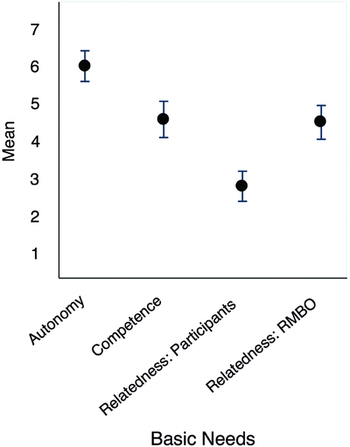
The first question examines whether farmers felt that the plover programme supported their basic needs for autonomy, competence and relatedness, the determinants of self-directed behaviour. On average, farmers overwhelmingly felt that the plover programme fostered a high level of autonomy, with almost 50% of the sample scoring this as ‘very true’ (M = 5.9, SD = 1.2, Md = 6.5). Farmers also indicated that that it was ‘somewhat true’ that the programme enhanced their competence (M = 4.5, SD = 1.4, Md = 4.4). Farmers did not indicate that the programme provided a sense of relatedness among programme participants (M = 2.78, SD = 1.18, Md = 2.83), but they felt moderately connected to RMBO (M = 5.41, SD = 1.64, Md = 5.75; Fig. 2).
Means and jack-knifed 95% confidence intervals for basic needs related to programme participation. 1= not true at all, 4 = somewhat true, 7 = very true.

Programme participation
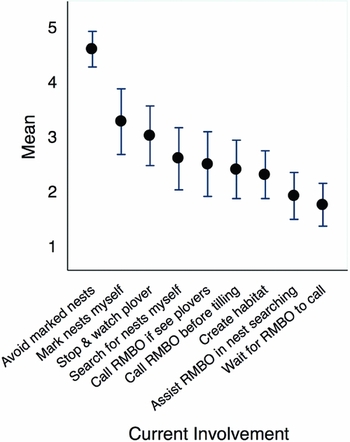
Respondents indicated that they most frequently participated in the programme by avoiding plover nests (Fig. 3). All other ways respondents engaged with the programme were considered occasional or rare. Of these, the active field-based conservation activities were reported as relatively the most frequent behaviours: searching for nests, self-marking nests, stopping to watch plovers, and calling RMBO when observing plovers in their fields.
Means and jack-knifed 95% confidence intervals showing engagement in different aspects of the plover programme. 1 = almost never, 2 = rarely, 3 = occasionally, 4 = often, 5 = almost always.

Motivations for participating in the programme
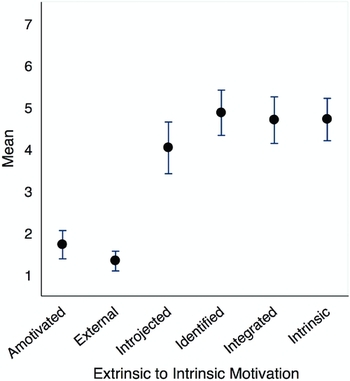
The second question examined farmers' perceptions of their programme participation as being extrinsically (for example to receive a reward or avoid punishment) or intrinsically (for example for personal satisfaction) motivated. Farmers on average indicated that they had chosen to initiate programme participation because they wanted to (intrinsic motivation: M = 4.7, 95% confidence interval [CI] = 4.2, 5.2; integrated motivation: M = 4.7, 95% CI = 4.1, 5.2; identified motivation: M = 4.9, 95% CI = 4.3, 5.4), and not because they were trying to receive a reward (external motivation) (Fig. 4). We averaged identified, integrated, and intrinsic motivation together into a composite measure of self-directed motivation (Cronbach's alpha = 0.87; M = 4.7, 95% CI = 4.3, 5.2).
Means and jack-knifed 95% confidence intervals showing motivations for participating in the plover nest protection programme. 1 = does not correspond at all, 4 = corresponds moderately, 7 = corresponds exactly.

In response to a question on the extent to which the financial incentive itself served as a motivator for initially participating in the programme, farmers on average indicated that the incentive influenced them to a small or moderate extent (M = 2.7, 95% CI = 2.2, 3.1). Further, farmers on average neither agreed nor disagreed that their effort would increase if the price offered for protecting nests hypothetically increased (M = 3.9, 95% CI = 3.2, 4.5).
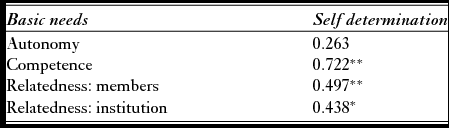
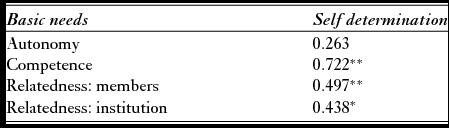
After combining identified, integrated, and intrinsic motivations into a composite measure of self-determined motivation, we found that farmers who considered the programme to promote feelings of competence and relatedness, also perceived their participation in the programme as more self-determined (Table 2). Autonomy support was not related to self-determined motivation.
Spearman correlations between basic needs and self-determination. *p < 0.10, **p < 0.05.
Motivations and programme participation
Because of the variety of ways farmers can engage with the programme, and because they are not necessarily mutually exclusive (for example, an individual can wait for the RMBO to call and assist with nest searching), we grouped farmers according to their involvement with the programme. We found a two-cluster solution to be meaningful, interpretable, and parsimonious; we assigned farmers to clusters, which we simply label as higher engagement (32%) and lower engagement (67%). Farmers in the higher engagement group exhibited greater engagement in all activities except avoiding nests; all farmers ‘often’ or ‘almost always’ engaged in this last behaviour (grand M = 4.6, 95% CI = 4.32, 4.92). This is unsurprising given that avoiding nests is the base condition upon which the programme rests.
We used the exact logistic regression to explain cluster membership (1 = higher current engagement, 0 = lower current engagement, n = 28) as a function of self-determined motivation and price motivation. Self-determination was positively related to high involvement (b = 1.58, p < 0.01). For every 1-level increase in self-determination, the odds of a programme participant being in the higher-engagement category increased by 386%. Payment as a motivator was marginally related to involvement (b = 0.54, p < 0.08). Acknowledging that this is a marginal finding, the interpretation is that for every 1-level increase in price motivation, the odds of being a more highly-engaged programme participant increased by 72%. Thus, current programme engagement may be a function of both self-determined and price motivation; however, self-determination seems to be the primary driver of current involvement.
Self-determination and change in future programme engagement
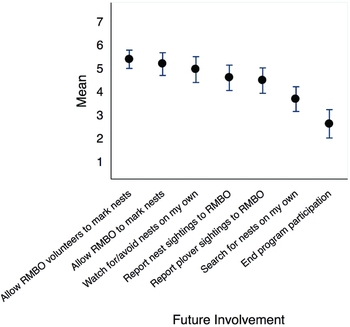
If the current programme no longer provided a payment for successfully hatched nests, farmers indicated on average that they would remain involved (Fig. 5). They would be slightly to moderately likely to: allow volunteers to locate and mark nests on their property (M = 5.35, Md = 6), allow RMBO to locate and mark nests (M = 5.15, Md = 6), watch for and avoid nests on their own (M = 4.91, Md = 5), report sightings (M = 4.56, Md = 5), and report found nests (M = 4.44, Md = 5). Farmers were unsure about searching for nests on their own (M = 3.65, Md = 4). Farmers, on average, were moderately unlikely to completely end their involvement in the programme (M = 2.59, Md = 2); only 14% of farmers said they were moderately or extremely likely to end their participation.
Means and jack-knifed 95% confidence intervals for intention to continue in the plover programme if the financial incentive was removed. 1 = extremely unlikely, 2 = moderately unlikely, 3 = slightly unlikely, 4 = unsure, 5 = slightly likely, 6 = moderately likely, 7 = extremely likely.

Farmers were clustered based on these responses and, again, we found a two-group solution to be meaningful and parsimonious. We labelled these groups as higher future engagement (74%) and lower future engagement (26%) in relation to their intention to remain involved. On average, farmers in the higher engagement group were more likely to engage in each behaviour except for ending participation; they were less likely than farmers in the lower engagement group to end their participation if the financial incentive disappeared.
The logistic regression explaining cluster membership (1 = higher future engagement, 0 = lower future engagement, n = 28) as a function of self-determined motivation and price motivation indicated that self-determination helped to explain membership in the high future involvement group (b = 1.30, p < 0.01). Specifically, for every 1-level increase in self-directed motivation, the odds of being in the high involvement group increased by 265%. Price motivation was not related to membership in the high future involvement group (b = –0.31, p = 0.92).
DISCUSSION
Balancing human needs with biodiversity protection remains an unresolved challenge on working landscapes. In light of the Endangered Species Act's ineffectiveness in recovering species on private lands (Norris Reference Norris2004), conservation practitioners and policy leaders have sought opportunities to protect imperilled species by focusing on incentivizing private landowners to contribute to recovery efforts before ESA prohibitions are triggered (US Department of Agriculture 2012; Donlan et al. Reference Donlan, Gartner, Male and Li2013). The success of these initiatives rests on the participation of private landowners and thus the institutions that seek to engage these landowners.
Although the payment offered to landowners is generally considered the primary motivator of participation, previous research indicates that non-economic factors related to the programme itself can facilitate or inhibit participation (Langpap Reference Langpap2004, Reference Langpap2006; Muradian et al. Reference Muradian, Arsel, Pellegrini, Adaman, Aguilar, Agarwal, Corbera, Ezzine de Blas, Farley and Froger2013; Sorice et al. Reference Sorice, Haider, Conner and Ditton2011, Reference Sorice, Oh, Gartner, Snieckus, Johnson and Donlan2013). Self-determination theory provides a useful framework through which to understand how incentives can affect behaviour (see Pelletier et al. Reference Pelletier, Tuson, Green-Demers, Noels and Beaton1998; Sheldon et al. Reference Sheldon, Nichols and Kasser2011). We found that farmers currently enrolled in RMBO's mountain plover nest protection programme felt that the programme provided a high level of autonomy, the opportunity to increase competence, a feeling of being part of RMBO, but little social connection amongst participating farmers. About one-third of farmers (32%) were currently highly engaged with the plover programme and most (86%) said they would be unlikely to end their involvement with the programme if the financial incentive ended. Although we didn't explicitly measure satisfaction, the intention to continue in the programme after an extant financial incentive is removed provides a proxy measure. Farmers' intention to continue may be because the programme generally met their basic needs. Competence was strongly associated with self-directed motivation. The plover programme's requirement of avoiding marked nests until they hatch educates the farmers on the basic habitat needs of a declining species including the amount of space necessary for nest survival. Further, it encourages farmers to monitor the status of nests, and can result in a feeling of accomplishment when the nest hatches. Thus, farmers' willingness to participate into the future may be a function of the increased awareness of the imperilled plover and the rapid feedback regarding the farmer's effort, creating a sense of competence and accomplishment.
Conservation incentive programmes can engender feelings of relatedness by increasing feelings of community amongst participants and by generating feelings of connectedness to the institution implementing the programme. Although farmers did not feel an enhanced sense of connection to others in the programme, they did feel connected to RMBO. This may be at least partially attributed to a programme structure in which RMBO travels out to individual farmer's lands to interact with them and monitor nests. Further, the employee who meets with farmers is also a local farmer in the county. Thus, his identity as both a farmer and an RMBO employee serves as bridging or linking capital that may lead other farmers to feel more connected to RMBO (Woolcock Reference Woolcock2001). Alternatively, this connection to RMBO may also be a consequence of positive interactions with the farmers. For example, Wagner and Fernandez-Gimenez (Reference Wagner and Fernandez-Gimenez2008) found that community-based collaborative management in Colorado resulted in greater increases in indicators of social capital between agencies and group members than amongst group members themselves.
Our results showed that both relatedness within programme participants as well as between participants and RMBO were similarly related to farmers' feelings of self-determination (see Table 2). Thus, cultivating both types of relatedness can be important. Community-based conservation relies on increasing social connectedness to engage individuals in conservation behaviours and allow trust and norms of behaviour to become established at larger scales (such as community and region; O'Riordan & Stoll-Kleemann Reference O'Riordan and Stoll-Kleemann2002; DeCaro & Stokes Reference DeCaro and Stokes2008). Additional research into whether the types of relatedness together can substitute, complement, or synergistically enhance existing perceptions of autonomy and competence would advance efforts to create programmes that lead to sustained conservation behaviours.
Although a critical determinant of self-determined behaviour, we found that autonomy was not significantly related to self-directed motivation. We believe, however, that this is a statistical issue rather than a substantive one. There was a distinct lack of variation in the autonomy measure (M = 5.94, SD = 1.22, Md = 6.5, 95% CI = 5.53, 6.36). That is, most farmers perceived the plover programme to convey a high degree of autonomy regardless of their motivation for participation in the programme.
Overall, self-determination helped to explain the level of current and future programme involvement for farmers. Farmers who perceived more strongly that their participation was of their own volition and initiative were more likely to be highly engaged with the programme. In general, this supports the propositions of self-determination theory, as applied to this case study.
However, our results did not support the hypothesis that farmers who emphasized payments as a primary motivator would be less highly engaged in a programme without a financial incentive. Instead, price motivation was not statistically significant in second model of farmer involvement. One possible explanation may again lie with the programme design. Crowding-out theory posits that the hidden costs of financial incentives can be averted under conditions in which farmers perceive conservation incentive programmes as supporting their behaviour rather than controlling it. In such cases, the perception of personal causation (namely self-directed motivation) can remain the primary driver of behaviour (Frey & Jegen Reference Frey and Jegen2001). Based on our results and the literature, we posit a list of potential reasons (hypotheses) for perceiving this programme as supportive:
-
• Choice and flexibility. Farmers have many ways they can engage with the programme. As their priorities shift, they can change how actively involved they remain in the programme without sacrificing conservation outcomes.
-
• Obligation. Once nests are hatched farmers face no further restrictions or responsibilities, and, other than lack of payment, accidental nest loss by machinery does not carry repercussions.
-
• Feedback. Farmers receive rapid feedback on the outcomes of their behaviour. Successfully hatched nests provide information that increases farmers' knowledge and feelings of accomplishment in helping the species.
-
• Ease of programme entry and exit. The programme has no enrolment criteria because any farmer's field has the potential to serve as habitat for the opportunistic mountain plover. Additionally, farmers re-enrol on an annual basis, allowing them the flexibility to enter and leave the programme based on their own changing priorities.
-
• Professional engagement. The local farmer who works for RMBO enhances participation and engagement through social capital: bonding ties with other farmers lead to linking ties between RMBO and farmers (Woolcock Reference Woolcock2001). This facilitates feelings of relatedness between farmers and the organization.
Exploring the question of the role of self-determination in programme participation provides insight into the importance of programme design and administration, not only for this prelisting conservation programme, but for all conservation programmes in the USA and internationally that employ financial payments to induce participation. First, previous research has shown that potential participants jointly consider both the economic and non-economic elements of a programme when deciding to participate (Langpap Reference Langpap2004, Reference Langpap2006; Sorice et al. Reference Sorice, Haider, Conner and Ditton2011, Reference Sorice, Oh, Gartner, Snieckus, Johnson and Donlan2013; Blackmore & Doole Reference Blackmore and Doole2013). Second, landowners tend to prefer programmes that build in choice and autonomy (Sorice et al. Reference Sorice, Oh, Gartner, Snieckus, Johnson and Donlan2013). Third, programmes that support the antecedents of self-determination (autonomy, competence and relatedness) are expected to be more likely to lead to continued engagement in the conservation behaviour of interest due to the attribution of behaviour as stemming from personal volition (Ryan & Deci Reference Ryan and Deci2000; Frey & Jegen Reference Frey and Jegen2001).
Our case study provides preliminary support to this last proposition of continued engagement. However, our study was limited in that it focused on current participants receiving payments and looked for relationships between indicators of motivation that may reflect the possibility of ‘crowding out’. Further, although behavioural intentions are often the best predictor of behaviour in the absence of actual behaviour (Bamberg & Möser Reference Bamberg and Möser2007; Fishbein & Azjen Reference Fishbein and Ajzen2010), intentions do not always correspond to overt behaviour (Bagozzi Reference Bagozzi1992; McCleery et al. Reference McCleery, Ditton, Sell and Lopez2006). Ultimately, more robust tests of crowding out theory require longitudinal data and experimental designs that can track effort over time (Ferraro & Miranda Reference Ferraro and Miranda2014).
CONCLUSIONS
Conservation incentive programmes are often created in a non-participatory manner that either focuses on the needs of the species or incorporates landowner demographics as a marketing segmentation tool (see for example Sullivan et al. Reference Sullivan, Amacher and Chapman2005; Kaetzel et al. Reference Kaetzel, Hodges, Houston and Fly2009). However, private landowners own and manage their land based upon their own unique interests and priorities, and they evaluate conservation programmes through the lens of their own values and opinions on property rights, government regulation, and environmental conservation (Freyfogle Reference Freyfogle, Grinlinton and Taylor2011). Thus, an increased understanding of the needs of potential participants, as well as the key factors that may engender sustained stewardship behaviours is vital during the programme design phase (Siebert et al. Reference Siebert, Toogood and Knierim2006; Sorice & Donlan Reference Sorice and Donlan2015).
Despite the potential to subvert long-term stewardship behaviour, conservation practitioners rely on financial incentives as necessary inducements for private land conservation. Given the voluntary nature of conservation programme participation, a human-centred approach to programme design that focuses on the needs of private landowners may allow conservation practitioners to better ensure landowner needs and values are incorporated into the programme (Sorice et al. Reference Sorice, Oh, Gartner, Snieckus, Johnson and Donlan2013; Sorice & Donlan Reference Sorice and Donlan2015). Our results support the relationship between perceptions of self-determination and engagement in a conservation incentive programme for an at-risk species. When designed to allow for autonomy, competence and relatedness, completion-contingent reward programmes, such as the plover programme, may not necessarily harm future effort (Frey & Jegen Reference Frey and Jegen2001). However, the relationship between programme design, landowner perceptions of programmes, and behaviour needs further research to understand the conditions under which stewardship behaviours occur only as part of a market exchange (namely for the money) or as part of a personal stewardship ethic (intrinsic motivation).
ACKNOWLEDGEMENTS
We thank T. VerCauteren and S. Gallagher for input on sampling and questionnaire development. L. Snyder provided critical advice about farmers in the area and assisted with survey logistics. Finally, we thank the farmers in the mountain plover nest conservation programme that took part in our survey. This work was supported by the Virginia Agricultural Experiment Station and the McIntire-Stennis Program of the National Institute of Food and Agriculture, US Department of Agriculture.
Supplementary material
To view supplementary material for this article, please visit http://dx.doi.org/10.1017/S0376892915000302