I. INTRODUCTION
Titanium dioxide (Titania, TiO2) has been considered to be one of the most important semiconductor materials due to its wide practical uses in several applications including energy storage, solar cells, catalysis and photocatalysis. It has a wide-band-gap energy (3.0–3.2 eV) that allows absorption of photon energy to excite electron- (e −) hole (h +) pairs that can induce redox reactions.Reference Fox and Dulay1 Since Honda and Fujishima first discovered its ability to decompose water and produce hydrogen under ultraviolet (UV) irradiation,Reference Fujishima and Honda2 TiO2-based materials have been intensively studied and used as photocatalysts.Reference Fox and Dulay1, Reference Linsebigler, Lu and Yates3–Reference Maeda and Domen5 Over the past decades, tremendous efforts have been devoted to improving the physical, chemical and catalytic properties of TiO2 for enhanced photocatalytic efficiency.Reference Ye, Zhang, Hu, Ge, Lu, He, Chen and Yin6–Reference Zuo, Wang, Wu, Zhang, Borchardt and Feng10
With continued development in nanomaterials synthesis, a variety of tailored TiO2 nanostructures have been suggested and investigated for practical application in photocatalysis.Reference Zhang, Bang, Tang and Kamat11−Reference Cao, Li, Wang, Shao and Liu13 Among various TiO2 nanostructures, there has been increasing interest in colloidal TiO2 nanostructured shells due to their advantageous characteristics including facile functionalization, relatively large surface area-to-volume ratio, and improved accessibility for reactant molecules.Reference Demirörs, van Blaaderen and Imhof14−Reference Lee, Othman, Eom, Lee, Kim and Kim19 Various forms of hollow TiO2 shells and metal (or metal oxide)-TiO2 core–shell nanostructures with spherical or nonspherical morphologies have been studied from both the synthetic and application viewpoints.Reference Ye, Zhang, Hu, Ge, Lu, He, Chen and Yin6, Reference Lee, Othman, Eom, Lee, Kim and Kim19 In this article, we intend to summarize our recent research activities on the synthesis and photocatalytic applications of TiO2 nanostructured shells. We organize this article as follows: we first introduce synthetic strategies for preparing TiO2 shell structures using both template-free and typical template-assisted methods. Then we discuss how the crystallinity of the nanoshells can be manipulated by citing a few methods developed in our laboratory. We also discuss their photocatalytic applications as well as promising strategies for further enhancing the catalytic activity. Finally, we conclude with a summary and our perspective on the continued development of this field.
II. STRATEGIES FOR SYNTHESIS OF TiO2 NANOSHELLS
Since the reporting of several pioneering works in the early 2000s, there have been many further reports on the formation of a TiO2 layer on the surface of nanomaterials to produce core–shell nanostructures.Reference Pastoriza-Santos, Koktysh, Mamedov, Giersig, Kotov and Liz-Marzán20–Reference Sakai, Kanda, Shibata, Ohkubo and Abe22 Most of these efforts have been devoted to depositing the nanoscale TiO2 layer, formed by limited hydrolysis–condensation kinetics using small amounts of sol-gel precursors, on the modified surface of solid (metal, metal oxide, polymer, and/or carbon) cores.Reference Zheng, Meng and Tang18, Reference Lee, Othman, Eom, Lee, Kim and Kim19, Reference Mayya, Gittins, Dibaj and Caruso23–Reference Lu, Yin and Xia25 Liz-Marzan et al. achieved a coating of a thin TiO2 layer on simultaneously reduced silver (Ag) nanoparticles.Reference Pastoriza-Santos, Koktysh, Mamedov, Giersig, Kotov and Liz-Marzán20 Xia et al. synthesized hollow TiO2 nanoshells by hydrolyzing a TiO2 precursor and then depositing the product onto the surface of close-packed polystyrene (PS) spheres, followed by rapid evaporation of solvent and chemical etching of the sacrificial PS cores.Reference Zhong, Yin, Gates and Xia26
TiO2 shells can also be produced without the use of special templates.Reference Yang and Zeng27, Reference Hu, Ge, Sun, Zhang and Yin28 Similar to the SiO2 case which we reported recently, the core portion of TiO2 spheres can be preferentially removed to form hollow capsules through a “surface-protected etching” process.Reference Hu, Ge, Sun, Zhang and Yin28, Reference Zhang, Zhang, Ge and Yin29 The Ostwald ripening mechanism has also been considered as a method for transforming solid TiO2 particles into hollow ones without using specific templates.Reference Yang and Zeng27, Reference Li and Zeng30, Reference Li and Zeng31
A. Template-free synthesis
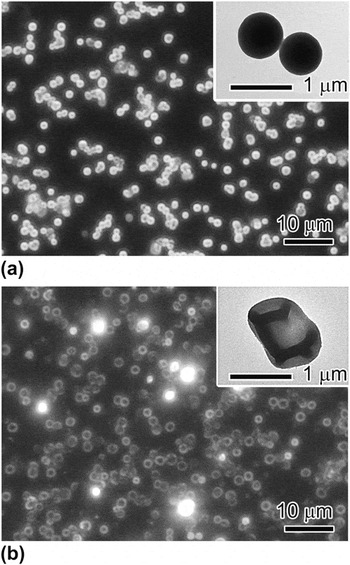
We have developed a template-free method for preparing TiO2 hollow shells by heating sol-gel-derived TiO2 microspheres with poly(acrylic acid) (PAA) in diethylene glycol (DEG).Reference Hu, Ge, Sun, Zhang and Yin28 Initially, sol-gel-derived TiO2 microspheres are solid particles containing micropores [Fig. 1(a)]. DEG is used as both a solvent and an etching agent because amorphous TiO2 particles prepared through a sol-gel process can be dissolved in pure DEG at high temperatures. Interestingly, heating TiO2 microspheres in the presence of PAA slows down the dissolution and eventually produces hollow shells [Fig. 1(b)]. Upon heating to high temperatures, PAA molecules can bind to the surface of TiO2 spheres and act as protecting agents during the subsequent etching. With its multiple carboxylate groups on a polymer chain, PAA acts as a crosslinker to connect adjacent TiO2 nanoparticles into a stable shell and protects them against rapid dissolution by DEG. Dissolution of TiO2 preferentially occurs inside the microsphere after DEG penetrates through the protected outer layer and reacts with unprotected core material. Thus, preferential removal of core material through the formation of soluble titanate species leaves behind hollow shells. The shells become thinner after continuous heating at high temperature and are eventually completely dissolved by the solvent. As the PAA chains are stretchable, the separation between adjacent surface nanoparticles increases after the removal of the cores. This explains why the diameter of the shells is significantly larger in comparison to the primary microspheres [Fig 1(b), inset]. Also, because the PAA chains are flexible, the shells are unable to support themselves mechanically when they are dried on a solid substrate.
Dark-field optical microscopy images of (a) the primary TiO2 microspheres and (b) the corresponding hollow shells. The insets are TEM images of the primary particles and hollow shells. Adapted with permission from Ref. Reference Hu, Ge, Sun, Zhang and Yin28© 2007 American Chemical Society.

Ostwald ripening is a classical phenomenon in solid dispersions or liquid sols in which small crystals or sol particles dissolve and regrow on larger ones. For some time now, the Ostwald ripening mechanism has been widely used for explaining the formation of hollow nanostructures. Zeng et al. first proposed the mechanism in the formation of hollow TiO2 shells through the hydrothermal treatment of titanium tetrafluoride (TiF4) solution.Reference Yang and Zeng27 The TiF4 precursor can first be hydrolyzed and condensed to produce solid TiO2 microspheres. Core portions of the TiO2 spheres can be continuously dissolved and then redeposited on the outer region to yield hollow TiO2 shells. Li and Zeng have also extended the hollowing process via Ostwald ripening to the synthesis of hollow tin (Sn)-doped TiO2 shell structures by using a similar hydrothermal treatment.Reference Li and Zeng31 The ripening strategy has been extended to the preparation of other oxides including silicon dioxide (SiO2),Reference Zhang, Ge, Hu, Zhang, Aloni and Yin32 tin dioxide (SnO2),Reference Lou, Wang, Yuan, Lee and Archer33 cuprous oxide (Cu2O),Reference Chang, Teo and Zeng34, Reference Teo, Chang and Zeng35 cobalt (II,III) oxide (Co3O4),Reference Liu and Zeng36 and many othersReference Zhang, Wang, Goebl and Yin37 through a similar formation mechanism.
B. Template-assisted method
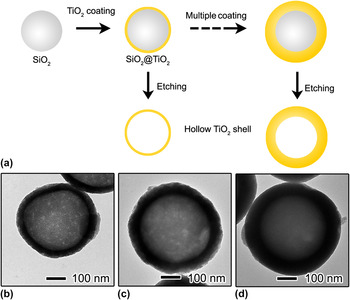
Compared with the template-free synthesis, the template-assisted method represents a more universal process for synthesizing nanostructured shells.Reference Joo, Zhang, Lee, Dahl, Zaera and Yin38, Reference Joo, Zhang, Dahl, Lee, Goebl, Zaera and Yin39 In fact, template-assisted synthesis has been the most commonly used method during the past decades for the preparation of shell structures. The principle of this strategy is straightforward and involves several sequential steps: (i) preparing the original templates; (ii) depositing the shell materials on the surface of the templates; (iii) selective etching to remove the templates. Various types of colloidal particles have been reported as having been experimented as core templates including gold (Au) nanoparticles,Reference Mayya, Gittins and Caruso21 silver (Ag) nanoparticles,Reference Pastoriza-Santos, Koktysh, Mamedov, Giersig, Kotov and Liz-Marzán20 PS,Reference Wang, Chen and Tang16, Reference Imhof17 glucose-derived carbon,Reference Zheng, Meng and Tang18, Reference Ao, Xu, Fu and Yuan40, Reference Ao, Xu, Fu and Yuan41 and silica.Reference Ye, Zhang, Hu, Ge, Lu, He, Chen and Yin6, Reference Lee, Othman, Eom, Lee, Kim and Kim19, Reference Joo, Zhang, Lee, Dahl, Zaera and Yin38, Reference Joo, Zhang, Dahl, Lee, Goebl, Zaera and Yin39 Among them, uniform silica spheres prepared by the Stöber method have been the most popular template due to the ease of coating them with TiO2 materials as well as their convenient removal by base etching.Reference Ye, Zhang, Hu, Ge, Lu, He, Chen and Yin6, Reference Lee, Othman, Eom, Lee, Kim and Kim19, Reference Lee, Joo, Yin and Zaera42 Deposition of TiO2 layers on the surface of silica spheres can be easily achieved through a sol-gel process which uses titanium tetrabutoxide (TBOT) as the TiO2 precursor and hydroxypropyl cellulose (HPC) as surfactant.Reference Ye, Zhang, Hu, Ge, Lu, He, Chen and Yin6, Reference Lee, Othman, Eom, Lee, Kim and Kim19, Reference Lee, Joo, Yin and Zaera42 The thickness of the TiO2 shells can be conveniently increased by carrying out multiple coating steps. Hollow TiO2 shells can then be obtained using an aqueous solution of NaOH to remove the silica cores [Fig. 2(a)]. In a typical synthesis, a single run of the TiO2 coating procedure produces ∼25 nm TiO2 shells [Fig. 2(b)], while repeating the coating steps three and five times can increase the shell thickness to ∼50 and ∼70 nm, respectively [Figs. 2(c) and 2(d)].Reference Joo, Zhang, Lee, Dahl, Zaera and Yin38
(a) Schematic illustration showing the typical template-assisted synthesis for hollow TiO2 shell nanostructure and corresponding TEM images of TiO2 hollow spheres with different thicknesses prepared using multiple sol-gel coating processes: (b) once (c) three times, and (d) five times.

III. CRYSTALLINITY CONTROL
Typical sol-gel processes, which prepare TiO2 shell nanostructures by direct hydrolysis and condensation of titanium alkoxides, cannot yield crystalline structures. However, good crystallinity is an important feature required for many practical applications including sensors, energy storage, and photocatalysis.Reference Wang, Chen and Tang16, Reference Yang, Niu, Lu, Hu and Han43, Reference Kamata, Lu and Xia44 There is no doubt that anatase phase TiO2 is considered to be the most active phase due to its higher reduction potential and lower recombination rate of electron-hole pairs in photocatalytic applications even though the rutile phase has the advantage of better absorption in the visible regime due to a lower band-gap energy. To achieve high activity in photocatalysis, it is important for the material to have a high surface area with well-developed porosity, which provides a large number of redox reaction sites on the catalyst surface as well as ensures easy diffusion of reactant molecules. It is therefore believed that well-crystallized anatase TiO2 with large surface area and porosity is the preferred form for photocatalysis.
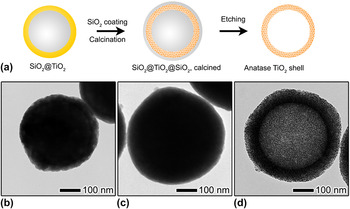
Calcination is considered to be a simple method to enhance the crystallinity of TiO2 shells. Nevertheless, direct calcination of either hollow TiO2 or SiO2@TiO2 core–shell structures cannot produce a stable shell morphology with the targeted anatase crystalline phase because the thin TiO2 layer can be damaged during extensive structural reorganization at high calcination temperatures. Recently we have developed a “protected calcination method” to achieve crystalline TiO2 shells with porous characteristics [Fig. 3(a)].Reference Joo, Zhang, Lee, Dahl, Zaera and Yin38 The “protected calcination” process not only improves the crystallinity of the samples but also brings additional benefits such as high surface area and well-developed mesoscale porosity. Compared with direct calcination, the major modification we introduced into this process is to protect the TiO2 shells with an additional outer silica layer. Calcination of SiO2@TiO2@SiO2 composites followed by chemical etching produced well-defined hollow TiO2 shells containing mesopores which could be easily observed by transmission electron microscopy (TEM) imaging [Figs. 3(b)–3(d)]. Our results suggest that the outer silica layer not only suppresses the crystal growth of TiO2 but also inhibits phase transformation. Similar to colloidal silica, the sol-gel-derived TiO2 layer contains micropores with diameters typically below 2 nm. Silicate species may be able to penetrate into these pores and condense in the TiO2 framework during the outer silica coating. The penetrated silica may then act as a barrier, preventing the extensive structural reorganization and growth of amorphous TiO2 into large crystal grains during calcination. This behavior may result in smaller anatase grains than those produced at similar calcination temperatures without the protection of silica.
(a) Schematic illustration of silica-protected calcination procedure and corresponding TEM images of the product at each step: (b) SiO2@TiO2 (c) SiO2@TiO2@SiO2 after calcination, and (d) final hollow TiO2 after the removal of the SiO2.

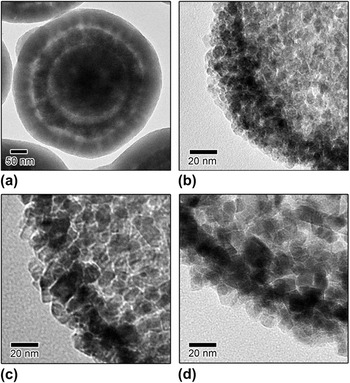
The presence of a silica layer significantly limits the growth of anatase grains to below ∼5 nm even at a calcination temperature as high as 900 °C. Although the crystalline hollow TiO2 structures have considerably large surface areas (above 300 m2/g), the small grain size is not optimal for reactions such as the photocatalytic decomposition of organic molecules. For increasing the crystallinity of TiO2 shells in a controllable manner, we have further developed a “partial etching and recalcination” process.Reference Joo, Zhang, Dahl, Lee, Goebl, Zaera and Yin39 When the TiO2 shell is coated with an additional layer of silica, the silica that penetrates into or near the TiO2 layer has a more disrupted Si–O–Si network than silica in other regions, making it more vulnerable to etching in base solution. Indeed, preferential etching can be achieved, as evidenced by the appearance of a small gap between the TiO2 layer and both the outer and inner SiO2 layer in the TEM image [Fig. 4(a)]. The degree of preferential etching can be easily controlled by both the duration of etching and concentration of etchants. The preferential removal of surrounding silica in or near the TiO2 layer allows further growth of anatase crystal domains during the recalcination process. Figures 4(b)–4(d) are TEM images showing the different sizes of TiO2 crystal grains produced by recalcining a partially etched SiO2@TiO2@SiO2 sample at different temperatures followed by the complete removal of SiO2 using NaOH. Compared with the original TiO2 shell samples produced simply by using the silica-protected calcination process [∼4 nm grain size, Fig. 3(d)], the crystal grain size increased to 7 and 10 nm upon recalcination for 4 h at 700 and 800 °C, respectively [Figs. 4(b) and 4(c)]. Prolonged heating at 800 °C for a longer time period (16 h) gives crystal grains with an average size above 14 nm [Fig. 4(d)]. As discussed in Sec. IV, the TiO2 nanostructured shells with controllable crystallinity are particularly interesting for photocatalytic applications due to their large active sites.
TEM images of (a) partially etched SiO2@TiO2@SiO2, and (b–d) final TiO2 shell nanostructure after recalcining SiO2@TiO2@SiO2(partially etched) at different conditions and NaOH etching: (b) 700 °C for 4 h, (c) 800 °C for 4 h, and (d) 800 °C for 16 h.

IV. PHOTOCATALYTIC APPLICATION AND ACTIVITY ENHANCEMENT
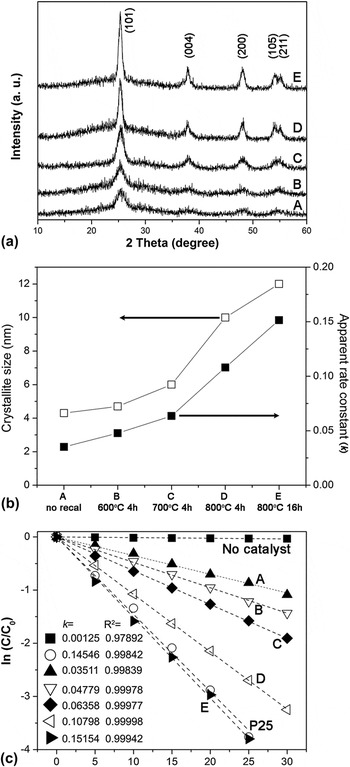
TiO2 is the most studied and most promising photocatalytic material, which can absorb UV light to promote redox reactions. Its high photocatalytic activity can be improved by tuning several characteristics including surface area, surface properties, crystalline phase, and crystallinity.Reference Joo, Zhang, Dahl, Lee, Goebl, Zaera and Yin39 Nanostructured TiO2 shells are good candidates for photocatalysis due to their relatively large surface area, excellent water dispersity, and controllable anatase crystallinity. The hollow TiO2 shells prepared through the “partial etching and recalcination” process show a well-developed anatase phase with the grain size tunable by adjusting the recalcination temperature and time [Figs. 5(a) and 5(b)]. When used for photocatalytic degradation of dye molecules such as Rhodamine B (RhB), the TiO2 nanoshells significantly enhanced the decomposition rate while the control sample without catalyst showed the lowest apparent rate constant (k) values [Figs. 5(b) and 5(c)]. As expected, TiO2 shells prepared without partial etching and recalcination [Sample A in Fig. 5(a)] showed the lowest k values among TiO2 catalysts tested, while k continuously increased as recalcination temperature increased. Eventually, TiO2 shells recalcined at 800 °C for 16 h (Sample E) showed the largest k value, indicating the highest catalytic efficiency. The improved catalytic activity should be attributed to the enhanced crystallinity of the anatase grains, resulting in better charge separation during photocatalysis. Although it is generally accepted in catalysis field that the activity of a catalyst benefits from a higher specific area, our studies however have clearly shown that photocatalytic activity can be promoted more by enhanced crystallinity due to better charge separation, even though the value of surface area decreases correspondingly.
(a) X-ray diffraction patterns, (b) calculated crystallite grain size and apparent rate constant value (k) during photocatalytic RhB decomposition, and (c) photocatalytic reaction results of TiO2 samples: TiO2 shells (A) without recalcination process, (B) recalcined at 600 °C for 4 h, (C) recalcined at 700 °C for 4 h, (D) recalcined at 800 °C for 4 h, (E) recalcined at 800 °C for 16 h. Adapted with permission from Ref. Reference Joo, Zhang, Dahl, Lee, Goebl, Zaera and Yin39© 2011 Royal Society of Chemistry.

The synthesis of highly active visible-light-responsive photocatalysts has attracted intensive interest because they hold the promise of more efficient harvesting of solar energy. Modification of TiO2 through nonmetal anion doping, metal cation doping or plasmonic metal decoration lowers its band-gap energy and allows for absorption of photon energy in the visible regime, thus utilizing a greater portion of the solar spectrum. Recently, we demonstrated the nitrogen doping of porous TiO2 nanocrystal clusters by NH3 treatment.Reference Zhang, Joo, Lu, Dahl, Oliveira, Ye and Yin45 After gas phase treatment at high temperature, the white powder became yellowish, indicating the successful N doping which yielded particles capable of visible light absorption. It has been known that metal nanoparticles such as Au or Ag can enhance the activity of photocatalysts in visible light due to their plasmonic properties. By combining nonmetal doping with the plasmonic effect, we have designed SiO2/Au/N-doped TiO2 shell nanostructures for improving photocatalytic activity.Reference Zhang, Lima, Lee, Zaera, Chi and Yin46 The catalyst has a sandwich structure that comprises a SiO2 core, a layer of decorated gold nanoparticles (AuNPs), and a doped TiO2 nanocrystalline shell. The TiO2 shell was doped with both N and C using an unconventional method that involved introducing 3-aminopropyl-triethoxysilane (APTES), which originally acted as a ligand for immobilization of AuNPs on the surface of the SiO2 support, but upon subsequent decomposition at high temperature served as a source of both the N and C dopants. Eventually, the sandwich-structured catalysts showed excellent catalytic activity for oxidation of organic compounds under UV, visible and direct sunlight. The enhanced photocatalytic efficiency can be attributed to the interfacial nonmetal doping which improves visible light absorption, and to the plasmonic metal decoration, which enhances light harvesting and charge separation.
V. CONCLUSIONS AND OUTLOOK
Extensive research efforts have been devoted to the synthesis of TiO2-based hollow shells and core–shell nanostructures due to their promising applications in photocatalysis. In this article, we have reviewed our recent efforts in TiO2 nanostructured shells, focusing on the synthesis, crystallinity control and photocatalytic performance. Two synthetic strategies for preparing TiO2 shell nanostructures have been discussed, including template-free and template-assisted methods. We have also discussed the strategies for controlling the crystallinity of the TiO2 shells, including “silica-protected calcination” and “partial etching and recalcination” methods. We finally discussed the performance of TiO2 nanostructured shells in photocatalysis, and various approaches to enhance the catalytic activity.
The systems reviewed in this article represent our efforts in engineering TiO2 materials at the nanometer scale with a high degree of control over the morphology, crystallinity, doping, and interface. We believe the fine manipulation of the nanostructures will eventually allow us to significantly enhance the photocatalytic efficiency of TiO2-based catalyst materials. However, there are still challenging issues remaining in the synthesis of well-defined photocatalysts with high activity toward practical photocatalysis such as water-splitting and artificial photosynthesis. More rational design and modification strategies for TiO2-based nanostructure photocatalysts such as well-controlled nonmetal doping, plasmonic metal decoration and the hybridization with other semiconducting materials will be examined as our next steps.
ACKNOWLEDGMENTS
Financial support of this work was provided by the Office of Basic Energy Sciences of the U.S. Department of Energy, SISGR-Catalysis for Energy Grant No. DE-SC0002247. Y.Y. also thanks the Research Corporation for Science Advancement for the Cottrell Scholar Award, 3M for the Nontenured Faculty Grant, and DuPont for the Young Professor Grant. J.B.J. was partially supported by a National Research Foundation of Korea Grant funded by the Korean Government (No. NRF-2009-352-D00056).