INTRODUCTION
The bluespotted cornetfish Fistularia commersonii Rüppell, 1835 is a widely distributed Indo-Pacific species commonly found among reefs and on shallow sandy bottoms (Fritzsche, Reference Fritzsche1976), including seagrass meadows (Nakamura et al., Reference Nakamura, Horinouchi, Nakai and Sano2003). It is primarily piscivorous both in the native habitat (Takeuchi et al., Reference Takeuchi, Hashimoto and Gushima2002) and in the recently colonized eastern Mediterranean habitat (Kalogirou et al., Reference Kalogirou, Corsini, Kondilatos and Wennhage2007), living either solitary or in small groups (Golani et al., Reference Golani, Orsi Relini, Massutì, Quignard and Briand2002). Among the members of the Fistulariidae family, two species have been recorded in the Mediterranean: F. petimba off the southern coast of Spain (Càrdenas et al., Reference Cárdenas, Berastegui and Ortiz1997) and F. commersonii along the Israeli coast (Golani, Reference Golani2000). Soon after its first appearance, the latter species was documented in large numbers along the coasts of Turkey (Bilecenoglu et al., Reference Bilecenoglu, Taşkavak and Kunt2002; Gokoglu et al., Reference Gokoglu, Bodur and Gulyavuz2002) as well as at Rhodes (Corsini et al., Reference Corsini, Kondilatos and Economidis2002), and for this reason was considered an established alien species in the Mediterranean (Golani et al., Reference Golani, Orsi Relini, Massutì, Quignard and Briand2002). Further records from the north Aegean Sea, Greece (Karachlè et al., Reference Karachlé, Triantaphyllidis and Stergiou2004), from the Strait of Sicily (Azzurro et al., Reference Azzurro, Pizzicori and Andaloro2004; Fiorentino et al., Reference Fiorentino, Giusto, Sinacori and Norrito2004), from the Tunisian coast (Ben Souissi et al., Reference Ben Souissi, Zaouali, Bradai and Quignard2004; Charfi-Cheikhrouha, Reference Charfi-Cheikhrouha2004), from the southern Tyrrhenian Sea (Pipitone et al., Reference Pipitone, D'Anna, Coppola, Di Stefano and Badalamenti2004), from the south-western Sicilian coast (Milazzo et al., Reference Milazzo, Barraco, Beltrano, Cannizzaro, Puleo, Rizzo, Salvo and Vitale2006), from the northern Tyrrhenian Sea (Micarelli et al., Reference Micarelli, Barlettani and Ceccarelli2006), from the eastern coast of Sardinia (Pais et al., Reference Pais, Merella, Follesa and Garippa2007) and from the Adriatic Sea (Dulčić et al., Reference Dulčić, Scordella and Guidetti2008), confirmed the rapid westward spreading of this lessepsian immigrant in the Mediterranean. For the speed of its westward and northward expansion within the Mediterranean F. commersonii is considered among the most successful lessepsian migrants (Karachlè et al., Reference Karachlé, Triantaphyllidis and Stergiou2004) and one of the 100 ‘worst invasive’ alien marine species in the Mediterranean (Streftaris & Zenetos, Reference Streftaris and Zenetos2006). Although, the specific dynamics of biological invasions are poorly known (Golani et al., Reference Golani, Azzurro, Corsini-Foka, Falautano, Andaloro and Bernardi2007), the range extension of lessepsian migrants in the Mediterranean seems to be mainly related to abiotic (e.g. temperature) or biotic (e.g. spawing season) factors (Golani, Reference Golani1998a). According to the latter author, once a lessepsian fish species has arrived in the Mediterranean and established a self-sustaining population, there are no physical barriers preventing its dispersal westward.
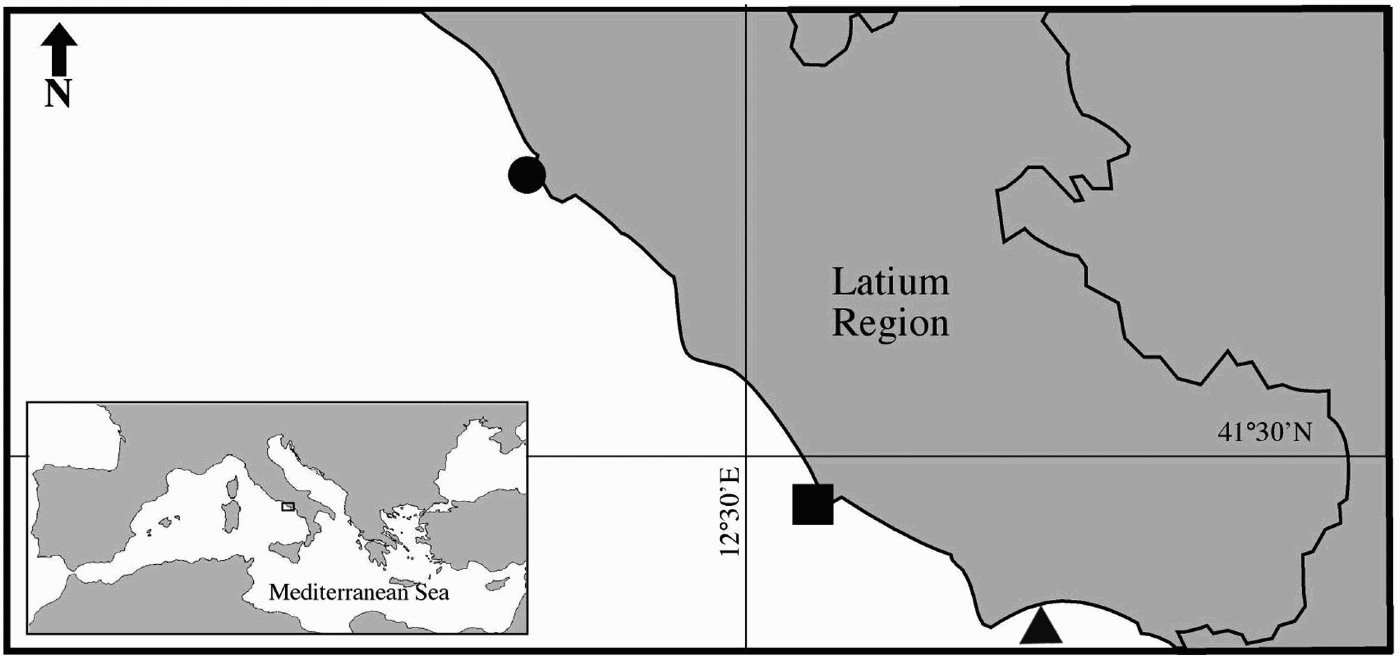
In this paper, the biometric and meristic characters of eleven individuals of this species captured along the Latium coasts (Figure 1) in October–November 2007 are presented. Data on gonad condition and information on stomach contents are also given.
Map showing the area where Fistularia commersonii were collected in the central Tyrrhenian Sea (▴, Terracina; ■, Anzio; ●, Civitavecchia).

MATERIALS AND METHODS
Between 29 October and 15 November 2007 a total of ten adult specimens of Fistularia commersonii were captured by trawlers operating in littoral waters on muddy or sandy bottoms along the coast of Anzio (only eight available for study). Four additional individuals were trawled at Terracina in October (only two available for study) and one further specimen was captured in November 2007 by gill-net set at 10 m depth on a Posidonia oceanica bed at Civitavecchia. With the exception of the latter specimen that was collected and examined fresh, all the other samples were stored in a freezing chamber at –20C° for a few days. All collected specimens were photographed, weighed and identified to specific level on the basis of keys furnished by Fritzsche (Reference Fritzsche1976). Morphometric and meristic characters were recorded and gonads extracted and weighed in order to determine sex and reproductive status. Macroscopic and microscopic observation of gonads was performed and maturity stage assessed on the basis of structure, size and shape (Holden & Raitt, Reference Holden and Raitt1974). In addition, stomach contents were analysed, weighed and preserved in 70% ethanol. All biometric and meristic parameters were taken following Fritzsche (Reference Fritzsche1976) and measurements recorded to the lowest millimetre (mm) by using a measuring tape and a clock-calliper. A test for homogeneity of variance (Levene's test) was used to ascertain the significance of systematic error occurrence in total length (TL)-standardized measurements and log-transformed ray counts among the 11 analysed specimens. The log-transformation of ray counts was needed, being a non-continuous variable. Gonad weight (GW), stomach weight (SW) and eviscerated weight (EW) were taken by means of a digital balance to an accuracy of 0.1 g. One specimen of F. commersonii (code no. Z6995) was deposited in the Zoological Museum of the University Federico II of Naples. The remaining samples are temporarily stored in the freezing chamber of the ICRAM laboratory in Rome.
RESULTS
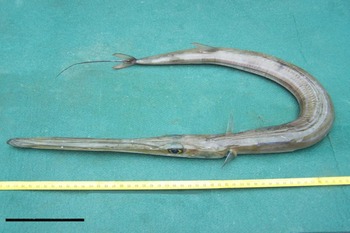
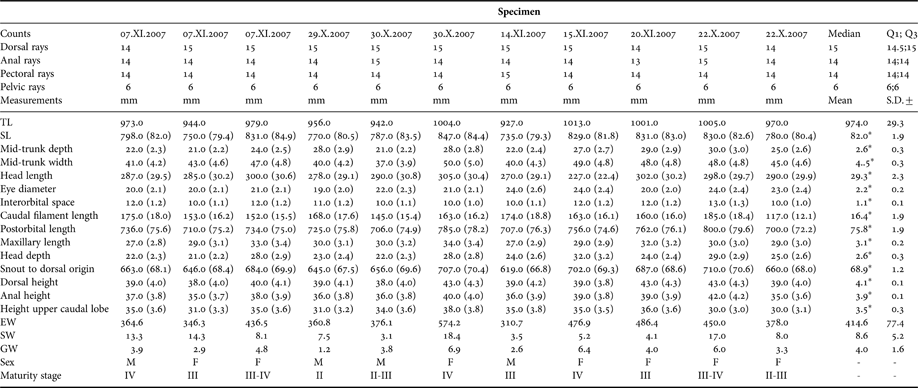
The specimens of Fistularia commersonii collected from Latium waters ranged from 735 to 847 mm in standard length (SL). According to Golani (Reference Golani2000) and Golani et al. (Reference Golani, Orsi Relini, Massutì, Quignard and Briand2002), all specimens can be described as follows: body extremely elongated becoming depressed behind the head. Snout tubular and very long with a small slightly oblique mouth. Strong serrated ridges on the snout (in contrast with smooth ridges typical of F. tabacaria). Teeth very small. Dorsal and anal fins are located far back on the body and are similar in shape and opposite to each other. Caudal fin forked with two distinct middle rays forming a long filament. Skin smooth, without bony plates along the midline of the back or spines on the posterior part of the lateral line (typical of F. petimba). Lateral line running anteriorly almost along the middle of the back, then curving down to the side and continuing posteriorly onto the caudal filament. Colour brownish to olive-green on the head, back and flanks. Belly white, with dorsal and anal fins tips orange. Caudal filament dark. In freshly caught specimens a pair of blue stripes and/or a double row of blue spots are visible along the back (Figure 2). As shown in Table 1, variances among the 11 analysed specimens were found to be homogeneous both as for TL-standardized measurements (Levene test: F10;143 = 1.2 × 10⁻², P > 0.05) and as for log-transformed ray counts (Levene Test: F10;33 = 6 × 10⁻³, P > 0.05). These results indicated that systematic bias occurrence was not significant in measurements and counts for each specimen, suggesting furthermore that biological variability was scarce among sampled specimens as far as analysed morphometrics were concerned.
Fistularia commersonii Rüppell, 1835 captured at Anzio (central Tyrrhenian Sea). Scale bar: 10 cm.

Meristic and biological data for eleven specimens of Fistularia commersonii caught in the central Tyrrhenian Sea. Measurements are given as absolute (mm) and as percentage (in parentheses) values of TL (%).

Asterisks (*) refer to mean values and their standard deviations calculated on percentage values of TL. Abbreviations: see Materials and Methods; SD, standard deviation; weights in grams (g).
Stomach contents consisted exclusively of juveniles and small-sized fish belonging to the Gobiidae, Labridae and Sparidae families. Among these families the most numerous prey items were Coris julis, Boops boops and some unidentified gobiid species. The gonads are composed of two fused lobes divided by connective tissue as previously observed (Azzurro et al., Reference Azzurro, Pizzicori and Andaloro2004). Macroscopically they appear as a single oblong slightly depressed structure extending throughout the length of the body cavity just behind the digestive tube; they are whitish in males and pinkish in females and are connected by a mesentery to a thick fatty layer adherent to the peritoneal membrane. Macroscopic and microscopic analysis permitted us to determine the sex and maturity stage of each gonad (see Table 1), on the basis of an eight-point maturity scale for total spawners (Holden & Raitt, Reference Holden and Raitt1974).
DISCUSSION
During the last fifty years an increasing number of tropical and subtropical fish species has been documented in the Mediterranean basin (Golani et al., Reference Golani, Orsi Relini, Massutì, Quignard and Briand2002). Of the 65 lessepsian fish which have penetrated into the Mediterranean through the Suez Canal (Golani et al., Reference Golani2006), only four other species have reached the western Mediterranean basin (Golani et al., Reference Golani, Orsi Relini, Massutì, Quignard and Briand2002): Abudefduf vaigiensis recorded in the Gulf of Naples (Tardent, Reference Tardent1959) and in the Ligurian Sea (Vacchi & Chiantore, Reference Vacchi and Chiantore2000), Siganus luridus recorded in the southern Tyrrhenian Sea (Castriota & Andaloro, Reference Castriota and Andaloro2005), Stephanolepis diaspros, which reached the Palermo coasts (Catalano & Zava, Reference Catalano and Zava1993) and Pomadasys stridens reported from the Gulf of Genoa (Torchio, Reference Torchio1969). However, only Siganus luridus has been successful in establishing a self-sustained population as far as the Strait of Sicily (Azzurro & Andaloro, Reference Azzurro and Andaloro2004). For this reason the latter fish species has been considered among the most successful lessepsian migrants (Papaconstantinou, Reference Papaconstantinou1990; Golani et al., Reference Golani, Orsi Relini, Massutì, Quignard and Briand2002; Streftaris & Zenetos, Reference Streftaris and Zenetos2006) and the object of many ecological studies (Lundberg & Golani, Reference Lundberg and Golani1995; Azzurro et al., Reference Azzurro, Fanelli, Mostarda, Catra and Andaloro2007). The success of herbivorous rabbitfish in colonizing the Mediterranean has been explained with the ‘empty niche’ hypothesis, corroborated by the scanty number of true indigenous species belonging to the same trophic guild. The same explanation cannot be applied to the extraordinary population explosion and rapid westward dispersion experienced by Fistularia commersonii in the Mediterranean. The latter fish is a higher order carnivore (Karachlè et al., Reference Karachlé, Triantaphyllidis and Stergiou2004; Kalogirou et al., Reference Kalogirou, Corsini, Kondilatos and Wennhage2007) just like many other indigenous species occurring in the Mediterranean Sea, and the mechanisms underlying its undisputed invasive success remain to be determined (Golani et al., Reference Golani, Azzurro, Corsini-Foka, Falautano, Andaloro and Bernardi2007). The combination of temperature regime and thermal tolerance of any given fish species determine its geographical distribution, principally because reproduction processes occur only between strict temperature intervals (Wootton, Reference Wootton1992). On this basis, Golani (Reference Golani1998a) suggested for lessepsian invaders a correlation between the early start of spawning season and westward distribution. Spawning season of F. commersonii in the Mediterranean is not well known; a sexually immature female was found in November (Pipitone et al., Reference Pipitone, D'Anna, Coppola, Di Stefano and Badalamenti2004), postspawning females in the months of October and November (Fiorentino et al., Reference Fiorentino, Giusto, Sinacori and Norrito2004; Pais et al., Reference Pais, Merella, Follesa and Garippa2007) and an apparently spawning or close to spawning female during the month of December (Azzurro et al., Reference Azzurro, Pizzicori and Andaloro2004). Our specimens are all mature or maturing males and females with more or less turgid gonads occupying 1/2 or 2/3 of the ventral cavity (Stages II–III–IV according to Holden & Riatt, 1974). This seems indicative of a protracted spawning season for this species in the Mediterranean which is in contrast with data coming from the Pacific where floating eggs are found during the summer months along the coast of California (Watson & Sandknop, Reference Watson, Sandknop and Moser1996). As demonstrated for other lessepsian migrants (Golani, Reference Golani1998b), it is possible that the spawning season of Mediterranean populations of the bluespotted cornetfish changed under the influence of local biotic and abiotic factors, such as food availability, competition with indigenous species, available substrate, currents and temperature regimes.
Feeding habits of lessepsian colonizers generally remain similar to those of the mother population (Golani, Reference Golani1998b). According to Corsini et al. (Reference Corsini, Kondilatos and Economidis2002), Kalogirou et al. (Reference Kalogirou, Corsini, Kondilatos and Wennhage2007) and to qualitative observations carried out in this work, the stomach of this species contains multiple prey items ranging from bottom-dwelling fish (e.g. gobioids and synodontids) to schooling pelagic fish (e.g. atherinids and engraulids). This type of feeding habit was also observed from studies carried out in shallow reef waters of southern Japan (Takeuchi et al., Reference Takeuchi, Hashimoto and Gushima2002). The latter authors reported different hunting techniques employed by F. commersonii according to prey fish type. This versatility adopted during foraging activity may represent one of the features contributing to the extraordinary success of this colonizer in the Mediterranean.
The Latium shores are characterized by sandy/rocky bottoms including sparse Posidonia beds which appear to be the preferential habitat of F. commersonii in the Mediterranean (see Bilecenoglu et al., Reference Bilecenoglu, Taşkavak and Kunt2002; Pipitone et al., Reference Pipitone, D'Anna, Coppola, Di Stefano and Badalamenti2004; Pais et al., Reference Pais, Merella, Follesa and Garippa2007). However, with the exception of the Civitavecchia specimen, all other specimens in this study were caught by trawlers operating on sandy/muddy bottoms as previously observed (Kalogirou et al., Reference Kalogirou, Corsini, Kondilatos and Wennhage2007).
Never before has the species been recorded in such large numbers from a single locality in the western Mediterranean. According to Francour et al. (Reference Francour, Boudouresque, Harmelin, Harmelin-Vivien and Quignard1994) experience with southern fish species migrating to the French Mediterranean coast, shows that the pattern of colonization follows two distinct temporal steps; migration of small groups of adult specimens, followed by recruitment and juveniles findings. Apart from those mentioned in the eastern basin (Corsini et al., Reference Corsini, Kondilatos and Economidis2002; Kalogirou et al., Reference Kalogirou, Corsini, Kondilatos and Wennhage2007), no juvenile individual has yet been documented in the western Mediterranean. Therefore, the finding of small groups of adults of uniform size in this area may be indicative of an incoming establishment of a new self-generating population of this species also in the western sector of the Mediterranean. This idea seems to be confirmed by our histological data on the gonads (P.N. Psomadakis, unpublished data) and by the courting activities observed by a SCUBA diver at the Pontine Islands (Costa, Reference Costa2007). Although sampling effort remained high, bluespotted cornetfish findings along the Latium coast suddenly ceased after the last specimen caught at Civitavecchia on 20 November 2007. Morphometric and meristic characteristics of all our specimens resulted extremely homogeneous (Table 1). The scarce biological variability observed in our sample could indicate a high degree of genetic resemblance among analysed individuals. These data support the idea that the Mediterranean invasion of the bluespotted cornetfish resulted from the success of very few individuals as shown from genetic studies (Golani et al., Reference Golani, Azzurro, Corsini-Foka, Falautano, Andaloro and Bernardi2007). Furthermore, in contrast with Fischer & Bianchi (Reference Fischer and Bianchi1984), all our specimens presented a dark instead of a white caudal filament. This structure is lined with sensorial pores (Fischer & Bianchi, Reference Fischer and Bianchi1984), apparently functioning as an extension of the lateral line system for enhancement of mechanoreception stimuli.
Up to now only three adult individuals of this species have been officially reported in the western basin; notably in the Gulf of Castellamare (Sicily, southern Tyrrhenian) (Pipitone et al., Reference Pipitone, D'Anna, Coppola, Di Stefano and Badalamenti2004), along the coasts of Monte Argentario (northern Tyrrhenian) (Micarelli et al., Reference Micarelli, Barlettani and Ceccarelli2006) and along the eastern Sardinian coast (central Tyrrhenian) (Pais et al., Reference Pais, Merella, Follesa and Garippa2007). The ‘core’ of the Mediterranean population seems to be located in the north-eastern sectors of the Levant Sea, including Cyprus, Crete, Rhodes and in the Strait of Sicily (Golani et al., Reference Golani, Orsi-Relini, Massutì and Quignard2006). This distribution is probably due to the general circulation of superficial currents, which in the eastern basin flow anticlockwise along northern Africa and then up past the coasts of Israel, Lebanon, Syria and follow the Turkish coastline westwards towards the western sectors of the Mediterranean (Hamad et al., Reference Hamad, Millot and Taupier-Letage2006). The temporal and spatial distribution of F. commersonii in the Mediterranean seems to confirm this explanation. This invader has demonstrated great capacity to adapt to local hydro-climatic conditions, extending its range to the central and northern Tyrrhenian and possibly further northward. Contemporarily to our findings along the Latium coast, F. commersonii was captured in the Strait of Messina (Costa, Reference Costa2007) and different unpublished records of the species were documented in Sardinian coastal waters (B. Díaz López, 2007, personal communication; F. Maggiani, 2007, personal communication; F. Lampis, 2007, personal communication).
It is also to be underlined that F. commersonii is the first lessepsian fish species recorded along the Latium coasts, a marine area where the local ichthyofauna shows interesting figures either in terms of abundance (Psomadakis, Reference Psomadakis2002) or in terms of species richness (Psomadakis et al., Reference Psomadakis, Dalù, Scacco and Vacchi2005, Reference Psomadakis, Ceddia and Vacchi2006a,Reference Psomadakis, Scacco and Vacchib).
According to theoretical ecology, species with an ‘r-strategy’ (e.g. small body size, rapid growth, short longevity, early sexual maturity, high reproduction potential and usually one reproductive season) would be more adapted to the role of colonizers, due to their ability for rapid population growth. Many aspects of the early life stages of the bluespotted cornetfish are still poorly known (Golani et al., Reference Golani, Azzurro, Corsini-Foka, Falautano, Andaloro and Bernardi2007). Therefore, future studies specifically targeting the biological features and life history traits of this remarkable lessepsian invader are needed and may help to better understand its invasive potentiality and its impact on Mediterranean ecosystems.
ACKNOWLEDGEMENTS
This work could have not been possible without the help and collaboration of fishermen and operators of the cooperatives ‘Isole Pelagie’ and ‘Concordia’ of the port of Anzio. A special thanks goes to our friend and collaborator Mr P. Sorrentino (Anzio) who collected and stored samples for this study. We are grateful to all trawler captains of the Anzio fishing fleet which captured and handed over to us Fistularia commersonii specimens. Furthermore Bruno, Giacomo and Franco, all from the fishing port of Civitavecchia are acknowledged for capturing and providing one specimen. D. Venerelli and C. Marigliani, trawler captains from Terracina, are also acknowledged. Many thanks to Professor F. Costa (Messina), to Dr B. Díaz López (Bottlenose Dolphin Research Institute (Golfo Aranci), Dr F. Maggiani (Area Marina Protetta, Capo Carbonara), Dr G. Carrabs (AUSL, Latina) and F. Lampis (Nuoro) for sharing with us information regarding this species. Many thanks also to Dr E. Azzurro (ICRAM, Milazzo) for his helpful suggestions and to two anonymous referees who provided valuable improvements to the text. Dr A. Machulska (ICRAM, Roma) and Mrs E. Faller (Stazione Zoologica A. Dohrn, Napoli) are acknowledged for helping with reference search and P. Di Matteo (Makers Associati, Napoli) and Dr N. Maio (Museo Zoologico, Università Federico II, Napoli) for their technical help. Lastly, we wish to thank Dr A. Priori (ICRAM, Roma) for histological preparation of bluespotted cornetfish gonads and Dr A. Longobardi and Dr T. Petochi, both from ICRAM (Roma), for helping with interpretation of oocyte maturity stages.