


1. The issue
We examine the formal encoding of feature indeterminacy, focussing on case indeterminacy as an exemplar of the phenomenon. Forms that are indeterminately specified for the value of a feature can simultaneously satisfy conflicting requirements on that feature and thus are a challenge to constraint-based formalisms which model the compatibility of information carried by linguistic items by combining or integrating that information (Groos & van Riemsdijk Reference Groos, van Riemsdijk, Belletti, Brandi and Rizzi1979, Zaenen & Karttunen Reference Zaenen, Karttunen, Alvarez, Brodie and McCoy1984, Pullum & Zwicky Reference Pullum and Arnold1986, Ingria Reference Ingria1990, Bayer Reference Bayer1996, Dalrymple & Kaplan Reference Dalrymple and Kaplan2000, Levy Reference Levy2001, Levy & Pollard Reference Levy, Pollard, Eynde, Hellan and Beermann2001, Sag Reference Sag2003, Blevins to appear). Much previous work in constraint-based formalisms has sought to provide an analysis of feature indeterminacy by departing in some way from ‘vanilla’ assumptions either about feature representations or about how compatibility is checked by integrating information from various sources. In the present contribution we argue instead that a solution to the range of issues posed by feature indeterminacy can in fact be provided in a ‘vanilla’ feature-based approach which is formally simple, does not postulate special structures or objects in the representation of case or other indeterminate features, and requires no special provision for the analysis of coordination. Our account covers the behaviour of both indeterminate arguments and indeterminate predicates, that is, predicates placing indeterminate requirements on their arguments.
In the remainder of this section, we present the linguistic data which exemplify the indeterminacy problem. Though we focus on case indeterminacy, we see no reason to believe that our approach cannot be extended unproblematically to other indeterminate features as well. Section 2 presents our analysis of case as a complex feature structure and shows how this accounts for the full range of data presented, including the role of modifiers in limiting indeterminacy (what we call the transitivity problem), and the interaction of indeterminacy on both head and argument (what we call the second-order indeterminacy problem). Section 3 presents a comparison with previous proposals and evaluates their ability to account for the full range of phenomena to be analysed. Section 4 concludes.
1.1 Case agreement
We start by reviewing some of the key evidence illustrating the phenomenon of indeterminacy. In a great many languages, dependents are required to agree with their nominal head in a variety of morphosyntactic features, including case. Case agreement between Russian nouns and their adjectival modifiers is shown in (1):
- (1)
(a) staraja kniga (Russian) old book nomnom ‘(the/a) old book’ (nominative adjective, nominative noun)
(b) staruju kniguold book accacc ‘(the/a) old book’ (accusative adjective, accusative noun)
If the case of the adjective does not match that of its head noun, the result is ungrammatical:
- (2)
(a) *staruju kniga (Russian) old bookaccnom ‘(the/a) old book’ (accusative adjective, nominative noun)
(b) *staraja kniguold book nomacc ‘(the/a) old book’ (nominative adjective, accusative noun)
Case agreement between nouns and their determiners and modifiers is commonly found in the world's languages, as is case government, where a predicate imposes requirements specifying the case of its argument(s).
1.2 Arguments with indeterminate case
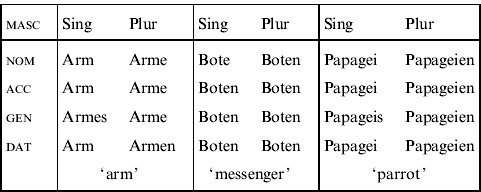
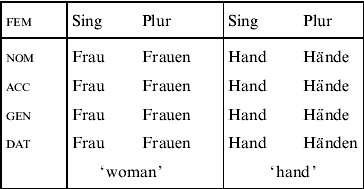
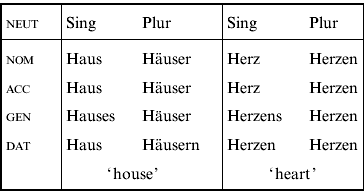
Of course, morphosyntactic features do not always have a unique exponent: paradigmatic syncretism is a widespread phenomenon. For example, German nominal paradigms are highly syncretic, with a single form corresponding to a number of distinct paradigm cells, as shown in the illustrative masculine, feminine and neuter paradigms in (3)–(5).
(3) Masculine

(4) Feminine
(5) Neuter
The masculine weak declension plural noun Papageien ‘parrots’, which shows no case distinctions, can satisfy different case requirements, occurring with verbs that take accusative objects (7a) as well as with those that take dative objects (7b).
(6) Papageien (German) parrots nom/acc/dat/gen ‘parrots’ (nominative, accusative, dative, or genitive)
- (7)
(a) Er findet Papageien. (German) he finds parrots obj=accnom/acc/dat/gen ‘He finds parrots.’
(b) Er hilft Papageien. he helps parrots obj=datnom/acc/dat/gen ‘He helps parrots.’
1.2.1 Indeterminacy
Groos & van Riemsdijk (Reference Groos, van Riemsdijk, Belletti, Brandi and Rizzi1979) and Zaenen & Karttunen (Reference Zaenen, Karttunen, Alvarez, Brodie and McCoy1984) were among the first to point out that syncretic forms can be syntactically indeterminate – that is, simultaneously compatible with more than one requirement for a feature such as case. At least some of the syncretisms illustrated above behave indeterminately, in that the form is compatible with more than one set of morphosyntactic requirements imposed at the same time; such a situation can arise, for example, under coordination. Thus the German form Papageien is able to simultaneously satisfy both acc and dat requirements imposed by different verbs, as in (8), showing that it is indeterminate between acc and dat.
(8) Er findet und hilft Papageien. (German) he finds and helps parrots obj=accobj=datnom/acc/dat/gen ‘He finds and helps parrots’
The same is true of the feminine plural form Frauen ‘woman’.
(9) Er findet und hilft Frauen. (German) he finds and helps womenobj=accobj=datnom/acc/dat/gen ‘He finds and helps women.’
Examples of indeterminate forms are widely found. Dyła (Reference Dyła1984) shows that the Polish interrogative pronoun kogo ‘who’ is indeterminately accusative and genitive, and can be the object of an accusative-taking and a genitive-taking verb at the same time, as in (10), while a form such as co ‘what’, which is indeterminately nom/acc, cannot (11).
(10) Kogo Janek lubi a Jerzy nienawidzi? (Polish)who Janek likes and Jerzy hates acc/genobj=accobj=gen ‘Who does Janek like and Jerzy hate?’
(11) * Co Janek lubi a Jerzy nienawidzi? what Janek likes and Jerzy hates nom/accobj=accobj=gen ‘What does Janek like and Jerzy hate?’
The syntactic effects of indeterminacy can also be observed outside of coordination. A much-discussed instance concerns German free relative constructions, in which the case-matching requirement is not violated just when the relative pronoun is indeterminate between the matrix case and the case required within the relative clause.Footnote 2 The examples in (12) illustrate the case-matching requirement: in (12a), from Groos & van Riemsdijk (Reference Groos, van Riemsdijk, Belletti, Brandi and Rizzi1979), unambiguously nominative wer satisfies the nominative requirements both of the relative clause predicate stark ist and of the matrix verb muss; (12b) is ungrammatical because wer does not satisfy the dative requirement of geholfen wird.
- (12)
(a) Wer nicht stark ist muss klug sein. (German) who not strong is must clever be nomsubj=nomsubj=nom ‘Who isn't strong must be clever.’
(b) *Wer nicht geholfen wird, muss klug sein. who not helped is must clever be nomsubj=datsubj=nom ‘Who isn't helped must be clever.’
In contrast, the relative pronoun was is indeterminately nominative and accusative, and thus can simultaneously satisfy the accusative requirement of gegessen and the nominative requirement of übrig war.
(13) Ich habe gegessen was übrig war. (German) I have eaten what left was obj=accnom/accsubj=nom ‘I ate what was left.’
Similar data can be found in other languages with indeterminate relative pronouns, as seen in the following Russian example from Levy (Reference Levy2001) :
(14) Kogo ja iskal ne bylo doma. (Russian)who I sought not was home acc/genobj=accsubj=gen ‘The person who I was looking for wasn't home.’
These data show that any formal treatment of indeterminacy cannot rely on special properties of coordinate structures, but must be general enough to account for indeterminacy in both coordinate and noncoordinate structures.
1.2.2 Ambiguity
Not all instances of syncretism in the paradigm are susceptible to analysis as indeterminacy. Instead, such forms may exhibit ambiguity: ambiguous forms can obey either one requirement or another, but cannot obey conflicting requirements at the same time (Zaenen & Karttunen Reference Zaenen, Karttunen, Alvarez, Brodie and McCoy1984, Pullum & Zwicky Reference Pullum and Arnold1986, Ingria Reference Ingria1990, Dalrymple & Kaplan Reference Dalrymple and Kaplan2000). Unlike indeterminacy, ambiguity often involves a difference in meaning between the cells of the paradigm (though this is not a necessary property of ambiguous forms). For example, the German pronominal form sie is ambiguous, and can mean either ‘she’ or ‘they’, as in (15).
- (15)
(a) Sie singt. (German)she/they sing sg/plsg ‘She sings.’
(b) Sie singen.she/they singsg/plpl ‘They sing.’
It cannot be used indeterminately, as shown in (16), from Pullum & Zwicky (Reference Pullum and Arnold1986: 765).
(16) *Sie singt und singen. she/they sing and singsg/plsgpl
The English form sheep is likewise ambiguous rather than indeterminate: The sheep is ready, The sheep are there, *The sheep that is ready are there (Ingria Reference Ingria1990). Such structures violate what Zaenen & Karttunen (Reference Zaenen, Karttunen, Alvarez, Brodie and McCoy1984) call the ‘Anti-Pun Ordinance’, which forbids the use of an ambiguous form in two senses at once, as if it were actually indeterminate.
Where there is a syncretism in the inflectional paradigm, it is an empirical question whether the forms should be analysed as ambiguous or indeterminate. Here we shall have nothing further to say about whether particular syncretic forms are best analysed as ambiguous or indeterminate (but see Blevins Reference Blevins2000 for some interesting discussion). The data above show that the syncretic forms Frauen and Papageien are at least indeterminate between acc/dat. In line with standard practice, and if we have no evidence to the contrary, we will treat them as fully case-indeterminate: that is, we expect that they can satisfy conflicting constraints involving any combination of case values.
The formal analysis of ambiguous forms is straightforward, since an ambiguous form can be treated in just the same way as two separate but morphologically identical forms with different features. In contrast, an adequate analysis of indeterminacy, where a form can simultaneously satisfy conflicting constraints, has proved more elusive in previous work, though a number of different proposals have been made for the syntactic representation of indeterminacy based on the kinds of examples which we have just discussed. We now present some more complicated patterns which must be captured by any fully adequate approach to feature indeterminacy and which have proved problematic for some existing approaches. We show in section 2 that the analysis we propose handles these patterns straightforwardly.
1.3 Modifiers resolving indeterminacy
Although an indeterminate form can simultaneously satisfy conflicting requirements (as in the examples above), modifiers of the same noun must exhibit compatible agreement behaviour (Anette Frank, p.c.; Levy Reference Levy2001). Any fully adequate approach to the problem of modelling feature indeterminacy will have to take account of this behaviour, which we refer to in what follows as the transitivity problem. It can be seen in (17) for the Russian noun doč ‘daughter’, which, like mat' ‘mother’ (see below), is indeterminately nominative or accusative. Though either nominative or accusative adjectives may modify doč, all of the adjectives must have the same case-marking; intuitively, the addition of a determinate modifier makes the NP determinate for the case feature.
- (17)
(a) krasivaja umnaja doč (Russian) beautiful clever daughter nomnomnom/acc ‘(a/the) beautiful clever daughter’
(b) krasivuju umnuju doč beautiful clever daughter accaccnom/acc
(c) *krasivaja umnuju doč beautiful clever daughter nomaccnom/acc
(d) *krasivuju umnaja doč beautiful clever daughter accnomnom/acc
This pattern is strikingly different from the patterns we have observed for predicates. Examples such as (8) and (9) show that an indeterminate noun can appear as an argument of different predicates which impose incompatible case requirements – in a coordinate structure with an accusative-governing and a dative-governing predicate in (8), for example. This is not possible for modifiers; a form that is indeterminately nominative and accusative cannot be simultaneously modified by a nominative adjective and an accusative adjective. Instead, modifiers remove or reduce the indeterminacy of the nouns they modify.
Compatibility is also required between modifiers and predicates. A noun that is indeterminately nominative or accusative must take a nominative modifier if the predicate requires nominative case, and an accusative modifier if the predicate requires accusative; other patterns are disallowed, even if the noun itself is indeterminate. This is shown in (18) and (19). In these examples, the transitive verb ljubit' ‘love’ takes a nominative subject and an accusative object (as do most Russian verbs). When the noun phrase is a subject, the adjective must be nominative, even if the noun is indeterminate, as in (18); when the noun phrase is an object, the adjective must be accusative, as in (19). This holds true regardless of word order.Footnote 3
- (18)
(a) Staraja mat' ljubit syna. (Russian) old mother loves son nomnom/accsubj=nom ‘The old mother loves (her) son.’
(b) *Staruju mat' ljubit syna.old mother loves son accnom/accsubj=nom
- (19)
(a) Syn ljubit staruju mat'. (Russian) son loves old mother obj=accaccnom/acc ‘The son loves (his) old mother.’
(b) *Syn ljubit staraja mat'.son loves old mother obj=accnomnom/acc
Similarly, for the German case-indeterminate noun Papageien, a dative-taking verb requires a determiner (20) or an adjective (21) to be compatible with the dative requirement.
- (20)
(a) Er hilft den Papageien. (German) he helps the parrots obj=datdatnom/acc/dat/gen ‘He helps the parrots.’
(b) *Er hilft die Papageien.he helps the parrotsobj=dataccnom/acc/dat/gen
- (21)
(a) Er hilft alten Papageien. (German) he helps old parrots obj=datdatnom/acc/dat/gen ‘He helps old parrots.’
(b) *Er hilft alte Papageien.he helps old parrotsobj=dataccnom/acc/dat/gen
In sum, modifiers must be compatible with other modifiers of the same argument, and a modifier of an argument must be compatible with the requirements imposed by the predicate. Conflicting requirements may be imposed on an argument only by different predicates, as in examples (8), (10), and (13) in section 1.2.
1.4 Indeterminate predicates and second-order indeterminacy
Just as syncretic nouns may be syntactically indeterminate for the case they express, predicates may be indeterminate in the case requirements that they place on their arguments.Footnote 4Levy (Reference Levy2001) shows that predicates in Russian can be indeterminate in the case they select for a complement, requiring, for example, objects that may be either genitive or accusative. Simple examples are shown in (22), with more natural examples in (23).
- (22)
(a) On ždal zvonok. (Russian) he waited-for callobj=acc/genacc ‘He waited for a (phone) call.’
(b) On proždal zvonka naprasno. he waited-for call in.vainobj=acc/gengen ‘He waited in vain for a (phone) call.’
- (23)
(a) On proždal svoju podrugu Irinu naprasno. (Russian) he waited-for self's girlfriend Irina in.vain obj=acc/genacc ‘He waited for his girlfriend Irina in vain.’
(b) On ždal zvonka ot svoego brata Grigorija. he waited-for call from self's brother Gregory obj=acc/gengen ‘He waited for a call from his brother Gregory.’
That this is not simply an ambiguity is shown by the fact that both cases can be selected at the same time when the complement is a coordinate structure. This is illustrated in (24) from Levy (Reference Levy2001), in which a coordinated object contains a genitive conjunct and an accusative conjunct.
(24) Včera ves' den' on proždal svoju podrugu Irinu i zvonka ot svoego brata Grigorija. (Russian)yesterday all day he waited-for self's girlfriend Irina and call from self's brother Gregoryobj=acc/genaccgen ‘Yesterday he waited all day for his girlfriend Irina and for a call from his brother Gregory.’
Similar patterns are found in Polish. Example (25), from Przepiórkowski (Reference Przepiórkowski1999), shows that a verb which allows either an acc or a gen complement may occur with a coordinate object in which one conjunct is acc and the other is gen. Note that the modifiers inside a conjunct must show case agreement with the head noun within their respective conjunct.
(25) Dajcie wina i całą świnię! (Polish)give wine and whole pigobj=acc/gengenaccacc ‘Serve some wine and a whole pig!’
Any treatment of indeterminate predicates must accommodate this ability to impose indeterminate case selection requirements. This is not a marginal phenomenon; Levy (Reference Levy2001) reports that in the languages that he checked showing case alternation for a given grammatical function (including Russian, Polish, Turkish, Tatar and Marathi), coordination of case-mismatched conjuncts is always possible.
What is particularly interesting about this type of predicate indeterminacy is that case is itself an indeterminate feature, as we have seen for both Russian and Polish. This leads to what we call the second-order indeterminacy problem, discussed in detail by Levy (Reference Levy2001) and Levy & Pollard (Reference Levy, Pollard, Eynde, Hellan and Beermann2001). Theories of indeterminacy must be formulated to allow indeterminate requirements to be placed (for example, by the verb in (24)) on indeterminate features such as case (leading to second-order indeterminacy), since it is possible for indeterminate verbs (i.e. those placing indeterminate requirements) to co-occur with nouns which are themselves indeterminate:
(26) On ždal mat' i mal'čika. (Russian) he waited-for mother and boy obj=acc/gennom/accacc/gen ‘He waited for his mother and a boy.’
In the next section, we present a new view of feature indeterminacy and indeterminate feature specification which makes use of no formal machinery beyond the simple underspecification of atomic attribute-value pairs, and which not only captures the basic patterns of indeterminacy, but also produces correct results for the transitivity problem and the second-order indeterminacy problem. Section 3 compares our approach to some previous theories of indeterminacy in terms of the basic insights they capture, showing that such theories suffer from various problems, particularly with the more complex patterns discussed above.
2. Proposed analysis
Since the foundational work of Groos & van Riemsdijk (Reference Groos, van Riemsdijk, Belletti, Brandi and Rizzi1979) and Zaenen & Karttunen (Reference Zaenen, Karttunen, Alvarez, Brodie and McCoy1984), it has been clear that approaches which rely on specification of simple atomic values for indeterminate features, and on the integration (typically by unification) of information from head and dependent, are problematic. If we assume that a verb like findet ‘finds’ specifies acc for its object's case value, and that hilft ‘helps’ specifies dat, we obtain a case clash between the acc specification and the dat specification in an example like (27), leading to the incorrect prediction that the example is unacceptable:
(27) Er findet und hilft Papageien. (German) he finds and helps parrots obj=accobj=datacc=dat feature clash ‘He finds and helps parrots.’
(For more discussion of this point, see (among others) Ingria Reference Ingria1990, Johnson & Bayer Reference Johnson, Bayer, Morrill and Oehrle1995, Bayer Reference Bayer1996, Dalrymple & Kaplan Reference Dalrymple and Kaplan2000, and Levy Reference Levy2001.) This obviously correct observation has led to proposals which postulate a wide variety of additional formal devices, or departures from otherwise standard assumptions, to accommodate various facets of the indeterminacy problem.
Our proposal, in contrast, handles the data discussed so far, including the transitivity problem and the second-order indeterminacy problem, without introducing new structures or operations and without departing from standard assumptions about feature specification. That is, our analysis maintains the ‘vanilla’ assumption that compatibility between requirements is checked by stating equalities that integrate information from different sources. The essence of our approach to the indeterminacy problem is that we view the value of case as a complex feature structure. The basic intuition is that the lexical specification of case associated with an indeterminate element is more general – in other words, less specified – than that of a determinate element.Footnote 5 Case specifications associated with modifiers and predicates must be compatible, and may restrict the indeterminacy. On our view:
• The value of the case attribute is a feature structure which allows specification and differentiation of each (core) case by means of a separate (boolean-valued) attribute: nom, acc, dat, and so forth. A negative value indicates the inability of a form to satisfy the corresponding case requirement, while a positive value indicates that the form can satisfy the requirement. Indeterminate forms can satisfy more case requirements than determinate forms; thus, indeterminate forms contain a smaller number of negative specifications and allow a larger number of positive specifications for case.
• Nouns and their modifiers specify negative values for the cases they do not express, and specify or are compatible with positive values for the cases they do express. As we will see, it is this which captures the intuition that modifiers restrict or remove the indeterminacy of the nouns they modify.
• Verbs (and other predicates) specify positive values for the case(s) they require to be realized. Since indeterminate forms can have positive values for more than one case feature, this allows indeterminate forms to satisfy conflicting requirements imposed by different predicates.
For concreteness, we present our analysis in terms of the f(unctional)-structures of Lexical Functional Grammar (LFG; Kaplan & Bresnan Reference Bresnan1982, Bresnan Reference Bresnan2001, Dalrymple Reference Dalrymple2001), although we believe that the basic insights of the analysis can be incorporated into any feature-based theory which permits underspecification of feature structures. LFG f-structures are attribute-value matrices that record syntactic information such as grammatical functions and, of import here, case requirements. For clarity of presentation, we depart from standard LFG notation and representation in two respects: first, we use a slightly simplified version of the standard LFG notation for feature structure constraints; second, where the value of an attribute is unspecified, we often represent case attributes graphically with unspecified values in the f-structure, rather than omitting the attribute altogether.
To illustrate our approach, we consider the case system of German, which has four cases (nominative, accusative, dative, genitive). The case structure of a fully determinate accusative noun is shown in (28a), and (28b) shows a fully determinate dative noun.
(28)

A verb requiring a dative obj, as in (29), combines with a dative argument (28b), but not an accusative argument (28a).
(29) Er hilft ihm/*ihn. (German) he helps him.dat/him.acc ‘He helps him.’
The case specification associated with the verb hilft is given in (30):
(30) hilft: objcasedat=+
The combination of the dative object ihm with hilft is shown in (31), where the positive dat specification imposed by the verb is compatible with the intrinsic case specifications of the object:
(31)
In contrast, the accusative object ihn cannot combine with hilft, since a clash in case specifications results: the positive dat specification imposed by hilft clashes with the negative dat specification of ihn, since ihn cannot express dative case:
(32)
2.1 Indeterminacy
This representation (using atomic boolean-valued features) allows a straightforward treatment of indeterminacy. Indeterminate nouns simply have fewer negative case specifications than fully specified nouns, thereby ruling out fewer possibilities for satisfying case requirements. An indeterminate noun is negatively specified for any cases it does not express. It also requires a positive specification for at least one of the cases that the noun can express, since any use of a noun must express some case; this is crucial in preventing the imposition of incompatible and unsatisfiable case requirements on indeterminate nouns.
Consider again the masc noun Papagei ‘parrot’, which is generally considered to have the paradigm shown in table (33).Footnote 6
(33)
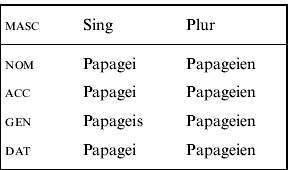
Since the plural form is fully case-indeterminate, the case specification for Papageien is as given in (34); this can be read as requiring that within the case structure, the value for nom, acc, dat, or gen must be+.Footnote 7 In other words, Papageien is a cased form: it must express some case or other, but there are no restrictions on which case it expresses. This permits the form to occur in contexts compatible with a positive specification of one or more of the cases, and does not impose any negative case specifications that would rule out case possibilities for the form.
(34) Papageien; case{nom|acc|dat|gen}=+
Combining Papageien with a verb requiring an accusative object in an example like (7a), repeated as (35a), results in a case specification like (35b) for the object, the result of combining the information from the verb and that from the noun in the same feature structure. In example (7b), repeated as (36a), the verb takes a dative object, and this results in the case specification in (36b).Footnote 8
- (35)
(a) Er findet Papageien. (German) he finds parrots obj=accnom/acc/gen/dat ‘He finds parrots.’
(b)
- (36)
(a) Er hilft Papageien. he helps parrotsobj=datnom/acc/gen/dat ‘He helps parrots.’
(b)
For sentences like (8) (repeated in (37a)), with coordinated accusative and dative verbs, no clash results from simultaneously specifying positive values for both acc and dat on an indeterminate noun like Papageien. The specification for the verbs in (37a) is shown in (37b).
- (37)
(a) Er findet und hilft Papageien. (German) he finds and helps parrots obj=accobj=datnom/acc/gen/dat ‘He finds and helps parrots.’
(b) findet: objcaseacc=+
hilft: objcasedat=+
The relevant portion of the analysis of (37a) is given in (38). Coordinate structures in LFG are treated as sets (Kaplan & Maxwell Reference Kaplan and Maxwell1988); here, the coordinated verbs findet and hilft give rise to a coordinate structure in which the functional structure of the object Papageien is shared between the two verbs. This is indicated by the line connecting the obj of the verb findet ‘finds’ to the obj of hilft ‘helps’. Since Papageien is the object of both verbs, it must satisfy the requirements imposed by both; this is possible because it allows both acc and dat to be positively specified.
(38)
The case selection specifications introduced by the verbs are (both) imposed directly on the (shared) object within the coordinate structure. The treatment of indeterminacy involves simply and solely the use of the underspecified case structure.
A partially indeterminate form such as Arme ‘arms.nom/acc/gen’ or Männer ‘men.nom/acc/gen’ is specified as in (39). The positive specification for nom, acc, or gen permits the form to appear as an argument of a predicate that requires nominative, accusative, or genitive case, while the negative specification for dat precludes its occurrence with verbs requiring dat case or with dat modifiers. We discuss modification and case requirements in the next section.
(39) Männer: casedat=−
case {nom|acc|gen}=+
The approach also deals unproblematically with cases of NP coordination in which one conjunct is indeterminate, as in (40). The dat+ case specification associated with the verb is satisfied (independently) by each conjunct; no clash results in either conjunct.
(40) Er hilft Kindern und Frauen. (German) he helps children and womenobj=datdatnom/acc/dat/gen ‘He helps children and women.’
Importantly, no special provision is needed for coordination. In the analysis of German free relatives, the indeterminate relative pronoun was can simultaneously fill nominative and accusative case requirements, as shown in (13), repeated here as (41):
(41) Ich habe gegessen was übrig war. (German) I have eaten what left was obj=accnom/accsubj=nom ‘I ate what was left.’
The case specifications for was are given in (42):
(42) was: casedat=−
casegen=−
case {nom|acc}=+
These specifications are compatible with positive requirements for either nom or acc (though not with dat or gen specifications), and so this form can appear as the subject of a verb that requires nominative case and a the object of a verb that requires accusative case. As above, the result is that both acc and nom are positively specified.
(43) übrig: subj case nom=+
gegessen: obj case acc=+
In sum, by representing the value of the morphosyntactic case feature as a feature structure, and using underspecification, our analysis ensures that positive specifications can be successfully imposed on indeterminate arguments by different predicates, whether in a coordinate structure, a relative clause construction, or any other construction where an argument must satisfy the case requirements of more than one predicate.
2.2 Transitivity
We have seen that modifiers behave differently from predicates in that they reduce or remove the indeterminacy of the nouns they modify. Intuitively, this is because modifiers also realize features of the head. This is straightforwardly and naturally captured in our analysis: modifiers specify negative requirements for case features with which they are not compatible, and in so doing may restrict the case options of the noun that they modify. An unambiguously dative adjectival modifier like German alten ‘old’ is specified as follows, where (adj ∊) refers to the structure of the noun being modified (we use the set membership symbol here because each modifier is a member of the set of modifiers at f-structure).Footnote 9
(44) alten: (adj∊) casenom=−
(adj∊) caseacc=−
(adj∊) casegen=−
The presence of a modifier can render indeterminate nouns fully (or partially) determinate. Though the indeterminate noun Papageien can appear where accusative and dative requirements are simultaneously imposed, it cannot be modified by an unambiguously accusative or dative modifier in such a situation, since such modifiers restrict the case possibilities of the noun in a way which is incompatible with the requirements of the predicates. An unambiguously dative modifier like alten ‘old’ imposes a negative specification for acc, clashing with the positive specification for acc of the accusative-taking verb findet in (45):
- (45)
(a) * Er findet und hilft alten Papageien. (German) he finds and helps old parrotsobj=accobj=datdatnom/acc/dat/gen ‘He finds and helps old parrots.’
(b)
And a modifier that is indeterminately nominative/accusative but not dative, such as alte ‘old’, imposes a negative specification for dat; this specification is incompatible with the requirements of hilft:
- (46)
(a) * Er findet und hilft alte Papageien. he finds and helps old parrotsobj=accobj=datnom/accnom/acc/dat/gen ‘He finds and helps old parrots.’
(b) alte: (adj∊) case gen=−
(adj∊) casedat=−
(c)
In contrast, modification by a suitably indeterminate modifier is acceptable, since no incompatible specifications are imposed. The indeclinable adjective rosa ‘pink’ is fully indeterminate, and imposes no additional case restrictions:
(47) rosa: [no case restrictions]
The noun Papageien can be modified by rosa and still satisfy simultaneous accusative and dative requirements, since its case realisation possibilities are not restricted by the modifier.
- (48)
(a) Er findet und hilft rosa Papageien. he finds and helps pink parrotsobj=accobj=datnom/acc/dat/gen ‘He finds and helps pink parrots.’
(b)
Modifiers that are incompatible with the case expression possibilities of the noun are also disallowed. The lexical entry given in (39) for the noun Männer ‘men’, repeated in (48), requires dat to have a negative value:
(49) Männer: casedat=−
case {nom|acc|gen}=+
This prevents Männer from combining with an unambiguously dative modifier, such as the plural adjective alten ‘old’, whose lexical entry was given in (44). This is because a clash in the value for dat would result; Männer is negatively specified for dat, while alten requires a positive specification for dat.
However, Männer can combine with the genitive plural alter, whose case specification is given in (50a), resulting in the unambiguously genitive structure shown in (50b).
- (50)
(a) alter: casenom=−
caseacc=−
casedat=−
(b)
2.3 Indeterminate predicates and second-order indeterminacy
We now turn to the treatment of indeterminate requirements imposed by predicates, exemplified above with data from Polish and Russian. We assume six core cases for Russian (nominative, accusative, genitive, dative, instrumental, and prepositional).Footnote 10 In (51), repeated from (24), the noun podrogu ‘girlfriend’ is accusative, while the noun zvonka ‘call’ is genitive:
(51) Včera ves' den' on proždal svoju podrugu Irinu i zvonka ot svoego brata Grigorija. (Russian)yesterday all day he waited-for self's girlfriend Irina and call from self's brother Gregoryobj=acc/genaccgen ‘Yesterday he waited all day for his girlfriend Irina and for a call from his brother Gregory.’
- (52)
(a) podrugu: case nom=−
caseacc=+
casegen=−
casedat=−
caseinst=−
caseprep=−
(b) zvonka: case nom=−
caseacc=−
casegen=+
casedat=−
caseinst=−
caseprep=−
The Russian verb proždat' ‘wait for’ imposes indeterminate case requirements, requiring an object which is either genitive or accusative:
(53) proždat': objcase {acc|gen}=+
Since the object is a coordinate structure, modelled as a set of f-structures, any specification of a feature for the coordinate structure amounts to specifying that feature for each conjunct (member of the set of f-structures).Footnote 11 In particular, any determinate or indeterminate case requirement placed on the coordinate structure as a whole is required to hold of each conjunct. In this example, each conjunct must satisfy the (indeterminate) requirement that its case be either gen or acc. This indeterminate case specification permits the verb to occur with a gen complement, an acc complement, or a coordination with mixed case, as in (51), whose structure is shown in (54).
(54)
Crucially, the indeterminate requirements imposed by the verb can be resolved differently in each conjunct, as is standard with functional uncertainty expressions and coordination (Kaplan & Maxwell Reference Kaplan and Maxwell1988, Dalrymple Reference Dalrymple and Kaplan2001: chapter 14). This allows the verb to govern coordinated objects with different case features, as long as each conjunct is compatible with a positive specification for either acc or gen. Again, nothing special needs to be added in order to ensure that conjuncts of a coordinated argument may independently satisfy the indeterminate case requirements associated with the verbal predicate, since this falls out from the standard treatment of coordination in LFG.
Levy (Reference Levy2001) has observed that independent resolution of indeterminate case requirements is found quite generally in languages with case alternation for the governed argument, as our analysis predicts. However, if a language is, unusually, subject to an additional case-matching requirement in this circumstance, this can be treated as an additional fact about nominal coordination which may be simply expressed in the relevant coordination rule by requiring all of the conjuncts to express the same case.
Within each conjunct, of course, values must be consistent (in line with transitivity), as is evident in the Polish example (25), repeated as (55), where the modifier of świnię ‘pig’ is required to bear accusative case. This follows from our treatment of case features of modifiers: case specifications for the adjective całą ‘whole’ must be compatible with the specifications of the accusative noun it modifies, świnię.
(55) Dajcie wina i całą świnię! (Polish)give wine and whole piggenaccacc ‘Serve some wine and a whole pig!’
Finally, it follows from our analysis that the nouns themselves may be indeterminate and at the same time subject to an indeterminate case selection by the verbal predicate: all that is required is that each noun is consistent with one of the values specified by the indeterminate predicate.
In sum, our approach to feature indeterminacy assumes that case is a possibly underspecified structured value, with different cases distinguished by different attributes. This permits a clean and intuitive approach to case indeterminacy: indeterminate elements simply express fewer constraints over the case feature, and predicates and modifiers interact to provide further specification of case, often narrowing down the indeterminacy. It follows that such constraints must be compatible, solving the transitivity problem. Indeterminate behaviour (e.g. in free relatives and under coordination) follows with no further stipulations. Indeterminate predicates are associated with a (limited) functional uncertainty in the statement of their case requirements, accounting for the second-order indeterminacy problem and capturing the case alternation facts under coordination.
3. Previous proposals
The combination of feature indeterminacy with a range of syntactic constructions in which an indeterminate element can be subject to conflicting requirements poses a particular challenge to constraint-based syntactic formalisms, and has generated a range of proposals for changes or extensions to the basic information-combining machinery of such formalisms, or the introduction of additional representational devices. In the following, we situate our own proposal within the array of responses that the phenomenon of indeterminacy has provoked. We discuss several alternative formal proposals for the treatment of indeterminacy, highlighting problems of coverage where these occur, and drawing attention to the additional machinery adduced in the solution of the indeterminacy problem. We concentrate attention on these particular proposals because they are representative of the range of proposals that have previously been made, and we omit discussion of some other influential proposals for the treatment of feature indeterminacy, e.g. Johnson & Bayer (Reference Johnson, Bayer, Morrill and Oehrle1995) and Bayer (Reference Bayer1996), which have been shown to be untenable or otherwise unattractive in other work (Bayer Reference Bayer1996, Dalrymple & Kaplan Reference Dalrymple and Kaplan2000, Sag Reference Sag2003), or which are not substantially different from the proposals we discuss in this section.
Section 3.1 discusses the proposal of Dalrymple & Kaplan (Reference Dalrymple and Kaplan2000) ; though this proposal is simple and formally appealing, it does not provide an adequate treatment of either the transitivity problem or the second-order indeterminacy problem. Section 3.2 discusses two proposals by Ingria (Reference Ingria1990), the first of which does not adequately address the transitivity problem. The other proposal is very similar (though not identical) to our approach; Ingria dismisses this proposal on the basis of objections which we believe are ill-founded. Section 3.3 discusses several approaches within Head-driven Phrase Structure Grammar (HPSG), showing that they are either unwieldy or move HPSG substantially closer to LFG in its modelling assumptions.
Other authors have also proposed to treat the value of the case feature as a feature structure. Neidle (Reference Neidle and 1982) proposes a feature structure representation of the Russian case system, based on work by Jakobson (Reference Jakobson1958), which encodes commonalities across the various case forms in a compact way, though she does not apply the representation to an account of indeterminacy. Blevins (to appear) uses a structured approach to case based on notions of markedness in his discussion of the treatment of indeterminacy, encoding six cases by means of boolean values of three features, again based on Jakobson (Reference Jakobson1958).Footnote 12 Our proposal differs from Blevins's and Neidle's proposal for case decomposition in that we posit a separate feature for each case possibility in the language, though it may well be that a more compact and illuminating representation can be given while preserving the insights of our approach. As pointed out by an anonymous reviewer, it has proven difficult to define general principles of structural organisation in feature decompositions of the Jakobsonian kind; the Russian syncretisms that motivated the original Jakobson proposal have been shown by Baerman et al. (Reference Baerman, Brown and Corbett2005: chapter 3) to have ‘limited application beyond Russian’. We leave for future work the issue of the extent to which a more compact and linguistically well-motivated representation of case can be given, perhaps using notions of markedness.
3.1 Dalrymple & Kaplan Reference Dalrymple and Kaplan2000
Dalrymple & Kaplan (Reference Dalrymple and Kaplan2000) use sets (rather than atoms) as values for indeterminate features such as case, and they propose that the value of the case feature of a noun is the set of all cases with which it is compatible. Predicates check for case compatibility by checking whether the case they require is a member of the case set of the argument. The treatment is similar in spirit to the present proposal: members of the case set in Dalrymple & Kaplan's proposal correspond to the positively specified case attributes in our theory, and elements that do not appear in a case set are the negatively specified attributes. However, that proposal does not allow modifiers to contribute additional constraints to reduce or remove indeterminacy in nouns, and thus it does not provide a solution to the transitivity problem.
On the Dalrymple & Kaplan approach, the indeterminately accusative/dative noun Papageien has the case value {acc, dat} (again, assuming for simplicity that the indeterminacy here is limited to these two cases). The verb findet requires acc to be a member of the case set of its object, and hilft requires dat; in example (8), repeated in (56), both of these requirements are satisfied.
(56) Er findet und hilft Papageien.he finds and helps parrotsacc∊obj casedat∊obj case {acc, dat}‘He finds and helps parrots.’
In contrast, example (57) is unacceptable; the unambiguously dative form wem has the case specification {dat}. This set does not contain acc as a member, and does not satisfy the case requirements imposed by the verb nehme.
(57) * Ich nehme, wem du vertraust. I take who you trustacc∊obj case {dat} dat∊obj case ‘I take who(ever) you trust.’
This treatment works well for simple cases of indeterminacy, but it does not provide an account of the transitivity problem, nor does it provide a straightforward solution to the second-order indeterminacy problem, as we now show.Footnote 13
3.1.1 Transitivity
The inability of the Dalrymple & Kaplan approach to account for transitivity of agreement requirements is the most serious problem for their analysis. They explicitly acknowledge that their account does not extend to examples exhibiting transitivity requirements (Dalrymple & Kaplan Reference Dalrymple and Kaplan2000: 777f.), and they do not consider how the simple examples we examined above could be treated within their approach. Example (18), repeated in (58), illustrates the problem. Example (58a) is correctly predicted to be grammatical, since the case requirements of both the adjective and the verb are satisfied by the case set of the indeterminate noun mat'. However, example (58b) is also incorrectly predicted to be grammatical, since here too all requirements are satisfied.
- (58)
(a) Staraja mat' ljubit syna. (Russian) old mother loves sonnom∊case {nom,acc} nom∊subj case ‘The old mother loves (her) son.’
(b) * Staruju mat' ljubit syna. old mother loves sonacc∊case {nom,acc} nom∊subj case
The problem is that requirements imposed by the modifier do not narrow down the possibilities for case expression of the noun (the modifier cannot remove members from the case set), and so there is no way to rule out unacceptable examples such as (58b). In contrast, our approach allows underspecification of the case properties of the noun and further instantiation of these properties by the modifier, which allows for a treatment of the transitivity problem.
3.1.2 Second-order indeterminacy
Dalrymple & Kaplan discuss examples of indeterminate predicates as well as indeterminate verbs, but do not discuss cases in which a predicate places indeterminate requirements on a feature that is itself indeterminate, as found in Russian and Polish ((24) and (25) respectively). Given that nouns in these languages can be indeterminately specified for case, Dalrymple & Kaplan must analyze the case feature as set-valued. There is no easy way on their approach to express indeterminate requirements on indeterminate features. One way to do this within the spirit of the set-based account would be to allow the verb to specify the set of the possible cases of its object. The requirement would then be that the set of cases which the object can express would have to overlap with the set of cases required by the predicate; formally, this would require a non-null intersection between the predicate's case set and the object's case set. Though it is not possible to impose this requirement within the standard formal assumptions of LFG, other feature-based theories might be enriched or modified to impose such a requirement. Nevertheless, the fact that additional formal devices must be brought to bear to solve the second-order indeterminacy problem is another strike against their analysis.
3.2 Ingria Reference Ingria1990
Ingria (Reference Ingria1990) claims that the standard formal assumptions of feature-based theories like LFG are inadequate to deal with indeterminacy and the patterns we have examined so far, and proposes to enrich them with a new way of handling disjunctive feature values – that is, this approach introduces an additional mechanism for checking feature compatibility. On his approach, the value specified by a noun for an indeterminate feature like case may be a disjunction. Disjunctive feature values are checked not with equality but by means of a nondistinctness check, which is represented as≈rather than =. On Ingria's analysis, the value of the case feature for an indeterminately nominative and accusative noun like German Papageien ‘parrots’ is (at least) a disjunction acc∨dat over the two possible values acc and dat. Predicates check to see if their case requirements are compatible with (or, in Ingria's terms, nondistinct from) the case values of their arguments, but do not replace or instantiate the disjunction with a specific value:
(59) Er findet und hilft Papageien. he finds and helps parrotsobj case≈accobj case≈datacc∨dat ‘He finds and helps parrots.’
In example (59), the requirements imposed by each verb are met, since the value acc∨dat is nondistinct from both acc and dat. In contrast, example (60) is unacceptable: the unambiguously dative form wem has case dat, and this value is distinct from the case requirements imposed by the verb nehme.
(60) * Ich nehme, wem du vertraust. I take who you trustobj case≈accdatobj case≈dat ‘I take who(ever) you trust.’
This treatment is somewhat heavy-handed in that it introduces a new formal mechanism to deal with indeterminacy, but it works well for determinate nouns and for simple cases of indeterminacy. However, it faces problems in dealing with more complex cases, as we now show.
3.2.1 Transitivity
As noted by Blevins (to appear), the Ingria analysis is designed to circumvent the undesirable effects of transitivity of equality imposed by standard analyses of feature agreement using equality: his analysis does not produce a feature clash between acc and dat in examples like (27), and so correctly predicts that (27) is acceptable. However, as shown above, transitivity is in fact desirable in some cases. The requirements imposed by a modifier must be compatible with the requirements of other modifiers and with the requirements of the predicate. Ingria's analysis fails to capture this, since his analysis imposes a nondistinctness check by the adjectival modifier which does not constrain or narrow the possibilities for case expression of the noun; modifier requirements and verbal requirements are checked independently, and neither can affect the other. The case requirements in (61a) are correctly met, but Ingria's analysis incorrectly predicts that in (18), repeated as (61), the case requirements in (61b) are met as well, and therefore that (61b) is as acceptable as (61a):
- (61)
(a) Staraja mat' ljubit syna. (Russian) old mother loves soncase≈nomnom∨accsubj case≈nom ‘The old mother loves (her) son.’
(b) * Staruju mat' ljubit syna. old mother loves soncase≈accnom∨accsubj case≈nom
3.2.2 Feature structures and the analysis of Hungarian
Ingria (Reference Ingria1990) discusses an alternative analysis of German case, citing a personal communication from Andy Haas, which is very close to our proposal: the value of the case feature is a feature structure whose attributes are the case possibilities nom, acc, and so forth, and forms are positively specified for the cases they express. One important difference that distinguishes the Haas/Ingria proposal from ours is that indeterminate forms are not underspecified, but are given a positive specification for all the case possibilities with which they are compatible. For example, according to the Haas/Ingria analysis, the indeterminately accusative/dative noun Papageien is specified with both acc+ and dat+ (assuming for simplicity that the indeterminacy is just between these two values). If indeterminate nouns are fully specified with positive or negative values for all of their case possibilities, it is not possible for modifiers to narrow down the case expression possibilities of the nouns they modify. However, we have seen in the previous section that underspecification is desirable; although the unmodified noun mat' ‘mother’ is indeterminately nominative and accusative, the modified phrase staruju mat' ‘old.acc mother’ is fully specified as accusative, and can be used only in accusative environments. Thus, an analysis like ours, involving underspecification, fares better in dealing with the transitivity problem than the Haas/Ingria proposal.
In fact Ingria dismisses this alternative Haas/Ingria analysis on the basis of patterns of definiteness agreement in Hungarian, to which we now turn; all Hungarian data cited below are from Ingria (Reference Ingria1990). Hungarian verbs are marked as definite or indefinite, depending on the definiteness of their objects:
- (62)
(a) Akart egy könyvet. (Hungarian) he.wanted a bookindefindef ‘He wanted a book.’
(b) *Akarta egy könyvet.he.wanted a bookdefindef ‘He wanted a book.’
(c) Akarta a könyvet. he.wanted the bookdefdef ‘He wanted the book.’
Sentential complements behave as definite objects:
(63) János akarta, hogy elhozzak egy könyvet. (Hungarian)John wanted that I.bring a bookdefdef ‘John wanted me to bring a book.’
The verb must also agree in definiteness with a topicalized or displaced constituent (for example, a relative pronoun), which may be an argument of a subordinate clause. Because verbs must appear in the definite form when they have a sentential complement, any constituent which is displaced from a sentential complement must itself be definite in order to meet the definiteness agreement requirements of the verb:
- (64)
(a) Ez az a könyv amelyiket akarta hogy elhozzam.this that the book which he.wanted that I.bring defdefdefdefdef ‘This is the book which he wanted me to bring.’
(b) * Egy könyv amit akarta hogy elhozzak. a book which he wanted that I.bringindefindefdefdefindef ‘a book which he wanted me to bring’ (Hungarian)
Crucial for Ingria's argument is the existence of verb forms that allow either definite or indefinite constituents to be displaced from sentential complements:
(65) Egy könyv akartam, hogy elhozzon. (Hungarian)a book I.wanted that he.bringindefindef/defdefdef ‘It was a book that I wanted him to bring.’
Ingria's analysis of these verbs is that they are indeterminately indefinite and definite, and can thus license a definite sentential complement and an indefinite topicalized constituent at the same time. We find this analysis reasonable.
Since the Haas/Ingria analysis involves positive specification of all of the values that an indeterminate form can express, their analysis of Hungarian necessitates the following claims:
(66) Hungarian, Haas/Ingria analysis
(a) Indeterminately definite/indefinite verbs must be positively specified for both definiteness and indefiniteness:
(b) Definite and indefinite relative pronouns must be partially unspecified:
• Definite relative pronoun amlyiket: [def +]
• Indefinite relative pronoun amit: [indef +]

These two claims together entail that when a definite or indefinite pronoun appears with an indeterminate verb, it ‘becomes’ indeterminate for definiteness, which is the wrong result: definite pronouns are unambiguously definite even when they appear with indeterminate verbs, and similarly for indefinite pronouns.
However, there is a further alternative analysis of the Hungarian facts which does not suffer from these problems: the pronouns can be analysed as unambiguously definite or indefinite, not as underspecified, and the indeterminate verbs can be treated as completely unspecified for definiteness. If the verb places no constraints on topicalized argument, either a definite or an indefinite pronoun is correctly allowed.
(67) Hungarian, our alternative analysis
(a) Indeterminately definite/indefinite verbs are unspecified for definiteness and indefiniteness.
(b) Definite and indefinite relative pronouns are fully specified:
• Definite relative pronoun amlyiket:
• Indefinite relative pronoun amit:


These assumptions account adequately for all of the data that Ingria presents. Thus, the Ingria objections to a feature structure-based account of indeterminacy are not fatal for the type of approach we pursue here. Furthermore, Ingria's approach is undesirable in two respects: it complicates the standard assumptions of feature-based theories by adding a new formal operation, a nondistinctness check, to handle indeterminacy; and, even in doing so, it fails to provide an account of the transitivity problem.
3.3 HPSG accounts
The problem of indeterminacy and neutralisation has received a good deal of attention within HPSG, because it poses a particular challenge to the modelling assumptions that feature structures are (i) totally well-typed (that is, are specified for all features that are appropriate for that type of feature structure) and (ii) sort-resolved (that is, assigned a maximal type (one which has no subtypes)). Two types of approach can be distinguished. One strand of work, represented by Daniels (Reference Daniels, Eynde, Hellan and Beermann2001), Levy (Reference Levy2001) and Levy & Pollard (Reference Levy, Pollard, Eynde, Hellan and Beermann2001), maintains the standard modelling assumptions of HPSG, requiring feature structures to be totally well-typed and sort-resolved. Levy (Reference Levy2001) in particular is notable for addressing in some considerable detail the issues and problems raised here, and most especially the problem of indeterminate requirements placed by predicates over indeterminate features (the second-order indeterminacy problem). The other strand, represented by Sag (Reference Sag2003), adopts an approach which allows underspecification, and thus entails giving up these standard assumptions. The guiding intuition behind all of these HPSG analyses of indeterminacy is that of Johnson & Bayer (Reference Johnson, Bayer, Morrill and Oehrle1995) and Bayer (Reference Bayer1996), introducing conjunctive and disjunctive types in the modelling of feature indeterminacy (syncretism) and feature neutralisation (e.g. in the coordination of unlikes).
3.3.1 Levy/Pollard
We take Levy (Reference Levy2001) and Levy & Pollard (Reference Levy, Pollard, Eynde, Hellan and Beermann2001) as representative of the first approach, and follow the presentation of the more accessible Levy paper; Levy & Pollard (Reference Levy, Pollard, Eynde, Hellan and Beermann2001) state that the approach of Daniels is ‘essentially equivalent’ to their own proposal. This analysis maintains the standard HPSG requirement of sort-resolution, meaning that the value of every attribute must be a maximal (leaf) type. In other words, all structures, including indeterminate forms and coordinate structures, must have fully specified case values. This is at odds with the intuition embodied by our analysis: that information can be partial or underspecified. Levy introduces ‘double sets’, in which feature values are modelled as sets of sets, organised into a lattice separate from and additional to the normal type system of HPSG, and uses lattice-theoretic orderings and set-theoretic operations such as intersection to constrain case values.
A noun that is indeterminate between nom and acc case has as its case value the set {{nom},{acc}}. Predicates specify a lower bound for the case of their arguments on this lattice, with the effect that a predicate is satisfied by an argument that has exactly the case it requires, or an indeterminate case that includes the required case as one of its possibilities. For example, a predicate requiring an acc argument can take as its argument an indeterminately nominative/accusative noun with case {{nom},{acc}}. This makes the correct predictions for simple cases of indeterminacy, as well as for noncoordinate constructions such as the German free relative construction illustrated in (13). In such cases, an indeterminate argument is acceptable just so long as it satisfies the case requirements of each predicate.
To solve the transitivity problem, Levy's treatment of modification appeals to intersection: the case value for a modified noun is obtained by intersecting the case of the noun and the case of the modifier. This means that the case of an indeterminate noun can be made more determinate, or completely determinate, by its modifier, and produces the right results for examples like (18)–(19).
The second-order indeterminacy problem is addressed by a special rule for coordinate phrases which computes a case value for the coordinate structure using an operation of double intersection defined on double sets. For example, a coordinate phrase with an acc conjunct and a gen conjunct has as its case value the set {{acc,gen}}.Footnote 14 A coordinate phrase with this specification cannot be the argument of a predicate which requires an acc predicate, since such a predicate is not compatible with the gen specification contributed by the gen conjunct. Only an appropriately indeterminate predicate can take a coordinate structure as its argument if the conjuncts of the coordinate phrase express different cases. The introduction of this special rule for coordinate phrases enables a treatment of coordinated nouns with different cases as arguments of indeterminate predicates, as in example (24).
The Levy/Pollard approach does in fact successfully handle the data presented above, including the transitivity problem and the second-order indeterminacy problem. However, other HPSG researchers have criticised it for being overly complex; Sag (Reference Sag2003: 288) observes that the Levy/Pollard proposal and related proposals ‘have imposed new hierarchies on maximal types or else have introduced considerable complexity into existing type hierarchies’. And indeed, we believe that allowing underspecification, as our approach does, leads to a simpler treatment of indeterminacy, for two reasons. First, indeterminate nouns can be associated with very general descriptions of the case feature which can then be enriched by constraints associated with modifiers and predicates; no new types or type hierarchies are required. Second, the treatment of coordination in LFG together with the standard assumption that case is a distributive feature provides a straightforward treatment of indeterminate predicates that does not require the coordinate structure to bear a special disjunctive type, computed on the basis of the case of the conjuncts; instead, case constraints imposed by a predicate are applied directly to the conjuncts.
3.3.2 Sag
Sag (Reference Sag2003) proposes an account of the indeterminacy and transitivity data which in some respects resembles ours, in that – unlike the Levy/Pollard approach – it appeals to underspecification, though it differs in appealing to type subsumption rather than equality. Starting from the observation that the requirement of sort-resolvedness presents a real difficulty to getting an elegant and uncomplicated treatment of these data in HPSG, Sag proposes to abandon this foundational requirement.Footnote 15
The abandonment of the requirement for sort-resolvedness means that while all the appropriate features for a feature structure must be specified, the values no longer have to be maximal in the type system. Like Levy's analysis, the basic idea is that predicates impose a lower bound on the case value of their arguments, while arguments either fix their type or provide an upper bound on their own case value. This means that an argument can take on a range of case values within a construction, provided that any value that the argument takes is compatible with its own and its predicate's lexical specifications.Footnote 16
When a predicate specifies a lower bound on the case of its argument, it specifies the most general type that the case may have; the specification in the lexical entry for findet, for example, which takes an acc object, is compatible with an acc noun or any indeterminate form which is compatible with acc. In the following hierarchy of types we follow Sag in representing the lower (more general) types higher in the following diagram showing the hierarchy of types. (68) is the type hierachy for the case system of German (Sag Reference Sag2003: 278). The most specific types, at the bottom of the hierarchy, are those that coordinated predicates with different case requirements call for.
(68)
Nouns also use type subsumption: Frauen ‘women’ which can resolve to any case, has no case specification at all, and a fully determinate form such as the dative Kindern ‘children’, specifies that dat is the upper bound on its case: this ensures that it is incompatible with (for example) more specified subtypes acc&dat, dat&gen and so forth, though it is compatible with a more general oblique requirement. Intuitively, verbs place requirements which are compatible downwards in the hierarchy (hence compatible with more informative types) and nouns place requirements which are compatible upwards in the hierarchy (and so compatible with more general requirements).
Like the Levy/Pollard proposal, and unlike our account, Sag's treatment requires a special treatment for coordination. Much of the work of controlling information flow must be explicitly stated in the coordination schema, in order to allow just the right amount of movement up and down the relevant type hierarchy for case.Footnote 17 Sag solves the transitivity problem by requiring identity of case values to be imposed NP-internally. Thus, an example like (69) is ruled out because the case restrictions imposed by the determiner are incompatible with the requirement (imposed by the predicate) for case to be greater than (more specific than) or equal to dat.
(69) Er hilft * die Frauen.he helps the.acc women ‘He helps the women.’
Indeterminate requirements on predicates are treated in a similar way to the Levy/Pollard approach. In example (25), repeated as (70), the indeterminate predicate dajcie sets the more general type acc∨gen as the lower bound for its NP argument. The nouns fix the type of their case as gen and acc respectively:Footnote 18
(70) Dajcie wina i całą świnię!give wine gen and whole.acc pig.acc ‘Serve some wine and a whole pig!’
In sum, the Levy/Pollard and Sag approaches are able to handle the same range of data as our approach, but we believe that the cost to the theory is high: the Levy/Pollard approach proposes additional data structures and relations that have been criticised by other HPSG researchers as too complex, while Sag proposes to abandon a fundamental tenet of the theory and move to a formal setting closer to the one that we have advocated here, allowing underspecification to handle indeterminacy. Both approaches require a special rule for coordinate structures, while our approach works within the independently-motivated treatment of coordination that is standard within LFG. We believe that the simplicity of our approach and the fact that we need no special structures or stipulations to handle particular constructions in the grammar is a strong argument in its favour.
4. Conclusion and further issues
We have outlined a new approach to syntactic indeterminacy which views the value of an indeterminate feature such as case as a complex and possibly underspecified feature structure. Our approach correctly allows for incremental and monotonic refinement of case requirements in particular contexts. It uses only atomic boolean-valued features (in contrast to the set values of Dalrymple & Kaplan Reference Dalrymple and Kaplan2000), and requires no special mechanisms or additional assumptions in the treatment of coordination or other phenomena to handle indeterminacy (in contrast to the treatment of Ingria Reference Ingria1990).
In outlining the proposal here we have used a representation containing a feature for each case, but it may well be that this level of verbosity is unnecessary. We leave to future work the question of whether a more compact representation of case, perhaps based on some notion of markedness, might not be possible without loss of empirical coverage.


