Introduction
Sudden sensorineural hearing loss (SNHL) is a frustrating and frightening condition, especially when the hearing loss is bilateral. It is defined as the hearing loss of more than 30 dB in three consecutive frequencies developing in less than 3 days.Reference Wilson, Byl and Laird1 Multiple causes have been proposed for sudden SNHL, such as viral infection, vascular compromise, autoimmune causes and membrane rupture. As the aetiology of most cases of sudden SNHL is unknown, the majority of sudden SNHL cases are considered idiopathic.Reference Chau, Lin, Atashband, Irvine and Westerberg2
One of the possible causes of sudden SNHL is septic emboli.Reference Schuknecht and Donovan3 Regarding pathophysiology, hearing loss caused by septic emboli could be attributed either to cochlear artery occlusion or infection at the site of embolisation.
Infective endocarditis is a deadly disease,Reference Habib, Lancellotti, Antunes, Bongiorni, Casalta and Del Zotti4 with high mortality, despite improvement in its management. Infective endocarditis is defined as an infection of the endocardial surface of the heart, which may include one or more heart valves or the mural endocardium. Diagnosis of infective endocarditis is difficult as it is rare and symptoms may vary. It can present either as a rapidly progressive infection, or a subacute, chronic disease, with low-grade fever and non-specific symptoms.Reference Habib, Lancellotti, Antunes, Bongiorni, Casalta and Del Zotti4 Many patients may initially experience a general malaise,Reference Connaughton and Rivett5 and fever may not be present in elderly or immunocompromised patients.Reference Perez de Isla, Zamorano, Lennie, Vazquez, Ribera and Macaya6 The incidence of infective endocarditis varies from 4 to 15 per 100 000 population.Reference Pant, Patel, Deshmukh, Golwala, Patel and Badheka7
We present two cases of bilateral, sequential, total sudden SNHL, in which the patients were later diagnosed with infective endocarditis. The cause of sudden SNHL in these cases was septic emboli.
Case reports
Case one
A 52-year-old woman was admitted to our clinic for bilateral sudden SNHL accompanied by tinnitus and vertigo. She had first presented with sudden SNHL of the right ear and one week later developed sudden SNHL of the left ear. The hearing loss was profound in both ears.
The patient reported having fever one week prior to the hearing loss of the right ear, with a temperature of 38–38.5 °C recorded two to three times daily, which had been attributed to a viral infection. Otoscopy findings were normal. Eye movement examination revealed horizontal nystagmus to the right. An audiogram showed deafness in all frequencies (Figure 1). The tympanogram was normal. Laboratory tests showed a raised white blood cell count of 12 300. The C-reactive protein level was 7.4 mg/dl. Cerebrospinal fluid results were normal. Auditory brainstem responses and reflexes were absent.
Audiogram of 52-year-old woman, showing total deafness in all frequencies, in the right (a) and left (b) ears.

She received treatment with intravenous (IV) prednisolone 1 mg/kg daily for 4 days, followed by oral tapering for 9 days, and acyclovir. There was no improvement of hearing. The fever subsided with treatment. However, the fever recurred one month later, with temperatures reaching 38.6 °C.
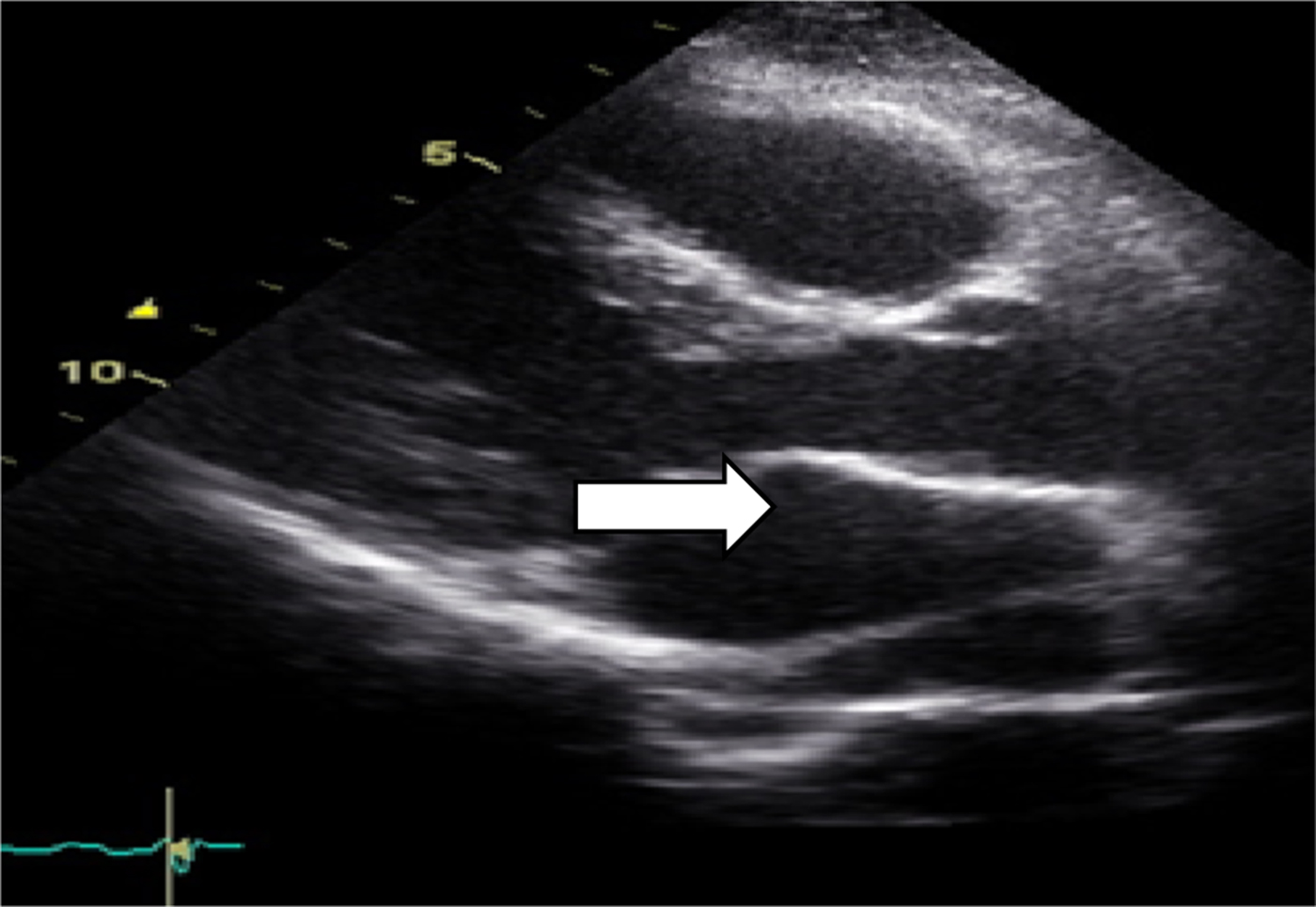
As the fever persisted, the patient was re-examined and a heart murmur was noted. She subsequently underwent an echocardiogram, which revealed vegetations of the mitral valve (Figure 2). Blood culture for Gram-positive cocci was positive and a diagnosis of infective endocarditis was established. The patient was treated with proper antibiotics for one month before undergoing surgery for a mitral valve replacement.
Transthoracic echocardiography parasternal long axis view in systole. Typical-appearing mitral valve vegetations (arrow) attached to the atrial side of the anterior and posterior mitral valve leaflets.

Case two
A 64-year-old man was admitted for sudden SNHL of the left ear (Figure 3). Past medical history included diabetes mellitus, chronic mild renal failure and heart failure. He had undergone coronary artery bypass grafting and mitral valve replacement five years earlier, followed by the implantation of a cardioverter defibrillator two years later.
Audiogram of 64-year-old man, showing high frequency sensorineural hearing loss (SNHL) of the right ear (a) and profound SNHL of the left ear (b).

He was treated with four intratympanic dexamethasone injections, IV prednisolone 1 mg/kg for 4 days, followed by tapering with oral steroids, and acyclovir, with no improvement.
Three months later, the patient presented with profound sudden SNHL of the right ear as well. His audiogram was similar to that in case one (Figure 1). He received the same treatment as in case one, with no improvement.
Four months later, the patient was re-admitted with fever (39.9 °C), deterioration of renal function and stroke. A computed tomography scan of the brain showed infarction of white matter on the left side. Blood culture for Gram-positive cocci was positive. Cerebrospinal fluid examination findings were normal. Transoesophageal echocardiography revealed vegetations of the prosthetic mitral valve, establishing the diagnosis of infective endocarditis (Figure 4). He was treated with proper IV antibiotics, but subsequently died as a result of sepsis and acute heart failure.
Transoesophageal echocardiography, four-chamber view, zoomed image, showing bi-leaflet mechanical prosthesis in mitral position. A large (24 mm) mobile vegetation is clearly seen originating from the prosthesis ring and prolapsing into the left atrium, attached to the atrial side of the valve occluders.

Discussion
Septic emboli are considered to be a cause of sudden SNHL.Reference Scasso, Bruschini, Berrettini and Bruschini8 Several reports in the literature mention hearing loss as a result of infective endocarditis. In a case report by Lau et al., a patient with staphylococcus endocarditis presented with bilateral and profound sudden SNHL.Reference Lau, Ceranic, Harris and Timehin9 Mikaberidz et al. reported a case of hearing loss caused by Pasteurella multocida infective endocarditis, and attributed hearing loss to undiagnosed meningitis.Reference Mikaberidz, Li and Taub10 In addition, Ahmed et al. presented a case of unilateral hearing loss caused by septic emboli in a case of biventricular mural vegetations.Reference Ahmed, Katz, Crooke, Li, Doddamani and Haramati11
Our case reports suggest that sudden SNHL may be a first symptom of infective endocarditis, as the latter can remain undiagnosed for a long period of time. In case one, the only symptom was fever; the time interval between sudden SNHL and infective endocarditis diagnosis was two months. In case two, the predisposing factor was a prosthetic valve; the time interval between sudden SNHL of the first ear and infective endocarditis diagnosis was seven months. Patients with a prosthetic valve (such as patient two) have a higher risk of infective endocarditis; in addition, they develop disease complications more often and have a higher mortality risk than patients with a native valve.Reference Lalani, Chu, Park, Cecchi, Corey and Durante-Mangoni12
Our two case reports highlighted two features that are not common among sudden SNHL patients: hearing loss was bilateral-sequential and profound in both cases. Bilateral sudden SNHL is rare. Nearly all cases are unilateral; less than 2 per cent of sudden SNHL patients have bilateral involvement.Reference Kuhn, Heman-Ackah, Shaikh and Roehm13 Furthermore, hearing loss is profound in the minority of sudden SNHL cases, and even in those cases hearing loss is not total. Therefore, these characteristics should enable differentiation from sudden SNHL with idiopathic causes and prompt appropriate investigations.
• There have been sporadic reports of sudden sensorineural hearing loss (SNHL) caused by septic emboli, due to infective endocarditis
• The pattern of hearing loss in septic emboli cases is not well discussed in the literature
• Our case reports show that hearing loss in such cases is profound, can be bilateral and is not reversible
• Sudden SNHL can be a first symptom of infective endocarditis and long precede its diagnosis, which has not been previously reported
Conclusion
Sequential, bilateral, profound sudden SNHL should prompt the otolaryngologist to further investigate for aetiologies that are not limited to otological causes. Infective endocarditis should be considered as a possible cause, even in cases where there are no obvious predisposing factors, ensuring prompt diagnosis of a life-threatening condition.