


1. Introduction
Recent descriptions and debates on the status of null subject languages reveal that classic views of the null subject parameter, such as Rizzi's (Reference Rizzi1982), are too simplistic; languages do not split into just two options, allowing or disallowing null subjects. Comparing languages like Italian and English, Rizzi concludes that the licensing of null subjects is a parametric option. Summarizing Rizzi's observations, the following set of properties derives from the language-particular value of the null subject parameter:
- (1)
(a) Licensing of referential null subjects.
(b) Licensing of expletive null subjects.
(c) Pronominal verbal inflection.
(d) Availability of subject-verb inversion.
(e) Lack of that-t effects.
Under the earlier formulations, the properties listed in (1) are expected to cluster together if a language has a positive setting for the null subject parameter. However, crosslinguistic research reveals that the correlations are not so robust. In fact, after surveying around 100 languages, Gilligan (Reference Gilligan1987) concludes that only four of the correlations hold, and all of them are unidirectional:
- (2)
(a) If referential null subjects are allowed, then null expletive subjects are allowed.
(b) If there is subject–verb inversion, there are null expletives.
(c) If there is subject–verb inversion, there are no that-t effects.
(d) If there are no that-t effects, there are null expletives.
Recent studies confirm Gilligan's (Reference Gilligan1987) view that the null subject parameter cannot be viewed simply as a split between languages with and languages without null subjects, in which all the properties in (1) cluster together. Figueiredo Silva (1996), Holmberg (Reference Holmberg2005), Neeleman & Szendrői (Reference Neeleman and Szendrői2007) and Holmberg et al. (Reference Holmberg, Nayudu and Sheehan2009), among others, show that there are several types of null subject languages.Footnote 2 Holmberg et al. (Reference Holmberg, Nayudu and Sheehan2009) propose a split between ‘consistent’ null subject languages and ‘partial’ null subject languages; in partial null subject languages null subjects are allowed in a much more restricted set of environments than in consistent null subject languages. Brazilian Portuguese and Finnish are examples of partial null subject languages. For instance, Brazilian Portuguese allows indefinite null subjects and embedded referential null subjects controlled by a c-commanding antecedent, but disallows referential third person null subjects in root contexts. Holmberg (Reference Holmberg2005, Reference Holmberg2010) explains these differences in terms of the properties of the head of the inflectional domain – T.
Another productive line of inquiry addresses the issue of how different types of null subjects are licensed, particularly in partial null subject languages. Modesto (Reference Modesto, Dubinsky and Davies2007, Reference Modesto and Biberauer2008) and Miyagawa (Reference Miyagawa2011) claim that null subjects can be licensed by a c-commanding operator when the referential properties of the inflectional domain are not available.
In this paper, we discuss null subjects in Capeverdean, a Portuguese-based creole. We argue that this language is a clear case of a partial null subject language, and describe an asymmetry between root and embedded null subjects. To anticipate that discussion, we will show the following:
- (3)
(a) Capeverdean lacks root referential null subjects.
(b) Capeverdean has expletive null subjects.
(c) Capeverdean has embedded null subjects bound by a matrix operator antecedent.
We provide an analysis of embedded null subjects in Capeverdean showing that both the properties of the inflectional head (along the lines of Holmberg Reference Holmberg2005) and the licensing mechanisms for the null subject (along the lines of Modesto Reference Modesto, Dubinsky and Davies2007, Reference Modesto and Biberauer2008) need to be considered.
The paper is structured as follows. Section 2 spells out our assumptions regarding the syntax of null subjects, along the lines of Holmberg's work, namely, that the properties of the inflectional head T are relevant, and sets out the research questions:
(i) Does Capeverdean allow null subjects?
(ii) Is it a partial or a consistent null subject language (in the senses defined in Holmberg et al. Reference Holmberg, Nayudu and Sheehan2009)?
(iii) If it is partial, what is the distribution of the null subjects allowed?
(iv) Furthermore, what is the licensing mechanism for these null subjects?
Section 3 discusses the properties of null subjects in root questions, showing that the language does not allow null referential subjects, but has null expletive subjects; these facts motivate the proposal that Capeverdean is a non-consistent null subject language. Section 4 focuses on embedded null subjects. Section 5 describes the difference between Capeverdean and Brazilian Portuguese in terms of the syntax of subjects and topics; we claim that the Capeverdean embedded null subject is a pro, licensed as a bound variable, as proposed in Modesto (Reference Modesto2000) for Brazilian Portuguese, and not a deleted topic, licensed by a moved topic, as proposed, also for Brazilian Portuguese, in Modesto (Reference Modesto and Biberauer2008). Finally, Section 6 presents the further predictions of our proposal and offers some concluding remarks.
2. Null subjects: Background assumptions
As mentioned in the introduction, the null subject literature of the past two decades recognizes that, whereas certain languages have null subjects across the board (e.g. Italian, Spanish or European Portuguese), others only allow null subjects in certain syntactic environments. One of the earliest findings regarding asymmetries in the availability of null subjects was the difference between expletive and referential null subjects. German, for instance, has expletive null subjects in root contexts, but does not allow referential null subjects (Gilligan Reference Gilligan1987).
Holmberg (Reference Holmberg2005, Reference Holmberg2010) and Holmberg et al. (Reference Holmberg, Nayudu and Sheehan2009) suggest that the split between ‘consistent’ and ‘non-consistent’ null subject languages depends on the properties of T. Following in the spirit of early proposals that null subjects are available when the inflectional head (T) is pronominal (e.g. Rizzi Reference Rizzi1982, Barbosa Reference Barbosa1995, Alexiadou & Anagnostopoulou Reference Alexiadou and Anagnostopoulou1998), Holmberg (Reference Holmberg2005, Reference Holmberg2010) and Holmberg et al. (Reference Holmberg, Nayudu and Sheehan2009) suggest that a definiteness feature in the head of the inflectional domain (T) is relevant for characterizing a language as null subject. In languages like English or Swedish, this feature is absent (see Holmberg & Roberts Reference Holmberg and Roberts2010 for independent evidence). In consistent null subject languages, T bears a D(efiniteness)-feature, which is licensed under agreement with the referential subject or under incorporation of a related pronominal category. On the other hand, in partial or non-consistent null subject languages T is not specified for D(efiniteness) and, consequently, null subjects are restricted to indefinite environments. Since pro does not bear a D-feature in partial null subject languages, it may have a c-commanding antecedent. This is schematized in (4):
(4) Subj T[+Df] – T and Subj enter agree relation
Ø T[+Df] – T assigns interpretation to the subject under agree
Subj T[αDf] – Value of T determined by the subject
Ø T[αDf] – Only indefinite reading is possible
Another relevant factor for determining the syntax of null subjects is how null categories are licensed. As clearly stated in Neeleman & Szendrői (Reference Neeleman and Szendrői2007), not all null forms are licensed in the same way and this derives a wide typology of constructions involving these categories.
Brazilian Portuguese provides a clear example of the relevance of the licensing mechanism, as discussed in Modesto (Reference Modesto2000).
Brazilian Portuguese is undergoing a change with respect to the setting of the null subject parameter (Duarte 1995, among others). In a diachronic study of popular theater plays written in the 19th and 20th centuries, Duarte (Reference Duarte1993a) provides clear evidence that Brazilian Portuguese is losing referential null subjects. She observed an increasing rate of overt referential subjects in the corpora she examined, as shown in (5).
(5) Rate of overt referential subjects in Brazilian Portuguese
1845 – 20% 1882 – 23% 1937 – 46%
1975 – 67% 1992 – 74%
Duarte (Reference Duarte1993b) also observed another piece of evidence indicating the ongoing change in Brazilian Portuguese, which is that the language does not display the typical effects of the Avoid Pronoun Principle (Chomsky Reference Chomsky1981), in that it allows embedded overt subjects co-referential with a matrix subject:
(6) O povo brasileiroi acha que elei tem uma grave doença. the people Brazilian thinks that he has a serious illness ‘Brazilian people think they have a serious illness.’
The intended reading for a sentence like (6) would be ruled out in a consistent null subject language. For instance, in European Portuguese (6) is ungrammatical with the co-referential interpretation for the two subjects.
However, it is not the case that Brazilian Portuguese has lost null referential subjects altogether. Figueiredo Silva (Reference Figueiredo Silva1996), among other authors, notes that referential null subjects can still be found in some specific contexts. One such context is question–answer pairs with 1st or 2nd person verbal morphology, as in (7):
- (7)
A: O que você comprou?
the what you bought
‘What did you buy?’
B: Ø comprei um livro.
bought a book
‘I bought a book.’
Referential null subjects are also found in embedded complement clauses, in spite of the loss of the Avoid Pronoun Principle. As argued in Modesto (Reference Modesto2000), in a sentence like (8) the embedded pronoun is optional:
(8) O Pedro disse que (ele) ganhou na loto.
(Modesto Reference Modesto2000: 44)the Pedro said that he won in.the lotto
‘Pedro said he won the lotto.’
The example in (8) is particularly interesting because the null subject is possible but its interpretation is limited and different from what happens in typical pro-drop languages such as European Portuguese (Modesto Reference Modesto2000):
- (9)
(a) Brazilian Portuguese
O Pedroi disse que Øi/*j ganhou na loto.
the Pedro said that won in.the lotto
‘Pedro said that he won the lotto.’
(b) European Portuguese
O Pedroi disse que Øi/j ganhou na loto.
the Pedro said that won in.the lotto
‘Pedro said that he won the lotto.’
As shown in (9), the embedded null subject is obligatorily co-referential with the matrix subject in Brazilian Portuguese, which is not the case in European Portuguese. Modesto (Reference Modesto2000) contends that in Brazilian Portuguese pro is available but cannot be identified by the inflectional head. According to his proposal, pro in Brazilian Portuguese is instead licensed and identified as a null bound variable (along the lines of Cinque Reference Cinque1988). Crucially, for a variable interpretation to obtain, it must be c-commanded by an antecedent. This proposal explains why the embedded subject cannot have a disjoint reading. Such a reading is only possible when pro is licensed as a pronoun with free reference and not as a bound variable.
Modesto (Reference Modesto and Biberauer2008) further develops this analysis in order to account for some of the properties of embedded null subjects in Brazilian Portuguese. In particular, he aims to explain why they do not behave like PRO in control structures, and also why they do not display features of A-movement, contra Nunes (Reference Nunes2008). Modesto (Reference Modesto and Biberauer2008) proposes that null subjects in Brazilian Portuguese are instances of topic deletion. This analysis explains, among other things, the fact that the relation between a topic subject and a null subject cannot cross islands, and also the existence of intervention effects, when a wh-phrase is moved across a null subject to the left of a preverbal subject.
We will return to Modesto's two analyses below. What is important at this stage is the observation that two factors are relevant in the different null subject constructions, both the properties of the head of the inflectional domain (T) and the licensing mechanisms for null categories. Thus, several possibilities emerge in evaluating a given language:
- (10)
(a) Does the language allow null subjects or not?
(b) If yes, does the language allow null subjects consistently or partially?
(c) If partially, what is the distribution of null subjects?
(d) What is the licensing mechanism for the null subjects allowed?
These are the questions we intend to address for Capeverdean.
3. Null subjects in Capeverdean
The status of Capeverdean with respect to the null subject parameter has been the subject of some controversy in the literature. Baptista (Reference Baptista2002) contends that Capeverdean is a null subject language, whereas Pratas (Reference Pratas2002, Reference Pratas2007) claims that the language is a non-pro-drop language, specifically, a language with obligatory referential lexical subjects.
In part the debate was obscured by the fact that the authors used a uniform set of tests to determine the language's pro-drop status. However, we know that languages may be consistent or non-consistent regarding the null subject. As Gilligan (Reference Gilligan1987) has observed, languages do not behave uniformly with respect to the null subject criteria listed in Rizzi (Reference Rizzi1982). In fact, as shown in Pratas (Reference Pratas2002), Capeverdean displays mixed properties. We describe these properties in the next subsections.
3.1 No root referential null subjects
As shown in (11), root referential null subjects are ruled out in Capeverdean for all persons:
- (11)
(a) *(N) papia txeu.
1sg speak muchFootnote 3
(b) *(Bu) papia txeu.
2sg speak much
(c) *(E) papia txeu.
3sg speak much
Baptista (Reference Baptista2002) proposes that subject clitic pronouns are agreement markers lexicalizing the head position of agreement projections, and not the subject of the root clause. Under this analysis, the sentences in (11) are actually null subject sentences because Spec,TP is empty.
To test these competing hypotheses, we draw on De Cat (Reference De Cat2005). This paper provides several arguments to decide between two competing analyses of French subject clitics: one in which the clitic is an agreement marker (as in Rizzi Reference Rizzi, Jaeggli and Silva-Corvalán1986), and one in which the clitic is an argument (as in De Cat Reference De Cat2005). De Cat's argumentation is the following: if the clitic is the argument, it should only be doubled in contexts in which a pronoun and a DP are independently found to be doubled, as in contexts of contrastive topic or left dislocation, for instance:
(12) Jean, je l'ai vu.
Jean I him.have seen
‘Jean, I saw him.’
If the clitic is an agreement marker, its role in the sentence is to mark agreement and not argumenthood. In that case, it is expected that clitics appear independently of the discourse function of the argument. As De Cat (Reference De Cat2005) notes, this is not the case, since subject clitics only double a DP in topic contexts:
- (13)
A: Qui est arrivé?
who be arrived
‘Who arrived?’
- B:
(a) #Jean, il est arrivé.
Jean 3sgbe arrived
‘Jean, he arrived.’
(b) Jean est arrivé.
Jean be arrived
‘Jean arrived.’
- (14)
A: Qu'est-ce que Jean a fait?
‘What has Jean done?’
B: Jean, il a chanté.
Jean 3sg has sung
‘Jean sang.’
On the basis of this type of data, De Cat (Reference De Cat2005) concludes that subject clitics in French are true arguments and not just argument markers.
Returning to Capeverdean, the language has a full array of pronominal forms. As shown in the table in (15), the language has strong, weak and clitic pronominal forms:
(15) Capeverdean pronominal forms

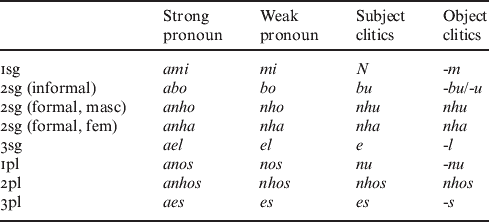
As we can see in the following examples, clitic doubling by a strong pronoun is possible, but limited to certain discourse settings. If the clitic is an argument, it should only be doubled in contexts in which a pronoun and a DP are independently found to be doubled, as in contexts of contrastive topic or left dislocation.
As De Cat finds from French, clitic doubling in Capeverdean is restricted to topic doubling environments:Footnote 4
- (16)
A: Kenha ki txiga?who that arrive
- B:
(a) #Djon, e txiga.
Djon 3sg arrive
(b) Djon./Djon ki txiga.
Djon Djon that arrive
- (17)
A: Kusé ki Djon faze?
what that Djon do
‘What has Djon done?’
B: Djon, e kanta./E kanta.
Djon 3sg sing 3sg sing
‘Djon, he sang.’/‘He sang.’
Given the logic of De Cat's statement that an argument clitic will only be doubled where a pronoun and a DP are independently found to be doubled, as in contrastive topic or left dislocation, we have evidence that the clitic in Capeverdean is the subject of the clause, and that root null subjects are ruled out.Footnote 5
3.2 Expletive null subjects
Unlike languages with obligatory overt subjects, Capeverdean has expletive null subjects, as illustrated in (18):
(18) Sata txobe na Lisboa.
prog rain in Lisbon
‘It's raining in Lisbon.’
The contrast between referential and expletive subjects is highly relevant. A consistent null subject language will allow for both kinds of null subjects. On the other hand, expletive null subjects are found in some languages that do not have referential null subjects (Safir Reference Safir1982, Vikner Reference Vikner1995, Holmberg Reference Holmberg2005), which indicates that the licensing of null expletives is independent of the licensing of referential null subjects. As such, one can set the expletive data aside (see Pratas Reference Pratas2007 for an analysis of null expletives in Capeverdean), and focus on the distribution of null and overt referential pronouns.
3.3 Indefinite null subjects
In contrast to referential null subjects, indefinite subjects in Capeverdean can be null, as illustrated in the following example:
(19) Li pode fumadu.
loc may smoke.pass
‘People may smoke here.’
3.4 Inversion restricted to unaccusative contexts
Another property that is relevant for the current discussion concerns the availability of VS word order. Some languages with referential pro may have a VS word order with all verb classes, under specific discourse conditions (see Rizzi Reference Rizzi1982, and Gilligan Reference Gilligan1987 for a refined version of the correlation). As shown in (20), subject–verb inversion is disallowed in Capeverdean both with transitive and with unergative verbs:
- (20)
(a) *Le Djon livru.
read Djon book
(b) *Le livru Djon
read book Djon
‘Djon read the book’
(c) *Ta trabadja Djon.
tma work Djon
‘Djon works.’
This holds irrespective of the discourse settings and is independent of the definiteness of the subject. As shown in (21), there is no improvement in acceptability when the inversion occurs with indefinite subjects.
- (21)
(a) *Le tres omi livru.
read three man book
‘Three men read the book.’
(b) *Ta trabadja tres omi.
tma work three man
‘Three men work.’
The only verbs allowing subject–verb inversion are the unaccusatives. As shown in the examples in (22), inversion is limited to indefinite subjects:
- (22)
(a) (dja) Txiga tres omi.Footnote 6
tma arrive three man
‘There arrived three men.’
(b) *(dja) Txiga Djon/*(dja) More Djon.
tma arrive Djon tma die Djon
(c) Djon (dja) txiga./Djon (dja) more.
Djon tma arrive Djon tma die
‘Djon arrived.’/‘Djon died.’
Definiteness effects in inversion contexts show up in many languages that do not have consistent referential null subjects (see Pinto Reference Pinto1997, among others). Moreover, given that Capeverdean has null expletives (see (18) above), inversion with unaccusatives may be the counterpart of English presentational sentences like There comes a man, in which the preverbal position is occupied by a null expletive and the argument is necessarily indefinite (assuming Belletti's Reference Belletti1988 analysis for expletive-associate constructions in unaccusative contexts).
3.5 No that-t effects
As mentioned above, one of the properties typically associated with languages that have obligatorily overt referential subjects is that-t effects, whereby extraction is barred from a subject position in the presence of a complementizer. As shown in (23), and argued at length in Nicolis (Reference Nicolis2005), in Capeverdean extraction out of an embedded subject position after an overt complementizer is fully grammatical:
(23) Kenha ki bu ta pensa ma kunpra livru?
who comp 2sgtma think comp buy book
‘Who do you think bought the book?’
This fact would be compatible with the view advocated by Baptista (Reference Baptista2002) that Capeverdean is a null subject language. However, as argued in Gilligan (Reference Gilligan1987), lack of that-t effects is not a sufficient condition for the identification of a language as pro-drop, since it implies only the availability of null expletives. These, as we have seen, are also possible in languages like German, which require overt referential subjects.
In short, we have identified the following properties of null subjects in root contexts in Capeverdean:
- (24)
(a) Null subjects cannot be referential in root contexts.
(b) Null subjects can be expletive in root contexts, in expletive-associate environments and with weather-predicates.
(c) Null subjects can be indefinite in root contexts.
On the basis of these properties, it is legitimate to postulate that Capeverdean is a non-consistent null subject language. Let us see, then, if Capeverdean null subjects behave as predicted under Holmberg's (Reference Holmberg2005) analysis.
As mentioned above, Capeverdean lacks a specification for person inflection. This may be taken as a sign that there is no incorporation of any kind in T, making this functional category an inherent bearer of [+Definiteness] feature. There are now two options: either there is no [D] feature in T, and no kind of null subject is licensed, or the feature is underspecified. If the latter option is right, two types of null subjects are possible: expletive and indefinite. This is indeed confirmed by the facts, as we saw above. However, matters turn out to be more complicated. In the next section, we show that referential null subjects are also possible in the language, but only in embedded contexts.
4. Null subjects in embedded complement clauses
Thus far we have only looked at matrix contexts, concluding that Capeverdean is a non-consistent null subject language, which disallows referential null subjects. One might expect that referential null subjects are ruled out in both root and in embedded contexts, just as in English or French (Chomsky Reference Chomsky1981, Montalbetti Reference Montalbetti1984). On the other hand, if we consider other non-consistent null subject languages, such as Brazilian Portuguese, Capeverdean null subjects in embedded contexts might be expected.
Prima facie, the distribution of pronominal subjects in embedded contexts does not challenge the conclusion that referential null subjects are ungrammatical. Referential null subjects are also ruled out in the subject position of complement clauses, even when their reference can be easily retrieved from context:
- (25)
(a) Djon fla m-e ta bai ku nos.
Djon say comp-3sgtma go with us
‘Djon says that he goes with us.’
(b) *Djon fla ma Ø ta bai ku nos.
Djon say comptma go with us
However, this is not the whole picture. Certain embedded contexts permit referential null subjects. Two such cases, an embedded complement clause within a wh-question and a relative clause, are illustrated in (26) and (27), respectively:
- (26)
(a) Kenhai ki ta atxa ma Øi/*j kore faxi labanta mo.
who comptma think comp run fast raise hand
‘Whoever thinks he ran fast raise (their) hand.’
(b) Kenhai ki ta atxa ma el*i/j kore faxi labanta mo.
who comptma think comppron run fast raise hand
‘Whoever thinks he ran fast raise (their) hand.’
- (27)
(a) Ningeni ka atxa livru ki Øi/*j perdeba.
no.one neg find book that lose.pst
‘No one has found the book that (they) lost.’
(b) Ningeni ka atxa livru ki el*i/j perdeba.
no.one neg find book that 3sg lose.pst
No one has found the book that he lost.'
As shown in the (a) examples, the subject of an embedded complement or relative clause can be null.Footnote 7 There is, however, an important difference between the (a) and (b) sentences in (26) and (27). In the (a) sentences, the embedded null subject is necessarily coindexed with the matrix subject, whereas in the (b) examples, the overt subject is obligatorily disjoint from the matrix subject. Thus, the subject is not really optional. Whether the subject is null or overt crucially affects its interpretation.
This behavior is consistent with Chomsky's (Reference Chomsky1981) Avoid Pronoun Principle further qualified in Montalbetti (Reference Montalbetti1984), according to which overt pronouns in null subject languages are to be avoided whenever co-reference is intended. What we observe in the data just presented is that Capeverdean displays a mixed behavior. It has obligatory overt subjects in embedded contexts when the matrix subject is a DP (see 25a, b), but the subject of the embedded clause must be null when the matrix subject is a wh-operator, as in (26), or a quantified DP, as in (27), and co-indexation is intended.
Holmberg's (Reference Holmberg2005) analysis is compatible with the facts just presented, but it is insufficient. As in root contexts, the embedded T in Capeverdean is underspecified for the [D] feature, and is thus unable to license a null subject (unless it gets an indefinite reading). If, on the other hand, the null subject is a variable licensed by a matrix operator, then there is no clash. We expect, then, that embedded null subjects in Capeverdean are restricted to operator-variable contexts.
However, as shown for Brazilian Portuguese, non-consistent null subject languages are not uniform. A full understanding of this pattern requires a closer comparison between Capeverdean and Brazilian Portuguese.
5. Types of null subjects and embedded null subjects
As shown in Section 2 above, Brazilian Portuguese also has embedded null subjects which are obligatorily co-referential with the matrix subject. Modesto (Reference Modesto2000) argues that the embedded pro in Brazilian Portuguese is a variable, which explains its obligatory co-reference. In a modified version of this analysis, Modesto (Reference Modesto and Biberauer2008) suggests instead that the embedded null subject is a deleted topic, licensed by a moved topicalized item.
Let us test these two proposals, spelled out in A and B, against the Capeverdean data:
A. The embedded null subject is a pro, licensed as a bound variable, as proposed in Modesto (Reference Modesto2000) for Brazilian Portuguese.
B. The embedded null subject is a deleted topic, licensed by a moved topic, as proposed in Modesto (Reference Modesto and Biberauer2008) for Brazilian Portuguese.
The two hypotheses make different predictions. If the null subject is a moved (and deleted) topic, it creates a chain with a topic licensing it. This type of chain is subject to locality and subjacency relations. As such, and as demonstrated by Modesto (Reference Modesto and Biberauer2008), null subjects in Brazilian Portuguese cannot occur in islands.Footnote 8 If the null subject is a pro licensed as a variable, it is predicted that it can occur in islands. The latter prediction is borne out in Capeverdean, as shown by a sentence such as (28), in which the null subject is inside a relative clause:
(28) Ningeni ka atxa livru ki Øi perdeba.
no.one neg find book that lose.pst
‘No one has found the book that he lost.’
We will therefore adopt for Capeverdean a version Modesto's (Reference Modesto2000) analysis of embedded null subjects in Brazilian Portuguese. We propose that pro is available in Capeverdean, but is restricted to contexts in which it establishes a relation with an operator. It follows that the subject must be c-commanded by its antecedent, as in the examples presented above (see (26a) and (27a)). We predict, however, that pro cannot be bound by a non-c-commanding ‘no one’, as in (29).
(29) [Amigu di [ningen]i]j ka atxa livru ki Ø*i/j perdeba.
friend of no.one neg find book that lose.pst
‘No one's friend has found the book that he lost.’
Other properties of the embedded null subject in Capeverdean confirm its status as a bound variable.
(30) The antecedent of the null subject is not necessarily animate
Mas di ses avioni ka ta lebaba ningen kantu Øi kai.
more than six plane negtma take.pst no.one when fall
‘More than six planes didn't take anyone when they fell.’
As discussed in Holmberg & Sheehan (Reference Holmberg and Sheehan2010), the fact that this relation is not restricted to animate antecedents shows that this is not a logophoric relation.
(31) The binding relation is established with the subject in the first clause up
Ningeni ka fla ma tudu algenj ta atxa ma Ø*i/j
no.one neg say comp every person tma think comp
sta duente.
be sick
‘No one said that everybody thinks (they) are sick.’
(32) Sloppy readings Footnote 9
Ningeni ka fla ma Øi kore faxi i tudu algenj
fla ma Ø*i/j laba mo.
no.one neg say comp run fast and every person
say comp wash hand
‘No one said (they) ran fast and everybody said (they) washed their hands.’
(33) Split antecedents allowed Footnote 10
Tudu alunusi fla tres omij pa Øi + j laba losa.
every student tell three men for wash dishes
‘Every student told three men for (them all) to wash the dishes.’
As a whole, these arguments confirm the hypothesis that the relation established between the antecedent and the embedded null subject is not one of control, replicating findings by Holmberg & Sheehan (Reference Holmberg and Sheehan2010).
Note that the analysis proposed by Modesto (Reference Modesto and Biberauer2008) for Brazilian Portuguese cannot be fully extended to Capeverdean, since there is no perfect overlap between the two languages. In Capeverdean, the referential null subject is only available with wh-antecedents or when the antecedent is a quantified DP. In sentences in which the subject of the matrix clause is a non-quantified DP, pro is ruled out. In Brazilian Portuguese, the antecedent may be a non-quantified DP, as in (9a) above, repeated here as (34).
(34) Brazilian Portuguese
O Pedro1 disse que Ø1/*2 ganhou na loto.
the Pedro said that won in.the lotto
‘Pedro said that he won the lotto.’
This difference calls for an explanation.
Both Brazilian Portuguese and Capeverdean allow embedded null subjects, and Brazilian Portuguese permits embedded null subjects if they are co-referent with a matrix referential subject. Both Brazilian Portuguese and Capeverdean permit embedded null subjects when the subject is coindexed with a quantified or interrogative matrix subject. We suggest that in Capeverdean, pro may be a bound variable. The crucial difference between the two languages therefore lies in the nature of the subject antecedents.
Modesto (Reference Modesto and Biberauer2008) argues that all subjects in Brazilian Portuguese occupy an A-bar position from which they are able to bind a variable. This position is a topic position in the left periphery of the clause, which attracts DPs, in particular the subject DP. According to Modesto (Reference Modesto and Biberauer2008), this is a consequence of the fact that Brazilian Portuguese is a topic-prominent language.Footnote 11Modesto (Reference Modesto2000), Costa & Galves (Reference Costa, Galves, Beyssade, Bok-Bennema, Drijkoningen and Monachesi2002) and Costa, Duarte & Silva (Reference Costa, Duarte and Silva2006) argue that the A-bar status of subjects does not follow from the fact that subjects occupy a peripheral position, but from the specific properties of the extended IP in Brazilian Portuguese. Independent evidence for the mixed A- and A-bar–status of the extended IP comes from the fact that topics can trigger verbal agreement in the language, as shown in (35):Footnote 12
(35) Essas florestas chovem muito.
(Galves Reference Galves2001; Duarte Reference Duarte2008: 9, ex. (4))those forests rain.3pl a.lot
‘In those forests, it rains a lot.’
For Capeverdean, we assume a much simpler analysis. Following Pratas (Reference Pratas2002, Reference Pratas2004, Reference Pratas2007), we assume that the matrix subject is in Spec,TP, which has A-properties. The fact that these subjects can serve as operators will then depend on its inherent status. If they are quantified, they have an inherent operator status and, as such, they can bind a variable. In Capeverdean, in contrast to Brazilian Portuguese, only wh-antecedents (which occupy an A-bar–position) or expressions that have an inherent operator status can serve as binders for the null variable in embedded subject position.
Independent evidence for the claim that preverbal subjects in Capeverdean remain in Spec,TP, in contrast to what Modesto (Reference Modesto and Biberauer2008) argues for Brazilian Portuguese, comes from the fact that subjects are adjacent to the verb in Capeverdean but not in Brazilian Portuguese:
(36) (Onti) Djon (*onti) bai sinema.
adv Djon adv go movie.theater
‘Yesterday Djon went to the movies.’
This gives independent support to the different nature of embedded null subjects in Capeverdean and in Brazilian Portuguese. In the latter, the null subject is a deleted topic, which is confirmed by the fact that it establishes a relation with a dislocated topic, as suggested in Modesto (Reference Modesto and Biberauer2008). In Capeverdean, it is a pronominal category, which remains in Spec IP, as shown by the adjacency requirement. As such, the two languages have in common the superficial fact that both have embedded null subjects. Their different properties, however, suggest that they are not of the same type.
We are now able to provide an analysis of the full array of subjects in Capeverdean:
- (37)
(a) Root referential lexical subject
T bears an underspecified [D] feature. Its value is fixed by the lexical subject in Spec,TP, under Agree.
(b) Root indefinite null subject
T bears an underspecified [D] feature. No subject is present to assign its reference. An indefinite reading obtains.
(c) Root expletive null subject
T bears an underspecified [D] feature. No subject is present to assign its reference. An indefinite reading obtains.
(d) Root referential null subject
T bears an underspecified [D] feature. There is no referent to fix the value of T. Indefinite reading clashes with the referential value. Ungrammaticality obtains.
(e) Embedded referential null subject bound by operator
T bears an underspecified [D] feature. pro is a variable. pro is bound by overt operator.
(f) Embedded referential null subject bound by referential DP
T bears an underspecified [D] feature. pro is a variable. Antecedent DP is not a legitimate binder. Ungrammaticality obtains.
Returning to the four questions raised in (10) at the end of Section 2 above, we are now able to provide complete answers:
- (38)
(a) Does the language allow null subjects or not?
Yes.
(b) Does the language allow null subjects consistently or non-consistently?
Non-consistently.
(c) If non-consistently, what is the distribution of null subjects?
Null subjects are allowed in root expletive and indefinite contexts, and in embedded contexts when bound by an operator.
(d) What is the licensing mechanism for the null subjects allowed in the language?
Since T bears an underspecified definiteness feature, null subjects are licensed when their value is compatible with an indefinite reading (in indefinite and bound variable contexts), cases where no clash obtains between the value of pro and the value of T.
6. Properties and predictions
The analysis of embedded null subjects as pro variables bound by A-bar–elements makes two further predictions. First, it is expected that quantifiers other than negative words and wh-expressions license embedded null subjects, which is confirmed by the following set of data:
(39) Tudu/ Mas di seis/Metade di alunos ka atxa livru
all more than six half of the.students neg find book
ki Ø perdeba.
that lose.pst
‘Every/more than six/one half of the students haven't found the book that they had lost.’
Secondly, the analysis proposed here has consequences for current debates on the nature of the null subject parameter. As has been observed by other authors (Rizzi Reference Rizzi, Jaeggli and Silva-Corvalán1986, Sigurðsson Reference Sigurðsson1993, Coelho et al. Reference Coelho, Costa, Silva, Oliveira and Menuzzi2001, Holmberg Reference Holmberg2005, among others), the null subject parameter is not a uniform phenomenon. Given this view, the availability of pro is not the crucial criterion to determine the status of a language as pro-drop, but rather the combination of its availability and its licensing and identification mechanisms. This predicts a much richer array of typological possibilities for null subject languages, as has been independently argued in Holmberg (Reference Holmberg2005). Note that, because we crucially involve T in the analysis of the null subject types, this proposal has no bearings on the typology of null objects available for the languages under discussion in this paper.
For Capeverdean, our analysis suggests that pro is available in the language as a bound variable. This is crucially different from what happens in consistent pro-drop languages, like Spanish or Italian, in which pro is licensed by a specific featural make-up of T.
If our analysis is broadly correct, Capeverdean enriches the typology of possible null subject patterns. It is a non-consistent null subject language, in which pro is licensed in a different way. It shares with Brazilian Portuguese the feature specification of T, which explains the lack of referential null subjects in root contexts, but it diverges from Brazilian Portuguese in the mechanism for licensing embedded pro, because of the different syntax of subjects and topics. This is in line with Holmberg's (Reference Holmberg2010) view on the null subject parameter, in which the parameter derives from properties of T and from the availability of licensing mechanisms for pro. In fact, Capeverdean provides direct evidence for Holmberg's (Reference Holmberg2010) claim that non-consistent null subject languages may constitute a case in which pro is available only if bound. The specific type of binding will depend on independent properties of each particular language. In the case of Capeverdean, we argue that the specific type of binding depends on the availability of pro functioning as a variable, and on the syntax of subjects.
Our analysis indirectly contributes to another debate on the syntax of embedded null subjects: the movement theory advocated in Nunes (Reference Nunes2008) and disputed in Modesto (Reference Modesto and Biberauer2008). The availability of embedded null subjects in islands supports the claim put forward in Modesto (Reference Modesto and Biberauer2008) that embedded null subjects are not derived by A-movement.
To conclude, in this paper, we summarize it as follows:
(i) We have provided evidence against the view that Capeverdean is a pro-drop language.
(ii) We have shown that in spite of its non-pro-drop status, Capeverdean allows embedded null subjects, obligatorily identified by a matrix quantified antecedent or a wh- antecedent.
(iii) We have analyzed the embedded null subject available in Capeverdean as a variable only partly similar to the null subject available in Brazilian Portuguese.
(iv) We have proposed that the difference between the licensing mechanisms for variable embedded subjects in Brazilian Portuguese and Capeverdean stems from properties of topics and subjects in the two languages.
(v) We have argued that the behavior of subjects in Capeverdean contributes to a better understanding of the family of null subject constructions in that it provides evidence for further distinguishing the availability of null forms from their identification and licensing mechanisms.


