Introduction
The eudicot plant family Apiaceae, comprising 466 genera and 3820 species (Plunkett et al., Reference Plunkett, Pimenov, Reduron, Kljuykov, BE, TA, MJ, PM, Spalik, MF, BY, FD, CJ, JM, AD, Muckensturm, Kadereit and Bittrich2018), contains numerous species of economic and nutritional importance. The genus Daucus is one of the important genera belonging to this family, covering species from a wide range of climatic regions across the world and exhibiting high morphological plasticity (Knothe and Steidley, Reference Knothe and Steidley2019). The cultivated carrot (Daucus carota L. subsp. sativus, 2n = 2x = 18) is among the top 10 most important vegetable cultivated worldwide (Iorizzo et al., Reference Iorizzo, Ellison, Senalik, Zeng, Satapoomin, Huang, Bowman, Iovene, Sanseverino, Cavagnaro, Yildiz, Macko-Podgórni, Moranska, Grzebelus, Grzebelus, Ashrafi, Zheng, Cheng, Spooner, Van Deynze and Simon2016).
It is a multi-nutritional dietary food source and has antioxidant and anticancer properties due to the presence of carotenoids (α-carotene and β-carotene:C40H56), anthocyanins, dietary fibres, minerals (Ca, Fe, P, Mg, etc.) and ascorbic acids (Arscott and Tanumihardjo, Reference Arscott and Tanumihardjo2010; Sharma et al., Reference Sharma, Karki, Thakur and Attri2012; Ahmad et al., Reference Ahmad, Cawood, Iqbal, Arino, Batool, Tariq, Azam and Akhtar2019; Yoo et al., Reference Yoo, Bang, Pike, Patil and Lee2020). Being a rich source of carotenoids, carrots are considered vital for protection against cardiovascular disease, cataracts, jaundice and various types of cancers (Rong et al., Reference Rong, Lammers, Strasburg, Schidlo, Ariyurek, de Jong, Klinkhamer, Smulders and Vrieling2014; Que et al., Reference Que, Hou, Wang, Xu, Tan, Li, Wang, Khadr and Xiong2019).
Anthocyanins are another class of ubiquitously present natural pigments imparting black, blue, purple colour to different fruits and vegetables (Singh et al., Reference Singh, Bhatia, Kumar, Sharma, Dash and Dey2018a, Reference Singh, Singh, Thakur, Kumar, Petropoulos, Ferreira and Barros2018b). The importance of anthocyanins in health facilitated the development of black carrot varieties across the world, including varieties such as Pusa Asita, Kashi Krishna and Punjab Black Beauty (Selvakumar and Kalia, Reference Selvakumar and Kalia2018). Recently, emphasis has been given to polyphenols in vegetable crops which render colour, flavour, bitterness, scent and have radical scavenging activities (Leja et al., Reference Leja, Kaminska, Kramer, Maksylewicz-Kaul, Kammerer, Carle and Baranski2013; Kamiloglu et al., Reference Kamiloglu, Van Camp and Capanoglu2018). The analysis of ascorbic acid, cupric ion reducing antioxidant capacity (CUPRAC) and ferric reducing ability of plasma (FRAP) have been attributed to be an efficient approach for determining the antioxidant capacity of crops (Assous et al., Reference Assous, Abdel-Hady and Medany2014; Singh et al., Reference Singh, Bhatia, Kumar, Sharma, Dash and Dey2018a, Reference Singh, Dey, Kumar, Bhatia, Ghemeray and Behera2019c). Carotenoids, anthocyanins, betalains and chlorophylls are commonly utilized natural food pigments (Cortez et al., Reference Cortez, Luna-Vital, Margulis and de Mejia2016).
Cytoplasmic male sterility (CMS) based heterosis breeding has proved instrumental in the generation of high-yielding and nutrient-rich hybrids across the vegetable crops (Liu et al., Reference Liu, Ou, Chen, Cao, Zhao, Miao, Kong and Zhuang2019; Singh et al., Reference Singh, Dey, Bhatia, Kumar, Sharma and Behera2019a, Reference Singh, Dey, Bhatia, Kumar and Behera2019b, Reference Singh, Bhatia, Kumar, Das, Ghemeray, Behera and Dey2021). Among the CMS systems prevalent in carrot, the Sp-cytoplasm-based carrot resources exhibit replacement of stamens with petal-like structures rendering failure of male reproductive function (Robison and Wolyn, Reference Robison and Wolyn2006; Szklarczyk et al., Reference Szklarczyk, Szymański, Wójcik-Jagła, Simon, Weihe and Borner2014). This phenomenon is regarded as maternally inherited petaloid-type CMS (pt-CMS). The mitochondrial atp9 gene is associated with pt-CMS in carrot and Szklarczyk et al. (Reference Szklarczyk, Szymański, Wójcik-Jagła, Simon, Weihe and Borner2014) explained clearly the two functional carrot atp-9 genes, atp9-1 and atp9-3. They reported the overexpression of atp9-1 relative to atp9-3 in CMS plants, whilst the reverse is true in fertile plants. The pt-CMS system is quite stable and has been widely exploited for heterosis breeding in carrot (Morelock et al., Reference Morelock, Simon and Peterson1996; Szklarczyk et al., Reference Szklarczyk, Szymański, Wójcik-Jagła, Simon, Weihe and Borner2014). The quantity and composition of phytochemical profiling in carrot vary widely among different root colours, tissues, organs during plant growth and development, type of genotype genetic background, and cultivar type (Sharma et al., Reference Sharma, Karki, Thakur and Attri2012; Ahmad et al., Reference Ahmad, Cawood, Iqbal, Arino, Batool, Tariq, Azam and Akhtar2019). About 44 and 24 genes have been well determined in carrot for the isoprenoid and carotenoid biosynthetic pathways, respectively (Iorizzo et al., Reference Iorizzo, Ellison, Senalik, Zeng, Satapoomin, Huang, Bowman, Iovene, Sanseverino, Cavagnaro, Yildiz, Macko-Podgórni, Moranska, Grzebelus, Grzebelus, Ashrafi, Zheng, Cheng, Spooner, Van Deynze and Simon2016).
Combining ability is pivotal for choosing the superior heterotic parents in carrot heterosis breeding (Singh et al., Reference Singh, Bhatia, Kumar, Sharma, Dash and Dey2018a; Aditika et al., Reference Aditika, Kanwar, Priyanka, Singh and Singh2020). Hitherto, scanty information is available regarding the genetic characterization of pt-CMS lines of temperate carrots, genetic variability analysis, gene action and identification of elite combiners based on pt-CMS system in carrot. The present investigation is the first report giving an account of physio-biochemical characterization of parental pt-CMS lines, analysis of genetic architecture for different antioxidant traits and the potential of the pt-CMS system for developing heterotic carrot cultivars.
Materials and methods
Plant materials
Plant materials comprised of 10 genetically diverse pt-CMS lines and 10 elite inbreds of temperate carrot with superior agro-morphological and root traits (Table 1). All the parents were evaluated for agro-morphological root traits and eight different physio-biochemical traits. The present experiment was carried out at the Naggar Farm of ICAR-Indian Agricultural Research Institute (IARI), Regional Station, Katrain, Kullu Valley, Himachal Pradesh, India. The experimental field is located at 32.12° N latitude and 77.13° E longitude at an altitude of 1560 m above mean sea level. The experiment was conducted for two consecutive years, 2016–2017 and 2017–2018. The indigenously developed petaloid CMS lines after more than nine generations of backcrossing were used as female parents. At the flowering stage, 10 petaloid CMS lines were manually pollinated with 10 male fertile inbreds as testers in the line × tester mating design (Kempthorne, Reference Kempthorne1957) to produce 100 testcross progenies. The CMS parental lines (A lines) were maintained through crossing with their respective fertile maintainers (B lines). While B lines were maintained through mass selection after roughing the undesirable types. The selected A and B lines were kept together in the ratio of 3:1 under 40 mesh insect-proof net house and honeybee colonies were kept inside for pollination. Similarly, the male fertile tester lines were maintained through mass selection and roughing of undesirable types every year.
Characterization of carrot genotypes for important quality traits

TCC, total carotenoid content; CD, critical difference; S.E., standard error; CV, coefficient of variation.
The petaloid CMS lines were grown under a muslin cloth cage to avoid any kind of contamination naturally. The fully opened flowers of pt-CMS lines were chosen and pollinated by bringing field fresh pollen from testers grown under the muslin cloth bag. The seeds were harvested manually without any admixture at full umbel maturity.
Characterization of testcross progenies
A total of 100 testcross progenies of temperate carrots along with 20 parental lines (10 pt-CMS and 10 inbreds) and one commercial CMS-based temperate carrot hybrid as standard check were evaluated for different quantitative and qualitative traits. The crop was raised following all the recommended good agricultural practices by ICAR-IARI, Regional Station, Katrain guidelines for growing healthy carrot crops with a better expression of data. The plot size was 10 × 1.5 m2 and inter- and intra-row spacing was 25 cm × 10 cm. All the 20 parental genotypes including 100 testcrosses and one standard check were evaluated in randomized complete block design with three replications for two consecutive years, 2016–2017 and 2017–2018. Ten randomly selected carrot plants were labelled for data recording and biochemical analysis. Ten roots of each line in replicated trial per genotype per plot were harvested at edible maturity and homogenized for analysis of antioxidant compounds.
Determination of physio-biochemical traits
The estimation of important bioactive and phytopigments was computed in 20 parental lines along with 100 testcross progenies and one commercial check. Estimation of phenolic compounds, vitamins (pro-vitamins; β carotene, lycopenes, total carotenoids, ascorbic acid) and antioxidants (CUPRAC, FRAP, anthocyanins) was conducted for nutritional profiling. For the extraction and analysis of biochemical traits, 10 randomly selected roots of each genotype from three replications were chopped at fresh marketable stage, then homogenized and pooled sample of 10 roots of each genotype/replication was used for biochemical analysis.
Cupric ion reducing antioxidant capacity (CUPRAC) assay
To estimate the antioxidant capacity based on CUPRAC assay (μ moltrolox/g), the method of Apak et al. (Reference Apak, Guclu, Demirata, Ozyurek, Celik, Bektas Oglu, Berker and Ozyurt2007) was followed. Ten fresh roots of each genotype/replication were chopped and homogenized for CUPRAC assay. A sample of 5 g fresh weight (FW) was refrigerated immediately and stored till biochemical analysis. The preparation of ethanol extract was carried out by crushing the 5 g homogenized root sample in 15 ml of 100% ethanol using a sterilized mortar pestle. This extract was centrifuged at 10,000 rpm for a period of 15 min at 4°C followed by storage of supernatant at −20°C. After this, 100 μl of sample extract was blended with 4 ml of CUPRAC reagent comprising 1 ml neocuproine, 1 ml ammonium acetate, 1 ml CuCl2 and 1 ml of distilled water (pH 7.4). Then the absorbance was recorded at a wave length of 450 nm using double beam UV-VIS spectrophotometer. For reducing the error while analysis, CUPRAC estimation was performed in triplicate for each extract of each genotype of carrot in all the replications.
Ferric reducing ability of plasma (FRAP) assay
For determination of antioxidant capacity based on FRAP assay (μ moltrolox/g), the approach followed by Benzie and Strain (Reference Benzie and Strain1999) was followed. The preparation of FRAP reagent was done by mixing acetate buffer (300 mM, pH 3.6), a solution of 10 mM TPTZ in 40 mM HCl and 20 mM FeCl3 at 10:1:1 (v/v/v) ratio. The sample preparation was done by crushing the 5 g homogenized sample in 15 ml of 100% ethanol using mortar pestle followed by its centrifugation at 10,000 rpm for 15 min at 4°C and storage of supernatant at −20°C. Then 100 μl of this extract was thoroughly mixed with the FRAP reagent (3.0 ml) for assay. Optical density was calculated at the wavelength of 593 nm using double beam UV-VIS spectrophotometer in triplicate.
Estimation of total phenolic content (TPC)
For the quantification of TPC (mg of gallic acid/100 g FW) in carrot parental lines and their testcross progenies, the Folin–Ciocalteu method (Ainsworth and Gillespie, Reference Ainsworth and Gillespie2007) with minor alterations was utilized. An amount of 5 g of homogenized root sample was crushed in 15 ml of 80% ethanol using mortar pestle for the preparation of extract to estimate TPC. The aqueous extract was centrifuged at 10,000 rpm for 15 min at 4°C followed by storage of the supernatant at −20°C. Thereafter, 0.50 ml of extract was blended with 2.5 ml of 1:10 diluted Folin–Ciocalteu reagent. The neutralization of this mixture was done with 2 ml of 20% sodium carbonate (Na2CO3) solution. The incubation of reaction mixture was accomplished at room temperature for 30 min. Optical density of the resulting blue coloured supernatant was estimated at 750 nm with the help of double beam UV-VIS spectrophotometer. For the calibration, gallic acid was used.
The calculation was performed as per formulae:

Quantification of total ascorbic acid (TAA) content
The direct colorimetric method suggested by Ranganna (Reference Ranganna1979) was used for quantification of TAA (mg/100 g) content by using 2,6-dichlorophenol indo-phenol solution (dye) which is decolourized by ascorbic acid in sample extracts. To prepare the ascorbic acid standard, 100 mg of L-ascorbic acid was dissolved in 3% HPO3 (metaphosphoric acid) and made the final volume to 100 ml with 3% metaphosphoric acid followed by further dilution by taking 10 ml of 1 mg/ml ascorbic acid. The final volume was made up to 100 ml with 3% metaphosphoric acid. The dye solution was prepared by dissolving 50 mg of the sodium salt of 2,6-dichlorophenol indo-phenol dye in 150 ml of hot glass distilled water containing 42 mg of NaHCO3 (sodium bicarbonate). The final volume was made up to 200 ml followed by storage in a dark bottle at refrigerated conditions and was standardized for each day. The dye factor was determined as per the formula: Dye factor = 0.5/titre value. The 5 g sample of fresh homogenized carrot roots of each genotype/replication was extracted with 4% oxalic acid and volume made to 100 ml before centrifugation. Then 5 ml of supernatant was pipette out and 10 ml of 4% oxalic acid was added to it. Titration was carried out against 2, 6-dichlorophenol indo-phenol dye. Titre value was recorded and used for calculation of TAA content as per the given formula:

Estimation of anthocyanin content
To determine the anthocyanin content (mg/100 g), the procedure described by Ranganna (Reference Ranganna1979) was followed with slight modifications. The homogenized root sample of each carrot genotype per replication (2 g) was crushed using mortal-pestle in 15 ml of ethanol–hydrochloric acid mixture (95% C2H5OH and 1.5 N HCl in the ratio of 85:15). The extraction mixture was transferred in a 50 ml volumetric flask followed by overnight storage at 4°C. Then its filtration was done through Whatman No. 1. The absorbance of filtrate was recorded at 535 nm using a double beam UV-VIS spectrophotometer. The anthocyanin content was calculated as:

Quantification of total carotenoid content (TCC), β-carotene and lycopene
To quantify the concentration of carotenoids such as TCC (mg/100 g), β-carotene (μg/100 ml) and lycopene (mg/100 g), the protocol postulated by Rangana (1979) was followed. The 5 g of homogenized sample of carrot roots was mixed with 30 ml acetone till the residue ended up to a colourless solution. The extract was decanted into a funnel filled with 20 ml of petroleum ether (BP 60–80°C). To remove the extra amount of water, 5% sodium sulphate (Na2SO4) was added to the extract solution. The final volume was made up to 50 ml. Then at 503 and 452 nm, the absorbance was recorded using double beam UV-VIS spectrophotometer. The carotenoids were estimated as per the formulae:


Principal component analysis and construction of dendrogram
The dendrogram and cluster analysis of parental genotypes was accomplished based on a biochemical assessment by calculating Euclidian distance employing R statistical hclust package program (R Studio Team, 2020). To demonstrate the variation, determining the role of individual traits and genotypes in controlling variation and, to reduce the variable space components, the principal component analysis (PCA) analysis was carried out (Jolliffe and Cadima, Reference Jolliffe and Cadima2016). The PCA-biplot analysis was performed using R statistical package ‘ggbiplot’ in R Studio Team (2020).
Genetic architecture, variance and statistical analysis
The analysis of variance (ANOVA) of all the resultant data of biochemical and antioxidant compounds was carried out by GLM procedure of SAS version 9.4 (statistical analysis system) software (SAS Institute, 2013). For heterosis analysis, combining the ability assessment of bioactive compounds line × tester (Kempthorne, Reference Kempthorne1957) statistical analysis was performed using software, Windostat Version 9.3 from Indosat Services, Hyderabad, India. The F-test was utilized to analyse the significance at 5 and 1% probability for combining the ability of data.
The heterosis of antioxidants compounds present in carrot was calculated as per Singh et al. (Reference Singh, Bhatia, Kumar, Sharma, Dash and Dey2018a):


The significance was tested at 5% and 1% level of significance.
The estimate of narrow sense heritability (h ns2) was computed by Reference Robison and WolynRobinson (Reference Robinson1966) and was grouped as high (>30%), medium (10–30%) and low (<10%).
Results
Parental chemotypic characterization and principal component analysis
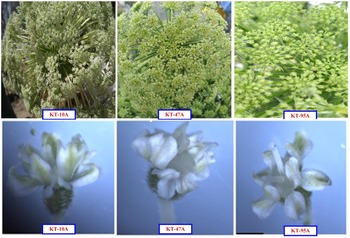
All the parental lines of carrot had fine-textured orange-coloured roots with orange core and they were devoid of any physiological disorder. All the pt-CMS lines reflected the conversion of stamens to petal-like structures (Fig. 1) and were used as female parent in the crossing programme. The results pertaining to chemotypic characterization of parental lines comprising pt-CMS lines and inbred testers along with commercial checks are presented in Table 1. The pooled data analysis of 2 years for antioxidant and bioactive compounds of parental genotypes revealed substantial chemotypic variation which is a pre-requisite for the selection of parents for carrot hybrid breeding programme. The pooled estimates of total carotenoids in the parental genotypes varied from 0.13 to 4.34 mg/100 g. The petaloid CMS line, KT-62A followed by KT-80A had the highest concentration of total carotenoids as compared to standard check and other parental lines (Table 1). Likewise, for β-carotene, the pt-CMS lines KT-47A (3.92 μg/100 g), KT-8542A (3.77 μg/100 g) and testers NK-1 (3.49 μg/100 g) and KS (3.49 μg/100 g) exhibited high performance as compared to commercial check over the 2 years. Only one CMS line, KT-39A (1.35 mg/100 g) outperformed the commercial check for lycopene content. The pooled concentration of antioxidant-related traits, CUPRAC and FRAP among the parental pt-CMS lines varied from 0.33 μ moltrolox/g (KT-98A) to 0.56 μ moltrolox/g (KT-8542A) and 0.05 μ moltrolox/g (KT-47A) to 0.34 μ moltrolox/g (KT-39A), respectively. The mean estimates for the ascorbic acid content among the pt-CMS lines varied from 2.44 mg/100 g (KT-95A) to 10.23 mg/100 g (KT-62A). The concentration of TPC and anthocyanin concentration among the pt-CMS varied from 185.63 mg of gallic acid/100 g FW (KT-62A) to 622.53 mg of gallic acid/100 g FW (KT-10A) and 0.05 mg/100 g (KT-95A) to 0.29 mg/100 g (KT-10A). The tester KS-73 (0.52 mg/100 g) exhibited the highest concentration of anthocyanin among parental lines and also outperformed the standard check, Pusa Nayan Jyoti.
Flowers of pt-CMS lines. Upper lane represents the umbels of sterile CMS lines in the field conditions. Lower lane is the microscopic view of pt-CMS flowers reflecting the conversion of stamens to petal-like structures.

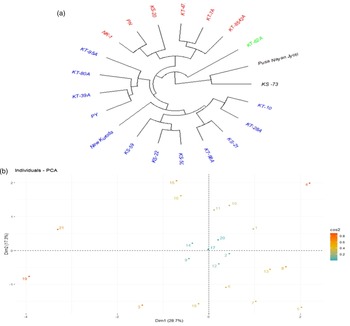
The dendrogram analysis for antioxidant and bioactive compounds of parental lines based on Euclidean distance revealed substantial genetic variation (Fig. 2(a)). The commercial check, Pusa Nayan Jyoti remained separate from the other parental genotypes except for KS-73 which was comparable to commercial check for lycopene and anthocyanin concentration. All the parental lines were clustered into four distinct groups. The pt-CMS line KT-62A remained solely in a distinct cluster as it exhibited the highest concentration of total carotenoids and ascorbic acid amongst parental genotypes. The transformation of data from large to lesser principal components and estimating direction in which data are dispersed, the PCA was carried out based on antioxidant traits. The scree plot and PCA analysis revealed that the first two components (PC1: 28.7% and PC2: 17.3%) explained 46% of total variation (Fig. 2(b) and online Supplementary Fig. S4). The variables exhibiting close association were clustered together like CUPRAC, FRAP, ascorbic acid. The boxplot distribution of antioxidant and bioactive compounds across the parental types is presented in online Supplementary Fig. S1.
Dendrogram and principal component analysis of parental carrot genotypes based on antioxidant and bioactive compounds. (a) Dendrogram analysis depicting genetic variation among parental chemotypes based on Euclidean distance matrix. (b) Principal component analysis of parental genotypes.

Variance analysis for physio-biochemical traits
The variance analysis (ANOVA) for combining the ability of different bioactive and antioxidant compounds depicted substantial genetic variation among all the treatments comprising parents, testcross progenies and commercial checks for all the eight biochemical traits under study (Table 2). The mean squares of environments were found significant for only carotenoid content. The means squares of lines and testers were also found significant for all the studied antioxidant traits. The mean squares of parents versus testcross progenies were also significant for all the traits except for anthocyanin content. The line × tester (crosses) mean squares were also significant for all the antioxidant traits. The genotype × environment (G × E) and environment × parent versus crosses mean square were found significant for the carotenoid content (total carotenoid and β-carotene) (Table 2). While for the other antioxidant traits, the variance analysis of G × E interaction was non-significant. The variance analysis revealed significant differences for environment × 100 testcross progenies for total carotenoid and β-carotene content. The results indicated the presence of inherent variation among all the parents and their 100 crosses.
Variance analysis (ANOVA) of combining ability for physio-biochemical traits in carrot

L, lines; T, testers; df, degree of freedom.
*, **, ***, ****Significance at 5, 1, 0.1 and 0.01% probability through F-test.
Appraisal of genetic architecture and genetic components of variance
The appraisal of genetic variance components, predictability ratio, heritability and gene action for eight different bioactive compounds in temperate carrots over the 2 years is presented in Table 3. The results of pooled analysis revealed a higher value of specific combining ability variance (σ sca2) as compared to general combining ability variance (σ gca2) for all the bioactive compounds except for TCC and β-carotene both in line and tester genotypes. The magnitude of σ gca2 for FRAP, CUPRAC, lycopene ascorbic acid and anthocyanin was less than unity. The estimates of residual or environmental variance (σ 2Env) were significantly non-zero for carotenoids and β-carotene content, while no contribution of residual variance was found for all other antioxidant traits. The effects of σ 2Env × lines, σ 2Env × testers, σ 2Env × GCA and σ 2Env × crosses were significant and less than unity for TCC and β-carotene. The genetic architecture analysis revealed that the estimates of dominance variance (σ 2D) were greater than additive variance (σ 2A) for all the bioactive compounds except for TCC and β-carotene, however, the value of both σ 2D and σ 2A was less than unity for FRAP, CUPRAC, lycopene and anthocyanin content. The degree of dominance for all the antioxidant and biochemical traits was greater than unity except TCC and β-carotene indicating the role of over-dominance for the expression of majority of traits. The ratio of additive to dominance variance (σ 2A/σ 2D) was greater than unity for TCC and β-carotene, while it was less than unity for rest of the traits. Predictability ratio (σ gca2/σ sca2) of less than unity value for all the traits indicates the influence of non-additive gene action. To determine the efficiency in response to selection, heritability is computed for different traits. The pooled heritability analysis across the environments revealed moderate estimates of heritability in narrow sense (h ns2) for all the traits except for TCC and β-carotene with higher h ns2. High genetic advance estimates (GA) at 5% selection intensity for TPC accompanied with moderate h ns2 indicated high selection efficiency for this trait. The low estimates of GA at 5% selection intensity were recorded for all other traits.
Genetic architecture and variance components for different physio-biochemical traits

σ 2A, additive genetic variance; σ 2D, dominance variance; σ gca2, estimates of GCA variance; σ sca2, estimate of SCA; σ 2Env, environmental variance; TCC, total carotenoid content; Anth, anthocyanin.
Combining ability effects for identification of elite parental types
The pooled analyses results over the 2 years for general combining ability (GCA) effects of parents are summarized in Table 3. The estimates of GCA effects revealed that the pt-CMS line, KT-28A was a good general combiner for TCC, β-carotene and anthocyanin content, while it was a poor combiner for all other antioxidant traits under study. The CMS line, KT-80A exhibited significantly high GCA effects for TCC, β-carotene, FRAP and ascorbic acids content. The line, KT-10A was found to be a significantly poor general combiner for majority of the antioxidant and bioactive traits except for anthocyanin. Likewise, the CMS line, KT-98A exhibited significantly high GCA effects at P < 0.001 for majority of the antioxidant traits except TCC, ascorbic acid and anthocyanin content. The CMS line, KT-62A exhibited significant GCA effects in desirable direction for TCC, β-carotene, lycopene, ascorbic acid and anthocyanins at P ⩽ 0.001 while the line, KT-47A exhibited a positive significant GCA effect for majority of antioxidant traits except for TCC, β-carotene and lycopene content. The line, KT-39A was found to be a good general combiner for only FRAP and ascorbic acid content at P ⩽ 0.001 and was a poor general combiner for all other antioxidant compounds. The line, KT-7A exhibited significant GCA effects in desirable direction for lycopene, CUPRAC, FRAP and anthocyanin contents and was a poor combiner for all other traits. The line, KT-95A was found to be a good general combiner for TCC, β-carotene, FRAP and ascorbic acid content and the line, KT-8542A exhibited significantly high GCA effects in desirable direction for lycopene, ascorbic acid and TPC. Among the 10 testers, KS-20 was found to be a good general combiner for TCC, β-carotene and anthocyanin while it was a poor combiner for rest of the traits. The tester, KS-21 exhibited significantly poor GCA effects in negative direction for all the traits except for TCC, β-carotene, FRAP and anthocyanin content. The genotype, KS-22 depicted significantly high GCA effects in desirable direction for TCC and lycopene concentration at P ⩽ 0.001 and was a poor combiner for all other traits. Whereas KS-50 exhibited positive GCA effects significant at P ⩽ 0.001 for CUPRAC, ascorbic acid, total phenol and anthocyanin concentration. The tester KS-59 was found to exhibit significantly high GCA effects at P ⩽ 0.001 for β-carotene, lycopene, FRAP and ascorbic acid content and was a poor combiner for all other traits. The tester, NK-1 was a poor general combiner for all the traits except TCC, ascorbic acid and lycopene concentration. The PY exhibited significant GCA effects in desirable direction for ascorbic acid and total phenols at P ⩽ 0.001 while it was a poor combiner for all other traits. Whereas tester PN exhibited positive GCA effects significant at P ⩽ 0.001 for FRAP and total phenol only. The tester New Kuroda was found to exhibit significant GCA effects at P ⩽ 0.001 for CUPRAC and anthocyanin concentration while it was a poor combiner for all other traits. The tester genotype, KS-73 was a good general combiner for only TCC and β-carotene content.
Combining ability effects for identification of superior testcross progenies
The pooled specific combining ability (SCA) effects of 100 testcross progenies of temperate carrots over the environments (year 1 and year 2) are summarized in online Supplementary Table S3. Among 100 testcross progenies, for the CUPRAC content, a total of 45 crosses exhibited positive significant SCA effects in desirable direction. Similarly, for the FRAP content, the significant SCA effects in desirable direction were recorded in 31 crosses among 100 testcross progenies. The 32, 32, 34, 40, 41 and 40 number of crosses amongst 100 hybrids exhibited significantly positive SCA effects in desirable direction for ascorbic acid content, TPC, anthocyanin, lycopene content, β-carotene and TCC, respectively. With respect to CUPRAC content, the highest significant SCA effects in desirable direction were observed in the cross combination, KT-98A × KS-50 (poor × poor general combiner) followed by KT-47A × KS-90 (poor general combiner × poor general combiner) and KT-28A × KS-73 (poor general combiner × poor general combiner). Similarly, for the FRAP content, the hybrid, KT-39A × KS-20 (good general combiner × poor general combiner) followed by KT-47A × KS 21 (good general combiner × good general combiner) and KT-62A × PY (poor GCA × poor GCA) depicted the highest value of SCA effects in desirable direction. The highest significantly positive SCA effects in desirable direction for ascorbic acid content was observed in the cross combination, KT-47A × KS-20 (good general combiner × poor GCA), followed by KT-8542A × KS-59 (good general combiner × good general combiner) and KT-62A × KS-50 (good general combiner × good general combiner). The cross combination, KT-98A × KS 90 (good combiner × good general combiner) exhibited the highest significant positive SCA effects for TPC, followed by KT-98A × KS-50 (good combiner × good general combiner) and KT-80A × KS-73 (poor general combiner × good combiner). The highest positive SCA effect for anthocyanin content was found in the cross combination, KT-62A × KS-21 (good general combiner × good general combiner) followed by KT-8542A × KS-50 (poor general combiner × good general combiner) and KT-7A × KS-20 (good general combiner × good general combiner). The cross combination, KT-7A × KS-59 (good general combiner × good general combiner) exhibited the highest SCA effects for the lycopene content in desirable direction. It was followed by the crosses KT-47A × KS-59 (poor general combiner × good general combiner) and KT-95A × NK-1 (poor general combiner × good general combiner). For the β-carotene content, the highest positive SCA effects in desirable direction were depicted in the cross combination, KT-62A × KS-21 (good general combiner × good general combiner) followed by KT-39A × PY (poor general combiner × poor general combiner) and KT-10A × KS-73 (poor general combiner × good general combiner). Likewise, the cross combination KT-62A × KS-22 (good general combiner × good general combiner) exhibited the highest positive SCA effects for TCC in desirable direction followed by KT-80A × KS-73 (good combiner × good combiner) and KT-62A × NK-1 (good general combiner × good general combiner).
Physio-biochemical characterization of 100 testcross progenies
The analysis of results over the environments regarding per se performance of 100 testcross progenies of temperate carrot for different bioactive and antioxidant traits is summarized in online Supplementary Table S4 and Fig. S2. The mean value of 100 hybrids for traits related to antioxidant potential, CUPRAC and FRAP, ranged from 0.14 μ moltrolox/g (KT-62A × KS-59) to 6.60 μ moltrolox/g (KT-98A × KS-50) and 0.03 μ moltrolox/g (KT-7A × KS-20) to 0.62 μ moltrolox/g (KT-47A × KS-21), respectively. For the CUPRAC content among 100 hybrids, 13 hybrids depicted better performance when compared to commercial check (Pusa Nayan Jyoti). The cross combination, KT-98A × KS-50 followed by KT-62A × New Kuroda, KT-47A × KS 90 and KT-8542A × KS-20 exhibited the highest mean performance for the CUPRAC content over the years. Similarly, for the FRAP content, out of 100 crosses, four crosses (KT-47A × KS-21 followed by KT-95A × KS-21, KT-39A × KS-20 and KT-80A × KS-50) revealed higher performance than the best check (Pusa Nayan Jyoti) (online Supplementary Table S4). The mean per se performance of hybrids for ascorbic acid content and TPC varied from 1.62 mg/100 g (KT-98A × KS-22) to 12.03 mg/100 g (KT-47A × KS-20) and 110.07 mg of gallic acid/100 g FW (KT-95A × NK-1) to 1239.99 mg of gallic acid/100 g FW (KT-98A × KS 90), respectively. Among the 100 testcross progenies, 49 and 14 outperformed the best check, Pusa Nayan Jyoti for the ascorbic acid and TPC. The highest average ascorbic acid content was observed in the cross combination, KT-47A × KS-20 followed by KT-8542A × KS-59 and KT-62A × KS-50 (online Supplementary Table S4). With respect to the TPC the cross combination KT-98A × KS 90 followed by KT-98A × KS-50 depicted the highest mean value. For the anthocyanin content, the per se performance of the 100 testcross progenies varied from 0.03 mg/100 g (KT-8542A × KS 90) to 1.07 mg/100 g (KT-7A × KS-20) (online Supplementary Table S4). Out of 100 hybrids, six hybrids had performed better than the best check (Pusa Nayan Jyoti) for the anthocyanin content over the environments. Among 100 crosses, the mean value for lycopene, β-carotene and TCC varied from 0.03 mg/100 g (KT-95A × NK-1) to 3.94 mg/100 g (KT-7A × KS-59), 1.00 μg/100 ml (KT-8542A × KS-73) to 7.98 μg/100 ml (KT-98A × NK-1) and 0.31 mg/100 g (KT-47A × KS-20) to 8.43 mg/100 g (KT-28A × New Kuroda), respectively. Of the 100 crosses, 15, 55 and 71 crosses outperformed for the lycopene, β-carotene and TCC, respectively, compared to the commercial check, Pusa Nayan Jyoti.
Identification of elite combiners
The elite heterotic combiners based on pt-CMS system were determined based on heterosis analysis over the mid parent and better parent. The results pertaining to top 10 superior combiners over the mid parent (MPH) and better parent (Heterobeltiosis, BPH) for different antioxidant and bioactive traits across the environments are presented in online Supplementary Table S4. The data analysis over the years revealed that the 100 testcross progenies exhibited significant MPH and BPH for different antioxidant traits under study in both the directions. Some of the elite combiners pertaining to physio-biochemical traits are depicted in online Supplementary Fig. S3. For the antioxidant capacity-related traits, CUPRAC and FRAP, the estimates of MPH varied from 16.26% (KT-62A × NK-1) to 178.06% (KT-98A × KS-50) and 19.07% (KT-39A × KS-20) to 908.33% (KT-47A × KS-59), respectively. Likewise, the estimates of heterobeltiosis varied from 17.83% (KT-7A × NK-1) to 832.24% (KT-98A × KS-50) for CUPRAC and 22.52% (KT-62A × PY) to 706.67% (KT-47A × KS-59) for the FRAP content. Highest significant heterosis for CUPRAC content over the mid parent and better parent in desirable direction was observed in the cross combination, KT-98A × KS-50 followed by KT-62A × New Kuroda, KT-7A × New Kuroda and KT-47A × NK-1. Among the 100 testcrosses, 18 and 12 crosses exhibited significantly high heterosis in desirable direction for the CUPRAC content over the mid parent and better parent, respectively. Similarly, for the FRAP content, the highest significant estimates of MPH and heterobeltiosis in desirable direction were depicted in the cross combination, KT-47A × KS-59 followed by KT-47A × KS-21 and KT-47A × KS-59. Among the 100 hybrids, 27 and 18 hybrids exhibited significantly high estimates of MPH and heterobeltiosis in desirable direction for the FRAP content, respectively.
The estimates of MPH and heterobeltiosis for the ascorbic acid content among the 100 testcross progenies varied from 10.42% (KT-7A × PY) to 155.58% (KT-47A × KS-20) and 13.84% (KT-28A × NK-1) to 121.20% (KT-47A × KS-20), respectively. Amongst 100 testcross progenies, 27 and 17 hybrids exhibited significant high heterosis in desirable direction for the ascorbic acid content over the mid parent and better parent, respectively. The cross combinations KT-47A × KS-20, KT-95A × New Kuroda and KT-47A × KS-20 depicted the highest positive heterosis for the ascorbic acid content in desirable direction. For the TPC, the average and better parent heterosis varied from 25.01% (KT-80A × KS-22) to 314.95% (KT-98A × KS 90) and 18.46% (KT-28A × PY) to 302.17% (KT-98A × KS 90), respectively. The highest estimates of MPH and heterobeltiosis for the TPC in desirable direction were revealed in the crosses, KT-98A × KS 90 followed by KT-98A × KS-50 and KT-8542A × KS-59. A total of 37 and 27 number of hybrid combinations exhibited significant heterosis over mid parent and better parent, respectively, for the TPC amongst 100 testcross progenies. The estimates of MPH and heterobeltiosis for the anthocyanin content varied from 15.38% (KT-98A × KS-59) to 1546.38% (KT-62A × KS-21) and 20.78% (KT-95A × New Kuroda) to 1083.33% (KT-62A × KS-21), respectively. The hybrid combination, KT-62A × KS-21 followed by KT-7A × KS-20 and KT-8542A × KS-50 exhibited significantly high estimates of heterosis for the anthocyanin content. Likewise, for the lycopene content, the mid parent and better parent heterosis estimates varied from 15.72% (KT-80A × KS-20) to 777.81% (KT-47A × KS-59) and 10.51% (KT-80A × KS-22) to 222.61% (KT-98A × KS-59), respectively. The cross combination, KT-47A × KS-59 followed by KT-7A × KS-59 and KT-47A × KS 90 exhibited the highest estimates of MPH in desirable direction for lycopene content. Similarly, the cross combination KT-98A × KS-59 followed by KT-47A × KS-90 and KT-98A × NK-1 exhibited significantly high estimates of heterobeltiosis for lycopene content. Among the 100 crosses, only 40 and 32 crosses over the mid parent and better parent, respectively, showed significant heterosis for lycopene content.
For the β-carotene content, the estimates of MPH and heterobeltiosis over the environments ranged from 6.15% (KT-10A × KS-50) to 185.66% (KT-95A × KS-20) and 8.03% (KT-39A × KS 90) to 281.32% (KT-62A × KS-21), respectively. The hybrid combination KT-62A × KS-21, followed by KT-80A × New Kuroda and KT-62A × KS-59 exhibited significantly highest heterosis over the better parent in desirable direction for the β-carotene content. The MPH and BPH estimates varied from 6.76% (KT-62A × KS-20) to 390.38% (KT-28A × KS-59) and 19.18% (KT-80A × PY) to 312.88% (KT-98A × PY), respectively, for the TCC. Among the 100 testcrosses, 79 and 73 crosses, respectively, exhibited the highest heterosis over the mid parent and better parent for the TCC. The significantly high estimates of heterosis in desirable direction for the TCC was observed in the cross combinations, KT-28A × KS-59, KT-98A × PY, KT-98A × KS-22 and KT-95 × KS-21.
Interaction analysis
The interaction analysis among different antioxidant and bioactive compounds was computed via Pearson's correlation coefficient using ‘corrgram’ statistical package of R programming (R Studio Team, 2020). The association results pertaining to eight different antioxidant traits are depicted in online Supplementary Fig. S4. The TCC exhibited a negative correlation with all the studied antioxidant traits except for ascorbic acid content. The non-significant positive association was found for β-carotene with CUPRAC, FRAP and anthocyanin concentration. The data analysis revealed positive interaction among lycopene, CUPRAC, FRAP, anthocyanin and TPC. The analysis of interaction results also revealed a positive association of FRAP with all the antioxidant traits except for TCC. A significant interaction was observed between FRAP and anthocyanin content at P ⩽ 0.05. A positive correlation was observed for ascorbic acid and all other bioactive compounds except for β-carotene and TPC. The interaction analysis revealed a significantly positive association of TPC with anthocyanin content at P ⩽ 0.05. Likewise, anthocyanin exhibited significant positive interaction with TPC and FRAP content at P ⩽ 0.05.
Discussion
Carrot is one of the most important dietary sources of provitamin A across the world (Halilu et al., Reference Halilu, Ado, Aba and Usman2016). Despite of its economic, dietary and industrial value, meagre efforts have been made for enhancing its productivity in developing countries like India. The pollination control mechanisms such as sporophytic self-incompatibility and CMS are important for giving impetus to vegetable hybrid industry (Singh and Vidyasagar, Reference Singh and Vidyasagar2012; Sehgal and Singh, Reference Sehgal and Singh2018; Que et al., Reference Que, Hou, Wang, Xu, Tan, Li, Wang, Khadr and Xiong2019; Singh et al., Reference Singh, Dey, Bhatia, Kumar and Behera2019b). In this context, the present investigation highlights the potential of pt-CMS system of temperate carrots using indigenous germplasm for enhancing its nutritional and industrial value along with determining the genetic architecture of underlying nutritional traits.
In the present investigation, the pooled analysis over the environments for different antioxidant and bioactive compounds revealed remarkable variation among parental lines. The carotenoids are known to play a major role in human health having antioxidant potential and are accumulated in an abundant amount in commercial carrot genotypes (Jourdan et al., Reference Jourdan, Gagné, Dubois-Laurent, Maghraoui, Huet, Suel, Hamama, Briard, Peltier and Geoffriau2015). Thus, enhancement of carotenoids especially β-carotene in carrot varieties is a major breeding target objective (Bogacz-Radomska and Harasym, Reference Bogacz-Radomska and Harasym2018). In the present investigation, the content of TCC and β-carotene among parental types varied from 0.13 to 4.34 mg/100 g and 1.64 to 3.92 μg/100 g, respectively. These results are comparable to the findings of Koley et al. (Reference Koley, Singh, Khemariya, Sarkar, Kaur, Chaurasia and Naik2014) for β-carotene in orange genotypes of carrot. The value of total carotenoids was quite high in most of the genotypes and the proportion of β-carotene was comparatively lower. The lower value of β-carotene may be attributed to the analysis through spectrophotometer. However, the values of β-carotene are comparable to a few previous results in tropical carrots (Koley et al., Reference Koley, Singh, Khemariya, Sarkar, Kaur, Chaurasia and Naik2014). The results suggested that the pt-CMS lines KT-62A and KT-80A can be effectively utilized in breeding carotenoid-rich cultivars.
The results were further supported by dendrogram for bioactive traits and PCA which depicted substantial genetic variation. Similar trends were reported by Koley et al. (Reference Koley, Singh, Khemariya, Sarkar, Kaur, Chaurasia and Naik2014) in tropical carrot genotypes and substantial variation among the carrot parental types could be explained by genotype, season of growing, maturity, portion of root sample and biochemical assay approach. Further, the ANOVA also indicated considerable genetic variation among all the carrot genotypes comprising parental chemotypes and their testcross progenies.
The variance analysis revealed significant differences among all the genotypes, which is a pre-requisite for the success of any crop genetic improvement programme. The results are in agreement with the findings of Singh et al. (Reference Singh, Bhatia, Kumar, Sharma, Dash and Dey2018a) for antioxidant traits in cauliflower and Poleshi et al. (Reference Poleshi, Cholin, Manikanta and Ambika2017) for root traits in tropical carrots. The pooled analysis over the years revealed significant mean squares at P ⩽ 0.001 for lines, testers and line × tester interaction for all the antioxidant and bioactive traits, which indicated the preponderance of both additive and non-additive gene action governing the expression of target traits in temperate carrots. Thus, selection and heterosis breeding would be instrumental in developing antioxidant-rich carrot hybrids. These results corroborate the findings of Ssemakula et al. (Reference Ssemakula, Dixon and Mazia-Dixon2007) for total carotenoid in cassava, Halilu et al. (Reference Halilu, Ado, Aba and Usman2016) for provitamin A in maize and Pepra et al. (Reference Pepra, Parkes, Manu-Aduening, Kulakow, van Biljon and Labuschagne2020) for provitamin A in cassava. All the studied traits were qualitative in nature; hence less influence of environment in controlling trait phenotype is evident. But, the significant mean squares of G × E interaction over the years for carotenoid concentration (TCC and β-carotene) indicated the influence of environment for the expression of carotenoid content in carrot genotypes. Thus, the considerable variation in carotenoid concentration is attributed to genotypic and environmental factors (Pepra et al., Reference Pepra, Parkes, Manu-Aduening, Kulakow, van Biljon and Labuschagne2020). As the TCC and β-carotene were also under the influence of environment, which imply that they are quantitative traits controlled by a few major genes or oligogenic traits (Halilu et al., Reference Halilu, Ado, Aba and Usman2016). However, the effects of minor genes and minor QTLs were not ruled out. These results indicated the need of multi-environment testing of carrot genotypes for carotenoid improvement. The observed results indicated the oligogenic control of carotenoid expression (Halilu et al., Reference Halilu, Ado, Aba and Usman2016).
The perusal of genetic components of variance revealed the role of SCA in the generation of heterotic hybrids as evident from higher magnitude of σ sca2 as compared to σ gca2 of parental types for majority of bioactive compounds (online Supplementary Table S3). The greater than unity value of degree of dominance indicated the role of over-dominance for the accumulation of majority of traits except for carotenoids and β-carotene. Further the preponderance of non-additive (dominance and epistasis) gene action controlling the expression of CUPRAC, FRAP, anthocyanin, TPC, ascorbic acid and lycopene was found as indicated by less than unity value of σ 2A/D and σ gca2/σ sca2. These results emphasized the scope of hybrid breeding in the development of superior varieties of carrot with higher nutritional potential. The influence of additive gene action was much pronounced in the genetic control of TCC and β-carotene as evident from σ 2A/σ 2D ratios. These results are in agreement with the Singh et al. (Reference Singh, Bhatia, Kumar, Sharma, Dash and Dey2018a) for the antioxidant traits in cauliflowers.
The narrow-sense heritability describes the phenotypic variance is an important component of crop breeding as a response to selection (artificial or natural) relies on additive genetic effects (Singh et al., Reference Singh, Bhatia, Kumar, Sharma, Dash and Dey2018a; Karabolias et al., Reference Karabolias, Greenberg, Barrero, Maron, Shi, Monteverde, Pineros and McCouch2020). The moderate estimates of h ns2 for majority of traits except for carotenoids indicated that selection at early generation would be impractical and must emphasize for the multi-location multi-year experiments. For the TCC and β-carotene, selection would be easy as evident from higher estimates of h ns2. The effects of σ 2Env × lines, σ 2Env × testers, σ 2Env × GCA and σ 2Env × SCA interaction variance were significant for TCC and β-carotene which necessitate the need of multi-year and over the environment evaluations for the selection of TCC and β-carotene during carrot breeding programme. The results are in line with Ssemakula et al. (Reference Ssemakula, Dixon and Mazia-Dixon2007) for TCC in cassava and Athanase and Rob (Reference Athanase and Rob2019) for β-carotene in cassava. These pooled analysis results over the years indicated that the TCC and β-carotene accumulation in carrot roots is governed by a few major genes. Thus, selection followed by recombination would be an appropriate approach to enhance the frequency of genes controlling the target trait.
The acquaintance with the aspects of combining the ability of parental types utilized for hybrid breeding and heritability analysis is crucial for crop genetic improvement programme (Singh et al., Reference Singh, Bhatia, Kumar, Sharma, Dash and Dey2018a). The analysis of GCA effects over the years indicated that none of the parental types exhibited significant GCA in desirable direction for all the traits simultaneously. These results corroborated the findings of Athanase and Rob (Reference Athanase and Rob2019) and suggested the need of multiple crossing in suitable breeding design for stacking favourable alleles of antioxidant capacity in carrot genotypes. The GCA effects over the years depicted that petaloid CMS lines KT-80A and KT-62A had significant GCA in desirable direction for TCC, β-carotene and ascorbic acid content. These lines can be effectively utilized as female parent for the improvement of carotenoids and ascorbic acid in temperate carrots. The GCA analysis helped in the identification of suitable combiners among parental lines for the improvement of respective antioxidant and bioactive traits in carrot. The parental lines with significantly high GCA in desirable direction over the years are most suitable for recombinant breeding.
The SCA effects provide the estimation of loci with non-additive and epistatic gene action. It also leads to the identification of specific heterotic crosses for hybrid development. The significantly high SCA effects in desirable direction exhibited by poor × poor crosses for the CUPRAC content in KT-98A × KS-50, for the FRAP content in KT-62A × PY and for the β-carotene in KT-39A × PY could be explained by dominance × dominance type of non-allelic epistatic interaction (Singh et al., Reference Singh, Bhatia, Kumar, Sharma, Dash and Dey2018a; Athanase and Rob, Reference Athanase and Rob2019). Biparental crossing or reciprocal recurrent selection followed by hybrid breeding would be useful for the improvement of target traits involving such cross combinations. The majority of the heterotic cross combinations manifesting high SCA in desirable direction had one of the parents with poor GCA like poor × good combiner or good × poor combiner. For instance, the cross combination KT-39A × KS-20 for FRAP content, KT-47A × KS-20 for ascorbic acid content and KT-47A × KS-59 for the lycopene content had one of the parents with poor GCA. These results could be due to favourable additive effects of good GCA parent and epistatic effects of poor GCA parent (Singh et al., Reference Singh, Bhatia, Kumar, Sharma, Dash and Dey2018a, Reference Singh, Dey, Bhatia, Kumar, Sharma and Behera2019a). The higher estimates of SCA effects over the years in the crosses involving good × good combiners like KT-7A × KS-20 for anthocyanin content, KT-62A × KS-21 for β-carotene content and KT-62A × KS-22 for TCC could be attributed to stacking of favourable alleles of both parents for the improvement of target trait (Athanase and Rob, Reference Athanase and Rob2019). These cross combinations could be useful for the accumulation of desirable alleles for enhancing the concentration of bioactive compounds. The pooled combining ability analysis over the years in the carrot for antioxidant traits also indicated that the parents depicting high per se performance always were not having high GCA in desirable direction, which revealed the role of both GCA and SCA for the selection of parents to develop heterotic hybrids.
In majority of cases, the cross combinations exhibiting significant high estimates of MPH or heterobeltiosis in desirable direction had positive SCA effects for all the antioxidant and bioactive traits in carrot. It is evident that combining ability is positively associated with heterosis. Concurrently, the heterotic cross combinations exhibiting the highest MPH always did not reveal significant SCA effects in desirable direction such as KT-95A × KS-21 for β-carotene content, KT-98A × KS-59 for the lycopene content and KT-62A × PY for the TPC. Similarly it is true for the heterobeltiosis estimates such as KT-98A × KS-59 for TCC, KT-98A × KS-59 for lycopene content, KT-80A × KS-21 for the FRAP assay and KT-47A × New Kuroda for the ascorbic acid content. It might be due to the fact that SCA is the function of a specific cross while heterosis is related to mid parent, better parent or commercial check. The interaction analysis results indicated a significant positive association among the antioxidant traits under study. For instance, a significant positive association was observed for FRAP with anthocyanin content and TCC with ascorbic acid content. These results indicated that breeding for the improvement of one trait will simultaneously improve the closely associated trait. These results are in agreement with the findings of Singh et al. (Reference Singh, Bhatia, Kumar, Sharma, Dash and Dey2018a) for antioxidant traits in snowball cauliflower.
Conclusion
The present investigation provided an insight into the genetic architecture of physio-biochemical traits and breeding for their enrichment in carrot lines exploiting pt-CMS system. The findings revealed substantial genetic variation among parental genotypes for their successful utilization in carrot breeding. It highlighted the influence of both GCA and SCA effects in selecting desirable parents for carrot improvement programme. The preponderance of additive gene effects in some of the cross combinations derived from good × good GCA illustrated the scope of isolation of transgressive segregants. The studied traits were under the genetic control of both additive and non-additive gene action indicating the scope of hybrid development in carrot for antioxidant-rich breeding. The significant year × genotype interaction for the TCC and β-carotene content revealed the role of a few major genes controlling the expression of carotenoids in carrot root. High estimates of both MPH and heterobeltiosis for all the antioxidant traits indicated the scope for generation of nutritionally superior carrot hybrids. The information generated in this study will be useful to carrot breeders, researchers and geneticists for designing novel carrot cultivars with better quality.
Supplementary material
The supplementary material for this article can be found at https://doi.org/10.1017/S1479262121000599
Acknowledgements
The first author is thankful to ICAR-IARI for providing senior scholarship during the Ph.D. research programme. The authors are thankful to Head ICAR-IARI, regional station Katrain, Kullu Valley, Himachal Pradesh for providing necessary lab and field facilities during the experiment. The authors are also thankful to Head, Division of Vegetable Science and Director ICAR-IARI for providing necessary facilities during the course of study.
Author contributions
Hemant Ghemeray: investigation, experimentation, conducting field trials, data recording. Saurabh Singh: software analysis, writing original draft, formal analysis. Raj Kumar: conceptualization, resources, supervision of experiment, data curation. Reeta Bhatia: data curation, editing. V. K. Sharma: data analysis and editing. T. K. Behera: supervision, review and editing; S.S. Dey: conceptualization, supervision, validation, visualization, review and editing.
Conflict of interest
None.