1. Introduction
Heugh (Reference Heugh, Ouane and Glanz2011: 105) refers to the ‘baffling phenomenon’ of the continued use of education programmes in multilingual, postcolonial contexts that ‘have succeeded only in providing successful formal education for a small percentage of children, [and] yet . . . continue to be used as if they could offer lasting educational success for the majority’ (Heugh Reference Heugh, Ouane and Glanz2011: 106). The common factor that Heugh argues against in such programmes is the use of what is essentially a foreign language for the majority of children, and often their teachers. There has been much debate around the situation, since the oft-quoted statement made by UNESCO in 1953 that it is ‘axiomatic that the best medium for teaching is the mother tongue of the pupil’ (UNESCO 1953: 6), but this debate has not been adequately reflected in changes to actual practice.
The status quo is maintained by the prevalence of a number of beliefs about language learning that serve to keep languages such as English as the obvious choice medium of instruction. One such belief is the time-on-task argument, the view that the use of ‘local’ languages is considered to eat into the time that could be spent mastering a language of wider communication. A related belief is that the use of languages other than this ‘target language’ will actually hinder its acquisition, due to what has been termed, variously, ‘negative transfer’, ‘cross-linguistic influence’, or ‘interference’. In addition, negative attitudes are often held about the intrinsic nature of certain languages, so that it is believed that languages that have not hitherto been used to teach academic subjects cannot be used to do so. These and other beliefs have been discussed and refuted at length (e.g. Tucker Reference Tucker, Cenoz and Genesee1998; Siegel Reference Siegel1999b; Heugh Reference Heugh2002), with little impact outside the academic sphere.
The search for effective approaches to primary education has become globalised by shared commitments to strategies such as the Millennium Development Goals, Education for All, and the Global Partnership for Education; and by a shift in this supranational discourse from ‘Education for All’ to ‘Learning for All’ (World Bank 2011), with interest redirected to what actually happens in the world's classrooms once enrolment targets have increased the number of children in school. The choice of medium of instruction is very much bound up in the question of what it means to provide effective universal primary education, and research within this area has thus never been more relevant than it is within the current era of such global commitments.
At the same time, the debate has been complicated by shifts in our understanding of the complexity of language use – both due to the changing nature of linguistic diversity, as a result of globalisation, more dynamic patterns of migration, and different media and technologies of communication, and due to our heightened awareness that categories such as ‘native speaker’, ‘mother tongue’ and ‘speech community’ have never adequately captured the complex reality of language use (Blommaert & Rampton Reference Blommaert and Rampton2011; Jørgensen et al. Reference Jørgensen, Karrebæk, Madsen and Møller2011). This more nuanced understanding of language use makes it hard to work with familiar frameworks of ‘mother tongue education’, ‘bilingual programmes’, and ‘medium of instruction’, since these abstract idealisations are often so far away from what is actually being done with language in the world's classrooms.
This paper argues for the replication of two key studies within the field. The first half of the paper discusses Afolayan (Reference Afolayan and Bamgbose1976), a widely-cited study conducted in Ife, Nigeria to test the effectiveness of teaching children in the mother tongue for six years of primary education. Having introduced the project and outlined the procedure followed in the original study, we make the case for its approximate replication in new contexts. The key argument we make is that the frequency with which the success of this study is cited, without due attention paid to the details of its methodological procedure, may actually be detrimental to the success of other experiments. The careful replication of this successful study would add to the empirical base on which other programmes could reasonably be initiated.
The second half of the paper discusses Siegel (Reference Siegel1997b), an evaluation of a pre-school programme in Papua New Guinea that used Tok Pisin (an English-based pidgin) as the medium of initial literacy and numeracy, to test the common assumption that the educational use of an English-based pidgin will interfere with the subsequent learning and use of English. Having introduced this second study, we will argue for its approximate replication in other contexts in which English-based pidgins or creoles are spoken. The key argument we make here is that pidgins and creoles remain so stigmatised in the domain of formal education that there is an urgent need for replication of one of the few available studies that tests the assumptions on which such stigma is based, and that provides further substantiation of this original study.
2. Study 1: Afolyan (1976)
The first study we would like to suggest for replication is the Six-Year Primary Project (SYPP) of Ife, Nigeria (Afolayan Reference Afolayan and Bamgbose1976). The study was carried out between 1970 and 1976 in order to test the effectiveness of teaching children in the mother tongue for six years of primary education, and was deemed to indicate very positive results. The principal reason that this study merits replication is the regularity with which it continues to be cited as evidence of the effectiveness of mother tongue education, often with very little detail or explanation included.
For example, a simple search in Google Scholar in October 2013 returns eight references to the effectiveness of this particular experiment within publications from 2013, 44 references since 2009, and 212 results in total. In one such recent publication, a study commissioned for the EFA Global Monitoring Report 2005, Benson Reference Benson(2004: 12) states that ‘The Six-Year Yoruba Medium Primary Project demonstrated unequivocally that a full six-year primary education in the mother tongue with the L2 taught as a subject was not only viable but gave better results than all-English schooling.’ In a stock-taking overview prepared for the 2006 biennial meeting of the Association of the Development of Education in Africa, it was noted that ‘The Six-Year Primary Project (SYPP) in Nigeria, sometimes called the Ife Mother Tongue Education Project, is to date the most authoritative case study on the use of mother tongue in formal education’ (Alidou et al. Reference Alidou, Boly, Brock-Utne, Diallo, Heugh and Wolff2006: 105). These two reports, while presenting an overview of other studies, both emphasise the results of the SYPP as the most significant. More problematic are other publications that cite the SYPP as evidence of effective mother tongue education, stating that this one project ‘demonstrated conclusively’ (Orekan Reference Orekan2011: 34), ‘proved conclusively’ (Fasokun Reference Fasokun2003: 5), or ‘clearly bears out’ (Olarewaju Reference Olarewaju1996) the effectiveness of such an approach, without providing any contextual detail of the complexity of the original study.
Considering that many other studies have been done in the field (see reviews in Benson Reference Benson2004; Ouane & Glanz Reference Ouane and Glanz2011), we question why the SYPP continues to be cited as the study above all others. We suggest that, when one single study is put forward with such regularity as evidence of the effectiveness of a highly complex innovation, there must be grounds for asking what exactly the original study has shown: has it shown that education through the mother tongue is effective in any given context, or has it shown only that education through the mother tongue was shown to be effective for this particular group of Yoruba-speaking children, within an incredibly thorough and well-implemented intervention? The argument we present in this half of the paper is that such frequent citation of a single piece of research, as has been outlined above, necessitates approximate replications of this study in different contexts, in order to ascertain exactly what the original research has shown us regarding mother tongue education. We also argue that such citations of success, without due attention to the rigour with which the original study was carried out, can be misleading, thus potentially leading to hasty implementation of poorly-planned programmes that are likely to fail.
2.1 The original study
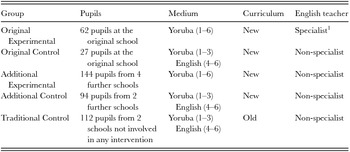
The original study was designed to test the validity of claims (e.g. UNESCO 1953) that the mother tongue is the most effective medium through which to deliver primary education. Conducted in the Western State of Nigeria from 1970, it investigated the effectiveness of using the mother tongue (in this case Yoruba) as the medium of instruction throughout the whole six-year cycle of primary school. National policy at the time was for the mother tongue to be used as the medium of instruction from Years 1 to 3, before a switch to English from Year 4 onwards. The original intention of the study was to compare the performance of two experimental classes taught in Yoruba for the full six years of primary school with a control class at the same school, taught in Yoruba for three years before switching to English. However, a number of factors led to modifications.
Firstly, the use of Yoruba from Year 4 onwards necessitated the development of curriculum and materials using this language. In order to compare the two groups, it became necessary to update the English-medium curriculum followed by the control group too. Secondly, to avoid a potential negative impact on the experimental group's transition to secondary education (conducted through the medium of English), this group were taught English by a specialist English teacher, using new English language teaching materials. Thirdly, as additional classes were selected for the project from other schools, from 1973 onwards, non-specialist English teachers had to be used, thereby presenting a greater number of variables.
In total, a number of different groups were created, as shown in Table 1. The variable of medium of instruction was thus investigated alongside other variables of curriculum design, materials development, and specialist English teaching, so that a very complex phenomenon of effective primary education was really being investigated, rather than medium of instruction alone. Prior to starting the project, comprehensive attention was given to fighting the ‘psychological battle’ (Afolayan Reference Afolayan and Bamgbose1976: 118) involved in convincing stakeholders of the worth of the project, to obtaining the necessary financial support for the project, to drawing on the advice of a steering committee of linguists and educationists, and to taking principled decisions as to the selection of the experimental and control classes and teachers for the project. During the project, there was continuous provision for in-service training and materials development, along with attention to corpus planning of the Yoruba language. Afolayan (Reference Afolayan and Bamgbose1976) sets out the immense complexity of the experiment and, importantly, the thoroughness with which the implementation was considered and put into place. Fafunwa, Macauley & Sokoya (Reference Fafunwa, Macauley and Sokoya1989) attest to the continuation of this comprehensiveness throughout the project, dealing also with the evaluative components of the project that were integrated throughout.
Different groups in the SYPP

Based on a combination of non-verbal intelligence tests, achievement tests in each school subject, and demographic data, evaluation of the project demonstrated that the original experimental group and the additional experimental group consistently outperformed all other groups. This result was seen across all academic subjects, including the language subject of English. Longitudinal data from evaluation of the experimental students’ achievement of admission to, and performance during, secondary school (and, in some cases, tertiary institutions) supports these results (Fafunwa et al. Reference Fafunwa, Macauley and Sokoya1989).
In summary, an immensely well-implemented and comprehensively evaluated study has indeed shown the efficacy of a programme of primary education that combined the use of the mother tongue with the production of effective curriculum and methodology. This has provided evidence that it is possible to implement such programmes and, importantly, provided counter-evidence to arguments that mother tongue education will disadvantage children, either academically or in terms of the acquisition of a language such as English. The key point of this paper, however, is that the SYPP has not provided evidence that using the mother tongue throughout primary school is guaranteed to produce similar results in any context. The constant citation of the success of the SYPP, without due attention either to the context in which it was conducted, or to the complexity of the project, may lead to hasty attempts to implement mother tongue education elsewhere, which are more likely to fail. Such failure can then do more harm than good, as it may be taken as evidence against the effectiveness of teaching through more familiar languages. In addition to the practicalities of implementation, Stroud (Reference Stroud2001) argues that the extent to which such programmes are designed and implemented by, and with, the language communities themselves has a profound impact on their success. Top-down implementation of a new programme, based solely on evidence that mother tongue education is feasible, is unlikely to succeed. It is for these reasons that we argue here for the approximate replication of the SYPP in further contexts, in the manner outlined in the following section.
2.2 Approaches to replication
In this section, we present two broad types of context in which we suggest that approximate replication of the SYPP needs to be carried out. Our purpose in suggesting new contexts for replication is to test the validity of the claims that have been drawn from the success of the SYPP under different conditions, as shall be exemplified below. The underlying assumption within citations of the SYPP's success is that the findings of the study are generalisable to any context, and this requires careful validation. Thus, an approximate replication of the original study in (potentially any) different context would help us to examine the extent to which this is the case. We argue that approximate replications of the SYPP in new contexts, with due attention to the procedural rigour of the original project, would make valuable contributions to this field.
In each case, the approximate replication we make the case for would entail closely replicating the approach taken by the SYPP, using the details provided by Afoyalan (Reference Afolayan and Bamgbose1976), and later Fafunwa et al. (Reference Fafunwa, Macauley and Sokoya1989) as a procedural guide. The advantage of replicating this particular project is that it was very thoroughly documented in terms of the procedure followed. However, in each case the language and context themselves would be different. Thus, issues of corpus planning, materials development, and ensuring the availability of teachers who are trained to teach through this language would be different. In addition, given the integration of language and curriculum exemplified so clearly by the experience of the SYPP, replication studies would need to incorporate elements of curriculum development that followed the same principles, but that met the needs of the specific context in which the studies were conducted. Finally, considerations of financial, logistical and theoretical support would need to be taken with a rigour that is replicated from the original study, although the specifics of such considerations would obviously be context-dependent.
The first type of context in which an approximate replication is advocated is any geographical area (whether a country, state, or district), in which there is considered to be an ‘obvious choice’ language that can be considered to be a dominant, familiar language for school-aged children. Despite the growing awareness of linguistic heterogeneity (e.g. Blommaert & Rampton Reference Blommaert and Rampton2011; Blommaert Reference Blommaert2012), such languages can still be identified in many areas of the world, and our heightened awareness of complexity should not be used as an argument to maintain the status quo of using languages such as English instead. For example, Heugh (Reference Heugh2002) laments academics’ portrayal of South Africans’ multilingualism as a complicating factor that prevents the implementation of effective education programmes. She argues that the vast majority of South Africans identify with a dominant first language, regardless of the number of other languages they also use. There are a number of such cases in many African states. In such contexts, mother tongue education is often in place for the early years of education (as had been the case in the Western State of Nigeria prior to 1970), and approximate replications of the SYPP would therefore entail implementing programmes that extended this provision for the full cycle of primary education, and potentially into secondary education. Such replications could be modelled very closely on the original study, with the key variable of language being changed from Yoruba to any other appropriate language. This type of replication would demonstrate the extent to which SYPP has made a valuable contribution to the field of mother tongue education. Positive results would support the original findings, while negative results from a rigorous replication would provide empirical justification for caution.
The second type of context in which such replications would be valuable includes geographical areas where there is not such an ‘obvious choice’ language in place. This may include areas in which each language has only a very small population of speakers, as is the case in the Melanesian region of the South Pacific. In countries such as Papua New Guinea, the Solomon Islands, and Vanuatu, there has been only very limited provision of mother tongue education (with the majority of work having been carried out in the first of these). A large number of languages remain uncodified, and there are limited written materials currently available in many others. There is thus a far more complex project to implement than was the case in the Western State of Nigeria, both for pragmatic reasons, and due to the need to convince stakeholders that mother tongue education is possible. These are the contexts where an approximate replication of the SYPP is most needed, in order to test the argument, in a principled manner, that mother tongue education is a viable option. In Papua New Guinea, significant progress has been made in this regard since the introduction of community-based pre-schools that operate through local languages (Siegel Reference Siegel1997a; Klaus Reference Klaus2003). However, it has been considered impractical to extend this measure beyond the very early years of education, and recent reports suggest that the national government is now returning to a policy of English-only education, ‘to address the concerns of parents, teachers, students, academics and political leaders that vernacular in elementary schools created a poor standard of spoken and written English’, and because, ‘since English is the only language of communication used in administration and businesses around the world it is important that it is used for teaching and learning in our schools’ (Belden Reference Belden2013). Meanwhile, the government of Vanuatu set out a policy in 1999 for education to be conducted through the mother tongue for a similar period of early education, and yet very little progress has been made in its implementation since that date. Pilot projects that the government initiated were implemented hastily and without providing sufficient training and support for teachers (Nako Reference Nako, Sanga, Niroa, Matai and Crowl2004), thus presenting the impression that mother tongue education is unfeasible. Replication of the SYPP study, if carried out with the rigour of the original, could help policymakers in the Melanesian countries to make informed decisions about mother tongue education, based on empirical evidence. Results from such studies would also play a role in validating the results of the original study, either supporting the evidence in favour of mother tongue education, or delimiting the scope of the contexts to which the conclusions from the SYPP can be applied.
In summary, the contexts in which approximate replications of the SYPP could be carried out are potentially infinite. Nevertheless, a small number of such rigorous replications carried out within the first type of contexts would provide valuable evidence to support (or challenge) the findings of the original project. If this could be achieved, the SYPP would remain a seminal study to cite, but now in the capacity as the first key study that provided principled evidence in favour of mother tongue education, rather than as the sole evidence held up in support. Replications within the second type of contexts would provide equally valuable insights into what exactly the results of the original study have shown us, and how far these results can be generalised.
3. Study 2: Siegel (Reference Siegel1997b)
The second study is Siegel's (Reference Siegel1997b) evaluation of a pre-school programme in Papua New Guinea that used Tok Pisin (a variety of Melanesian Pidgin) as the medium through which to teach initial literacy and numeracy. The study was carried out between 1989 and 1992 in order to test the common assumption that the educational use of an English-based pidgin (a contact language usually spoken as a second or auxiliary language by a community, which is lexically similar to but grammatically distinct from English) will interfere with the subsequent learning and use of English. This widespread assumption has had a significant impact on education policy in contexts in which pidgins and creoles are spoken. It has led, firstly, to there being almost no education programmes worldwide that make use of a pidgin or creole as a resource to be used within the classroom (Siegel Reference Siegel1999a; Simmons-McDonald Reference Simmons-McDonald2004; Siegel Reference Siegel2007), and, secondly, to a common scenario in which these languages are actually banned from educational institutions, due to concerns that they will have a negative impact on English (Lynch Reference Lynch, Mugler and Lynch1996; Alobwede Reference Alobwede1998; Willans Reference Willans2011).
Continuing the argument made in the first half of this paper, the concerns are that speakers of English-based pidgins and creoles are deprived of the opportunities to learn through a language that is familiar to them, and that these languages are devalued in the minds of their speakers. Furthermore, given the lexical similarities between English and an English-based pidgin or creole, there is an additional concern that children may actually be further disadvantaged if they cannot use and talk about both languages, since they will not have the opportunity to learn where the similarities and differences lie between them. As Siegel Reference Siegel(1997b) notes, the lexical similarities between English and a language such as Tok Pisin may well cause some confusion for learners, and empirical research to determine whether this is the case is thus of paramount importance. However, without such evidence, it appears that policies preventing the use of pidgins and creoles in education are put forward on ostensibly linguistic grounds that may be completely unjustified. For example, the following notice was displayed at a secondary school in Vanuatu in 2004 (Reference WillansWillans 2014):

This notice makes clear that the ban is rationalised by beliefs about the negative influence on English caused by the use of Bislama (a closely-related variety of Melanesian Pidgin to Tok Pisin). Such school policies are common in Vanuatu (Lynch Reference Lynch, Mugler and Lynch1996; Willans Reference Willans2011) and elsewhere (Alobwede Reference Alobwede1998; Siegel Reference Siegel and Nero2006), but there is an urgent need to establish whether they have any empirical basis at all, or whether they are founded primarily on lingering colonial attitudes towards these languages and their speakers.
3.1 The original study
Siegel Reference Siegel(1997b) was an evaluation of a pre-existing programme, which had been established as part of a grass-roots movement throughout Papua New Guinea in the 1980s to provide pre-school education through the medium of a familiar language. The programme was intended to prepare children for primary school, by helping them to acquire literacy in either a local vernacular or Tok Pisin, before entering the English-only environment of the primary school. The programme has demonstrated that linguistic diversity does not have to be a barrier to the use of vernacular languages in education, with approximately 91 different languages being used by 386 such pre-schools by 1991 (Troolin Reference Troolin2013: 288, citing figures from Yeoman & Obi Reference Yeoman and Obi1993).Footnote 2
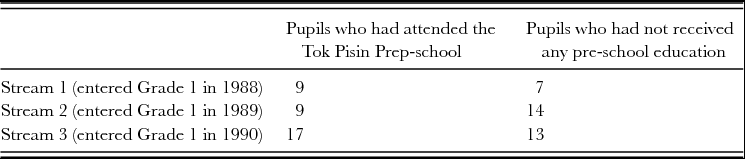
The particular programme evaluated in Siegel Reference Siegel(1997b) is the Tok Pisin Prep-school programme in the Ambunti District of the Sepik Province. Since Tok Pisin was widely spoken throughout the area, this language was chosen as the medium of instruction. The programme was evaluated by comparing test scores in English, Maths and General subjects throughout several grades of primary school for children who had attended the prep-school and those who had not. In addition, interviews and questionnaires were conducted with teachers, parents and community members to ascertain opinions about the programme. Table 2 summarises the participant groups. The three hypotheses tested were:
-
• H0 There is no difference between the marks of the two groups
-
• H1 The marks of the ‘no-prep’ students are significantly higher than those of the ‘ex-prep’ students, especially in English (as would be expected if Tok Pisin has a negative influence on English)
-
• H2 The marks of the ‘ex-prep’ students are significantly higher than those of the ‘no-prep’ students
Participant groups

Detailed discussion of the results is given in Siegel Reference Siegel(1997b). However, in brief, the data shows, firstly, that ex-prep children scored significantly higher overall than no-prep children in all subjects, including English. According to Siegel, ‘there was a significant multivariate main effect for prep-school attendance for each of the streams, accounting for 54 per cent of between-subjects variance for Stream 1, 30.3 per cent for Stream 2, and 26 per cent for Stream 3’ (Siegel Reference Siegel1997b: 94). Both H0 and H1 can thus be rejected, demonstrating that the use of Tok Pisin did not hinder the subsequent acquisition and use of English in primary school. Secondly, this finding appeared consistent, and any initial advantage that ex-prep children might have enjoyed over their classmates who were just entering education for the first time did not disappear over time; the data collected in the research period suggests that they seemed to have maintained their higher level of attainment over the no-prep children. Interview and questionnaire data also revealed positive perceptions of the programme among teachers and community members, with factors such as attendance, readiness for learning, and participation all considered to be higher in ex-prep children.
The study does not demonstrate conclusively that the positive results achieved by the ex-prep children are due to the fact that they had acquired initial literacy through Tok Pisin in particular. It may be that two additional years of pre-school education in any language would have given the ex-prep children the same advantage (Siegel Reference Siegel1997b: 96). It might also be the case that parents who opt to enrol their children in pre-school continue to provide a supportive family environment throughout primary school (Siegel Reference Siegel1997b: 92). However, the study provides evidence that Tok Pisin does not have a negative effect on the subsequent use of English. It thus makes a valuable contribution to the debate, by refuting the widespread claim that an English-based pidgin or creole will interfere with its speakers’ acquisition of English. However, a review of the literature since the publication of this study indicates that attitudes towards pidgins and creoles in formal education remain as negative as ever (Simmons-McDonald Reference Simmons-McDonald2004; Siegel Reference Siegel2007; Migge, Léglise & Bartens Reference Migge, Léglise and Bartens2010), with few attempts yet being made to incorporate pidgins and creoles into education systems. It is therefore argued that replication of this study would be invaluable at this time.
3.2 Approaches to replication
Given that pidgins and creoles remain stigmatised in education, thus preventing many speakers of these languages from using them within the learning process, there is an urgent need for empirical testing of the assumptions on which negative attitudes are based. We therefore argue for the replication of Siegel (Reference Siegel1997b), as one of the few empirical studies that has directly tested the belief that the use of an English-based pidgin or creole will have a negative impact on the subsequent acquisition of English. Only through rigorous examination of beliefs about language learning can it be seen whether they are based on any foundation, or whether they are simply lingering colonial attitudes that have been passed on and reinforced by current generations of speakers. Arguments about the negative influence of a pidgin or creole on the acquisition of the language from which it has been lexified are so widespread that far greater evidence is needed to support Siegel's findings, if it is to be shown that the arguments are unfounded.
Given that two decades have passed since the original study, too many variables have changed over the course of time to permit an exact replication. The participants (children and teachers) in a replication study would clearly be different people, but there have also been significant changes to the school structure in Papua New Guinea since 1991. In recognition of the success of the grassroots pre-school programme, the national government has restructured the formal education system so that all children should now spend the first three years at community-built elementary schools (incorporating one year of pre-school education and what was formerly the first two years of primary education), using the vernacular or Tok Pisin, before entering primary schools and making the transition to English (Siegel Reference Siegel1997a; Litteral Reference Litteral1999).Footnote 3 As a result, it may no longer be possible to replicate a study that compares an experimental group who have attended a pre-school with a control group who have not, throughout Grades 1 to 5, since all children are expected to attend the new elementary schools. In addition, societal attitudes towards the value of pre-school education, and towards the use of different languages within schools, may well have changed since the early 1990s, which will have had an enormous effect on the development of early education programmes.
However, an approximate replication study could be conducted using test results from Grades 3 to 7, i.e. comparing the scores of children who have attended a Tok Pisin-medium elementary school with those who have attended a vernacular-medium or English-medium elementary school. Although this would utilise a participant group who were two years older than in the original study, this would have an added advantage in that it would avoid one of the problematic issues of the original design. It would replace the independent variable ‘attendance at pre-school’ (which conflates medium of instruction with the potential advantage of simply having had more time in school) with ‘medium of initial education’ (thereby eliminating any variation in the number of years of formal education completed). A replication study of this nature could test whether significantly higher or lower test scores were achieved by children who had attended elementary schools that used Tok Pisin in particular. The design of such a study would of course need to build in mechanisms to control for differences other than medium of instruction between the pre-school programmes. A further advantage of this type of approximate replication is that a larger participation size than in the original study could be used, which would help to test the validity of the original findings.
A second type of approximate replication could be conducted by setting up an experimental design in which children could be randomly assigned to the experimental and control groups, rather than evaluating pre-existing programmes. In a large enough elementary school, it would be possible to use two separate classes within each year group – one using Tok Pisin as the medium of instruction, and the other using a vernacular or English. The procedure for such a study would be very similar to that of the original study, using results from the subsequent tests in Grades 3 to 7, once the children entered the English-medium environment of primary school.
Thirdly, as was argued in the first half of the paper, it is also necessary to replicate this type of study in different contexts, in order to test its generalisability. In Papua New Guinea, the pre-school programme using Tok Pisin has been developed over a number of decades, and there is thus a strong foundation on which programmes are implemented, with support from a variety of sources. However, in the neighbouring countries of Vanuatu and The Solomon Islands, in which a variety of Melanesian Pidgin (Bislama and Solomons Pijin, respectively) is also spoken, there has typically been greater resistance to the use of this language in education. Before this situation can change, it is necessary to demonstrate that Bislama or Pijin will not have a negative influence on the subsequent acquisition or use of English in these particular contexts, rather than relying on evidence from a different country. Further afield, approximate replication studies along similar lines would also be valuable in other contexts (such as West Africa and the Caribbean) in which English-based pidgins and creoles are spoken. Finally, there is clearly scope for replication studies in contexts in which pidgins and creoles that are lexified by languages other than English are used (such as the French-based creoles of Mauritius, the Seychelles and Haiti). Building up a comprehensive body of empirical evidence through replications of Siegel (Reference Siegel1997b) would be valuable in as many contexts as possible in which pidgins and creoles might be considered viable languages for use in education.
Conclusion
This paper has argued for the approximate replications of two different studies, with the aim of adding to the empirical basis on which decisions are made about which languages to use within classroom contexts. Replications of Afolayan (Reference Afolayan and Bamgbose1976) would enable us to establish how generalisable the results of the original study are to other contexts, and to build up a bank of rigorous research that could help to inform policy in a variety of contexts. Replications of Siegel (Reference Siegel1997b) would add much-needed evidence about the particular category of pidgins and creoles, enabling principled decisions to be taken about the use of these languages within education.
However, it may be that the field does need to respond more clearly to our heightened awareness of linguistic complexity than such studies can achieve, particularly taking into account the composite linguistic repertoires with which children begin school. As Banda (Reference Banda2009) notes, the mother tongue education debate inadvertently pits a child's (ostensibly singular) ‘mother tongue’ against a ‘foreign language’ such as English, thereby disregarding the way these and other languages are used alongside one another in daily life. This misses the opportunity to establish how indigenous languages ‘can be harnessed into an integrated multilingual teaching programme’ alongside languages such as English (Banda Reference Banda2009: 2), and we are increasingly recognising the need for educators and policy-makers to consider the sociolinguistic realities of their own communities, and . . . do more to disinvent the language ideologies and language policies that prevent linguistic hybridity from entering into the domain of education (Higgins Reference Higgins2009: 156).
We may thus need to examine the potential for a conceptual replication of studies such as Afolayan (Reference Afolayan and Bamgbose1976) and Siegel (Reference Siegel1997b), through which we can seek to understand the educational effectiveness of drawing on multiple linguistic resources within the classroom, rather than a single ‘mother tongue’. Such an endeavour would enable a principled, experimental evaluation of a programme that draws more fluidly on multiple linguistic resources, moving us beyond simply ‘imagining multilingual schools’ (García, Skutnabb-Kangas & Torres-Guzmán Reference García, Skutnabb-Kangas and Torres-Guzmán2006).
Acknowledgements
The authors are grateful for feedback from Jeff Siegel on an earlier draft of this paper.
Fiona Willans is a lecturer in Linguistics in the School of Language, Arts and Media at the University of the South Pacific. She is based at the Laucala Campus in Suva, Fiji. Her research interests include multilingual education, language policy and planning, and language ideologies, with a particular focus on postcolonial contexts. She has published in journals that include International Journal of Bilingual Education and Bilingualism, Current Issues in Language Planning and TESOL Quarterly.
Constant Leung is Professor of Educational Linguistics in the Centre for Language Discourse and Communication, Department of Education and Professional Studies at King's College London. He also serves as Deputy Head of Department. He was the founding chair of the National Association for Language Development in the Curriculum (NALDIC), a national subject association for teachers of English as an Additional Language in the UK. His research interests include additional/second language curriculum, language assessment, language policy, and teacher professional development. He has written and published widely on issues related to ethnic minority education, additional/second language curriculum, and language assessment. His recent research includes: Modelling academic language and literacy in ethnolinguistically diverse classrooms in school and university (ESRC-funded, co-investigator Brian Street), and Inclusive academic language teaching – European core curriculum for teacher education (Comenius-funded multilateral project). He is Associate Editor for Language Assessment Quarterly and Editor of Research Issues for TESOL Quarterly. He is an Academician of Social Sciences (UK).