During the last decade, leftist politicians and political parties have gained substantial electoral support throughout Latin America. These victories represent a sizeable triumph, considering that “by 2009, nearly two-thirds of Latin Americans lived under some form of left-leaning national government” (Levitsky and Roberts Reference Levitsky and Roberts2011, 1). Given that before 1998 the political left had little national presence, what explains this so-called left turn across the region?
This question has fuelled considerable scholarly activity in recent years. In general, the shift to the left has been interpreted as a consequence of the failures of the neoliberal/liberal-democratic paradigm (for instance, Arnson Reference Arnson2007; Cameron Reference Cameron2009; Luna and Filgueira Reference Luna and Filgueira2009). Individual explanations perceive the left's electoral success as a manifestation of voters’ growing frustration and disappointment with representative democracy and/or as a general reaction to the perils of globalization, providing political space for leftist contenders who offer the electorate alternative policy proposals in order to mitigate the deleterious effects of market-oriented reforms. However, studies applying these supply- or demand-side oriented explanations have, so far, presented rather mixed results. Above all, they have been criticized for their inability to accommodate evidence of voter support for market reforms across the region (Baker Reference Baker2003) or to account for the fortuitous timing of the left turn, which gained momentum at a time when economies in the region were booming (Remmer Reference Remmer2012).
Explanations have typically been rooted in theoretical perspectives inspired by research on the advanced industrial democracies. We believe that these studies therefore tend to underestimate the distinct nature of market reforms and the complexities involved in the simultaneous transformation of political and economic regimes that Latin American countries were undergoing, and therefore that their findings are inconclusive. The implications of such a systemic shock are far reaching, and single-item explanations of electoral behavior under such circumstances (such as attitudes and ideology) might not be able to capture underlying interactions. Similarly, macroeconomic measures such as growth—or a rather static measure for inequality, such as the Gini coefficient—may not be able to account for people's experienced hardship.
We contend that theories of subjective well-being in psychology and economics can improve our understanding of electoral behavior in such a context.Footnote 1 Specifically, we explore how the concept of life satisfaction provides insight into how individuals in developing countries assess their own welfare, and argue that life satisfaction can serve as a more encompassing measure of retrospective utility than either objective economic conditions or subjective economic perceptions. We assert that the unexplained heterogeneity in electoral outcomes across Latin America can be explained by the interaction between the life satisfaction of the electorate and the ideology of the incumbent. Therefore, we hypothesize that the greater the proportion of unsatisfied voters under a right incumbent, the greater the vote share of the left in country i at election time t.
Drawing on insights from the empirical literature on subjective well-being, we show that life satisfaction is a temporal measure that aggregates across the various life domains of the electorate, which, in turn, are tied to the contemporary political economy of Latin American countries. A measure such as life satisfaction may help us understand public frustration in contexts in which public opinion and economic conditions appear to have little elucidatory power. In particular, life satisfaction is tied to economic activities, inequality and relative distribution, offering us “an empirical approximation to individual welfare” (Frey, Luechinger and Stutzer Reference Frey, Luechinger and Stutzer2009, 2). We thus consider this retrospective personal welfare evaluation as a uniting base for an otherwise rather heterogeneous electoral alliance.
Using expert survey data on policy positioning in 18 Latin American countries (Wiesehomeier and Benoit Reference Wiesehomeier and Benoit2009), we test our proposition at the macro level for all presidential elections between 1998 and 2009, and cross-nationally at the individual level, against the most prominent explanations in the literature. We consider macroeconomic indicators such as gross domestic product (GDP) growth, trade and government spending, but also voters’ socio- and egotropic economic evaluations. Our results illustrate that aggregate dissatisfaction under a right incumbent indeed contributed to the electoral success of the left. In the remainder of this article we provide a brief summary of the literature on the left turn in Latin America, discuss important theoretical implications from the literature on subjective well-being, describe the data we use to test our expectation and report our results. The final section concludes.
Explaining the Left's Electoral Success
Several authors posit that the electoral success of the left across Latin America over the last decade is a manifestation of the electorates’ growing disillusionment with the institutions of representative democracy (Mainwaring Reference Mainwaring2006; Roberts Reference Roberts2007). Others argue that this phenomenon simply reflects an individual-level ideological shift throughout the region (Castañeda Reference Castañeda2006), engendering a backlash against the neoliberal policies of the 1990s (Baker and Greene Reference Baker and Greene2011). A correlated, but distinct, explanation is predicated on the high levels of inequality that characterize many Latin American societies (Castañeda Reference Castañeda2006; Cleary Reference Cleary2006; Debs and Helmke Reference Debs and Helmke2010). According to this explanation, the inability of two decades of market reform to address the social inequalities in the region has generated consistent and widespread support for parties that advocate the redistribution of wealth.Footnote 2
Although far from constituting a consensus, explanations of the left's electoral success have begun to coalesce around arguments rooted in economic voting that stress the temporal performance of incumbents and the electorates’ policy preferences. Following the “economic policy performance” argument, Panizza (Reference Panizza2005), for instance, suggests that the electoral success of the contemporary left in Latin America can be understood within the context of heterogeneous “losers’ alliances” that have little in common except a belief that past economic performance, coupled with Washington consensus measures, have proven deleterious for their personal economic utility.Footnote 3 Other studies have contended that the left's electoral resurgence is a product of price instability under right-leaning incumbents (Murillo, Oliveros and Vaishnav Reference Murillo, Oliveros and Vaishnav2010; Lora and Olivera Reference Lora and Olivera2005). The electorate has, therefore, punished right-leaning incumbents for overseeing policies that have failed to improve their economic well-being.
The “economic policy mandate” argument, on the other hand, is also rooted in retrospective evaluations of previous policies. However, rather than voters simply punishing incumbents for poor economic performance, they choose left-leaning candidates because of the policy proposals they espouse (Baker and Greene Reference Baker and Greene2011), suggesting that Latin American voters are clearly motivated by ideology. Indeed, Baker and Greene (Reference Baker and Greene2011) have argued that the electorate across Latin America has provided the left with a moderate policy mandate to halt or reverse certain aspects of the Washington consensus, while leaving other policies intact.
While we do not disagree with these explanations, their empirical bases are inconclusive. The economic performance argument struggles with findings that both inflation under a right government and high growth produced by a right incumbent contributed to the left's electoral success (Lora and Olivera Reference Lora and Olivera2005; Murillo, Oliveros and Vaishnav Reference Murillo, Oliveros and Vaishnav2010; Remmer Reference Remmer2012). Since the electoral shift has not clearly followed objective economic performance, and subjective perceptions of economic conditions have not influenced the electorates’ vote choice (Baker and Greene Reference Baker and Greene2011), these studies may fail to translate objective economic conditions into observable individual perceptions. The economic policy argument, in turn, is confronted with remarkably stable public attitudes toward democracy, redistribution and support for the market as an economic instrument among the Latin American public during the last 15 years, and the fact that there has been no discernable shift in the ideological identification of those who vote for the left (Arnold and Samuels Reference Arnold and Samuels2011; Baker Reference Baker2003; Baker and Greene Reference Baker and Greene2011; Remmer Reference Remmer2012).
The limitations of objective and attitudinal economic measures means we are left with unexplained heterogeneity regarding the left turn in Latin America. However, the policy mandate argument and the policy performance argument are not mutually exclusive, and it is difficult to capture the interdependence between them. Although analytically distinct, both explanations are ultimately rooted in widespread dissatisfaction among the electorate, which is assumed to be the underlying motivation for voters to elect left-leaning candidates.
Hence we believe that the explanations discussed so far are not rival explanations, but rather, taken together, contribute to aggregate dissatisfaction among voters—which in turn can be captured by subjective well-being. We contend that voters will make their choices at the ballot box on the basis of their personal welfare (Fiorina Reference Fiorina1981), which is expressed as life satisfaction shaped by the performance of the economy and economic policies under a particular incumbent government. Thus voters’ subjective well-being under right incumbents serves as a means to characterize the otherwise highly unstable and heterogeneous electoral alliance that supported the left in Latin America, providing a novel approach toward the electoral process across the region and thereby complementing our understanding of the left turn. The next section will discuss the concept of life satisfaction in relation to the political economy of Latin American democracies that are undergoing market reforms.
Life Satisfaction and the Economy
Although our argument is simple, as the following discussion will show, it is far from simplistic. In particular, studies have demonstrated that the relationship between life satisfaction and market reforms is rather complex. Since our focus is on the effect of life satisfaction on political behavior, it is beyond the scope of this article to replicate these complexities. The purpose of this section is therefore to build on the existing empirical literature on subjective well-being, illustrating the usefulness of such an encompassing measure of personal utility.
The study of subjective well-being (or happiness) analyzes how individuals perceive their quality of life and which factors determine to what degree people evaluate their lives positively or not.Footnote 4 Life satisfaction is the result of a reflection about an individual's situation and is thus much more than just a good or bad mood. The finding that well-being and happiness are related to a person's social context and life experiences resonates with discussions of how voters form ideas on economic conditions. As Weatherford (Reference Weatherford1983, 870) noted, “[t]he evaluation of economic conditions is a natural situation for contextual effects to operate through interpersonal contact […].” Therefore people will evaluate information at the larger individual and national level, but will tend to extrapolate from their more immediate social context (Mondak, Mutz and Huckfeldt Reference Mondak, Mutz and Huckfeldt1996). Even if non-material aspects—such as personal relationships with family and friends, health and personal values—play an important role, studies have shown that subjective well-being is sensitive to objective economic conditions and their changes, to the extent they affect a person's environment.
Research on life satisfaction in advanced industrial countries has consistently shown that factors such as income and inflation—and particularly the experience of unemployment—influence an individual's well-being (Clark Reference Clark2010; Di Tella, MacCulloch and Oswald Reference Di Tella, MacCulloch and Oswald2001; Diener and Ryan Reference Diener and Ryan2009; Helliwell Reference Helliwell2003), findings that have also been corroborated for Latin American countries (Graham and Pettinato Reference Graham and Pettinato2000). With regards to income, research suggests that the assessment of life satisfaction is driven by a relative notion (D'Ambrosio and Frick Reference D'Ambrosio and Frick2004; Emmons and Diener Reference Emmons and Diener1985; Graham and Pettinato Reference Graham and Pettinato2002a). Moreover, studies not only find a negative impact of a reference group's income on a person's well-being, but also comparisons with one's own prior living conditions (Clark, Frijters and Shields Reference Clark, Frijters and Shields2007; Senik Reference Senik2009). Such social comparisons involve reference values upon which these comparisons are made, which set benchmarks that may be interpreted in terms of seized or lost opportunities. As such, life satisfaction can serve as a measure of retrospective utility, which encompasses both objective economic conditions and subjective economic perceptions.
Compared to advanced industrial countries, however, relative comparisons matter more and become especially pressing for life satisfaction in contexts of transformations such as those experienced in the emerging market economies that underwent economic and financial liberalization. Using the Live in Transition Survey covering all countries of the former socialist bloc, Senik (Reference Senik2009) shows that negative comparisons with former schoolmates or colleagues, and the deterioration of respondents’ own living standards, have a strong negative impact on subjective well-being. She furthermore finds that income comparisons that reduce life satisfaction increase the demand for income redistribution. The same is true for the experience of unemployment (Alesina and Giuliano Reference Alesina and Giuliano2009).
Using monthly surveys from 1992 to 2005, Grosfeld and Senik (Reference Grosfeld and Senik2008) reveal an interesting relationship between satisfaction and inequality in the context of political and economic transitions in Poland, a dual transition similar to the experience of many Latin American countries. Initially, inequality is perceived as a positive sign of the increased opportunities created by reforms. However, inequality undermines people's life satisfaction over time, when individuals become increasingly skeptical about the legitimacy of the enrichment of reform winners. Similarly, Easterlin (Reference Easterlin2009, 17) shows that losers of transition reforms in East European countries experienced the biggest loss in life satisfaction over time, revealing a widening gap between winners and losers.
Unsurprisingly, these relationships are also found in Latin American countries. Graham and Pettinato (Reference Graham and Pettinato2000) analyze the survey responses of the 1999 Latinobarómetro wave, which covered 17 countries, to study the determinants of life satisfaction. Although in general they confirm conventional wisdom, the authors find that (contrary to what can be observed in advanced economies) being self-employed exerts a significant and negative effect on well-being. The authors explain this result with reference to the large informal sectors that typically prevail in Latin American economies, a context in which being self-employed is more often than not a necessity due to the lack of alternatives, rather than a choice. In a later study, Graham and Pettinato (Reference Graham and Pettinato2002a) explore the effects of relative income differences on the evaluation of subjective well-being with panel data from Russia and Peru. They confirm that such differences affect life satisfaction, especially for individuals in the middle of the distribution who tend to be more unsatisfied despite their absolute gains. The authors attribute this to what they refer to as “distributional stress”—a consequence of globalization and the changing nature of reference norms and aspirations.Footnote 5
The importance of relative income and reference groups for subjective well-being, and the tolerance of inequality in countries undergoing market reforms, can be explained by the expectation of future upward mobility and expected gains from transitions. In Latin America, those who support market reforms also tend to be positive about their prospects of upward mobility (Graham and Pettinato Reference Graham and Pettinato2002b), which explains the persistence of voter support for the market despite growing inequality, as the poor majority believes their future income will be above the mean income (Benabou and Ok Reference Benabou and Ok1998). Hirschmann (Reference Hirschmann1973) previously noted the importance of future expectations for the assessment of inequality during the development process using the image of a traffic jam in a tunnel: the advancement of one lane gives hope for those who are stuck. In other words, at the outset there is a high tolerance for inequality and income differences, as the advancement of others supplies information that helps to form expectations about future gains. Graham and Pettinato (Reference Graham and Pettinato2002b) find that in Latin American countries with more inequality, expectations of future upwards mobility were higher. However, if inequality persists over time, expectations get frustrated. What is important to note then, especially regarding the timing of the left turn, is that those frustrations only become manifest after a period of growth and development and not at a time of general stagnation.
Thus the empirical literature on subjective well-being underscores that life satisfaction is shaped by the main factors that have been used to explain the motivation of the Latin American electorate to turn to the left in large numbers across the continent. Existing explanations of the left's electoral success have highlighted the importance of the dual transition, but they have struggled to empirically capture this experience and thus the heterogeneity of the left's electoral base, which has been characterized as a motley crew, “composed of their traditional supporters, including the industrial unions and public sector workers, plus a new constituency of the impoverished, self-employed, middle classes, informal and unemployed workers and sectors of the business elite, with which they have little in common but their opposition to neoliberalism” (Panizza Reference Panizza2005, 5).
Life satisfaction captures dynamics and temporal interactions behind these processes, as it can incorporate the individual's experience of significant economic and societal changes. It is therefore an effective temporal measure of personal utility, which can overcome the limitations of objective economic measures and attitudinal items.Footnote 6 First, life satisfaction can help explain the findings of studies based on macroeconomic conditions, which have grappled with empirical results demonstrating that both inflation under a right government and high growth produced by a right incumbent contributed to the left's electoral success (Lora and Olivera Reference Lora and Olivera2005; Murillo, Oliveros and Vaishnav Reference Murillo, Oliveros and Vaishnav2010; Remmer Reference Remmer2012). Indeed, whereas inflation directly affects citizens’ everyday needs, Easterlin (Reference Easterlin2009) argues that GDP does not reflect the hardship experienced during far-reaching economic changes.
Secondly, life satisfaction can complement the literature that has relied on single items of attitudinal data regarding the market, democracy and redistribution. The Baker and Greene (Reference Baker and Greene2011) index of mass support for the market can be understood as an attempt to alleviate the problems of single items, as it combines seven different survey questions, such as attitudes toward the market as a system or toward privatization. However, it is well established that Latin American citizens’ attitudes regarding these issues have remained remarkably stable over time (Arnold and Samuels Reference Arnold and Samuels2011; Baker and Greene Reference Baker and Greene2011; Remmer Reference Remmer2012).Footnote 7 This makes it difficult for such an index to capture the dynamics of an individual's experience as a consequence of rapid economic and social changes. In addition, the authors include attitudes towards trade with the United States as a means to capture attitudes toward North-South trade; however, as Arnold and Samuels (Reference Arnold and Samuels2011) highlight, the only (negative) change in mass public opinion throughout Latin America is precisely the attitude toward the United States. Thus it is difficult to ascertain what exactly the Baker and Greene index reflects. Life satisfaction, in turn, is an ex post concept confined to retrospective evaluations of personal needs covered; it is influenced by policy, but not by factors such as political appeals and campaigns. Convictions about the market as an economic system might not change, but the negative impact of market forces themselves is most likely reflected in people's life satisfaction, in some instances to a considerable extent.
In sum, since it is a multifaceted measure of an individual's assessment of experienced utility, life satisfaction is the best way to capture the dynamics of the economic performance and the policy mandate arguments, especially in connection with the contemporary political economy of Latin American countries.Footnote 8 We consider life satisfaction as equally encompassing and multidimensional as a voting decision made at the ballot box (Singer Reference Singer2010), and therefore hypothesize that the greater the proportion of unsatisfied voters under a right incumbent, the greater the vote share of the left in country i at election time t. This argument is akin to the hypothesis that the left's electoral victories have been driven by retrospective considerations of incumbent performance, but also aligns with the suggestion that a “losers’ alliance”, comprised of those negatively affected by Washington consensus reforms, shaped these results (Panizza Reference Panizza2005). Before we turn to the discussion of our results, in the following section we explain the data we use to test our hypothesis.
Method and Data
Since executives mostly shape policy in Latin American democracies, voters can easily attribute responsibility for policy decisions and outcomes. Indeed, the left turn has primarily been observed in presidential elections. We thus focus on the relationship between voters’ life satisfaction under a right incumbent and support for the left in presidential elections across Latin America. To examine the temporal dynamics of this relationship, we have compiled a dataset of the degree of electoral support for leftist candidates for all presidential elections between 1998 and 2009 in 18 Latin American countries.
We follow Baker and Greene (Reference Baker and Greene2011) and use generalized estimation equations (GEE), which permit the analysis of unbalanced, quasi-panel data such as ours, given the unevenly spaced nature of elections across Latin America.Footnote 9 We conduct country-election-year analyses, since we wish to explain the increasing electoral support for left-leaning candidates in some countries and years compared to others. Baker and Greene (Reference Baker and Greene2011) argue that individual-level relationships between explanatory variables and vote choices can remain the same across elections even if consequential aggregate shifts in both variables occur, which would mean that we could miss important causal implications. They contend “it is the aggregate time-series evidence – rather than that based on individual-level survey data – which is most likely to yield valid inferences about the underlying individual-level effects we are trying to measure” (Kramer Reference Kramer1983, 93, cited in Baker and Greene Reference Baker and Greene2011).
However, as an additional test, we replicate the analysis of our central hypothesis at the individual level using the responses to the Latinobarómetro survey from 2006, a major election year across the region. Since our model includes individual determinants of vote choice and country-level factors, and in order to account for macro-level variance, we employ a multilevel model.Footnote 10 Fitting the null multilevel model indicates that about 31 percent of the variance in vote choice can be attributed to country effects, which is confirmed by a simple likelihood ratio test comparing the null multilevel model with a null single-level model. We thus employ multilevel models with country-level effects.Footnote 11
For our macro-level models, the dependent variable follows the logic of the measure of Vote-Revealed Leftism (VRL). The advantage of this measure is that it “expresses with a single number the degree of support for candidates with leftist ideologies in a given election by taking into account the ideological positions and relative electoral success of all competitors” (Baker and Greene Reference Baker and Greene2011, 47). Formally, VRL can be expressed as:
 $$VR{{L}_t}\, = \,\mathop{\sum}\limits_{i\, = \,{\rm{1}}}^n {Ideology} {{\,}_{it}}\,\ast\,Voteshar{{e}_{it}}$$
Using the expert survey scores of Wiesehomeier and Benoit (Reference Wiesehomeier and Benoit2009), we assign each presidential candidate in country i at election time t a score on a scale that runs from 1 (right) to 20 (left).Footnote 12 Each ideology score is then multiplied by the vote share of the respective presidential candidate, and those products are summed. Thus the higher this score, the higher the support for leftist positions in that particular country in a given year.Footnote 13
For our additional individual-level models, the dependent variable is based on each respondent's answer to the vote intention question.Footnote 14 The political party named by each individual was then awarded an ideology score, based on the Wiesehomeier and Benoit (Reference Wiesehomeier and Benoit2009) expert survey data discussed above. This ideology score serves as the dependent variable for each individual observation in the multilevel models, and ranges from a minimum of 2.8, representing the most right-leaning party named by a respondent, to a maximum of 18.35, representing the most left-leaning party named (mean of 9.937).
To test our central hypothesis (that the greater the proportion of unsatisfied voters under a right incumbent before an election in a given country, the greater the vote share of the left), we use an interaction term between Executive Ideology and Unsatisfied Voters. The measures for each constituting term are straightforward.
At the macro level, Unsatisfied Voters is the percentage of voters that states that they are not very satisfied or not satisfied at all with their life in a particular country, as captured by the annual Latinobarómetro surveys conducted between 1997 and 2008. The construction of this variable requires two steps. First, we consider only those respondents who we can credibly assume would vote. We opt for this rather conservative approach, since it is conceivable that those who are extremely frustrated turn their back on politics; in fact, the group that we consider as voters is, on average, more satisfied with their lives than the group of respondents as a whole.Footnote 15 This means that we excluded all respondents to the vote intention question who reported they would not vote, would cast a blank vote, were not registered, did not answer or did not know. Secondly, among this group of voters, we define our subgroup of unsatisfied voters as those who state that they are “not very satisfied” or “not satisfied at all”. To make sure we capture the survey results prior to the election outcome we are trying to explain, we employ a one-year lag, since Latinobarómetro usually hold their annual surveys in the months following the elections.Footnote 16Unsatisfied Voters then simply represents the percentage of voters in country i at election time t−1 that is unsatisfied with their life. At the individual level, Unsatisfied Voters is simply the response to the general life satisfaction question, captured by a 1 (very satisfied), to 4 (very unsatisfied) ordinal scale.
Across all of the models, Executive Ideology is the ideology of the incumbent in country i at time t, derived from the expert survey of Wiesehomeier and Benoit (Reference Wiesehomeier and Benoit2009) and based on the same 1 to 20 scale as above.
We test our argument against the most prominent alternative explanations found in the literature. In order to control for retrospective economic evaluations of incumbent performance at the macroeconomic level (poor economic performance and macroeconomic instability), we include Inflation, logged and lagged one year, and the annual percentage change in GDP (see Murillo, Oliveros and Vaishnav Reference Murillo, Oliveros and Vaishnav2010). As the effect of these variables is also conditional on the ideology of the incumbent, we interact both variables with Executive Ideology.
In a similar vein, we also consider subjective measures of the state of the economy and control for sociotropic and egotropic assessments of the national economy, taken from the annual Latinóbarometro surveys. For our time-series, cross-sectional models, we lag these variables by one year. Personal Economic Situation captures the percentage of voters that answered “bad” or “very bad” to the question regarding their personal and family present economic situation in country i at time t. National Economic Situation is the percentage of voters that chose “bad” or “very bad” in response to the question about the present economic situation of country i at time t. For the individual-level, cross-sectional models, we draw on the same two questions from the 2006 Latinobarómetro survey to capture pocketbook and sociotropic economic evaluations, as represented by the full ordinal scale, from 1 (very good) to 5 (very bad). As retrospective economic evaluations are indelibly associated with the incumbent government, once again, across all of the models, we interact these two variables with Executive Ideology.
Trade, a proxy for globalization, represents the openness of an economy to international trade. It is the standard measure of imports plus exports as a percentage of GDP, logged and lagged one year. As increased exposure to the international economy may generate compensatory demands from a disgruntled electorate under a fiscally conservative right incumbent, we also control for government spending as a percentage of GDP. Again, we interact both of these variables with Executive Ideology.
As control variables we include the level of inequality in society, as captured by the Gini coefficient taken from the United Nations University's World Institute for Development Economics Research database. We use the Gini coefficient for the closest year before any election or the next closest available measure in a particular country, and also we include the squared term of this variable to test for a possible inverted u-shaped relationship (Debs and Helmke Reference Debs and Helmke2010). Party System is a proxy for the institutionalization of the political system and the space this may generate for left parties (Roberts Reference Roberts2007; Kaufman Reference Kaufman2011), a measure taken from the Inter-American Development Bank that is only available cross-nationally (Berkman et al. Reference Berkman, Scartascini, Stein and Tommasi2008). Finally, we control for the Age of Democracy, a count variable that captures the number of years since country i democratized at time t (Cleary Reference Cleary2006).
Discontent and Voting for the Left
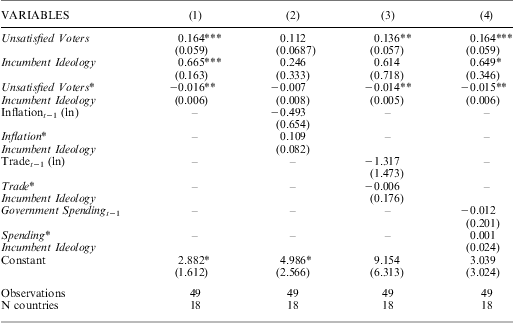
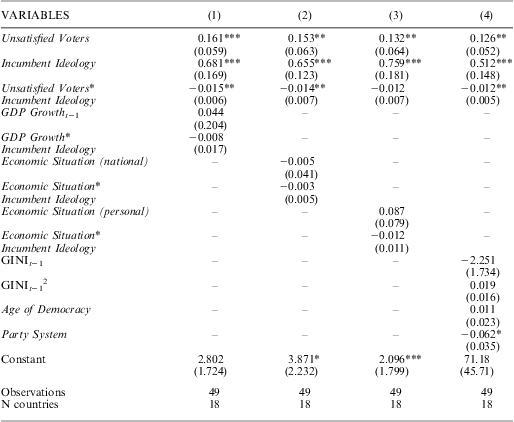
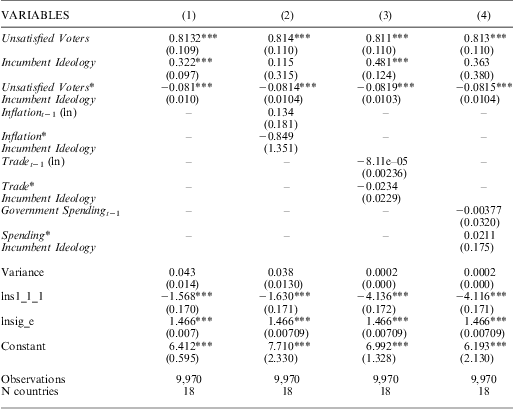
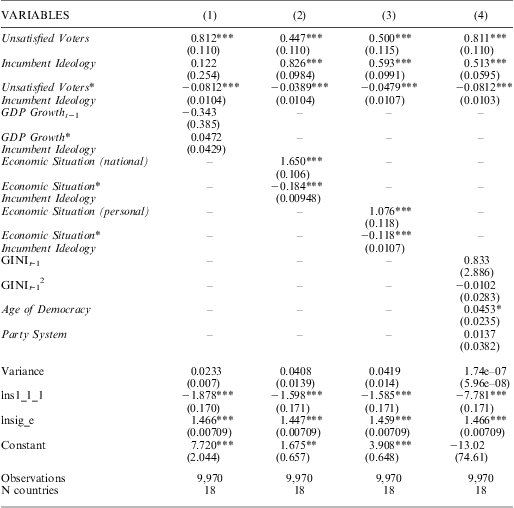
We now turn to a systematic assessment of the relationship between life satisfaction and the electoral success of the left across Latin America. Tables 1A and 1B report the estimates for our time-series, cross-sectional GEE models, with the measure of VRL as the dependent variable. Tables 2A and 2B report the results of our multilevel models with the individual responses to the vote intention question as the dependent variable. As a first step for both estimations, we ran a simple base model (Column 1) before controlling for alternative hypotheses. If our proposition holds (that is, if the life satisfaction of the electorate is related to the electoral gains of the left, conditional on the ideology of the incumbent), we should see a negative sign on our interaction term, Executive Ideology x Unsatisfied Voters. This is, indeed, what we find.
GEE Estimations of Vote-Revealed Leftism

Note: entries are GEE estimates using the independent correlation structure (tested with the stata library QIC (Cui, Reference Cui2007). Results are average estimates over five multiply imputed datatsets using Amelia (Honaker, King & Blackwell, Reference Honaker, King and Blackwell2007), and the Stata library miest written by Kenneth Scheve to calculate the models. Robust standard errors are in parentheses. ***p < 0.01, **p < 0.05, *p < 0.1.
GEE Estimations of Vote-Revealed Leftism
Note: entries are GEE estimates using the independent correlation structure (tested with the stata library QIC (Cui, Reference Cui2007). Results are average estimates over five multiply imputed datatsets using Amelia (Honaker, King & Blackwell, Reference Honaker, King and Blackwell2007), and the Stata library miest written by Kenneth Scheve to calculate the models. Robust standard errors are in parentheses. ***p < 0.01, **p < 0.05, *p < 0.1.
Multilevel Estimates of Voter-Revealed Leftism
Note: entries are multilevel models with maximum-likelihood estimation and identity covariance structures. Standard errors are in parentheses. ***p < 0.01, **p < 0.05, *p < 0.1.
Multilevel Estimates of Voter-Revealed Leftism (continued)
Note: entries are multilevel models with maximum-likelihood estimation and identity covariance structures. Standard errors are in parentheses. ***p < 0.01, **p < 0.05, *p < 0.1.
Even when we add our control variables to the models, the relationships remain remarkably stable across all alternative specifications. The interpretation of our interaction terms, however, requires a bit more work. As our conditioning ideological variables are continuous, the combined marginal effects and the corresponding standard errors are best presented graphically.Footnote 17 Therefore, for both the macro and multilevel models, we calculate the marginal effects, along with their 95 percent confidence intervals, across the range of actual ideology values in our dataset. The resulting graphs show that the findings for these models do not differ from the results of those without any controls.
Starting with our macro-level models, Figures 1 and 2 display the marginal effects for our base model, together with the models containing our alternative specifications (for the marginal effects for these specifications, see the online appendix). Whenever the upper and lower bounds of the confidence interval are both above (or below) the zero line, the effect is statistically significant. The graphs reveal that aggregate dissatisfaction under a right-wing government will add to the VRL.
Marginal effects for macro-level models
Marginal effects for macro-level models (continued)
Controlling for rival hypotheses, the effect of unsatisfied voters does not reach statistical significance for any ideological score above roughly 8, which means that only executives with an ideology score of 8 or below suffer from losses.Footnote 18 This comprises over 59 percent of all incumbents in our sample, and includes, for instance, former incumbents such as Jorge Batlle Ibáñez during the 2004 elections in Uruguay (ideology of 6.53), Nicanor Duarte in the 2008 elections in Paraguay (ideology of 5) and Fernando Henrique Cardoso in the 2002 elections in Brazil (ideology of 7.5).
As these results show, the left's electoral success can be explained by the aggregate dissatisfaction of the electorate, as captured by life satisfaction, under right-leaning incumbents during the late 1990s and early 2000s. This resonates well with the literature on the left turn, which has suggested that widespread dissatisfaction among the voting public was the underlying motivation for voters to support left-leaning candidates at the polls.
However, the results for the alternative explanations are not as robust. The only statistically significant result is for the interaction term Trade x Executive Ideology. The effect of trade is significant only for executives with an ideology score between 4 and 10, and from the marginal effects plot, no clear directional relationship can be deciphered. Among our control variables, only Party System reaches statistical significance at the 10 percent level. The negative relationships indicate that the higher the level of party system institutionalization, the less political space there is for left parties to emerge, and the lower the vote share of the left. This is a reasonably substantive relationship. The difference between the most institutionalized party system in the region and the least institutionalized is equivalent to a reduction in VRL of 1.7 points. This is roughly akin to the difference in support for the left in the 2006 Mexican election and support for the left in the 2005 election in Bolivia.
While our macro-level models capture the effect of life satisfaction on the actual electoral support for the left over the last decade, and thus model the complex temporal relationships involved in the phenomenon of the left turn, our individual-level models check whether the effect of life satisfaction holds for the electorate's hypothetical vote intention. As we can see from Tables 2A and 2B, our interaction term, Life Satisfaction x Executive Ideology, is negatively signed and statistically significant in every multilevel model. Figures 3 and 4 display the marginal effects of life satisfaction on the electorate's vote intention, conditional on the ideology of the incumbent, while controlling for alternative explanations.
Marginal effects for multilevel models
Marginal effects for multilevel models (continued)
As each individual pane in these figures demonstrates, the level of life satisfaction of individual members of the electorate clearly conditions their vote intention. Dissatisfaction under a right-leaning incumbent will add to the hypothetical vote share of the vote. Conversely, dissatisfaction under a left incumbent will have a deleterious effect on the hypothetical vote share of the left.
According to our base model, in the northwest pane of Figure 3, this relationship is statistically significant for all right-leaning incumbents with an ideology of 9 and below, and for all left-leaning incumbent with an ideology of 11 and above. This relationship holds, even when we control for competing explanations (Figures 3 and 4). Clearly, life satisfaction (as a manifestation of retrospective utility that incorporates dissatisfaction with poor economic growth, macroeconomic instability, rising indigence and liberalization), together with unobserved heterogeneity can explain the vote intention of individual voters, conditional on the incumbent's ideology. This finding complements the existing literature on the left turn in Latin America, and complements and contributes to the rich literature on retrospective voting.
Turning to the alternative explanations, GDP Growth x Executive Ideology and Trade x Executive Ideology again reach statistical significance, but only for incumbents with an ideology between 4 and 12. As before, we cannot discern a clear directional relationship from the marginal effects plot. Perceptions of the current Economic Situation, at both the national and individual levels, are also statistically significant. Under a right incumbent, poor pocketbook and sociotropic evaluations add to the left's hypothetical vote share. Under a left incumbent, however, poor economic evaluations reduce the hypothetical vote share of the left. Finally, we find greater potential electoral support for the left in more mature democracies (Cleary Reference Cleary2006). The difference between the oldest and youngest democracies in the region is equivalent to an ideological score differential of 1.8 with respect to the vote intention question.
Our analysis highlights a number of intriguing results that relate life satisfaction to electoral behavior in the young democracies of Latin America. Our aggregate time-series models capture the actual temporal electoral dynamics at play across the region over the last 15 years, as the majority of incumbent governments during this period were right leaning. In fact, in only 8 percent of elections during this period did incumbent presidents have an ideology greater than 13 on our scale from 1 (right) to 20 (left). However, as an added robustness test, we also examined this relationship at the individual level for the 2006 election year. This test demonstrated that life satisfaction could condition the hypothetical vote choice of the electorate across both left and right incumbents.Footnote 19 None of the alternative explanations proved as robust. The results for sociotropic and egotropic evaluations, although significant at the individual level, disappear when modeling this effect over time. These economic evaluations could not explain the actual pattern of left-leaning electoral victories during the last 15 years, which was the temporal dynamic we wished to explore. Conversely, life satisfaction (as a dynamic measure of public frustration) captures these trends at the individual and aggregate levels.
We also estimated a series of alternative specifications as robustness checks.Footnote 20 First, we controlled for the explanations for the left turn presented by Baker and Greene (Reference Baker and Greene2011). In the multilevel models, we controlled for attitudes toward trade, privatization and the role of the state versus the market.Footnote 21 We also controlled for pessimism regarding crime, negative US sentiment and support for democracyFootnote 22 and included controls for age, gender, marital status, education and income. The controls for democracy proved to be insignificant, while a negative opinion of the United States contributes to support for leftist positions. However, our results for life satisfaction remained unchanged.
Secondly, we controlled for per capita GDP and replaced Trade first with a measure for foreign direct investment (FDI) and then with the Swiss Economic Institute (KOF) index for economic globalization, which measures not only actual flows but also policy restrictions. Then we excluded possible outliers. Thirdly, we excluded possible outliers. Fourthly, we re-ran the multilevel models and only included countries in which elections were held in 2006.Footnote 23 In the multilevel models, we also dichotomized our life satisfaction variable into those who are satisfied and those who are not satisfied. The interaction term remained correctly signed and statistically significant. Finally, we also re-ran the macro-level models with 10 and 40 multiply imputed datasets,Footnote 24 and without any imputation at all. None of these changes influenced the results presented here.
Conclusion
The study of subjective well-being is attracting growing attention from political scientists. Only recently have studies started to explore, in addition to economic factors, the political determinants of life satisfaction.Footnote 25 In this article, however, we follow Frey and Stutzer's appeal (2002) and consider the effect of life satisfaction on political behavior. Building on the empirical literature on subjective well-being in economics and psychology, we emphasize the value of the concept of life satisfaction in explaining electoral behavior in the political economic context of young democracies undergoing market reform, and apply the notion of aggregate dissatisfaction to the so-called left turn in Latin America.
We show that subjective well-being does indeed add to the vote share of leftist positions, a finding that is robust against the most prominent explanations found in the literature. Our results demonstrate that life satisfaction can be a useful supplement to explanations rooted in economic voting. Compared to standard measures, it captures temporal dynamics and the complex psychological interaction of perceptions linked to relational comparisons, which play an important role in times of prolonged adjustments and crisis. This property helps shed light on the mixed empirical evidence of the left's electoral success, which the contemporary literature has struggled with.
Yet in the Latin American context, this raises questions about the sustainability of the left turn. Many of the explanations predicated on the theory of economic voting establish a link between the left turn as a specific electoral behavior and demands for increased public expenditure. However it is increasingly difficult to extrapolate clear left-right ideological positions on the policy dimension of redistribution in Latin America, as recent presidential elections have markedly shown. As such, the incumbent's ideology becomes a less salient explanation of redistributive policy agendas across the region. In Brazil, all candidates, irrespective of their partisan hue, explicitly expressed their support for the maintenance and extension of the cash transfer program, Bolsa Familia. In fact, recent research indicates that the campaigns of right-leaning incumbents in gubernatorial elections successfully hijacked credit for the Bolsa Familia, thus increasing their vote share (Montero Reference Montero2010). Similarly, the conservative presidential candidate, Sebastián Piñera, successfully contested the 2010 election in Chile on a platform that pledged to largely leave intact the social policy introduced by his predecessor from the left-leaning Concertacíon.
This suggests that the “new left”, rather than representing a new epoch in Latin American politics, is simply part of a larger election cycle (Arnold and Samuels Reference Arnold and Samuels2011). Thus the argument presented here offers a first step toward a temporal explanation that moves beyond the left turn, in a context of stable mass political beliefs. In the current political economy of Latin America, the left may be the more credible alternative for alleviating the detrimental effects of market reforms as captured by subjective well-being. However, since life satisfaction is not specifically “left”, and an electoral alliance based on aggregated dissatisfaction is not especially stable, such a premise calls into question the sustainability of this left turn. Although our macro study relies on a moderate number of observations, the results of this article are instructive. If current left incumbents are unable to deliver policies that improve the electorate's well-being, they run the very real risk of losing office at the next election, as the results from our individual-level models suggest. Future research should concentrate on the dynamics behind life satisfaction and policy delivery to fully untangle the implications for the survival of the incumbent president.