College education, whatever its form, has always carried with it a consciousness of possibilities for women.
In the Company of Educated Women, B. M. Solomon1
B. M. Solomon, In the Company of Educated Women (New Haven, Conn.: Yale University Press, 1985).
Refers to the veil and/or proper, modest Islamic dress.
Literally translates to “sisters,” although in postrevolutionary Iran, the term refers to a female government employee.
Iranian women are a visible and significant part of this country's elite public college campuses. For over a decade, the number of women attending institutions of higher education has been growing steadily.4
Shahla Kazemipour, “Evaluation of Women's Expanded Participation in Higher Education.” A report prepared for Iran's Ministry of Culture and Higher Education, 1999.
Amid these social and political debates lies a gaping hole; a void concerning our understanding of how this institution impacts Iranian women. Specifically, what role does higher education play in the lives of Iranian women? In addition, what are the experiences of Iranian women at these institutions? In this manuscript, I examine the experiences of modern-day women in Iranian institutions of higher education. The literature is silent on these women's own perception and opinions about this topic.5
Mahnaz Kousha's recent publication Voices from Iran: The Changing Lives of Iranian Women (Syracuse, N.Y.: Syracuse University Press, 2002) is one recent scholarly work recognizing the importance of women's own perceptions and opinions about their realities.
IRANIAN WOMEN'S PUBLIC STATUS AND ROLE: “THE WOMAN QUESTION”
The role and status of women in Iranian society, or more commonly termed “the woman question,” is by definition central to feminist scholarship, which by now encompasses a wide spectrum of thought (e.g., Western feminism, legal feminism, Marxist feminism, postmodern feminism, radical feminism, among others). In this study of the role of higher education in the lives of Iranian women, I pose “the woman question” within an emerging epistemology where the content and form are both Islamic: Muslim feminism. Iranian Muslim feminists
6Until now Iranian Muslim feminist discourse has been situated in women's weekly and monthly magazines. See for example Etezadi Tabatabai, Zan Ruz, June 1981; F. Hashemi, Ettellaat,28 July 1980; Zan Ruz, June 1991.
L. Abu-Lughod, Remaking Women, Feminism, and Modernity in the Middle East (Princeton, N.J.: Princeton University Press, 1998).

an states that education is the duty of every Muslim (male and female).
In the Iranian context, however, an “Islamicized” state has not always recognized women's status. Throughout its first decade in power, the IRI undermined the legal and social position of women by repealing the Family Protection Act,8
The Family Protection Act of 1967 and 1973 restricted polygamy, raised the age of marriage for girls, and allowed women the right to divorce.
Valentine Moghadam, “Islamic Feminism and its Discontents: Toward a Resolution of the Debate,” Signs: Journal of Women in Culture and Society 27 (2002): 1135–71.
Afsaneh Najmabadi, “Power, Morality, and the New Muslim Womanhood,” in The Politics of Social Transformation in Afghanistan, Iran and Pakistan, ed. Myron Weinter and Ali Banuazizi (Syracuse, N.Y.: Syracuse University Press, 1994), 366–89.
Therefore, although Iranian Muslim feminists cite education as the most important social vehicle for the advancement of women's status in Iranian society, to date, there has been scant empirical research to investigate its connection to women's advancement in society. In fact, little is known about girls/women's education: few studies look at girls' access to education at primary levels11
Golnar Mehran, “Ideology and Education in the Islamic Republic of Iran,” Comparative Education Review 20 (1990): 53–65.
Patricia Higgins and Pirouz Shoar-Ghaffari, “Sex-Role Socialization in Iranian Textbooks,” NWSA Journal 3 (1991); Jacquelline R. Touba, “Cultural Effects on Sex Role Images in Elementary School Books in Iran: A Content Analysis after the Revolution,” International Journal of Sociology of the Family 17 (1987): 143–58.
J. Matini, “The Impact of the Islamic Revolution on Education in Iran,” in At the Crossroads: Education in the Middle East, ed. A. Badran (New York: Paragon House, 1989), 43–55; Hammed Shahidian, “The Education of Women in the Islamic Republic of Iran,” Journal of Women's History 3 (1991): 6–38, 12–14, 17–20; Khosrow Sobhe, “Education in Revolution: Is Iran Duplicating the Chinese Revolution?” Comparative Education Review 18 (1982): 276.
S. Ghahreman, “The Islamic State's Policy Towards Women's Access to Higher Education and Its Socioeconomic Effects,” Nimeh-ye Digar 7 (1988); S. Mojab, “State Control and Women's Resistance in Iranian Universities,” Nimeh-ye Digar: Iranian Women's Feminist Journal 1 (1991): 35–76.
Women's Education in Iran
The history of women's education in Iran is relatively new. Girls have been allowed into schools for only a little over a century, and admitted to colleges and universities for only 75 years. Women's education is rooted in religious and political debates concerning the role of education for Iranian women and began as a hodgepodge of predominantly Western influences. “Modern schooling” for women as prescribed by the United States of America, England, France, and even Russia appeared in Iran as early as 1835.15
Reza Arasteh, Education and Social Awakening in Iran, 1850–1968, 2nd ed. (Amsterdam: E. J. Brill, 1969).
Guity Nashat, Women and Revolution in Iran (Boulder, Colo.: Westview Press, 1983).
By the 1920s there were approximately 58 schools in Tehran that provided education for approximately 3,000 girls.17
Parvin Paidar, Women and the Political Process in Twentieth-Century Iran (Cambridge: Cambridge University Press, 1995).
It took more than a century from the opening of the first school for girls in 1895, and the forceful rule of Reza Khan of the Pahlavi dynasty (r. 1925–41), for girls and women to substantially participate in schooling in Iran. In 1932, supported by liberal intellectuals, Tehran University opened its doors to Iranian women. Admitting women to Iran's system of higher education symbolized Reza Khan's modernizing agenda that included reforms to the status of women through their participation in the educational system.18
Eliz Sanasarian, The Women's Rights Movement in Iran: Mutiny, Appeasement, and Repression from 1900 to Khomeini (New York: Praeger, 1982).
Hamideh Sedghi and Ahmad Ashraf, “The Role of Women in Iranian Development,” in Iran: Past, Present and Future, ed. J. W. Jacqz (New York: Aspen Institute for Humanistic Studies, 1976).
Kaveh S. Mirani, “Social and Economic Change in the Role of Women: 1956–78,” in Women and Revolution in Iran, ed. G. Nashat (Boulder, Colo.: Westview Press, 1983).
Although many lauded the increase in women's higher education enrollment as evidence of women's advancement under the Shah, the statistics concealed vast numbers of Iranian women who were not represented in the educational system—women who were illiterate, poor, tribal, and/or rural. For instance, rural and poor women, most often more traditional and more religious than their urban counterparts, elected not to go to Pahlavi's “secular” schools. This urban–rural and socioeconomic discrepancy illustrates how the Pahlavi's educational agenda affected only a small portion of Iranian women (and men)—those from urban upper class families with access to education.21
Said Arjomand, The Turban for the Crown (New York: Oxford University Press, 1988); Nikki Keddie, The Roots of Revolution: An Interpretive History of Modern Iran (New Haven, Conn.: Yale University Press, 1981); Mojab, “State Control and Women's Resistance in Iranian Universities,” 35–76; Robert E. Rucker, “Trends in Post-Revolutionary Iranian Education,” Journal of Contemporary Asia 21 (1991): 455–69.
Women's education under the IRI
When Khomeini came to power in 1979, his newly formed Islamic Republic inherited a “Westernized” education system that was fundamentally secular and promoted education for a small segment of Iranian women—urban, elite women. His newly formed government set out to “Islamicize” the country with the educational system as its top priority. This system of “purification” required the educational system to be culturally and religiously transformed. The overriding objectives were to stress values over knowledge, to make education meet the needs of society, and to eradicate what remained of the influence of the Pahlavi period.22
David Menashri, Education and the Making of Modern Iran (Ithaca, N.Y.: Cornell University Press, 1992), 227.
Mojab, “State Control and Women's Resistance in Iranian Universities,” 35–76; Rucker, “Trends in Post-Revolutionary Iranian Education,” 455–69; Sobhe, “Education in Revolution,” 276; Farideh Selhoun, “Iran,” Integrateducation 20 (1983): 13–14.
H. Esfandiari, “The Politics of the ‘Women's Question’ in the Islamic Republic, 1979–1999,” in Iran at the Crossroads, ed. John L. Esposito and R. K. Ramazani (New York: Palgrave, 2001), 75–92.
Although Khomeini shunned Western-style education, he strongly advocated Islamic education to advance his political and social agenda. Khomeini believed that women should be educated to the extent that it did not interfere with a gender-segregated society. Regulations were put in place concerning what women could study barring nearly half of available fields of study.25
Matini, “The Impact of the Islamic Revolution on Education in Iran,” 43–55.
Men could not enter such fields as dental hygiene, midwifery, family health, fashion design, and sewing-instructor training.
Once the educational system was deemed “Islamicized,” there was greater freedom in the negotiation of women's roles within its system. As a result of the lobbying efforts of the Women's Cultural and Social Council, many of the restrictions on women's higher education were slowly lifted. By the mid-1990s, with all limitations lifted, Iranian women began gaining admission to fields that, before the revolution, had been male dominated.
One of the most commonly cited reasons for women's advancement in entering institutions of higher education has been attributed to the solid and strong Islamic identity that Iranian universities have established. It is an atmosphere that has secured the trust of traditional religious families who make up the vast majority of the Iranian population. Sociologist Jaleh Shaditalab states,
Before the revolution some families did not want their girls to go to school because their teachers would have been men. But since it came in an Islamic packaging, people were more willing to accept it as Islamic education. That's why you see the rate of enrollment in schools rise. Now we see the share of girls in universities…families now think the universities are teaching Islamic beliefs, and that there is no harm in their daughters going to university because they are sleeping in [single-sex] dormitories.27
Quoted in Jane Howard, Inside Iran: Women's Lives (Washington, D.C.: Mage Publishers, 2002), 84.
SEEKING THE VOICES OF WOMEN: METHODOLOGY
The role of gender in Muslim societies is an understudied phenomenon that lends itself to an inductive approach to data gathering, a method that can best be characterized by grounded theories.28
M. Q. Patton, Qualitative Evaluation and Research Methods (Newbury Park, Calif.: Sage, 1990).
M. B. Miles and A. M. Huberman, Qualitative Data Analysis: An Expanded Sourcebook (Thousand Oaks, Calif.: Sage, 1994).
Context for Research and Role of Researcher
Conducting research in Iran is a difficult task. In a milieu of pulsing Islamic fervor, collecting data on Iran's system of higher education, which inevitably reflected young Iranians' questioning of strict religious and cultural norms, is treacherous. The data presented here were collected during fieldwork in Iran in the summer of 2002 and the winter of 2003. This was a time of heightened sensitivity, as the U.S. presence in two neighboring countries—Afghanistan and Iraq—threatened IRI's legitimacy. The Iranian college students in this study—all born after 1979—are part of a cohort known to Iranians as children of the revolution, or the “fruit of Iran's 1979 revolution.” This generation of approximately 21 million in 200130
“Employment in Iran” in Eqtesad-e Iran 6 (November 2003): 39–40, http://www.netiran.com/php/artp.php?id=24.
Sobhe, “Education in Revolution,” 276.
As both an Iranian woman and a U.S.-trained researcher, I am able to use a dual perspective, both inside and outside of the Iranian women whom I study, to design, collect, and analyze my data. Anya P. Royce would identify me as a “cultural broker”—someone who is able to communicate with two distinctly separate worlds.32
Anya P. Royce, Ethnic Identity: Strategies of Diversity (Bloomington, Ind.: University of Indiana Press, 1982).
Data Collection
I translated a self-designed questionnaire into Farsi and subsequently edited it several times for clarity and political sensitivity. It included one page of demographic information and twenty-nine questions (nine multiple choice, twenty open ended) designed to illuminate participants' college experience.33
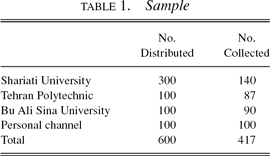
An optional section asked whether the respondent was willing to be contacted for a personal interview. Of the 417 respondents, 212 provided their contact information from which I followed up with 34 interviews; time did not allow me to contact all students who had expressed an interest in follow-up interviews. Interview data were used to explore themes; data in this paper are from the questionnaires.
The questionnaires were officially sanctioned and supervised by the Ministry of Education and each college's administration. Securing permission from governmental authorities was mandatory before I approached any colleges or universities. For this research, they provided a letter granting me permission to conduct research, providing that each school would distribute, collect, and review the questionnaires before handing them back to me. Despite previous approval of the questionnaire and its distribution, one institution (Shariati University) alerted authorities that students' responses could be politically sensitive and thus 160 of the 300 completed questionnaires were confiscated.
In reaction to this official action, I used personal contacts to distribute another 100 questionnaires at Sharif and Tehran Universities, two of Iran's most prestigious institutions; ten students distributed ten surveys each. Altogether, I collected a total of 417 completed questionnaires.34
In addition to these surveys, I also interviewed men and women who opted out of the college track, as well as with those who had failed the college entrance examination and had enrolled in a private college (such as Azad University). I also conducted formal interviews with seven college administrators. Their comments have helped inform the content of this work.
Sample
Respondents in this study attended five Iranian universities: Shariati University,35
The university is named after the Iranian thinker Dr. Ali Shariati (d. 1977), whose published lectures during the 1960s and 1970s had a great impact on the debate concerning women in an Islamic society.
Depending on the field, female students at Tehran Polytechnic range from one-third to two-thirds of the total students enrolled in each department. The university provides training in fields such as electrical engineering, biomedical, textile manufacturing, and so forth. Women who are accepted at Tehran Polytechnic have some of the highest college entrance examination scores in Iran.
The social climate in cities other than the capital city, Tehran, is considered more traditional and religious. My intent in including an institution outside of Tehran in my study was to pose a counterpoint to what I heard from students in what is considered a cosmopolitan setting.
Sharif University, established in 1966, is one of the largest engineering schools in IRI and has a student body of approximately 8,000. Tehran University was established in 1934 and was the first to admit women.
B. Glaser, Basics of Grounded Theory Analysis: Emergence Versus Forcing (Mill Valley, Calif.: Sociology Press, 1992); A. Strauss and J. Corbin, eds. Basics of Qualitative Research: Techniques and Procedures for Developing Grounded Theory, 2nd edition. (Thousand Oaks, Calif.: Sage, 1998).

It should be noted that access to higher education has been expanded to include Iran's minorities, and, as such, this sample captures Iran's unique linguistic40
Languages in Iran are generally divided by linguists in two groups: Western (Gilaki, Mazandari, Tajik, Tati, Talishi, Kirmanji, Baluchi, Parachi, Ormuri, Luri, Sivandi, Gabri, and Qumzari dialects) and Eastern (Afghi, Ossetic, Yaghnobi, Munjani, and Pamiri). For a discussion of Iran's linguistic diversity see Richard Nyrop, Iran: A Country Study (Washington, D.C.: American University, 1978).
Some of the major ethnic groups in Iran include the Gilani, Mazandaranis, Kurds, Turks, Lurs, Bakhtiaris, and Baluchis.
Data Analysis
Data analysis in this study is based on grounded theory, an inductive approach that required each questionnaire response to be considered independently. The open-ended responses generated a myriad of issues that were coded and organized along themes. In sum, four themes emerged through the analysis as factors that paradoxically both facilitated and inhibited women's college experience: sense of self, real-world experiences, influence of family, and financial empowerment. For each of these themes, I assigned women's “voices” that were reflective. Once these “voices” were selected, they were translated from their original Farsi text. Despite my efforts to translate their statements as accurately as possible, translation inevitably loses some of the original connotation. Words that have no direct translation have been directly introduced with the closest English definition parenthesized and/or footnoted. My aim was to preserve the integrity of women's voices that were open and revealing about the realities of their lives. I purposefully have avoided quantifying responses; to do so, I believe, would have weakened my emphasis on women's words.42
M. Belenky, Women's Ways of Knowing: The Development of Self, Voice, and Mind (New York: Basic Books, 1997); C. Gilligan, In a Different Voice: Psychological Theory and Women's Development (Cambridge, Mass.: Harvard University Press, 1993).
FINDINGS
A Sense of Self: Intellectual Development but Little Academic Growth
Iranian women's college experience fosters nonacademic intellectual growth. The experience is one of self-growth, self-actualization, and self-respect. What college seems to shed from young Iranian women are their sheltered upbringings. Before college, their daily lives are literally confined to their homes; there is very little young, unmarried women can do outside the home. Freed from the dictates of family life, they begin to understand themselves. It is the first, and sometimes the only space, where Iranian women have a public presence. Within this public space, they begin to understand themselves in relationship to Iranian society. A twenty-two-year-old Iranian Lur from Malayer, a town on the outskirts of Hamedan, “sighs” that, other than studying, there are very few options for young Iranian women.
Outside of school I didn't have any particular activity but to study. I spent most of my time at home. I didn't have a special place to go. I loathed the small town mentality/environment of shahristān.43
Commonly referred to as smaller provinces or townships.
In our society, girls have nothing else to do except study. They can have no fun or entertainment. They cannot work. With all the societal limitations for girls, we [girls] have only one thing to do and it is to study.
Sometimes I'd be able to have my friends over. My mother would make us lunch and we'd put on some music and dance.
Now in our dorm room, every night I dance with my roommates. Some of my roommates have never done that before; I'm one of the lucky ones because my parents let me have my friends over.
What I have gained from college has been gaining an independent life, finding friends and learning social behavior. I used to look at society and people through blinds. It was a limited view. My horizon has been expanded. Now life has become more valuable. I see myself with value and as one who is worthy of that value. I have gained self-respect.
For most of these women, college is their first chance to leave their homes and travel beyond the boundaries of their small towns and villages. This experience alone is a leap toward personal growth that helps these women to see possibilities and shape their expectations. For these young women, entering college is an awakening—an understanding of their own self—one that stems from being on their own. Until now, their sense of self was entangled with that of their families and even their small communities. Their notion of self rested on the collective family identity and not their individual selves. Understandably, being on their own and being separated from family can also create feelings of loneliness. A twenty-year-old Iranian Geelak studying graphics at Sharif University in Tehran whose family is from Ramsar, a small town near the Caspian Sea, explains that going to college in Tehran is marked by a duality: a sometimes lonely but largely a growing experience. She states,
I have gone through a lot of changes. My expectation from life has risen, tremendously. Even though every once in a while I feel empty. But I try to think about life in this big city [Tehran] and life's bigger possibilities. This is what college has done for me.
ī (loneliness) is their interpretation of being and living on their own. Unraveled from controlled home environments, young college women understand their sense of self in society and the complications that this Muslim society poses for them in terms of their gender. This discovery of self for them is associated with loneliness. A twenty-two-year-old dental student at Bu Ali Sina University puts it quite succinctly:
Before college I looked at life in a simple way. But now, I have entered college, I have entered society. I see life's complexities.
Muslim women must abide by a modest dress code, hijāb, that covers their body and hairline. Rūsarī refers to a woman's headscarf, and mānto is a loose fitting overcoat that can be worn in place of a chador, the traditional body covering for Muslim women.
Her comment echoes a statement made by Farzaneh Milani in “Lipstick Politics in Iran,” New York Times, 19 August 1999.
These college women seem to become socially savvy, although not necessarily academically astute. Nearly all respondents expressed strong disappointment in how little they learn in college. Two general issues seem to pose as obstacles for women to gain academic knowledge: a lack of qualified professors, which is common with most developing nations; and not being taken seriously as female college students.
The scarcity of good professors is a recurring reason behind their inability to develop academically. One twenty-one-year-old dental student at Bu Ali Sina University says that,
We don't have many knowledgeable and professional professors. Those who don't know the topics they are teaching make their classes extremely difficult for no reason at all. Only to make us small [humiliate us]. Or they don't show up to class at all. In the end, their lack of knowledge works out bad for us in two ways. We don't learn and we get a bad grade.
They [administrators] will have to start the class at the beginning of the semester and if they can't find anyone to teach the course, they just put anybody to show up to teach the class. I often know more about the subject than the professors who are up there in front of the class. They don't know the answers and send us to find our own answers. It is very frustrating.
We can't just go and talk to the male professors, even if it is strictly to improve or expand our knowledge. People will talk if you make a [office] visit more than once. The door to their office has to be open so no one suspects anything so if you want to discuss a sensitive issue you can never approach your professor in their office. It is always right after class with a lot of people shouldering you for the same attention from the professor. You can barely talk or reach your professors.
Sometimes they [professors] make it unreasonably difficult and sometimes it is not difficult but in most cases it doesn't make a difference whether I am in class or not. My presence in class doesn't count.
In class, if you know professors [they] are wrong and you want to argue the point, they single you out as a troublemaker. So these classes become a one-way discussion, men only.
Real-World Experiences: Increased Hope and Opportunity for Second-Class Citizens
In Iranian society, entering college, and by extension, acquiring higher education credentials, offers the promise of social and financial mobility for young adolescents. The competition that surrounds the college entrance examination is one testament of how highly coveted college credentials are in Iran. One can imagine that, for women living in a restrictive Muslim society, college embodies hopes and dreams to transcend their realities. One respondent who had not included any demographic information anonymously said the following:
More than anything I wanted to go to college. My parents, my relatives, my friends, everybody, I wanted to show them all that I could pass kunkūr and get in. I would get a lot of respect if I passed. My parents would be most proud.
Women are always looked at as qeshr (an extra layer) in this society. They're small and haqīr (insignificant). College finally grants us our share of the society. As a result, girls get their worth and importance in this society.
The only right women find that is granted to them and is encouraged is the right to an education. Even Khomeini used to preach that women must get an education. In today's Iranian society, women are considered “second-class citizens.” They have no rights; no place in society, there is no place for women's rights. Going to the university has become the only thing that we are allowed to do.
Other than their expected roles as mothers and wives, women are generally isolated from participating in society. There is a connection between these women's statements of feeling marginal and their naiveté about social life. Because they have been isolated and have not experienced life in the public sphere, they feel and know they are treated lesser to men. Young women described this position, repeatedly, as marginal—as “second class citizens.”
A substandard social position is created for these women when they lack knowledge about life beyond that of their families. Their most salient feature of this seclusion is that they have not learned about diversity and/or the opposite sex. Prior to college, not only were they not allowed to socialize with the opposite sex, but also they did not come into contact with the diversity of Iranian ethnic cultures. For instance, in the Hamedan region where Bu Ali Sina University is situated, there are Kurds and Turks among the “mainstream” Fars. Yet, these ethnic communities dramatically curtail contact with one another. Amazingly, these young women grow up in towns, villages, communities without ever coming into contact with “other types of Iranians,” as was put in one questionnaire. They know these “other” ethnic groups exist, but it is a coexistence that is solidly void of contact. Thus, when young women enter college, their understanding of the variety of cultures that exist in Iran is quite limited. A twenty-one-year-old electronic engineering student at Shariati who grew up in Tehran admits that she was not aware of diversity among Iranians. She explains,
My college experience has allowed me to come into contact and deal with people with different languages and religions—the ones that I had absolutely no knowledge of before coming to college. My preconception of these religions was not positive. I have also learned about different cultures.
More profound than learning about diversity in and about their society is their social experience with the opposite sex. College is the first public context in which young Iranian women and men come into social contact with one another. This twenty-two-year-old dental student at Bu Ali Sina University states,
While I was living at home I had no contact with the opposite sex. Actually, I better say I didn't have permission to have contact with them. But since I have been in college, my unique experience here has been to have contact [with men]. I am more comfortable around them [men] now. My perception towards the opposite sex has completely changed.
Although contact between the sexes is monitored and tightly controlled, young men and women surreptitiously find ways to communicate and to meet. Comments about how telephone numbers are exchanged under the watchful gaze of authorities abound among these college women. For many, the exchange of telephone numbers with the opposite sex is a “game.” Rendezvous' are orchestrated outside the college campus to avert the watchful eyes of the school administrators, even though it is known that there are just as many monitors beyond the college campus walls. One of the most notorious forms of off-campus scrutiny is conducted by a government body called the kumīta (morality squad) whose patrol cars roam city streets night and day looking for social violations. A twenty-year-old graphic design major at Shariati University describes the punishment for coming into contact with the opposite sex:
Last month, several of us made plans to go out to a movie. When my girlfriends and I arrived at the movie theater, I shook the hand of my brother's roommate, Keivan. Just then one of kumīta (morality squad) patrols drove up. One of the morality guardians got out of the car and asked what this man's relation was to me. When I told them it was my brother's roommate, they asked Keivan to go into the patrol. We were so scared for him. It happens all the time but each time, it still scares you. It leaves you trembling. They drove Keivan around for twenty minutes shouting at him and slapping him across the face. When he came back, there were tears in his eyes. We decided not to go to the movie that night after all.
One night a whole bunch of us were walking back to the girls' dormitory. A patrol drove up and asked what the relation was of the boy walking next to me. I told him we are college mates. He started shouting and yelling at him but then found out that he was from his hometown. So he hit him across the head and told him that he better watch his steps next time. He let him go because he was from the same hometown.
In one scenario, a respondent's anecdote illustrates how such a “game” between young men and women comes with a “high price tag.” She recounts a story of how authorities caught her and her boyfriend during their school holidays; a memory revealing that these women endure physical and emotional scars in their quest to find a male friend, partner, or even husband. As a twenty-four-year-old physical education major at Tehran University, she recalls her bitter memory:
Last Noruz46
Noruz is the Persian New Year celebrated at the turn of the vernal equinox (21 March) of a calendar year.
Finding a suitable husband is a powerful subthread in these women's words. For many, finding a man who has an equal, if not a better, college education seems a difficult task. There is a social stigma connected to marrying men who are less educated, and in today's Iran, this is an increasingly challenging agenda. A twenty-four-year-old Iranian Kurd majoring in music at Tehran University explains,
The positive part of my college education is that I will be able to be a better mother. But here is the negative part to it—I'll also have a hard time finding a suitor. It disqualifies many of the suitors that our family knows. Boys are at a disadvantage for marriage when women have more education than they do.
After graduation we [women] get married and end up at home and/or we will never use our education. Even, in regard to marriage, our education will create a bigger problem for us…outdoing them [men] in education will make it more difficult for us to find a husband.
College elevates hopes and increases opportunities, because only with a college degree can these women have a better chance of becoming participating members of society, understanding themselves and feeling independent for the very first time, coming into contact with the opposite sex, and increasing their value in marriage. In reality, however, this promise fails. Out of college, these women will most likely not find employment, will not gain independence, and will have difficulty finding a suitable marriage partner. They do not get integrated into society, and, educated, they are relegated to the confines of their homes. Isolation from the public sphere continues after college. In the words of one twenty-one-year-old woman from Hamedan, “college is a four-year detour from our father's house to our husband's.”
Family Influence: A Force That Both Enables and Disables
Another relevant factor in the college experience of Iranian women is the role of family, defined as both immediate and extended. I found families to play a crucial role in enabling women to succeed in gaining access to college but, at the same time, limiting their life before and after college. I also found that women either described their families as mazhabī (religious) and/or referenced them as sunnatī (traditional). There is a fine line between these two descriptors. Although some families are both religious and traditional, not all religious families are traditional.
My family is very religious. My father is a clergyman but he is not very sunnatī. He encouraged me to study and to come to college. When I am ready for marriage, I know they will let me decide whom I want to marry…I'll of course consult with them but it will be my decision in the end.
Rawdha may be metaphorically defined as “the Garden of Paradise,” where believers interact and recall the principle beliefs of Islam during eulogies for different Shi

i martyrs. The term originally comes from a book called Rawdhat al-shuhada by Mulla Hossein Kashifi (who has compiled Lubb-i lubab-i mathnawi). He was the first person who compiled a book with such content, and later on, it became prevalent in Shi
i circles. Since then, whenever such sessions are held, they are called rawdha.
Surprisingly, both religious and/or traditional families are described as supporters and facilitators of women gaining access to college. For instance, women discuss how their entire families helped them study for the college entrance examination. A twenty-two-year-old physics major at Tehran Polytechnic who comes from a village, Harseen, and a mazhabī family of six children whose parents are both illiterate, explains:
All my family expected me to do was to study. From the moment I woke up to when I went to bed I couldn't do anything else. Just study. My mom even made me extra rich foods so that I had extra energy to study. I studied day and night. There is nothing harder than getting ready for kunkūr.
Another twenty-year-old graphic design major at Shariati University states that her brother and sister cleared out of their shared bedroom in their Hamedan apartment so that she could have ample space to study. Similar stories of “family sacrifice” and dedication to women's education abound in these women's responses. Most women seem to attribute their success in gaining access to college to their families. However, their comments are also balanced with a sense of needing to escape a “confining” family environment. In this next quote, a woman from the village of Marvdasht studying biology at Bu Ali University describes her family environment as “suffocating”:
Most Iranian girls, in order to escape the dictating conditions of their home environment—they do their best to get accepted to college, especially in a town away from their hometown so that they can flee the family pressures that suffocate them.
Girls face so many problems with their families and with society as a whole that they force themselves to escape these problems and to find shelter through education.
In most Iranian family environments, a girl who attends university and one who does not, never share the same liberties. And for an Iranian girl, the most important way to escape her family environment and gain freedom and independence is to enter university.
Parents now have a better understanding and pay a lot more attention to their daughters [college] education. The expectation is that once educated, they will have a better place in society and a better future both for marriage and financial possibilities.
an and the Traditions of the Prophet (Hadith or Sunnah) state that education is the duty of every Muslim (male and female). In addition, because institutions of higher education are “Islamicized” under the IRI, families accept and encourage their daughters to pursue education. As such, they are willing to modify their religious and/or traditional beliefs to align with contemporary pressures facing their daughters' future. Families as enablers make accommodations for their daughters' future; as disablers, they set restrictions before and after college.
Financial Empowerment: Preparing for Jobs That May Not Materialize
Financial empowerment was a fourth theme that emerged. Regardless of their socioeconomic background, women indicated that they would not like to be dependent on their families or husbands and that they would like to be able to work. Finding a job is closely equated to freedom, independence, respect, and social status—all qualities, in their opinion, of which Iranian women are deprived. They hope college would enable them to find employment, allowing them to perhaps parlay the financial gains and economic independence into other less tangible but vitally important rewards that are shortchanged them in Iranian society. In the following quote, a nineteen-year-old computer science major at Bu Ali University elaborates on the importance of working after earning her college degree. She considers working not only as an essential financial component of her future goals but also one that is associated with social and intellectual status.
The most essential goal for my future is to be a contributing member of the society in a way that I can strive for higher social status and higher intellectual status. However, one of my biggest problems is to be financially independent and to have sufficient income…. Ever since I entered the university I have wanted to work. It is for certain, and I believe, that a woman even in her marital relationship when she can have a source of income of her own and not to be fully dependent on someone else, she will have tremendous self-respect and at the very least she will not feel like a burden on anyone, at least financially. Similarly, when a woman finds employment, her job/work will have a positive impact with her social interactions.
I will work under any condition, any condition at all. Regardless, I believe that a woman, in particular, an Iranian woman, with attention to her psychosocial condition, must have a job outside of her house. Iranian women are under a lot of pressure. They don't have the same freedom that Western women have so they have to make sure that they push their way into the job market.
However, inasmuch as these women would like to “push” their way into the workforce, the Iranian labor market fails to facilitate these college-educated women. In commenting about finding jobs after college, women list a host of obstacles they foresee as barring them from the labor market. One twenty-three-year-old engineering major at Tehran Polytechnic places the issue as women's broader societal confrontation, conjuring an image she calls a “battle”:
My battle starts the minute I walk out of my home each morning. As I am waiting to catch a sawārī [ride], I endure honks and lurid comments by passing male motorists; during the ride I am made offers of sīgha [temporary marriage]. At the university gate, I am stopped and told that my makeup and hijāb are improper, and in class my comments are dismissed or discredited by my male peers and male professors as “emotional female viewpoints.” Do I think I will find a job after I graduate? What man in this society is going to take me, take us [women], seriously enough to hire us?
Women's “lower status” in the Muslim world predates the advent of Islam and was tied to social and economic conditions of the time and geographic region. These ingrained cultures were so well established that they altered the early teachings of Islam (see Nashat, Women and Revolution in Iran). As Leila Ahmed states, “conceptions, assumptions, and social customs derived from the traditions in place in the Middle East at the time of the Islamic conquests entered into and helped to shape the very foundations of Islamic concepts and social practice as they developed during the first centuries of Islam.” (Quoted in Women and Gender in Islam: Historical Roots of a Modern Debate [New Haven, Conn.: Yale University Press, 1992], 5); Two popular Iranian Islamic thinkers, Dr. Ali Shariati (d. 1977) and Ayatollah Mortaza Motahhari (d. 1979), have both offered seminal texts that urge Muslims to distinguish religion from social custom. For example, see Ziba Mir-Hosseini, “Stretching the Limits: A Feminist Reading of the Sharia in Post-Khomeini Iran,” in Feminism and Islam: Legal and Literary Perspectives, ed. Mai Yamani (New York: New York University Press, 1996), 285–319. Dr. Shariati's most famous work is Fatemeh is Fatemeh; and Dr. Motahhari's text is The System of Women's Rights in Islam.
I think that because of the governing conditions in the working atmosphere in Iran, working in a place that I have interest in (petrochemical refinery) will be extremely difficult because they [men] have a hard time accepting that a woman can also possess such skills or to be able to do the same type of work as men.
Center for Women's Studies, Gender Dimensions of Labor Market and Employment Patterns in the IRI (Tehran: Center for Women's Studies in Tehran University, 2004).
If we were to hire for a position and it came to a man and a woman, we would prefer the female. Men usually hold a couple of jobs in order to maintain their family but with women you have a dedicated employee. The men are either tired between jobs, can't work longer hours, or don't concentrate…a host of reasons why women make better employees than men. The bias or the sexism that exists in the labor market has to do with our farhang.
For me, working is extremely important but…because I am a girl and I live in a shahristān after my education I am expected and forced to stay home. This is the biggest problem for me because I would like to enter society and not stay behind…I dread to be idle at home after I graduate. Our society is so religious and in most cases superstitious that I feel after my studies I will become a loner at home. And, I won't be given the permission to live life the way I want to and make decisions for myself. I like to use my time productively but I don't have any decision making power. I can't make plans for my future on my own accord. So I am forced like many other women in our society to wait for my fate, at home.
Despite college women's expressed desire to work, Iranian women continue to remain largely outside the workforce. In fact, only 15.1 percent of Iranian women work for wages outside the home.50
Ibid.
United Nations, Women in the Islamic Republic of Iran: A Country Profile, no. 15 (New York: Economic and Social Commission for Asia and the Pacific, United Nations Statistical Profiles, 1998).
Employers think that technical jobs are for men. If I work, I will probably teach. Private sector jobs are co-ed and I know I will face harassment. In this society, teaching is an acceptable profession that provides a muhīt-i sālim (safe and healthy environment). I have better grades than half the men in my class, but I'll end up teaching and they will end up with the well-paying jobs.
THE PARADOX OF HIGHER EDUCATION
Understanding the role of higher education in the lives of Iranian women brings to focus IRI's concerns about the growing numbers of women on public college campuses. As young Iranian women continue to press for acceptance into higher education, and have reversed the gender gap, government officials' fears have also been elevated. They fear that women's increasing access to higher education is incendiary to the sacrosanct family structure of this Muslim society. Better educated women are considered too independent and may find it difficult to find a husband. In this society, a woman who remains unmarried can potentially pose social havoc. The remedy, as IRI policymakers see it, is to place limitations on female college enrollments. It is a discussion that is noticeably void of the very voices that such policies will impact: young Iranian women.
In this study I sought to hear college-going women's voices and to understand the role higher education plays in their lives. These women reveal that college is fertile ground for personal growth, the only accessible lever by which women hope to raise their social status and gain respect—from others as well as themselves. They begin to see themselves and society as part of a broader picture, one not limited to their immediate families. Before attending college, these young women seldom participate in activities beyond the private sphere of their homes. In college, they come into contact with different people, the opposite sex, and learn about themselves and the complexities of their society. Their college experience provides them with intellectual growth that raises expectations: socially, they claim more independence and equality in marriage and community; and, economically, they demand to become full participants in the labor force. For them, higher education is the only public space that gives them limited freedom and hope for a better future.
Although college represents a land of opportunity where they envision new possibilities for themselves, there is also a deepening realization of the far-reaching limitations placed on women in Iranian society. This is the paradox of their college experience: the very nutrient that gives these women sustenance to grow, also poisons their hopes. Once these women are admitted, they realize that college replicates the broader Iranian society. They are not taken seriously in class, nor are they expected to find employment thereafter. College turns out to be a social experience, not an academic endeavor, in which they fulfill their prescribed female role of finding a husband in Iranian society. Their newly developed aspirations are dimmed as they graduate from college and find that they are relegated back to the private realm—and restrictions—of their homes; or, ironically, they find that their higher education, which they hoped would improve their marriage prospects, now “overqualifies” them with most Iranian men. This finding highlights the contradictions and complexities of an educated Iranian woman's life: that a college education, although exposing women to life's possibilities, also paradoxically leads them to realize what lies beyond their grasp.
The findings in this paper also reveal that embedded in each theme are concepts that need further exploration. There is a distinction between mazhab (religion), sunnat (tradition), and farhang (culture). Whereas mazhab implies religious tenets of the holy Qur
an, sunnat are locally specific customs that have developed throughout history. The latter are patriarchal traditions that can be traced back to pre-Islamic Iran but ones that have been instilled through religious teachings. These two interconnected and distinct forces—religion and tradition—impact the lives of Iranian women and are convoluted by a clerical polity that interprets Qur
anic laws and sets societal rules. The combination of these forces, farhang e Islami, is a complex web of social mores: mores that are based on conflated religious, legal, political, and economic factors. The complexities and subtleties of these concepts warrant a more in-depth discussion that is beyond the scope of this paper. An analysis of religion alone is therefore insufficient. Future research should examine how each of these concepts relates to Iranian Muslim women's education.
In conclusion, my findings reveal that the number of women on university campuses is a testament to women's strong-willed desire to use this institution—this public sphere—to push the envelope. Subject to humiliation and worse, young women assume the risk of using their mānto and facial makeup as a way of asserting themselves behind the Islamic garb prescribed by the authorities. Wearing the veil to college is a visible sign of their mounting determination; such that they continue to be at the center of a political and social dilemma. By arguing for quotas, policymakers are missing the tremendous value and potential this institution can have for Iranian women and for the broader society.