Introduction
Potato late blight, caused by Phytophthora infestans (Mont.) de Bary, leads to high yield losses worldwide (Dowley et al., Reference Dowley, Grant and Griffin2008; Wiik, Reference Wiik2014). At the former Institute of Potato Research (now Julius Kühn Institute (JKI), Groß Lüsewitz, Germany), a long-term pre-breeding programme for durable P. infestans resistance has been run since the 1950s. Initially, crosses were made with resistant wild Solanum species to introgress resistance into the cultivated gene pool. In particular, accessions of S. demissum, S. okadae, S. phureja, S. sparsipilum, S. stoloniferum, S. tuberosum ssp. andigena, S. vernei and S. bulbocastanum were used as resistant progenitors. Progenies were backcrossed several times with common cultivars to select clones combining resistance and acceptable agronomic and qualitative traits. Thus, a unique gene pool was developed over decades. By using gene-specific markers, tracing the transmission of resistance genes from wild species in the course of a breeding programme became possible. In a marker-assisted approach, we here report the presence of known late blight resistance genes in the JKI potato gene pool and draw conclusions on the genetic basis of late blight resistance in this gene pool.
Experimental
A total of 52 pre-breeding clones highly resistant to P. infestans were used for this study (online Supplementary Table S1). They originated from crosses carried out between 2001 and 2014 and represent higher backcross generations of BC5, BC6 or BC7. Additionally, eight common cultivars were included, five of which were described as susceptible (‘Adretta’, ‘Belana’, ‘Gala’, ‘Krone’, ‘Princess’) and three as moderately resistant (‘Sarpo Mira’, ‘Alanis’, ‘Otolia’). Field resistance was evaluated in a randomized block design with two replications over 3 years at the JKI experimental station in Groß Lüsewitz. Plants were inoculated in early July with a P. infestans suspension containing races collected from the field over years. The field assessment was carried out twice a week until maturity. The relative area under the disease progress curve was calculated and converted into scores from 1 (highly resistant) to 9 (highly susceptible) according to OEPP/EPPO (2021).
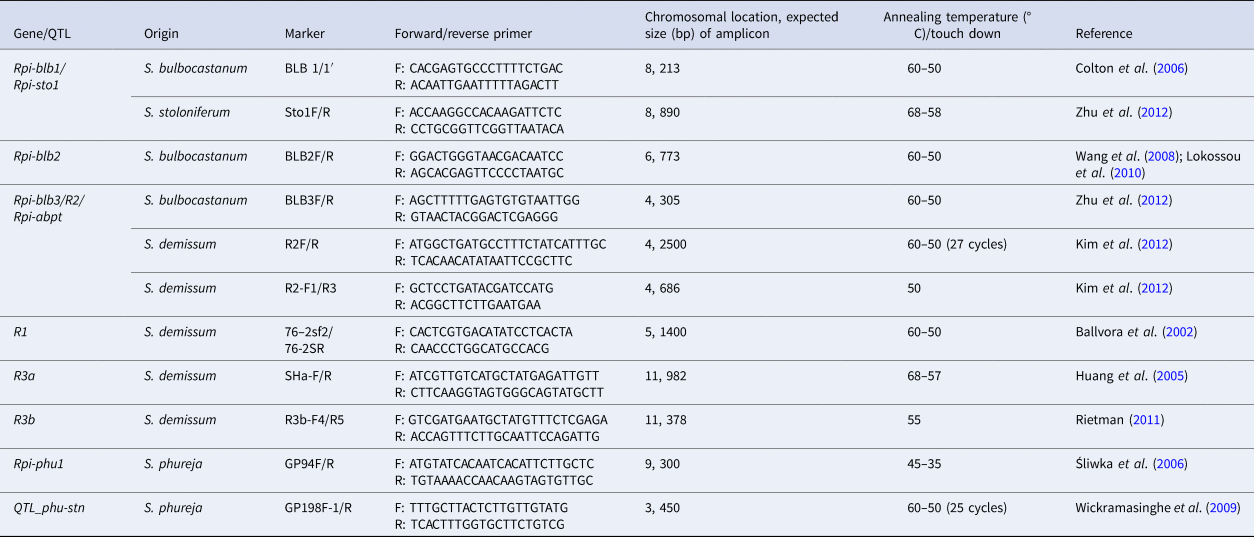
Plants for marker analysis were cultivated in a greenhouse for 4 weeks and DNA was extracted from young leaves using the DNeasy Plant Pro Kit (Qiagen; Hilden, Germany). Eleven pairs of gene-specific PCR primers for seven known resistance genes and one QTL allele were used (Table 1). These markers were selected based on the resistance genes coming from the wild progenitors. The PCR reactions of 20 μl consisted of 20 ng template DNA, 0.4 μM of each primer and 10 μl Red HS Taq Master Mix (Biozym; Hessisch Oldendorf, Germany). The PCR products were visualized by agarose gel electrophoresis.
Molecular markers used to detect corresponding late blight resistance genes

Discussion
In total, 36 of 52 clones tested yielded PCR amplicons for up to four resistance genes for seven of the eight genes tested (online Supplementary Table S1).
The resistance gene R1 was detected in six clones, eight clones were positive for Rpi-blb3/R2/Rpi-abpt, 13 for R3a and 27 for R3b. All eight cultivars contained the genes R3a and R3b, in cultivar ‘Alanis’ the genes R1 and Rpi-blb2 were observed as well.
The resistance genes R1 to R11 from the wild species S. demissum were frequently used in potato breeding due to their early discovery (Vleeshouwers et al., Reference Vleeshouwers, Raffaele, Vossen, Champouret, Oliva, Segretin, Rietmann, Cano, Lokossou, Kessel, Pel and Kamoun2011). The hypothesis that they continue to occur in many cultivars for this reason is confirmed by the present study. Markers indicative for R3 genes were found in many clones and in all cultivars, indicating that these genes have remained for a long time in breeding germplasms after they had been overcome by the pathogen. For example, Rakosy-Tican et al. (Reference Rakosy-Tican, Thieme, König, Nachtigall, Hammann, Denes, Kruppa and Molnár-Láng2020) detected R3a and R3b in ‘Quarta’, ‘Baltica’ and ‘Sapro Mira’ and R3b in ‘Romanze’.
Rpi-blb1/Rpi-sto1 was detected in four clones. According to Van der Vossen et al. (Reference Van der Vossen, Sikkema, Hekkert, Gros, Stevens, Muskens, Wouters, Pereira, Stiekema and Allefs2003), Rpi-blb1/Rpi-sto1 provides broad-spectrum resistance and thus makes an important contribution to broaden the genetic base for resistance.
Since Rpi-phu1 from S. phureja does not appear in any of the clones, it may not have entered the gene pool or got lost by selection or genetic drift. QTL_phu-stn was detected in five clones. Costanzo et al. (Reference Costanzo, Simko, Christ and Haynes2005) first described this QTL and Wickramasinghe et al. (Reference Wickramasinghe, Qu, Costanzo, Haynes and Christ2009) developed a marker. The present study is, to our knowledge, the first to investigate the presence of this QTL in potato breeding germplasm. Rpi-blb2 was determined in only one clone, which is not surprising since crosses between S. tuberosum and S. bulbocastanum are difficult to achieve.
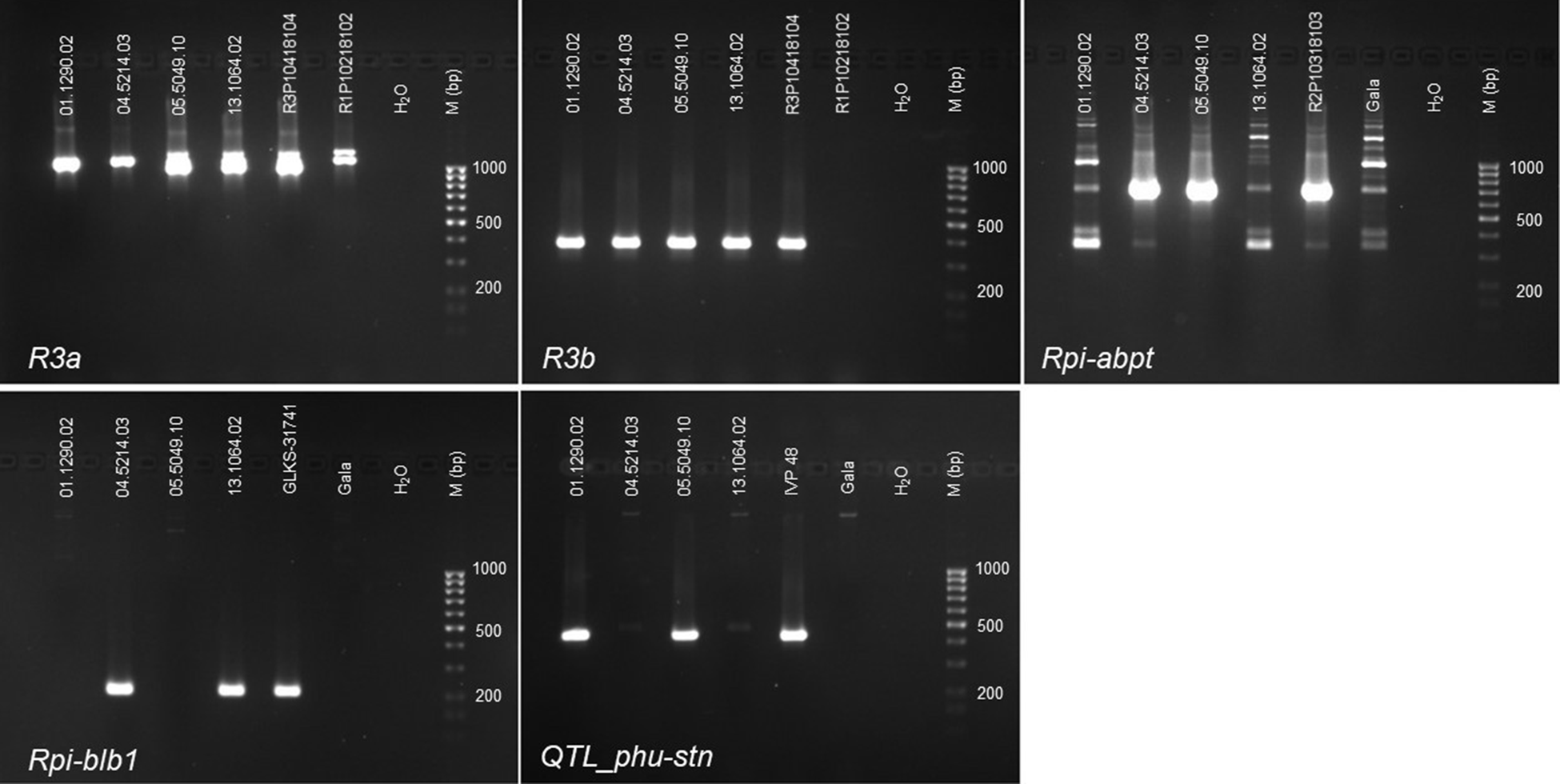
In the older clones from 2001 to 2003, markers for up to two genes per clone were detected. The 2004 and 2005 clones contained markers for up to four genes per clone. The most recent clones in this study showed markers for up to three genes (Fig. 1, online Supplementary Table S1).
Detection of R3a, R3b, Rpi-abpt, Rpi-blb1 and QTL_phu-stn in the clones 01.1290.02, 04.5214.03, 05.5049.10 and 13.1064.02 using gene-specific markers. Every last line (M) is a 100 bp ladder (AppliChem; Darmstadt, Germany). R3a and R3b: positive control R3P10418104, negative control R1P10218102 Rpi-abpt: positive control R2P10318103, negative control ‘Gala’ Rpi-blb1: positive control GLKS-31741, negative control ‘Gala’ QTL_phu-stn: positive control IVP 48, negative control ‘Gala’.

The results indicate that the JKI potato gene pool contains resistance genes introgressed from wild species in the past, which had been maintained over generations of breeding. These genes, with exception of R3a and R3b, which were also found in susceptible cultivars, in addition to QTLs with smaller effects, are presumably involved in the high resistance properties of a large part of the gene pool. Already broken resistances inherited from S. demissum may still contribute to increase the resistance level (Stewart et al., Reference Stewart, Bradshaw and Pande2003). Additionally, it was shown that durable resistance properties of crop plants can be achieved by stacking of resistance genes (Zhu et al., Reference Zhu, Li, Vossen, Visser and Jacobsen2012; Haverkort et al., Reference Haverkort, Boonekamp, Hutten, Jacobsen, Lotz, Kessel, Vossen and Visser2016; Ghislain et al., Reference Ghislain, Byarugaba, Magembe, Njoroge, Rivera, Román, Tovar, Gamboa, Forbes, Kreuze, Barekye and Kiggundu2019; Stefańczyk et al., Reference Stefańczyk, Plich, Janiszewska, Smyda-Dajmund, Sobkowiak and Śliwka2020). Rogozina et al. (Reference Rogozina, Beketova, Muratova, Kuznetsova and Khavkin2021) found the resistance level to be correlated to the number of genes. In the present study, some clones carried just one or none of the analysed genes, whilst showing high resistance levels (online Supplementary Table S1). Late blight resistance of the gene pool under survey appears, thus, not solely based on individual major resistance genes, but also on quantitative effects. In a meta-analysis focused on quantitative P. infestans resistance, QTLs for resistance were found to be located on all 12 chromosomes (Danan et al., Reference Danan, Veyrieras and Lefebvre2011). Whether a similar situation is present in the JKI potato gene pool remains to be analysed.
Supplementary material
The supplementary material for this article can be found at https://doi.org/10.1017/S1479262121000447
Acknowledgements
The authors thank the Federal Ministry of Food and Agriculture for funding this project and all potato breeders of the GFPi for providing cultivar material.