Scholars of international relations have devoted considerable attention to understanding the effects of election observers (EOs).Footnote 1 In addition to investigating whether EOs deter fraud, scholars have also recently examined how EOs affect turnout, protest, and violence.Footnote 2 One critical mechanism linking EOs to those outcomes is via changes in local attitudes about elections. Yet EOs' effects on local attitudes have rarely been theorized or directly tested in the literature. Moreover, we know little about how the effects vary with the identity of EO groups. Despite the proliferation of EO missions from governments and international organizations, relatively little research has examined their effects comparatively at any level of analysis or outcome. Given that diverse entities serve as EOs,Footnote 3 we would expect observers to have diverse effects on the local credibility of elections. Our study therefore answers the question of how EO identity affects the local credibility of elections and provides evidence of the mechanisms behind the effects.
These gaps in knowledge are important to fill not just from a scholarly viewpoint, but from the perspective of practitioners. EOs say explicitly that they seek to shape local attitudes. Although EOs have multiple objectives, the Declaration of Principles for International Election Observation, a document endorsed by forty-two major international observation groups, states that a central goal of election observation is to “promote public confidence, as warranted.”Footnote 4 EOs' emphasis on promoting public confidence is rooted in their understanding that perceptions of election credibility are essential for democratization and security. As the director of electoral programs at the National Democratic Institute (NDI, a leading American observer group) put it, “genuine stability, like democracy, is about much more than elections, but both depend on elections being credible.”Footnote 5
We argue that election observers enhance the local credibility of elections when the public perceives observers as capable and unbiased. The argument has three parts. First, learning of EOs' activities around elections can encourage people to believe that local political actors do not intend to commit fraud or will not be able to commit fraud, which in turn increases perceived election credibility. Second, this change in beliefs occurs only if the public perceives EOs as capable and willing to detect fraud. Third, perceptions of EOs' capabilities and intentions vary across observer groups. These perceptions have several potential sources, including perceptions of EOs' sponsoring countries, knowledge about EOs' activities in the current election, and knowledge about EOs' activities in past elections.
We test the theory using data from a large-scale, nationally representative survey fielded in Tunisia immediately following the country's December 2014 presidential election. An experiment informed randomly selected respondents about the activities of observers from the following countries and organizations, all of which observed the election: the African Union (AU), the Arab League (AL), the European Union (EU), Tunisia, and the United States. A control group received no information. Informing respondents about EOs' activities did not affect election credibility on average. It did, however, have a positive, significant effect on individuals' beliefs about the credibility of the election when the observers in question were perceived as especially able and willing to detect and deter fraud.
Surprisingly, the group perceived as relatively able and willing was the Arab League, an organization whose missions “have been carried out on ad hoc bases without applying standardized methodology[,] and for this reason they have been often criticized as lacking effectiveness.”Footnote 6 In line with our theory, however, we show that the local population viewed Arab League observers as more capable and less biased than other observer groups even though the international community's perceptions differ. We provide statistical evidence in favor of these mechanisms using mediation analysis. Although international audiences view Arab League observers as lacking effectiveness, there were reasons for Tunisians to have thought they had relatively good knowledge about the local context and resources. The Arab League observers were likely perceived as the international EOs with some of the best insight into the Tunisian context thanks to Arab states' common language, colonial history, and religion. There were also reasons for Tunisians to have thought the Arab League observers were not biased in favor of a particular candidate given the organization's diverse member states.
Our argument and findings have implications both for theories about and the practice of election observation. Continuing the line of research pioneered by Judith Kelley,Footnote 7 we compare different EO groups, finding that observers typically regarded by the international community as low quality swayed local audiences' attitudes significantly—and more than observers typically regarded as high quality. In other words, international and local audiences do not necessarily regard the same information sources as credible. International and domestic audiences may come to different conclusions about elections if EO groups respond differently to invitations to monitor or come to different conclusions about elections.
Although international audiences may reward observers who adhere to professional standards and thus encourage a “race to the top,”Footnote 8 domestic audiences may have different perceptions and priorities. Our evidence suggests that improving local perceptions of high-quality EOs' capabilities and neutrality may help them enhance local election credibility. Yet high-quality EOs sometimes have to compete with “zombie” EOs from authoritarian states that seek to legitimize flawed elections.Footnote 9 Should zombie EOs be trusted locally, then high-quality EOs will face competition when trying to influence local perceptions.
This article contributes to the literature on regime complexity.Footnote 10 To the best of our knowledge, no previous research has directly compared the effects of overlapping and competing third-party monitors on citizen attitudes or behaviors. Yet this is an important task since third-party monitors in many issue areas vary significantly in their capabilities and biases, both observed and perceived. Such variations are relevant for the effectiveness of other complex regimes that involve multiple audiences, including those related to peacekeeping, human rights, labor, and the environment.
Consider, for example, peacekeeping. Peacekeepers attempt to prevent conflict recurrence by gathering and providing credible information concerning the disarmament and demobilization process,Footnote 11 including about former combatants' compliance with standards established by peace processes.Footnote 12 There is reason to suspect that significant variation exists both within and across conflicts in individuals' likelihoods of viewing peacekeepers as capable and unbiased, especially in an increasingly complex security landscape.Footnote 13 Civilians may form such views through experience—those exposed to the services peacekeepers provide may find them trustworthy, whereas those exposed to abuse may notFootnote 14—or use heuristics such as peacekeeper nationality.Footnote 15 These perceptions could in turn shape the credibility of the peace processes that peacekeepers observe. Although peace-building effectiveness depends on more than local perceptions, these perceptions are in fact an integral component of interventions' success and thus merit further academic attention.Footnote 16
Likewise, some human rights advocates explicitly seek to influence individual attitudes and behaviors. As Karisa Cloward notes about international efforts to promote norms related to human rights and gender equality, “many transnational campaigns promote norms for which individuals—not states—are the primary transgressors.”Footnote 17 The organizations that make up these campaigns and monitor and report on human rights violations have biases.Footnote 18 As such, we expect that organizational identity could shape how audiences perceive human rights advocates and thus condition their effects.
How Observers Increase Election Credibility
Following other research, we define an election as credible when “people trust its results and believe that it produces an outcome that reflects the will of the people.”Footnote 19 In other words, a credible election involves a generally fair—though not necessarily perfect—process. The overall result in a credible election reflects the will of the people.
People generally form their opinions about election credibility based on their vote choice, with winners perceiving elections as more credible than losers,Footnote 20 and their perceptions about the fairness of the electoral playing field. Perceptions about the fairness of the electoral playing field tend to be shaped by a country's institutions,Footnote 21 but they also derive from other sources of information, including friends and family, the media, and political parties.Footnote 22 Although public and expert perceptions of election integrity are generally similar,Footnote 23 uncertainty often remains. In uncertain elections—especially ones that, for example, follow a suspension of elections, are transitional, or have significant pre-election concernsFootnote 24—citizens tend to be more receptive to new information.
By engaging in a number of monitoring activities around countries' elections, EOs affect beliefs about election credibility by providing information to the public about the electoral playing field. At a minimum, during an election, they are present at polling stations and observe votes being counted. Longer-term missions may engage in more activities, including monitoring the election management body, political environment, and media. EOs also evaluate elections and make public statements, usually after elections, that assess whether the process was free and fair.
In focusing on how observers' monitoring activities affect local perceptions of credibility we speak to the concerns of election observers themselves who regularly debate whether accepting invitations to monitor unfair elections might legitimize them.Footnote 25 Citizens in observed countries may hear about EOs' monitoring activities before, during, and after an election, including by seeing them in polling stations. Thus, EOs' monitoring activities are hypothesized to affect perceptions of election credibility as well as other outcomes such as voter turnout, opposition boycotts, and citizen protests.Footnote 26
Observers' monitoring activities can enhance perceptions of election credibility through two mechanisms. First, staunchly authoritarian governments are less likely than democratic ones to invite EOs to monitor elections since EOs use a variety of technologies to detect cheating.Footnote 27 From a citizen's perspective, it may be unclear why governments intending to cheat would invite observers to monitor an election. In other words, if election observers monitor an election, then people may infer, possibly incorrectly, that incumbents are not the cheating type. People may therefore be more likely to trust the outcome of the election when they are aware of the activities of observers.
Second, if people believe incumbents are the cheating type even though they know about observers' monitoring activities, they may think it less likely that incumbents (or opposition politicians) will be able to cheat when EOs are present. Observers can take a number of actionsFootnote 28 that are designed to prevent politicians from committing fraud.Footnote 29 Although there is debate about the conditions under which EOs succeed at deterring fraud, they have reduced incumbent vote shares when present at polling stations in at least some cases.Footnote 30 Thus, people may be more likely to perceive an election as credible when they learn that EOs are monitoring an election. Hypothesis 1 summarizes this prediction.
H1
People will believe elections are more credible when they learn about the monitoring activities of election observers.
Prior research supports the idea that locals in observed countries believe elections are more credible when they are aware of EOs' activities. People can learn about the presence and activities of observers through several mechanisms, including seeing them at polling stations and in media. In Kosovo, Dawn Brancati manipulated the amount of information people had about European EOs' presence at a municipal election via a flyer.Footnote 31 She found that information about EOs was positively correlated with perceptions that the elections were free and fair. Although this study was a first step in understanding the relationship between EOs and beliefs about election credibility, it is important to explore the effects of observers across a variety of groups because it is rare for a single observer group to be present at an election. Would non-European or domestic observers have had the same positive effect on public confidence in the vote in Kosovo?
How EO Identity Shapes Election Credibility
To understand how EO identity might affect elections' local credibility, we draw on a well-recognized insight from the public opinion literature: updating in light of new information depends on perceptions of the source of that information. Specifically, we posit that the credibility-enhancing effects of observers requires EOs to be perceived as able and willing to detect fraud.Footnote 32 If observers are not perceived as able and willing to detect fraud, then the signal their invitation sends about the inviting government's type is less clear. If observers are not perceived as able and willing to detect fraud, then individuals are less likely to believe that they will deter it. Election observation is a complex regime, and not all EOs are able and willing to detect fraud.
Perceived Capabilities
Observers will be more likely to enhance perceptions of election credibility when they are perceived as relatively capable of detecting fraud. Capabilities are relevant for both of the information-transmission mechanisms we discussed. On the one hand, people might perceive incumbents planning to cheat as being willing to invite EOs who cannot detect cheating. On the other hand, people might doubt whether incapable EOs would deter politicians from committing fraud.
Observers' perceived capabilities depend on at least three factors. First, perceptions of capabilities may involve beliefs about observers' issue expertise, defined as knowledge about democracy and elections. Some, but not all, EOs have significant skill at supporting democracy via monitoring elections. Many organizations engaged in democracy promotion have professionalized,Footnote 33 and some election observers have been leaders in this trend, developing techniques such as parallel vote tabulations and voter registration audits to credibly detect malpractice.Footnote 34 Yet election observers vary in their abilities, and not all groups use these advanced techniques. For example, organizations based in democratic countries tend to have more expertise than those based in autocratic countries.
Second, perceptions of capabilities may involve beliefs about observers' local knowledge, defined as knowledge about the country where they are working. If EOs have honed their craft by monitoring elections around the world, they may not have learned the language and culture of the countries where they work. One touted advantage of non-Western organizations engaged in democracy promotion is that they may have stronger local knowledge.Footnote 35 As Thomas Carothers has explained, the understanding of the “political culture, the language, and the territory” that comes through local knowledge helps observers detect and deter fraud.Footnote 36
Finally, perceived capabilities may involve beliefs about observers' resources, defined as the financial resources that enable EOs to do their work effectively. Before and during elections, EOs attempt to detect and deter fraud through their presence, training, and support. To effectively detect and deter fraud, EOs must generally send larger and longer missions. Thus, observers may be likely to enhance perceived election credibility only when they are perceived as having the resources required for capable missions.
These factors can all contribute to individuals' beliefs about how able observers are to detect fraud. Again, these beliefs are important. If observers are not perceived as able to detect fraud, then their monitoring activities will not signal that their government is committed to clean elections, nor will they reassure individuals of the absence of fraud. Ability, however, is not the only mechanism essential to this causal chain. For observers to enhance the credibility of elections—even if they are perceived as capable—they also must be perceived as willing to detect fraud.
Perceived Biases
International actors intervene in elections in biased ways that favor a candidate or party.Footnote 37 Biased EOs' monitoring activities may not send a clear signal about whether the government is the cheating type. After all, an authoritarian government may be willing to invite EOs that are biased in its favor because such EOs will not be interested in gathering information about cheating.Footnote 38 Nor do the monitoring activities of biased observers suggest that fraud will be detected since observers may ignore bad behavior by favored parties. For example, biased organizations may engage in fewer activities that encourage good behavior, such as sending longer missions and visiting many polling stations.
Some international EOs are—or are perceived to be—biased. Democracy promoters often take partisan stances around countries' elections.Footnote 39 International observers may be ascribed biases even when they do not exist in practice, since they may be sponsored by countries that take sides in the domestic politics of developing countries.Footnote 40 Evidence from Russia confirms that citizens' trust in observers is heavily shaped by their beliefs about EOs' partisan biases.Footnote 41 Similarly, EOs are less likely to denounce elections in countries that are large recipients of foreign aid, likely because of the interests of the states funding observation missions.Footnote 42 In this way, EOs' evaluations may contribute to perceptions of bias.
In addition to variation in perceived biases across international monitoring groups, there may also be differences in perceived biases between international and domestic observers. Given that the participants in domestic observer missions have a larger stake in the outcome of elections than foreign observers, they may be perceived as more biased, all else equal. This is a fear that many international EOs have had about domestic EOs in the past.Footnote 43 Even though most domestic EOs are explicitly nonpartisan, there are also some affiliated with local political parties or sibling political parties from abroad.
Regardless of the source of perceived bias, the public could discount the actions of observers who are perceived as biased. Such observers are not likely to contribute to the overall credibility of the political process locally even if they are able to detect fraud since they are perceived to be less likely to make a good-faith effort. Therefore, we might expect EOs to enhance individuals' opinions about elections only when they are perceived to support electoral processes regardless of their outcomes. Hypothesis 2 thus summarizes our argument about how observers' perceived capabilities and biases determine whether they will enhance local perceptions of election credibility. It contrasts with Hypothesis 1, which suggests that any observers will enhance election credibility.
H2
People will believe elections are more credible when they learn about the monitoring activities of election observers that they perceive as capable and unbiased.
This argument implies that when EOs are perceived as incapable or biased they will not increase elections' credibility. Such EOs could even cast doubt on the fairness of the playing field by prompting citizens to ask why a fair election needs to be monitored. Cross-national surveys show that most people support inviting EOs to elections.Footnote 44 Nevertheless, learning about the activities of incapable or biased monitors can remind people of fraud without reassuring them that fraud will be deterred. Thus, it is possible in this scenario that learning about EOs' activities could undermine election credibility.
The Sources of Perceptions about EOs
Our theory about election observer identity suggests that EOs' effects are conditional: only EOs that the public perceives as relatively capable and neutral will enhance domestic perceptions of election credibility. H2 takes these perceptions about EOs as given and makes a prediction about how they shape the likelihood that information about EOs' activities will enhance the credibility of elections. We do not fully develop and test a theory about the determinants of perceptions of EOs' capabilities and biases here.Footnote 45 However, thinking carefully about the sources of such perceptions helps us develop ex ante expectations about how domestic audiences might perceive different EOs.
There are at least three factors likely to shape individuals' perceptions of EOs. First, sponsoring country is a heuristic for people forming judgments about observers. In many countries, people do not know much about EOs. But they likely know something about the countries that sponsor observers. Thus, their judgments about EOs' capabilities and biases may be grounded in their assumptions about the level of issue expertise, local knowledge, resources, and biases associated with various sponsoring countries. When EOs are sponsored by an international organization, people may also make assumptions about which country within that organization is most important. Sponsoring country is an important heuristic even for nongovernmental organizations (NGOs), since national origin shapes NGO behavior and NGOs are often identified in the media by their nationalities.Footnote 46
Second, EOs' recent actions offer another lens. As normative and strategic actors, EOs care about their reputations. Through their press releases and other marketing activities, EOs attempt to promote an image of themselves as capable and nonpartisan, and the public may respond to these efforts. EOs' evaluations about the current election may also factor into citizens' perceptions about their capabilities and biases. For example, if an EO endorses an election won by a party against which it was perceived as biased, then the public may no longer perceive that EO as biased.
Third, EOs' past actions can provide information about EOs' capabilities and biases to the public. Although EOs can publicize their current activities, in countries where election observers have been present in the past, individuals may have formed lasting impressions based on EOs' previous roles.Footnote 47 As with EOs' recent actions, EOs' past actions may include their past marketing efforts and also their previous activities and evaluations.
Tunisia
An experimental research design allows us to randomly assign EOs' identity to individuals. Tunisia was the site of our survey experiment, which informed respondents about different EOs' monitoring activities and then measured perceptions of election credibility as well as EOs' perceived capabilities and biases. Specifically, we studied the 2014 runoff presidential election held on 21 December.
Case Selection Rationale
Testing our hypotheses in Tunisia makes sense for at least three reasons. First, there was variation in the identity of observer groups. As is typical in a country holding transitional elections, many election observers accepted the invitation to monitor the election. The international groups included three American NGOs—the Carter Center, International Republican Institute (IRI), and NDI—as well as four intergovernmental organizations—the African Union, Arab League, European Union, and Francophonie. Several Tunisian political parties and NGOs also served as observers. The online appendix contains information about the activities and composition of the groups. Scholars have documented variation in the capabilities and biases of the international EOs that were present,Footnote 48 so we anticipated that the public was likely to perceive them in different ways, as well.
Second, the observers did not vary in their reported judgments about the election, which might have affected their likelihood of enhancing perceptions of election credibility.Footnote 49 Specifically, the diverse election observer groups agreed that the presidential election met international standards.Footnote 50 At the same time, the observers agreed that the election had some flaws, such as illegal campaigning outside of polling stations and campaign finance violations. On the whole, these and other flaws were characterized as being relatively modest, and observers concluded that the results reflected the will of the people. The NDI election report provides a representative assessment:
The December 21, 2014, presidential runoff election in Tunisia marks the culmination of a constitutional and electoral phase that has lasted nearly four years. The third and final contest in a series of votes organized in recent months, this election provided citizens with the opportunity to freely select their president for the first time in the country's history. The election commission ensured a smooth and well-organized process, election officials were highly competent, and voters demonstrated a strong familiarity with election day procedures.Footnote 51
Third, Tunisia is important for understanding democratic transitions in the Arab world—a region with largely authoritarian governments. Many observers have been frustrated by the democratic decline that followed the region's popular revolutions in 2011. In addition to sponsoring EOs, the international community has supported Tunisia's transition to democracy in myriad ways.Footnote 52 Elections in Tunisia will likely influence how international actors engage in future democratic transitions in the region.
The 2014 Presidential Runoff Election
The 2011 revolution in Tunisia ousted Zine El Abidine Ben Ali, the country's long-ruling dictator. The Constituent Assembly that formed after the revolution wrote and passed a new constitution in January 2014 and a new electoral law in May 2014. The first parliamentary election was set for October 2014 with the presidential election following a month later.
The presidential contest occurred in two stages: a first round on 23 November and a runoff on 21 December. Twenty-seven candidates competed in the first round, although only two were front runners: Beji Caid Essebsi and Moncef Marzouki. Essebsi, an official from the Ben Ali era, ran for Nidaa Tounes, a secular party, and secured 39 percent of the first-round vote. Marzouki, the president of Tunisia during the transition period and founder of another secular party, Congress for the Republic (CPR), secured 33 percent of the first-round vote. Ennahda, the main Islamist party, declined to nominate or endorse a presidential candidate. Although Ennahda did not field a candidate, the presidential election was still fairly polarized between Ennahda and Nidaa Tounes. In our survey, only 19 percent of Ennahda supporters said they would have or did vote for Essebsi. This polarization seemed to have more to do with party loyalty than support for political Islam—our measure of political Islam did not correlate strongly with support for Essebsi (47 percent of those who opposed separation of mosque and state supported Essebsi, as did 53 percent of those who supported separation of mosque and state). In a hard-fought runoff, Essebsi prevailed with 56 percent of the vote. Although his victory prompted some protests, the election was generally peaceful, and Marzouki accepted the results.
The Experimental Design
We hypothesized that EOs will enhance perceived election credibility only if they are perceived as capable and unbiased. To test our theory, we fielded a nationally representative panel survey with two survey waves that included numerous questions measuring Tunisian political attitudes. The second wave included the experiment on EO identity we describe shortly.Footnote 53 We hired a Tunisian survey firm, ELKA Consulting, to field the survey. Local interviewers conducted the interviews face-to-face and in the local Arabic dialect. The first wave followed the parliamentary election on 26 October 2014. The second wave recontacted the same people during the two weeks following the presidential runoff election on 21 December 2014. The survey sampled both male and female adult Tunisians, and a total of 1,107 people participated in the second wave and our experiment. Fifty-nine percent of voters in our survey reported voting for Essebsi in the runoff election, compared to 56 percent in the overall population, which confirms that the sample was representative. Further details about the sample are provided in the appendix.
The second wave of the survey contained an experiment designed to isolate the effect of EOs' identity on local perceptions of election credibility. Empirical testing of our theory is fraught since finding a correlation between EOs' identity and perceptions of election credibility in a cross-national study, for example, could indicate that EOs increase election credibility or that certain EOs observe more credible elections. As Susan Hyde and Nikolay Marinov noted in a related study of the informational effects of EOs, the “ideal empirical test … would involve the random assignment of international observers across countries.”Footnote 54 A design like that would take tremendous resources and coordination across countries and observer groups, not to mention facing serious ethical hurdles, rendering it a near impossibility. Given that, our experiment—which randomizes information about observers' identity around a single election—is a good alternative.
The experiment informed randomly selected respondents about various EOs' monitoring activities. We provided individuals with information about specific monitoring activities to ensure that all respondents had the same level of information about EOs.Footnote 55 The experiment was preceded by a series of questions, including about vote choice and participation in and around the elections. The experiment was followed by questions designed to measure perceptions of election credibility and observers' capabilities and biases. The experiment involved five treatment groups as well as a control group that did not receive information about EOs. The treatments were read aloud:
Now we would like to ask you some questions about the electoral process and the results of the recent election. As you know, voters took to the polls on December 21st to cast their vote for the president. You may not be aware, however, that election observers from [GROUP] monitored the election after receiving an invitation from the Tunisian government. The [GROUP] observers monitored the political situation before and during the election, and they stationed themselves throughout the country to monitor voting and vote counting on Election Day.
The [GROUP] observers planned to evaluate the elections for compliance with standards for free and fair elections and report on incidences of manipulation, undue partisan interference, voter intimidation, and voter fraud.
As a manipulation check, we asked respondents at the end of the survey whether they remembered the identity of the observers that we had told them about. Seventy-nine percent of the respondents in the treatment groups correctly recalled the EOs' identity.
To determine treatment assignment, interviewers rolled dice at the start of interviews.Footnote 56 This process successfully produced experimental groups that were balanced in terms of size and a number of demographic characteristics, including education, rural-urban location, and turnout at the parliamentary election. We also examined balance on responses to questions in the first wave of our survey, which was fielded just after the parliamentary election and asked people if they had heard about EOs in the news or about EOs' evaluations. Sixty-two percent of respondents reported hearing about EOs, but only 33 percent reported hearing about EOs' evaluations. Fortunately, there was balance across the experimental groups in pre-existing knowledge about EOs. Thus, it should have been possible to experimentally study the effect of providing new information about EOs' identity. Our balance checks indicated slight imbalance in terms of age, gender, employment status, political interest, political knowledge, and vote choice (see appendix for balance table). Because those variables may be correlated with perceptions of election credibility, we control for them in the analyses.
The observers referenced in the treatments were American organizations, the European Union, the Arab League, the African Union, and Tunisian organizations.Footnote 57 Our treatments were truthful, since the groups were all active in Tunisia. We focused on these five groups because we anticipated that they would produce variation in terms of people's perceptions of capability and bias. No previous study had—to the best of our knowledge—investigated the sources of observers' perceived capabilities and biases. Thus, we offer our ex ante expectations about how the observers might have been perceived based on our theory as well as case knowledge. Later, we show how the observers were actually perceived and discuss what our findings suggest were the main drivers of local perceptions.
Earlier, we suggested three potential sources of individuals' perceptions about EOs: sponsoring countries, recent actions, and past actions. Sponsoring country was the most relevant factor for our study. Since Tunisia had a limited history with election observation, EOs' past actions were likely not a significant source of information. EOs' recent actions were unlikely to have differentiated EOs in the eyes of the public. As detailed in the appendix, content analyses of EOs' press releases in Tunisia indicate that most EOs attempted to cultivate a reputation for capability and neutrality, but these efforts did not result in significant media coverage. Furthermore, all EOs endorsed the election, meaning that there was no variation on that dimension. For these reasons, and also because knowledge about EOs was not widespread, we anticipated that individuals would use the heuristic of sponsoring country to evaluate EOs.
Based on the sponsoring-country heuristic, the diverse EOs in our treatment ought to have been associated with varying perceptions of capability. In terms of issue expertise, we expected EU and American EOs to be perceived most favorably because of the democratic histories of their sponsoring countries. In contrast, the sponsoring countries of EOs from the AL, AU, and Tunisia were new democracies and nondemocracies, perhaps causing those EOs to be viewed as less capable. In terms of local knowledge, we expected observers from the AL, EU, and Tunisia to be perceived most favorably because of their shared language (French and Arabic), colonial history (French and Ottoman Empires), and geographic proximity. In contrast, we expected the AU and American EOs to be perceived as less knowledgeable about Tunisian culture, history, and politics. In terms of resources, we expected observers from the AL, EU, and United States to be perceived most favorably because of their sponsoring countries' wealth. Recall that people may infer something about EOs' resources when they come from relatively rich countries or organizations, which was the case for EOs sponsored by the AL (and particularly its Gulf monarchies), the EU, and the United States.
The different sponsoring countries of the EOs ought to have been associated with different perceived biases. We expected Tunisian observers to be perceived as relatively biased since they had a stronger stake in the outcome of the election and some were explicitly partisan. We also expected some international EOs to be perceived as relatively biased. It is well-known in Tunisia that foreign countries take sides in the country's (and region's) politics, with the EU and United States in particular perceived as supporting candidates and parties that are pro-Western, secularist, or both.Footnote 58 We therefore expected EOs sponsored by the EU and US to be perceived as biased. In contrast, powerful Arab states have taken multiple (and no) sides in the politics of the region, with Saudi Arabia, for example, supporting secularists, Qatar supporting Islamists, and other states (e.g., Kuwait and Oman) remaining nonaligned.Footnote 59 We thus expected EOs from the Arab League to be perceived as relatively neutral since they were sponsored by countries with diverse (and neutral) partisan stances. Finally, since AU countries have not generally taken sides in Tunisian politics, we expected their EOs to be perceived as relatively neutral.
Although we do not test these ex ante expectations of the components of perceived capabilities and bias, the theory provides a useful guide for how each group might be perceived and the results are generally consistent with the expectations we described.
Findings
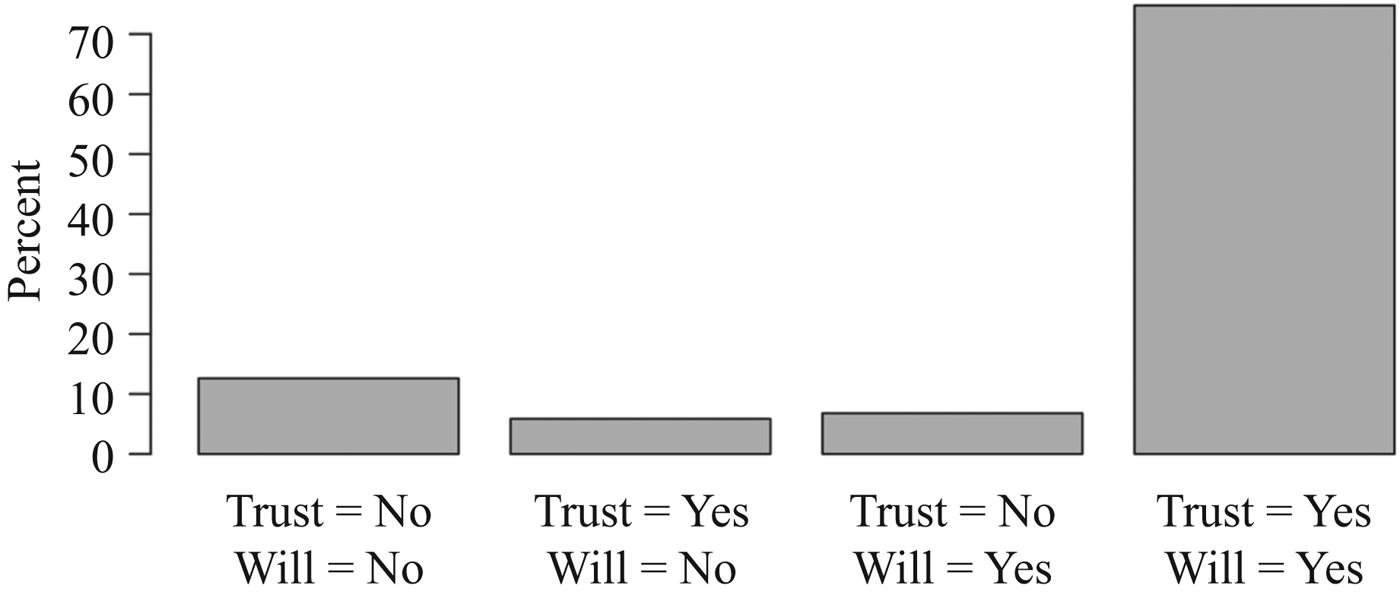
The dependent variable in this study is credibility, which we measure using responses to two questions asked immediately following the treatment. The first question asked, “Do you trust the results of the recent election?” The second question asked, “Do you think the results of the election reflected the will of the people?” Both questions were answered using “yes” or “no” response options. Following the literature on measuring electoral integrity,Footnote 60 we combine the two measures. Our measure of credibility ranges from 0 (“no” to both questions) to 2 (“yes” to both questions). As Figure 1 shows, Tunisians generally thought the election was credible, with 75 percent of respondents in the control group trusting the results of the election and thinking that they reflected the will of the people.Footnote 61 Since perceived credibility was high in Tunisia, EOs could not enhance credibility greatly, although we show that they do enhance credibility under certain circumstances.
Respondents' beliefs about the election's credibility (control group)

The Effects of EOs on Perceived Credibility
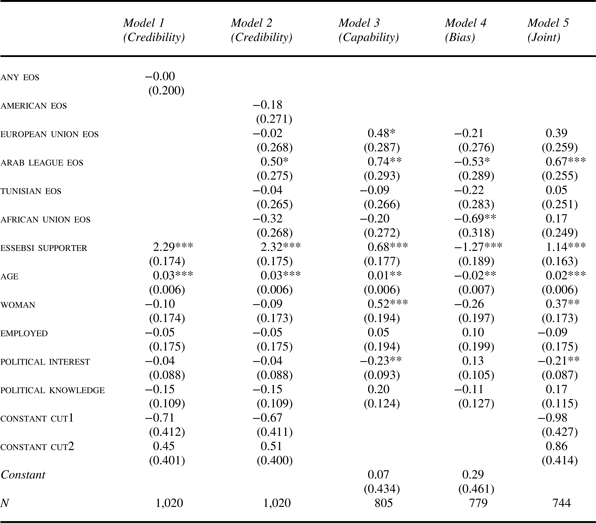
We begin by examining whether people believed the election was more credible when they learned about the monitoring activities of election observers in general (H1). The literature suggests that EOs convey information to the public about the fairness of the electoral playing field. To test this hypothesis, Table 1 summarizes the average effects of information about EOs' monitoring activities on perceptions of election credibility, comparing respondents assigned to the treatment groups with respondents assigned to the control group. We use ordered logistic regressions that control for the respondent's age, gender, employment status, political interest, political knowledge, and vote choice, which our balance checks suggest are appropriate to include. In Model 1, we pool all treatments for a comparison with the control group; in Model 2, we examine the treatments separately.
The average effects of EOs on beliefs about elections credibility and the hypothesized mediators

Notes: This table reports the coefficient estimates from ordinal logit (Models 1–2, 5) and logit (Models 3–4) models of credibility, capability, bias, and the joint capability and bias score with heteroskedastic-consistent robust standard errors in parentheses. The comparison group is the control group for Models 1–2 and the American EOs group for Models 3–5. *p < .1 (two-tailed); **p < .05; ***p < .01.
Contrary to H1, information about EOs' monitoring activities did not, on average, enhance perceptions of election credibility in Tunisia. We do see that supporters of the winning candidate, Essebsi, were much more likely to perceive the election as credible on average. This finding is consistent with the literature on the winner-loser gap. Age is also positively associated with perceptions of election credibility, suggesting that older individuals perceived the election as more credible than younger individuals.
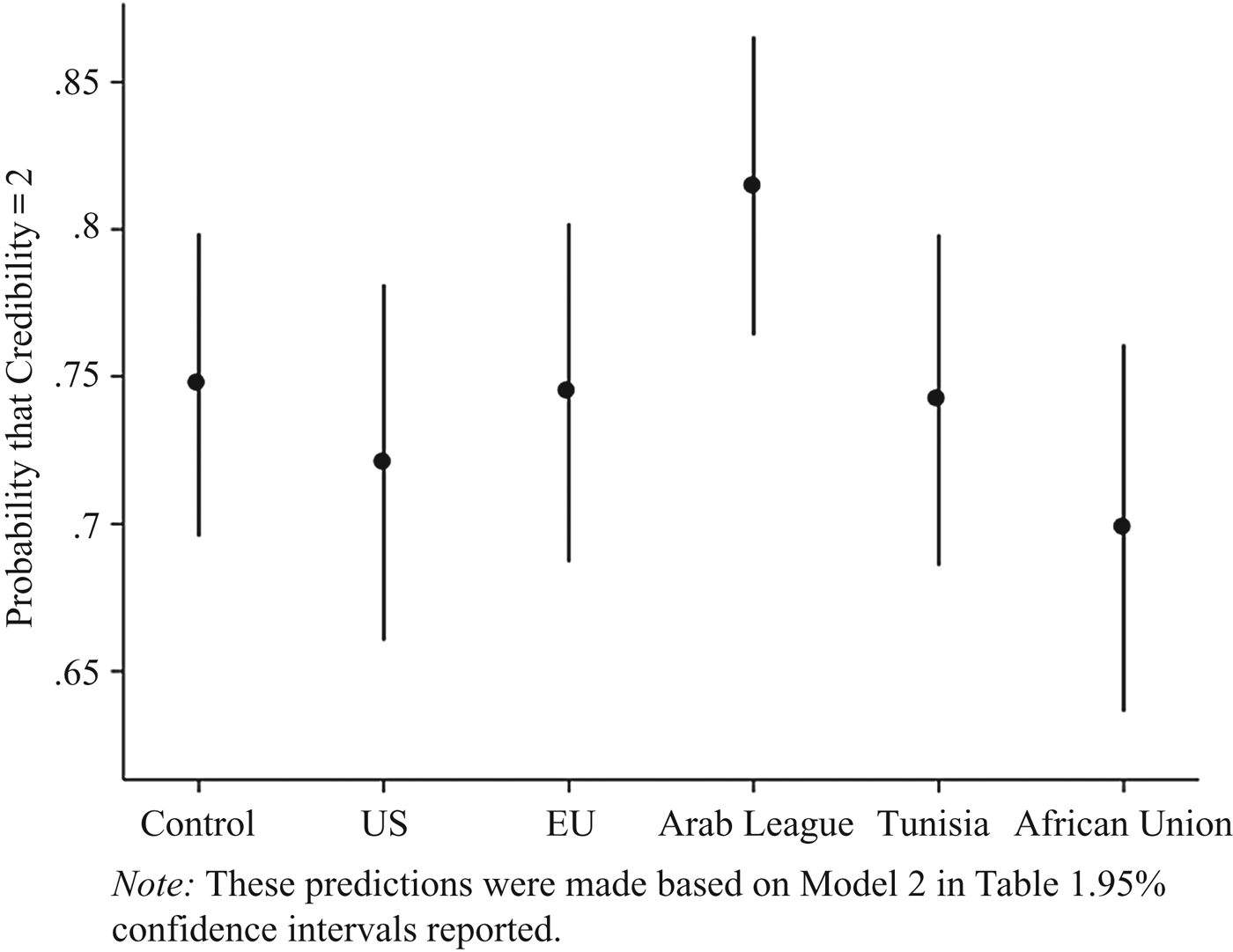
Although information about EOs' monitoring activities on the whole did not enhance perceptions of credibility relative to the control of no information, information about observers from the Arab League did do so. To illustrate the significant positive effect of arab league eos on credibility relative to the control and all other groups, Figure 2 plots the predicted probability of perceiving that the election was credible for each group. It uses the highest category of credibility as the outcome (equivalent to respondents believing both that the election results were trustworthy and that they reflected the will of the people).Footnote 62
Predicted probabilities of perceiving the election as credible

As Figure 2 shows, respondents told about the Arab League observers were more likely to perceive the election as credible than respondents given no information about observers. They were also more likely to perceive the election as credible than respondents in the other treatment groups. The arab league eos treatment significantly increased the credibility of the election relative to all other treatments at the p < 0.1 level and relative to some at the p < 0.05 level. The p-values for each comparison are as follows, with the Benjamini-Hochberg corrected p-values in parentheses to control for the false discovery rate (and thus the possibility of incorrectly inferring that an effect was meaningful given our multiple treatments): AL vs. Control = 0.069 (0.073), AL vs. AU = 0.004 (0.020), AL vs. EU = 0.073 (0.073), AL vs. Tunisia = 0.060 (0.073), and AL vs. US= 0.019 (0.048).Footnote 63
The finding that Arab League observers significantly enhanced perceptions of election credibility is robust to a number of tests reported in the appendix. First, the results are similar if we transform credibility to a dichotomous measure and then run a binary logit.Footnote 64 Second, the results are similar if we use the subcomponents of credibility—trust and will—as our dependent variables, although the coefficient estimate on arab league eos just loses significance at conventional levels when we use the will response as the dependent variable. Third, the results are similar if we do not control for any of the variables suggested by our balance tests. Finally, the results are robust to the inclusion of additional control variables, such as whether the respondent voted at the presidential election.
Since an important factor shaping individuals' beliefs about election credibility is vote choice, we next explore how vote choice interacted with the treatment. The appendix shows that EOs' effects were concentrated among people who did not support the winning candidate, Essebsi. His supporters believed the election was extremely credible, and learning about the monitoring activities of various EOs did not alter that. This pattern may be a result of a ceiling effect, since the probability that winners thought the election was credible is nearly 1 for all experimental conditions. Losers were significantly less likely to think the election was credible. Learning about the monitoring activities of Arab League EOs increased their beliefs that the election was credible relative to the control and all other groups.
We argue in other work that a Bayesian model of opinion updating is a useful framework for understanding how vote choice interacts with new information about elections to shape beliefs about election credibility.Footnote 65 This framework implies that changes in beliefs about election credibility depend on the strength of individuals' prior beliefs about election credibility, the content of those beliefs (i.e., whether they think the election was credible or not), and the credibility of the source of the new information. Thus, in addition to a ceiling effect, we might observe a weaker treatment effect among winners because they had strong priors that the election was credible. Learning about the monitoring activities of even capable and unbiased monitors (i.e., a credible source) did little to further increase that belief. Losers, however, may have had weaker priors that the election was credible. A Bayesian model implies that learning about the monitoring activities of the Arab League therefore had a stronger effect on their beliefs about the election.
Variation in EOs' Perceived Biases and Capabilities
If our argument is correct, the Arab League EOs' effect on credibility should have been driven by their perceived abilities and neutrality. We hypothesized that people will believe elections are more credible when they learn about the monitoring activities of EOs that they perceive as capable and unbiased (H2). To test that argument, we asked treated respondents two questions immediately following the questions measuring credibility. First, we asked, “How capable do you think the observers from [GROUP] were of detecting fraud during the election?” That question was answered on a four-point scale, with response options ranging from “not capable at all” to “very capable,” though we transform it into a dichotomous variable in our main analysis.Footnote 66 We refer to this measure as capability.Footnote 67
Second, and following research on electoral interventions, we asked, “Do you think the observers from [GROUP] preferred one political party over another or do you think they supported the democratic process, whatever the outcome of the election?”Footnote 68 The question had two response options: “preferred one political party over another” and “supported the democratic process, whatever the outcome of the election.” We refer to this measure as bias.
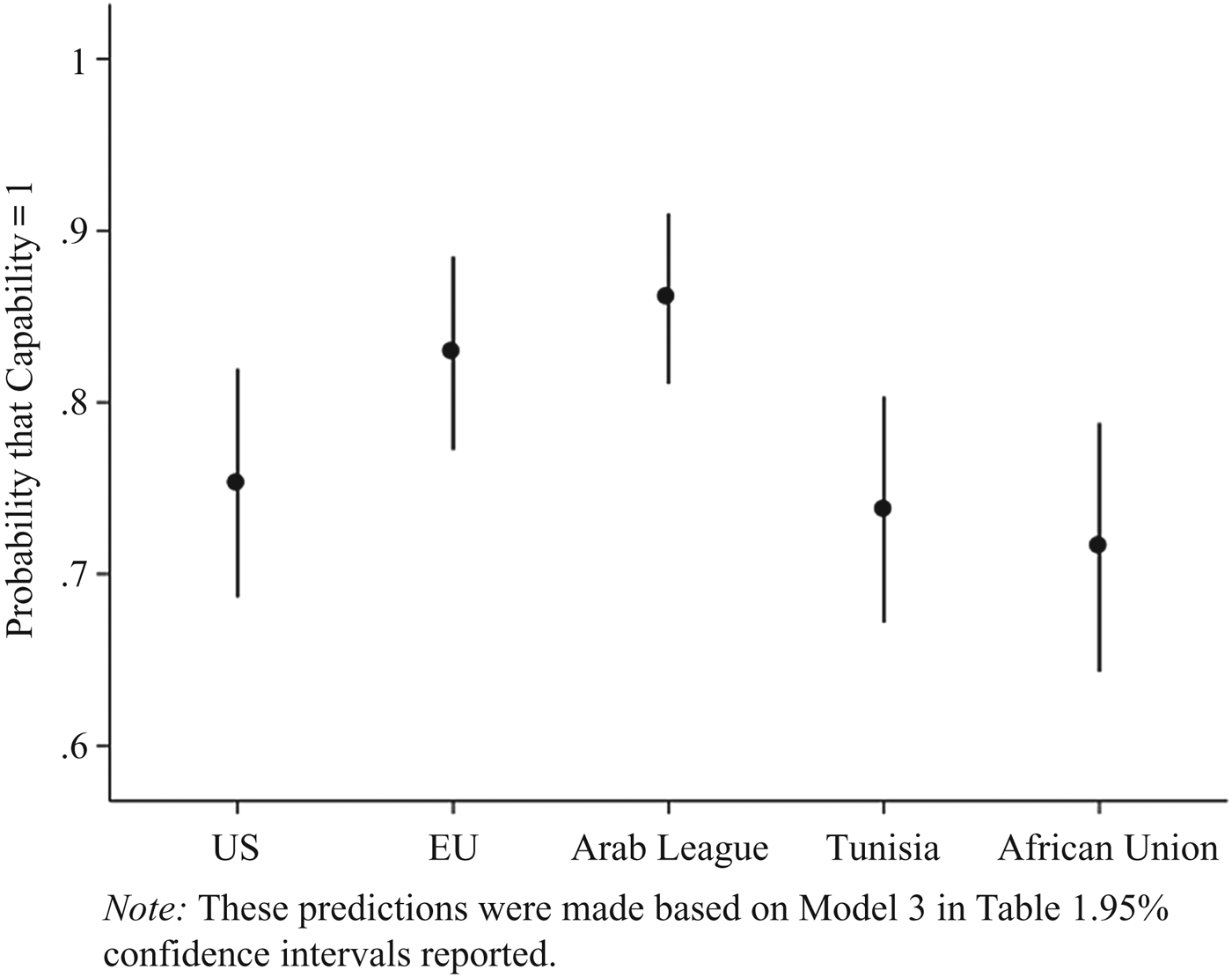
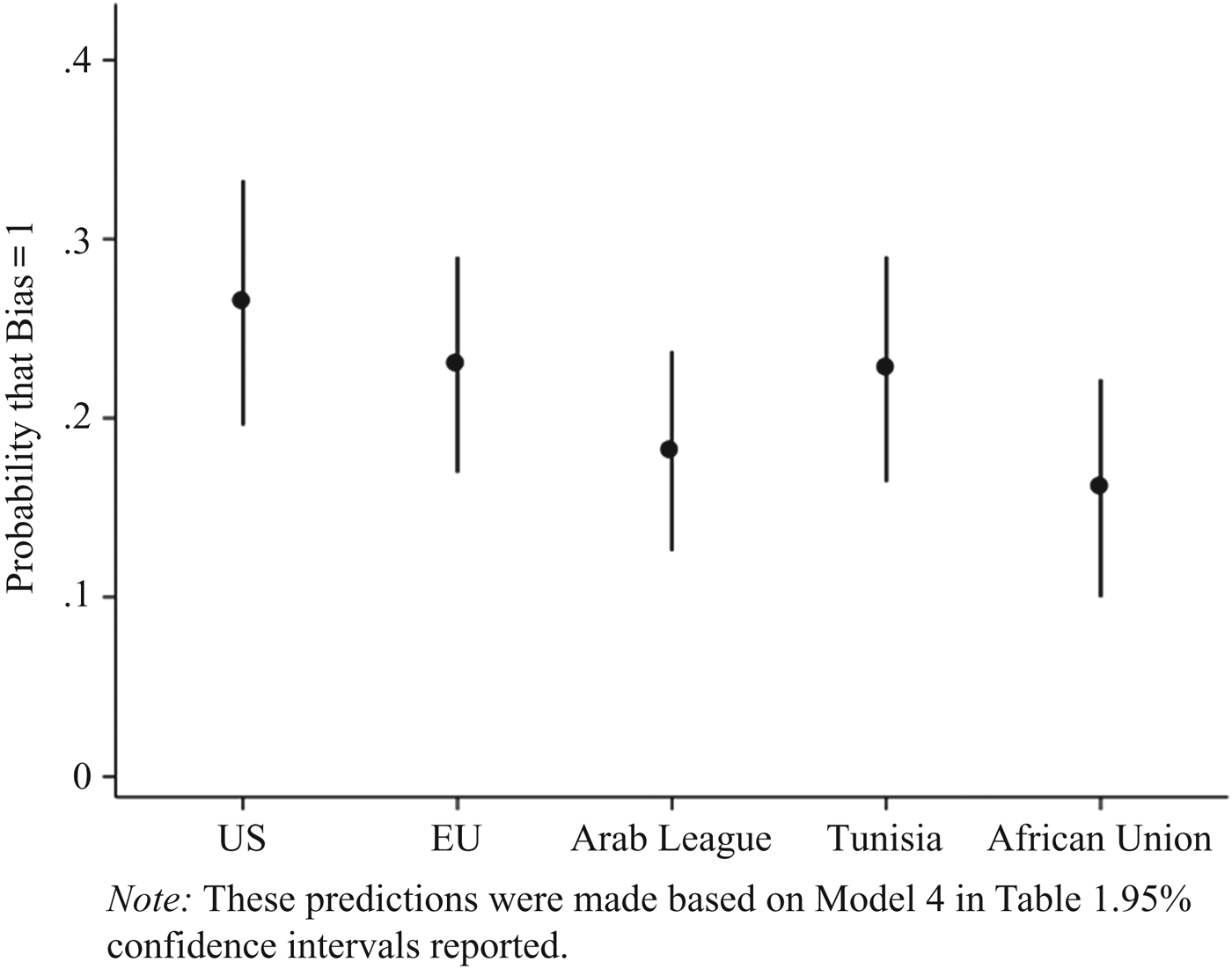
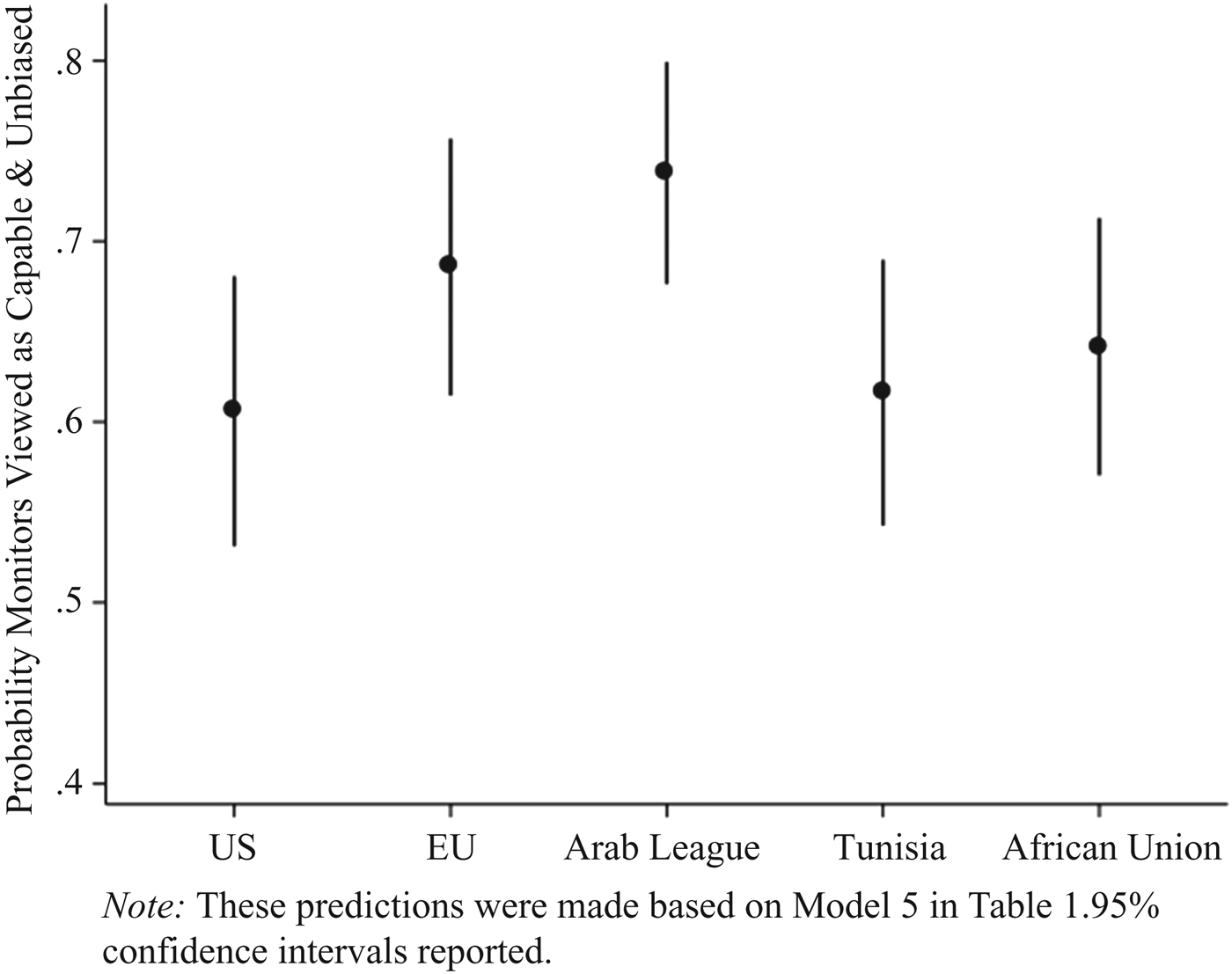
Finally, we create a measure of the combined capability and bias responses. This measure, called joint, is coded 2 if respondents viewed the observers as both capable and unbiased, 1 if respondents viewed the observers as either capable or unbiased but not both, and 0 if respondents viewed observers as neither capable nor unbiased. In Models 3, 4, and 5 in Table 1, we treat capability, bias, and joint respectively as our dependent variables. The comparison group is now the omitted category of american eos. To make the results easier to interpret, we graph the predicted probabilities of viewing the EOs as capable (Figure 3) and biased (Figure 4) separately, as well as graphing the probability that observers are perceived as both capable and unbiased (Figure 5).
Predicted probabilities of perceiving the observers as capable

Predicted probabilities of perceiving the observers as biased

Predicted probabilities of perceiving the observers as both capable and unbiased

In general, Tunisians had a positive view of observers, with the majority seeing them as capable and unbiased. That most people viewed the election as credible and most viewed the observers as capable and unbiased is consistent with our theory. Seventy-nine percent of respondents judged observers as “somewhat” or “very capable.” Similarly, 78 percent of respondents thought that the observers supported the democratic process, regardless of the election's outcome. Sixty-six percent of respondents judged EOs as both capable and unbiased. However, these overall tendencies mask considerable variation across groups.
To begin, and as Figure 3 shows, respondents in our survey were significantly more likely to view the observers from the Arab League as capable than they were to view the observers from the United States, AU, or Tunisia as capable. The only observers with a roughly similar level of perceived capability were those from the European Union.Footnote 69
Although we did not ask respondents on which dimension they perceived the observers as being capable, we suspect that the Arab League and EU observers' relatively high levels of perceived capabilities were related to their perceived strength in terms of local knowledge and resources. As we noted, people can infer information about EOs' capabilities from their sponsoring countries. In that way, both the AL and EU might have been perceived to have relatively good knowledge about Tunisia thanks to the cultural, historical, and linguistic ties we discussed. Of course, Tunisian EOs would have also had a firm understanding of the local political context, but they may have been perceived as lacking in the financial resources that the AL and EU EOs had given their sponsoring countries' wealth.
As Figure 4 shows, respondents were also significantly less likely to view observers from the Arab League as biased than they were to view the observers from the United States as biased (p = 0.07). The Arab League observers had the least perceived bias on average of any group other than the AU. In general, that pattern is consistent with our expectations. Whereas the US and EU are generally perceived as biased in the Arab world, the Arab League has no clear partisan bias since its members have taken multiple political stances in the region and Tunisia. Similarly, the AU has not taken sides in notable ways in Tunisian politics.
That there were significant differences among some of the EOs in terms of perceived biases—though fewer than in terms of perceived capabilities—makes sense given the electoral environment. The main political divide in Tunisia at the time of our study was the Islamist-secularist cleavage. Although the Islamist party did not field a candidate in this election, support for Essebsi still generally fell along partisan lines. Thus, we expected our argument about the heuristics individuals use to assess EOs' biases to apply. Given that the election would likely have had stronger partisan dimensions had it involved a secular candidate competing against an Islamist candidate, the perceived biases of EOs were also likely somewhat harder to detect than they might have been.
Finally, we combined the capability and bias measures to form one variable, joint. We plot the predicted probabilities that respondents viewed the EOs as both capable and unbiased for those in each of the treatment groups. Figure 5 shows that the Arab League EOs were significantly more likely to be seen as both capable and unbiased than EOs from the AU, Tunisia, or US.Footnote 70 Although the Arab League EOs were more likely to be perceived as capable and unbiased than EU EOs, the difference is not significant at traditional levels. This pattern is likely why we see the smallest (though still significant) difference in the treatment effect on election credibility between the Arab League and EU EOs.
Mediation Analysis
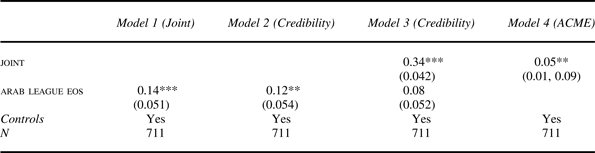
To further test the theory, we employ a nonparametric causal mediation model to estimate the average causal mediation effect (ACME) of the arab league eos treatment that is mediated by our joint measure of capability and bias.Footnote 71 This estimate examines whether perceiving EOs as capable and unbiased was the mechanism through which the Arab League treatment affected the perceived credibility of the election. To estimate the ACME we created a variable coded 1 if respondents were in the arab league eos group and coded 0 if respondents were in any of the other EO treatment groups. As can be seen in Model 1 of Table 2, the arab league eos treatment is significantly and positively associated with the joint measure of capability and bias. Model 2 further shows that respondents in the arab league eos group viewed the election as significantly more credible than respondents in the other EO treatment groups.
Perceptions of capabilities and biases mediate the effect of observers' identity on election credibility.

Notes: This table reports the coefficient estimates from OLS regression models (Models 1–3) with standard errors in parentheses. In Model 1, joint is the dependent variable. In Models 2 and 3, credibility is the dependent variable. All models include the control variables shown in Table 1. The nonparametric estimate of the ACME uses Models 1 and 3. Column 4 holds the ACME for joint and the 95% quasi-Bayesian confidence interval derived from 1,500 simulations is in parentheses. **p < .05 (two-tailed); ***p < .01.
However, as Model 3 shows, when we control for the hypothesized mediator, joint, the effect of the arab league eos loses significance, whereas joint is highly correlated with credibility. In other words, people who believed EOs were both capable and unbiased viewed the election as significantly more credible. We would expect to see this pattern if joint mediates the effect of the arab league eos on credibility. We next estimate the mediated effect using the nonparametric modeling technique cited earlier. Model 4 shows that the estimated average causal mediated effect is positive and statistically significant.
Alternative Explanations
We consider several potential alternative explanations. They relate to respondents' pre-existing knowledge of EOs, favorability toward or identification with EOs' sponsoring countries, and support for political Islam. All results are reported in the supplementary appendix.
Knowledge of EOs
One alternative explanation for our finding about the Arab League EOs is that they were the EOs people knew the least about in advance of our study. That would provide an alternative explanation for why the informational treatment associated with the AL EOs had a larger effect. Our analysis of the Tunisian media around the election does not support this explanation. As we describe in the appendix, we searched three Tunisian news sources for articles about EOs. EOs were mentioned infrequently, and AL EOs were not referenced systematically less than other EOs.
We also examine this alternative explanation with our survey data. We use a Wave 1 question that asked individuals whether they had heard about EOs in the news. This question did not measure knowledge about a specific observer group but rather whether the respondent had heard about EOs in general. Although we asked this question in both waves, we use the Wave 1 measure since we asked the Wave 2 question after the EO identity experiment. Nevertheless, the Wave 1 and Wave 2 measures are highly correlated.
First, there was little imbalance in the Wave 1 measure across the EO identity treatment conditions. Thus, previous knowledge about EOs was distributed evenly across our experimental conditions. Consistent with this finding, when we add a control to Model 2 in Table 1 for whether the respondent had heard about EOs, the effect of arab league eos remains positive and significant.
Second, we repeat Model 2 from Table 1, now dividing our sample according to people who had heard about EOs previously and those who had not heard anything about EOs at the election. As might be expected from an information-updating logic, people who had not previously heard about any election observers were moved most by the new information contained in the arab league eos treatment. Importantly, and consistent with our overall findings, none of the other treatment conditions produced this effect. Thus, among individuals who had not heard information about any EOs, only information about the Arab League monitors increased individuals' perceptions of election credibility. The pattern was similar for people who had previously heard about observers, though the effects were more modest. We therefore conclude that the arab league eos effect was not driven by what people already knew about EOs, or by the possibility that the Arab League was the organization about which individuals had heard about the least.
Favorability Toward Sponsoring Countries
We argued that individuals' perceptions of EOs derive from assessments about EOs' capabilities and biases. However, it is possible that their perceptions simply reflect their favorability toward EOs' sponsoring countries and organizations. Contrary to this argument, some of the observers in our study were perceived relatively favorably on only one dimension (e.g., the AU EOs were perceived as relatively neutral but not particularly capable).
To test this alternative explanation, we use a question from Wave 1 that asked how favorably respondents felt toward various countries and organizations.Footnote 72 Inconsistent with the alternative explanation, Tunisians reported feeling most favorably toward the EU (80%), France (83%), and Tunisian NGOs (72%) and somewhat less favorably toward Arab states (63%) and the United States (62%). Patterns of relative favorability were similar for election losers, the subset of respondents who reacted most strongly to the arab league eos treatment. We introduced a dichotomous variable indicating whether the respondent felt favorably toward the country or organization in question and its interaction with the treatment variables in Model 2 in Table 1. In no cases do we find a significant interaction between the treatment and favorability.
This analysis has a limitation. We asked about favorability toward “Arab states” rather than the “Arab League.” It is possible that Tunisians felt more positively toward the Arab League than toward Arab states. However, responses to a question in the World Values Survey in Tunisia in 2013 indicate that this dynamic is unlikely. In response to a question about confidence in the Arab League, only 19 percent of Tunisian respondents indicated that they had “a great deal” or “quite a lot” of confidence.Footnote 73
Identification with EOs
People may have responded to information about the arab league eos treatment because it primed them to think about countries with which they identify. Yet Tunisian observers—with whom the public presumably would have felt the strongest identification—were not perceived as particularly capable or unbiased, and they did not improve individuals' beliefs that the election was credible relative to the control. Moreover, Tunisians do not strongly identify as Arab.Footnote 74 A nationally representative panel survey of Tunisians in 2013 and 2015 found that only 5 percent chose to identify as citizens of the Arab community when asked to say how they related to the world.Footnote 75 Similarly, only 5 percent of respondents in that survey agreed with this statement: “Above all, I am an Arab.”
Support for Political Islam
Finally, we explore whether political Islamists were particularly likely to identify with the Arab League. Earlier, we noted that election losers were more responsive to the arab league eos treatment.Footnote 76 Could this effect have arisen because election losers identified with the Arab League as a result of support for political Islam?
First, we considered whether Islamists were more likely than secularists to identify with the Arab League. As we discussed, powerful Arab states have taken multiple (and no) sides in the Islamist-secularist divide. Because the Arab League has never been an Islamist organization,Footnote 77 we view it as unlikely that Islamists would have more affinity for the Arab League than secularists.Footnote 78 Data from another representative survey in Tunisia confirm this view since a chi-square test does not reveal a significant difference between secularists and Islamists in terms of reported trust in the Arab League.Footnote 79
Second, using our own data, we find no evidence that the Arab League EOs affected Islamists more than secularists. We introduce a dichotomous variable indicating whether the respondent supported political Islam and its interaction with the treatments in Model 2 of Table 1.Footnote 80 The Arab League treatment effect is strong and positive among secularists and just loses significance among Islamists. This loss of significance is in part a result of a loss in statistical power; when the sample is restricted to Islamists, each treatment group is reduced to around fifty respondents. Thus, contrary to the proposed explanation, there is a strong and significant treatment effect among secularists and a weaker treatment effect among Islamists.
Finally, we test another observable implication of this alternative explanation, which is that the Arab League treatment effect should be stronger among Islamist election losers than among secularist election losers. To do so, we separate the election losers into secularists (68%) and Islamists (32%). We find that the Arab League EOs treatment increased election credibility for both secularist losers and Islamist losers. Thus, we conclude that a more plausible explanation for the treatment effect among election losers is that they had weaker priors that the election was credible than election winners.
Discussion
Our findings about the credibility-enhancing effects of Arab League observers are surprising in the context of the literature on election observation. Although the AL is not a “zombie” election observation group equivalent to the Commonwealth of Independent States, researchers have not counted it among the EOs most likely to engage in effective monitoring. For example, Alberto Simpser and Daniela Donno do not consider it a “high quality” EO group,Footnote 81 and Judith Kelley does not count it among her list of “reputable” organizations.Footnote 82 Although the Arab League did voice support for the Tunisian revolution, it is hardly a democracy-promoting organization in Tunisia or the region.
There are many reasons that scholars have evaluated the Arab League election observers relatively critically. Although the AL signed the Declaration of Principles for International Election Observation in 2015, it does not frequently observe elections.Footnote 83 A study of Arab League observation missions noted a number of limitations: they have no legal framework, use “ad hoc” methods, send short-term missions of only a few days, and send small teams.Footnote 84 These limitations are not surprising when we consider that the Arab League is an intergovernmental organization that includes few democracies as members. These general limitations were all characteristic of the Arab League EO mission in Tunisia, as illustrated by our descriptions of EOs in the appendix. Yet despite their limitations, the Arab League observers were those most likely to enhance Tunisians' perceptions of election credibility according to our survey evidence.
Our findings about the non-effects of Tunisian observers are also striking. In the democracy-promotion literature, local organizations are commonly assumed to have numerous advantages over international organizations in terms of their larger missions, better local knowledge, and greater local legitimacy.Footnote 85 Yet Tunisians did not perceive domestic observers as relatively capable, perhaps noting their inexperience or worrying about a potential lack of resources. The Tunisian observers were perceived as among the more biased groups. Finally, most observers did not enhance perceived election credibility, contrary to the idea that they are generally able to inform the public about election integrity.
Together, these findings imply that in Tunisia, the observers most likely to contribute to the actual quality of elections were not those most likely to contribute to the perceived quality of elections locally. If this paradox extends to elections in other environments, then policymakers seeking to enhance both the actual and perceived credibility of elections should pursue a multipronged strategy. But are our findings in Tunisia likely to extend to other elections?
External Validity
We consider two aspects of the case from the perspective of generalizability. First, the sources of individual perceptions about EOs may be different in other countries. At the time of the 2014 presidential runoff election, democratic Tunisia had a short history with EOs, and EOs agreed about the quality of the election in their evaluations. Thus, the sponsoring-country heuristic may have played a larger role in shaping individuals' perceptions of EOs than it might elsewhere. For example, in other countries, EOs have monitored elections many times and attracted intense attention. Perhaps the most extreme example is Kenya, where EOs have monitored elections since 1992 and become embroiled in numerous controversies.Footnote 86 In the 2007 presidential election that was plagued by large-scale violence, the International Republican Institute, an American observer group, was accused of bias when it withheld the results of an exit poll that suggested that the wrong person had been pronounced as victor.Footnote 87 Based on this history, Kenyans may perceive IRI observers as biased. Thus, Tunisians' use of sponsoring country as a heuristic may not generalize to other countries where EOs' history or current actions are more salient. Regardless of the source of perceptions about EOs' capabilities and bias, we argue that our finding—that EOs perceived as relatively capable and neutral increased election credibility—is generalizable to other contexts.
Second, because the 2014 presidential runoff in Tunisia was the first such election following the revolution, it was a transitional election and falls into the category of elections that researchers label as “uncertain.” Other elections in that category follow the previous suspension of elections and countries' first multiparty elections.Footnote 88 We argue that EOs are most likely to influence individuals' perceptions of election credibility in uncertain elections because it is in those contexts that they are able to provide new information. Thus, we believe that the credibility-enhancing effect we identify is most likely to translate to other uncertain elections. That being said, we believe that Tunisia is a relatively hard case to find significant effects within the category of uncertain elections. As we have argued elsewhere, individuals' prior beliefs about election credibility are stronger when there is wide agreement on the quality of an election, either clean or fraudulent, and when the public has good access to political information via the media.Footnote 89 Given that those conditions were met in the election we studied, we suspect that the strength of Tunisians' prior beliefs about election credibility made them relatively unlikely to update on the basis of information about EOs' monitoring activities. Thus, even stronger effects might be found in uncertain elections where the quality of the election is more indeterminate or the informational environment is weaker.
Conclusion
In most countries today, observers play an important role in monitoring compliance with international electoral standards. Our analyses show that informing people about the monitoring activities of observers can enhance their beliefs about the credibility of the process. Yet EO identity matters because only some observers have a credibility-enhancing effect: EOs that people perceive as both relatively capable and unbiased. In Tunisia, the credibility-enhancing observers came from the Arab League, a primarily autocratic organization not known for its quality when it comes to monitoring elections. Thus, one potential avenue for donors to improve public confidence in elections abroad would be to help strengthen the capabilities and neutrality of observers from organizations, such as the Arab League, that have the trust of publics in observed countries.
As with any single-country study, the findings should be interpreted in light of the context. It may be that in their first postrevolution election for president, Tunisians had yet to construct strong priors about the electoral playing field or observers. Citizens' inexperience with democratic elections may have caused observers' activities to be unusually influential. That said, the election was generally regarded as free and fair. Thus, we conclude that the information environment was relatively good for a transitional election and not a “most likely” case for finding significant effects. Even larger effects might be the case in elections with greater uncertainty and more significant pre-election concerns. Although our study is a step in understanding baseline effects and dynamics, it is important to replicate it in other contexts to identify the full scope and range of EOs' impacts.
Still, the results from Tunisia have meaningful implications. They suggest that certain EOs can move people's attitudes, even if the international community or scholars view them as unreliable information sources. This is an important finding for at least two reasons. First, individuals' perceptions of election credibility are correlated with the probability of postelection democratic engagement, protest, and violence.Footnote 90 Thus, EOs have the potential to influence broader outcomes related to democracy and security via their effects on individual attitudes. Second, incumbents are known to strategically invite certain observers, including “zombie” observers, with the goal of shaping citizen attitudes.Footnote 91 Since we show that election observers can influence citizen perceptions, our findings offer micro-level support for previous arguments about why incumbents invite these groups.
Future research can build on our study in several ways. First, we studied EOs' attitudinal effects by examining a largely, though unanticipatedly, clean election with different groups that agreed the election had integrity to isolate the effects of EO identity. Future research could study the effects of EOs when observers disagree or when they monitor different types of elections, including nontransitional elections and more problematic contests. Of particular interest from a policy perspective is the question of whether Arab League EOs could also enhance the credibility of more deeply flawed elections, including in cases where other EOs are more critical.
Second, EOs' effects on election credibility can be examined over time, including in countries with both positive and negative previous experiences with EOs. In such contexts, EOs' reputations may be durable and differ from Tunisia. Scholars could also compare EOs to other potential sources of information about the electoral playing field, such as the media, political elites, or civic education programs.
Third, researchers could investigate the sources of perceptions about observers' capabilities and biases. For example, a parallel encouragement design could replicate our study with a twist: assigning randomly selected respondents to a second experimental condition designed to encourage them to think of the assigned observers as particularly capable and unbiased. Such a design could also be used to unpack the effects of different types of perceived capabilities (e.g., local knowledge versus resources). Future research could investigate how different audiences evaluate observer groups' capabilities and biases. EOs from countries that have explicitly taken sides in an election may be perceived as more or less biased depending on who individuals support in the election. More broadly, local elites (not to mention international elites) may view EOs differently than ordinary citizens. Given that EOs serve multiple audiences that are seeking to evaluate elections' credibility, scholars might compare similar treatments about the same election across diverse samples.
It will also be important to think about how perceptions about observers' capabilities and biases might condition the effects of their evaluations. Our intuition is that positive evaluations issued by observers perceived as capable and biased against endorsing the election will have the strongest effect on peoples' perceptions of election credibility. This hypothesis can be tested using a similar experimental method to the one used here, but it would include content from observers' evaluations in the treatment.
Third parties play important roles in many domains of world politics, including in the implementation of peace agreements,Footnote 92 arms control,Footnote 93 and international standards related to the environment, labor, and human rights.Footnote 94 Most of these issue areas—including peacekeeping,Footnote 95 the environment,Footnote 96 and human rightsFootnote 97—are characterized by multiple, overlapping groups that are all seeking to influence individual perceptions. As such, they represent excellent opportunities for our theory to be extended and tested. At the same time, they differ from election observation in important respects, such as the number of overlapping organizations and the degree of hierarchy among these organizations. Thus, our general theory about the importance of perceived capabilities and biases will need to be adapted and further specified for application to other issues.
For example, the relevant sources of capability and bias will vary across issue areas. We hypothesized that EOs' relevant capabilities relate to their experience, knowledge of the local context, and resources. These are also plausible dimensions of capability for peacekeepers, and failings along some of these dimensions have been emphasized in recent research.Footnote 98 Peacekeepers' perceived capabilities might also involve other dimensions. In recent years, for example, United Nations (UN) peacekeepers have introduced a cholera epidemic in Haiti, engaged in widespread transactional sex in Liberia, and been involved in high-profile rape scandals.Footnote 99 Those abuses call into question UN peacekeepers' basic competence and ethics, and therefore might undermine their perceived capabilities. Thus, future theory building will require researchers to identify the relevant dimensions of capability and bias for the particular issue area. It must more fully consider the possibility that the presence of certain types of third parties could detract from the local credibility of political processes. We hope that future research will continue to explore how third parties shape local perceptions.
Supplementary Material
Supplementary material for this article is available at <https://doi.org/10.1017/S0020818318000140>.