Introduction
The glassy-winged sharpshooter (GWSS), Homalodisca vitripennis (Germar) [=H. coagulata (Say)] (Hemiptera: Cicadellidae) (Takiya et al., Reference Takiya, McKamey and Cavichioli2006) is a xylem feeding leafhopper of economic importance that transmits a strain of Xylella fastidiosa (Wells), a bacterium that causes Pierce's disease in grapevines (Vitis vinifera L. and V. labrusca L.), in addition to diseases in many other plants (Hopkins & Mollenhauer, Reference Hopkins and Mollenhauer1973; Hopkins, Reference Hopkins1989). The GWSS is native to the southeastern United States and northeastern Mexico (Young, Reference Young1958; Turner & Pollard, Reference Turner and Pollard1959; Nielsen, Reference Nielson1968; Brlansky et al., Reference Brlansky, Timmer, French and McCoy1983; Varela et al., Reference Varela, Smith and Phillips2001; Redak et al., Reference Redak, Purcell, Lopes, Blua, Mizell and Andersen2004; Triapitsyn, Reference Triapitsyn2006). Since 1990, this insect has established and spread in southern California, USA, where it poses a serious threat to the wine and table grape industry (Sorensen & Gill, Reference Sorensen and Gill1996). Previously, we demonstrated that the GWSS that invaded California is of Texas, USA origin. Our data showed that GWSS populations in the USA were genetically distinct, clustering into two main groups or clades (de León et al., Reference de León, Jones and Morgan2004a), an observation that was recently confirmed by Smith (Reference Smith2005).
Uncertainty exists as to whether egg parasitoids native to California will be as effective against GWSS as they are in their co-evolved native range (Jones, Reference Jones, Tariq, Oswalt and Esser2001; Logarzo et al., Reference Logarzo, Triapitsyn and Jones2003, Reference Logarzo, Virla, Triapitsyn and Jones2004; Virla et al., Reference Virla, Logarzo, Jones and Triapitsyn2005). As a consequence, beginning in 2000, egg parasitoids of closely related hosts belonging to the sharpshooter tribe, Proconiini [Tapajosa rubromarginata (Signoret)] (Young, Reference Young1968), were sought from regions in South America, where climate types and habitats were similar to California, for a neoclassical biological control program (Jones, Reference Jones, Tariq, Oswalt and Esser2001, Reference Jones, Parra, Zucchi, Vendramim, Moraes, Bogorni, Silveira Neto and Bento2003; Logarzo et al., Reference Logarzo, Virla, Jones and Hoddle2005). Biological control is an important component of the management of GWSS (Morgan et al., Reference Morgan, Triapitsyn, Redak, Bezark, Hoddle and Hoddle2000; Jones, Reference Jones, Tariq, Oswalt and Esser2001; CDFA, 2003). In surveys conducted in Argentina and Chile during 2000 through 2005, two prospective egg parasitoid candidate agents were identified among several Gonatocerus Nees species reared from T. rubomarginata (Jones et al., Reference Jones, Logarzo, Triapitsyn, Casas, Virla and Purcell2005a,Reference Jones, Logarzo, Virla, Luft, Tariq, Blincoe, Mochel, Oswalt and Esserb; Logarzo et al., Reference Logarzo, Virla, Jones and Hoddle2005; Virla et al., Reference Virla, Logarzo, Jones and Triapitsyn2005). They were identified by S. Triapitsyn as Gonatocerus tuberculifemur (Ogloblin) and G. metanotalis (Ogloblin) (Hymenotpera: Mymaridae). Another Proconiini sharpshooter, Anacuerna centrolinea (Melichar), was recently discovered in Chile that is also attacked by G. tuberculifemur (Logarzo et al., Reference Logarzo, de León, Triapitsyn, González and Virla2006). Gonatocerus tuberculifemur is now being permitted for release in California (CDFA, 2005). Mymarid wasps are the best-known egg parasitoids for controlling populations of leafhoppers (Huber, Reference Huber1986; Döbel & Denno, Reference Döbel, Denno, Denno and Perfect1993). Taxonomic and biological studies are important to biological controls programs (Logarzo et al., Reference Logarzo, Virla, Triapitsyn and Jones2004; Virla et al., Reference Virla, Logarzo, Jones and Triapitsyn2005), as are molecular genetic studies. Molecular studies of insects are becoming increasingly important in resolving taxonomic relationships critical to the success of biological control programs (Caterino et al., Reference Caterino, Cho and Sperling2000). Release of unidentified and uncharacterized strains could make it impossible to document their establishment and dispersal; therefore, genetic typing of strains prior to their release in the field is necessary. Identifying the correct natural enemy is critical to the success of classical biological control programs; in addition, identifying geographic variation in populations of the same species is as important as correct species determination. Lack of proper identification procedures has affected several projects (Rosen, Reference Rosen and Romberger1977; Messing & Aliniazee, Reference Messing and Aliniazee1988; Löhr et al., Reference Löhr, Varela and Santos1990; Narang et al., Reference Narang, Tabachnick, Faust, Narang, Barlett and Faust1993; Miller & Rossman, Reference Miller and Rossman1995; Schauff & LaSalle, Reference Schauff and LaSalle1998; Gordh & Beardsley, Reference Gordh, Beardsley, Bellows and Fisher1999; Unruh & Woolley, Reference Unruh, Woolley, Van Driesche and Bellows1999).
The overall objective of the present study with G. tuberculifemur was to genetically characterize this prospective egg parasitoid candidate agent using two molecular methods, inter-simple sequence repeat-polymerase chain reaction (ISSR-PCR) DNA fingerprinting utilizing a 5′-anchored ISSR primer and a phylogeographic approach inferred from the mitochondrial cytochrome oxidase subunit I gene (COI). ISSR-PCR is a sensitive technique because it targets random simple sequence repeats or microsatellites within the entire genome, thus revealing highly polymorphic banding patterns or multiple loci (Zietkiewicz et al., Reference Zietkiewicz, Rafalski and Labuda1994). Therefore, increased power to resolve genetic relationships comes with information from many loci within the nuclear DNA (Zietkiewicz et al., Reference Zietkiewicz, Rafalski and Labuda1994; Karp & Edwards, Reference Karp, Edwards, Caetano-Anolles and Gresshoff1997; Wolfe & Liston, Reference Wolfe, Liston, Soltis, Soltis and Doyle1998; de León & Jones, Reference de León and Jones2004, Reference de León and Jones2005; de León et al., Reference de León, Jones and Morgan2004a,Reference de León, Jones and Morganb, Reference de León, Jones, Sétamou and Morgan2006). Similarly, phylogenetics utilizing mitochondrial DNA, typically inherited as a single locus, is a widespread approach for delineating and identifying morphologically similar or cryptic species and identifying the geographic origins of invasive species (Rosen, Reference Rosen and Romberger1977; Narang et al., Reference Narang, Tabachnick, Faust, Narang, Barlett and Faust1993; Schauff & LaSalle, Reference Schauff and LaSalle1998; Unruh & Woolley, Reference Unruh, Woolley, Van Driesche and Bellows1999; Avise, Reference Avise2000; Roderick & Navajas, Reference Roderick and Navajas2003; Brown, Reference Brown, Ehler, Sforza and Mateille2004; MacDonald & Loxdale, Reference MacDonald and Loxdale2004; Roderick, Reference Roderick, Ehler, Sforza and Mateille2004). A purpose of this study was to begin to gain insights into whether cryptic or genetically distinct populations of G. tuberculifemur exist in Argentina and Chile. We asked how genetic variation is structured and whether some populations could be better suited for use as a biological control agent. Gonatocerus tuberculifemur individuals with different morphotypes (‘red’ or ‘black’ gasters) were identified; so the second objective was to determine whether these ‘morphotypes’ were actually different strains and whether ‘colour’ can be used as a diagnostic tool to distinguish them. Third, field host range tests in Argentina showed that a small number of G. tuberculifemur-like individuals emerged from a different leafhopper tribe, Cicadellini (Jones et al., Reference Jones, Logarzo, Triapitsyn, Casas, Virla and Purcell2005a,Reference Jones, Logarzo, Virla, Luft, Tariq, Blincoe, Mochel, Oswalt and Esserb), and so the objective here was to determine whether these individuals were actually G. tuberculifemur and whether they could be genetically distinguished. This objective was important to determine the host specificity of G. tuberculifemur. Fourth, since resolution of phylogenetic relationships requires information about variability, not only at the level of populations within a species but also between species (Narang et al., Reference Narang, Tabachnick, Faust, Narang, Barlett and Faust1993; Unruh & Woolley, Reference Unruh, Woolley, Van Driesche and Bellows1999), a molecular systematic approach was undertaken with various named and one unnamed Gonatocerus species, along with G. tuberculifemur geographic populations from South America. The named Gonatocerus species were also included to test the support for the species groups considered.
Materials and methods
Insect collection
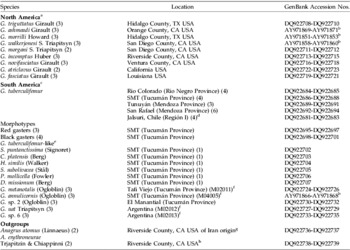
Five populations of G. tuberculifemur were collected in Argentina and Chile, South America. See table 1 for a summary of all the Gonatocerus species utilized in the current study for both phylogeographic and phylogenetic analyses showing collection sites and GenBank Accession Nos for mitochondrial COI partial sequences. Analyses included G. tuberculifemur-like egg parasitoids emerging from Cicadellini leafhoppers in Argentina: Syncharina puntanctissima (Signoret); Ciminius platensis (Berg); Hortensia similis (Walker); Scopogonalia subolivacea (Stål); Plesiommata mollicella (Fowler); and Dechacona missionum (Berg). Gonatocerus tuberculifemur individuals with different morphotypes (red or black gasters) were selected and analyzed separately. However, all G. tuberculifemur specimens collected from the various sites for the phylogeographic analysis were of mixed morphotypes that occurred sympatrically. Both morphotypes were randomly analyzed in the current study. South American egg parasitoid species with unique codes were imported to the USDA, APHIS, Arthropod Quarantine Facility, Edinburg, TX and sent to USDA, ARS, Beneficial Insects Research Unit (Weslaco, TX) in 95% ethanol. All other egg parasitoids were sent directly in ethanol to ARS-Weslaco. All egg parasitoids were identified by S. Triapitsyn, and voucher specimens of egg parasitoids used in the current study are deposited in the Entomology Research Museum, University of California, Riverside (UCRC).
Summary of Gonatocerus Nees species used for both phylogeographic and phylogenetic studies inferred from COI sequence data. SMT, San Miguel de Tucumán, Argentina, South America. Numbers in parenthesis indicate the number of individuals.

a Emerged or were reared on H. vitripennis eggs (Triapitsyn, Reference Triapitsyn2006).
b de León et al. (Reference de León, Jones, Sétamou and Morgan2006).
c Unless otherwise stated, specimens emerged from T. rubromarginata eggs. Unless otherwise stated, specimens are from Argentina, South America.
d Emerged from Anacuerna centrolinea eggs in Chile [first record (Logarzo et al., Reference Logarzo, de León, Triapitsyn, González and Virla2006)].
e Emerged from Cicadellini leafhoppers eggs.
f Unique codes associated with imported colonies at the USDA, APHIS, Arthropod Quarantine Facility, Edingburg, TX USA. In quarantine were reared on H. vitripennis eggs.
g Emerged from eggs of Circulifer tenellus (Baker).
h Emerged from eggs of Erythroneura variabilis (Beamer).
Genomic DNA isolation
Total genomic DNA was extracted according to standard methods (Sambrook & Russell, Reference Sambrook and Russell2001) as previously described (de León et al., Reference de León, Jones and Morgan2004b, Reference de León, Jones, Sétamou and Morgan2006; de León & Jones, Reference de León, Jones and Morgan2005). Briefly, individual wasps were homogenized on ice in 1.5 ml microfuge tubes in 60 μl of lysis buffer [10 mm Tris-HCl (pH 7.5), 1 mm EDTA (pH 7.5), 1% IGEPAL CA-630)] with two 20-s bursts with 10 min intervals on ice (Pellet Pestle Motor, Bel-Art Products, Pequannock, NJ). To avoid cross contamination between samples, a sterile plastic pestle was used per individual insect. The final DNA pellet was resuspended in 61 μl of TE [Tris-HCl (pH 7.5), 1 mm EDTA (pH 7.5)]. To confirm for the presence of genomic DNA, amplification reactions were performed with 1 μl of stock DNA and 28S primers at an annealing temperature of 65°C (forward: 5′-CCCTGTTGAGCTTGACTCTAGTCTGGC-3′ and reverse: 5′-AAGAGCCGACATCGAAGGATC-3′) (Werren et al., Reference Werren, Windsor and Guo1995) with 1.5 mm MgCl2 and the amplification conditions described below.
ISSR-PCR DNA fingerprinting
ISSR-PCR amplification reactions are described in previous works (de León & Jones, Reference de León and Jones2004, Reference de León and Jones2005; de León et al., Reference de León, Jones and Morgan2004b, Reference de León, Jones, Sétamou and Morgan2006). The reactions were performed with the 5′-anchored primer HVH(TG)7T (Zietkiewicz et al., Reference Zietkiewicz, Rafalski and Labuda1994), where H=A/T/C and V=G/C/A. Briefly, the reactions were performed in a final volume of 20 μl with the following components: 1× PCR buffer [50 mm KCl, 20 mm Tris-HCl (pH 8.4), 1.5 mm MgCl2, and 0.01% gelatin], 0.25 mm deoxynucleotide triphosphates, 0.25 μM ISSR primer, 1.0 μl of stock genomic DNA and 0.05 U/μl Taq DNA Polymerase (New England Biolabs, Beverly, MA). The cycling parameters were as follows: 1 cycle at 94°C for 2 min followed by 45 cycles at 94°C for 1 min, 56°C for 1 min, and 72°C for 2 min. Reactions were optimized for amount of genomic DNA, annealing temperature, MgCl2 concentration and cycle number. Negative control reactions were performed in the absence of genomic DNA. Amplification products were loaded onto 2% agarose gels and submitted to electrophoresis in 1× TBE buffer (90 mm Tris-borate, 2 mm EDTA) in the presence of 0.2 μg ml−1 ethidium bromide. Gels were photographed with the Chemi Doc System and markers/bands were scored via the Quantity One Software™ (Bio-Rad Laboratories, Hercules, CA).
Amplification and sequencing of the partial mitochondrial cytochrome oxidase subunit I gene (COI)
The general primers C1-J-1718 (forward: 5′-GGAGGATTTGGAAATTGATTAGTTCC-3′) and C1-N-2191 (reverse: 5′-CCCGGTAAAATTAAAATATAAACTTC-3′) of Simon et al. (Reference Simon, Frati, Bechenbach, Crespi, Liu and Flook1994) were utilized (Tm 58°C; 2.0 mm MgCl2; 2 U Taq DNA Polymerase; 40 cycles) to amplify the COI partial gene from egg parasitoids. To reduce primer-dimer formation in certain species, assay conditions were slightly modified. For G. metanotalis, the primer concentration was reduced to 0.125 mm, and 2 μl of template were used; and for G. tuberculifemur, the following conditions were used: Tm 48°C; 1.8 mm MgCl2; 0.188 mm primer concentration. Amplification products were subcloned with the TOPO Cloning Kit (Invitrogen Life Technologies, Carlsbad, CA), plasmid minipreps were prepared by the QIAprep Spin Miniprep Kit (Qiagen Inc, Valencia, CA) and sequencing was performed by GENEWIZ INC (North Brunswick, NJ) as previously described (de León et al., Reference de León, Jones, Sétamou and Morgan2006). GenBank Accession Nos for the COI sequences are shown in table 1.
DNA sequence analysis
The DNA sequencing software program Sequencher (Gene Codes Corp., Ann Arbor, MI) was utilized to process the raw sequences, and the program DNAStar (DNAStar, Inc; Madison, WI) that includes the multiple sequence alignment program using the ClustalW algorithm (Higgins et al., Reference Higgins, Thompson, Gibson, Thompson, Higgins and Gibson1994) was used to calculate percentage divergence (%D), measured as a function of genetic distance as previously described (de León et al., Reference de León, Jones, Sétamou and Morgan2006). The alignment program ClustalX (Thompson et al., Reference Thompson, Gibson, Plewniak and Higgins1997) and the phylogenetic program PAUP version 4.0b10 for Macintosh (PPC) (Swofford, Reference Swofford2002) were utilized for alignment, bootstrapping (as percentage of 1000 replications) (Felsenstein, Reference Felsenstein1985) and reconstruction of trees. Phylogenetic trees were constructed using both distance and maximum parsimony methods. For the distance analyses, the neighbour-joining algorithmic method was performed utilizing the uncorrected ‘p’ genetic distance parameter (Saitou & Nei, Reference Saitou and Nei1987). For parsimony analyses, heuristic searches for the most parsimonious trees were conducted using simple step-wise addition and the branch-swapping algorithm by tree bisection-reconnection. In all analyses, all characters were unordered and unweighted, gaps were treated as missing data and constraints were not enforced. Mitochondrial DNA sequences were translated into amino acid sequences by using the invertebrate mitochondrial code with the computer program EMBOSS Transeq (http://www.ebi.ac.uk/emboss/transeq/index.html?).
Results
ISSR-PCR DNA fingerprinting
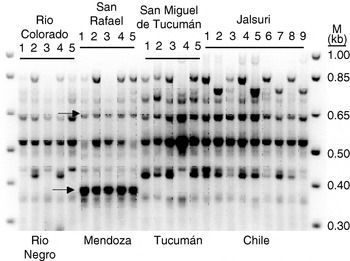
DNA fingerprinting of G. tuberculifemur geographic populations from South America showed that the population from San Rafael was associated with a fixed geographic specific banding pattern. Two bands were San Rafael specific (fig. 1, see arrows) and were not present in the rest of the populations. Populations from Tunuyán were not available at the time of this experiment. In general, other than some slight variation within the Chile population, the rest of the populations were associated with a similar banding pattern, thus demonstrating their genetic similarity.
ISSR-PCR DNA fingerprinting of G. tuberculifemur geographic populations from South America. Randomly chosen field-collected individuals per population from Argentina – Rio Colorado, San Rafael, San Miguel de Tucumán and Chile – Jalsuri were subjected to ISSR-PCR DNA fingerprinting with a 5′-anchored primer. The Province of each location is listed at the bottom of the figure. M: 1.0 Kb plus DNA ladder.

Analysis of the COI partial gene from G. tuberculifemur geographic populations
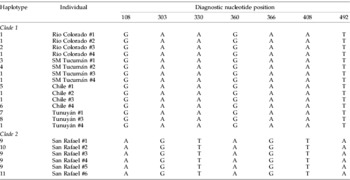
Sequencing of the COI partial gene produced a 518 bp fragment for all G. tuberculifemur individuals and Gonatocerus species. A total of 11 haplotypes were identified among the populations out of 21 individuals, demonstrating genetic variation. Eight haplotypes (1–8) (out of 15 individuals) were identified and assigned to clade 1 and another three (9–11) (out of six individuals) were identified and assigned to clade 2; all haplotypes from individuals from the San Rafael population fell into clade 2. Individuals from San Rafael were from collections made in two separate years (January 2004 and 2006). Haplotype 1 was shared among the four geographic populations within clade 1, haplotype 2 was Rio Colorado specific, haplotypes 3 and 4 were San Miguel de Tucumán specific, haploptypes 5 and 6 were Chile specific, haplotypes 7 and 8 were Tunuyán specific and haplotypes 9–11 were San Rafael specific. No sharing of haplotypes was seen between the two clades, demonstrating haplotype or geographic structure. Individual haplotype specifics are not shown. Since several individuals per population were analyzed, a pattern of clade-specific or diagnostic nucleotides were identified that allowed the discrimination of the populations. For example, at nucleotide #108 all individuals within clade 1 contained a guanine (G), whereas all individuals within clade 2 (San Rafael) contained an adenine (A) (table 2). Seven point mutations were identified between the two clades, three were transversions and four were transitions; however, no amino acid substitutions were observed.
Mitochondrial COI clade diagnostic nucleotides for individuals from Argentina and Chile. Specific details on haplotypes are not shown here.

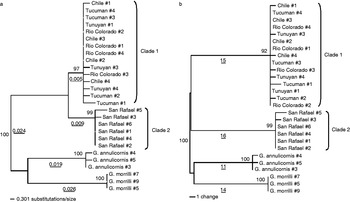
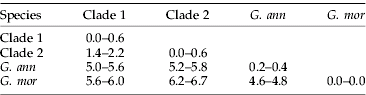
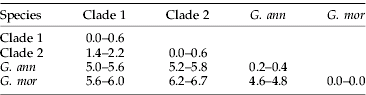
Levels of genetic divergence in the COI partial gene among populations were determined by calculating the pairwise estimates for genetic distance. The percentage sequence divergence (%D) is shown in table 3. Individuals within each clade were pooled respectively. Two Gonatocerus species (G. annulicornis and G. morrilli) were included as outgroups. The intra-populational and -specific variation (0.0–0.6%) was small within each clade and species. The %D within each G. tubeculifemur clade was 0.0–0.6, whereas the %D between them was 1.4–2.2. A neighbour-joining distance tree showed that individuals clustered into two well-supported distinct clades with very strong bootstrap support values of 97–99%, with all of the San Rafael individuals forming a distinct clade (fig. 2a). A single most parsimonious tree demonstrated the same tree topology as the neighbour-joining tree; two well-supported distinct clades were also observed with strong bootstrap values (92–99%) (fig. 2b). Although the %D was moderate (1.4–2.2) between the two G. tuberculifemur clades, it corroborates with the results seen in figs 1 and 2 and table 2, showing a very clear genetic distinction between individuals from the two clades.
Phylograms inferred from the mitochondrial COI partial gene from geographic populations of G. tuberculifemur. (a) Neighbour-joining distance tree and (b) Parsimonious tree: bootstrap 50% majority-rule consenses tree based on 41 informative characters. Tree length=57 steps; consistency index (CI)=0.982; and retention index (RI)=0.994. G. annulicornis (South America) and G. morrilli (North America) were included as outgroups. The trees display estimated branch lengths (below branches, underlined) and bootstrap values (above branches) as percentage of 1000 replications. To account for intra- and inter-populational variation, several randomly chosen field-collected individuals (3–6) were included.

Pairwise DNA sequence distances (range) of the COI partial gene fragment from geographic populations of G. tuberculifemur from South America showing percentage divergence (%D). Individuals within each clade were pooled, 15 for clade 1: Argentina – San Miguel de Tucumán, Rio Colorado, Tunuyán, and Chile – Jalsuri; and 6 for clade 2: Argentina – San Rafael. See fig. 2 for assignments. Outgroups: G. ann, G. annulicornis (South America) (3 individuals); and G. mor, G. morrilli (North America) (3 individuals).
COI analysis of G. tuberculifemur individuals with different morphotypes and individuals emerging from Cicadellini leafhoppers
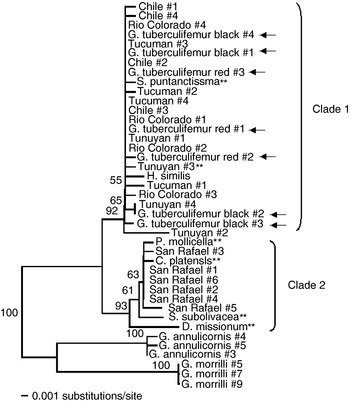
Gonatocerus tuberculifemur individuals with different morphotypes (red or black gasters) were identified; so we questioned whether these morphotypes were actually different strains and whether colour can be used as a diagnostic feature to distinguish them. Fig. 3 shows a neighbour-joining phylogram of the results of the COI sequence analysis with very strong bootstrap values (92–93%). All individuals, regardless of morphotype, clustered into clade 1 of the phylogram. As mentioned previously, in field host range studies, a small number of G. tuberculifemur-like individuals were also collected that emerged from Cicadellini leafhoppers (Jones et al., Reference Jones, Logarzo, Triapitsyn, Casas, Virla and Purcell2005a,Reference Jones, Logarzo, Virla, Luft, Tariq, Blincoe, Mochel, Oswalt and Esserb), and so we asked whether these individuals were G. tuberculifemur or a closely related strain. Fig. 3 shows that two egg parasitoids clustered into clade 1, whereas four clustered into clade 2 along with the San Rafael specimens. Field-collected specimens of G. tuberculifemur from Tunuyán that were previously unavailable clustered into clade 1. A single most parsimonious tree with a length of 77 steps, consistency index (CI) of 0.974 and a retention index (RI) of 0.989 showed the same topology as the neighbour-joining tree with strong bootstrap values (86–95%) (data not shown).
Neighbour-joining phylogram inferred from the mitochondrial COI partial gene showing G. tuberculifemur individuals with ‘red’ and ‘black’ gasters (colour listed after the species along with arrows in clade 1), including G. tuberculifemur-like egg parasitoids emerging from Cicadellini leafhoppers, followed by asterisks (**). The tree displays estimated branch lengths (below branches, underlined) and bootstrap values (above branches) as percentage of 1000 replications.

ISSR-PCR DNA fingerprinting of parasitoids emerging from Cicadellini leafhoppers
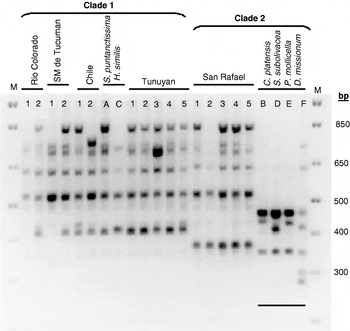
To further characterize G. tuberculifemur-like individuals emerging from Cicadellini leafhoppers, we submitted them to ISSR-PCR DNA fingerprinting. We have previously shown this method to be very sensitive because it targets the whole genome (de León et al., Reference de León, Jones and Morgan2004b, Reference de León, Hagler, Logarzo, Morgan, Tariq, Blincoe, Mochel, Oswalt and Esser2005, Reference de León, Jones, Sétamou and Morgan2006; Zietkiewicz et al., Reference Zietkiewicz, Rafalski and Labuda1994). Interestingly, four parasitoid specimens emerging from Cicadellini leafhoppers were shown to have very different ISSR-PCR banding patterns when compared to the rest of the G. tubeculifemur geographic populations (fig. 4; lanes B, D, E and F). Specimens in lanes A and C showed a similar banding pattern to the G. tuberculifemur populations from clade 1. In four of six specimens, molecular differences were uncovered with ISSR-PCR analysis that COI sequence analysis did not detect. ISSR-PCR DNA fingerprinting of G. tuberculifemur individuals with red and black gasters showed the same banding pattern as individuals from clade 1 (data not shown).
ISSR-PCR DNA fingerprinting of individuals emerging from Cicadellini leafhoppers, along with G. tuberculifemur geographic populations. The population of G. tuberculifemur from Tunuyán is an isofemale line. M: 1.0 Kb plus DNA ladder.

Mitochondrial COI phylogenetic relationships among Gonatocerus species
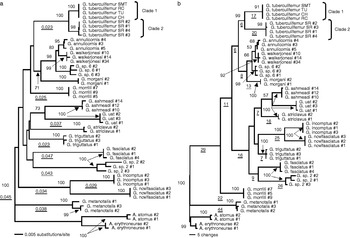
Geographic populations of G. tuberculifemur and several named and one unnamed Gonatocerus species from South America were included to test the support for the species groups considered and to confirm species boundaries. We obtained ten of the 13 Gonatocerus species delineated by Triapitsyn (Reference Triapitsyn2006). A total of 48 ingroup specimens were analyzed and four specimens from two Anagrus Haliday species (also a mymarid genus) were included as outgroups. Each named Gonatocerus species formed its own distinct clade or taxonomic unit (fig. 5), confirming the species boundaries of Triapitsyn (Reference Triapitsyn2006). The neighbour-joining distance tree showed that each taxonomic unit was supported by very strong bootstrap values (95–100%) (fig. 5a). Species boundaries were also confirmed with the parsimonious bootstrap 50% majority-rule consenses tree with strong bootstrap support (68–100%) (fig. 5b). In comparing the two trees, in general, the topology of the parsimonious tree varied with the phylogenetic placement of G. morrilli. The specimens of G. tuberculifemur, the potential biological control agent from South America, as shown previously on fig. 2, again formed two distinct clades among the named Gonatocerus species with both types of phylogenetic analyses. All specimens from San Rafael clustered into clade 2, whereas the rest of the populations from South America all clustered into clade 1, suggesting that G. tuberculifemur contains two distinct lineages. The unnamed Gonatocerus species (G. sp. 6) from South America also clustered into a distinct clade, suggesting that it is a valid species.
Phylogenetic relationships of several named and one unnamed Gonatocerus species along with G. tuberculifemur geographic populations from South America. Phylograms were created with the COI partial gene. Two to four individuals were included per species. (a) Neighbour-joining distance analysis and (b) Parsimony analysis: bootstrap 50% majority-rule consenses tree based on 139 informative characters. Tree length=400 steps; CI=0.485; and RI=0.850. Trees display estimated branch lengths (below branches, underlined) and bootstrap values (above branches) as percentage of 1000 replications. G. tuberculifemur locations: SMT, San Miguel de Tucumán; TU, Tunuyán; CH, Chile; RC, Rio Colorado; SR, San Rafael.

Discussion
The current report represents the first molecular genetic study of the prospective GWSS egg parasitoid candidate agent from South America, G. tuberculifemur, for a neoclassical biological control program in California (Jones, Reference Jones, Tariq, Oswalt and Esser2001, Reference Jones, Parra, Zucchi, Vendramim, Moraes, Bogorni, Silveira Neto and Bento2003; Logarzo et al., Reference Logarzo, Virla, Jones and Hoddle2005). Again, this parasitoid is now being permitted for release in California (CDFA, 2005). Two molecular methods, ISSR-PCR DNA fingerprinting and a phylogeographic approach inferred from COI sequence variation, were utilized. Excellent agreement was seen between the two molecular methods at distinguishing G. tuberculifemur geographic populations from South America. Both molecular methods distinguished populations of G. tuberculifemur from San Rafael as genetically distinct. Fixed geographic-specific markers were identified by ISSR-PCR analysis (figs 1 and 4) and two well-supported lineages or clades were uncovered by COI sequence variation (figs 2 and 5). All of the individuals from the San Rafael population clustered into clade 2, whereas the rest of the South American populations clustered into clade 1. Clade-specific diagnostic nucleotides in the COI partial gene were identified that allowed the discrimination of the geographic populations (table 2). Unique mitochondrial haplotypes were also observed. There was no haplotype sharing between the individuals from the two clades, demonstrating haplotype or geographic structure. Not sharing of haplotypes and uncovering fixed geographic variation inferred by ISSR-PCR analysis is an indication of lack of or reduced gene flow and reproductive isolation (Hoy et al., Reference Hoy, Ayyamperumal, Morakete, Lo and Nguyen2000; Scheffer, Reference Scheffer2000).
The present results confirm the utility of the ISSR-PCR DNA fingerprinting technique using a 5′-anchored ISSR primer as a good molecular diagnostic tool, at least with our experience with several Gonatocerus haplodiploid species. In recent studies, we have observed a good correlation between DNA banding patterns and distinct Gonatocerus species (de León et al., Reference de León, Jones and Morgan2004b, Reference de León, Jones, Sétamou and Morgan2006). We also used the method to distinguish a total of eight Gonatocerus egg parasitoid species (de León et al., Reference de León, Hagler, Logarzo, Morgan, Tariq, Blincoe, Mochel, Oswalt and Esser2005). Rapid and accurate distinction of egg parasitoids species is important in any biological control program. In addition, using ISSR compound primers, we determined the population genetic structure and the origin (Texas) of the GWSS (diploid species) that invaded California (de León et al., Reference de León, Jones and Morgan2004b).
Using a generalized molecular clock estimate for insect mitochondrial DNA of 2.3% per million years (Brower, Reference Brower1994) to roughly indicate the length of time since the two G. tuberculifemur clades diverged using the maximum pairwise divergence (2.2%) suggests that the two clades diverged 0.96 million years ago. Likewise, we recently identified a new species (G. walkerjonesi) within the genus Gonatocerus that was estimated to have diverged from a very closely related species (G. morrilli) 2.83 million years ago (de León et al., Reference de León, Jones, Sétamou and Morgan2006; Triapitsyn, Reference Triapitsyn2006). In general, in the present study, the COI gene is a good marker to determine species boundaries and phylogenetic analyses in the genus Gonatocerus. Species boundaries, using COI sequence data analyzed by the neighbour-joining method, corroborated the taxonomic analyses of Triapitsyn (Reference Triapitsyn2006). In a similar fashion, species boundaries and identification of possible cryptic species using the COI gene have been demonstrated in other insects [Fergusonina Malloch flies (Diptera: Fergusoninidae)] (Scheffer et al., Reference Scheffer, Giblin-Davis, Taylor, Davies, Purcell, Lewis, Goolsby and Center2004). Morphologically, almost every species in the USA has its ‘look-a-like’ species in the Neotropics, particularly in Argentina (S. Triapitsyn, unpublished data). The following South and North American species pair up morphologically: G. sp. 2 and G. fasciatus; G. annulicornis and G. walkerjonesi; G. metanotalis and G. triguttatus; and G. uat and G. ashmeadi, respectively. The phylogenetic relationships inferred from COI sequence data analyzed by the neighbour-joining method of the South and North American Gonatocerus species in the present study are all in accord with the morphological evaluations, with the exception of one pair, G. metanotalis and G. triguttatus. With the exception of one species, G. morrilli, the COI sequence data analyzed by the parsimony method also showed good agreement with the morphological analyses of Triapitsyn (Reference Triapitsyn2006). Gonatocerus morrilli belongs to the morrilli subgroup of the ater species group of Gonatocerus along with the following species: G. annulicornis, G. walkerjonesi, G. sp. 6 and G. morgani (Triapitsyn, Reference Triapitsyn2006; S. Triapitsyn, unpublished data). In general, though, the neighbour-joining method appeared to support the morphologically-defined relationships a little better than the parsimony method; but the heuristic search may not have been rigorous enough. However, COI sequence analysis did not resolve the separation of the small number of G. tuberculifemur-like individuals emerging from Cicadellini leafhoppers, although it is possible that they may be G. tuberculifemur. Most G. tuberculifemur-like individuals emerging from Cicadellini leafhoppers showed diagnostic ISSR-PCR banding pattern differences; and it is, therefore, also possible that these individuals could be different strains. Further analyses (morphological, biological and hybridization studies) are required to confirm the identity of these G. tuberculifemur-like individuals. For now, we can positively state that they are genetically distinct from G. tuberculifemur by ISSR-PCR analyses and at least supporting the host specificity of G. tuberculifemur individuals clustering into clade 2. A possible explanation for the COI sequence analysis not distinguishing most G. tuberculifemur-like individuals from G. tuberculifemur could be that they diverged a very short time ago and that the COI gene is not yet variant enough at this time to distinguish them. Time since divergence is a very significant factor as reviewed in Roderick & Navajas (Reference Roderick and Navajas2003). Another explanation could be that the genetic structure is changed in egg parasitoids of the same species emerging from different host tribes (Proconiini or Cicadellini). This would be a new function for the ISSR-PCR DNA fingerprinting method, although more work is required to confirm this possibility. Preliminary work with another Gonatocerus species (G. sp. 3) emerging from different host tribes shows the same situation as in the present study (J. de León, G. Logarzo & S. Triapitsyn, unpublished data). In the current study, neither COI sequencing nor ISSR-PCR DNA fingerprinting detected genetic differentiation between the coloured morphotypes (figs 3 and 4), indicating that colour cannot be used as a diagnostic tool. Lending support to this fact is that both morphotypes of G. tuberculifemur utilized in the phylogeographic studies were collected at all location sites, and random mixtures of morphotypes were included in the phylogeographic analyses.
Although the distribution of the two G. tuberculifemur clades has not yet been studied in depth, it appears that there is no overlap between them. Both San Rafael and Tunuyán belong to the same ecoregion, a semidesert area with similar temperature, precipitation and vegetation. San Rafael and Tunuyán are oases that have permanent rivers, but between them is a big desert depression. Yet the G. tuberculifemur population from San Rafael is geographically structured. This desert climate region may be serving as a physical barrier where gene flow may be prevented from occurring; and, therefore, populations may have been allowed to diverge. It is interesting to note that San Rafael and Tunuyán are only about 100 km apart, and yet there appears to be no gene flow between these populations. It is also interesting to note that climate-matching analysis using CLIMEX found a positive climate match between San Rafael in Argentina and California, USA; at the same time, no climate matches were observed between San Rafael and the southeastern USA, including Texas (Jones, Reference Jones, Parra, Zucchi, Vendramim, Moraes, Bogorni, Silveira Neto and Bento2003; W.A. Jones, personal communication). This event could have important implications to the biological control program in California. For example, the fact that the G. tuberculifemur population from San Rafael is geographically structured, combined with the predicted climate-matching event, that matches were found in California but not in the southeastern USA could reduce the risk of G. tuberculifemur, if released in California, of migrating or extending its range into the southeastern USA and attacking native or non-target leafhoppers from that region. If host specificity studies show G. tuberculifemur from San Rafael to attack non-target leafhoppers species from the southeastern USA, the climate-matching analysis predicts that G. tuberculifemur from San Rafael may have a reduced ability to survive or extend its range into the southeastern USA climate. Because of the complexity of most ecosystems, caution must be taken with this interpretation since the climate-matching approach only offers a prediction on whether natural enemies will survive or move around in certain environments or ecosystems. Startling mismatches between actual and predicted distributions or ‘species borders’ have been demonstrated (Holt et al., Reference Holt, Keitt, Lewis, Maurer and Taper2005; Parmesan et al., Reference Parmesan, Gaines, Gonzalez, Kaufman, Kingsolver, Peterson and Sagarin2005). Therefore, it is important to note that information about climate matching was only used as a starting ‘null hypothesis’ (Jones, Reference Jones, Parra, Zucchi, Vendramim, Moraes, Bogorni, Silveira Neto and Bento2003).
Gonatocerus tuberculifemur appears to be comprised of two distinct lineages, as evidenced by the two well-supported clades (and the ISSR-PCR data). Gonatocerus tuberculifemur exhibits mitochondrial phylogeographic structure, although preliminary hybridization studies have shown that individuals from the two well-supported clades do not hybridize. In addition, preliminary morphological data suggests that individuals from clade 2 represent a new species (J. de León, G. Logarzo & S. Triapitsyn, unpublished data). Taken together, this evidence is suggestive of reproductive isolation and a species level divergence. To confirm the identity of the G. tuberculifemur complex, continued sampling, cross-breeding and morphological studies of G. tuberculifemur from the two well-supported clades are in progress. It is also possible that additional clades may be uncovered. In addition to the diagnostic capability of ISSR-PCR, design of additional molecular markers (polymerase chain reaction-restriction fragment length polymorphism; PCR-RFLP) toward the COI gene are in progress to distinguish the individuals of G. tuberculifemur from the two clades to create isofemale lines for hybridization studies. Having two diagnostic marker sets adds confidence to the results. The information presented in the current study is critical to the biological control program in California and suggests that biological studies (e.g. risk assessment, host range) (Jones et al., Reference Jones, Logarzo, Triapitsyn, Casas, Virla and Purcell2005a,Reference Jones, Logarzo, Virla, Luft, Tariq, Blincoe, Mochel, Oswalt and Esserb; Logarzo et al., Reference Logarzo, Virla, Jones and Hoddle2005; Virla et al., Reference Virla, Logarzo, Jones and Triapitsyn2005) need to be performed on individuals from both clades to determine whether one population is more suited for the biological control program.
Acknowledgements
We thank Marissa González and Lisa A. Ledezma (current address: USDA, APHIS, PPQ-Edinburg, TX) and Laura Varone and Vanina Varni (USDA, SABCL-Argentina) for their excellent technical assistance. We are grateful to Eduardo Virla CONICET-PROMIMI (San Miguel de Tucumán, Argentina) for help in collection of G. tuberculifemur from Argentina. Many thanks go to David J.W. Morgan from CDFA, PDCP-Riverside, California, USA for specimens of certain egg parasitoids. We thank Walker A. Jones of USDA, ARS, EBCL-France for useful discussions on climate matching. We thank Katherine Aronstein from USDA, ARS-Weslaco, Texas, USA and Norman Barr from USDA, APHIS, PPQ-Edinburg, Texas, USA for reading and improving a previous version of the manuscript. Lastly, we thank the anonymous reviewers and the editor for also improving the manuscript.
Disclaimer
Mention of trade names or commercial products in this article is solely for the purpose of providing specific information and does not imply recommendation or endorsement by the U.S. Department of Agriculture.