INTRODUCTION
Fish introductions and intensification of fisheries are among the main threats to amphibian populations all over the world (for example Brönmark & Edenhamn Reference Brönmark and Edenhamn1994; Wellborn et al. Reference Wellborn, Skelly and Werner1996; Meyer et al. Reference Meyer, Schmidt and Grossenbacher1998). An important sector of the fish industry is fish pond culture, blamed for negative impacts on biodiversity owing to consumption of resources (land conversion) and introduction of exotic species (Beveridge et al. Reference Beveridge, Ross and Kelly1994). The contribution of cyprinids to world aquaculture production is the highest of any fish group; the common carp Cyprinus carpio is the most widely cultured cyprinid species in the world (FAO [Food and Agriculture Organization of the United Nations] 2007). Cyprinid culture (mainly common carp and the so-called Chinese carps, silver carp Hypophthalmichthys molitrix, bighead carp Hypophthalmichthys nobilis and grass carp Ctenopharyngodon idella) in open man-made ponds has traditionally been particularly popular in Central and Eastern (CE) Europe and in Asia (Martyshev Reference Martyshev1983; O'Grady & Spillet Reference O'Grady and Spillett1985). In CE Europe the total area used by cyprinid ponds exceeds 639 000 ha (Szücs et al. Reference Szücs, Stundi, Váradi, Leung, Lee and O'Bryan2007). Given the extensiveness of common carp (hereafter carp) occurrence and its notoriety in aquaculture, it is surprising that carp impact on amphibians, both in pond culture and as non-indigenous species in natural habitats, has prompted little interest (Gillespie & Hero Reference Gillespie, Hero and Campbell1999; Kloskowski Reference Kloskowski2009). Lack of thorough scientific research may be attributed to the fact that carp culture is most popular in low-income countries owing to low fish maintenance costs. Among the ‘old’ European Community (EC) countries it has been relatively common only in France and Germany (Horváth et al. Reference Horváth, Tamás and Seagrave1992). The bad reputation of carp in invaded systems and where it replaces indigenous fish in aquaculture (Kestemont Reference Kestemont1995; Zambrano et al. Reference Zambrano, Perrow, Macias-Garcia and Aguirre-Hidalgo1999) contributes to the perception of farm ponds as areas able to sustain only an impoverished fauna, although their importance as strongholds for waterfowl has been acknowledged (IUCN [International Union for Conservation of Nature] 1997). Notwithstanding, open shallow carp ponds have a large potential to contribute to preservation of local biological diversity (Szücs et al. Reference Szücs, Stundi, Váradi, Leung, Lee and O'Bryan2007). However, their suitability for amphibian reproduction remains to be investigated.
Carp may be produced in a polyculture of 2–3 species, occasionally combining different year-classes (Kestemont Reference Kestemont1995). However, in Europe, carp monoculture (with small additions of supplemental non-competing fish) is most prevalent, especially in the conditions of the most common extensive management (Kestemont Reference Kestemont1995; IUCN 1997). Apart from the domination of a single fish species, characteristic features of traditional carp pond culture that may be important for pond-breeding amphibians are separate stocking of fish age cohorts and a specific ‘hydroperiod’, dependent on the pond-specific flooding regime. Fish ponds can be supplied with water from different sources and the time necessary to fill the ponds can vary significantly. Fish cohorts are either left in the same ponds in the consecutive years, or they are translocated to a few wintering ponds in autumn and then re-established in newly flooded ponds in spring (Martyshev Reference Martyshev1983). Interannual carp cohorts are stocked in separate ponds to avoid intraspecific competition and cannibalism on fry (Smith & Reay Reference Smith and Reay1991; Horváth et al. Reference Horváth, Tamás and Seagrave1992). Year-classes grown in aquaculture clearly differ in average body size (O'Grady & Spillet Reference O'Grady and Spillett1985; Horváth et al. Reference Horváth, Tamás and Seagrave1992) and the spatially discrete distribution of fish size-cohorts may provide a mechanism generating differences between amphibian assemblages in the ponds (Kloskowski Reference Kloskowski2009). Water regime is important because pond permanency may influence the selection of oviposition site by amphibians (Wellborn et al. Reference Wellborn, Skelly and Werner1996). In natural habitats, pond-breeding amphibians typically trade off the risk of pond drying against the presence of vertebrate predators, which are restricted to more permanent waters (Wellborn et al. Reference Wellborn, Skelly and Werner1996; Snodgrass et al. Reference Snodgrass, Bryan and Burger2000; Van Buskirk Reference Van Buskirk2003), and, in spring, newly-flooded fish ponds may be perceived by amphibians as temporary habitats.
The purpose of the present study was to characterize use of commercial carp ponds by amphibians during the breeding season. Biotic and abiotic pond habitat properties were examined, including factors specific to pond culture that might influence amphibian species richness and patterns of community structure at farmed fisheries.
METHODS
Study system
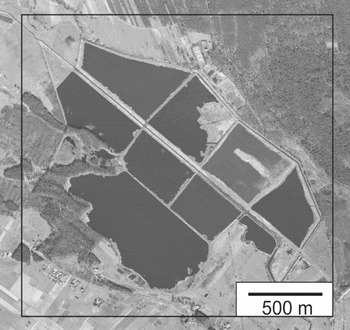
The study was conducted at four fish farms dispersed around the vicinity of Lublin, south-eastern Poland (51°18′–33′ N, 22°16′–25′ E; Fig. 1). The fish farms were embedded in patchy forest-agricultural landscapes. The man-made drainable ponds were of similar depth (mean depth: 0.7–1.3 m over the growing season), while the size of individual ponds ranged from 0.8–23 ha. Ponds were supplied with water from adjacent rivers or flooded by precipitation.
Aerial photograph of one of the four fish farm pond-complexes dispersed around the vicinity of Lublin, south-eastern Poland (51°33′ N, 22°22′ E).

Three carp year-classes were stocked in separate ponds: 0+ (young-of-the-year) fish stocked as larvae shortly after hatching, 1-year-old (1+) carp introduced to the ponds at c. 30–70 g individual weight and 2-year-old (2+) carp stocked at c. 150–240 g. The 0+ ponds received 40 000–60 000 fish larvae ha−1, the 1+ ponds received 5000–6000 fingerlings ha−1, and the 2+ ponds were stocked with 1000–2000 fish ha−1. Carp were left in the same ponds over the winter or placed in growing ponds between late March and early May. Cohorts of different ages were grown at all study sites. Supplemental fish (wels Silurus glanis or pike Esox lucius) were introduced in relatively small numbers (up to 1000 individuals ha−1 with 60–80% mortality rates per growing season) as larvae to a few of the 2+ ponds studied, but owing to small individual size their effect on amphibians was assumed to be negligible. Fish densities were within ranges typical for extensive European carp culture (Billard Reference Billard1999), but the ponds were manured in order to preclude nutrient depletion and to promote primary productivity, and the fish were supplied with supplementary food (cereal grains).
Amphibian sampling and environmental variables
Each year from 2005 to 2007, 12 different ponds were sampled to describe the amphibian community in terms of individual species distribution and reproductive performance. In total12 0+ ponds, 13 1+ ponds and 10 2+ ponds were included in the analyses; one study pond was drained in June and therefore not included in the analyses. Larval amphibians were trapped using funnel activity traps (Griffiths Reference Griffiths1985) approximately every two weeks, starting on 20–24 April and ending in mid-July (seven sampling sessions per year). In each pond ten traps were set in different locations at the interface between emergent plant stands and open water; traps were retrieved after 24 h (see Kloskowski Reference Kloskowski2009 for details of the trapping procedure). Two dip netting sessions, in late May and in mid-June, were conducted using a rigid-frame dip net (aperture diameter 75 cm) with a 1.5 m handle. Twenty sweeps were done every 10 m (20 m in large ponds) along the longitudinal axis of the pond. The dip net, operated by the same person, was moved forward 1.5 m along the sediment surface and then quickly raised vertically up to the surface. Additionally, amphibians were inventoried by visual identification of eggs and adult individuals, and by anuran calls during the trapping and dip netting visits to the ponds and during two surveys in late April and mid-May (the entire perimeter of each pond was searched, including the water 1–5 m from the shore). Amphibians were identified to species level with the exception of the youngest larval stages. Taxa in the Rana esculenta complex (‘water frogs’), ‘brown frogs’ (Rana temporaria versus Rana arvalis) and newt larvae were grouped.
Records of taxa detected by any sampling method were used to assess species occurrence and richness. To index the reproductive success of individual anuran species in a given pond the maximum number of larvae that had grown to at least developmental stage 38 (Gosner Reference Gosner1960) trapped in any one sampling event was used. Tadpole survival probability increases as an individual grows larger (Caldwell et al. Reference Caldwell, Thorp and Jervey1980), so it was assumed that abundance of late stage tadpoles was a good measure of survival to metamorphosis. As newt larvae were captured at relatively low frequencies, maximum numbers of all larval forms obtained in one sampling session were included. Adult newts were also recorded, because activity traps are highly suitable for their sampling (Griffiths Reference Griffiths1985), and the presence of mature individuals in a water body in spring strongly suggests they reproduced at that site (Babik & Rafiński Reference Babik and Rafiński2001). As activity traps are useful in sampling predatory invertebrates reported to prey on tadpoles (Elmberg et al. Reference Elmberg, Nummi, Pöysä and Sjöberg1992), adult Dytiscidae and Anisoptera naiads caught by the traps were quantified.
Chemical and physical parameters of the ponds were measured in June and early July; these included Secchi depth (range in ponds 20–152 cm), water conductivity (range in ponds 272–813 μS cm−1) recorded using a Slandi CM 204 conductivity meter, pH (range in ponds 6.8–9.4) using a Slandi PH 204 pH-meter (Slandi® Company, Michalowice, Poland) and dissolved oxygen (range in ponds 1.3–9.6 mg dm−3), using an Elmetron CX-401 multifunction meter (Elmetron, Zabrze, Poland). Estimates of the abundance of predaceous insects and values of the chemical and physical parameters were based on averages of catches/measurements over the season. The biomass of submersed plants was estimated using a ‘fork-like’ sampler between 30 June and 2 July each year. Eight samples per pond, consisting of all the above-sediment vegetation cut from 0.16 m2 squares, were gathered every 20 m within one or two line transects along the longitudinal axis of the pond. Samples were washed to remove detritus, sediment and epiphytes, and dried at 60° C to a constant weight. Other pond variables included in the analyses were the percentage of pond surface covered by emergent aquatic vegetation (range 5–68%; determined by digitizing aerial photographs), pond area (range 1–23 ha), carp cohort age and pond permanence (a term contrasting ponds that held water over winter and ponds which remained dry in winter and were refilled in late spring). Classification of ponds as ‘wintering’ (n = 14) or flooded in spring (n = 21) was based on information provided by local fisheries’ managers and verified by visits to the ponds between January and April.
Data analysis
Patterns of relationships between amphibian reproductive success and habitat variables were investigated with canonical correspondence analyses (CCA; CANOCO 4.5; ter Braak Reference ter Braak1986), a direct gradient analysis that iteratively develops an ordination of taxa and sampling sites, combined with multiple regression on a series of environmental gradients. A few ordination axes, weighted sums of environmental variables, are considered composite environmental gradients structuring species distribution patterns. To partial out the effects of the year of sampling and study locations (pond-complexes) from the model, they were included in the ordination as categorical (dummy) co-variables. The significance of the relationship of each environmental variable to the amphibian data was determined using stepwise forward selection by the magnitude of the additional variation the variable explained (‘conditional effects’). A Monte-Carlo procedure of 999 runs was used to test the significance of the ordination pattern (the trace statistics) and of the first canonical axis. Only variables with marginal and conditional effects at p < 0.1 were included in CCA. Environmental data were log or arcsin transformed to improve normality.
The pond-complexes constituted distinct dense clusters (neighbouring ponds were separated by 6–12 m wide levees; Fig. 1) 10–60 km apart and spatial non-independence (Legendre & Fortin Reference Legendre and Fortin1989) was assumed only between data points from the same pond-complexes (Petranka et al. Reference Petranka, Smith and Scott2004; Dormann et al. Reference Dormann, McPherson, Araújo, Bivand, Bolliger, Carl, Davies, Hirzel, Jetz, Kissling, Kühn, Ohlemüller, Peres-Neto, Reineking, Schröder, Schurr and Wilson2007). Generalized linear mixed models (GLMMs) with stepwise backward removal (GenStat version 11.0) were performed to quantify the relationship of species richness (model with Poisson distribution; logarithmic link function) and presence/absence patterns (binomial error distribution and a logit link) to pond variables. An alternative derivation was implemented of the penalized quasi-likelihood fitting of generalized linear models (Schall Reference Schall1991). Potential site and year effects were controlled by fitting year and pond-complex identity as random terms; incorporation of random terms circumvents the problem of spatially correlated results arising from grouped observations (McCulloch & Searle Reference McCulloch and Searle2001). The significance of the fixed terms was assessed using Wald's statistic.
To test for a nested distribution of the species assemblage, a species presence/absence matrix was constructed. In a nested system, rare species occur only in species-rich sites, whereas common species tend to be omnipresent (Atmar & Patterson Reference Atmar and Patterson1993; Hecnar & M'Closkey Reference Hecnar and M'Closkey1997). The nestedness in species distribution was examined using the system ‘temperature’ (T°) metric (a combination of a thermodynamic measure of order and disorder, and a Monte-Carlo simulation) proposed by Atmar and Patterson (Reference Atmar and Patterson1993), and calculated using the Nestedness Temperature Calculator computer program (Atmar & Patterson Reference Atmar and Patterson1995). Temperature varies from 0°, for a perfectly nested matrix, to 100°, for a totally random system. The significance of T°-values was based on a comparison of the data-matrix order with 500 randomly generated matrices (Monte-Carlo simulations) under a null model of equiprobable occurrences. Potential nested distribution was also investigated for each species separately to determine which species exhibited a nested distribution pattern along the carp age gradient in the ponds. A one-tailed Mann-Whitney U test of the null hypotheses of no clustering of species occurrence at the ends of the fish age gradient (ponds were rank-ordered from those containing 0+ cohorts to 2+ cohorts using 0–2 values to denote fish age) was performed (Schoener & Schoener Reference Schoener and Schoener1983; Simberloff & Martin Reference Simberloff and Martin1991).
RESULTS
In terms of overall occurrence, the most common taxa in carp ponds were ‘brown frogs’ (overall pond occupancy 85.7%), R. esculenta synkl. (62.9%) and B. bufo (60.0%). The other species detected in the ponds were Triturus cristatus, Triturus vulgaris, Bombina bombina, Pelobates fuscus, Bufo viridis and Hyla arborea (for mean amphibian densities in activity traps are summarized in Appendix 1, see supplementary material at Journals.cambridge.org/ENC).
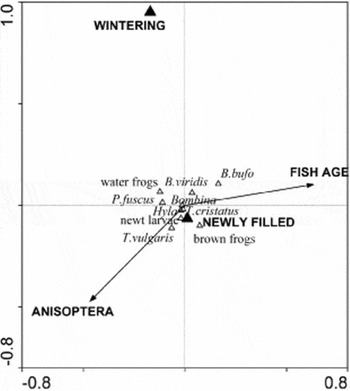
Based on forward model selection, age of fish cohorts in the ponds (CCA; λa = 0.056, F = 2.85, p = 0.014) and Anisoptera density (λa = 0.051, F = 2.67, p = 0.026) were the habitat factors best explaining distribution patterns of larval amphibians among ponds, followed by pond permanence (‘wintering’ versus newly-filled ponds). However, the effect of the last variable only approached significance (λa = 0.041, F = 2.50, p = 0.076). CCA was performed using only these three variables (Fig. 2). All other variables were insignificant (p > 0.1): Secchi depth (λa = 0.038), dytiscid density (λa = 0.026), water conductivity (λa = 0.026), pond area (λa = 0.024), pH (λa = 0.026), dissolved oxygen, emergent and submergent vegetation (all λa = 0.007).
CCA ordination diagram showing the distribution of pond-breeding amphibian species in relation to the multivariate environmental space in 35 ponds sampled between 2005 and 2007. The environmental gradients are represented by arrows and the single nominal (dummy) variable (WINTERING versus NEWLY FILLED PONDS) is drawn as centroids (denoted by filled-in triangles). The length of the arrows and the distance of the centroids from the origin reflect their importance for species distributions. Species proximity to the arrows, and their perpendicular distance along an arrow, indicates the strength of the influence of that environmental variable on the species. FISH AGE was included as an ordinal trend.

Correlation coefficients show that axis 1 of the CCA is a gradient of increasing fish age and decreasing Anisoptera larvae abundance (Appendix 2, see supplementary material at Journals.cambridge.org/ENC), and that axis 2 is largely defined by pond permanence contrasted between newly-filled and wintering ponds and decreasing Anisoptera density (Appendix 2, see supplementary material at Journals.cambridge.org/ENC). Water transparency and conductivity were also significantly related to axis 1 (r = −0.51 and r = 0.41, both p < 0.02), but contributed little to the cumulative effects of the two main canonical axes (both λa = 0.02, p > 0.1).
Ordination scores for amphibian taxa indicate a negative association between the reproductive performance of most amphibian species and the age of fish, and relatively low reproductive output of most amphibians in ponds holding water in winter (Fig. 2). The only species showing a positive relationship with increasing fish age was Bufo bufo (correlation between species and fish age, r = 0.38, p = 0.02). ‘Water frogs’ and B. bufo were the main species recorded in ponds after wintering, however, these species were also common in newly-filled ponds; they still tended to be clustered around the origin of the ordination (correlation between these species and wintering ponds: r = 0.20 and r = 0.19, respectively, both p > 0.05). Conversely, no species was strongly associated with newly-filled ponds (r < 0.20, all p > 0.05). Arrows expressing fish age and Anisoptera density aimed in different directions of the ordination space, indicating that the amphibian taxa common in 0+ ponds co-occurred with high Anisoptera densities. Only B. bufo larvae showed a marginally significant negative association with Anisoptera (r = −0.32, p = 0.06).
Eigenvalues of CCA axes 1 and 2 were relatively weak (Appendix 3, see supplementary material at Journals.cambridge.org/ENC) and the canonical eigenvalues accounted together for only 25.3% of the total variance. Permutation tests on the trace value (p = 0.004) and on the value of axis 1 (p = 0.028) indicated that the explanatory variables included in the model explained a significant amount of the variation in the species data. Large variation among study sites may account for the weak eigenvalues: when pond-complexes were included in the CCA model not as co-variables but as nominal variables, the amount of total variance explained by the canonical eigenvalues increased to 42.9%.
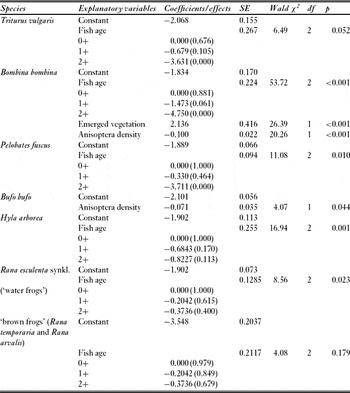
For most species, the probability of occurrence in the ponds decreased with fish age, apart from ‘brown frogs’ (GLMM: all predictive terms dropped at p > 0.17) and B. bufo, which responded (negatively) only to Anisoptera density (Table 1). Bufo viridis and T. cristatus were the least frequently detected species (28.6% and 17.1% of the ponds, respectively) and it was not possible to perform GLMM analyses for these species; they occurred only in 0+ ponds. GLMM models found the abiotic habitat variables had no significant effects (Table 1).
Results of GLMMs for the probability of amphibian taxa occurring in carp ponds. The fixed parts of reduced models resulting from the stepwise elimination of insignificant terms are presented. Fish age was treated as a nominal variable with three levels. In parantheses are back-transformed predicted means given for fish age. For ‘brown frogs’ all predictive terms were insignificant; fish age was the closest to significance.

Amphibian species richness depended solely on the age of carp stocks (predicted means: 7.39 in 0+ ponds, 3.05 in 1+ and 1.63 in 2+ ponds, Wald's statistic = 51.41, df = 2, p < 0.001). All other variables were dropped from the model at p > 0.1. The total amphibian assemblage was significantly nested, with a clear tendency for the less frequently occurring species to occupy the most species-rich ponds, while species-poor ponds contained predominantly more common species only (T° = 12.7°, p < 0.001). No amphibian species were found exclusively in ponds with ≥ 1+ fish. All taxa except B. bufo and ‘brown frogs’ exhibited nested patterns of occurrence across the fish age gradient (Mann-Whitney U test; all Bonferroni corrected p < 0.02).
DISCUSSION
Both CCA and GLMM results show that size-distributed carp stocks have strong predictable effects on amphibian community structure and reproductive performance. Ponds with 0+ stocks supported dramatically higher amphibian species richness than ponds stocked with older fish. Differential amphibian responses to the age of carp cohorts could be regulated either by trophic interactions dependent on the individual size of fish, or by avoidance of ponds stocked with larger-sized fish by breeding individuals (J. Kloskowski, unpublished data). Habitat selection to avoid predators is a common phenomenon in amphibians (Resetarits & Wilbur Reference Resetarits and Wilbur1989; Binckley & Resetarits Reference Binckley and Resetarits2003). However, the ability of breeding females to correctly assess the fitness consequences of ovipositing in particular ponds may be limited when pond flooding and stocking regimes are governed not by natural hydroperiod, but by anthropogenic activities. Carp predatory capability is size-dependent; in the first spring and summer of life carp are too small (body length of a few centimetres) to feed effectively on such prey as amphibian larvae (compare with Vilizzi Reference Vilizzi1998). Significant resource competition from carp is unlikely because amphibian larvae rely heavily on algae (Diaz-Paniagua Reference Diaz-Paniagua1985; Viertel Reference Viertel1990), which are of little dietary importance for carp (Vilizzi Reference Vilizzi1998; García-Berthou Reference García-Berthou2001). CCA indicated that, among the environmental variables studied, those associated with predation risk, namely fish age and Anisoptera densities, best differentiated habitats of individual amphibian taxa. Increasing age of carp was associated with reduced Anisoptera density, which suggests that pond-breeding amphibians had to trade off between the risk of predation by fish and by insect predators vulnerable to fish (see also Smith et al. Reference Smith, Rettig, Mittelbach, Valiulis and Schaach1999). Apart from B. bufo, no species stood out as being strongly associated with ≥1+ ponds. Apparently, older fish cohorts were able to suppress both aquatic insects and most amphibian species, whereas 0+ ponds provided conditions for high amphibian densities, irrespective of the abundance of predatory insects. However, B. bufo, not palatable to fish but vulnerable to predatory invertebrates, may profit from the presence of large-sized carp (see also Laurila Reference Laurila1998; Bardsley & Beebee Reference Bardsley and Beebee1998; Manteifel & Reshetnikov Reference Manteifel and Reshetnikov2002; Hartel et al. Reference Hartel, Nemes, Cogalniceanu, Öllerer, Schweiger, Moga and Demeter2007).
Amphibian community structure appeared unresponsive to abiotic pond characteristics. Water pollution caused by excessive manuring may affect amphibians (Ortiz et al. Reference Ortiz, Marco, Saiz and Lizana2004; Macias et al. Reference Macias, Marco and Blaustein2007); however, levels of eutrophication associated with additional feeding of fish and manuring in extensive and semi-intensive carp culture are presumably too low to adversely influence survival of larval amphibians, at least in 0+ ponds, where high water quality is required for effective fish production (reviewed in Billard Reference Billard1999). Pond permanency was expected to be vital to breeding habitat selection by amphibians (Wellborn et al. Reference Wellborn, Skelly and Werner1996; Snodgrass et al. Reference Snodgrass, Bryan and Burger2000), but its effect was only marginally significant in terms of community composition. Species recorded in the study ponds exhibited a nested distribution along the fish age gradient, rather than the replacement pattern which might have been expected to be reinforced by interspecific competition and individual species preferences for different sectors of the hydroperiod gradient (Wellborn et al. Reference Wellborn, Skelly and Werner1996; Van Buskirk Reference Van Buskirk2003), perhaps because there were only two types of hydroperiod in the system studied (ponds that already held water in the winter versus ponds refilled in late spring). In addition, in cultured ponds occurrence and size structure of fish are regulated by farming practices, in contrast to natural habitats, where they are strongly coupled with pond permanency (Fox & Keast Reference Fox and Keast1990; Snodgrass et al. Reference Snodgrass, Bryan and Burger2000). Overall, it is likely that the strong sorting influence of fish age overshadows the more subtle effects of the other factors (compare with Laurila Reference Laurila1998). Species vulnerable to fish (actually the majority of taxa encountered in the study area) may tend to be more nested than less vulnerable species (Hecnar & M'Closkey Reference Hecnar and M'Closkey1997). Short environmental CCA gradients reflect the limited range of habitat factors responsible for differential amphibian distribution in response to the relative environmental/structural homogeneity (similar water depth and morphology) of the ponds studied. Per cent variance explained by the CCA canonical axes appears low, but this is frequently the case with ecological data, for example when the presence/absence aspect is strong (ter Braak & Verdonschot Reference ter Braak and Verdonschot1995). As an ordination including co-variables is based on the residual variation in the species data that remains after fitting the effects of the co-variables, one of the reasons for the weak eigenvalues might be the effect of the metapopulation structure of some of the examined species on the amount of the variation explained by study sites as a co-variable; for example Triturus cristatus was detected only at one study site.
The present findings underpin the need for a flexible management policy with regard to pond-based fish culture. Wherever carp are able to grow to large size, their presence should be perceived as a threat to amphibian diversity. However, the 0+ ponds examined supported virtually all taxa recorded in the region (Głowaciński & Rafiński Reference Głowaciński and Rafiński2003) and merit consideration in conservation efforts. A preliminary study has indicated that 0+ ponds may be no less attractive for breeding amphibians than fishless ponds (Kloskowski Reference Kloskowski2009). Paradoxically, commercially-operated fisheries produce secondary breeding habitats for species endangered by fish introductions in many parts of Europe (T. cristatus, B. bombina, H. arborea and P. fuscus; Brönmark & Edenhamn Reference Brönmark and Edenhamn1994; Nyström et al. Reference Nyström, Birkedal, Dahlberg and Brönmark2002; Skei et al. Reference Skei, Dolmen, Rønning and Ringsby2006). In areas such as south-east Poland, where pristine wetlands have largely been destroyed (IUCN 1997), semi-natural carp ponds have the potential to function as a substitute for a range of natural amphibian breeding habitats. Farms comprising ponds stocked with different fish age-classes provide amphibians with reproductive patches of highly differing quality, and only a small sector of carp fisheries is suitable for reproduction of amphibians vulnerable to fish. Nevertheless, 0+ ponds as favourable habitat patches amidst a matrix of otherwise inhospitable habitat may increase the total amount of breeding habitat for a broad spectrum of amphibian species with varying habitat requirements, especially as amphibians appear able to properly assess the quality of breeding habitats within clustered ponds (reviewed in Petranka et al. Reference Petranka, Smith and Scott2004). Restriction of conservation measures to 0+ ponds has a practical aspect, as this stage of fish production usually requires only c. 10% of total farm area (Horváth et al. Reference Horváth, Tamás and Seagrave1992) and the potential losses in fish yield are economically the least costly (Kloskowski Reference Kloskowski2005). One possible recommendation for habitat improvement at 0+ ponds arising from the present study is that fish farms (pond complexes) should encompass 0+ ponds filled with water early and late in the season, so that (depending on the local sources of water supply and the stocking regime) the two types of ponds could accommodate both early-breeding amphibians and those preferring short-hydroperiod (i.e. late flooded) wetlands.
The strong pressure for economic efficiency of carp farming following the political transformations in the former Eastern bloc countries (Szücs et al. Reference Szücs, Stundi, Váradi, Leung, Lee and O'Bryan2007) may influence conditions for wildlife in ponds, for example when stocking density is increased or emergent vegetation is removed from ponds to expand the fish production area. Notwithstanding the privatization trend and intensification of the aquaculture sector in CE Europe in the last two decades, effective management of ponds for breeding amphibians is possible; according to the EU Common Fisheries Policy, carp ponds subjected to environmentally-sensitive farming practices may be considered for financial support from the European Fisheries Fund (EC Council Regulation No. 1198/2006). Also, for effective amphibian conservation, it may be critical to target the surrounding terrestrial environment of ponds and pond-complexes specialized for production of 0+ fish. Management prescriptions should aim to improve interhabitat connectivity and create protective core areas for various amphibian life-stages (Vos & Stumpel Reference Vos and Stumpel1995; Denoël & Ficetola Reference Denoël and Ficetola2008). Insights into the effects of stocking practices and the integration of farmed fisheries into conservation planning across the landscape may help to support amphibian populations on the vast scale of the carp pond industry.
ACKNOWLEDGEMENTS
I am grateful to the fish farmers (M. Filipiak, J. Orzepowski and M. Sagan) for allowing access to their ponds. M. Nieoczym and A. Flis provided field assistance. This research was funded by a grant from the Polish Ministry of Science and Higher Education (2P04G 050 30). The manuscript was improved by comments provided by two anonymous reviewers.