1 Introduction
Franconian (spoken in parts of Belgium, Germany and the Netherlands) and some North Germanic languages (Norwegian, Swedish and some varieties of Danish) display tone-accent oppositions in which pitch is used contrastively to distinguish between two types of stressed syllables, commonly referred to as Accent 1 and Accent 2. ‘Traditional’ autosegmental analyses of the phenomenon assume that the synchronic distinction between the two accent classes is derived from the presence of tone in the lexicon. For Scandinavian, this has been proposed in different variants (e.g. Bruce Reference Bruce1977, Riad Reference Riad1998, Reference Riad2006, Kristoffersen Reference Kristoffersen2000, Lahiri et al. Reference Lahiri, Wetterlin and Jönsson-Steiner2005). Starting with Morén (Reference Morén2005, Reference Morén2007), an alternative approach has emerged: essentially, Morén claims that the opposition between the accents has nothing to do with lexical tone at all. Instead, he argues that the accent contrast derives from contrastive foot structure on the surface: North Germanic Accent 1 is a monosyllabic foot; Accent 2 is a disyllabic foot. On this view, the tonal surface contrasts can be attributed to the association of postlexical, intonational tones to diverse metrical structures, i.e. the two types of feet. Morén-Duolljá (Reference Morén-Duolljá2013) develops the original argument further in a detailed case study of nominal paradigms in Götaland Swedish.Footnote 1
Within the Germanic language family, tonal accent is also found in Franconian, which is a cover term for several West Germanic dialects (Limburgian, Moselle Franconian and Ripuarian); Cologne can be regarded as roughly the geographic centre of the area. What differentiates Franconian dialects from other varieties of West Germanic is the lexically contrastive use of pitch: like many varieties of North Germanic, Franconian has two tone accents, usually referred to as Accent 1 (which I will refer to Class 1) and Accent 2 (Class 2).Footnote 2 Two minimal pairs from the Mayen dialect are provided in (1) (from Schmidt Reference Schmidt1986). The examples show that the accents can serve to distinguish segmentally identical lexical minimal pairs (a), as well as morphologically alternating forms (b); a more detailed discussion of the facts follows in §2. (I indicate Classes 1 and 2 as ‘1’ and ‘2’.)
-
(1)


The traditional autosegmental approach assumes that the surface contrast results from the storage of tonal information in the mental lexicon (e.g. Gussenhoven Reference Gussenhoven and Horne2000a, Gussenhoven & Peters Reference Gussenhoven and Peters2004, Peters Reference Peters and de Vaan2006, Fournier Reference Fournier2008); I refer to this type of analysis as the tonal approach. However, it has been argued that the phonological contrast between the tone accents corresponds to different foot structures, comparable to the approach of Morén-Duolljá for North Germanic (e.g. Kehrein Reference Kehrein2007, Reference Kehrein and Kehreinforthcoming, Hermans Reference Hermans, Nasukawa and Backley2009, Reference Hermans, Botma and Noske2012, Köhnlein Reference Köhnlein2011, Reference Köhnlein and Kehreinforthcoming, van Reference Oostendorp and KehreinOostendorp forthcoming; I refer to this as the metrical approach).
This paper contributes to the debate surrounding the underlying representation and surface derivation of tone-accent oppositions, in particular with respect to the phonological representation of the Franconian tone-accent contrast. Elaborating on the metrical analysis of the tonal mapping in Franconian dialects developed in Köhnlein (Reference Köhnlein2011), I make the claims in (2).
-
(2)

My analysis of Franconian is based on the assumption that Class 1 is a trochee consisting of two syllables (a syllabic trochee), while Class 2 comprises only one bimoraic syllable (a moraic trochee). The tonal contrasts derive from the association of intonational tones to tone-bearing units (here moras); the association varies depending on the foot type of word, i.e. on whether it belongs to Class 1 or to Class 2 (see §3 for further discussion).
I first show that tonal surface contrasts in Franconian can be analysed without making reference to lexical tone; apart from the tonal mapping, the analysis incorporates morphological alternations that cannot be accounted for under current tonal analyses. I then show how my analysis makes it possible to integrate other accent-related phenomena in Franconian in a unified approach: the accent contrast can be enhanced by other parameters, such as durational and segmental contrasts (vowel quality, vowel duration/length or obstruent voicing). Such correlates often accompany a tonal opposition, but they can also be present in contexts where the tonal contrast is neutralised, or are retained in dialects that have given up the tonal opposition altogether. I show that these aspects can be readily integrated into the metrical approach: as the basis of the account is the assumption of contrastive foot structure, it is to be expected that the opposition can have several correlates on the surface, similar to what is found in the realisation of word stress (see Kehrein Reference Kehrein and Kehreinforthcoming). As we will see, it is much more difficult (and perhaps impossible) to incorporate these facts in a synchronic tonal approach.
From a broader perspective, my analysis of the accent contrast in Franconian is compatible with Morén-Duolljá's approach to North Germanic; furthermore, a very similar analysis has been proposed for Scottish Gaelic, where a tonal surface contrast between two word accents has been analysed as a difference in underlying syllabification (see Iosad Reference Iosad, Hilpert, Jan-Ola, Mertzlufft, Rießler and Duke2015 for a detailed analysis, as well as Hammond et al. Reference Hammond, Warner, Davis, Carnie, Archangeli and Fisher2014). Generally speaking, we can refer to this as the contrastive metrical structure approach (see also Iosad Reference Iosadforthcoming). In holding metrical representations responsible for tonal surface contrasts in tone-accent languages, the analysis also shares similarities with the frameworks proposed in Halle & Vergnaud (Reference Halle and Vergnaud1987) and with van der Hulst's work on accentuation (see van der Hulst Reference Hulst, Oostendorp, Ewen, Hume and Rice2011 for an overview). One difference between these approaches and that adopted here is that the set of representational tools in this paper does not include grid marks as phonological objects; I use metrical trees only, both in underlying forms and in surface representations (see §3 for further discussion).
The paper is organised as follows. §2 provides some background on the Franconian tone-accent opposition, and in §3 I introduce the representational tools, and demonstrate how my account captures synchronic morphological alternations between the accents in Franconian. §4 provides an analysis of the basic tonal mapping for two Franconian dialects that are representative of the most diverse dialect areas, ‘Rule A’ dialects (exemplified by Cologne; data from Peters Reference Peters and de Vaan2006) vs. ‘Rule B’ dialects (Arzbach; data from Köhnlein Reference Köhnlein2011). The metrical analysis is then compared to the tonal approach. §5 shows how my analysis extends to non-tonal oppositions between the accents in Franconian (durational and segmental contrasts). §6 summarises the paper and identifies some issues for future research.
2 Tonal contours and morphological default
2.1 Tonal contours
The Franconian tone accents are restricted to syllables carrying primary word stress; consequently, there is a maximum of one tone accent per prosodic word. In general, the accents are distinguished primarily by their tonal melodies, as demonstrated by Werth (Reference Werth2011) in perception experiments. However, the opposition is often accompanied by other correlates: in most dialects, the tonal contrast is accompanied by durational differences, but there are also accent-based oppositions in vowel and consonant quality (this section focuses on the tonal differences between the accents; duration and segmental effects will be discussed in §5).
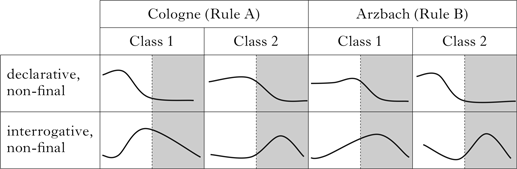
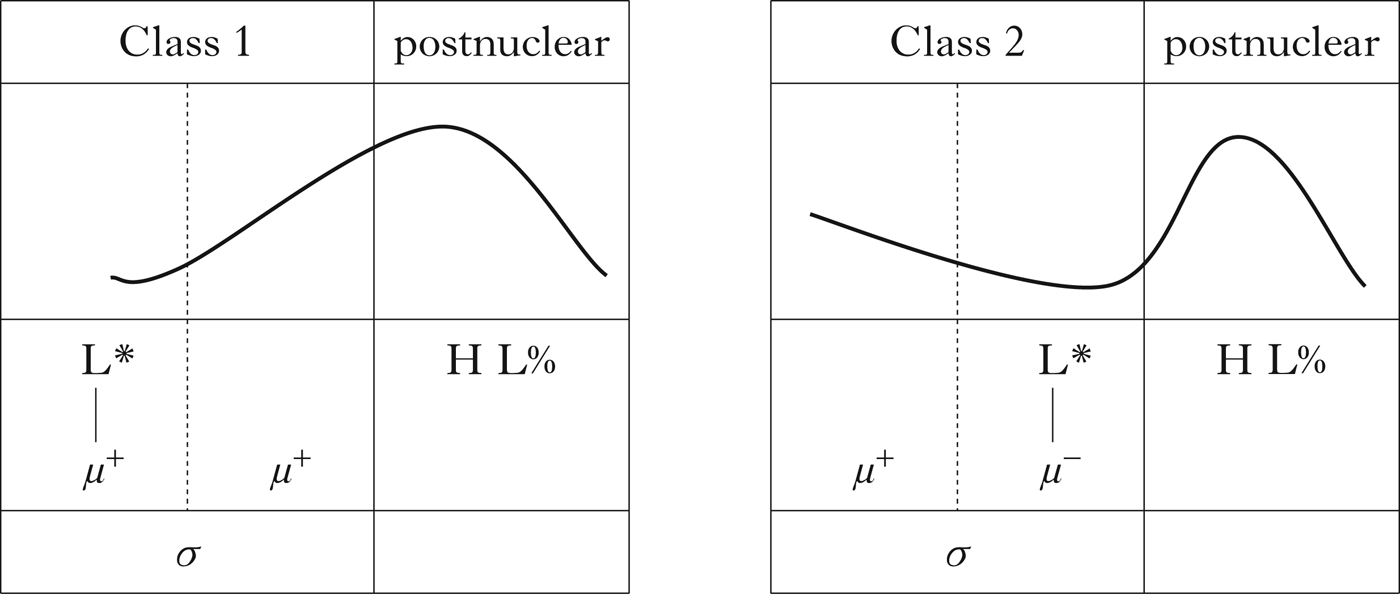
In most Franconian dialects, the tonal realisation of the accents varies considerably, depending on the pragmatic condition (declarative, interrogative), position in the phrase (final, non-final) and focal condition (focal, pre-focal, post-focal); out of focus, however, the contrast is often subject to neutralisation. There are also considerable tonal differences between dialects: the arguably most striking pattern of variation is the difference between Rule A and Rule B (see Bach Reference Bach1921, Schmidt Reference Schmidt1986, Schmidt & Künzel Reference Schmidt, Künzel and de Vaan2006, Köhnlein Reference Köhnlein2011, Reference Köhnlein and Kehreinforthcoming, Werth Reference Werth2011, Gussenhoven Reference Gussenhoven, Asu and Lippus2013): data from Köhnlein (Reference Köhnlein2011) show that the tonal melodies for the tone accents in Rule A and Rule B are reversed in declaratives but resemble each other closely in interrogatives. To illustrate these differences and similarities, Table I compares idealised contours for Cologne (Rule A; Peters Reference Peters and de Vaan2006) and Arzbach (Rule B; my data) in non-final nuclear position in an intonational phrase. The tone-accent contours in the nuclear syllables are unaffected by the context. Figure 1 shows that in both Rule A and Rule B, the nuclear melodies in declaratives are generally falling, and in interrogatives generally rising. The basic contrast between the accents lies in the timing of the tonal melodies. In declaratives pitch in Class 1 falls earlier than in Class 2 in Rule A; in Rule B, however, it falls later in Class 1 than in Class 2. In interrogatives, on the other hand, there is no such reversal; instead, the contours of Rule A and Rule B are similar: in both dialects, Class 1 shows an earlier rise than Class 2. In Köhnlein (Reference Köhnlein2011: 67), I refer to the relation between Rule A and Rule B as a semi-reversal of tonal melodies.
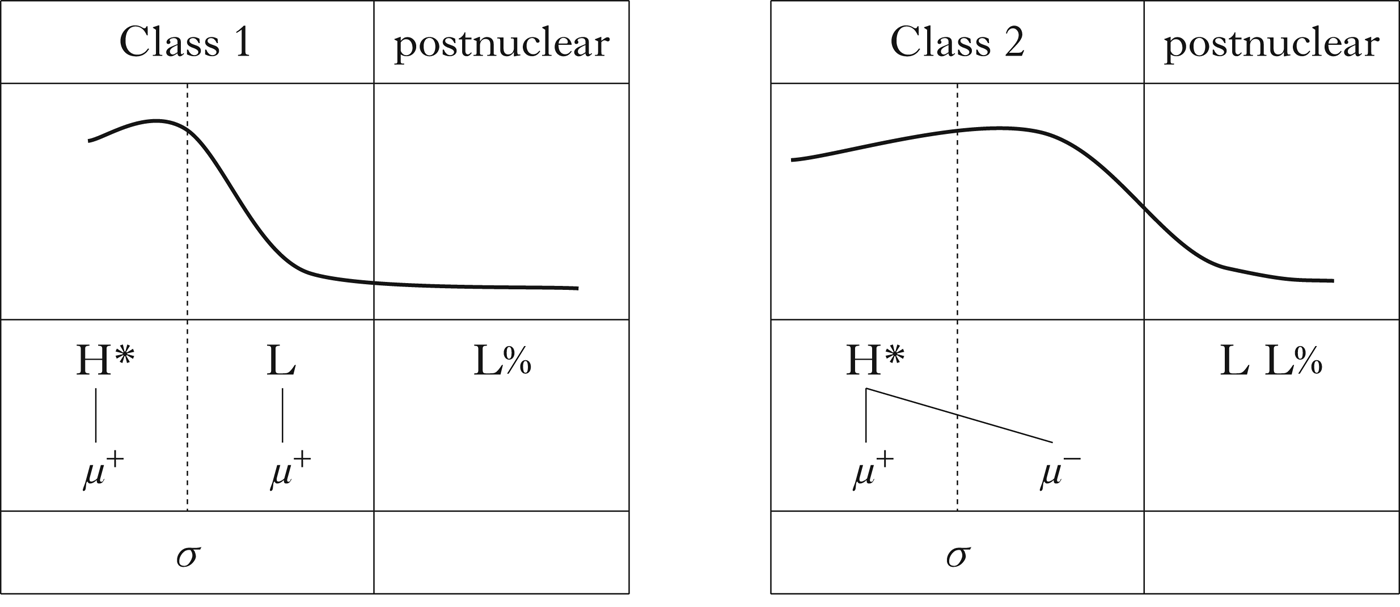
Tonal mapping for non-final declaratives in Cologne Franconian.

Idealised Cologne and Arzbach Franconian tonal contours, with focus on the non-final position of an intonational phrase. The nuclear contour is unshaded; the postnuclear contour is shaded.

2.2 Morphological alternations
This subsection discusses the most important morphological alternations between Accents 1 and 2, showing that Class 1 can be regarded as the morphologically marked form in Franconian. To understand the relation between simplex and complex forms in Franconian, we need to consider some of basic aspects of the diachronic development of the accent opposition. A detailed discussion of these complex matters would be beyond the scope of this paper, but I briefly consider here some outcomes of apocope, the process which is responsible for the large majority of lexical and morphological minimal pairs in Franconian.Footnote 3 In such minimal pairs, originally disyllabic words belong to Class 1, and their counterparts to Class 2. Two examples from Arzbach are provided in (3).
-
(3)
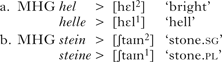
(3a) shows a lexical minimal pair that came into existence after schwa apocope in MHG helle. In (3b), we see another result of apocope, a minimal pair consisting of a Class 2 singular form and a Class 1 plural form. While the plural morpheme in the original Class 1 form was realised as schwa, the synchronic distinction is now solely expressed by an accent alternation. Van Oostendorp (Reference Oostendorp2005) notes that in synchronically alternating accent minimal pairs, the more complex form always belongs to Class 1. Based on this observation, he concludes that there is a correlation between morphological complexity and Class 1.Footnote 4 From a diachronic perspective, we can thus regard the Class 1 membership of complex forms as compensation for the loss of the schwa.
The correlation between morphologically simplex Class 2 forms and morphologically complex Class 1 forms holds equally for other types of synchronic alternations, e.g. in adjectival paradigms: for instance, simplex neuter forms of adjectives with Class 2 often correspond to segmentally identical feminine forms with Class 1. When the neuter form is Class 1, however, the feminine form always is Class 1 as well (van Oostendorp Reference Oostendorp2005). A comparable pattern can also be found in Franconian dialects with case systems: we often find minimal pairs involving unmarked Class 2 nominatives and marked Class 1 datives, such as Arzbach [haʊs2] ‘house.nom’ vs. [haʊs1] ‘house.dat’.
There is thus solid distributional evidence indicating that Class 1 is the marked accent class in Franconian; this will be incorporated in the analysis to be presented in §3. In this respect, note that the markedness of Class 1 poses a challenge for tonal analyses: these analyses regard Class 2 as the marked accent class. I return to this issue in §5.4.Footnote 5
3 Metrical representations and synchronic alternations
In this section, I present the tools which will be used in the representation of the Franconian accent opposition. §3.1 introduces the general set of metrical representations, and in §3.2 I show how Class 1 and Class 2 forms are derived. §3.3 discusses how synchronic alternations are incorporated into the approach.
3.1 General aspects: headedness and head domains in metrical feet
As briefly mentioned in §1, I argue that the Franconian tone-accent opposition derives from contrastive foot structure: that is, feet in Franconian can be either monosyllabic (Class 2; moraic trochees) or disyllabic (Class 1; syllabic trochees). Stressed syllables in Franconian tone-accent dialects are always heavy. The moraic trochee (Class 2) consists of two moras in a heavy syllable; the syllabic trochee (Class 1) has two syllables, with two moras in the stressed (heavy) syllable and one mora in the unstressed (light) syllable. Thus Class 1 is an uneven trochee, a cross-linguistically marked foot type (Hayes Reference Hayes1995: 75–76).
In my approach, the level of branchingness determines the head status of metrical nodes; as we shall see throughout this paper, this is the origin of all surface contrasts between Class 1 and Class 2, whether at the tonal, durational or segmental level. The head of a foot is determined at the highest level where the foot branches, with the strong branch being the foot-head. Class 2 feet are binary at the mora level but not at the syllable level; accordingly, their head is the first mora, as in (4b). Class 2 feet branch at the syllable and mora levels; as the syllable level is higher than the mora level, the foot-initial syllable is the head, as in (4a). The foot-heads in (4) are underlined; this is a purely notational device, since the head or non-head status of a specific node follows directly from the structure of the tree.
-
(4)
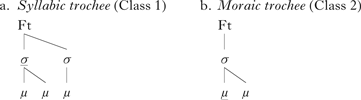
I also introduce a concept I refer to as head domains (see also Köhnlein Reference Köhnlein2011: 85–89, Reference Köhnlein and Kehreinforthcoming): a foot-head creates a head domain whose size depends on which node in the metrical tree is the foot-head. The elements included in the head domain are the head of the metrical constituent itself, as well as all metrical structure that is dominated by the head. Conversely, the dependent of the foot, and all metrical structure dominated by the dependent, are not part of the foot-head domain.
Consider the representations in (5), which illustrate the principle, and also demonstrate that the head domains for syllabic and moraic trochees differ: in the syllabic trochees in (a), the first syllable is the head of the foot, and the second syllable is the dependent. Crucially, both moras in the first syllable are thus dominated or licensed by the foot-head: therefore they are included in the foot-head domain. Intuitively, we can say that being included in the head domain makes these moras metrically ‘strong’ at the foot level. For purposes of illustration, I indicate membership of a head domain with +, as opposed to — for elements that are not members of a head domain.
-
(5)
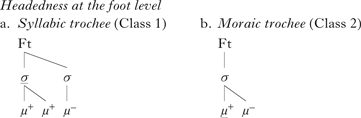
In the moraic trochee in (b), on the other hand, the first mora is the head of the foot; by virtue of being a foot-head, it is therefore a metrically strong mora at the foot level. The second mora in Class 2 is the dependent of the foot. Consequently, it is not dominated by a foot-head, and therefore metrically ‘weak’ at the foot level. As in the derivation of headedness itself, membership of a foot-head domain follows directly from the structure of the tree (the superscripts are notational devices, not phonological objects). Thus these representations are not meant to imply that a syllabic trochee with two moras in the stressed syllable has two heads – rather, it contains two ‘strong’ moras that are licensed by a common head, the first syllable of the disyllabic trochaic foot.
In terms of metrical strength at the foot level, we can say that the stressed syllable in a Class 1 syllabic trochee contains two ‘strong’ moras; in that sense, the structure is comparable to the ‘Germanic foot’, consisting of a stressed heavy and an unstressed light syllable, as proposed in Dresher & Lahiri (Reference Dresher and Lahiri1991). One difference between the heavy–light Germanic foot and the representations in (4) and (5) lies in the definition of headedness: where Dresher & Lahiri assume that the first two moras have head properties, the Class 1 foot proposed in this paper has two moras licensed by the foot-head, but these moras are not themselves heads.Footnote 6 We can also refer to the Class 1 foot as an uneven trochee, using the terminology of Hayes (Reference Hayes1995) and Kager (Reference Kager and Goldsmith1995, Reference Kager1999), i.e. a trochee containing three moras, unlike the canonical trochaic two-mora shape (see §3.2 for further discussion). I use the term syllabic trochee to indicate that the difference between head and dependent is calculated at the syllable level. In contrast, the stressed syllable in the ‘classical’ Class 2 moraic trochee contains one strong mora (the foot-head) and one weak mora (the foot-dependent).
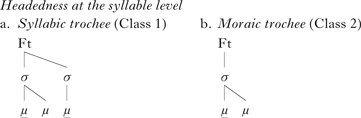
At the syllable level, the head–dependent relations are similar for the two foot types. In each heavy syllable, the first mora is the syllable head, and the second mora the dependent. This is shown in (6); syllable heads are underlined.Footnote 7
-
(6)
As a reviewer points out, Class 1 could also be regarded as a (minimally) recursive foot and Class 2 as a non-recursive foot. This would be in line with ideas on recursion in foot structure that have often been proposed in the literature (e.g. Hammond Reference Hammond1986, Rice Reference Rice1992, Davis Reference Davis, Downing, Hall and Raffelsiefen2005, Martínez-Paricio Reference Martínez-Paricio2013). Indeed, structures such as those in (7) would correspond closely to Morén-Duolljá's (Reference Morén-Duolljá2013) representation of the tone-accent opposition in Götaland Swedish.
-
(7)
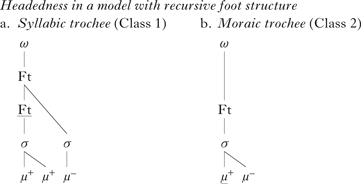
With representations such as in (7), the moraic strength of the first two moras in Class 1 could be attributed to the fact that these moras are both dominated by the head of the maximal foot, the lower foot node. In Class 2, on the other hand, we could regard the first mora as the foot-head (strong), and the second mora as the foot-dependent (weak) – this would derive the differences in moraic strength between Classes 1 and 2. Alternatively, we could assume that minimal feet are built directly on moras (cf. Kager Reference Kager1993). With respect to the accentual phenomena analysed in this paper, these different approaches seem largely compatible from an empirical perspective. In what follows, I shall employ the representations proposed in (4) and (5) – this also makes it easier to relate the patterns directly to the cross-dialectal analyses of the tonal mapping in Köhnlein (Reference Köhnlein2011).
3.2 Derivation of the metrical surface contrasts
3.2.1 The unmarked foot: Class 2
In §2.2 it was demonstrated that Class 2 is the unmarked accent class in Franconian; evidence for this claim comes from morphological alternations and the relation between function words and lexical words. Accordingly, the lexical representation of Class 2 words does not contain (unpredictable) information about foot structure: moraic trochees are the standard outcome of the footing process, both for monosyllabic and for disyllabic words. Consider the Arzbach examples in (8) (the absence of ‘2’ in the underlying form indicates that metrical structure is not stored in the lexicon).
-
(8)

The derivation of (8a) is straightforward: it is the result of a default footing procedure, resulting in a bimoraic monosyllabic trochee in a bimoraic monosyllabic word. The surface representation for [taʊf2] is given in (9a).
-
(9)
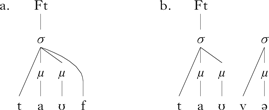
In disyllabic Class 2 words, only the first syllable is parsed, and the second syllable remains unfooted. This is shown in (9b) for [taʊ2və]. The unparsed second syllable follows from the avoidance of uneven Heavy–Light trochees, which are dispreferred in trochaic systems (see e.g. Hayes Reference Hayes1995, Kager Reference Kager and Goldsmith1995, 1999). I express this with the constraint *UnevenTrochee in (10a), which outranks Parse-σ ((10b); Prince & Smolensky Reference Prince and Smolensky1993), requiring all syllables in a word to be included in a foot. Lastly, I assume that the schwa syllable cannot form a foot on its own, since degenerate feet are prohibited by high-ranked FootBinarity ((10c); see e.g. Prince & Smolensky Reference Prince and Smolensky1993).
-
(10)
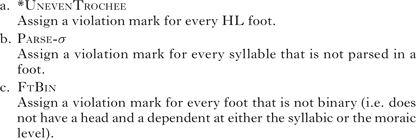
The resulting footing process is given in the tableau in (11); foot boundaries are indicated by parentheses.
-
(11)

3.2.2 The marked foot: Class 1
Class 1 feet, the marked member of the opposition, are obligatorily disyllabic; the first syllable is the foot-head (as discussed in §3.1). Class 1 feet characterise two sets of words: items that have an empty-headed second syllable (12a), as well as items in which the second syllable contains a vowel (12b); foot structure is present in the lexical representation (this is discussed in more detail below).
-
(12)

The resulting surface representations are given in (13).
-
(13)
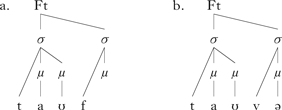
As shown in (b), [taʊ1və] contains a disyllabic foot in which both syllables contain vocalic material. [taʊf1], on the other hand, has a segmentally empty mora in the second syllable; i.e. the syllable is empty-headed. The empty-headed syllable appears in the surface representation because the head of a Class 1 foot is the initial syllable: if there were no empty-headed syllable following the first, stressed syllable, this syllable would not be the foot-head (the foot would be binary at the moraic level, not the syllable level).
Finally, consider how unpredictable accent patterns are stored in the lexicon. I assume that the foot structure of such items can be present in the underlying representations of the relevant morphemes, in the shape of metrical templates. In Optimality Theory, the possibility of storing metrical material in the lexicon follows from richness of the base (e.g. Prince & Smolensky Reference Prince and Smolensky1993, Smolensky Reference Smolensky1996, Kager Reference Kager1999). Furthermore, the assumption is in line with the principle of the homogeneity of inputs and outputs. In short, the principle expresses the idea that only phonological material that can appear in the surface representation can be present in the underlying representation, and vice versa (see Moreton Reference Moreton and McCarthy2004 for discussion).
It would certainly be possible to mark headedness with a diacritic in the lexicon (e.g. σ * for Class 1 syllables), and thereby avoid postulating empty units. In principle, this would be sufficient to derive the tonal differences between Classes 1 and 2 (see §4). However, there are additional empirical arguments for assuming that Class 1 is disyllabic: this evidence, which will be discussed in §5, concerns the interaction of accent membership with segmental structure as well as with vowel length; I therefore retain the representations introduced above. Consequently, Class 1 feet always contain a heavy syllable followed by a light one, independent of the number of vowels on the surface; this implies that all Class 1 items violate *UnevenTrochee. I assume that the obligatory weight of syllables with a tonal accent follows from a requirement that stressed syllables be heavy, commonly formulated as in (14a) (Prince Reference Prince1990).
-
(14)
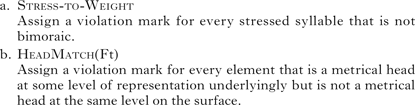
Given the influence of *UnevenTrochee and Stress-to-Weight, the grammar needs a device to protect marked Class 1 feet. To express this formally, I adopt a proposal of McCarthy (Reference McCarthy1995, Reference McCarthy2000), who argues that underlying metrical heads are subject to faithfulness. With respect to the foot level, the relevant constraint is HeadMatch(Ft), defined in (14b).
A lexically specified syllabic trochee will be (minimally) represented as a foot node dominating two syllable nodes, as in (15). Vocalic and/or consonantal moras can or cannot be present underlyingly, but this does not affect the headedness relations within the foot. In running text, I represent underlying syllabic trochees as /(σ+σ—)/.Footnote 8
-
(15)

To derive the uneven trochee surfacing in Franconian Class 1, HeadMatch(Ft) and Stress-to-Weight must both outrank *UnevenTrochee. This is exemplified in (16) for [taʊf1]. The empty-headed second syllable in the surface representation of the winner is enforced by HeadMatch(Ft), as shown in (a). If the second syllable were not parsed, as in (b), the foot-head would be the first mora of the stressed heavy syllable (recall that headedness is derived from the structure of the tree). Candidate (c), with a monomoraic head syllable, satisfies *UnevenTrochee, but violates high-ranked Stress-to-Weight. The lexical storage of foot structure in Franconian can thus be regarded as a specific instance of lexical stress (see Morén-Duolljá Reference Morén-Duolljá2013 for a similar argument with respect to North Germanic).
-
(16)

3.2.3 Synchronic alternations
Since my approach relies on the assumption that Class 1 is the marked accent class, it is possible to integrate morphological alternations into the synchronic analysis. Take the Arzbach minimal pair [ʃtaɪn2] vs. [ʃtaɪn1] in (3b) as an example: as argued in §3.2, the underlying representation of the Class 2 singular form is metrically empty /ʃtaɪn/. On the surface, this results in an unmarked Class 2 trochee. The plural form [ʃtaɪn1], however, is characterised by an accent switch from Class 2 to Class 1. To account for this change in class membership, I assume that the plural morpheme is a lexically stored disyllabic foot template /(σ+σ—)/. In the plural derivation, the underlying string /ʃtaɪn/ is combined with the foot template. Since underlying headedness has to be preserved (see §3.2), this results in a disyllabic Class 1 foot in which the stressed head syllable is followed by an empty-headed dependent syllable, as in (17). Other morphological alternations (see §2.2) can be expressed in the same way.
-
(17)

4 A non-tonal analysis of tonal mapping in Franconian
This section discusses how the tonal differences between the two accent classes can be derived from the metrical representations proposed in §3. For the purposes of this paper, I shall limit the analysis of the tonal mapping to two prototypical Franconian dialects, Cologne (Rule A) and Arzbach (Rule B). Due to space limitations, I restrict the discussion to the realisation of declaratives and interrogatives in non-final focus position. This is sufficient to discuss the crucial characteristics of Franconian tone-accent systems; a comprehensive analysis of four Franconian dialects (Arzbach, Cologne, Hasselt, Roermond) can be found in Köhnlein (Reference Köhnlein2011: 83–158); this also covers details of the tonal mapping in phrase-final focus position and in non-focal position (where we often find neutralisation).
4.1 Constraint set
The most important constraints for the analysis regulate the association of tone with tone-bearing units. The structure of these constraints is discussed in this section; other constraints will be introduced when needed. Throughout the analysis, moras are regarded as tone-bearing units in Franconian. Constraints on the association of tones will therefore be introduced as interactions between tones and moras. With respect to possible interactions, I distinguish two types of constraints, implicational and negatively stated constraints. The negatively stated constraints to be proposed here serve to capture the generalisation that low tones and metrically strong positions avoid each other, as do high tones and metrically weak positions (de Lacy Reference de Lacy2002). I adopt the constraint in (18) banning low tones from metrically strong positions, i.e. from head domains (adapted from de Lacy Reference de Lacy2002).
-
(18)

The constraint schema in (18) can be adapted to different levels of the prosodic hierarchy. Two modifications for the foot and syllable levels are provided in (19); for (a), I add a notational variant where ‘strong’ moras are represented with +, as in (4) and (5) above.
-
(19)
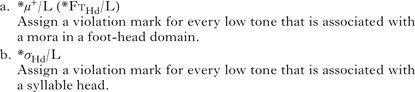
Implicational constraints regulate the general association between tones and tone-bearing units. The general shape of these constraints, formulated along the lines of Anttila & Bodomo (Reference Anttila and Bodomo2000), for lexical tone, and Gussenhoven (Reference Gussenhoven2004), for lexical and intonational tone, is presented in (20).
-
(20)
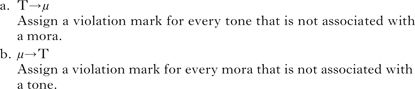
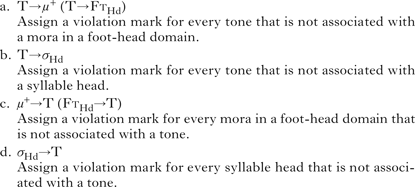
Following Yip (Reference Yip2002), I assume that constraints of this type are also active in the interaction of tone and metrically strong positions. These constraints have the structure in (21).
-
(21)

When applied to the foot and syllable levels, these constraints can be formulated as in (22).
-
(22)
4.2 Basic tonal mapping in Rule A (Cologne)
4.2.1 Declaratives
The nuclear pitch accent in Cologne declaratives is H*L. Generally, a starred tone can be regarded as the ‘tonal head’ of a pitch accent; such tones associate with the main stressed syllable of an accented word, most commonly the nuclear syllable. Starred tones can be preceded or followed by other tones (leading and trailing tones respectively), which can be realised in the accented syllable, but also to the left or right of the accented syllable (see e.g. Pierrehumbert Reference Pierrehumbert1980).
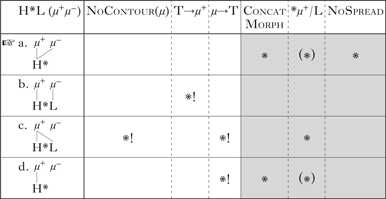
The tonal mapping for Cologne declaratives is given in Fig. 1; the surface difference between the accents is a falling tone for Class 1 (H* and L in the nuclear syllable) vs. a high level tone for Class 2 (only H* in the nuclear syllable; L postnuclear). As Fig. 1 shows, Class 1 can host two tones, and Class 2 only one. This difference can be attributed to the metrical strength of the respective moras, in combination with the grammar of the dialect: in Cologne Franconian, tones preferably associate to strong moras. As a consequence, Class 1 (two strong moras) is able to license both tones of the bitonal nuclear pitch accent H*L, while Class 2 (one strong and one weak mora) can only license H* – the trailing L will be realised after the nuclear syllable.Footnote 9 The crucial constraint for the tonal mapping in Cologne is T→μ+ in (22a), which requires tones to be associated to strong moras (i.e. moras in the head domain of a foot). Class 1 syllables, which contain two strong moras, are therefore better hosts for tone than Class 2 syllables, which contain only one; the second mora in Class 2 syllables is weak – it is the dependent in the foot.
I consider first the formalisation of the tonal mapping in Class 1 syllables: due to the influence of high-ranked T→μ+, both H* and L can be realised in the nuclear syllable (candidate (23a)).
-
(23)
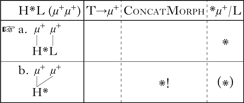
This mapping, however, violates *μ+/L, as a low tone is associated with a strong mora. Note that *μ+/L would also be violated by the losing candidate, (b), since the trailing tone would be realised on a postnuclear strong mora. Since this aspect is not crucial for the tonal mapping in the syllable with the tone accent, I do not display it in the output candidates – to indicate this, I give such violations in parentheses. Even if the trailing low tone were realised on a strong mora, (b) would still be still less optimal than (a): L does not occur in the same syllable as the starred high tone; this violates the constraint ConcatMorpheme in (24), which requires tones from one tonal morpheme to be realised in the same syllable.
-
(24)

ConcatMorpheme is a morphological interpretation of Concat (Riad Reference Riad1998); in Riad's analysis of the North Germanic tone-accent opposition, Concat serves to align the right edge of the lexical tone with the left edge of the following focus tone. A similar use can be found in Gussenhoven (Reference Gussenhoven2004), where Concatenate aligns tones of bitonal pitch accents with each other in the phonetic implementation. Here, ConcatMorpheme indicates that tones from the same tonal morpheme/pitch accent should preferably be close to each other (e.g. within the same syllable), rather than being distributed across the phrase (for further discussion, see Köhnlein Reference Köhnlein2011: 99–101).
In Class 2 syllables, only H* is realised in the nuclear syllable. This is the case because only the first mora is strong; the non-occurrence of the low tone on the weak second mora can be attributed to high-ranked T→μ+. Furthermore, the high-ranked constraint in (25) against tonal contours on moras (Goldsmith Reference Goldsmith1976) prohibits the association of both H* and L with the first, strong mora.
-
(25)

The non-occurrence of the low trailing tone in the nuclear syllable also violates ConcatMorpheme. To prohibit the association of the low trailing tone to the nuclear syllable, both NoContour(μ) and T→μ+ must outrank ConcatMorpheme, and T→μ+ must outrank *μ+/L.
Lastly, note that the second mora of Class 2 syllables does not remain tonally empty: the high tone spreads to the second mora. This can be attributed to μ→T, at the cost of violating a lower-ranked constraint against spreading, NoSpread (Goldsmith Reference Goldsmith1976). The resulting tableau is given in (26). The low trailing tone surfaces on a strong mora in postnuclear position.
-
(26)
4.2.2 Interrogatives
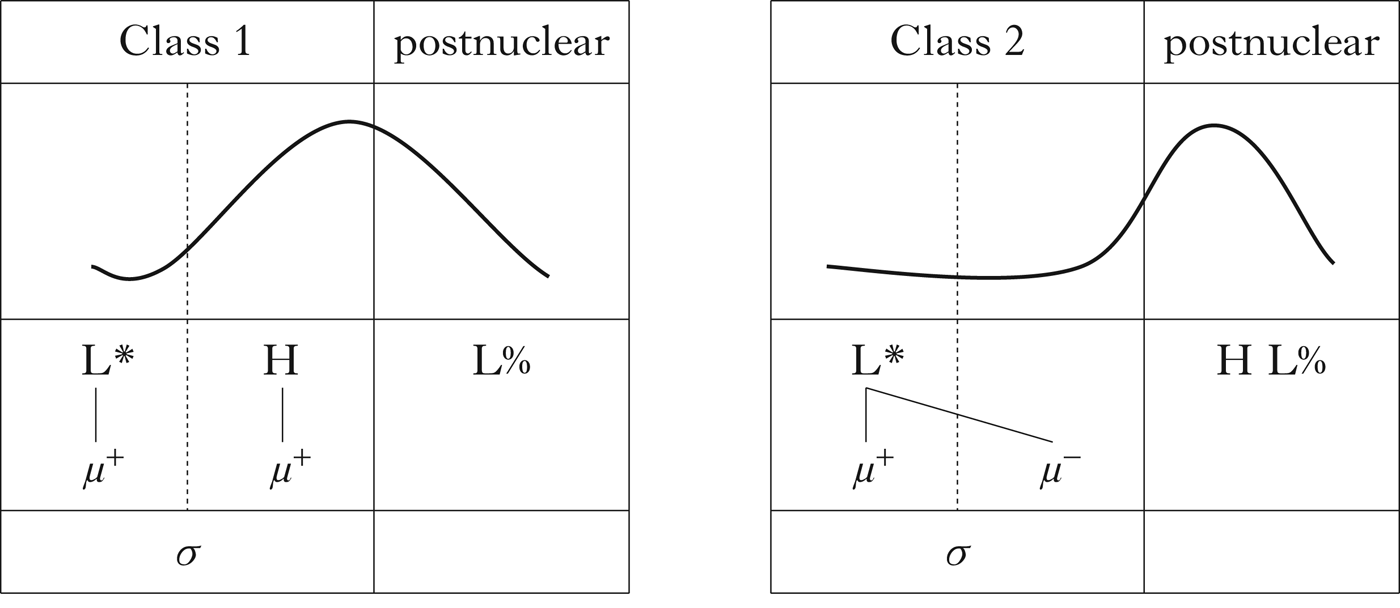
The tonal mapping for Cologne interrogatives is provided in Fig. 2. With the exception of a difference in the input melody (L*H instead of H*L), the tonal mapping in Cologne declaratives is the same as in interrogatives: in both cases, Class 1 can host two tones (because it contains two strong moras), and Class 2 one tone (because it contains one strong mora). As indicated in §4.2, this is a direct consequence of high-ranked T→μ+, which associates tones to moras regardless of their quality. Since the computation is essentially identical to that of the declarative forms (with the exception of the input melody), I do not give the relevant tableaux.
Tonal mapping for non-final interrogatives in Cologne Franconian.

4.3 Basic tonal mapping in Rule B (Arzbach)
In terms of tonal mapping, the Arzbach data appear to be somewhat more complex than the Cologne facts: the Class 1 tonal contour falls later than Class 2 in declaratives, but rises earlier than Class 2 in interrogatives (see also § 2.1). As we will see below, this effect mainly results from a combination of high-ranked *μ+/L, which blocks low tones from metrically strong moras, and a requirement that the starred tones of nuclear pitch accents be realised in the nuclear syllable.
4.3.1 Declaratives
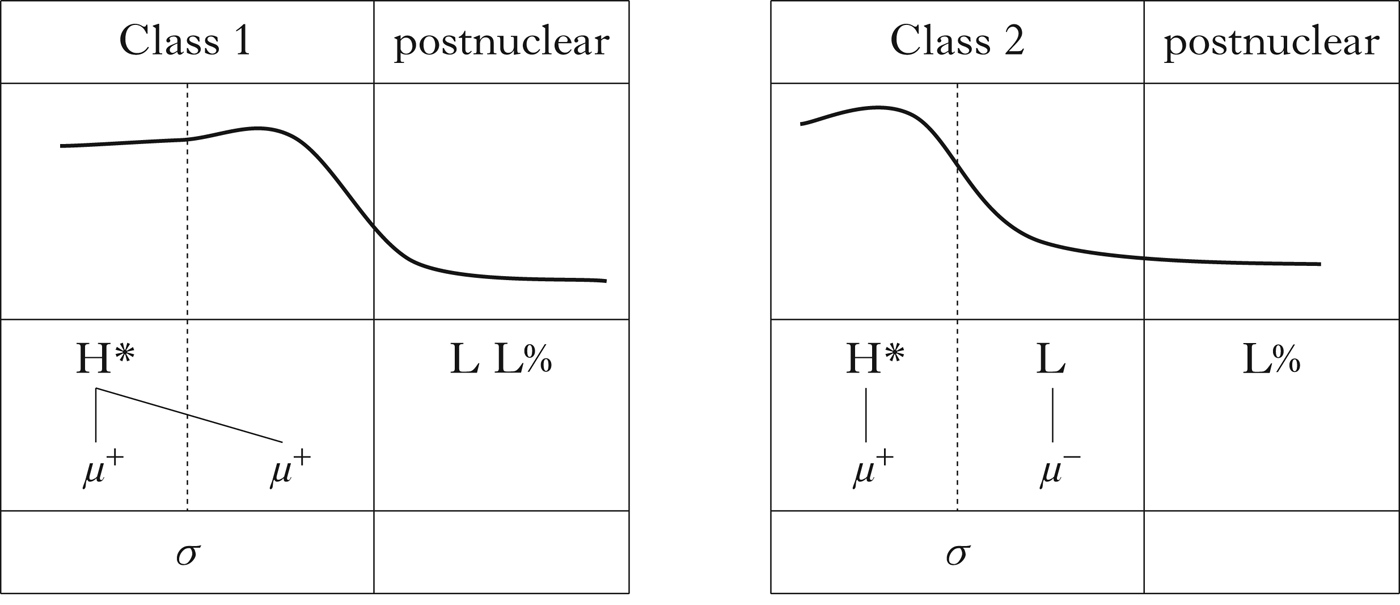
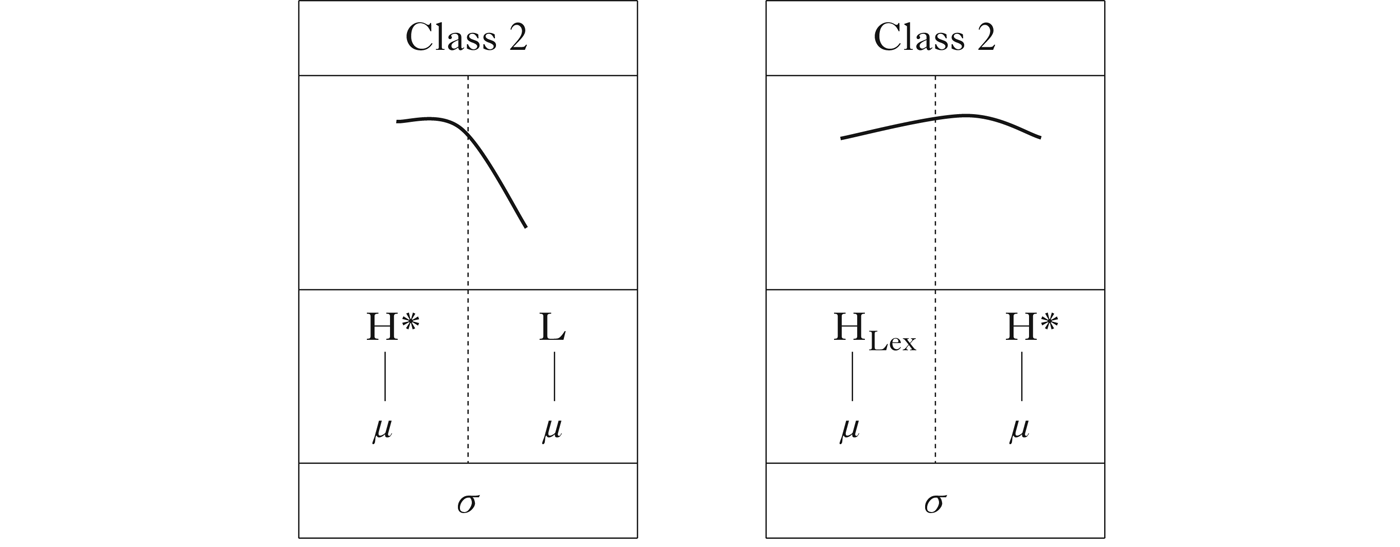
As shown in Fig. 3, the tonal contrast in Arzbach declaratives is one between a high level tone for Class 1 and a falling tone for Class 2.Footnote 10 This difference in the tonal melodies results from a different mapping of a declarative melody H*L. Like the Cologne system, the main difference is caused by the mapping of the low trailing tone; unlike in Cologne, however, L is blocked from the second mora of Class 1, while it can link to the second mora of Class 2. This is the opposite of the Cologne situation.
Tonal mapping for non-final declaratives in Arzbach Franconian.

L is avoided on the (strong) second mora in Class 1 because strong moras and low tone repel each other in the Arzbach grammar. In Class 2, however, the second mora of the syllable with the tone accent is weak, so the low tone can dock onto this mora. The avoidance of L on the second mora of Class 1 can be attributed to the influence of high-ranked *μ+/L: Class 1 is a syllabic trochee, and therefore contains two strong moras; given high-ranked *μ+/L, none of these moras is a suitable docking site for the low trailing tone. To block the association of L to a mora in the nuclear syllable, *μ+/L must outrank ConcatMorpheme as well as T→μ+.Footnote 11 Furthermore, high-ranked μ→T enforces spreading of H* to the weak second mora, which in turn implies a violation of NoSpread. The resulting tableau is given in (27).
-
(27)

Unlike in Class 1, the low tone can link to the second mora in Class 2, since this mora is the dependent of the moraic trochee and therefore weak. This association satisfies ConcatMorpheme as well as high-ranked *μ+/L, as in (28).
-
(28)
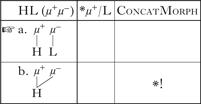
Lastly, note that ConcatMorpheme must outrank the constraint T→σHd, showing that the weak mora of the nuclear syllable is preferable to the head mora of a following unstressed syllable. (T→σHd will be relevant for the tonal mapping in interrogatives.)
4.3.2 Interrogatives
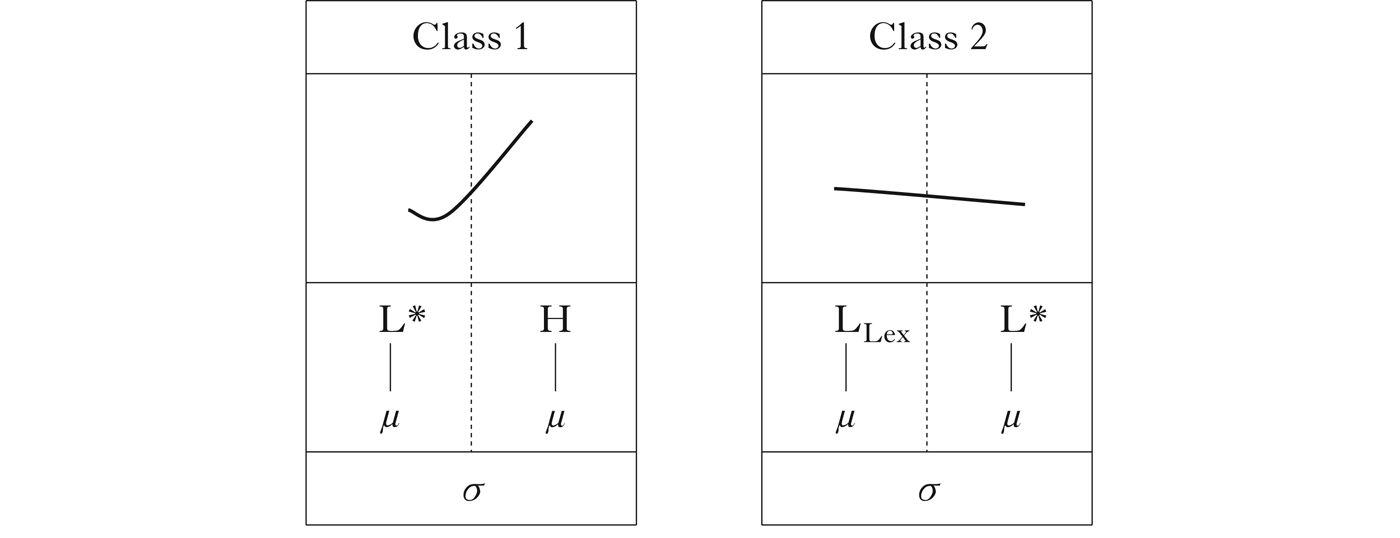
The tonal contrast in interrogatives derives from a different alignment of L* in the nuclear syllable. As shown in Fig. 4, L* is associated with the first mora in Class 1 and with the second mora in Class 2. Note that in Class 1, the high trailing tone is not associated with the second mora of the nuclear syllable, even though we find an early rise in that condition. In Arzbach interrogatives, the trailing H is always realised in postnuclear position, independent of the accent class (see Table I above for idealised contours); a similar avoidance of a LH sequence within a syllable is found in the Rule A dialect of Roermond (Gussenhoven Reference Gussenhoven and Horne2000a). The rise in Class 1 is thus due to interpolation between L* and a postnuclear H. I return to this issue below. First, however, I focus on the most fundamental aspect of the tonal surface, the alignment of L*, which is realised in the nuclear syllable in both Classes 1 and 2. This is different from declaratives, where the low trailing tone is blocked in Class 1 due to high-ranked *μ+/L (see §4.3). Consequently, this high-ranked constraint must be overridden in the present context.
Tonal mapping for non-final interrogatives in Arzbach Franconian.

To understand what enforces the violation of *μ+/L in Class 1, recall that starred tones are tonal heads of (nuclear) pitch accents; in this case, L* marks the nuclear syllable tonally. We can therefore assume that starred tones of (nuclear) pitch accents have to be aligned with an accented syllable (cf. e.g. Pierrehumbert Reference Pierrehumbert1980, Beckman & Pierrehumbert Reference Beckman and Pierrehumbert1986), here the nuclear syllable of an intonational phrase. This may potentially be a universal of intonation systems, and I therefore do not formulate it as a constraint (but see Arvaniti et al. Reference Arvaniti, Ladd, Mennen, Broe and Pierrehumbert2000 for counterarguments); instead, I assume that T* always associates with the nuclear syllable. This in turn implies that in Class 1 a violation of *μ+/L is inevitable – otherwise L* would be realised outside the nuclear syllable. Since both Class 1 moras are strong at the foot level, they are equally bad hosts for L*. The first mora is preferred over the second one, due to the influence of T→σHd; therefore, as shown in tableau (29), candidate (a) is more optimal than (b). Furthermore, *μ+/L outranks μ→T, which prohibits spreading of L to the second mora (candidate (c)).
-
(29)
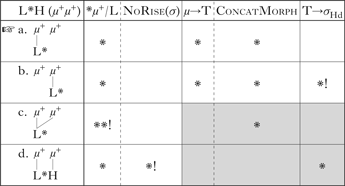
Lastly, the non-occurrence of the high trailing tone in the nuclear syllable of Class 1 needs to be formalised. I assume that linking the trailing H to the second mora of the nuclear syllable would violate the constraint NoRise(σ) in (30), proposed in Gussenhoven (Reference Gussenhoven and Horne2000a) for Roermond Franconian. To block H from associating with the nuclear syllable (candidate (d) in (29)), NoRise(σ) must outrank μ→T and ConcatMorpheme.
-
(30)

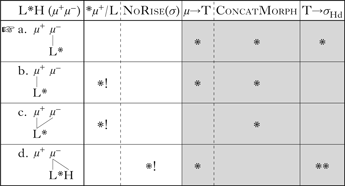
In Class 2, L* links to the weak second mora of the nuclear syllable, as shown in (31) for the winning candidate; this is due to the ranking *μ+/L ⪢ T→σHd. The opposite ranking would lead to an association of the low tone with the first mora, and candidate (b) would win. As for Class 1, a L*H mapping in the nuclear syllable is excluded by the ranking NoRise(σ) ⪢ μ→T, ConcatMorpheme.Footnote 12
-
(31)
4.4 Rule A vs. Rule B: typological aspects
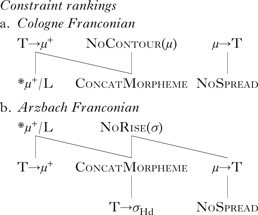
To conclude the analysis of the basic tonal mapping in Franconian, let us briefly compare the crucial aspects of the analyses for the Rule A dialect of Cologne and the Rule B dialect of Arzbach from a typological perspective. I assume that the semi-reversal between Rule A and Rule B is not due to representational differences, but rather from variation in the ranking of constraints. As can be observed in the Hasse diagrams in (32), the reversal in the declarative melodies can largely be attributed to a change in the ranking of the constraints *μ+/L and T→μ+ in the two dialect groups. High-ranked T→μ+ in Rule A leads to the association of two tones to Class 1 (two strong moras, two tones) vs. one tone to Class 2 (one strong mora, one tone). High-ranked *μ+/L in Rule B, on the other hand, blocks the association of the low trailing tone in Class 1 (two strong moras, no low tone), but allows it in Class 2 (low tone on the weak second mora). The non-reversal in Rule B interrogatives is due to a (possibly universal) requirement that a starred tone (here L*) be realised in a nuclear syllable, which overrides *μ+/L. This leads to an early-aligned low tone in Class 1 vs. a late-aligned tone in Class 2, largely resembling the Cologne situation. (32) also shows that, apart from the factors leading to the reversal, the two grammars are very similar to each other: in both varieties, high-ranked constraints against contours outrank ConcatMorpheme, and μ→T is ranked higher than NoSpread.
-
(32)
This is not meant to imply that etymologically related dialects always share the same set of representations, and derive synchronic differences from the grammar. Obviously, cross-dialectal differences can also arise from a restructuring of underlying representations, and the grammar may or may not be affected. In the Franconian case, however, the lexical distribution of the accents supports the analysis: as discussed in §2 and §3, evidence from synchronic alternations and the behaviour of function words vs. lexical words indicates that Class 1 is the morphologically active accent class in Franconian, a generalisation that holds across all the Franconian dialects described so far. By deriving the surface differences between different dialects from the same set of representations, the analysis therefore makes it possible to account for the semi-reversal between Rule A and Rule B on the basis of minimal differences in the grammar of the varieties (essentially the reranking of two constraints). At the same time, it captures the distributional similarities between the two dialect groups.
4.5 Tonal mapping under the tonal approach
In this subsection, I introduce the basic principles of the tonal approach and compare it to the metrical analysis proposed here. Under the tonal approach, the tonal surface contrasts between the two accents are derived from a privative opposition between an underlyingly toneless syllable (Class 1) and a syllable that is underlyingly specified with a lexical tone (Class 2). While the melodies in Class 1 are purely based on intonational tones, the lexical tone in Class 2 syllables interacts with intonational tones, thereby altering the tonal melody. This is assumed to lead to the surface contrasts between Class 1 and Class 2.
The tonal mapping in non-final Cologne declaratives and interrogatives is a perfect environment to discuss the approach, as the contours are prototypical for Rule A dialects. The analysis is taken from Peters (Reference Peters and de Vaan2006); see also Gussenhoven & Peters (Reference Gussenhoven and Peters2004).Footnote 13 As mentioned repeatedly throughout this paper, the Cologne tonal contrast in non-final declaratives and interrogatives is one between an early fall/rise for Class 1 and a high/low level tone in interrogatives (see § 2.1 and § 4.2). Peters assumes that the tonal contrast derives from an unspecified lexical tone TLex on the first mora of Class 2 vs. the absence of such a tone in Class 1, as in (33).
-
(33)
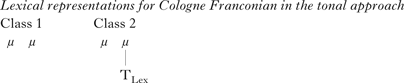
The resulting tonal mapping for declaratives is provided in Fig. 5; the nuclear pitch accent is H*L. In Class 1, both H* and L associate with the stressed syllable in a default one-to-one mapping, but Peters claims that this default mapping is not possible in Class 2, since the underlying lexical T* on the first mora of Class 2 blocks H* from associating with the first mora. The starred tone instead links to the free second mora, but the trailing L cannot associate anywhere in the syllable: both available moras are already occupied, and tonal contours are avoided. The underlyingly unspecified lexical tone then adopts the value of the following intonational tone, which Peters regards as a result of tonal assimilation (‘tone copying’ might be a more appropriate term, as no spreading is involved): in declaratives, TLex is thus realised as HLex, due to the influence of the following H*. Phonetically, this leads to falling pitch in Class 1, and a high level pitch in Class 2.
Tonal mapping for non-final declaratives in Cologne Franconian (Peters 2006).

Consider now the tonal mapping in interrogatives in Fig. 6, where the intonational melody is L*H. Class 1 has a default L*H mapping. Like the situation in declaratives, TLex blocks the association of the starred tone to the first mora in Class 2. L* therefore associates with the second mora, which leaves no space for the trailing H in the nuclear syllable. As underlying TLex is followed by L* in interrogatives, it is realised as LLex, due to tonal assimilation.
Tonal mapping for non-final interrogatives in Cologne Franconian (Peters 2006).

As we can see, the tonal approach can successfully derive the tonal surface patterns in Cologne. One might therefore wonder whether the tonal and metrical approaches to the Franconian tone accents could be regarded as empirically equivalent. I will show in the following section that the metrical approach is clearly preferable when it comes to the analysis of other, non-tonal phenomena relevant to the Franconian tone-accent opposition.
5 Beyond tonal mapping in Franconian
As briefly mentioned in §2.1, the tone-accent opposition is not exclusively tonal, but can have other correlates on the surface, viz. duration and segmental structure; these correlates are discussed in this section. I show that the resulting patterns follow naturally from the metrical analysis, while they are problematic for the synchronic tonal approach. I will end the section with another brief look at morphological alternations (see also §2 and §3).
5.1 Duration
In many Franconian dialects, the tonal opposition between Classes 1 and 2 is enhanced by a durational contrast. The Cologne dialect is again a perfect example to illustrate the patterns. In the dialect, the tonal contrast between the two classes is accompanied by substantial durational differences: Class 2 is always considerably longer than Class 1 (Gussenhoven & Peters Reference Gussenhoven and Peters2004, Peters Reference Peters and de Vaan2006). In some contexts, the durational contrast can even take precedence over the tonal one: Peters (Reference Peters and de Vaan2006: 23) states that ‘the distinction between Accent 1 and Accent 2 [in postnuclear position] is preserved by a durational difference rather than by a difference of the F0 contour’; he interprets these facts as ‘tonal lengthening due to the [unspecified] lexical tone on Accent-2 words’. On this analysis, it would follow that a tonal opposition can sometimes be expressed on the surface as a durational contrast, without an accompanying systematic tonal opposition. It is of course possible to maintain a tonal analysis by postulating a tonally conditioned lengthening rule; yet the rule itself is ‘phonetically arbitrary’ (as acknowledged by Gussenhoven & Peters Reference Gussenhoven and Peters2004: 264). In the metrical approach, on the other hand, it is to be expected that a metrically governed accent opposition can have varying cues, depending on the prosodic context it occurs in, as we find it in many stress languages (see also Kehrein Reference Kehrein and Kehreinforthcoming). In fact, this is precisely what happens in other Germanic languages: since the pioneering work of Fry (Reference Fry1955, Reference Fry1958) for English, it has been well known that stress can have multiple surface correlates. At least in nuclear position, pitch is commonly the strongest; yet the importance of different cues to word stress can differ depending on the position of a word in a phrase: in Dutch, in the absence of intonational pitch accents (outside of focus), duration is a strong predictor of word stress (van Heuven & de Jonge Reference Heuven and Jonge2011), and comparable results for German have been reported in Kohler (Reference Kohler2012). It is perfectly possible that Franconian, which has contrastive metrical structure within syllables (two types of feet), might use the same correlates for the accent contrast as other languages employ to express the location of word stress. The potential use of duration as a cue to the accent opposition therefore strengthens the argument that the opposition between Classes 1 and 2 is a metrical, foot-based contrast, not a tonal one.
A related phenomenon is found in Estonian, which has a ternary quantity contrast: as has been argued repeatedly in the literature, the durational difference between long and overlong syllables can be attributed to foot structure (see Prince 1980, Odden Reference Odden, Lehiste and Ross1997 for details of the analysis; for alternative approaches Hayes Reference Hayes1995, Pöchtrager Reference Pöchtrager2006, Spahr Reference Spahr, Asu and Lippus2013). On the foot-based view, overlong syllables are bimoraic, and form monosyllabic feet; the duration of the foot is expressed on one syllable (corresponding to monosyllabic Class 2 in Cologne). Long syllables are bimoraic as well, but they constitute the first syllable of disyllabic feet, which is why they have a shorter duration (corresponding to disyllabic Class 1 in Cologne).
Some further details from the Cologne accent contrast lend additional support to the idea that Class 2 corresponds to a monosyllabic foot and Class 1 to a disyllabic foot: Peters (Reference Peters and de Vaan2006) shows that the durational difference between Class 1 and Class 2 is even stronger in phrase-final position than in phrase-medial position; in other words, Class 2 is lengthened even more in phrase-final position than Class 1. In the tonal approach, there is no principled explanation for these facts, but they seem to support the metrical analysis of the accent contrast: under this approach, we can assume that monosyllabic phrase-final Class 2 syllables undergo phrase-final lengthening, a widely reported phenomenon (e.g. Turk & Shattuck-Hufnagel Reference Turk and Shattuck-Hufnagel2007, and references therein). The lengthening effect is much less prominent in ‘apparently’ phrase-final Class 1 cases, however, because the stressed syllable is never truly phrase-final in terms of metrical constituency: in these cases, there is always a second, empty-headed post-tonic syllable.
Interestingly, there are Franconian dialects that have given up the tonal contrast between the two accents altogether, but still maintain a length difference between Class 1 and Class 2: in Weert, for example, many Class 1 words with originally long vowels underwent vowel shortening, and Class 2 words with originally short vowels were lengthened (Heijmans Reference Heijmans, Fikkert and Jacobs2003) – similar patterns have also been described for Luxemburgish (Gilles Reference Gilles, Auer, Gilles and Spiekermann2002). Synchronically, these patterns lead to alternations between morphologically simplex Class 2 forms with long stressed vowels and complex Class 1 forms with short stressed vowels (for a diachronic account of these patterns, see Köhnlein Reference Köhnlein2015b).Footnote 14 Three examples from Heijmans’ (Reference Heijmans, Fikkert and Jacobs2003) paper are provided in (34).
-
(34)

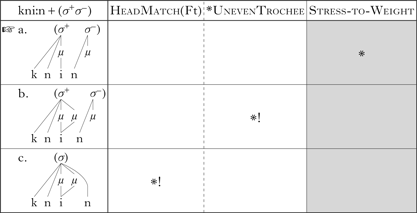
At first sight, the vowel shortenings in (34) might appear to be instances of subtractive morphology, but they can be analysed straightforwardly, without the necessity to assume a plural morpheme whose sole function is to delete phonological material. In fact, in comparison with ‘tonal’ Franconian dialects, Weert shows only minor modifications in the metrical surface representations. I regard the vowel-length contrast between the singular and the plural forms as an opposition between bimoraic vowels in the singular and monomoraic vowels in the plural. If we assume that Weert still has a metrical contrast between a disyllabic Class 1 foot and a monosyllabic Class 2 foot (similar to tonal Franconian dialects), these facts can be analysed as follows. Bimoraic vowels in the Class 2 singular forms in (34) are perfectly well-formed, and are footed as default monosyllabic, bimoraic trochees. Their derivation is similar to that of the Arzbach form [tauf2] discussed in §3.2 (cf. (12)). The short vowels in the plural can be derived if we assume that, as in other Franconian dialects, disyllabic feet can function as templatic plural morphemes /(σ+σ—)/. The difference between tonal Franconian dialects (bimoraic Class 1 syllables) and Weert (monomoraic Class 1 syllables) can be attributed to the application of trochaic shortening, a common process (e.g. Prince Reference Prince1990, Kager Reference Kager1993, Hayes Reference Hayes1995). Trochaic shortening applies in Weert, but not in tonal Franconian. In §3.2, I argued that in tonal dialects Stress-to-Weight outranks *UnevenTrochee, which means that all stressed syllables are bimoraic.
To account for the Weert alternations in question, it suffices to assume that the ranking of the two constraints is reversed – *UnevenTrochee ⪢ Stress-to-Weight. In morphologically alternating forms, this correctly derives vowel shortening in Class 1 plurals: consider the tableau in (35) for the form [kniːn1] ‘rabbit.pl’, which is derived from combining the segmental string /kniːn/ with the plural morpheme /(σ+σ—)/: high-ranked HeadMatch(Ft) in combination with *UnevenTrochee ⪢ Stress-to-Weight leads to the desired surface form. (35a) is the optimal candidate: the underlying head is preserved, and the resulting foot (two monomoraic syllables) does not violate *UnevenTrochee.
-
(35)
Thus the Weert facts can be successfully incorporated into the analysis of Franconian dialects; the crucial difference between Weert Franconian and ‘tonal Franconian’ lies in the ranking of two constraints that determine the metrical surface structure of the accents (see also Trommer & Zimmermann Reference Trommer and Zimmermann2014 for discussion of related phenomena). As Weert has abandoned the tonal contrast altogether, the facts do not lend themselves to a tonal analysis.
5.2 Vowel quality
As well as duration, vowel quality is another well-established phonetic/phonological correlate of metrical structure in general, and also plays a role in Franconian tone-accent dialects. Effects of accent class on vowel quality have been reported for various dialects (e.g. Frings Reference Frings1913, Dols Reference Dols1953, Cajot Reference Cajot and de Vaan2006). Consider an example from the dialect of Maastricht (e.g. Gussenhoven Reference Gussenhoven, Botma and Noske2012), where we find alternations between monophthongs and diphthongs that correlate with the tone-accent opposition. Here, I will concentrate on alternations between diphthongs and high vowels. On the surface, long high vowels can only occur in Class 2 syllables; in Class 1, they diphthongise. Two examples are provided in (36).
-
(36)

Since the two moras in a syllable with tone accent can differ in terms of metrical strength (depending on whether they belong to Class 1 or to Class 2), they can license segmental structure in different ways. In Köhnlein (Reference Kehrein, Köhnlein, Boersma and van Oostendorpforthcoming), I provide an OT analysis of vowel splits between diphthongs and monophthongs in Maastricht and Sittard.Footnote 15 My analysis relies on the assumption that strong moras in a stressed syllable preferably license a vocalic root node on their own, while weak moras prefer to receive their featural content via spreading. Class 1 syllables prefer diphthongs: they have two strong moras, and each mora is therefore a ‘good’ licensor of segmental features. Class 2 syllables, on the other hand, prefer monophthongs: they have only one strong mora, and the weak second mora is not a good host for an independent root node.
In the tonal approach, however, interactions between accent type and vowel quality are commonly attributed to functional considerations only: they are regarded as ‘contrast enhancement’ (e.g. Gussenhoven Reference Gussenhoven, Botma and Noske2012). While contrast enhancement might certainly play a role in the historical development of the patterns, this does not provide a phonological explanation for predictable synchronic alternations such as those between monophthongs and diphthongs. Generally, it seems difficult to reconcile a synchronic tonal analysis with these facts: on the one hand, interactions between tone and vowel quality are very rare across languages – in fact, various scholars have argued that they are absent from (synchronic) phonological systems (e.g. Hombert et al. Reference Hombert, Ohala and Ewan1979, de Lacy 2007; but see Becker & Jurgec Reference Becker, Jurgec and Kehreinforthcoming for a potential counterexample from Slovenian). More importantly, however, there seems to be a distributional asymmetry between accent-governed tonal contrasts and accent-governed vocalic oppositions: while out-of-focus tonal contrasts between Class 1 and Class 2 are neutralised in many dialects, vowel splits always seem to be preserved. If the vowel splits in question were somehow related to the presence or absence of lexical tones, we might expect that they could disappear in contexts where the tonal opposition is lost, yet this is unattested. Clearly, this poses a major problem for any tone-based synchronic analysis of the facts.
This asymmetry, however, is not problematic for the metrical approach; indeed, the analysis even predicts it: the asymmetry follows from differences in the interaction of foot structure with tones and segments respectively. Whether intonational tones are present in the surface structure of accent items depends largely on the position of an item in a phrase. Thus, in prosodic contexts where we find intonational tones, we also expect tonal contrast; in non-prominent contexts without intonational tones (e.g. non-final non-focal positions without a pitch accent), the tonal contrast will be neutralised. A phonologised segmental contrast, however, will be retained, independently of its position within a phrase: each lexical word, whether Class 1 or Class 2, necessarily contains segmental information and metrical structure, and is therefore subject to accent-governed segmental processes; hence the asymmetry between tonal and segmental contrasts.Footnote 16
5.3 Interactions with consonant voicing
From a historical perspective, all Franconian dialects display interactions between the accent class of a specific item and the voicing quality of originally word-medial consonants: across dialects, items with original intervocalically voiced consonants tend to belong to Class 1 synchronically.Footnote 17 Yet frequently occurring lenition processes commonly obscure the originally predictable contrast. In the dialect of Moresnet, however, we find a clear case of a predictable synchronic alternation. Moresnet is among the minority of Franconian dialects that display an accent opposition on short vowels + obstruents; as pointed out by van Oostendorp (forthcoming), the opposition in this context is phonemic: syllables with a short vowel + an underlyingly voiceless obstruent belong to Class 2, those with a short vowel + an underlyingly voiced obstruent to Class 1. On the surface, however, the voicing contrast is obscured by final devoicing. Consider the examples in (37).
-
(37)

(37a) shows that short vowels + underlyingly voiced obstruents always surface as Class 1, even if the obstruent is devoiced on the surface. As demonstrated in (b), short vowels + underlyingly voiceless obstruents always belong to Class 2. This is the case even when voiceless obstruents are voiced due to regressive voice assimilation, as in [stɔp2] ‘stop.inf’ vs. [stɔb2də] ‘stop.past’.
Van Oostendorp argues that this case of opacity can best be accounted for by a derivational account involving root-level and word-level phonology, on the assumption that the contrast between the two accents is metrical: according to van Oostendorp, the opposition derives from a contrast in syllabification between the two accent classes: Class 1 is disyllabic, and Class 2 is monosyllabic; these basic representational assumptions are thus identical to the account proposed in this paper. Van Oostendorp assumes that at the root level the voiced obstruent is syllabified in the onset of an empty-headed syllable, to satisfy a constraint against syllable-final devoicing (FinalDevoicingσ). Given the representations assumed here, we can reformulate this as a constraint that requires the feature [voice] to be licensed by a syllable onset – if parsed as an onset, [voice] will be retained. A voiceless obstruent, however, will be parsed as a coda. There is no need to protect the feature [voice], and an empty-headed syllable can thus be avoided (*Empty). The root-level output is shown in (38) in terms of the moraic approach (van Oostendorp uses a non-moraic model of the syllable).
-
(38)

Devoicing in Class 1 occurs at the word level, due to a high-ranked constraint that devoices obstruents at the end of a word, FinalDevoicingω (at the root level, this constraint is low-ranked). Despite devoicing, syllabification as a disyllabic word is retained, as a result of faithfulness to metrical structure (here faithfulness to metrical heads). The resulting word-level representations are provided in (39); the dot indicates that the input to the word level contains a disyllabic foot.
-
(39)

The interaction between obstruent voicing and class membership in Franconian can thus readily be integrated into the metrical approach. Once again, it would be much more difficult to integrate the Moresnet facts into a tonal analysis. It would certainly be possible to postulate an interaction between consonant voicing and low tone, such that the feature [voice] would be delinked from the coda consonant and then be realised as a low tone in Class 1. Together with an intonational high tone, this would result in a falling contour for Class 1 vs. a high level contour for Class 2 vowel (see van Reference Oostendorp and KehreinOostendorp forthcoming for a detailed discussion of this possibility). However, Jongen's (Reference Jongen1972) detailed description of the Moresnet facts shows that, as in many other Franconian dialects, the shape of the tonal melodies varies with intonation. Thus Class 1 does not always have a falling tone (HL), but can also be realised as a rising tone (LH). For a tonal analysis of the voicing alternation, this would obviously be an additional complication.
5.4 Morphological alternations
To end this section, I discuss a conceptual problem for tonal approaches to the Franconian tone-accent opposition: as discussed in §2 and §3, the distribution of the accents throughout the lexicon indicates that Class 1 is the marked, morphologically active accent class. As I have demonstrated, my analysis accounts for these distributional aspects; in tonal approaches, however, Class 2 is regarded as the marked member of the opposition. This is not only the case for the Cologne analyses of Gussenhoven & Peters (Reference Gussenhoven and Peters2004) and Peters (Reference Peters and de Vaan2006), but also for detailed tonal analyses of other dialects (e.g. Gussenhoven Reference Gussenhoven and Horne2000a, Hanssen Reference Hanssen2005, Fournier Reference Fournier2008). Accordingly, none of these analyses adequately captures the morphological aspects of the accent opposition. Of course, this is not an argument against tonal approaches per se, but one against marking Class 2 in the lexicon; however, since all current tonal approaches to Franconian mark Class 2 lexically, and fail to provide any evidence for this outside of the tonal mapping (to the best of my knowledge, there is no external evidence in favour of marking Class 2), I consider this to be an important advantage of the metrical analysis over current tonal approaches. Notice that the diachronic account of the tone-accent genesis put forward in Gussenhoven (Reference Gussenhoven and Lahiri2000b, Reference Gussenhoven, Asu and Lippus2013) explicitly acknowledges the importance of morphological alternations in Franconian: Gussenhoven (Reference Gussenhoven, Asu and Lippus2013) in fact refers to his scenario as the ‘morphological account’. It seems counterintuitive to me, however, that speakers would systematically have marked the morphologically less complex items with a lexical tone at the time of the accent genesis, as the tonal approach suggests.
6 Conclusion
In this paper, I have argued that contrastive metrical structure is a valuable tool in the analysis of various phonological phenomena. On the basis of the Franconian tone-accent opposition, I have shown that a contrast between two types of feet accounts for tone-based oppositions between Accent Class 1 (a syllabic trochee) and Class 2 (a moraic trochee). The analysis makes it possible to incorporate morphological alternations as well as the other types of surface contrasts between the accents found in various Franconian dialects: these involve differences in vowel quality (Maastricht, Sittard) and duration (Cologne, Weert), as well as predictable interactions with obstruent voicing (Moresnet). I have discussed why these facts are difficult to integrate into synchronic phonological approaches to the Franconian accent contrast that are based on the assumption that lexical tone is present in the lexicon. The approach put forward in this paper is similar to metrical analyses of tone-accent oppositions in North Germanic (e.g. Morén-Duolljá Reference Morén-Duolljá2013) and Scottish Gaelic (Iosad Reference Iosad, Hilpert, Jan-Ola, Mertzlufft, Rießler and Duke2015).
Future research will have to explore in which way the notion of contrastive metrical structure can be used to analyse related patterns in other languages and to types of phonological alternations not addressed in this paper. One example of such an alternation is provided by Botma & van Oostendorp (Reference Botma, Oostendorp, Botma and Noske2012), who argue that the long-debated difference between lax and tense monophthongs in Dutch can best be expressed in terms of contrastive syllable structure. Furthermore, Iosad (Reference Iosadforthcoming) demonstrates how contrastive metrical structure can account for the distribution of short-vowel stød in Danish.