




No CrossRef data available.
Infant joint attention skill and preschool behavioral outcomes in at-risk children
Published online by Cambridge University Press: 01 June 2004
Abstract
This study examined whether infant joint attention (JA) skills predicted social behaviors in a sample of at-risk preschool children (n = 30) with a history of prenatal exposure to cocaine. JA behaviors were assessed with the Early Social and Communication Scales at 12, 15, and 18 months of age. Three classes of JA were measured: Initiating JA (IJA), Responding to JA (RJA), and Requests. Behavioral outcomes were measured at 36 months and included ratings of disruptive and withdrawn behaviors and social competence. JA behaviors were related to behavioral outcomes after controlling for language and cognitive ability. The functionally distinct uses of JA were differentially related to behavioral outcome. IJA negatively predicted disruptive behaviors, whereas Requests positively predicted disruptive behaviors. Infant RJA negatively predicted withdrawn behaviors and positively predicted social competence. These results are interpreted in the context of competing theories that attempt to explain variability in the expression of JA skills in the second year of life.This research was partially supported by the Florida Department of Education and by a National Research Service Award from the National Institute on Drug Abuse (1 F32 DA05971-01). Portions of this paper, which was based on a dissertation submitted by the first author at the University of Miami, were presented at the biennial meeting of the Society for Research in Child Development in Albuquerque, NM, April 1999. The authors acknowledge the efforts of Joycelyn Lee for videotape coding and the teachers and staff at the Linda Ray Intervention Center, without whose commitment and efforts this research would not have been possible.
Information
- Type
- Research Article
- Information
- Copyright
- © 2004 Cambridge University Press
The development of the capacity to coordinate attention with a social partner is a major milestone of infant development that plays a significant role in social learning and social–cognitive development in the early years of life (Bakeman & Adamson, 1984; Baldwin, 1995; Bruner, 1975; Tomasello, Kruger, & Ratner, 1993). This capacity has been studied under the aegis of many terms, but it is increasingly referred to as joint attention (JA) skill (Carpenter, Nagell, & Tomasello, 1998; Dunham & Moore, 1995). Research on the construct of JA has been instrumental in acquiring a better understanding of early development in typical (Bates, Benigni, Bretherton, Camaioni, & Volterra, 1979; Bruner, 1975; Dunham, Dunham, & Curwin, 1993; Morales, Mundy, & Rojas, 1998; Mundy, Sigman, & Kasari, 1990; Tomasello & Farrar, 1986; Ulvund & Smith, 1996) and atypical development, especially autism (Loveland & Landry, 1986; Mundy & Neal, 2000; Mundy, Sigman, Ungerer, & Sherman, 1986; Sigman & Ruskin, 1999; Wetherby & Prutting, 1984).
Although much of the research on JA has focused on its role in cognitive and language development, relatively little attention has been paid to the social–emotional context and sequelae of JA development. Nevertheless, theory and a small emerging body of empirical literature suggest that JA skill development also plays an important role in early adaptive social–emotional behavioral development (Adamson & McArthur, 1995; Goldsmith & Rogoff, 1997; Mundy & Gomes, 1998; Mundy & Willoughby, 1996; Raver & Leadbeater, 1993). One hypothesis here is that disruptions in JA skill development may be an indicator of relative vulnerability for social behavior disturbance in high-risk samples of infants (Mundy & Willoughby, 1996), the initial examination of which is reported in this paper.
This hypothesis was examined in a group of children exposed to cocaine in utero. The sample was well suited to the goals of this study because cocaine exposed (CE) children are likely to be at risk for problematic outcomes in multiple domains because of both biological and psychosocial risk factors. For example, the biological effects of prenatal cocaine exposure on monaminergic systems in the developing brain may be related to disturbances in early arousal regulation, attention regulation, and communication development (Mayes, Grillon, Granger, & Schottenfeld, 1998; Singer, Arendt, Fagen, Minnes, Salvator, Bolek, & Becker, 1999; Volpe, 1992). Indeed, the teratogenic effects of in utero cocaine are related to subtle effects on both cognitive development and language in some affected children (Lester, LaGasse, & Seifer, 1998). In addition, the psychosocial risks associated with drug exposure are likely to affect caregiving factors (Beeghly & Tronick, 1994; Hans, 1999; Tronick & Beeghly, 1999) that have been observed to relate to infant JA (Flanagan, Coppa, Riggs, & Alario, 1994; Wachs & Chan, 1986), infant social initiations and responses (Landry, Smith, Miller–Loncar, & Swank, 1998), and infant–parent joint engagement (Raver & Leadbeater, 1995). Thus, a complex interaction of biological and social processes likely places CE children at risk for disturbances in social–communication functioning (Richardson, 1998). Nevertheless, there is wide variability in the outcomes for CE children, ranging from normal to clinical levels (Lester et al., 1998; Lester & Tronick, 1994). Therefore, it is likely that, as a group, CE children will be quite variable in the expression of JA skill, as well as later social behaviors. Such variability in development provides an optimal context for initial investigations of hypotheses about the biobehavioral continuity of infant JA with childhood social outcomes.
Defining JA
Our interest in this paper is to examine infant JA skills as a potential precursor for later social competencies in early childhood. The term JA skill refers to the development of behaviors that enable young children to coordinate their attention with others in social interactions. A skill-oriented conceptualization of JA emphasizes child-level characteristics that may help to explain both the emergence and variability in expression of JA behaviors in infancy (Mundy & Gomes, 1998; Mundy & Sheinkopf, 1998). In particular, this view offers a useful lens to view variability in different social pragmatic uses of JA.
In this paper we focus on individual differences in three functional uses of JA during an interaction with an examiner. First, we examine infants' ability to redirect their gaze to follow the pointing and line of regard of a social partner. This ability has been one of the most commonly studied variants of JA skill (Butterworth & Cochran, 1980; Corkum & Moore, 1998; Scaife & Bruner, 1975) and has been termed “responding to joint attention” (RJA; Seibert, Hogan, & Mundy, 1982). Second, we examine infants' initiation of attention directing behaviors for two different pragmatic functions: requests and social sharing (Bates et al., 1979; Bruner & Sherwood, 1983; Carpenter et al., 1998). Requests involve the use of nonverbal behaviors for imperative or instrumental functions, as when a 15-month-old points while making eye contact in order to elicit aid in obtaining a toy. In contrast, infants also come to use JA behaviors for social sharing, which has been termed “initiating joint attention” (IJA; Seibert et al., 1982). Here, infants initiate shared attention specifically for social, affiliative purposes, as when they engage in attention coordination simply to show a toy to a social partner (Rheingold, Hay, & West, 1976).
Potential Links Between JA and Social Competence
These three classes of JA behaviors—RJA, IJA, and Requests—appear to be good candidates for the prediction of later social competence in typically developing and at-risk populations. On face value, these behaviors reflect the infant's burgeoning social–communication competence and thus may support the continued development of adaptive social behaviors. In addition, early emerging JA skills may reflect and/or support the development of infants' social cognitive abilities (Baldwin, 1995; Baron–Cohen, 1993; Bates et al., 1979; Bretherton, 1991; Leslie & Happe, 1989; Tomasello, 1995). This link to social–cognitive development also suggests that JA skills may be related to social outcomes. Other research also suggests that some forms of JA behaviors in infancy reflect processes associated with self-monitoring, emotional reactivity, and prosocial affiliative tendencies (Kasari, Sigman, Mundy, & Yirmiya, 1990; Mundy, 2003; Vaughan, Mundy, Block, Delgado, Gomez, Meyer, Neal, & Pomares, 2003) and these dimensions of behavior have been related to the emergence of social competence in children (Masten & Coatsworth, 1998). For example, the degree to which infants engage in JA for the purpose of social sharing and social–declarative acts appears to be related to infant sociability and affiliation to a greater extent than requesting acts that appear to be more object–goal directed in nature (Kasari et al., 1990; Mundy, Kasari, & Sigman, 1992).
Related to the foregoing observation is the notion that the different classes of JA described above vary in pragmatic function and may reflect developmental processes that will differentially predict social outcomes (Mundy & Sheinkopf, 1998). Differences in the cortical (Caplan, Chugani, Messa, Guthrie, Sigman, Traversay, & Mundy, 1993; Henderson, Yoder, Yale, & McDuffie, 2002; Mundy, Card, & Fox, 2000), social (Flanagan et al., 1994; Wachs, 1988), and cognitive (Ulvund & Smith, 1996) correlates of these three types of attention sharing acts have been consistently observed, supporting the notion that they may reflect different integrations of multiple processes in development (Mundy & Sheinkopf, 1998). Therefore, studies of the nature and relations of JA skill development may be well advised to employ multiple measures that reflect these distinct domains. Such a method is adopted in this study and the convention of distinguishing the social–affiliative acts as JA skills proper and imperative–instrumental acts as requesting skills are used (Bruner & Sherwood, 1983; Seibert et al., 1982).
Of course, a complication in the research on the relations between infant JA and subsequent social outcomes is the possibility that associations between infant JA skills and later social competence may be accounted for by general factors, such as children's language and cognitive abilities. Infant JA skills have been shown to play a significant role in the process of early language development in samples of typical (Baldwin, 1995; Dunham & Dunham, 1992; Dunham et al., 1993; Mundy & Gomes, 1998; Tomasello & Farrar, 1986), high risk (Ulvund & Smith, 1996), and atypical children, such as those with autism (Mundy et al., 1990; Sigman & Ruskin, 1999). Because children who display deficits in language development are at risk for behavioral and emotional disorders (Baker & Cantwell, 1987; Beitchman, Hood, & Inglis, 1990), infant JA skills may be related to behavioral development as an epiphenomenon of the covariance between language development and social behavioral development. Similarly, cognitive and intellectual development may be related to both JA and later social behavior. For example, infant JA skills have also been found to relate to early childhood intellectual abilities (Ulvund & Smith, 1996). Thus, it is possible that language or cognitive development will mediate any observed relations between infant JA skills and later social–behavioral competence. In this report we provide an initial test of this hypothesis.
Our expectation was that JA skills would predict social outcomes independent of language and cognitive skills. This expectation reflects the theoretical assumption that JA skills are fundamentally social skills and their development is a multifaceted process that integrates self-regulatory and emotional processes, as well as those closely associated with language and cognitive development (e.g., Mundy, 2003; Mundy & Sheinkopf, 1998). Hence, although significant overlap may exist between JA, language, and cognitive development (Mundy & Gomes, 1998; Ulvund & Smith, 1996), the nature of JA development is such that it may be expected to be associated with later social development above and beyond the variance associated with these domains of development. This study was also designed to examine this hypothesis.
To summarize, JA skill appears likely to be an important correlate of social–behavioral development in young children. However, very little research has specifically addressed this hypothesis. The study reported here was designed to examine the hypothesis that individual differences in the rates of JA between 12 and 18 months of age would predict teacher-rated social behaviors at 36 months of age in a sample of at-risk children. Both language and cognitive models lead to the assumption that there would be no differences between different types of measures of JA, such as initiating, responding, or requesting measures, and outcome. Moreover, these models suggest that language and/or cognitive measures may mediate the relations between JA and outcome. However, factors other than language or cognition appear to be involved in the expression of JA skills. In particular, some types of JA behaviors, such as social indicating behaviors, appear to have more of a social–affiliative nature than others (such as requesting behaviors). Therefore, we examined two central questions in this study. First, we assessed whether infant JA skills would predict later social behaviors independent of language and cognitive abilities. Second, we examined whether the different classes of infant JA skills, each having a different social pragmatic function, would be differentially related to social behaviors in preschool children.
Methods
Subjects
Participants were drawn from a sample of 52 children enrolled in a birth to 3 years of age, center-based intervention program for CE children in Miami, Florida. As noted in the introductory section, there is reason to suspect that children with prenatal cocaine exposure will show variability in JA behaviors during infancy. Thus, measures of JA were included in data collection from the outset of planning for the intervention center. However, we should note that this sample is also one of convenience, one that allows for an initial examination of relations between JA and behavioral outcome in a special population.
A total of 30 children (13 males, 17 females) were selected for the analyses in the present study based on whether they had complete data on JA measures at 12, 15, and 18 months of age, as well as complete social competence, cognitive, and language data at 36 months of age. Details of these measures are presented below. Children had been enrolled in the intervention program in the first year of life and continued through their third birthday. Thus, the center-based staff was very familiar with the children in this study, increasing their value as informants for children's social and behavioral outcomes.
Participants were primarily African American (73%) or multiple race/ethnicity (13%, primarily biracial). The remaining children were Haitian (10%) or Hispanic (3%). The participants were overwhelmingly poor, with 87% receiving some form of public assistance. In addition, a number of children were in foster care (relative or nonrelative) and/or had one or more custody changes over the course of the study. Nine (30%) were in the custody of their biological mother from birth. One child (3.3%) was in the custody of the biological father, and two children (6.7%) had custody changes from the biological mother to father. Six (20%) were in the care of relatives from birth and one child (3.3%) was in nonrelative foster care from birth. Seven (20%) had complex custody arrangements with two or more changes in custody, including 3 children who were in an infant shelter home for a period of time. The modal number of custody changes was 0 (17 children), whereas 7 children had one change, 4 children had two changes, 1 child had three changes, and 1 child had five changes.
When assessed at 3 years of age, the sample had a mean Mental Development Index (MDI) score of 91.0 (SD = 12.7) on the Bayley Scales of Infant Development (Bayley, 1993). The mean expressive language score on the Reynell Scales (Reynell & Gruber, 1990) was 88.5 (SD = 13.9), and the mean receptive language score was 83.8 (SD = 14.6). Children who participated in the intervention program but did not meet selection criteria for the current study did not differ substantially on the above demographic or birth characteristics. Cognitive and language data were also similar across the selected and unselected children, with the exception of expressive language scores. Expressive language scores were higher in the selected subjects than unselected subjects (mean Reynell Expressive scores = 80.1, SD = 9.49), t (46) = −2.06, p = .045.
Other descriptive data, including birth information, are presented in Table 1. Information on gestational age (GA) and birth weight (BW) was available, but it was not always complete. GA was based on estimated due date as reported by caregivers. One child was missing information on GA, whereas six children were missing information on BW. For those with both GA and BW data, these two measures were highly correlated (r = .76). To the extent that data were available, children selected for this study did not differ significantly from those not selected on either GA or BW.
Description of the sample

Of note from these descriptive data is the distribution of the Bayley MDI scores. There was one child who scored at the floor of the test (as indicated by an MDI score of 49). Because this child was an outlier on this measure, the child was excluded from further analyses. One additional child received an MDI score of 71; all other children received MDI scores of greater than 75.
Data collection
Overview
Children were assessed at 12, 15, 18, and 36 months corrected age (age correction based on reported GA). Social communication behaviors, including JA, were assessed at 12, 15, and 18 months. At 36 months of age, children's social behaviors were assessed by way of a series of teacher report instruments. Cognitive (Bayley Scales of Infant Development, 2nd ed.) and language assessments (Reynell Developmental Language Scales) were also administered at this age. All assessments took place in the intervention center.
JA and nonverbal communication skill
JA behaviors were assessed with the Early Social and Communication Scales (ESCS; Mundy, Hogan, & Doehring, 1994). The ESCS is a 15–20 min videotaped, structured social observational measure designed to assess children's use of eye contact and gestures to regulate and respond to social interactions. The ESCS was administered by one of two female examiners. These examiners were known to the infants from other assessments at the center and thus were not completely novel individuals to the infants.
During the ESCS, children sat at a small table facing the examiner. A video camera was set up behind and slightly to the side of the examiner to capture the child's face and upper torso. The back and hands of the examiner were also captured in the camera's view. This camera positioning facilitated the judgment of when children made eye contact with the examiner. The examiner presented toys and interactive games designed to elicit several categories of nonverbal communication acts. For the purposes of this study, three categories of behaviors were coded: Requests, IJA, and RJA. These are described in more detail below.
Requests were coded to identify the use of eye contact and/or gestures that served to elicit aid in obtaining an object or event (e.g., pointing to obtain an out of reach toy or using eye contact to elicit aid in activating a wind-up toy). IJA acts were coded to identify the use of eye contact and/or gestures that serve to direct the examiner's attention to an object or event. Examples of these behaviors include holding up a toy to show to the examiner or pointing to an active wind-up toy or other spectacle or object/event of interest. In contrast to Requests, IJA acts do not appear to have an instrumental function and instead reflect bids for social sharing. RJA was coded to reflect the accuracy with which children monitored and responded to bids for shared attention from the examiner. Specifically, RJA acts were counted when a child accurately followed a series of pointing trials. These trials were presented at two times during the ESCS. The examiner would wait for the child to establish eye contact and would then shift her gaze toward one of three colorful posters on the wall while pointing at the poster and saying the child's name. The examiner would not instruct the child to look, instead simply saying the child's name in an enthusiastic manner. Each series of RJA trials involved points to the left, right, and behind the child.
Behavior counts of JA behaviors (IJA, RJA, Requests) were coded from videotapes. For IJA and Requests, these counts reflect the number of acts across an ESCS session. For RJA, the scores reflect the percentage of pointing trials to which the child responded accurately (i.e., followed the examiner's attentional shift). The interrater reliability for ESCS variables used in this study was assessed by examining the relation between the ratings of two independent trained coders on the behaviors of 10 children. Intraclass correlations were .89 for IJA, .79 for RJA, and .89 for Requests. All correlations were significant (p < .01). These reliability estimates are in accord with other studies using this instrument with a variety of populations (Mundy et al., 1994, 2000). The stability of IJA, RJA, and Requests were as follows (n = 29): for IJA, the correlation between ages (months) were r (12–15) = .62, p < .001; r (12–18) = .39, p = .04; r (15–18) = −.04, ns; for RJA, the correlation between ages (months) were r (12–15) = .15, ns; r (12–18) = .07, ns; r (15–18) = .34, p = .07; and for Requests, these age relations (months) were r (12–15) = .02, ns; r (12–18) = −.01, ns; r (15–18) = .62, p = .01.
Social outcome measures
When children turned 36 months of age, teachers completed a series of assessments of children's social competencies and social behaviors. One teacher completed the behavior ratings (the teacher who knew the child best served as the informant) for each child. We chose specifically to utilize teacher ratings in this study (i.e., as opposed to parent or caregiver ratings). As noted above, children varied with respect to their home placement and custody arrangements. Although ratings by caregivers would provide important information, the decision to use teacher reports was made in order standardize factors that could have influenced ratings of social behaviors. Such factors include the length of the relationship between the infant and adult, personality characteristics of the adult, and the nature of the relationship between the infant and adult (e.g., biological vs. foster parents).
The measures included the Adaptive Social Behavior Inventory (ASBI; Hogan, Scott, & Bauer, 1992), the Penn Peer Play Scale (PPPS; Fantuzzo, Sutton–Smith, Coolahan, Manz, Canning, & Debnam, 1995), and selected subscales from the Child Behavior Checklist 2–3 (CBCL 2–3; Achenbach, 1992). The ASBI is a 30-item paper and pencil measure of adaptive and maladaptive social skills. It is designed for use with preschool children and yields three subscale scores: ASBI Comply and Express, reflecting adaptive social behaviors, and ASBI Disrupt, reflecting disruptive behaviors. Item examples from the Express scale include “Understands others' feeling,” “Is sympathetic toward other children's distress,” and “Plays games and talks with other children.” The Comply scale includes several items reflecting compliance with directions and requests (e.g., “Is obedient and compliant.”). However, this scale also includes a number of items that reflect a child's level of socialization (e.g., “Is helpful to other children,” “Follows rules in games,” “Waits his/her turn in games,” and “Is calm and easy going.”). Item examples from the Disrupt scale include “Prevents other children from carrying out routines,” “Bullies other children,” “Teases other children,” and “Gets upset when you don't pay enough attention.” The psychometric properties of the ASBI have been investigated, with estimates of internal consistency (coefficient alpha) for the Comply, Express, and Disrupt scales reported as .79, .79, and .71, respectively (Hogan et al., 1992).
The PPPS is a 32-item paper and pencil measure of play behaviors designed for use in the early childhood period. The PPPS yields three subscales: PPPS Interaction reflects positive play behaviors, PPPS Disruption reflects disruptive behavior during play, and PPPS Disconnection reflects the degree to which they engage in solitary play or appear to withdraw from or avoid social interactions. Item examples from the PPPS Interaction scale include “Helps other children,” “Encourages others to join play,” and “Directs others' actions politely.” Item examples from the PPPS Disruption scale include “Starts fights and arguments,” “Destroys others' things,” and “Is physically aggressive.” Item examples from the PPPS Disconnection scale include “Hovers outside play group,” “Is ignored by others,” “Withdraws,” and “Wanders aimlessly.” Fantuzzo et al. (1995) report the internal consistency (coefficient alpha) of these scales as greater than or equal to .89.
The CBCL 2–3 is a widely used paper and pencil measure of problem behaviors in early childhood. Here teachers completed items from three of the subscales: CBCL Withdrawn, CBCL Anxiety, and CBCL Aggression. These subscales were selected in order to provide measurement coverage of both internalizing and disruptive problem behaviors. The internal consistency estimates for these scales, as reported in the manual for the scales, are .84, .78, and .92 for the Withdrawn, Anxious, and Aggressive scales, respectively (Achenbach, 1992).
Three aggregate scores were derived from the teacher reports of preschool behavior to provide outcome measures of adaptive and problem social behaviors. A Disruptive Behavior score was derived by standardizing and calculating the mean of CBCL Aggression, ASBI Disrupt, and PPPS Disruption. A Withdrawn Behavior score was derived by standardizing and calculating the mean of CBCL Anxiety, CBCL Withdrawn, and PPPS Disconnection. A Positive Social Behavior score was derived by standardizing and calculating the mean of ASBI Comply, ASBI Express, and PPPS Interaction. Component correlations within these three aggregate scales are presented along with estimates of internal consistency in Table 2. The correlations among the aggregate scales were as follows (n = 29): rDisruptive–Withdrawn = .27, p = .16; rDisruptive–Positive Soc. = .10, ns; rPositive Soc.–Withdrawn = −.66, p < .001.
Internal consistency and relations of components within the disruptive behaviors, withdrawn behaviors, and positive social behaviors aggregate measures at 36 months (n = 29)

Results
Preliminary analyses
Descriptive data for the main variables in this study are presented in Table 3. Because our hypotheses related to individual differences in the use of JA behaviors across the 12- to 18-month period, and because measures within a dimension tended to be correlated (e.g., IJA 12 months with IJA 15 and IJA -18 months), the JA behaviors were averaged over the three measurement points. These average rates of JA behaviors were then used in the analyses. Given the small sample size, this averaging method allowed us to reduce the total number of analyses. Nonetheless, descriptive data from individual time points (i.e., 12, 15, and 18 months) are presented along with average data in Table 3. Repeated measures analyses indicated that there was a significant effect of age (12–18 months) on both RJA, F (2, 28) = 34.26, p < .001, and Requests, F (2, 28) = 23.79, p < .001. Thus, there was an age-related increase in the mean number of Requests and in the percentage of accurate RJA responses from 12 to 18 months of age. Results of pairwise comparisons between age points are included in Table 3. The effect of age on the rate of IJA was nonsignificant.
Descriptive statistics for social attention and behavioral outcome variables (n = 29)

Prediction of outcomes
The primary hypotheses addressed in this study were (a) that infant JA behaviors would predict teacher-rated social–behavioral ratings over and above the variance accounted for by language or intellectual abilities and (b) that functionally distinct infant JA behaviors would be differentially related to positive and negative behavioral outcomes.
Correlation analyses were performed to assess the zero-order relations between infant JA behaviors and the cognitive, language, and behavioral measures at 36 months of age. These analyses are presented in Table 4. IJA was significantly related to later Positive Social and Disruptive behaviors. As expected, the relation between IJA and Disruptive behaviors was negative, with higher rates of IJA acts relating to lower ratings of Disruptive behaviors. However, unexpectedly, IJA and Positive Social behaviors were also negatively correlated.
Zero-order relations among infant joint attention variables and 36-month expressive language, cognitive abilities, and behavioral ratings (n = 29)

To assess the degree to which relations between IJA and outcome were mediated by cognition or language, the procedures outlined by Baron and Kenny (1986) were followed. The possibility of mediation can be considered to exist if (a) the independent variable (e.g., IJA behavior) predicts the mediator (i.e., language or cognitive scores), (b) the IJA behavior predicts the dependent variable (i.e., behavioral outcome ratings), and (c) the mediator variable predicts the dependent variable. If these conditions are met then partial correlations are used to test whether the relation between the predictor and outcome variable remains significant after controlling for the potential mediating variable (Baron & Kenny, 1986).
As seen in Table 4, Reynell Language scores and Bayley MDI scores were positively correlated. Based on this finding and in order to reduce the overall number of analyses, the Reynell language scores and the Bayley MDI scores were standardized and averaged, resulting in a language–cognitive composite score. This composite score was then utilized as the covariate in subsequent analyses. Table 5 presents the relations between infant JA behaviors and behavioral outcome ratings before and after controlling for the language–cognitive composite score. These results are described below. In addition to those relations reported in Table 4, neither children's birth characteristics (GA and BW) nor gender were significantly correlated with individual differences in predictor or behavioral outcome variables. However, GA was positively correlated with 36-month expressive language scores (r = .52, p = .004, n = 29).
Correlations between infant joint attention behaviors and 36-month behavior ratings and partial correlations after controlling for language–cognitive composite (n = 29)
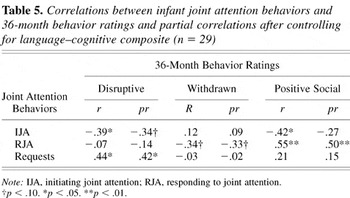
IJA was negatively correlated with the language–cognitive composite score (r = −.39, p < .05). The language–cognitive composite was positively but nonsignificantly correlated with Disruptive behaviors (r = .21, p > .20) and positively related to Positive Social behaviors (r = .54, p < .01). Thus, as seen in Table 5, the negative relation between IJA and Disruptive behavior was only slightly attenuated when controlling for the language–cognitive composite. The negative relation between IJA and Positive Social behaviors was reduced to nonsignificant levels after controlling for the covariate. Of course, the sample size limited the power of this study to detect small partial correlations. Nevertheless, language and cognitive skills appeared to account for a significant proportion of the shared variance between IJA and Positive Social Outcomes, whereas the negative relation between IJA and Disruptive behaviors was at least partially independent of 36-month language and cognitive abilities.
RJA acts were significantly and positively correlated with later Positive Social behavior ratings. The relation of RJA and Withdrawn behavior ratings was negative and approached a conventional level of significance (see Table 4). Thus, higher RJA scores were related to higher Positive Social behavior ratings and to lower ratings of Withdrawn behaviors. RJA was not correlated with Disruptive behaviors. The relation between RJA and the 36-month language–cognitive composite was positive, although it did not reach significance (r = .26, p > .10). Partial correlations (see Table 5) indicated that the relations between RJA and both Withdrawn and Positive Social behaviors were not attenuated by the language–cognitive covariate. Therefore, language and cognitive abilities did not mediate the relations between RJA and later social behaviors.
Finally, Requests were positively correlated with Disruptive behaviors, but they were not significantly related to Withdrawn or Positive Social behaviors. Requests were not significantly related to the language–cognitive composite (although Requests did correlate positively with Bayley MDI scores, as seen in Table 4). Because of this pattern, it cannot be expected that the language–cognitive composite would mediate relations between Requests and Disruptive behaviors. As can be seen in Table 5, this relation remained significant after including the language cognitive composite as a covariate in the model.
Regression analyses
The results presented above indicate that there was a significant pattern of relations between several infant JA measures and 36-month social behaviors. However, some of these JA measures were correlated (see Table 4). In addition, it was our a priori expectation that the JA measures would differentially relate to behavioral outcomes. Therefore, a series of regression analyses were performed in order to more fully examine the unique relations of infant JA measures with preschool behavioral outcomes. These analyses are presented in Table 6.
Regression analyses assessing the unique relations between infant joint attention behaviors and 36-month behavior ratings, before and after controlling for language–cognitive composite (n = 29)

The three JA measures (IJA, RJA, and Requests) were entered simultaneously at the first step in each regression model. The language–cognitive composite score was entered at the second step as an additional test of whether unique relations remained significant after controlling for language and cognitive abilities. Results for Disruptive behaviors and Positive Social behaviors are reported in Table 6. The regression model predicting Withdrawn behaviors did not reach significance and is therefore not reported in the table.
Disruptive Behaviors served as the dependent variable for the first analysis. Here, infant IJA, RJA, and Request measures together accounted for 40% of the variability in teacher ratings of 36-month disruptive behaviors. Each predictor had a unique contribution to the prediction of disruptive behaviors, with IJA and RJA predicting lower ratings of disruptive behaviors and Requests predicting higher ratings. The language–cognitive composite score did not add significantly to the proportion of explained variance in Disruptive behaviors and the unique effects of IJA, RJA, and Requests remained for the most part unchanged after entering the covariate in the model.
With respect to the prediction of Positive Social behaviors, IJA, RJA, and Requests combined accounted for 39% of the variability in teacher-rated positive social behavior. A unique effect was found for RJA, with the relation being positive. A marginally significant but negative relation was found for IJA behaviors. After the language–cognitive composite was entered into the model, RJA continued to be significantly related to Positive Social behaviors. However, the negative relation of IJA skills with Positive Social behaviors was no longer significant. Finally, the language–cognitive composite score was significantly related to positive behavioral outcome.
Discussion
The identification of infant predictors of later childhood behavioral outcome is an important goal for both basic and applied research in developmental psychology. The results of this study contribute to literature relevant to this goal by demonstrating that, consistent with theory (Goldsmith & Rogoff, 1997; Mundy & Willoughby, 1996, 1998; Raver & Leadbeater, 1995), JA skills reflect aspects of infant development that are related to preschool behavioral outcome and social competence. Furthermore, the results of this study indicate that different functional uses of infant JA, which are assessed in this study in terms of IJA, RJA and Requests, displayed unique and differentiated paths of association with later social behavioral development. Specifically, higher rates of IJA and RJA were predictive of lower ratings of disruptive behaviors, whereas higher rates of Requests were related to higher disruptive behavior ratings. RJA demonstrated a positive relation with later Positive Social behaviors. However, unexpectedly, rates of IJA in the second year of life were negatively related to Positive Social behavior ratings. The relation between IJA and Withdrawn behaviors was nonsignificant but in the positive direction.
These results were observed for a high-risk sample of CE infants and therefore may be limited to this or related populations of high-risk infants. In particular, the possible effects of prenatal cocaine exposure and associated social–environmental risks on JA may result in relations that are specific to this cohort or population. The sample was predominantly poor and a large percentage of the children were in relative or nonrelative foster care and/or had multiple custody arrangements over the course of the first 36 months of life. In addition, the sample used in this study was small, limiting the power to detect more modest effects and further limiting generalizability by affecting the stability of the findings. Nevertheless, despite these limitations, the results from this sample are consistent with the notion that disruptions in JA skill development may be an important indicator of relative vulnerability for behavioral disturbance in high-risk samples of infants (Mundy & Willoughby, 1996). Moreover, our findings provide further evidence that the behaviors measured in this study (IJA, RJA, and requesting) represent distinct elements of JA. Specifically, in addition to the unique longitudinal relations described above, this evidence also comes from our finding that IJA, RJA, and Requests had different developmental trajectories across the 12- to 18-month period, with increases in RJA and Requests but less of a developmental shift in IJA.
The possibility that the various components to JA skill have different developmental trajectories suggests that research needs to better describe the relations among these skills during infancy. Here we aggregated 12-, 15-, and 18-month measures of IJA, RJA, and Requests because our main interest was in individual differences in JA behaviors across this age period. The limited sample size of this study precluded a more detailed analysis of age-specific relations between JA and behavioral outcomes. Thus, although we believe that aggregating the three measurement time points was reasonable given our hypotheses and given the constraints imposed by sample size, a limitation of this approach was that it may have masked interesting relations that are specific to a particular age point.
This study examined the possibility that JA behaviors may have been related to later social competence as an epiphenomenon of associations with language and cognitive development. However, the results of this study were not consistent with this possibility. Language and cognitive abilities at 36 months were not related to all aspects of behavioral outcome. Furthermore, where language and cognition were related to outcome, as with ratings of positive social behaviors, infant JA measures appeared to predict positive social behaviors above and beyond the variance associated with language and cognition. Thus, although linguistic and cognitive skills can be expected to impact children's social functioning, it appeared unlikely that factors solely associated with language or cognition mediated the relations of infant JA to preschool social competence that was observed in this study.
Other factors may better account for the relations reported here. JA measures may be a precursor or an incipient form of infants' social understanding or social–cognitive ability (e.g., Moore, 1996; Tomasello, 1995). Thus, social–cognitive processes may have played a role in the developmental continuity of social behaviors observed here. However, a social–cognitive hypothesis has difficulty explaining at least one critical aspect of the data presented here: specifically, the differential relations between various functional measures of JA and behavioral outcomes. Much of current social–cognitive theory on JA makes no distinction between the factors that may be involved in JA skills used for declarative or imperative purposes (Carpenter et al., 1998). Therefore, in its current form this theory does not easily lend itself to an explanation of the divergent and significantly different direction of predictive associations of Requests and IJA with respect to later disruptive behavior ratings from this study.
One reason for this lack of consistency between theory and the results of this study is that, after the capacity for JA has been acquired, infants tend to display significant individual differences in the frequency and consistency of the display of JA skills (Mundy & Gomes, 1998). Although social–cognitive theory provides a cogent contribution to understanding the emergence of the capacity for JA (Carpenter et al., 1998), it does not speak so clearly to the factors that influence such individual differences in the frequency of display of JA behaviors. Therefore, the applicability of the typical social–cognitive perspective on the types of JA data presented in this study is not clear.
Beyond purely social–cognitive abilities, additional factors appear to be required to fully explain the variation in expression of early JA skills in the second year. Specifically, a consideration of motivational, temperamental, and self-regulatory processes may be important to understand individual differences in the frequency and consistency with which infants display different types of JA skills (Mundy & Sheinkopf, 1998; Mundy & Willoughby, 1998). The results of this study may serve to refine the hypotheses in this regard.
JA (e.g., IJA) may be indicative of the tendency to engage with or orient to others, approach others with positive affect, and engage in positive episodes of intersubjectivity (Mundy et al., 1992; Mundy & Hogan, 1994; Mundy & Neal, 2000). In turn, this tendency may contribute to social learning opportunities in the context of which may develop adaptive social behaviors with caregivers and subsequently with peers (Mundy & Willoughby, 1996, 1998; Stern, 1985). Thus, one temperament perspective on JA suggests that individual differences in JA skill reflect differences in both a constitutional tendency to engage others in positive sharing interactions and, as a consequence of this tendency, may also reflect differences in the tendency to engage in positive social learning and affiliative episodes with others (Mundy, 1995). This social style may be expected to reduce risk for maladaptive social behaviors in the face of less than optimal caregiving (Mundy & Willoughby, 1996, 1998), an expectation that is quite consistent with our findings that IJA and RJA were negatively related to later disruptive behavior ratings in this study. Past research showing that IJA acts are more likely to be associated with facial displays of positive affect are also consistent with our findings (Mundy et al., 1992). Together these observations point to a resiliency hypothesis. Children in this study were likely to have been exposed to varying degrees of disruptions in their home environments, based on their risk status (i.e., history of prenatal drug exposure and associated psychosocial risks). It may be that better developed JA skills reflect a set of social competencies and temperamental characteristics that support the development of adaptive social behaviors even in the face of environmental risk.
In contrast to the prediction of disruptive behaviors, we unexpectedly found negative correlations between IJA and later ratings of positive social behaviors at 36 months of age, a finding that is inconsistent with the theoretical position summarized above (Mundy & Willoughby, 1996, 1998). There are several possible explanations for these results. First, multiple factors are likely to contribute to IJA and these factors may affect the nature of IJA's relations to later social behaviors. For example, research from early childhood and school-age populations indicates that social approach and social inhibition may have independent effects on peer interactions (Asendorpf, 1990). Both factors may also have played a role in the expression of IJA in this sample. For example, Vaughan and colleagues (2003) have found that infant social approach and positive emotional reactivity is positively related to IJA at 9 months but negative reactivity is related to IJA at 12 months. In addition, research with preschool-age children has found that social cognitive abilities, a potential correlate of JA in infancy, are related to increased sensitivity to social criticism (Cutting & Dunn, 2002). These findings suggest that there are likely to be a variety of influences on individual differences in JA and these influences may change with age. Identifying the temperamental influences on JA may help to better understand the expression of JA in infancy and the specificity of relations between JA and social outcomes.
Thus, an inhibitory component could account for the negative association between IJA and later positive social behaviors, especially the tendency to initiate social interactions. It is possible that a singular emphasis on IJA as reflecting “sociability” (e.g., Mundy & Willoughby, 1996, 1998) may be incorrect and was not supported by the data in this study. Alternatively, post hoc, we may speculate that IJA reflects a tendency to engage others in a positively toned fashion but social–cognitive and inhibitory self-regulatory factors also contribute to IJA such that higher levels of IJA may predict a social but reflective child who is not necessarily as gregarious or boisterous as his or her peers. This perspective is consistent with theory and research on the connection between IJA and the medial frontal cortex that emphasizes the self-monitoring role of the medial frontal cortex (Henderson et al., 2002; Mundy, 2003; Mundy et al., 2000).
In addition to IJA, RJA was also negatively correlated with disruptive behaviors. It was suggested previously that, relative to IJA, RJA may be a more basic, early arising social skill that is more closely related to attention regulation and associated cognitive–executive processes than emotional behavioral development (Mundy et al., 1994; Mundy & Sheinkopf, 1998; Mundy & Willoughby, 1996). Some support of this conceptualization is provided by the observation that, at 6 months, RJA appears to be associated with parent report of general aspects of infant attention regulation skill (Morales, Mundy, Delgado, Yale, Messinger, Neal, & Schwartz, 2000). Hence, the negative association with disruptive behaviors may reflect the common contributions of attention regulation factors to both the development of better RJA skill and decreases in disruptive behavior.
In addition to associations with lower ratings of disruptive behaviors, RJA was also associated with positive social behaviors at 36 months. In prior theoretical formulations, a connection between prosocial tendencies and RJA had not been specifically suggested because, unlike IJA, data had not clearly connected RJA to positive affect or systems that presumably subserve social–emotional approach behavior (Mundy et al., 1992; Mundy & Neal, 2001). However, Morales and colleagues (Morales, Broderick, Clemens, Ogert, Weierstall, Martin, & Stafford, 2001) recently observed that RJA performance among typically developing 6-month-olds was positively correlated with a self-regulation strategy in a delay of gratification task at 24 months. Recent investigations of the relation between temperamental aspects of attention regulation and early socialization (Kochanska, Murray, & Harlan, 2000) and neuropsychological investigations of the potential relation between JA skills and executive capacities (McEvoy, Rogers, & Pennington, 1993) may prove quite relevant here. Adaptive social functioning in the form of both infant JA ability and later social interactions with peers may partially rest on a child's capacities to inhibit prepotent responses and initiate appropriate actions. Further, as was mentioned earlier, the functional uses of JA explored here may differ in their relations with such executive and regulatory capacities. For instance, it is conceivable that individual differences in requesting behaviors, at least in the extreme, may be related to relatively poor executive abilities, whereas RJA and IJA may require better developed executive skills.
RJA may also reflect processes associated with social compliance, at least in terms of the willingness to consistently follow the attention directives of a tester. In addition, our measure of social compliance (ASBI) was part of the social competence variable used in this study. It is plausible then to suggest that a combination of social–cognitive, attention or self-regulation, and compliance factors contributed to the positive relation of RJA with Positive Social behavior ratings and its negative relation to disruptive behaviors. Finally, although RJA was associated with the behavioral outcomes above and beyond variances in language and cognition, the limits of this study do not preclude the possibility that the association between RJA and later social behaviors may have been affected by variances shared by both of these domains with general aspects of language and cognitive development.
In contrast to the IJA and RJA findings, the results of this study suggest that individual differences in requesting behaviors may reflect a very different dimension of early behavior. As alluded to above, this conclusion is consistent with previous research indicating that IJA and Requests differ in their association with facial affect (Mundy et al., 1992), EEG indexes of cortical activity (Mundy et al., 2000), language development (Mundy & Gomes, 1998), and sensitivity to developmental disturbance in autism (Mundy et al., 1986). What might be the nature of the difference between infants who frequently engage in IJA or Requests? Whereas IJA may provide an index of a reflective social style (with both affiliative and inhibitory components), observations of children in the ESCS suggest that high frequencies of Requests may reflect an impulsive, demanding, or reward-seeking behavioral style. Such underlying behavioral tendencies may be related to aggressive and impulsive behavior (Kochanska, Murray, & Coy, 1997; Kochanska, Murray, Jacques, Koenig, & Vandergeest, 1996; O'Brien & Frick, 1996). This behavior style may derive from constitutional processes and/or in association with less than optimal caregiving, as data provide by Flanagan and colleagues (1994) suggest. This is not to say that higher rates of requesting will uniformly index less than optimal early development. In this study, requests were positively correlated with performance on the Bayley Scales, indicating that this aspect of the expression of social attention coordination was associated with cognitive development. Instead, it may be that extremes in the frequency of requesting acts reflect an imbalance between the deployment of different types of social attention behaviors and that such an imbalance may be an index of risk for the development of disruptive behavior disturbance in young children.
As noted previously, aspects of the caregiving environment are likely to play a role in the development of JA behaviors (Flanagan et al., 1994; Wachs & Chan, 1986). Of note here is recent research by Landry and colleagues. For example, Garner, Landry, and Richardson (1991) found that for low BW infants, caregivers appeared to vary their interactive style based on their infants' age and risk status in ways that served to support the development of JA abilities. In addition, Landry et al. (1998) found that individual differences in caregiver style (e.g., directiveness, sensitivity, and tendency to maintain joint engagement) were related to children's tendency to initiate and respond to caregivers during social interactions. Such results suggest that associations between JA and behavioral outcome may be partly mediated by aspects of the caregiving environment. However, earlier we speculated that JA skills may moderate (i.e., serve as a protective factor) the relations between environmental risk and negative behavioral outcomes. Thus, infant JA can be viewed as part of a complex pathway to later social competence. In this manner JA can be viewed in two different ways. First, it can be seen as an important social milestone, one whose expression may reflect constitutional features of the infant and may be affected by pre- and postnatal risk factors. Second, it can also be seen as a set of skills that act as an affordance for subsequent social development and that may moderate the relations between environmental risks and behavioral outcomes. These complex pathways need to be addressed in future research.
One additional dimension of the caregiver–infant dyad that may be relevant to investigations of the social–emotional context of JA development is parent–infant attachment. No direct data may be brought to bear on this issue at this time and it therefore warrants careful consideration in future studies. Nevertheless, some relevant information is available. For instance, in a study of 56 at-risk infants, Claussen, Mundy, Mallik, and Willoughby (2002) observed that attachment status, particularly disorganized status, was negatively associated with social attention coordination behaviors in infants. At 18 months of age, infants classified as disorganized (n = 28) tended to initiate fewer IJA and Requesting acts than did the secure (n = 5) and insecure infants (n = 23).
Although the results of Claussen et al. (2002) suggest that attachment status is associated with the rate with which infants in the second year of life initiate social interactions, such results do not lend a ready explanation for why higher frequencies of IJA were negatively related to disruptive behaviors but higher frequencies of requests were positively related to this outcome domain. Moreover, whereas RJA was a significant correlate of all aspects of outcome in the present study, RJA did not display any relation with attachment in the Claussen et al. (2002) study. Thus, it seems unlikely that the relations found in this study would be mediated by infant attachment status. Indeed, theoretically, attachment behaviors, especially those elicited in response to the security challenge of the Strange Situation, may be expected to serve distinctly different social functions than those elicited for communicative purposes in the ESCS, in which a security challenge is not a feature of the paradigm (Mundy & Willoughby, 1996, 1998).
In conclusion, the value of the current data appears to be twofold. Although the utility of the construct of JA is well recognized in the study of early language and cognitive development, the data in this paper may be among the first to empirically support a theory linking JA skill development with subsequent social competence. Furthermore, this association does not appear to simply be an epiphenomenon of variance shared with language or cognitive development. Thus, measures of JA may make a unique contribution to clinically useful batteries of infant predictors of later childhood behavioral outcome. This is important because there are few reliable and valid predictors of behavioral development from infancy, and it is unlikely that any one measure could be used in a singular fashion in predicting outcome. The identification of such predictors may also afford a better understanding of the processes associated with subsequent behavioral development, as well as help to identify infants who are most in need of early intervention services. With regard to the latter, methods are under development that specifically target the development of JA skills in early development (Kasari, Freeman, & Paparella, 2001; Yoder & Warren, 1999). Thus, the confluence of data of the kind presented here, with work underway on early intervention, may point to new methods for the reduction of risk for behavior disturbance in some samples of young children.
The results of this study also underscore the need to better understand the varied processes that contribute to the development of JA in infancy. Recent theoretical and empirical approaches to JA have emphasized connections between JA and language or social cognition. However, these approaches do not fair well in explaining the results of this study. Although it is possible that these views can be modified to better accommodate the connections between different types of JA skills and emergent aspects of social competence, these views may need to be expanded to accommodate additional attention regulation or temperament factors in the development and expression of JA skills. Even here, though, the results suggest that extant efforts (Mundy & Willoughby, 1996, 1998) may be valid in their general orientation but imprecise in their designation of the specific factors that are related to JA development. This is not surprising because, with few exceptions (e.g., Kim & Walden, 2001; Vaughan et al., 2003), there has been little work on the emotional and temperamental contributions to JA development. Perhaps over the next decade this critical gap in our understanding will be closed.
References
REFERENCES
Achenbach, T. M.
(1992).
Manual for the Child Behavior Checklist 2–3 1992 profile.
Burlington, VT:
University of Vermont, Department of Psychiatry.
Adamson, L. B., &
McArthur, D.
(1995).
Joint attention, affect, and culture. In
C. Moore &
P. J. Dunham (Eds.),
Joint attention: Its origin and role in development (pp.
205–221).
Hillsdale, NJ:
Erlbaum.
Asendorpf, J. B.
(1990).
Beyond social withdrawal: Shyness, unsociability, and peer
avoidance.
Human Development
33,
250–259.Google Scholar
Bakeman, R., &
Adamson, L.
(1984).
Coordinating attention to people and objects in mother–infant
and peer–infant interaction.
Child Development
55,
1278–1289.Google Scholar
Baker, L., &
Cantwell, D. P.
(1987).
Factors associated with the development of psychiatric illness in
children with early speech/language problems.
Journal of Autism and Developmental Disorders
17,
499–510.Google Scholar
Baldwin, D. A.
(1995).
Understanding the link between joint attention and language. In
C. Moore &
P. J. Dunham (Eds.),
Joint attention: Its origins and role in development (pp.
131–158).
Hillsdale, NJ:
Erlbaum.
Baron, R. M., &
Kenny, D. A.
(1986).
The moderator–mediator variable distinction in social
psychological research: Conceptual, strategic, and statistical
considerations.
Journal of Personality and Social Psychology
51,
1173–1182.Google Scholar
Baron–Cohen, S.
(1993).
From attention–goal psychology to belief–desire
psychology: The development of a theory of mind and its
dysfunction. In
H. Tager–Flusberg,
S. Baron–Cohen &
D. J. Cohen (Eds.),
Understanding other minds: Perspectives from autism (pp.
59–82).
Oxford:
Oxford University Press.
Bates, E.,
Benigni, L.,
Bretherton, I.,
Camaioni, L., &
Volterra, V.
(1979).
The emergence of symbols: Cognition and communication in infancy.
New York:
Academic Press.
Bayley, N.
(1993).
Bayley Scales of Infant Development
(2nd ed.).
San Antonio, TX:
Psychological Corporation.
Beeghly, M., &
Tronick, E. Z.
(1994).
Effects of prenatal exposure to cocaine in early infancy: Toxic
effects on the process of mutual regulation.
Infant Mental Health Journal
15,
158–175.Google Scholar
Beitchman, J. H.,
Hood, J., &
Inglis, A.
(1990).
Psychiatric risk in children with speech and language disorders.
Journal of Abnormal Child Psychology
18,
283–296.Google Scholar
Bretherton, I.
(1991).
Intentional communication and the development of an understanding
of mind. In
D. Frye &
C. Moore (Eds.),
Children's theories of mind: Mental states and social
understanding (pp.
49–75).
Hillsdale, NJ:
Erlbaum.
Bruner, J., &
Sherwood, V.
(1983).
Thought, language, and interaction in infancy. In
J. D. Call,
E. Galenson, &
R. L. Tyson (Eds.),
Frontiers in infant psychiatry (pp.
38–55).
New York:
Basic Books.
Bruner, J. S.
(1975).
From communication to language: A psychological perspective.
Cognition
3,
255–287.Google Scholar
Butterworth, G., &
Cochran, E.
(1980).
Towards a mechanism of joint visual attention in human infancy.
International Journal of Behavioral Development
3,
253–272.Google Scholar
Caplan, R.,
Chugani, H.,
Messa, C.,
Guthrie, D.,
Sigman, M.,
Traversay, J., &
Mundy, P.
(1993).
Hemispherectomy for early onset intractable seizures: Presurgical
cerebral glucose metabolism and postsurgical nonverbal communication
patterns.
Developmental Medicine and Child Neurology
35,
582–592.Google Scholar
Carpenter, M.,
Nagell, K., &
Tomasello, M.
(1998).
Social cognition, joint attention, and communicative competence
from 9 to 15 months of age.
Monographs of the Society for Research in Child Development
63(4, Serial No. 255).Google Scholar
Claussen, A. H.,
Mundy, P. C.,
Mallik, S. A., &
Willoughby, J. C.
(2002).
Joint attention and disorganized attachment status in infants at
risk.
Development and Psychopathology
14,
279–291.Google Scholar
Corkum, V., &
Moore, C.
(1998).
The origins of joint visual attention in infants.
Developmental Psychology
34,
28–38.Google Scholar
Cutting, A. L., &
Dunn, J.
(2002).
The cost of understanding other people: Social cognition predicts
young children's sensitivity to criticism.
Journal of Child Psychology & Psychiatry & Allied
Disciplines
43,
849–860.Google Scholar
Dunham, P., &
Dunham, F.
(1992).
Lexical development during middle infancy: A mutually driven
infant–caregiver process.
Developmental Psychology
28,
414–420.Google Scholar
Dunham, P. J.,
Dunham, F., &
Curwin, A.
(1993).
Joint-attentional states and lexical acquisition at 18 months.
Developmental Psychology
29,
827–831.Google Scholar
Dunham, P. J., &
Moore, C.
(1995).
Current themes in research on joint attention. In
C. Moore &
P. J. Dunham (Eds.),
Joint attention: Its origins and role in development (pp.
15–28).
Hillsdale, NJ:
Erlbaum.
Fantuzzo, J.,
Sutton–Smith, B.,
Coolahan, K. C.,
Manz, P. H.,
Canning, S., &
Debnam, D.
(1995).
Assessment of preschool play interaction behaviors in young
low-income children: Penn Interactive Peer Play Scale.
Early Childhood Research Quarterly
10,
105–120.Google Scholar
Flanagan, P. J.,
Coppa, D. F.,
Riggs, S. G., &
Alario, A. J.
(1994).
Communication behaviors of infants of teen mothers.
Journal of Adolescent Health
15,
169–175.Google Scholar
Garner, P. W.,
Landry, S. H., &
Richardson, M. A.
(1991).
The development of joint attention skills in very-low-birthweight
infants across the first 2 years.
Infant Behavior and Development
14,
489–495.Google Scholar
Goldsmith, D. F., &
Rogoff, B.
(1997).
Mothers' and toddlers' coordinated joint focus of
attention: Variations with maternal dysphoric symptoms.
Developmental Psychology
33,
113–119.Google Scholar
Hans, S. L.
(1999).
Demographic and psychosocial characteristics of substance-abusing
pregnant women.
Clinics in Perinatolgy
26,
55–74.Google Scholar
Henderson, L. M.,
Yoder, P. J.,
Yale, M. E., &
McDuffie, A.
(2002).
Getting the point: Electrophysiological correlates of
protodeclarative pointing.
International Journal of Developmental Neuroscience
20,
449–458.Google Scholar
Hogan, A. E.,
Scott, K. G., &
Bauer, C. R.
(1992).
The Adaptive Social Behavior Inventory (ASBI): A new assessment of
social competence in high risk three-year-olds.
Journal of Psychoeducational Assessment
10,
230–239.Google Scholar
Kasari, C.,
Freeman, S., &
Paparella, T.
(2001).
Early intervention in autism: Joint attention and symbolic play.
In
L. Masters Glidden (Ed.),
International review of research in mental retardation: Autism
(Vol. 23, pp.
208–238).
New York:
Academic Press.
Kasari, C.,
Sigman, M.,
Mundy, P., &
Yirmiya, N.
(1990).
Affective sharing in the context of joint attention interactions of
normal, autistic, and mentally retarded children.
Journal of Autism and Developmental Disorders
20,
87–100.Google Scholar
Kim, G., &
Walden, T.
(2001, April).
Impact of temperamental distress on infant responsivity and
regulation in social referencing: Direct and indirect effects.
Paper presented at the biennial meeting of the Society for Research
in Child Development, Minneapolis, MN.
Kochanska, G.,
Murray, K., &
Coy, K. C.
(1997).
Inhibitory control as a contributor to consience in childhood: From
toddler to early school age.
Child Development
68,
263–277.Google Scholar
Kochanska, G.,
Murray, K.,
Jacques, T. Y.,
Koenig, A. L., &
Vandergeest, K. A.
(1996).
Inhibitory control in young children and its role in emerging
internalization.
Child Development
67,
490–507.Google Scholar
Kochanska, G.,
Murray, K. T., &
Harlan, E. T.
(2000).
Effortful control in early childhood: Continuity and change,
antecedents, and implications for social development.
Developmental Psychology
36,
220–232.Google Scholar
Landry, S. H.,
Smith, K. E.,
Miller–Loncar, C. L., &
Swank, P. R.
(1998).
The relation of change in maternal interactive styles to the
developing social competence of full-term and preterm children.
Child Development
69,
105–123.Google Scholar
Leslie, A. M., &
Happe, F.
(1989).
Autism and ostensive communication: The relevance of
metarepresentation.
Development and Psychopathology
1,
205–212.Google Scholar
Lester, B. M.,
LaGasse, L. L., &
Seifer, R.
(1998).
Prenatal cocaine exposure and child outcome: The meaning of subtle
effects.
Science
282,
633–634.Google Scholar
Lester, B. M., &
Tronick, E. Z.
(1994).
The effects of prenatal cocaine exposure and child outcome.
Infant Mental Health Journal
15,
107–120.Google Scholar
Loveland, K., &
Landry, S.
(1986).
Joint attention and language in autism and developmental language
delay.
Journal of Autism and Developmental Disorders
16,
335–349.Google Scholar
Masten, A. S., &
Coatsworth, J. D.
(1998).
The development of competence in favorable and unfavorable
environments. Lessons from research on successful children.
American Psychologist
53,
205–220.Google Scholar
Mayes, L. C.,
Grillon, C.,
Granger, R., &
Schottenfeld, R.
(1998).
Regulation of arousal and attention in preschool children exposed
to cocaine prenatally. In
J. A. Harvey &
B. E. Kosofsky (Eds.),
Cocaine: Effects on the developing brain
(Vol. 846, pp.
126–143).
New York:
The New York Academy of Sciences.
McEvoy, R. E.,
Rogers, S. J., &
Pennington, B. F.
(1993).
Executive function and social communication deficits in young
autistic children.
Journal of Child Psychology and Psychiatry
34,
563–578.Google Scholar
Moore, C.
(1996).
Theories of mind in infancy.
British Journal of Developmental Psychology
14,
19–40.Google Scholar
Morales, M.,
Broderick, M.,
Clemens, B.,
Ogert, A.,
Weierstall, K.,
Martin, M., &
Stafford, K.
(2001, April).
Longitudinal and concurrent relations between joint attention and
emotion regulation in typically developing 2-year-old children.
Paper presented at the biennial meeting of the Society for Research
in Child Development, Minneapolis, MN.
Morales, M.,
Mundy, P.,
Delgado, C. E. F.,
Yale, M.,
Messinger, D.,
Neal, R., &
Schwartz, H. K.
(2000).
Responding to joint attention across the 6- through 24-month age
period and early language acquisition.
Journal of Applied Developmental Psychology
21,
283–298.Google Scholar
Morales, M.,
Mundy, P., &
Rojas, J.
(1998).
Following the direction of gaze and language development in
6-month-olds.
Infant Behavior and Development
21,
373–377.Google Scholar
Mundy, P.
(1995).
Joint attention and social–emotional approach behavior in
children with autism.
Development and Psychopathology
7,
63–82.Google Scholar
Mundy, P.
(2003).
The neural basis of the social impairment in autism: The role of
the dorsal medial–frontal cortex and the anterior cingulate
system.
Journal of Child Psychology and Psychiatry
44,
1–17.Google Scholar
Mundy, P.,
Card, J., &
Fox, N. A.
(2000).
EEG correlates of the development of infant joint attention skills.
Developmental Psychobiology
36,
325–338.Google Scholar
Mundy, P., &
Gomes, A.
(1998).
Individual differences in joint attention skill development in the
second year.
Infant Behavior and Development
21,
469–482.Google Scholar
Mundy, P., &
Hogan, A.
(1994).
Intersubjectivity, joint attention and autistic developmental
pathology. In
D. Cicchetti &
S. Toth (Eds.),
Disorders and dysfunctions of the self. Rochester Symposium on
Developmental Psychopathology
(Vol. 5, pp.
1–30).
Rochester, NY:
Rochester University Press.
Mundy, P.,
Hogan, A., &
Doehring, P.
(1994).
A preliminary manual for the abridged Early Social Communication
Scales.
Miami, FL:
Author.
Mundy, P.,
Kasari, C., &
Sigman, M.
(1992).
Nonverbal communication, affective sharing, and intersubjectivity.
Infant Behavior and Development
15,
377–381.Google Scholar
Mundy, P., &
Neal, R.
(2000).
Neural plasticity, joint attention and autistic developmental
pathology. In
L. Glidden (Ed.),
International review of research in mental retardation
(Vol. 23).
New York:
Academic Press.
Mundy, P., &
Neal, R.
(2001).
Neural plasticity, joint attention and a transactional social
orienting model of autism. In
L. Glidden (Ed.),
International review of research in mental retardation.
New York:
Academic Press.
Mundy, P., &
Sheinkopf, S. J.
(1998).
Early communication skill and developmental disorders. In
J. Burack,
R. Hodapp, &
E. Zigler (Eds.),
Handbook of mental retardation and development (pp.
183–207).
Cambridge:
Cambridge University Press.
Mundy, P.,
Sigman, M., &
Kasari, C.
(1990).
A longitudinal study of joint attention and language development in
autistic children.
Journal of Autism and Developmental Disorders
20,
115–128.Google Scholar
Mundy, P.,
Sigman, M.,
Ungerer, J., &
Sherman, T.
(1986).
Defining the social deficits of autism: The contribution of
nonverbal communication measures.
Journal of Child Psychology and Psychiatry
27,
657–669.Google Scholar
Mundy, P., &
Willoughby, J.
(1996).
Nonverbal communication, joint attention, and early
socio-emotional development. In
M. Lewis &
M. Sullivan (Eds.),
Emotional development in atypical children (pp.
65–87).
Mahwah, NJ:
Erlbaum.
Mundy, P., &
Willoughby, J.
(1998).
Nonverbal communication, affect, and social emotional
development. In
A. Wetherby,
S. Warren, &
J. Reichle (Eds.),
Transitions in prelinguistic communication: Preintentional to
intentional and presymbolic to symbolic (pp.
111–134).
Baltimore, MD:
Brookes.
O'Brien, B. S., &
Frick, P. J.
(1996).
Reward dominance: Associations with anxiety, conduct problems, and
psychopathy in children.
Journal of Abnormal Child Psychology
24,
223–240.Google Scholar
Raver, C. C., &
Leadbeater, B. J.
(1993).
The problem of other in research on theory of mind and social
development.
Human Development
36,
350–362.Google Scholar
Raver, C. C., &
Leadbeater, B. J.
(1995).
Factors influencing joint attention between socioeconomically
disadvantaged adolescent mothers and their infants. In
C. Moore &
P. J. Dunham (Eds.),
Joint attention: Its origins and role in development (pp.
251–271).
Hillsdale, NJ:
Erlbaum.
Reynell, J. K., &
Gruber, C. P.
(1990).
Reynell Developmental Language Scales: U.S. edition.
Los Angeles:
Western Psychological Services.
Rheingold, H. L.,
Hay, D. F., &
West, M. J.
(1976).
Sharing in the second year of life.
Child Development
47,
1148–1158.Google Scholar
Richardson, G.
(1998).
Prenatal cocaine exposure. In
J. A. Harvey &
B. E. Kosofsky (Eds.),
Cocaine: Effects on the developing brain
(Vol. 846, pp.
144–152).
New York:
The New York Academy of Sciences.
Scaife, M., &
Bruner, J. S.
(1975).
The capacity for joint visual attention in the infant.
Nature
253(5489),
265–266.Google Scholar
Seibert, J. M.,
Hogan, A. E., &
Mundy, P. C.
(1982).
Assessing interactional competencies: The Early Social
Communication Scales.
Infant Mental Health Journal
3,
244–245.Google Scholar
Sigman, M., &
Ruskin, E.
(1999).
Continuity and change in the social competence of children with
autism, Down syndrome, and developmental delays.
Monographs of the Society for Research in Child Development
64(5, Serial No. 256).Google Scholar
Singer, L. T.,
Arendt, R.,
Fagen, J.,
Minnes, S.,
Salvator, A.,
Bolek, T., &
Becker, M.
(1999).
Neonatal visual information processing in cocaine-exposed and
non-exposed infants.
Infant Behavior and Development
22,
1–15.Google Scholar
Stern, D.
(1985).
The interpersonal world of the infant: A view from psychoanalysis
and developmental psychology.
New York:
Basic Books.
Tomasello, M.
(1995).
Joint attention as social cognition. In
C. Moore &
P. J. Dunham (Eds.),
Joint attention: Its origins and role in development (pp.
103–130).
Hillsdale, NJ:
Erlbaum.
Tomasello, M., &
Farrar, M. J.
(1986).
Joint attention and early language.
Child Development
57,
1454–1463.Google Scholar
Tomasello, M.,
Kruger, A., &
Ratner, H. H.
(1993).
Cultural learning.
Behavior and Brain Sciences
16,
495–552.Google Scholar
Tronick, E. Z., &
Beeghly, M.
(1999).
Prenatal cocaine exposure, child development, and the compromising
effects of cumulative risk.
Clinics in Perinatology
26,
151–171.Google Scholar
Ulvund, S. E., &
Smith, L.
(1996).
The predictive validity of nonverbal communicative skills in
infants with perinatal hazards.
Infant Behavior and Development
19,
441–449.Google Scholar
Vaughan, A.,
Mundy, P.,
Block, J.,
Delgado, C.,
Gomez, Y.,
Meyer, J.,
Neal, A. R., &
Pomares, Y.
(2003).
Child, caregiver, and temperament contributions to infant joint
attention.
Infancy
4,
603–616.Google Scholar
Volpe, J. J.
(1992).
Effect of cocaine use on the fetus.
New England Journal of Medicine
327,
399–407.Google Scholar
Wachs, T. D.
(1988).
Relevance of physical–environment influences for toddler
temperament.
Infant Behavior and Development
11,
431–445.Google Scholar
Wachs, T. D., &
Chan, A.
(1986).
Specificity of environmental action, as seen in environmental
correlates of infants' communicative performance.
Child Development
57,
1464–1474.Google Scholar
Wetherby, A. M., &
Prutting, C. A.
(1984).
Profiles of communicative and cognitive social abilities in
autistic children.
Journal of Speech and Hearing Research
27,
367–377.Google Scholar
Yoder, P., &
Warren, S.
(1999).
Facilitating self-initiated proto-declaratives and
proto-imperatives in prelinguistic children with developmental
disabilities.
Journal of Early Intervention
22,
337–354.Google Scholar
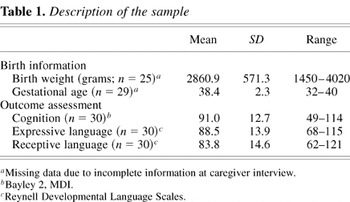
Description of the sample
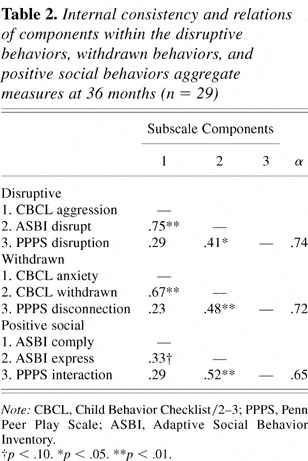
Internal consistency and relations of components within the disruptive behaviors, withdrawn behaviors, and positive social behaviors aggregate measures at 36 months (n = 29)
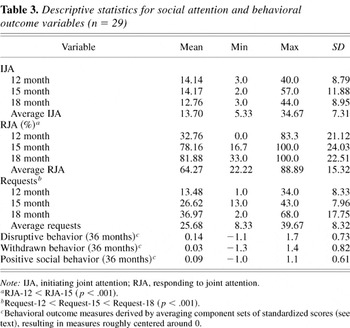
Descriptive statistics for social attention and behavioral outcome variables (n = 29)
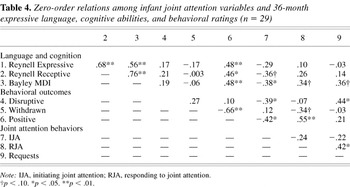
Zero-order relations among infant joint attention variables and 36-month expressive language, cognitive abilities, and behavioral ratings (n = 29)
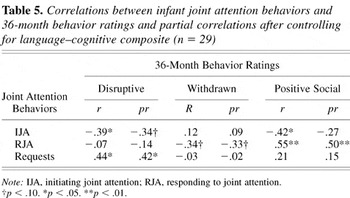
Correlations between infant joint attention behaviors and 36-month behavior ratings and partial correlations after controlling for language–cognitive composite (n = 29)
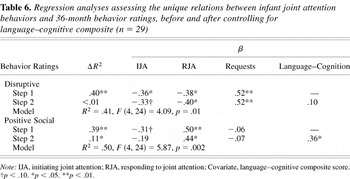
Regression analyses assessing the unique relations between infant joint attention behaviors and 36-month behavior ratings, before and after controlling for language–cognitive composite (n = 29)
 You have
Access
- 72
- Cited by