INTRODUCTION
Tagging animals has been over time a useful tool to understand important aspects about behaviour and population dynamics (Olson & Newton, Reference Olson and Newton1979; Pollock et al., Reference Pollock, Nichols, Brownie and Hines1990; Mowat & Strobeck, Reference Mowat and Strobeck2000; Williams et al., Reference Williams, Nichols and Conroy2002; Shiell, Reference Shiell2006; Lauzon-Guay & Scheibling, Reference Lauzon-Guay and Scheibling2008; Martínez et al., Reference Martínez, Byrne and Coleman2013). In these kinds of studies, a correct identification and high tag retention are essential to achieve a successful analysis (Caswell, Reference Caswell2001; Amstrup et al., Reference Amstrup, MacDonald and Manly2006). These results can help to comprehend current and future population dynamic of threatened and endangered species (Steyermark et al., Reference Steyermark, Williams, Spotila, Paladino, Rostal, Morreale, Koberg and Arauz-Vargas1996; Goldman, Reference Goldman2007), but also to evaluate movements and harvesting effect (Prentice et al., Reference Prentice, Flagg and McCutcheon1990; Donaldson et al., Reference Donaldson, Schmidt, Watson and Pengilly1992; Pengilly & Watson, Reference Pengilly and Watson1994; Medicci et al., Reference Medicci, Wolcott and Wolcott2006; Ebert, Reference Ebert and Lawrence2007).
Several internal and external tags have been developed; some common internal marks previously used in echinoderms were metallic labelled bars inserted into the coelomic cavity and tetracycline/calcein marks (Ebert, Reference Ebert and Lawrence2007; Gibbons & Andrew, Reference Gibbons and Andrews2004; Purcell et al., Reference Purcell, Blockmans and Nash2006; Purcell & Blockmans, Reference Purcell and Blockmans2009). More recently, a new electronic device called passive integrated transponders (PIT) has been used and tested on fish, birds, crustaceans, reptiles, mammals and echinoderms (Schooley et al., Reference Schooley, Van Horne and Burnham1993; Steyernark et al., 1996; Morgan, Reference Morgan2000; Duggan & Miller, Reference Duggan and Miller2001; Nicolaus et al., Reference Nicolaus, Bouwman and Dingemanse2008; Purcell et al., Reference Purcell, Agudo and Gossuin2008; Sonnernholzner et al., Reference Sonnernholzner, Montaño-Moctezuma and Searcy-Bernal2010; Leber & Blankenship, Reference Leber and Blankenship2011).
The evaluation of PIT-tags in echinoderms is considered highly variable. Some studies have found high retention and survival (Woods & James, Reference Woods and James2005; Sonnernholzner et al., Reference Sonnernholzner, Montaño-Moctezuma and Searcy-Bernal2010), while others have shown low retention, survival and behavioural changes (Purcell et al., Reference Purcell, Agudo and Gossuin2008; Cieciel et al., Reference Cieciel, Pyper and Eckert2009; Martínez et al., Reference Martínez, Byrne and Coleman2013). Furthermore, the elevated prices of PIT-tags represent a serious economic barrier against their use (Gibbons & Andrew, Reference Gibbons and Andrews2004). Conversely, external tagging devices are cheaper and easier to detect in the field, some of the most commonly used being T-bar tags, visible elastomers, coded-wire tags, or anchoraged attached labels (Walker, Reference Walker1981; Agatsuma et al., Reference Agatsuma, Nakata and Matsuyama2000; James, Reference James2000). However, T-bar has been tested on holothuroids with variable results in retention and mortality as well (Harriot, Reference Harriot1980; Kirshenbaum et al., Reference Kirshenbaum, Feindel and Chen2006; Purcell et al. Reference Purcell, Agudo and Gossuin2008).
Different species of sea cucumbers have been previously tagged using internal and external tags with variable results (Conand, Reference Conand, Yanagisawa, Yasumasu, Ogurao, Suzuki and Motokawa1991; Purcell et al., Reference Purcell, Blockmans and Nash2006; Cieciel et al., Reference Cieciel, Pyper and Eckert2009), mainly species with some commercial interest (Bradbury et al., Reference Bradbury, Palsson and Pacunski1996; Kirshenbaum et al., Reference Kirshenbaum, Feindel and Chen2006). Retention time could vary from weeks up to two years in some individuals (Conand, Reference Conand1990, Reference Conand, Yanagisawa, Yasumasu, Ogurao, Suzuki and Motokawa1991; Purcell et al., Reference Purcell, Agudo and Gossuin2008). Tag evaluation has been focused mainly in holothurians from tropical and temperate zones, and with commercial interest (Purcell et al., Reference Purcell, Agudo and Gossuin2008, Cieciel et al., Reference Cieciel, Pyper and Eckert2009). Nevertheless, no studies have examined tag retention in Caribbean sea cucumber species which have been exploited increasingly in recent years (Purcell et al., Reference Purcell, Samyn and Conand2012).
The sea cucumber Holothuria (Halodeima) mexicana (Ludwig, 1875) is considered one of the most common sea cucumbers in the Caribbean region, and is a commercially harvested species (Purcell et al., Reference Purcell, Samyn and Conand2012). The species inhabits in seagrass beds, mangroves, reef hard bottoms and sand plains from Florida Keys to Venezuela and it can reach a length of 30–50 cm (Hendler et al., Reference Hendler, Miller, Pawson and Kier1995). We evaluated the retention and the effect of tagging in the holothuroid H. mexicana. We hypothesize that tagging will not cause high stress in individuals, and a better retention rate will be obtained with PIT-tags.
MATERIALS AND METHODS
The study was conducted on Costa Azul beach, located in the municipality of Luquillo, on the north-eastern coast of Puerto Rico (18°23′18.46″N 65°43′5.52″W). The area is a shallow-water lagoon between 0.5 to 1.5 m depth with a well-developed seagrass meadow dominated by Thalassia testudinum and Syringodium filiforme, between the shoreline and a reef crest. Sixty holothuroids of the species Holothuria mexicana (17.47 ± 0.91 cm of ventral surface length; mean ± standard deviation) were randomly collected and placed in one metallic cage for each treatment (30 holothuroids per cage). The metallic cages dimensions were 3.0 m length, 1.5 m width, 1.5 m height and 1.4 cm of mesh size. Cages were fixed to the substrate with one iron bar to each corner, and the bottom was completely open to simulate natural conditions in captivity.
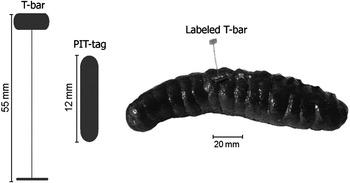
The experiment was carried out during 10 weeks, from November 2013 to January 2014 to analyse the effectiveness of two different tags. For T-bar tags, individuals were tagged with a thin tagging pistol. A light pressure was applied on the medium–ventral region until the thick skin was perforated by a needle of 1.5 mm diameter. When the needle penetrated into the coelomic cavity, the trigger was pressed and the T-bar (55 mm length) was attached with the proximal side of the tag inside the body, while the labelled distal part remained outside the holothuroid (Figure 1).
Form and dimensions of the two types of tested tags; see also a detail of a labelled individual of Holothuria mexicana (right side).

The PIT-tag was injected into the coelom through the skin in the medium–dorsal region with a plastic injector with a 2.15 mm diameter needle. The PIT-tag dimensions were 12 × 2.5 mm, and it was encapsulated in an approved biocompatible polymer (Figure 1). PIT-tags were read with a handheld portable reader (HDX/FDX-134.2 kHz). Sea cucumbers were measured in situ (ventral surface length) to avoid natural shrinking or stretching when disturbed (Hendler et al., Reference Hendler, Miller, Pawson and Kier1995). The reaction during tagging procedure was recorded (evisceration response: yes/no). This means that the animals ejected or not their viscera (often their intestine, reproductive organs and/or respiratory tree). Reading accuracy was corroborated by selecting and dissecting five sea cucumbers randomly of the group of ‘non-signal’ tagged individuals at the end of the study.
We used a non-parametric Spearman correlation analysis to test the influence of body size on retention rate and evisceration (Zar, Reference Zar2010). In addition, we ran a 2 × 2 Chi-square (χ²) contingency table to test differences in tag retention and evisceration between the two tagging techniques. Statistical analyses were performed in the free-license statistical program R-3.0.1 with a P value ≤ 0.05 (R Core Team, 2013).
RESULTS AND DISCUSSION
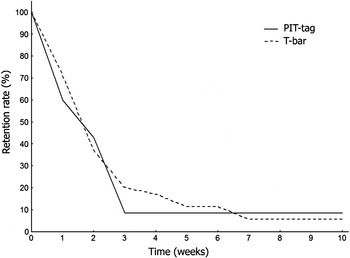
This study was successful in providing information on retention rates for the two tested tagging devices during the ten weeks of the experiment (Figure 2). Retention rate for both invasive tags remained lower than required for any long-term study. Between 30 and 40% of marks were lost during the first week, and this negative trend persisted throughout the second week when holothuroids retained 43% of PIT-tags and 37% of T-bars. The third week was critical: retention rate of T-bars declined to 20%, whereas PIT-tags were reduced to 10%.
Percentage of tag retention in the sea cucumber Holothuria mexicana for both types of tags.

Passive integrated transponder tags stabilized after the third week, maintaining a retention rate of 9% during the next 4 weeks. Conversely, T-bars continued diminishing slowly to a 6% retention rate during the last two weeks of the experiment (Figure 2). No differences in retention rate between the two types of marks were found (χ² = 0.215, df = 1, P = 0.643). Reading accuracy was 100% because no PIT-tags were found in the five dissected holothuroids, what eliminated the possibility of any potential reading error.
Tagging procedure caused stress in holothuroids. The penetration of the thick and extremely rigid wall can generate stress to the animals. 47% of individuals eviscerated during or no more than five minutes after tagging. A 40% of PIT-tagged individuals eviscerated versus 57% of T-bars. No differences in evisceration between both tags were detected (χ² = 0.39, df = 1, P = 0.532), nor we found any correlation between evisceration and body length (Pearson r = 0.097, P = 0.562). Stress of PIT-tagged animals could have been reduced by introducing the tag through the anus, instead of the body wall, but we did not test this method due to the lack of available information in holothuroids. It is probably that retention rate might have been the same, but stress rates might have been lower.
Laboratory studies conducted in the temperate holothuroid Cucumaria frondosa (Gunnerus, 1777) reported high retention rate for T-bars (Kirshenbaum et al., Reference Kirshenbaum, Feindel and Chen2006). Nevertheless, other studies in sea cucumbers, under suitable field conditions have obtained low retention rate for both types of marks tested here (Harriot, Reference Harriot1980; Purcell et al., Reference Purcell, Agudo and Gossuin2008). Environmental conditions may limit the use of both tags (Purcell et al., Reference Purcell, Blockmans and Nash2006; Lauzon-Guay & Scheibling, Reference Lauzon-Guay and Scheibling2008). The existence of an invasive device, external or internal, might be affecting the performance of the species in ways that are not evident under confinement, but the existence becomes significant in the wild. The external T-bar, for instance, is constantly exposed to the effect of substrate irregularities, being easily lost in the wild but not under control conditions such as those in a fish tank where rugosity is not significant. The cages were ‘bottom free’ to simulate natural conditions, but walls of metallic screen and the rocks inside the cage could reduce T-bar retention. Some individuals were detected rubbing themselves with the rocks, with other sea cucumber, and with the bars of the cages, which may favour the holothuroid to get rid of the T-bar. A similar behaviour was reported in a recent study conducted in the temperate sea cucumber Holothuria sanctori (Navarro et al., Reference Navarro, García-Sanz, Barrio and Tuya2013).
Another potential factor was the immunological rejection that could be elicited by the organism against invasive devices. Negative immunological effects have been reported on growth and survivorship in tagged sea cucumbers with T-bars (Conand, Reference Conand, Yanagisawa, Yasumasu, Ogurao, Suzuki and Motokawa1991; Purcell et al., Reference Purcell, Blockmans and Nash2006). This device may introduce error and confound results in studies on growth and/or movement due to the negative health effects triggered by this particular tag (Olson & Newton, Reference Olson and Newton1979). Furthermore, the development of necrosis around the hole found in 31% of our sample supports the unsuitability of T-bars not only because of low retention rate, but also for deleterious effects on health (Harriot, Reference Harriot1980; Purcell et al., Reference Purcell, Blockmans and Nash2006).
Passive integrated transponder tags do not seem to be as harmful as T-bars; however, the internal mark was rejected at a similar rate to the external one (Figure 2). The PIT-tag loss recorded here indicates that the sea cucumber body recognized in a short time period the existence of a non-self object, and eventually eliminated it in most of the tagged individuals. Tag loss greater than 50% after two weeks was not expected due to the presence of an external cover made of a biocompatible polymer. However, in a recent study where the same PIT-tags were used without a polymer cover, retention rate was 25% after one week, lower than the 60% of retention we recorded in the first week (Purcell et al., Reference Purcell, Agudo and Gossuin2008). This suggests that the polymer cover has a limited capacity to delay the immunological response; however, this event is not sufficient for long-term studies.
The PIT-tags and T-bars showed similar low retention rates after ten weeks. The necessity of a suitable device for tagging holothuroids is highly desired. The more recent use of fluorochromes in holothurians seems to be promising for long-term studies (Kirshenbaum et al., Reference Kirshenbaum, Feindel and Chen2006; Purcell & Simatuga, Reference Purcell and Simutoga2008), but further research are needed to validate this method in H. mexicana. This study confirmed that neither T-bar tags nor PIT-tags fulfil the requirements of non-harmful and high retention that are essential for long-term studies on H. mexicana.
ACKNOWLEDGEMENTS
We thank the Sea Grant Program (projects PD-295 & R/92-110) and the Center of Applied Tropical Ecology and Conservation of the University of Puerto Rico for their economic and logistical support. The first author also wishes to thank Dr Steven Purcell for his valuable comments.